Model Answer:
Animism and Naturism
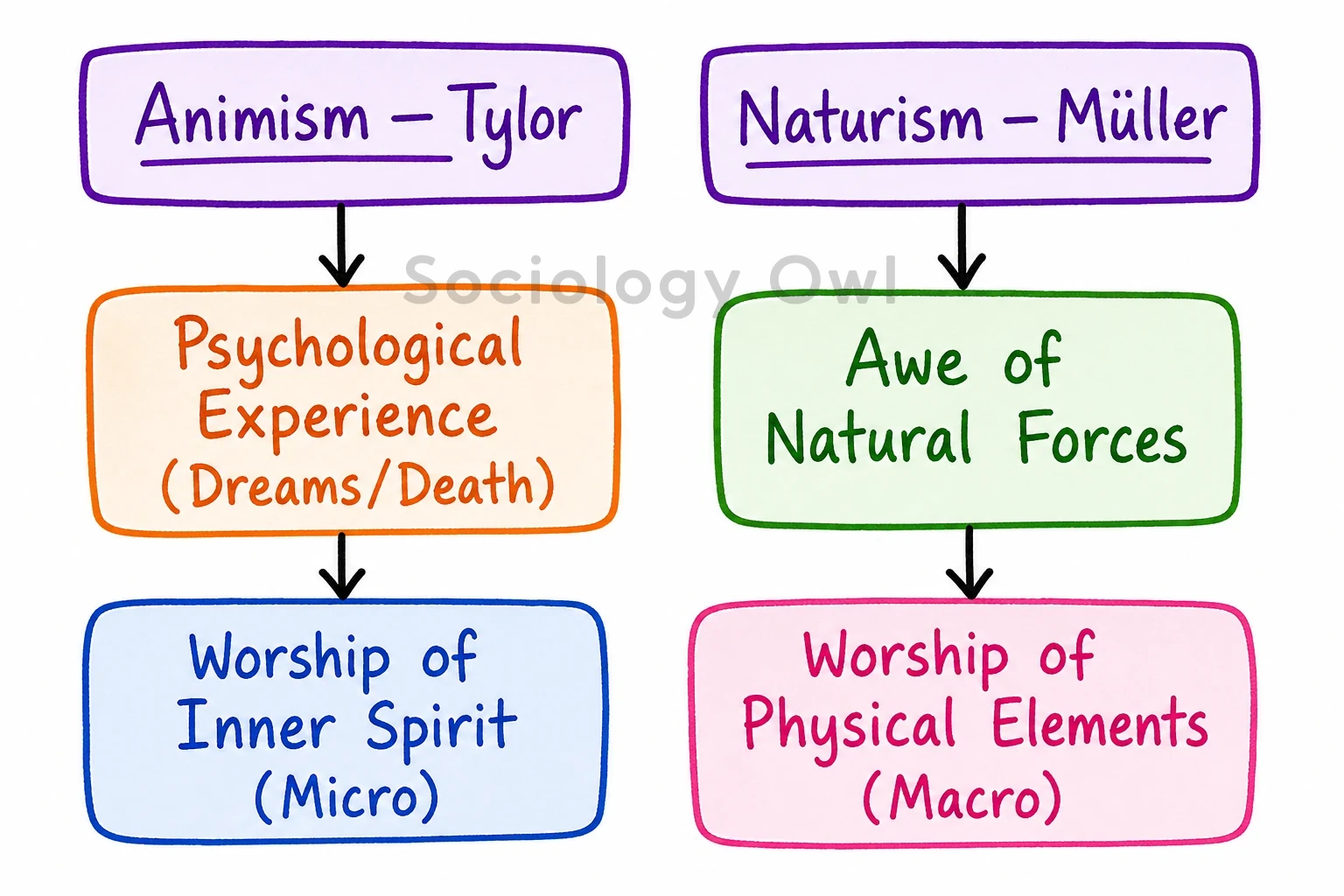
Animism and Naturism are early theories from the evolutionary school of religion, attempting to explain the origins of primitive belief systems.
Concepts and Differences
- Animism (E.B. Tylor): Rooted in primitive psychological experiences of dreams and death, it posits that all entities possess a dual existence and a soul (“anima”).
- Naturism (Max Müller): Stems from early man’s awe and fear of infinite natural forces. Through a “disease of language,” these abstract forces were gradually personified into deities.
- Core Difference: Animism venerates the hidden spirit inside specific objects, while Naturism worships the macro physical forces (like the sun or wind) themselves.
Emile Durkheim (The Elementary Forms of Religious Life) famously critiqued both theories, arguing that enduring social institutions like religion cannot stem from mere “illusions” or fear. Today, indigenous practices blending both—like India’s tribal Sarna religion—drive modern eco-spirituality and the conservation of sacred groves.
Conclusion
Though classically criticized for ethnocentric bias, Animism and Naturism remain foundational sociological frameworks, functionally validated today by their latent role in promoting ecological harmony.