Model Answer:
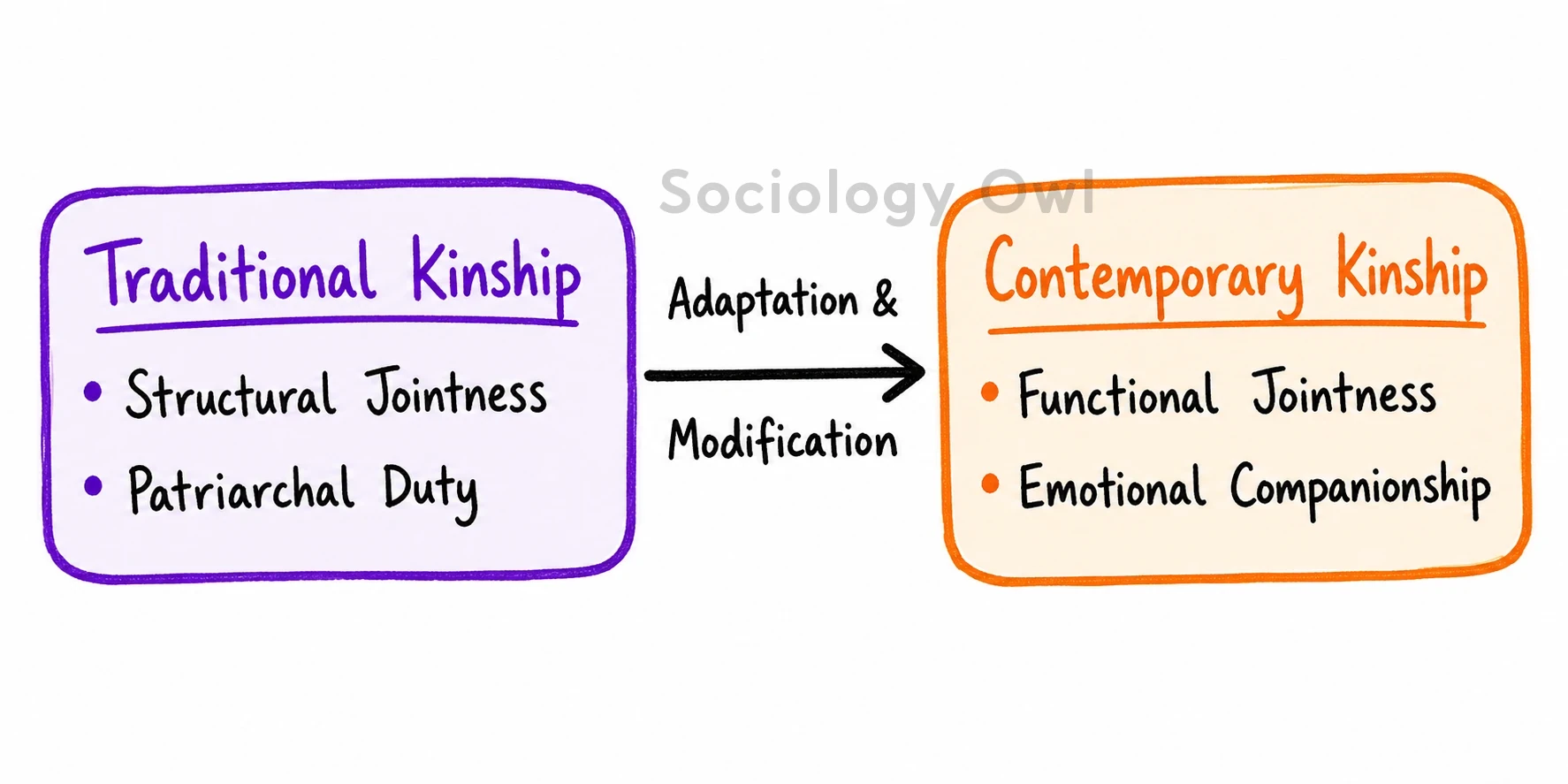
Iravati Karve viewed kinship as the bedrock of Indian families. Today, Indian kinship is transitioning from structural to functional jointness, fundamentally altering, rather than destroying, family bondings.
Transformation of Family Bondings
- “Household vs. Family”: A.M. Shah in The Household Dimension of the Family in India argues families are structurally nuclear but remain functionally joint, maintaining bonds through shared rituals and finances.
- “Sentiment of Jointness”: I.P. Desai notes psychological kinship ties remain strong despite physical migration. Sylvia Vatuk observes urbanites relying on kin networks, forming a “modified extended family”.
- Shifting Intimacy: Patricia Uberoi notes that family bonding is moving from patriarchal duty to emotional companionship. Additionally, Leela Dube highlights that changing patrilocality allows women stronger ties with their natal families.
The increasing reliance on the Maintenance and Welfare of Parents and Senior Citizens Act (2007) reflects the strain of spatial nuclearization on traditional intergenerational caregiving bonds.
Conclusion
Indian family bondings are not decaying but adapting. They are evolving from rigid obligatory kinship to negotiated, emotional relationships, ensuring the institution’s continued resilience in modern society.