Model Answer:
Under Article 280, the 14th Finance Commission (Y.V. Reddy) fundamentally restructured India’s fiscal federalism by significantly enhancing the financial autonomy and resource share of States.
1. Key Recommendations Boosting State Finances
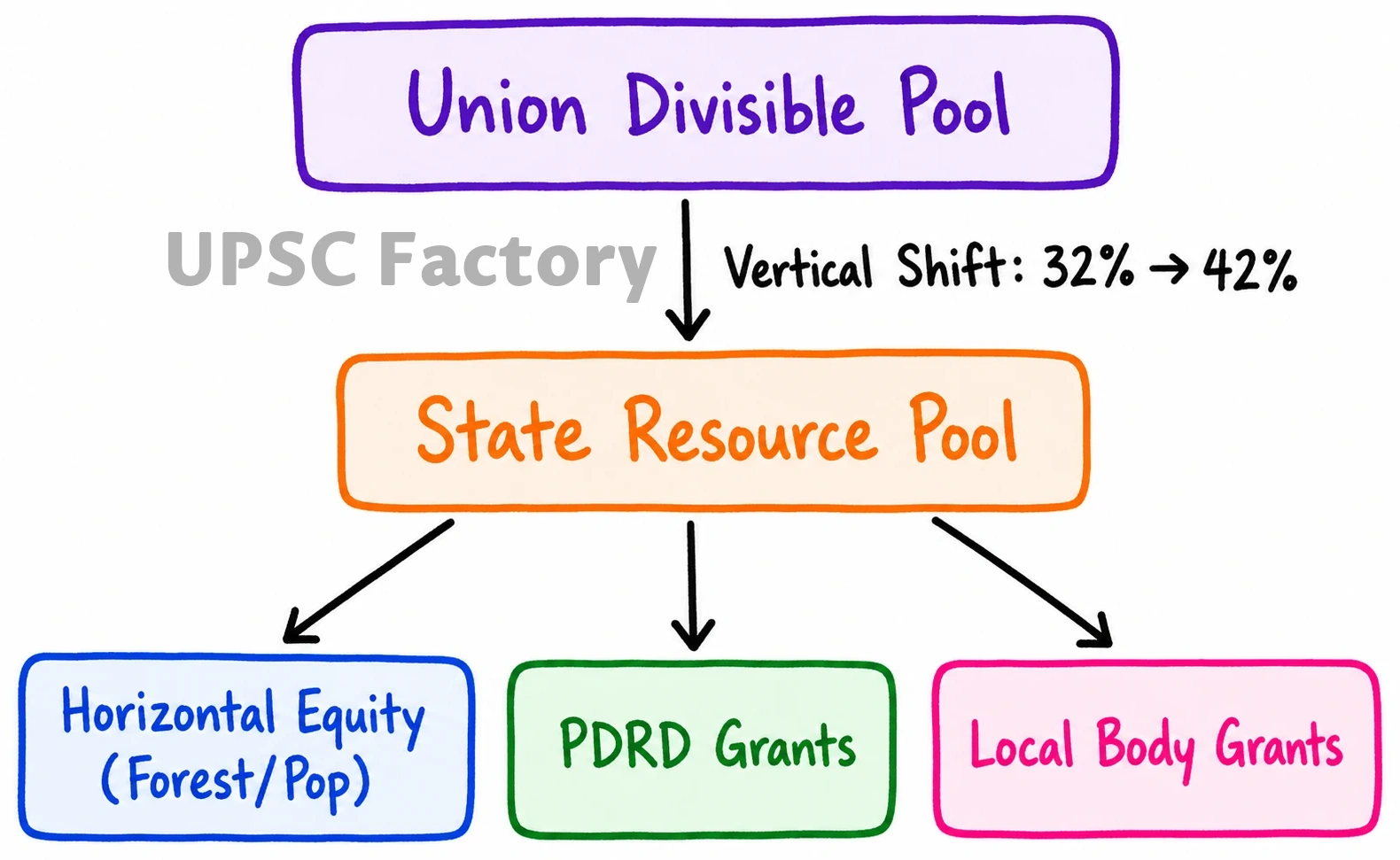
- Vertical Devolution: Recommended a historic leap in the States’ share of the divisible tax pool from 32% to 42%.
- Horizontal Equity: Introduced progressive criteria, giving weightage to demographic shifts (10% to 2011 population) and forest cover (7.5%).
- Statutory Grants: Allocated Post-Devolution Revenue Deficit (PDRD) grants to 11 vulnerable states to bridge revenue gaps.
- Local Body Grants: Recommended ₹2.87 lakh crore (basic and performance grants), bypassing state bottlenecks to directly fund panchayats/municipalities.
2. Impact on States’ Fiscal Position
- Enhanced Fiscal Autonomy: Replaced tied funds of Centrally Sponsored Schemes (CSS) with untied devolution, allowing localized policy design.
- Spurt in Capital Expenditure: Unrestricted funds enabled states to prioritize long-term physical and social infrastructure spending.
- Ecological Compensation: Forest-rich states were financially compensated, turning an ecological constraint into a fiscal asset (e.g., Arunachal Pradesh).
- Macro-Economic Stability: Despite expanded expenditures, most states were empowered to maintain their fiscal deficits within the 3% FRBM limit.
By shifting the paradigm from centralized planning to empowered cooperative federalism, the 14th FC laid a robust financial foundation for States, a legacy largely sustained by the 15th FC.