Model Answer:
The CBI derives its investigative powers from the Delhi Special Police Establishment (DSPE) Act, 1946. Its jurisdictional mandate frequently causes friction within India’s quasi-federal constitutional structure.
CBI Jurisdiction and State Consent Friction
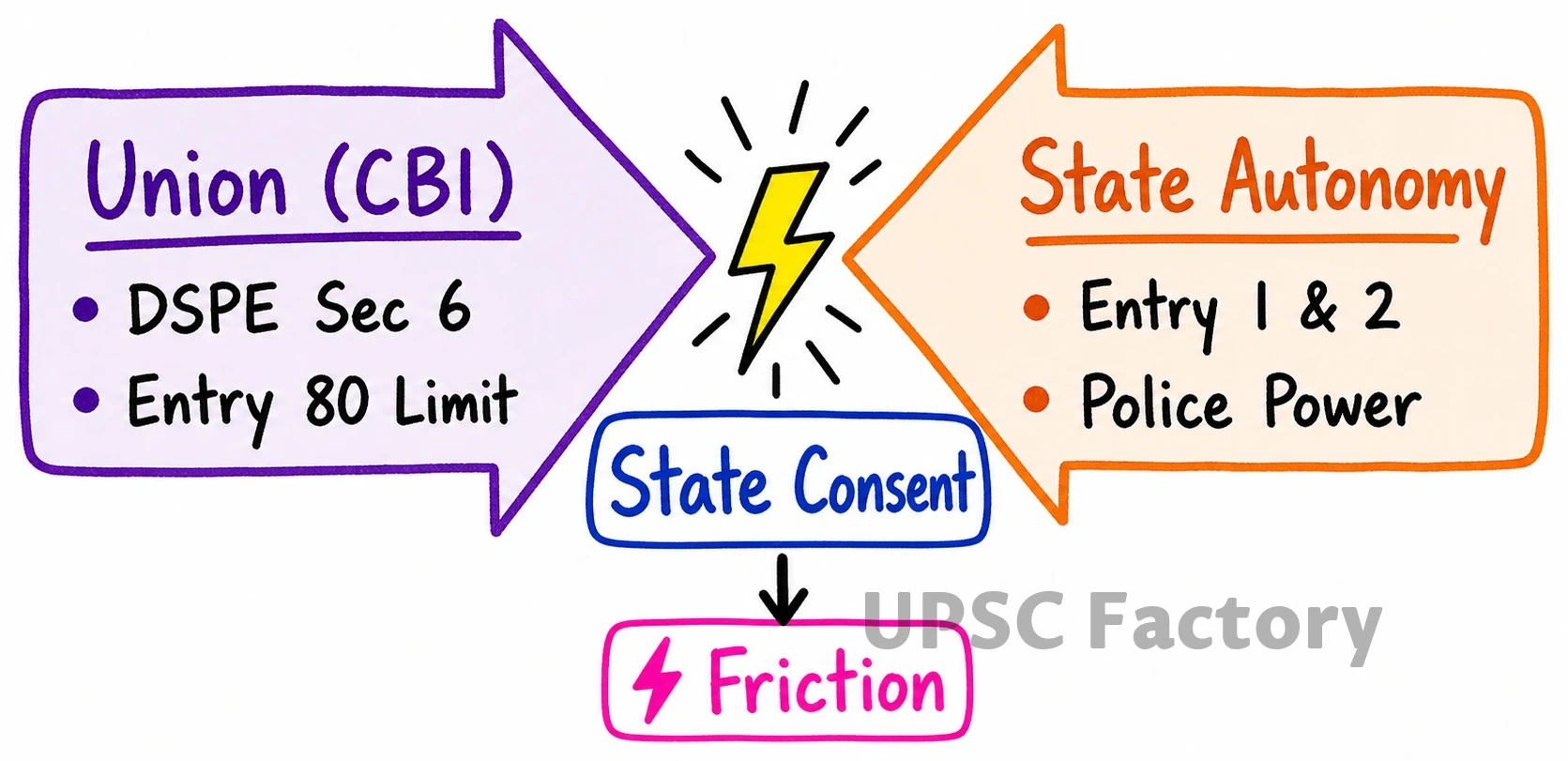
- Statutory Mandate: Section 6 of the DSPE Act strictly requires the host State’s consent before the CBI can investigate within its territory.
- Constitutional Limitation: Entry 80 of the Union List prohibits extending a state police force’s jurisdiction to another state without the latter’s consent.
- State Autonomy: “Police” and “Public Order” are exclusive State subjects (Entry 1 & 2, State List), mandating central deference.
- Types of Consent: States traditionally grant “general consent” for seamless anti-corruption probes, but can restrict operations via “case-specific consent.”
- Combative Federalism: Several states (e.g., West Bengal, Punjab, Kerala) have withdrawn general consent, alleging the political weaponization of central investigative agencies.
Exceptions to Withholding Consent & Federal Dynamics
Despite state resistance, withholding consent is not absolute, reflecting the unitary bias in India’s federalism to uphold the rule of law:
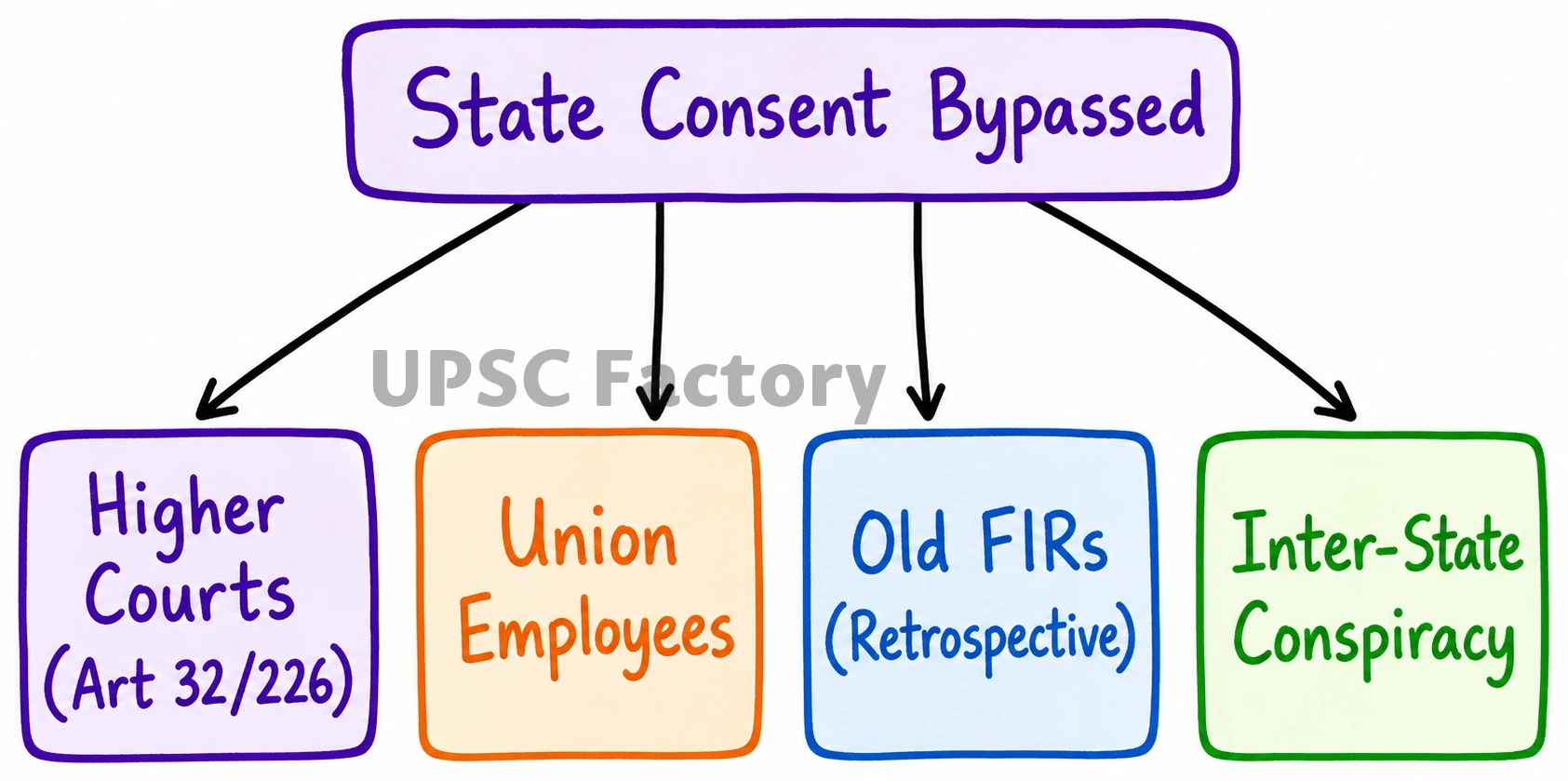
- Judicial Directives: The Supreme Court and High Courts can unilaterally order CBI probes, bypassing state consent entirely (Articles 32, 142, 226).
- Prospective Enforcement: Consent withdrawal cannot be applied retrospectively; pre-existing investigations continue unhindered (Kazi Lhendup Dorji vs. CBI).
- Union Employees: The CBI retains unhindered jurisdiction to probe corruption charges against Central Government employees stationed in non-consenting States.
- Inter-State Conspiracies: The CBI can register FIRs in Delhi and investigate connected crimes in non-consenting states if part of a broader conspiracy.
- Ancillary Central Agencies: Associated agencies (e.g., ED under PMLA, NIA) possess overarching statutory powers to bypass traditional state police limitations.
- Federal Balancing: This framework normally respects state police autonomy but prevents state apparatuses from shielding systemic corruption, epitomizing India’s asymmetric federalism.
To harmonize overarching national integrity with cooperative federalism, the CBI requires an independent, dedicated statutory framework to insulate it from political friction and resolve recurring Center-State jurisdictional mistrust.