Model Answer:
The RTE Act, 2009 (Article 21A) operationalises free and compulsory education primarily through material incentives. However, without corresponding behavioral shifts and parental awareness, its core developmental goals remain structurally underachieved.
1. Inadequacies of RTE’s Incentive-Centric Approach
- Proxy Enrollments: Material incentives (PM POSHAN, free uniforms) often drive paper enrollments without ensuring actual daily classroom attendance.
- Ignored Opportunity Costs: Free schooling alone fails to offset the immediate economic loss of child labor for destitute, unaware families.
- Quantity over Quality: Administrative focus skews heavily towards provisioning infrastructure and entitlements rather than foundational literacy (ASER Report 2023).
- Post-Elementary Dropouts: Because incentives and mandates typically stop at age 14, unaware parents abruptly withdraw children (UDISE+ 2021-22).
- Policy Misinterpretations: Without proper sensitization, progressive measures like the No Detention Policy are often misinterpreted as a “no need to study” mandate.
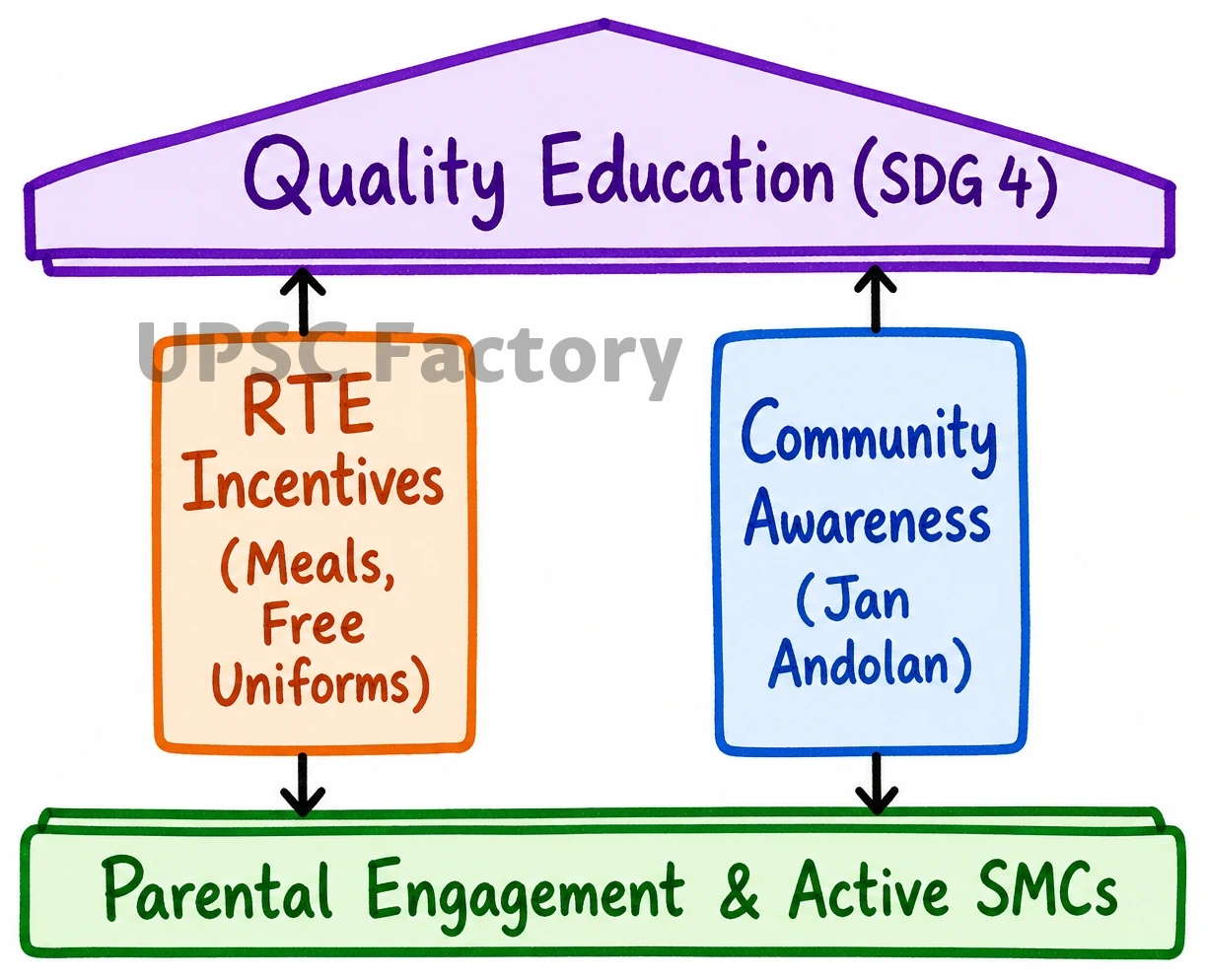
2. Need for Awareness to Actualise Educational Outcomes
- Dismantling Societal Prejudices: Deep-rooted awareness campaigns are essential to overcome patriarchal biases that restrict girl-child education (Beti Bachao Beti Padhao).
- Empowering First-Generation Learners: Unaware parents cannot provide academic reinforcement at home; sustained behavioral nudges are required to maintain student interest.
- Activating Institutional Oversight: RTE Section 21 mandates School Management Committees (SMCs), but low parental awareness limits community participation and school accountability.
- Long-Term Value Realisation: Parents must be sensitized to view education as long-term socioeconomic mobility rather than a mere avenue for free daily meals.
- Community-Led Drives: Initiatives like ‘School Chalo Abhiyan’ and Vidyanjali must be scaled to build a localized, cultural reverence for schooling.
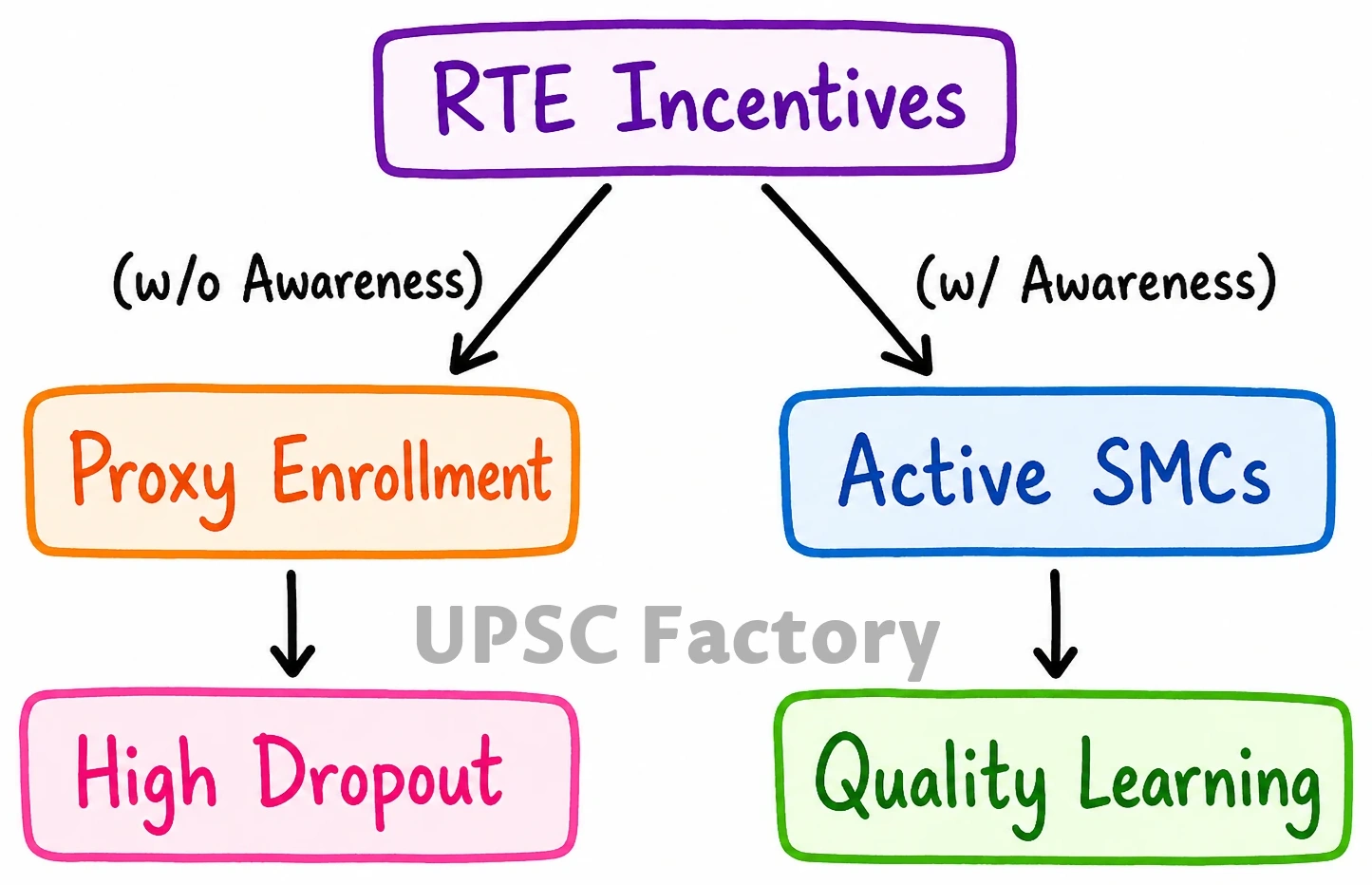
True educational empowerment requires transitioning from a passive entitlement model to active community participation. Supplementing RTE incentives with behavioral nudges (Jan Andolan) is imperative to actualize SDG 4 (Quality Education).