Model Answer:
A cloudburst is an extreme, sudden, and highly localized precipitation event over a small geographical area, frequently triggering devastating flash floods and landslides.
Definition and Parameters of Cloudbursts
- IMD Criteria: Officially defined by the India Meteorological Department as rainfall exceeding 100 mm per hour.
- Spatial Extent: Highly localized phenomenon, typically confined to a geographical area of 20–30 sq. km.
- Source Clouds: Generated exclusively by towering, moisture-laden Cumulonimbus clouds characterized by strong vertical growth.
Mechanism and Causes
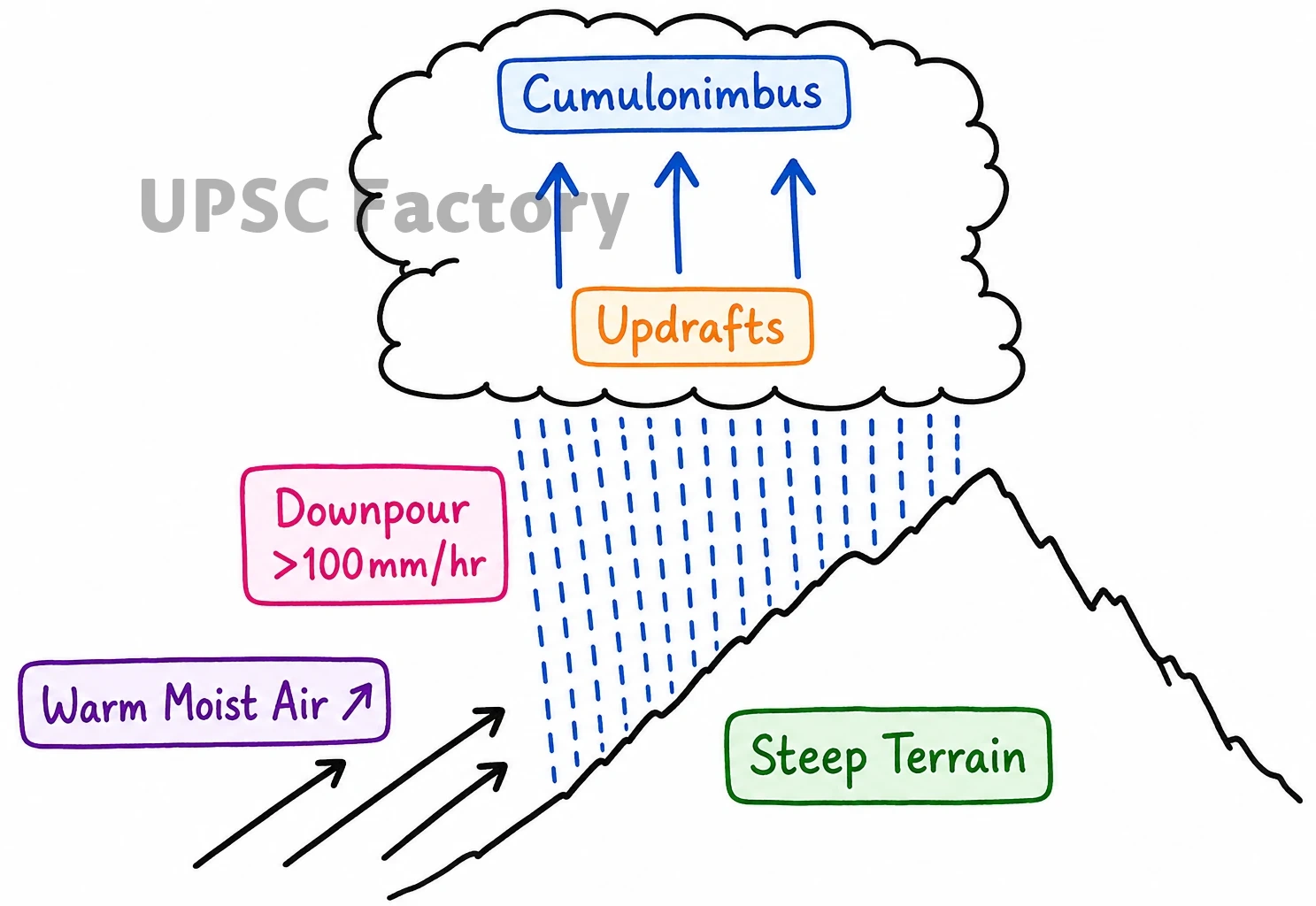
- Orographic Lifting: Warm, moist air masses collide with steep mountain terrains, forcing a rapid upward ascent (e.g., Himalayan slopes).
- Thermodynamic Instability: Intense vertical updrafts of warm air temporarily suspend massive quantities of condensed water droplets, preventing normal rainfall.
- Sudden Downpour: When accumulated raindrops coalesce and become too heavy for the updrafts to support, they crash down simultaneously.
- Catalytic Factors: Amplified by high relative humidity, low-level wind convergence, and climate change-induced warming (e.g., Kedarnath 2013, Sikkim 2023).
Minimizing the devastating impacts of cloudbursts requires expanding the Doppler Weather Radar (DWR) network for precise nowcasting and integrating decentralized early warning systems in fragile mountainous terrains.