Model Answer:
In developing nations, rural-urban migration disproportionately favors metropolises, creating “Primate Cities” (e.g., Mumbai, Dhaka) due to heavily skewed spatial development.
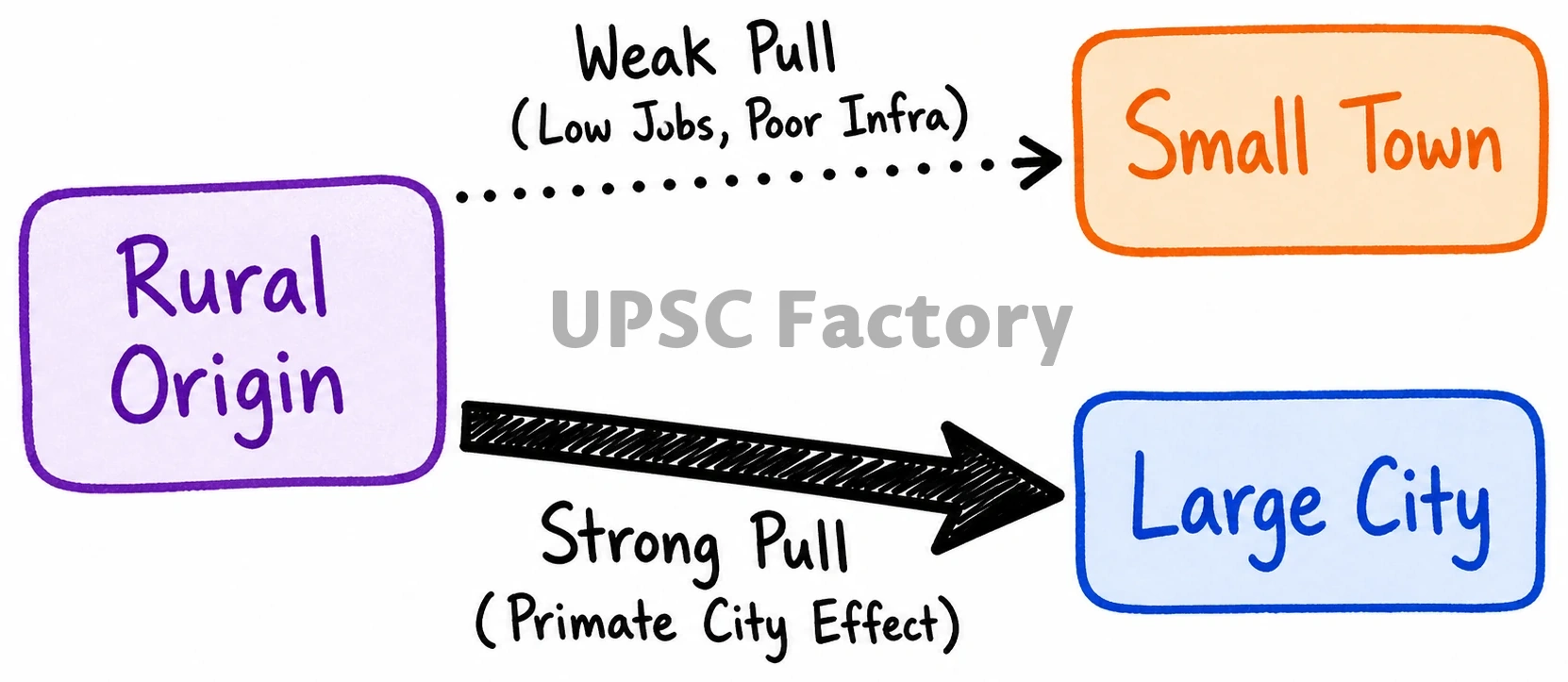
1. The Magnetism of Large Cities (Pull Factors)
- Agglomeration Economies: High concentration of capital and industries creates vast, diverse employment opportunities (Lee’s Push-Pull theory).
- Massive Informal Sector: High absorption capacity allows survival for unskilled, landless migrants (e.g., Dharavi’s micro-industries).
- Social Emancipation: Metropolises offer anonymity, allowing marginalized groups to escape rural caste and feudal rigidities.
- Migration Networks: Established kinship and village ties in big cities drastically lower the risks of relocation.
- Superior Civic Amenities: Centralization of premier education and tertiary healthcare attracts aspirational demographic segments.
2. Limitations of Smaller Towns in Developing Nations
- Economic Stagnation: Absence of large-scale manufacturing or IT/service hubs severely limits formal job creation.
- Inadequate Infrastructure: Severe deficits in reliable power, digital connectivity, and transit networks deter industrial investments.
- Agrarian Spillover: Small-town economies rely heavily on local agriculture, offering little refuge from regional agrarian distress.
Decentralizing urbanization by empowering tier-2 and tier-3 cities through targeted urban policies (e.g., AMRUT, PURA) is crucial for sustainable, balanced demographic transition.