Model Answer:
Auroras are luminous, dynamic optical phenomena occurring in the high-latitude night sky, resulting from the complex interaction between extraterrestrial solar winds and Earth’s upper atmosphere.
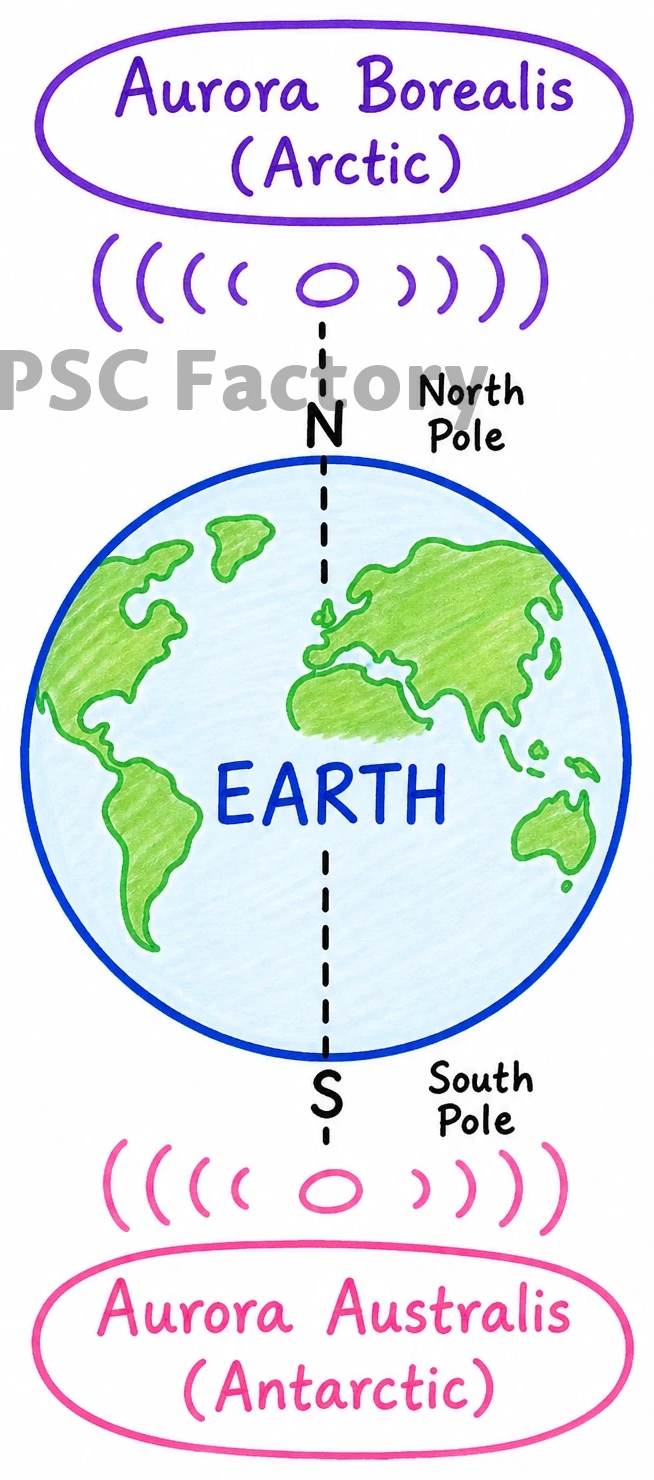
1. Aurora Australis and Aurora Borealis: Meaning and Characteristics
- Aurora Borealis (Northern Lights): Manifests around the Arctic Circle (Scandinavia, Canada, Alaska).
- Aurora Australis (Southern Lights): Illuminates the Antarctic Circle (Tasmania, New Zealand, Antarctica).
- Visual Signature: Appears as shimmering ribbons, arcs, or coronas of vibrant, pulsating light.
- Atmospheric Zone: Primarily confined to the auroral ovals within the Ionosphere and Thermosphere (100–300 km altitude).
2. Triggering Mechanism of Auroras
- Solar Activity (Initiation): The Sun emits charged plasma (electrons and protons), massively intensified during Coronal Mass Ejections (CMEs) or Solar Flares.
- Solar Wind Travel: These energetic particles traverse interplanetary space via solar winds at supersonic velocities.
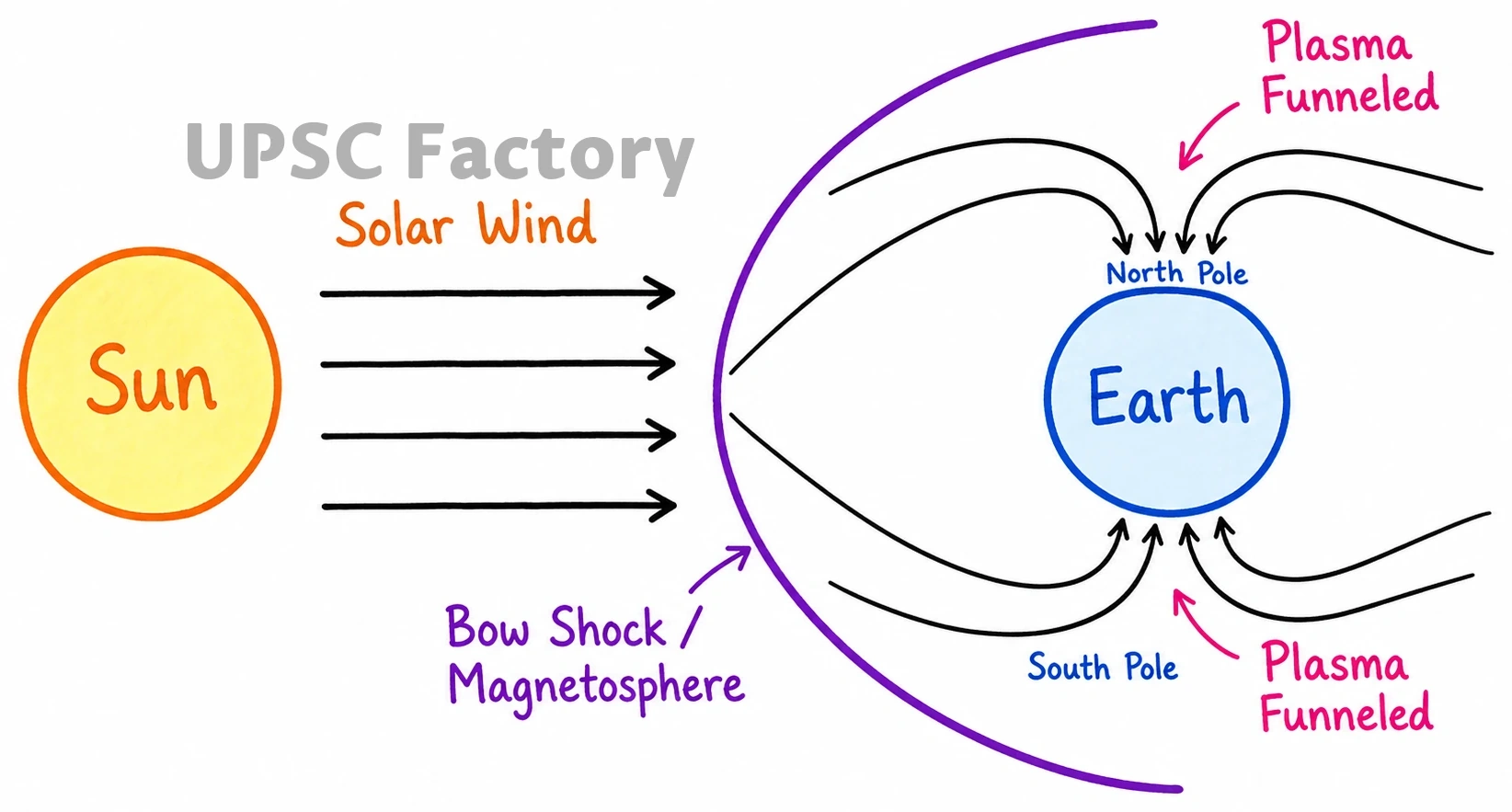
- Magnetospheric Shielding: Earth’s magnetic field (Magnetosphere) largely deflects this solar wind, creating a protective bow shock.
- Polar Funneling (Magnetic Reconnection): Magnetic field lines converge and weaken at the North and South Poles, acting as funnels drawing trapped solar plasma downward.
- Atmospheric Collision: The funneled energetic particles violently collide with atmospheric gases (atomic oxygen and diatomic nitrogen) in the Ionosphere.
- Excitation and Photon Emission: Collisions transfer energy, exciting gaseous electrons to higher orbital states. Visible light (photons) is emitted instantly as electrons return to their baseline ground state.
- Color Spectrum Generation: Gas composition and altitude dictate colors (Oxygen produces green at ~100km and red above 200km; Nitrogen yields blue/purple hues).
The intense May 2024 G5 Geomagnetic storm (Solar Cycle 25 maximum) underscores that understanding auroral mechanisms is critical for advanced space-weather forecasting and protecting vulnerable global satellite grids.