Model Answer:
A twister, commonly known as a tornado, is a violently rotating column of air extending from a supercell thunderstorm to the ground, causing intense, localized destruction.
1. Characteristics & Mechanism of Twisters
- Supercell Origin: Forms primarily within rotating updrafts (mesocyclones) of severe atmospheric thunderstorms.
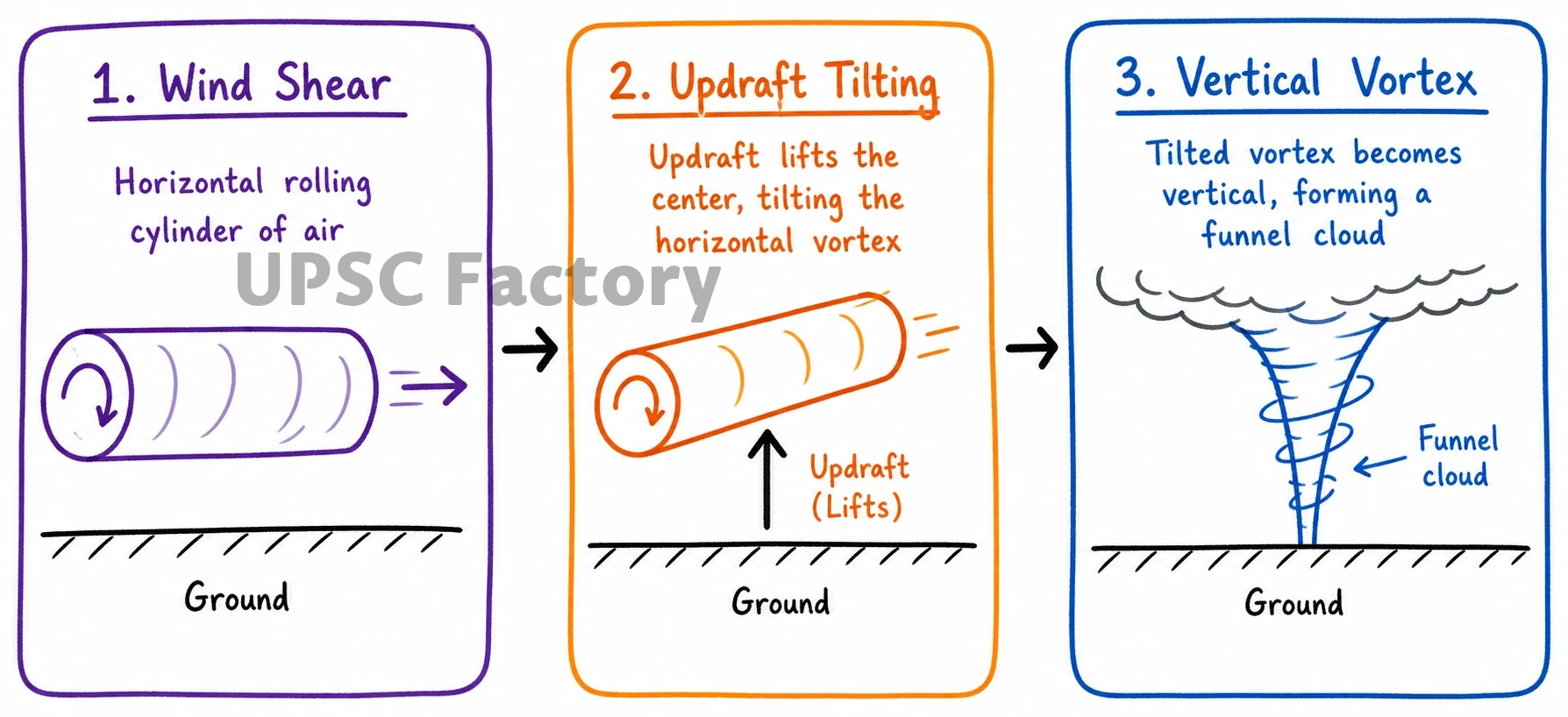
- Wind Shear Requirement: Significant variations in wind speed and direction at different altitudes create horizontal spinning tubes of air.
- Vertical Tilting: Strong convective updrafts tilt these rolling horizontal air columns into a vertical vortex.
- Vortex Intensification: As the column stretches, rotation accelerates (conservation of angular momentum), generating extremely destructive winds.
- Classification: Intensity is measured globally using the Enhanced Fujita (EF) Scale (EF0 to EF5 based on estimated wind speeds and damage).
2. Reasons for High Frequency Around the Gulf of Mexico
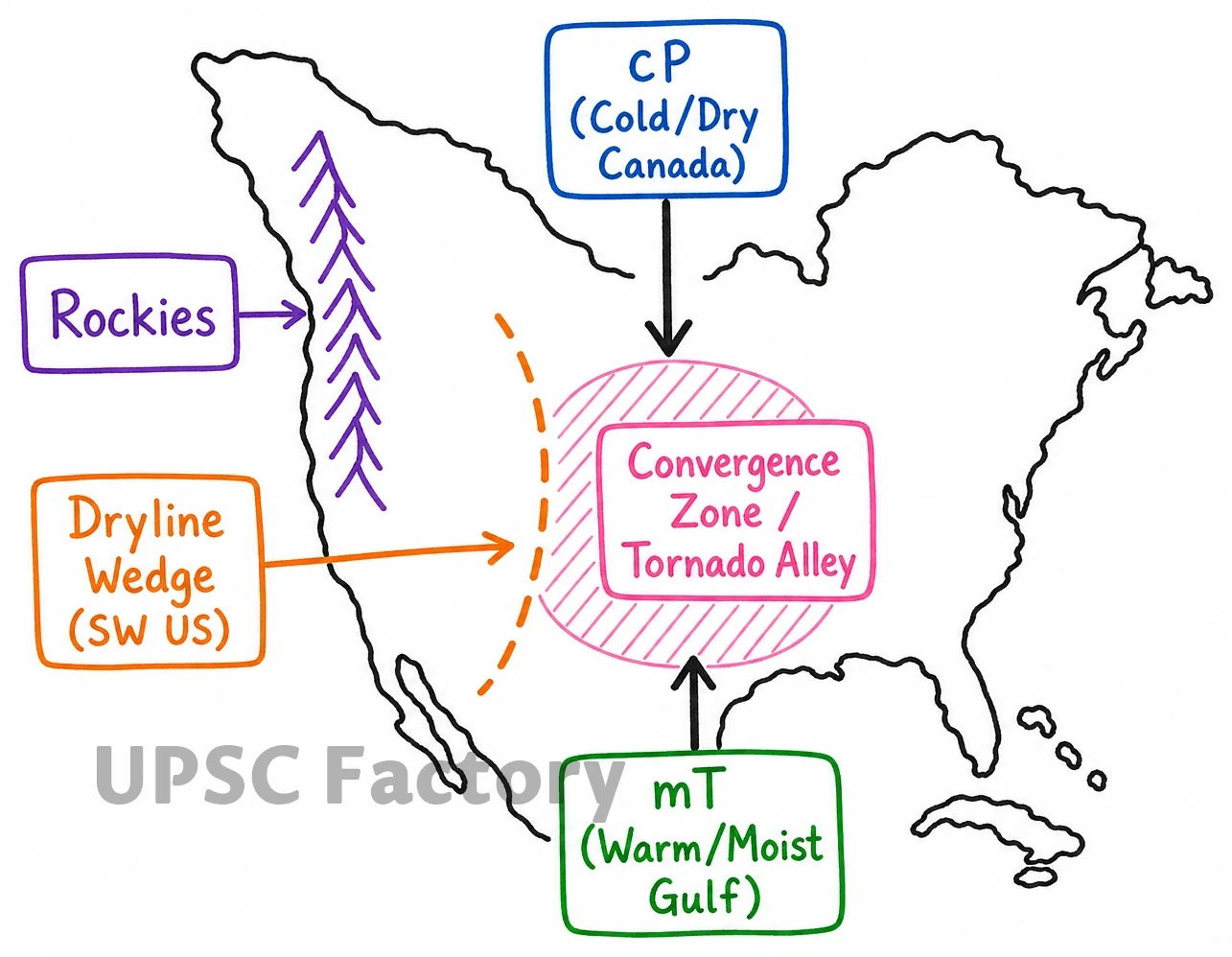
- Air Mass Collision: The region is a volatile convergence zone where warm, moist maritime tropical (mT) air from the Gulf clashes directly with cold, dry continental polar (cP) air from Canada.
- Topographical Funnelling: The absence of East-West mountain barriers across the Central North America allows unobstructed interaction of these contrasting air masses (Tornado Alley).
- Latent Heat Source: The persistently warm Gulf waters provide high specific humidity, acting as the primary thermodynamic fuel for intense supercell convection.
- The “Dryline” Trigger: Heavy, dry air from the Southwestern US deserts wedges abruptly under the lighter, moist Gulf air, forcing violent vertical uplifts.
- Jet Stream Dynamics: Strong upper-level polar jet streams over the region create high-altitude exhaust and intense wind shear, sustaining the tornado’s lifecycle.
- Climate-Driven Shifts: Rising Gulf sea-surface temperatures are increasing atmospheric instability, shifting tornado hotspots eastward into highly vulnerable coastal regions (Dixie Alley).
With climate change altering sea-surface temperatures and atmospheric dynamics, expanding Doppler radar networks and enforcing climate-resilient zoning is imperative to mitigate escalating twister-related catastrophes globally.