Model Answer:
Under Article 75(3), the Council of Ministers is collectively responsible to the Lok Sabha, establishing the constitutional foundation for executive accountability.
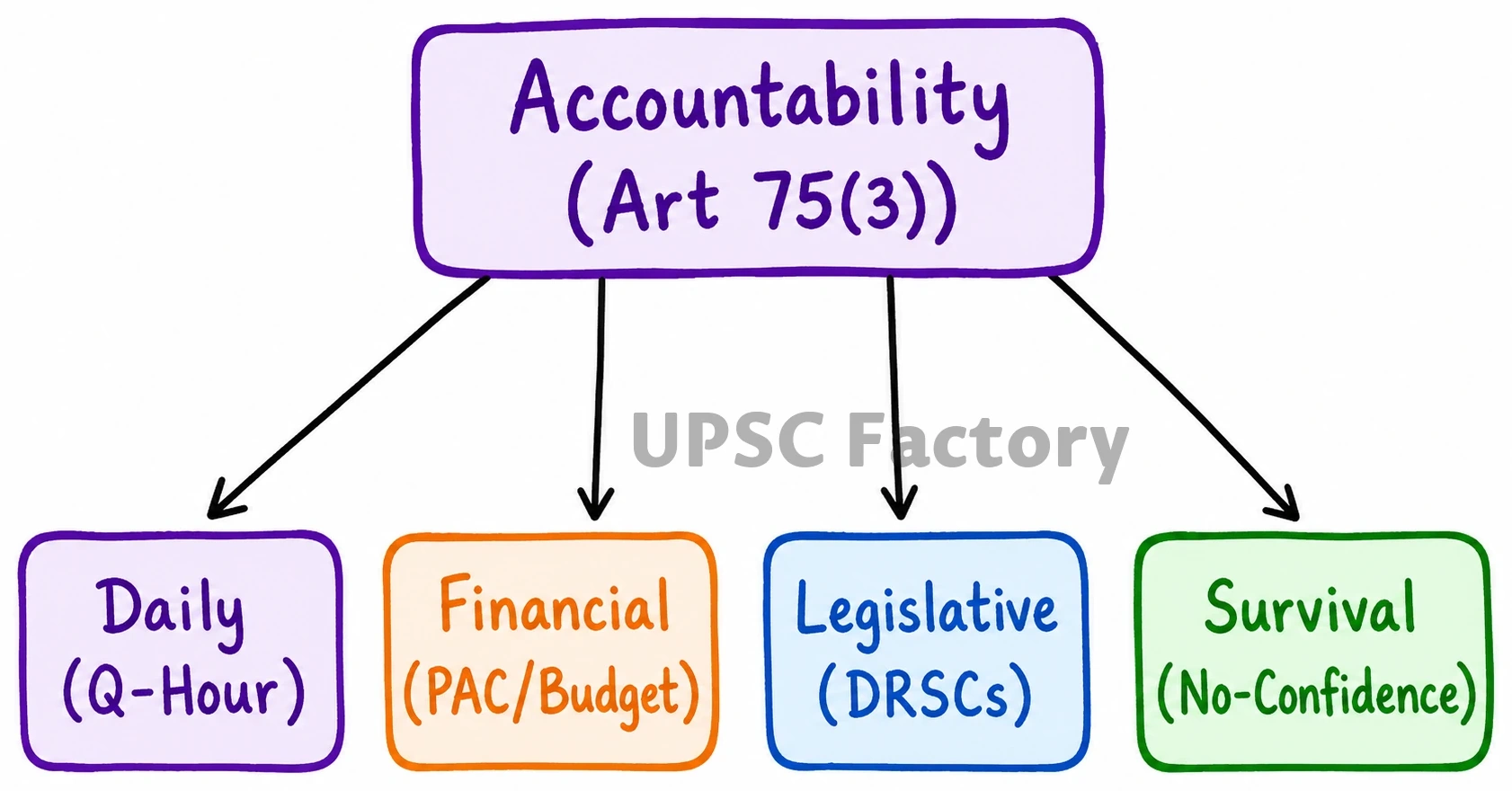
1. Mechanisms Ensuring Executive Accountability
- Procedural Devices: Question Hour, Zero Hour, and Adjournment Motions enforce daily executive oversight.
- Financial Control: Executed via budget approvals, cut motions, and post-expenditure scrutiny by the Public Accounts Committee.
- Legislative Oversight: Departmentally Related Standing Committees (DRSCs) enable detailed, non-partisan evaluation of bills and policies.
- Ultimate Sanction: The No-Confidence Motion ensures the government’s survival continuously depends on maintaining a legislative majority.
2. Constraints Weakening Parliamentary Oversight
- Partisan Restraints: The 10th Schedule (Anti-Defection Law) stifles intra-party dissent, reducing MPs to mere party delegates.
- Declining Scrutiny: A sharp drop in bills referred to DRSCs (from 71% in the 15th Lok Sabha to just 16% in the 17th Lok Sabha, per PRS data).
- Financial Bypassing: Frequent “Guillotining” of budget demands and bypassing the Rajya Sabha via the ‘Money Bill’ route (e.g., Aadhaar Act).
- Executive Unilateralism: Over-reliance on Ordinances (Article 123) and excessive delegated legislation evade direct parliamentary debate.
To restore parliamentary primacy, implementing NCRWC recommendations—such as mandating a minimum of 120 sitting days annually and making DRSC scrutiny mandatory for key bills—is imperative.