Model Answer:
Sea Surface Temperature (SST) rise is the chronic warming of the ocean’s uppermost layer, driven primarily by anthropogenic climate change absorbing excess atmospheric heat.
Phenomenon of Sea Surface Temperature (SST) Rise
- Heat Accumulation: Oceans absorb over 90% of greenhouse gas-induced trapped heat, rapidly accelerating surface warming.
- Thermal Threshold Breach: Warming increasingly causes SST to consistently surpass the critical 26.5°C baseline necessary for cyclogenesis.
Impact of SST Rise on Tropical Cyclones
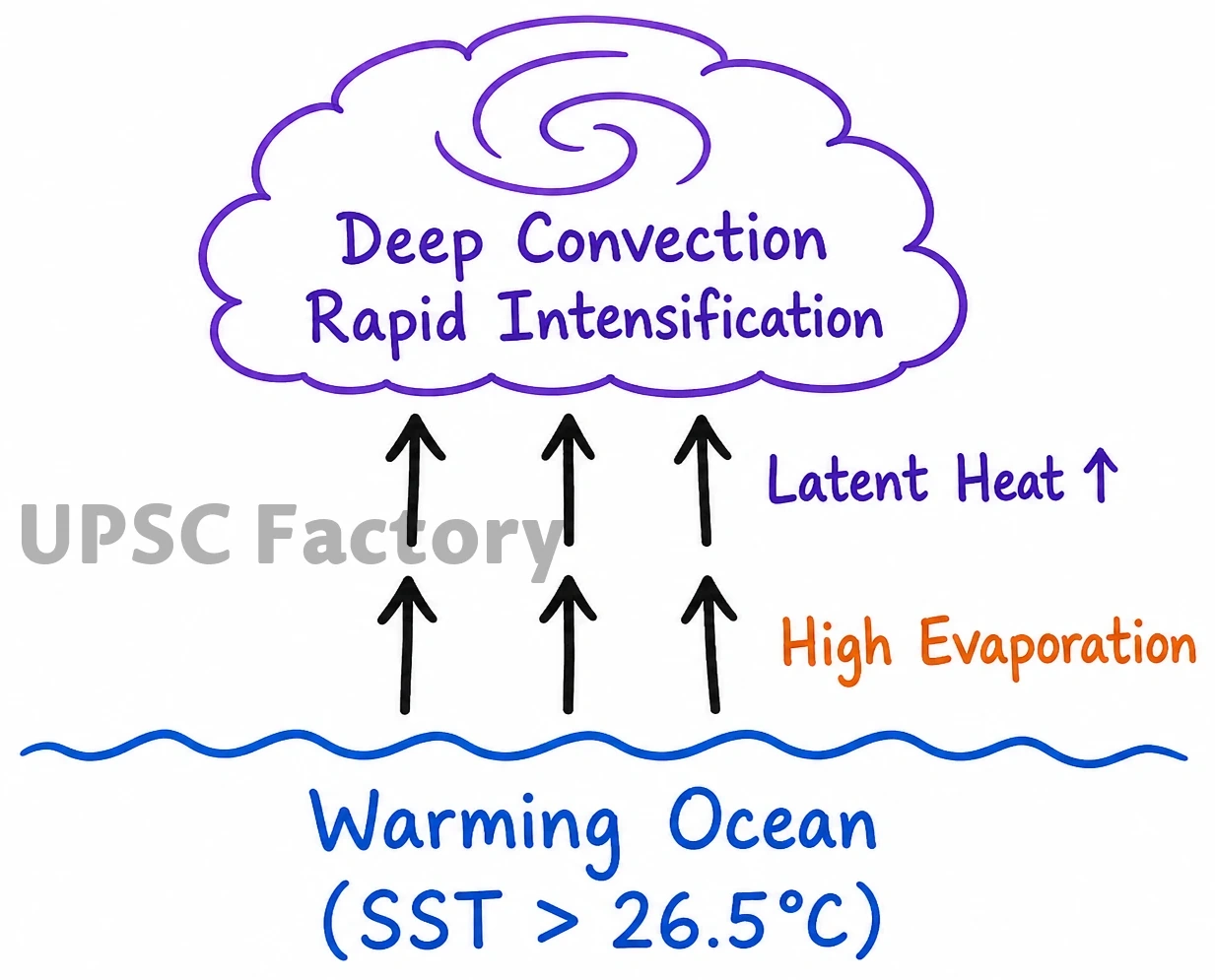
- Enhanced Fuel Supply: Warmer waters increase evaporation, supplying massive latent heat of condensation that powers deep convection currents.
- Rapid Intensification: Higher oceanic heat content triggers sudden, exponential wind speed escalation just before landfall (Cyclone Amphan, Bay of Bengal).
- Spatial Expansion: Historically cooler marine basins can now sustain active cyclogenesis, shifting vulnerability profiles (Cyclone Biparjoy, Arabian Sea).
- Extended Seasonality: Persistent thermal anomalies prolong the active cyclone season well beyond traditional pre- and post-monsoon windows.
- Moisture Loading: Warmer air above oceans holds more water vapor, significantly increasing the intensity of post-landfall extreme rainfall.
As the IPCC AR6 report projects continuous ocean warming, shifting focus toward dynamic multi-hazard early warning systems and climate-proofing coastal infrastructure is highly imperative.