Q. Do you think ‘objectivity’ is an over-hyped idea in sociological research? Discuss the merits and demerits of non-positivist methods.
UPSC Sociology 2024 Paper 1
Model Answer:
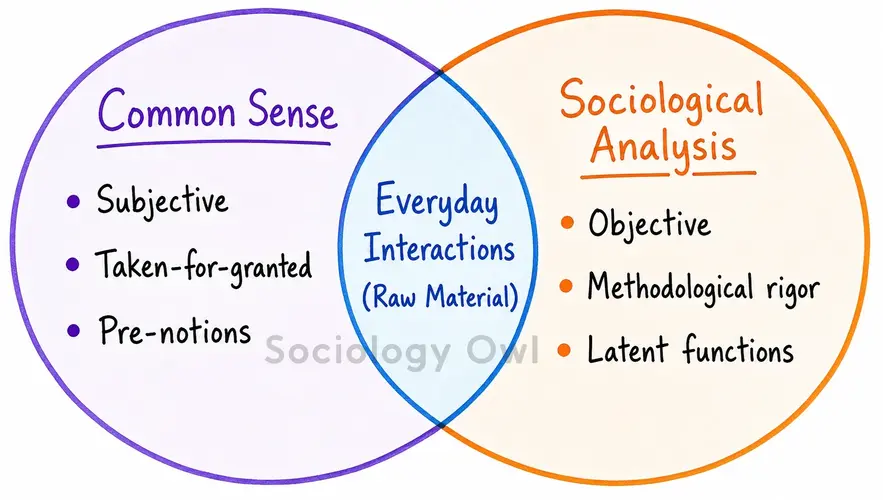
Objectivity in sociology implies studying phenomena without letting personal biases, prejudices, or values influence the research (Robert Bierstedt). Rooted in the Positivist tradition of Comte and Durkheim, it sought to model sociology on the natural sciences. However, treating pure objectivity as an absolute ideal is increasingly considered over-hyped.
The Myth of Absolute Objectivity
Inherent Value-Bias: Gunnar Myrdal argued that researchers’ values inevitably dictate topic selection. Similarly, Alvin Gouldner, in his essay Anti-Minotaur: The Myth of a Value-Free Sociology, dismissed absolute objectivity as an impossible illusion.
Masking Subjectivity: Feminist Standpoint Theory (Dorothy Smith) asserts that classical “objectivity” is frequently just male subjectivity disguised as universal truth.
Constructed “Facts”: While Durkheim championed statistical objectivity in Le Suicide, phenomenologists like J.D. Douglas demonstrated that suicide statistics are actually social constructs shaped by coroners’ interpretations, proving that purely objective data is often a mirage.
Merits and Demerits of Non-Positivist Methods
Recognizing these limitations, non-positivist paradigms (Interpretivism, Phenomenology) emerged to capture subjective realities.
Merits: They provide deep, contextualized insights through Max Weber’s Verstehen (interpretative understanding) and Clifford Geertz’s Thick Description. Instead of feigning absolute neutrality, they actively manage bias through Pierre Bourdieu’s “Reflexive Sociology”.
Demerits: These methods suffer from a Lack of Reliability, as deep qualitative data is difficult to standardize and replicate. Furthermore, heavy immersion risks the Hawthorne Effect, where the researcher’s presence alters the subjects’ natural behavior.
When studying gig economy workers, purely objective positivist data (e.g., algorithmic income statistics) fails to capture their complete reality. Non-positivist ethnography is required to uncover the lived experiences, meaning, and alienation associated with precarious labor.
Conclusion
While pure objectivity is unattainable, methodological rigor remains vital. Following Max Weber, sociologists distinguish between Value-Relevance (values guiding topic selection) and Value-Neutrality (impartial data collection). Ultimately, contemporary research balances these paradigms through Methodological Pluralism and Triangulation (Alan Bryman) to capture complete sociological truths.