Q. Do you think that BIMSTEC is a parallel organisation like the SAARC ? What are the similarities and dissimilarities between the two ? How are Indian foreign policy objectives realized by forming this new organisation ?
Question from UPSC Mains 2022 GS2 Paper
Model Answer:
BIMSTEC is not merely a parallel organization but serves as a pragmatic alternative to a stalled SAARC, uniquely bridging South and Southeast Asia.
SAARC and BIMSTEC: Similarities vs. Dissimilarities
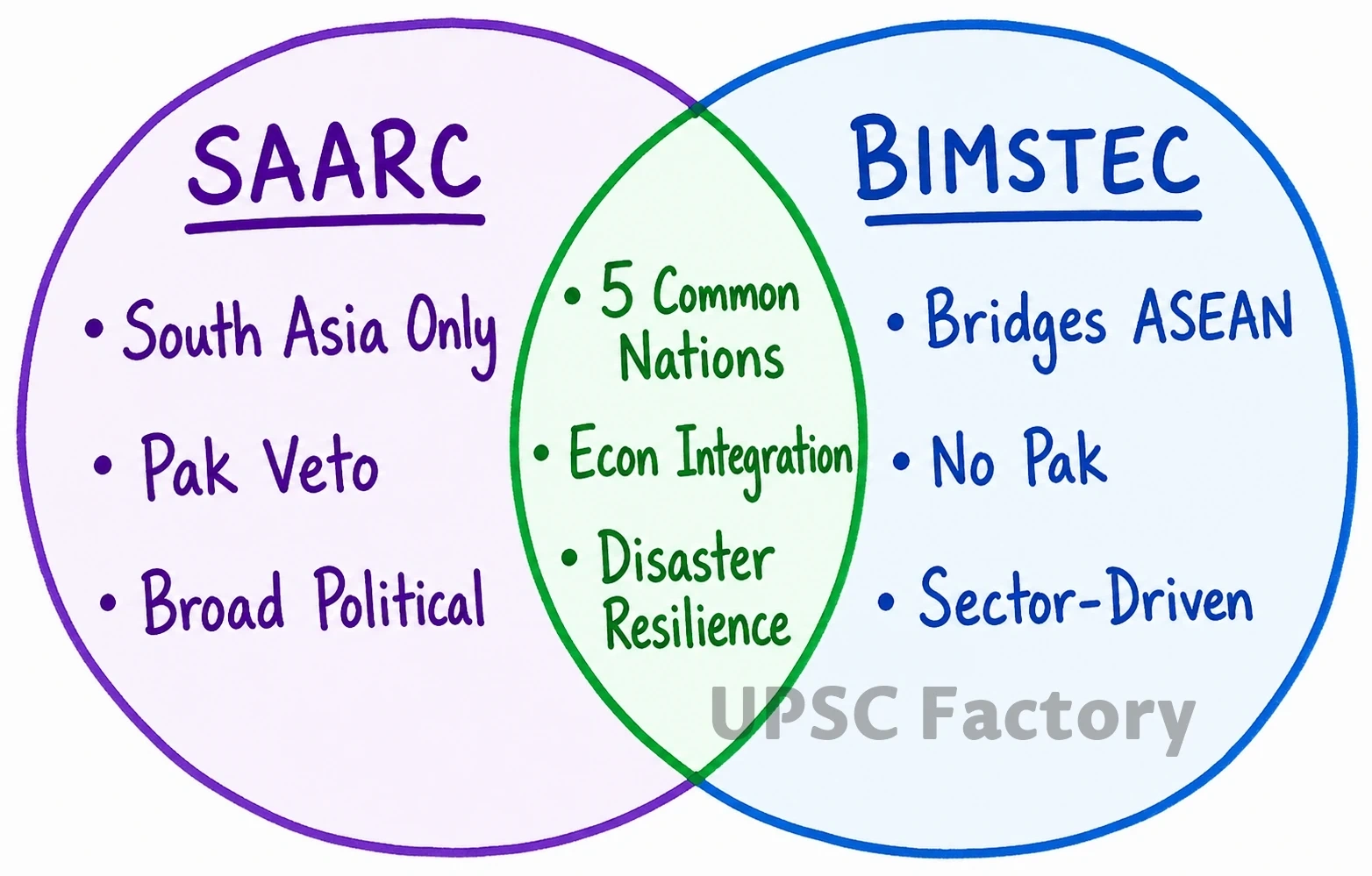
Similarities:
Geographical Overlap: Both share five common member states (India, Nepal, Bhutan, Bangladesh, Sri Lanka).
Shared Objectives: Both prioritize regional economic integration, poverty alleviation, and disaster resilience.
Dissimilarities:
Geopolitics: SAARC is paralyzed by Indo-Pak hostility; BIMSTEC excludes Pakistan, ensuring smoother consensus and avoiding bilateral hijacking.
Regional Scope: SAARC is exclusively South Asian; BIMSTEC physically bridges South Asia with ASEAN (Myanmar, Thailand).
Framework Approach: SAARC relies on a broad political framework; BIMSTEC is strictly sector-driven (e.g., BIMSTEC Master Plan for Transport Connectivity).
Realizing India’s Foreign Policy Objectives
Strategic Convergence: Acts as the primary linchpin integrating India’s “Neighborhood First” and “Act East” policies.
Bypassing Obstructionism: Circumvents Pakistan’s historical vetoes on regional connectivity while diplomatically isolating state-sponsored terrorism.
Northeast Development: Secures vital transit routes to the sea for landlocked Northeast India (Kaladan Multi-Modal Project, IMT Highway).
Maritime Security: Advances India’s ‘SAGAR’ vision, countering China’s growing footprint in the strategically vital Bay of Bengal.
By pivoting to BIMSTEC, India effectively circumvents historical regional gridlocks, fostering a secure, connected, and economically integrated Bay of Bengal community.
Q. India is an age-old friend of Sri Lanka.’ Discuss India’s role in the recent crisis in Sri Lanka in the light of the preceding statement.
Question from UPSC Mains 2022 GS2 Paper
Model Answer:
Deeply rooted in shared history, culture, and Buddhism, India-Sri Lanka relations found their most profound modern expression during Sri Lanka’s unprecedented 2022 economic crisis.
Foundation of the “Age-Old Friendship”
Civilizational Ties: Millennia of shared cultural and religious heritage (tracing back to Emperor Ashoka and Buddhism).
Strategic Convergence: Sri Lanka remains central to India’s “Neighbourhood First” policy and SAGAR doctrine (Security and Growth for All in the Region).
India’s Role in the 2022 Sri Lankan Crisis
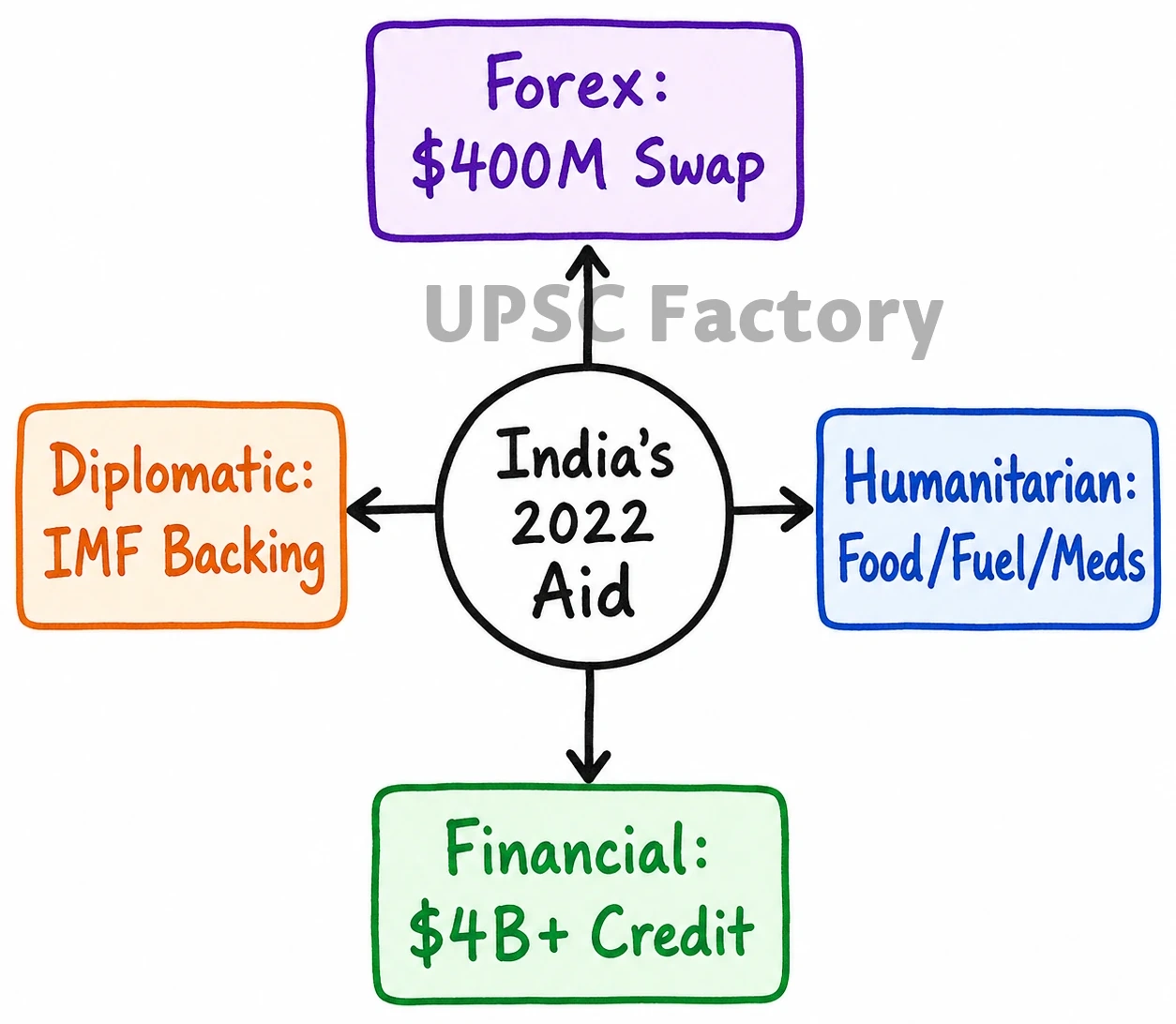
Unprecedented Financial Aid: Provided over $4 billion in economic assistance, serving as the primary anchor against complete economic collapse.
Forex Liquidity Relief: The RBI extended a $400 million currency swap and deferred billion-dollar Asian Clearing Union (ACU) payments.
Humanitarian Lifelines: Extended critical credit lines ensuring the continuous supply of daily essentials (fuel, life-saving medicines, 40,000 MT of rice, and fertilizers).
Diplomatic Championing: India became the first major bilateral creditor to issue written financing assurances to the IMF, expediting Sri Lanka’s bailout package.
Respecting Sovereignty: Extended support to the Sri Lankan people and democratic institutions without interfering in their internal political transition.
India’s swift, unconditional, and multifaceted intervention cemented its role as a reliable “First Responder,” effectively transforming historical civilizational goodwill into a resilient, modern strategic partnership.
Q. Reforming the government delivery system through the Direct Benefit Transfer Scheme is a progressive step, but it has its limitations too. Comment.
Question from UPSC Mains 2022 GS2 Paper
Model Answer:
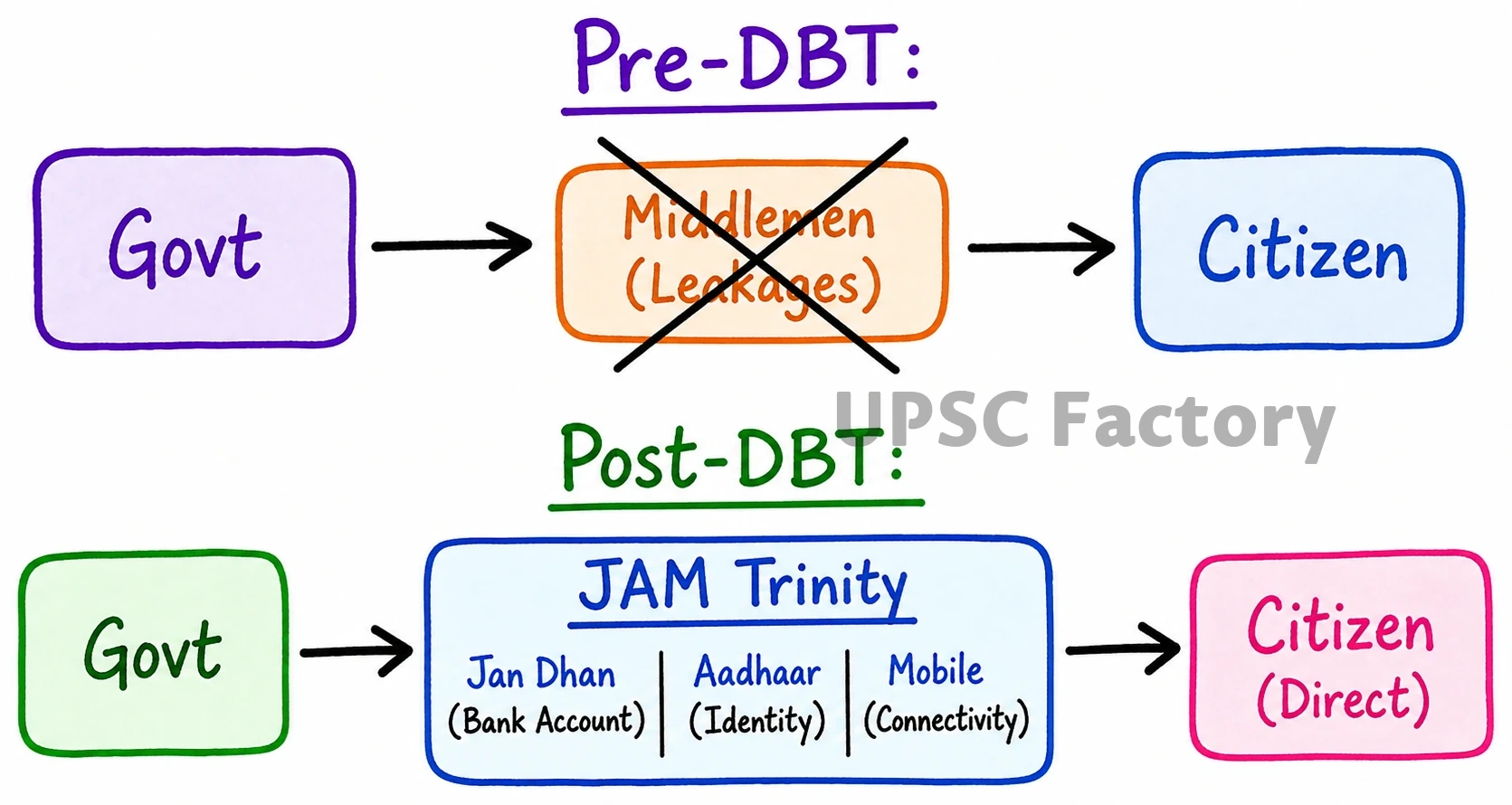
The Direct Benefit Transfer (DBT) scheme, leveraging the JAM Trinity, has progressively transformed India’s welfare delivery paradigm by maximizing transparency.
Progressive Impacts of DBT
Fiscal Efficiency: Eradicated middlemen and ghost beneficiaries, saving over ₹3.4 lakh crore (DBT Mission Data).
Targeting Precision: Ensures timely, direct financial support to verified individuals (PM-KISAN, PAHAL).
Financial Inclusion: Spurred mass banking access, especially empowering rural women (PM Jan Dhan Yojana).
Digital Divide: Poor network connectivity and distant bank branches plague remote tribal regions (NITI Aayog).
Financial Illiteracy: Vulnerable populations face dependency on banking correspondents and vulnerability to digital frauds.
Cash Substitution Risks: Transferred cash might be diverted to non-essentials instead of intended goals (nutrition vs. alcohol).
Strengthening digital infrastructure, providing offline alternatives, and building robust local grievance redressal are essential to fulfill Article 38’s welfare state mandate.
Q. The Rights of Persons with Disabilities Act, 2016 remains only a legal document without intense sensitisation of government functionaries and citizens regarding disability. Comment.
Question from UPSC Mains 2022 GS2 Paper
Model Answer:
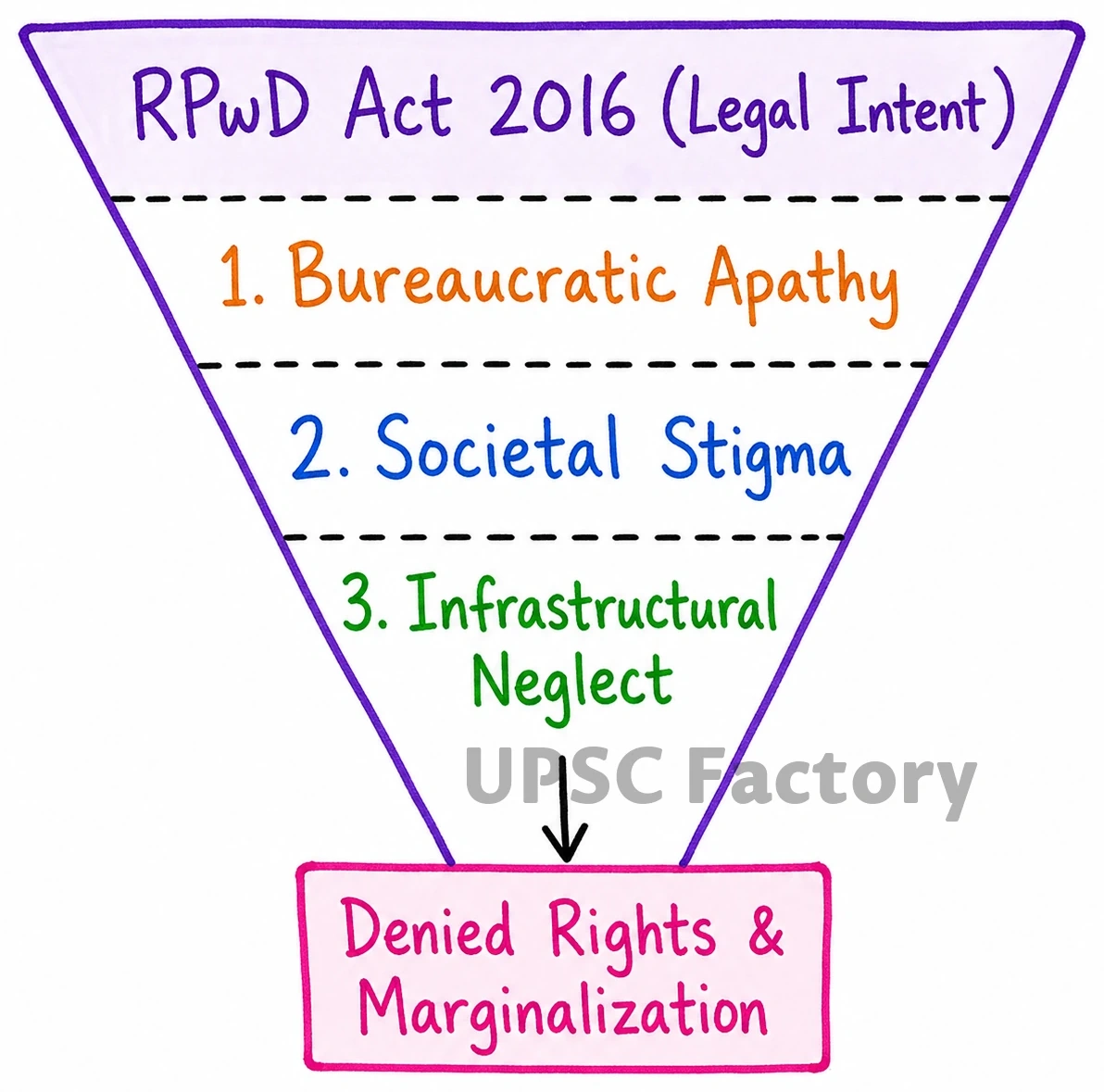
The RPwD Act 2016, aligned with UNCRPD, shifted disability from a ‘medical’ to a ‘social rights’ model. However, behavioral inertia severely impedes its true actualization.
1. Implementation Hurdles: Law vs. Ground Reality
Bureaucratic Apathy: Insensitive functionaries cause severe delays in certification and welfare delivery (e.g., pending UDID cards).
Infrastructural Neglect: Lack of administrative empathy leads to missed accessibility targets in public spaces (e.g., Sugamya Bharat Abhiyan).
Employment Discrimination: Employer prejudices often keep the mandated 4% public sector reservation unfilled or marginalized.
Societal Stigma: Deep-rooted societal pity or exclusion defeats the Act’s core mandate of dignity, despite legal backing.
2. The Imperative of Intense Sensitisation
Empathetic Governance: Sensitized officials shift from rigid, mechanical compliance to proactive, human-centric grievance redressal.
Inclusive Communities: Educating citizens dismantles stereotypes, fostering active peer acceptance in schools and neighborhoods.
Corporate Inclusion: Sensitizing employers drives genuine “reasonable accommodation” in workplaces beyond mere tokenism.
Rights Actualization: Eliminates systemic societal friction, allowing Persons with Disabilities (PwDs) to confidently assert legal rights.
True empowerment requires bridging the gap between statutory mandates and societal empathy, shifting from mere legislative enactment to behavioral transformation for inclusive development.
Q. The Gati-Shakti Yojana needs meticulous coordination between the government and the private sector to achieve the goal of connectivity. Discuss.
Question from UPSC Mains 2022 GS2 Paper
Model Answer:
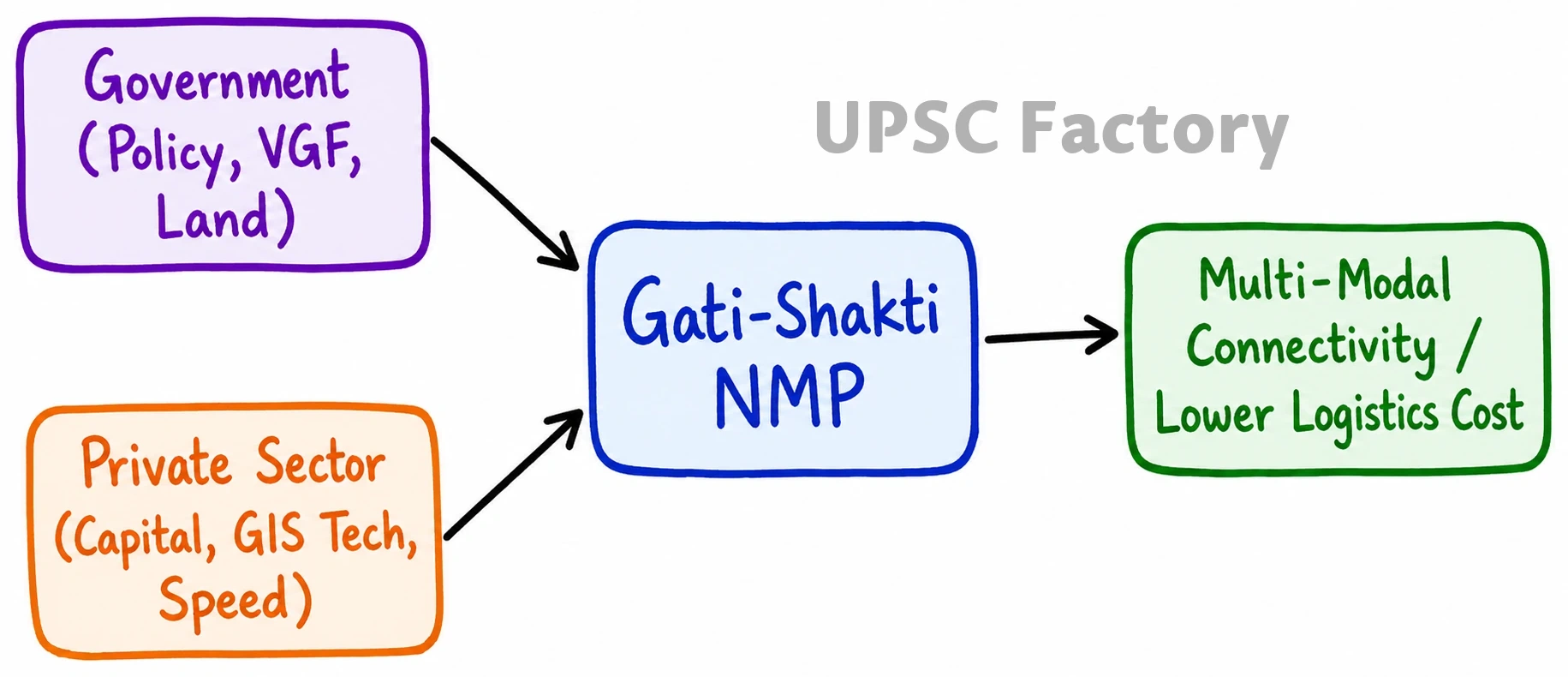
The PM Gati-Shakti National Master Plan (NMP) aims to break departmental silos for integrated multi-modal connectivity, necessitating robust Public-Private Partnership (PPP) to leverage capital and expertise.
1. Imperatives for Govt-Private Synergy
Funding Deficit: The ₹111 lakh crore National Infrastructure Pipeline (NIP) relies on ~21% private capital contribution (Kelkar Committee).
Technology Transfer: Private integration brings advanced GIS analytics and logistics management to the NMP portal.
Clearance Bottlenecks: Land acquisition and environmental delays demand seamless single-window clearances via the e-Gati Shakti portal.
Information Asymmetry: NMP spatial data must be transparently accessible to private developers for synchronized planning.
Dispute Resolution: Rigid contracts require independent sectoral regulators and faster arbitration mechanisms for viable renegotiations.
Meticulous PPP coordination, shifting from transactional contracts to collaborative governance, is vital to actualize Gati-Shakti’s vision and propel India toward a $5-trillion economy.
Q. Discuss the role of the National Commission for Backward Classes in the wake of its transformation from a statutory body to a constitutional body.
Question from UPSC Mains 2022 GS2 Paper
Model Answer:
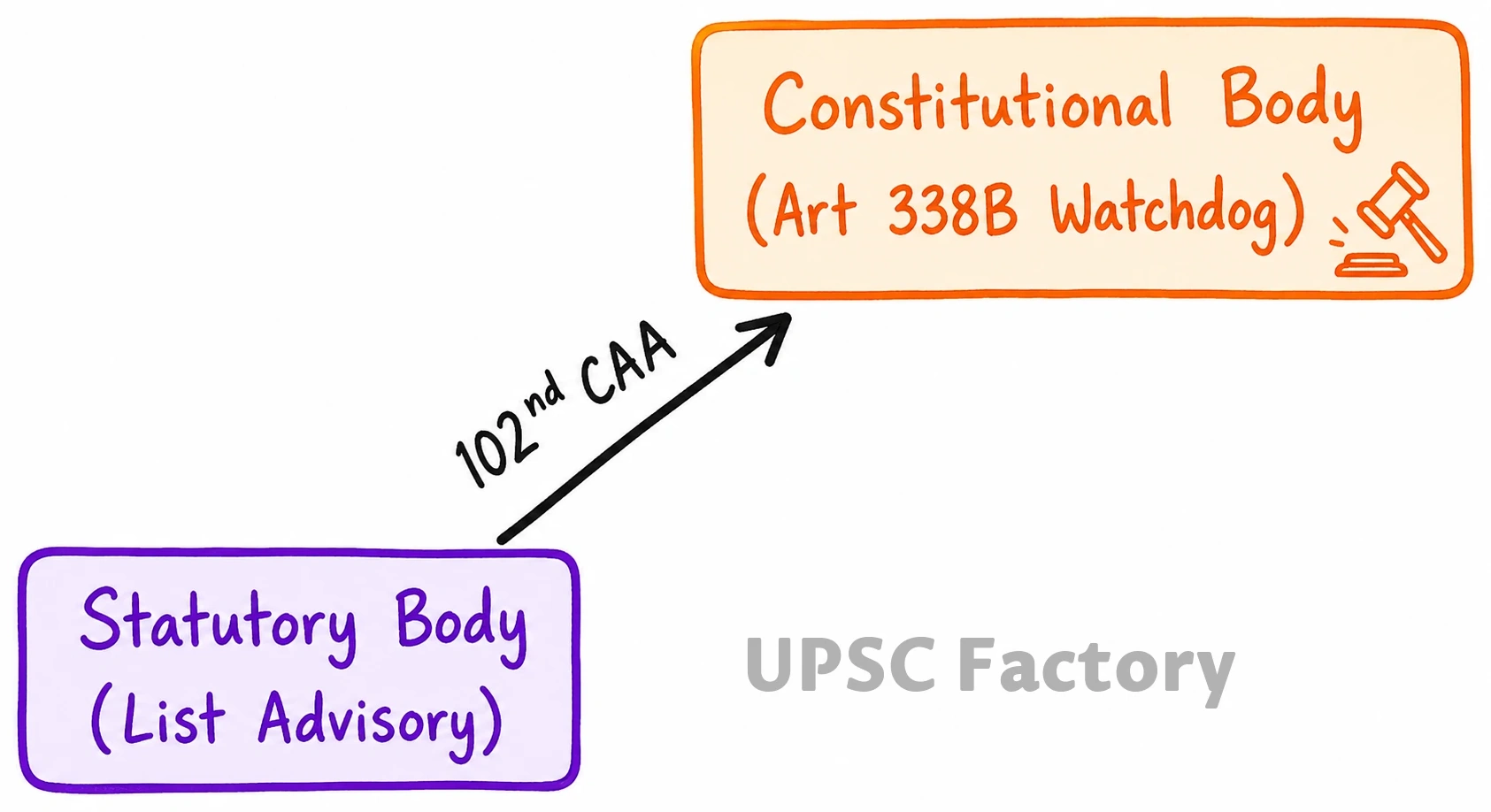
The 102nd Constitutional Amendment Act (2018) elevated the National Commission for Backward Classes (NCBC) from a statutory entity to a constitutional body by inserting Article 338B.
Enhanced Role and Powers Post-Transformation
Grievance Redressal: Expanded beyond merely advising on OBC list inclusions/exclusions to actively investigating specific complaints regarding the deprivation of SEBC rights.
Civil Court Powers: Vested with civil court authority to summon witnesses, demand public records, and receive evidence on oath (Article 338B(8)).
Socio-Economic Planning: Actively participates in and advises on the socio-economic development of SEBCs, evaluating their progress across Union and State schemes.
Mandatory Consultation: The Union and State governments are now constitutionally mandated to consult the NCBC on all major policy matters affecting SEBCs.
Safeguard Monitoring: Audits the implementation of constitutional and legal protections for OBCs, submitting actionable annual reports directly to the President.
This transformation upgrades the NCBC from a passive quota-advisory panel to a comprehensive institutional watchdog, essential for ensuring targeted welfare and substantive equality (e.g., advancing Justice Rohini Commission’s sub-categorization objectives).
Q. Discuss the role of the Vice – Presidents of India as the chairman of the Rajyasabha.
Question from UPSC Mains 2022 GS2 Paper
Model Answer:
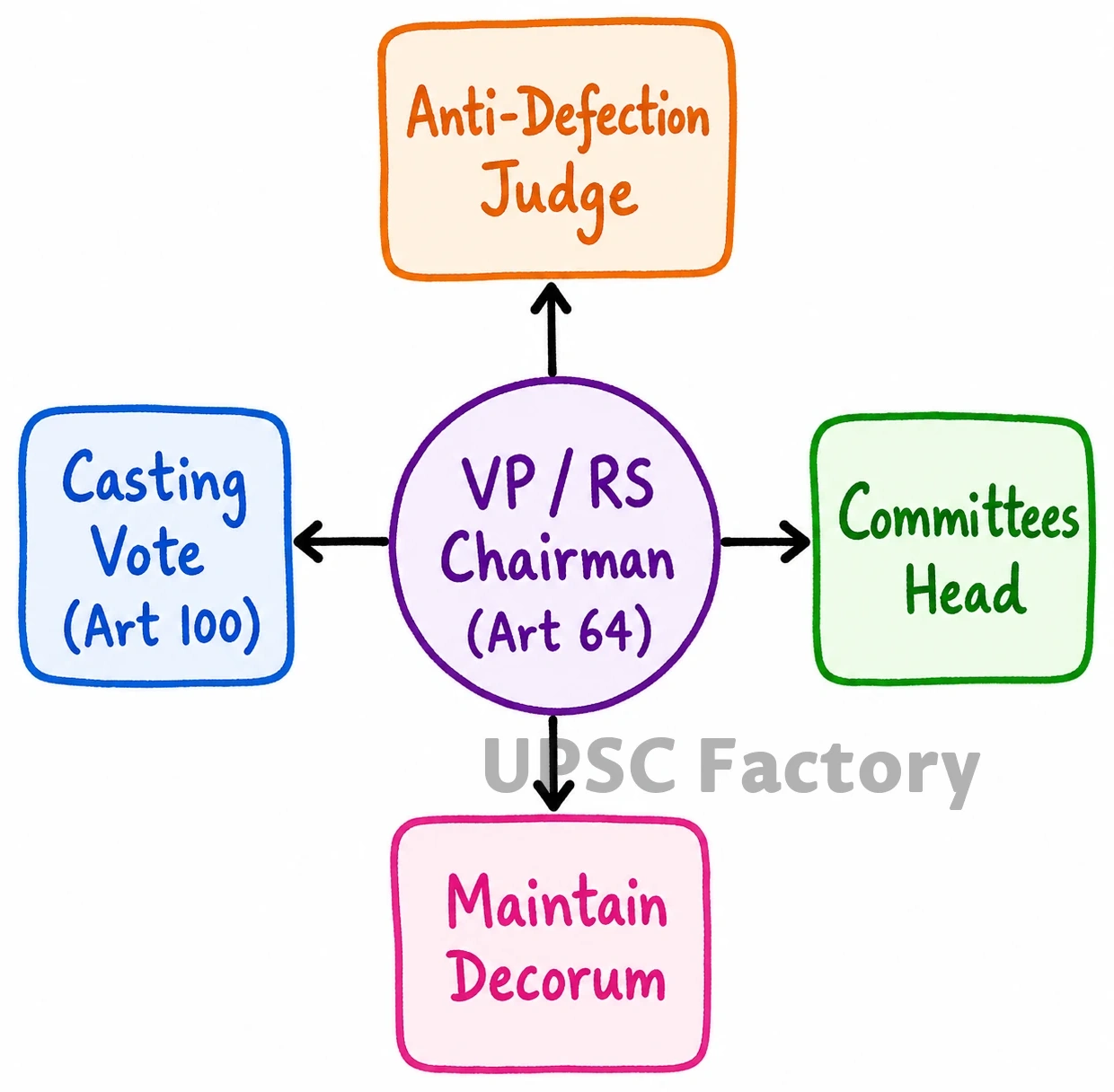
Under Articles 64 and 89 of the Constitution, the Vice-President serves as the ex-officio Chairman of the Rajya Sabha, acting as its principal presiding officer.
1. Legislative and Adjudicatory Powers
Casting Vote: Exercises a casting vote to resolve legislative deadlocks, though barred from voting in the first instance (Article 100).
Anti-Defection Adjudication: Functions as a tribunal to decide the disqualification of Rajya Sabha members under the Tenth Schedule.
Regulating Proceedings: Determines the admissibility of parliamentary questions, calling-attention notices, and motions of urgent public importance.
2. Administrative and Disciplinary Role
Maintaining Decorum: Enforces House rules and ensures smooth debates, holding powers to direct withdrawal or suspend unruly members (Rules 255/256).
Committee Management: Nominates members to various Parliamentary Committees and directly chairs the Business Advisory, Rules, and General Purposes Committees.
Custodian of Privileges: Acts as the principal spokesperson of the House, protecting the constitutional rights and privileges of its members.
By steering the “House of Elders” with impartiality and constitutional foresight, the Chairman ensures the Rajya Sabha effectively fulfills its role in deliberative democracy and cooperative federalism.
Q. To what extent, in your opinion, as the decentralisation of power in India changed the governance landscape at the grassroots?
Question from UPSC Mains 2022 GS2 Paper
Model Answer:
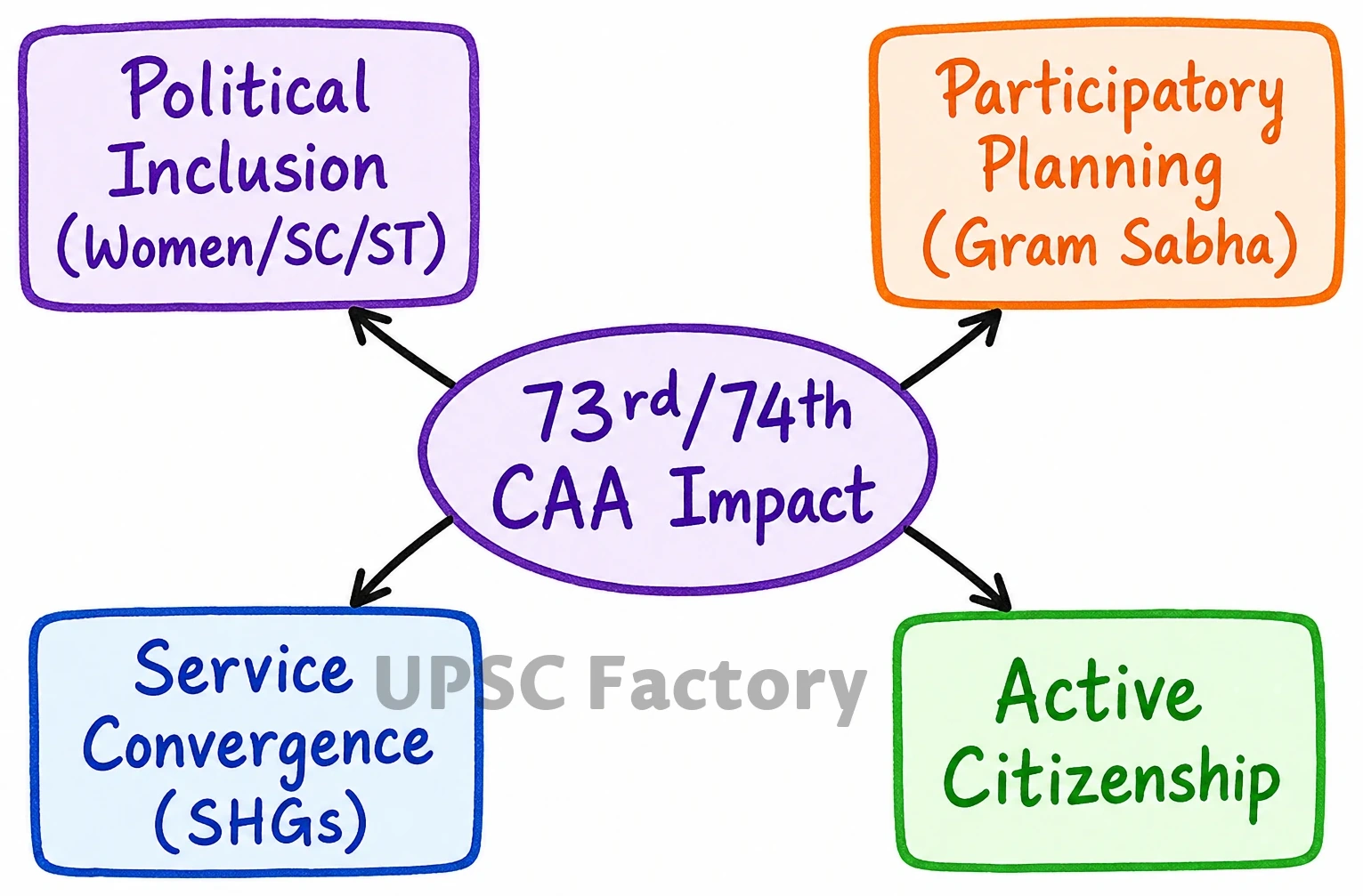
The 73rd and 74th Constitutional Amendment Acts revolutionized India’s democratic fabric, shifting representative governance toward participatory grassroots planning (Articles 243G/243W).
1. Transformative Changes at the Grassroots
Political Inclusion: Created 31+ lakh grassroots leaders, with over 46% women, and secured mandated SC/ST representation.
Participatory Planning: Institutionalized Gram Sabhas for localized decision-making and direct accountability (e.g., GPDPs, MGNREGA social audits).
Service Delivery Synergies: Enabled structural convergence between local bodies and self-help groups for poverty alleviation (e.g., Kudumbashree in Kerala).
Democratic Maturation: Transformed citizens from passive welfare recipients to active governance stakeholders.
2. Persisting Limitations in Local Governance
The ‘3Fs’ Deficit: Chronic shortage of devolved Funds, Functions, and Functionaries restricts true autonomy (2nd ARC 6th Report).
Proxy Governance: The pervasive Sarpanch Pati syndrome undermines the de facto agency of elected women representatives.
Parallel Bureaucracy: State parastatal agencies and excessive bureaucratic vetoes routinely bypass elected local councils.
Fiscal Dependency: Negligible internal tax generation leaves local bodies heavily dependent on tied State and Central grants.
Though decentralization successfully deepened political inclusion, achieving genuine functional autonomy requires urgent fiscal empowerment and capacity building as envisioned by the 2nd ARC.
Q. “Right of movement and residence throughout the territory of India are freely available to the Indian citizens, but these rights are not absolute. “ Comment.
Question from UPSC Mains 2022 GS2 Paper
Model Answer:
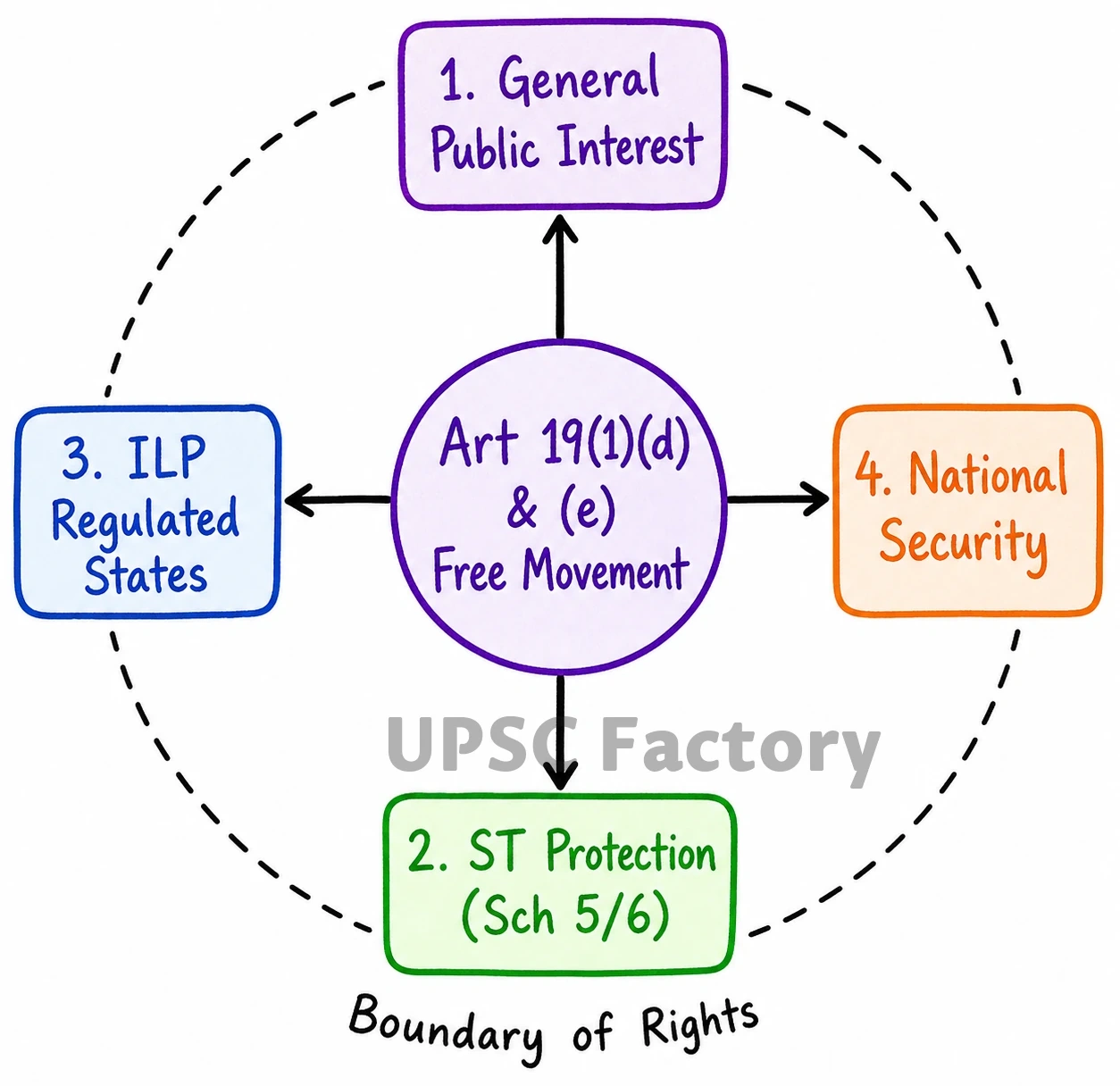
Articles 19(1)(d) and 19(1)(e) of the Constitution guarantee citizens the right to move freely and reside anywhere within India, fostering national integration.
1. Scope of the Freedoms
Internal Dimension: Protects movement and residence strictly within Indian territory (external travel is governed by Article 21).
National Unity: Designed to eliminate provincial barriers, promoting a cohesive national identity.
2. Reasonable Restrictions (Article 19(5))
These rights are structurally balanced against collective societal interests through specific constitutional limitations:
Interests of the General Public: The State can restrict movement for public order, health, or morality (State of UP v. Kaushaliya regarding public morals).
Protection of Scheduled Tribes: Restricts outsider settlement to safeguard indigenous land, culture, and customs from exploitation (5th and 6th Schedule areas).
Inner Line Permit (ILP) System: Regulates the entry of non-natives into specific protected border states (Arunachal Pradesh, Nagaland, Mizoram, Manipur).
National Security & Strategy: Access prohibited in sensitive border zones or military installations to protect state security (Official Secrets Act).
By balancing individual liberty with collective societal and security interests, the Constitution ensures cultural preservation and public order without compromising India’s democratic ethos.
Q. “The most significant achievement of modern law in India is the constitutionalization of environmental problems by the Supreme Court.” Discuss this statement with the help of relevant case laws.
Question from UPSC Mains 2022 GS2 Paper
Model Answer:
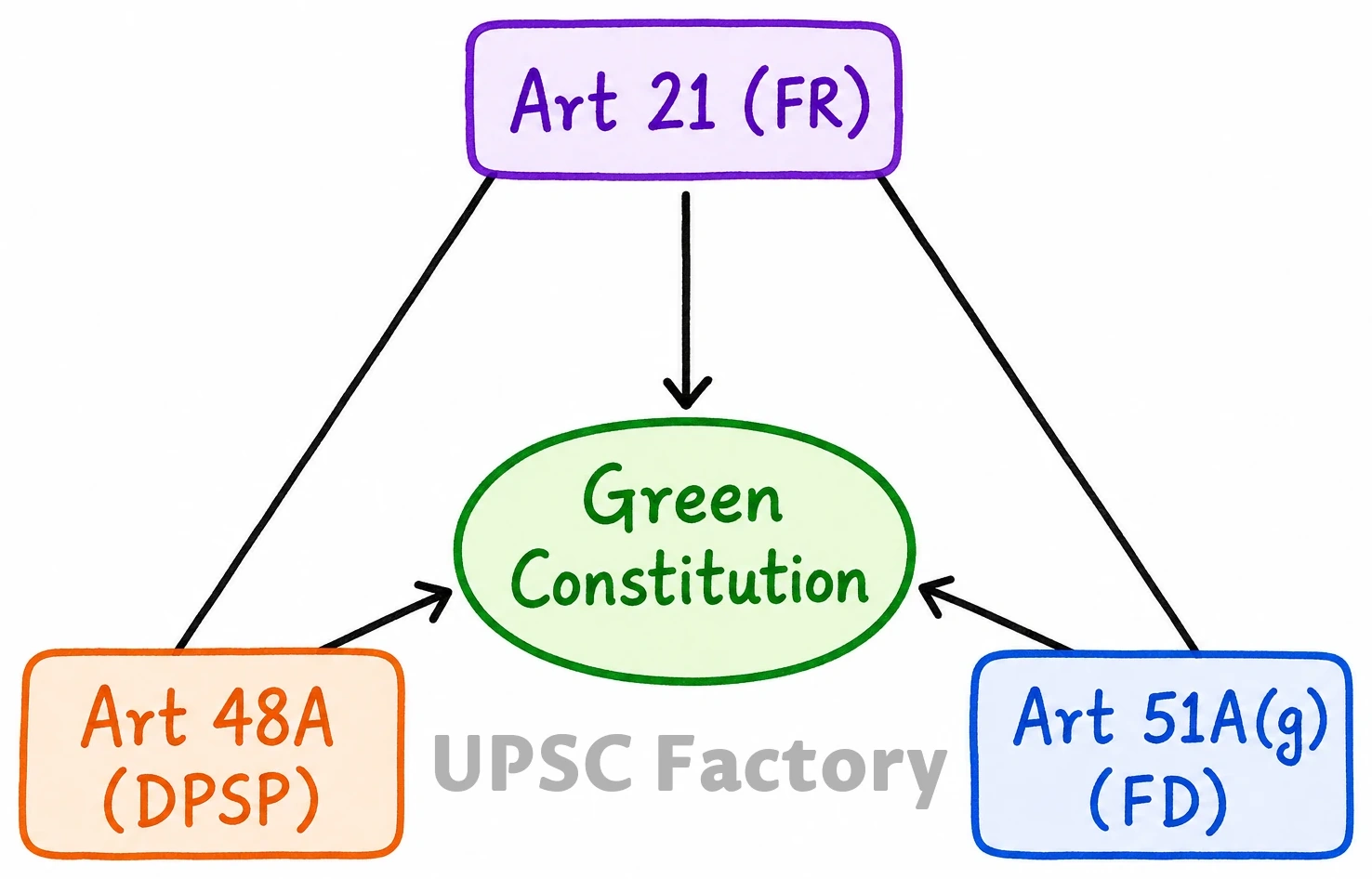
The Supreme Court (SC) pioneered “green constitutionalism” in India by elevating environmental protection from mere statutory regulations to fundamental constitutional rights.
1. Mechanisms of Constitutionalization
Expanding Article 21: Broadened the ‘Right to Life’ to explicitly include the right to a wholesome and clean environment.
Harmonious Construction: Integrated Directive Principles (Article 48A) and Fundamental Duties (Article 51A(g)) into judicially enforceable constitutional mandates.
Procedural Innovation: Diluted locus standi through Public Interest Litigation (PILs) under Article 32, democratizing environmental justice.
2. Landmark Case Laws & Evolved Principles
Right to Clean Air/Water: Recognized fundamental right to pollution-free water and air (Subhash Kumar v. State of Bihar, 1991).
Absolute Liability Principle: Established strict enterprise accountability for hazardous industries without exception (M.C. Mehta v. Union of India, Oleum Gas Leak).
Precautionary & Polluter Pays: Embedded international ecological norms directly into domestic constitutional law (Vellore Citizens Welfare Forum, 1996).
Public Trust Doctrine: Declared the State as a trustee holding natural resources for public use (M.C. Mehta v. Kamal Nath, 1997).
Continuing Mandamus: Enabled ongoing judicial monitoring of national forest canopies (T.N. Godavarman Case).
By interweaving ecological protection into the constitutional fabric, the Supreme Court not only secured intergenerational equity but also laid the foundational jurisprudence for specialized bodies like the National Green Tribunal.