Q. Child cuddling is now being replaced by mobile phones. Discuss its impact on the socialization of children.
Question from UPSC Mains 2023 GS1 Paper
Model Answer:
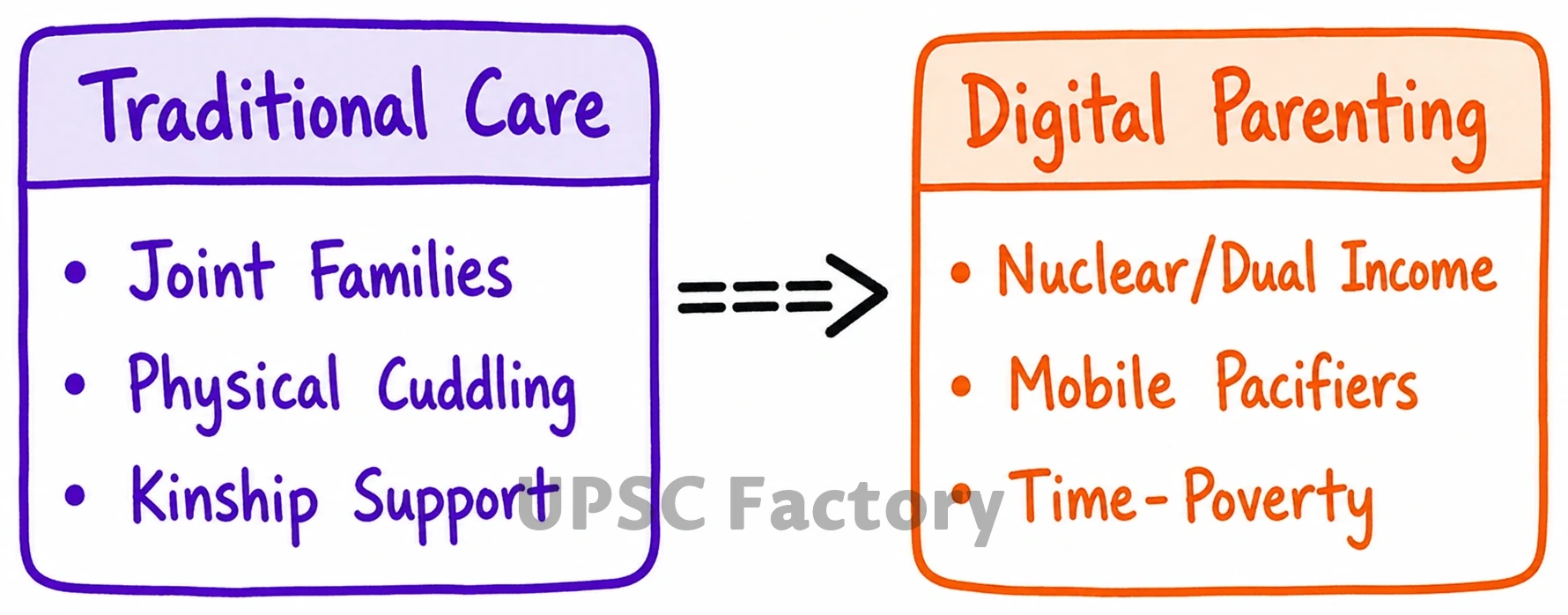
The transition from physical affection to digital pacifiers marks a rising trend of “digital parenting,” fundamentally altering the socio-emotional fabric of early childhood development.
Drivers of Digital Substitution
Time-Poverty: Dual-income nuclear families increasingly use smartphones as convenient, instant babysitters.
Kinship Decline: The breakdown of joint families limits traditional physical caregiving (e.g., grandparents’ storytelling).
Targeted Media: Globalization of hyper-engaging infant content hooks attention, replacing human interaction.
Impact on the Socialization of Children
Emotional Disconnect: “Touch deprivation” reduces oxytocin release, impairing empathy development and secure parental attachment.
Behavioral Shifts: Instant digital gratification fosters irritability, reducing patience and attention spans.
Social Isolation: Reduced physical peer-play creates isolated “iPad Kids” prone to Nature Deficit Disorder.
Altered Learning: While basic digital literacy may improve early, it strips away vital non-verbal social cues.
Adhering to WHO Screen Time Guidelines (2019) and promoting mindful parenting is vital to ensure technology supplements, rather than replaces, the indispensable warmth of human touch.
Q. Explain why suicide among young women is increasing in Indian society.
Question from UPSC Mains 2023 GS1 Paper
Model Answer:
According to the NCRB ADSI report, housewives constitute over 50% of female suicides, highlighting a growing mental health crisis among young Indian women.
Traditional and Familial Pressures
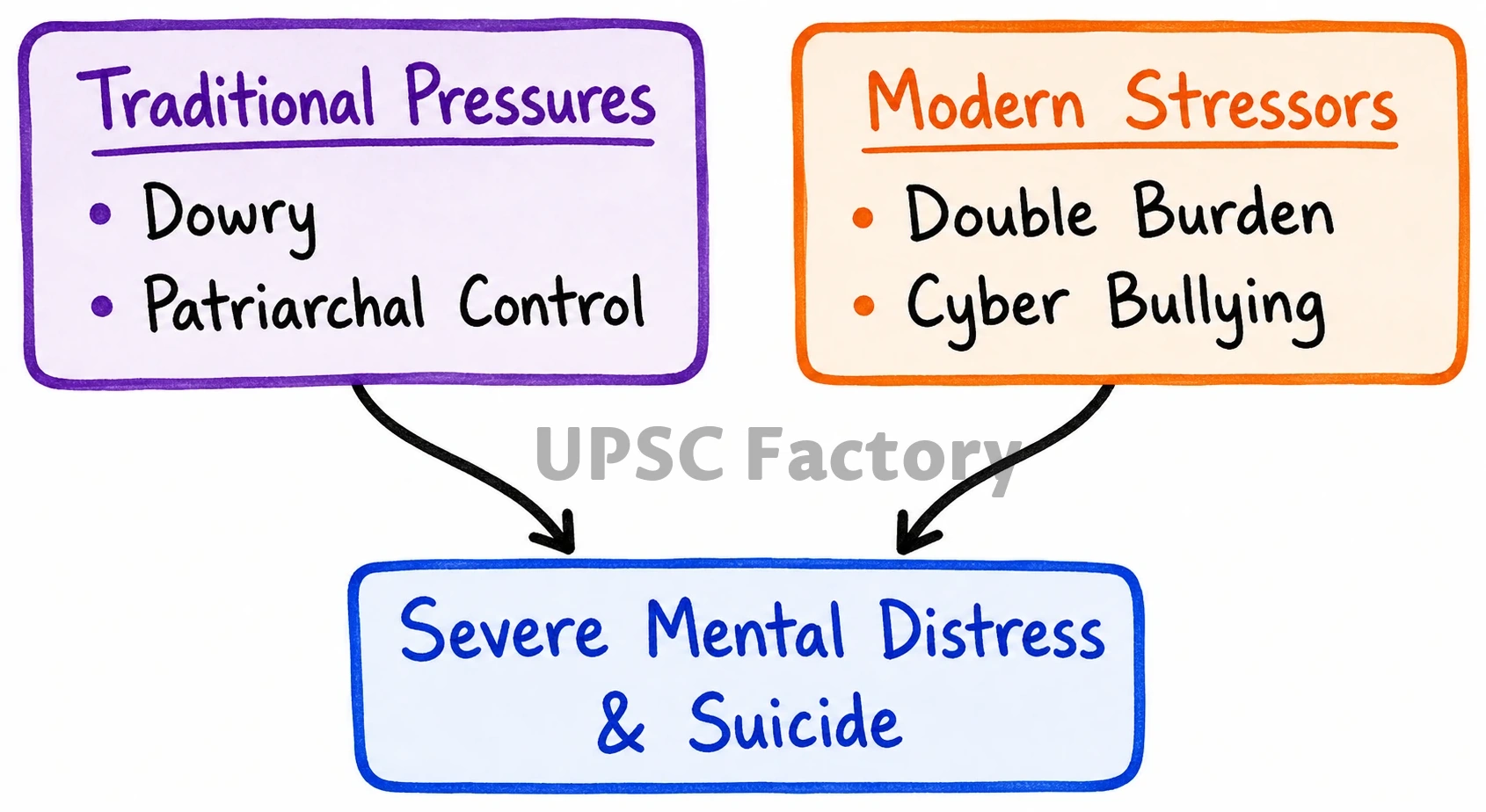
Domestic Violence & Dowry: Persistent physical and emotional cruelty by husbands or relatives remains a primary trigger (Section 498A).
Diminished Autonomy: Forced early marriages, restricted career mobility, and limited financial independence induce profound hopelessness.
Patriarchal Expectations: Extreme societal pressure for male offspring and rigid reproductive control (son meta-preference).
Modern and Transitional Stressors
The ‘Double Burden’: Exhaustion and burnout from balancing new professional aspirations with unequal, traditional domestic responsibilities.
Academic Stress: Intense educational competition, performance anxiety, and fear of failure among young female students (Kota suicides).
Digital Victimization: Rising cyber-bullying, revenge porn, and deepfakes cause severe reputational anxiety and trauma (IT Rules 2021).
Nuclearization of Families: The loss of traditional joint-family emotional support networks exacerbates isolation and unaddressed clinical depression.
Reversing this trend requires de-stigmatizing psychiatric care via the Mental Healthcare Act 2017, strengthening local crisis-intervention networks, and actively dismantling entrenched patriarchal socialization.
Q. Do you think marriage as a sacrament is loosing its value in Modern India?
Question from UPSC Mains 2023 GS1 Paper
Model Answer:
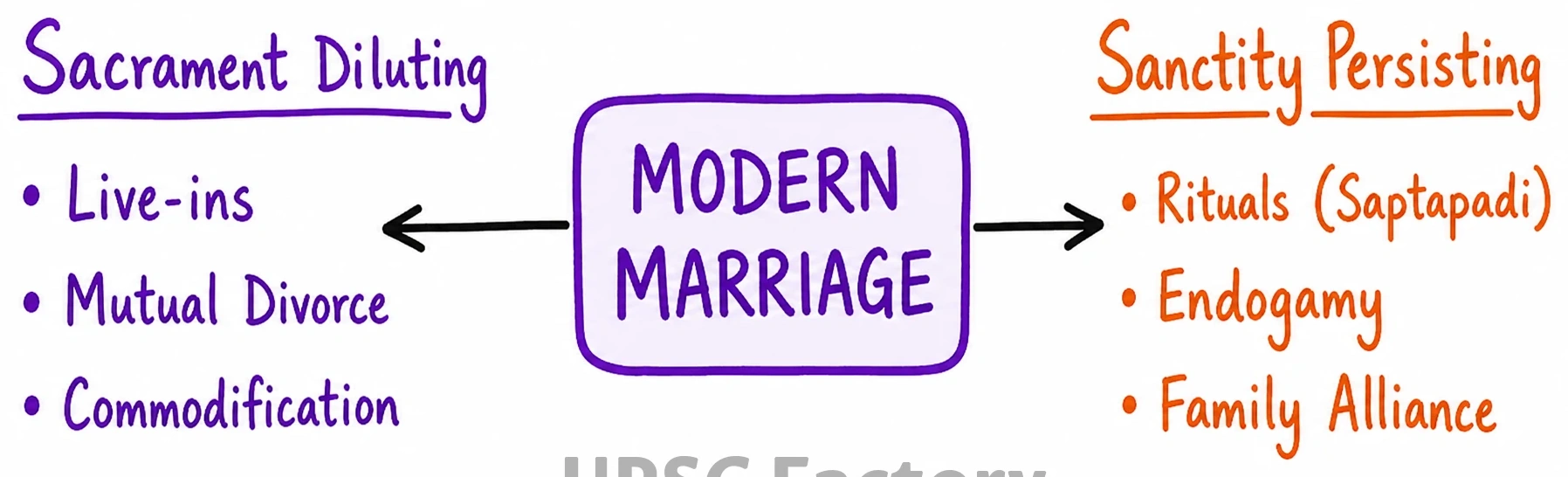
Historically an indissoluble samskara, Indian marriage is transitioning under modernization, yet largely retains its core cultural sanctity.
1. Indicators of Declining Sacramental Value
Legal Dissolution: Rising acceptance of mutual divorce challenges the concept of an eternal union (Hindu Marriage Act 1955, Sec 13B).
Contractual Alternatives: Growth of live-in relationships shifts the focus from sacred duty to individual choice and autonomy.
Secularization: Inter-faith civil marriages prioritize compatibility and consent over religious mandates (Special Marriage Act 1954).
Commodification: “Big fat Indian weddings” increasingly reduce sacred rituals to conspicuous consumption and status signaling.
2. Persistence of the Sacramental Core
Ritual Necessity: Legal and social validity still heavily relies on traditional customary rites (e.g., Saptapadi or seven steps).
Endogamy’s Resilience: Caste and religious boundaries remain deeply entrenched, even on modern digital matrimonial platforms (Shaadi.com).
Social Sanctity: Divorce, despite legal ease, carries significant social stigma and remains a strict last resort.
Family Centrality: Marriage continues to function primarily as an alliance between families, rather than just a contract between individuals.
Marriage in India is not losing its value; rather, it is evolving from a rigid, patriarchal sacrament into a flexible, egalitarian union that blends traditional sanctity with modern constitutional rights.
Q. Why is the South-West Monsoon called Purvaiya’ (easterly) in Bhojpur Region ? How has this directional seasonal wind system influenced the cultural ethos of the region?
Question from UPSC Mains 2023 GS1 Paper
Model Answer:
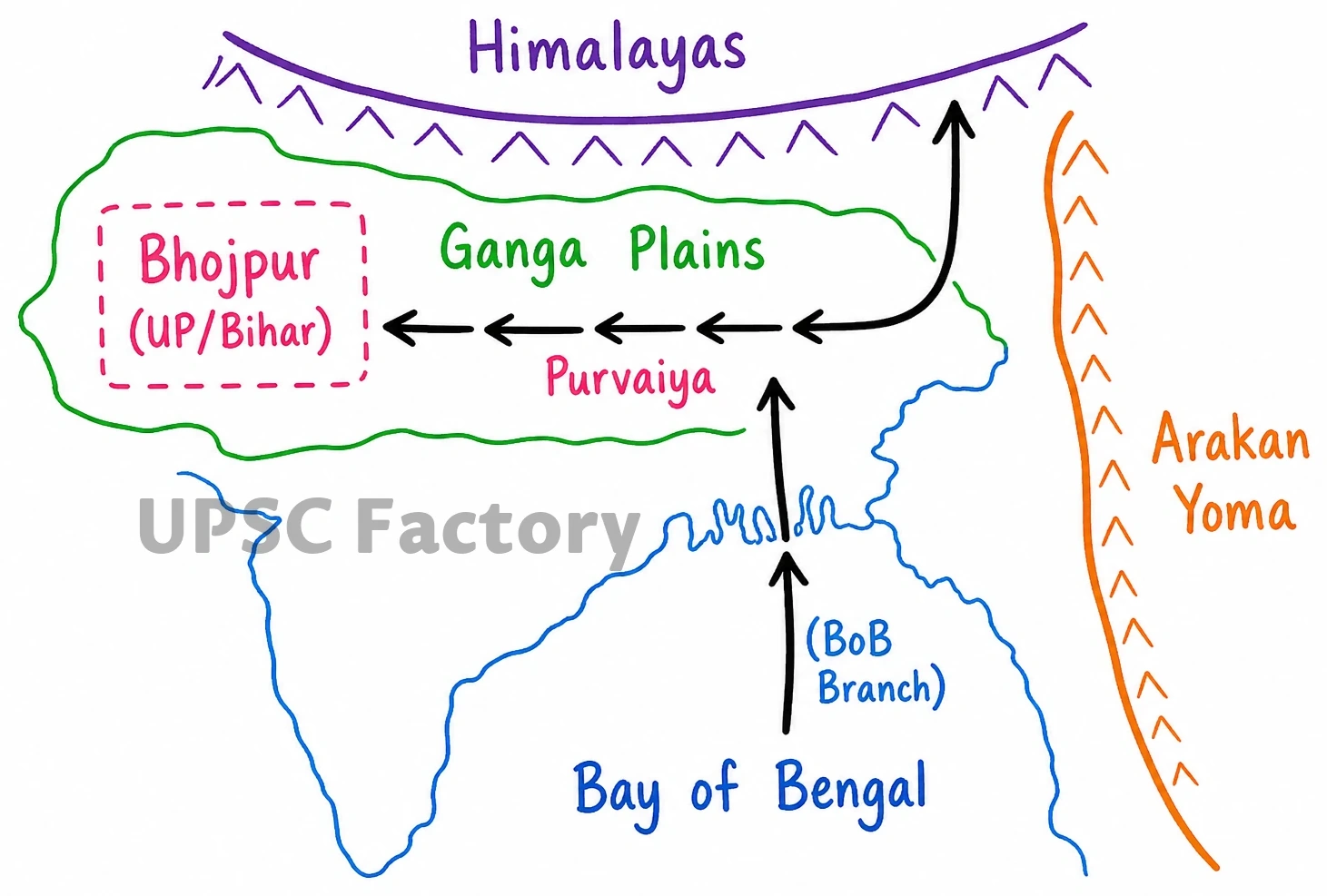
‘Purvaiya’ refers to the moisture-laden easterly winds of the South-West Monsoon, acting as the critical socio-economic lifeline for the Bhojpur region (Eastern UP, Western Bihar).
Monsoon Bifurcation: The advancing South-West Monsoon splits, sending its Bay of Bengal (BoB) branch northwards.
Orographic Deflection: The towering Himalayas and Arakan Yoma hills block the northward trajectory, deflecting the winds westward.
Ganga Plains Funneling: Guided by the low-pressure monsoon trough, these winds traverse the Indo-Gangetic plain from East to West.
Nomenclature: Because these deflected planetary winds enter the Bhojpur region from the east, the locals intuitively named them Purvaiya (Easterlies).
2. Influence on Bhojpur’s Cultural Ethos
Agrarian Rhythm: It signals relief from the scorching summer Loo, initiating the agricultural calendar and Kharif (paddy) sowing.
Folk Traditions: It inspires a rich tradition of emotive folk music detailing monsoon romance and longing (Kajari, Birha, Jhula).
Festivals & Rituals: The rains anchor seasonal socio-religious celebrations focused on nature, fertility, and marital bliss (Teej, Nag Panchami).
Culinary Ethos: The onset of Purvaiya drives traditional seasonal dietary shifts (e.g., consumption of malpua, pakodas) suited for humid weather.
Thus, ‘Purvaiya’ exemplifies environmental determinism, where a topographically deflected wind system transcends meteorology to profoundly shape the agrarian identity and cultural heartbeat of Bhojpur.
Q. How are the fjords formed? Why do they constitute some of the most picturesque areas of the world?
Question from UPSC Mains 2023 GS1 Paper
Model Answer:
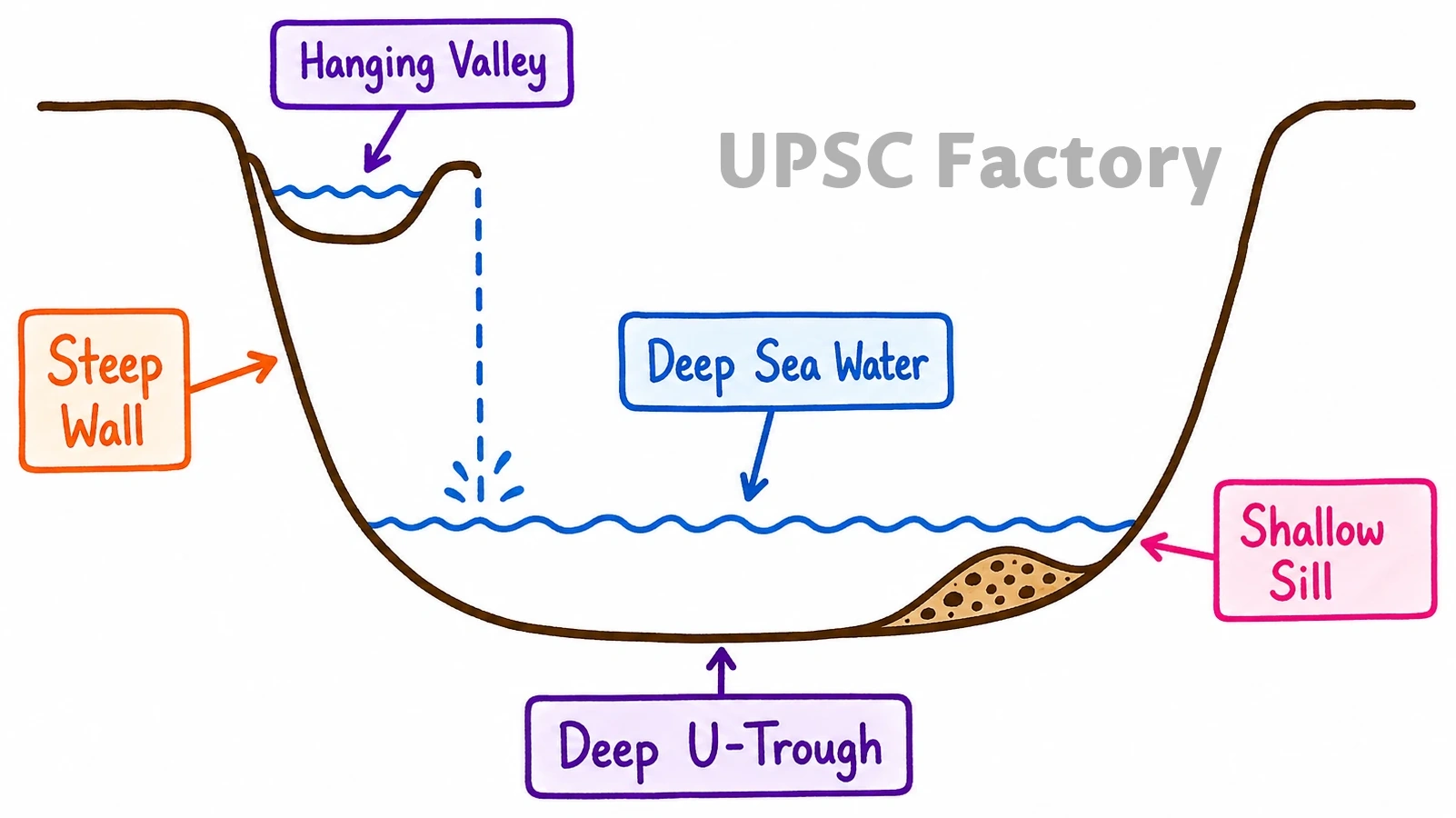
Fjords are deep, narrow, and elongated coastal inlets characterized by steep sides, primarily found in glaciated higher latitudes like Scandinavia.
Mechanism of Fjord Formation
Glacial Carving: Moving valley glaciers severely erode existing V-shaped river valleys, transforming them into steep-sided, flat-bottomed U-shaped troughs.
Over-deepening: Intense basal erosion by thick, heavy ice cuts the valley floor hundreds of meters below the contemporary sea level.
Sill Formation: The fjord mouth is usually shallower due to reduced ice erosion and terminal moraine deposition, creating a protective rock threshold.
Factors Making Fjords Picturesque
Dramatic Vertical Relief: Towering, near-vertical rock walls create a striking geomorphic contrast against deep, tranquil waters (Sognefjord, Norway).
Hanging Valleys: Tributary glaciers erode less deeply, leaving elevated valleys that produce spectacular, cascading waterfalls (Milford Sound, New Zealand).
Ecological Juxtaposition: Lush green alpine vegetation and snow-capped mountain peaks directly interface with rich, sheltered marine ecosystems.
Intricate Geometry: The winding, branching network of narrow glaciated inlets creates constantly shifting, highly dramatic visual vistas.
Fjords stand as magnificent geomorphic testaments to Pleistocene glacial dynamics, holding immense geographical and ecological value while acting as premium drivers of global ecotourism.
Q. Why is the world today confronted with a crisis of availability of and access to freshwater resources?
Question from UPSC Mains 2023 GS1 Paper
Model Answer:
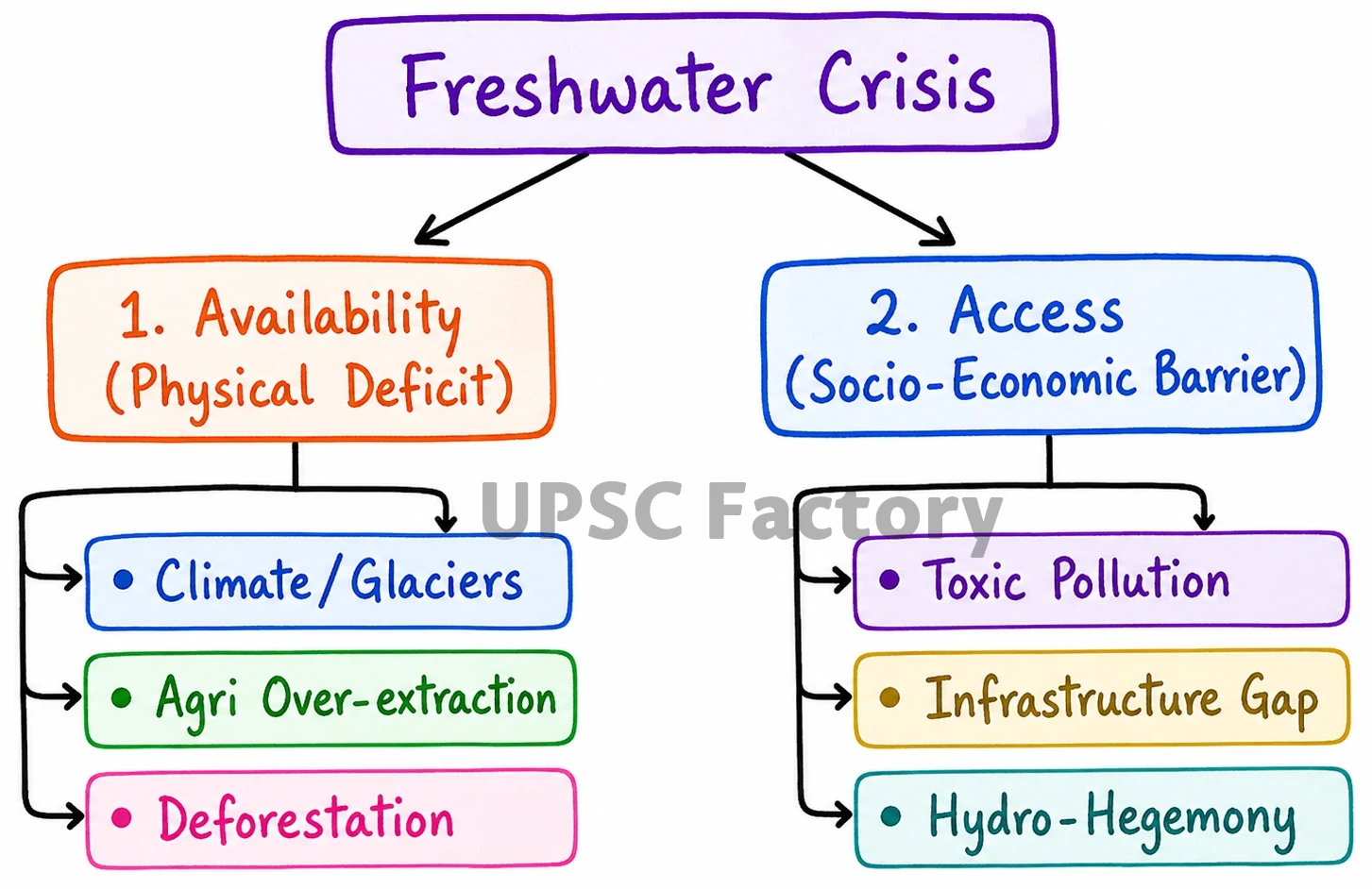
According to the UN World Water Report, over 2 billion people experience high water stress, driven by systemic deficits in both physical availability and socioeconomic access.
1. Drivers of the Availability Crisis (Physical Scarcity)
Over-extraction: Unsustainable groundwater mining, primarily driven by water-intensive agriculture, outpaces natural aquifer recharge (Punjab, US High Plains).
Ecological Degradation: Deforestation and the destruction of critical wetlands reduce nature’s capacity for water retention (Aral Sea, Lake Chad depletion).
2. Barriers to Access (Economic and Geopolitical Scarcity)
Severe Pollution: Industrial effluents and agricultural runoff render existing water resources toxic and unpotable (Flint water crisis, Yamuna frothing).
Infrastructure Deficit: Inadequate capital for distribution pipelines and treatment networks limits access in developing regions (Sub-Saharan Africa).
Transboundary Conflicts: Hydro-hegemony and geopolitical disputes over shared river basins restrict equitable downstream allocation (Nile/GERD, Jordan River).
Commercialization: Water privatization drives up tariffs, making clean water unaffordable for the urban and rural poor (Cochabamba Water War).
Achieving SDG 6 (Clean Water and Sanitation) demands a global transition toward circular water economies, integrated river basin management, and robust hydro-diplomacy.
Q. Discuss the consequences of climate change on the food security in tropical countries.
Question from UPSC Mains 2023 GS1 Paper
Model Answer:
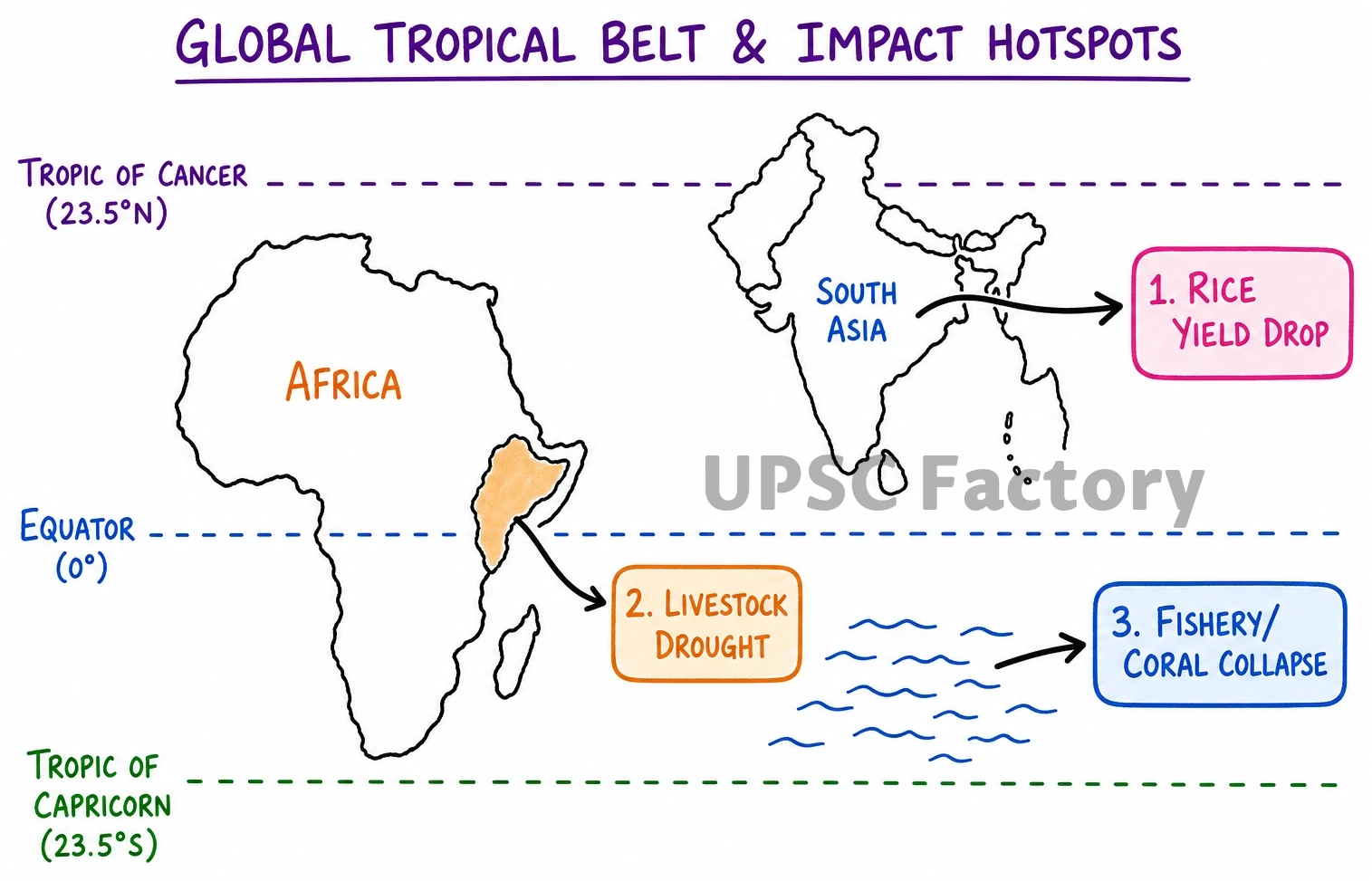
Tropical countries face disproportionate food security risks from climate change due to their high climate sensitivity and agrarian economies (IPCC AR6).
1. Impacts on Food Availability
Yield Reduction: Rising temperatures and erratic monsoons severely depress staple yields (10-20% projected drop in South Asian rice).
Livestock Depletion: Heat stress and water scarcity increase herd mortality and lower productivity (El Niño droughts in Horn of Africa).
Marine Crisis: Ocean warming and acidification decimate tropical coral fisheries, a primary protein source for coastal nations.
2. Impacts on Access, Stability, and Utilization
Economic Access: Frequent crop failures trigger agrarian income collapse and severe food inflation, crippling affordability.
Supply Stability: Extreme weather (cyclones, floods) destroys agricultural storage and disrupts distribution logistics, causing sudden supply shortages.
Nutritional Dilution: Elevated atmospheric CO2 reduces iron, zinc, and protein in crops, worsening “Hidden Hunger” (FAO SOFI).
Securing tropical food systems demands urgent investment in climate-smart agriculture, biofortified drought-resistant seeds, and robust early warning systems (SDG 2: Zero Hunger).
Q. Bring out the socio-economic effects of the introduction of railways in different countries of the world.
Question from UPSC Mains 2023 GS1 Paper
Model Answer:
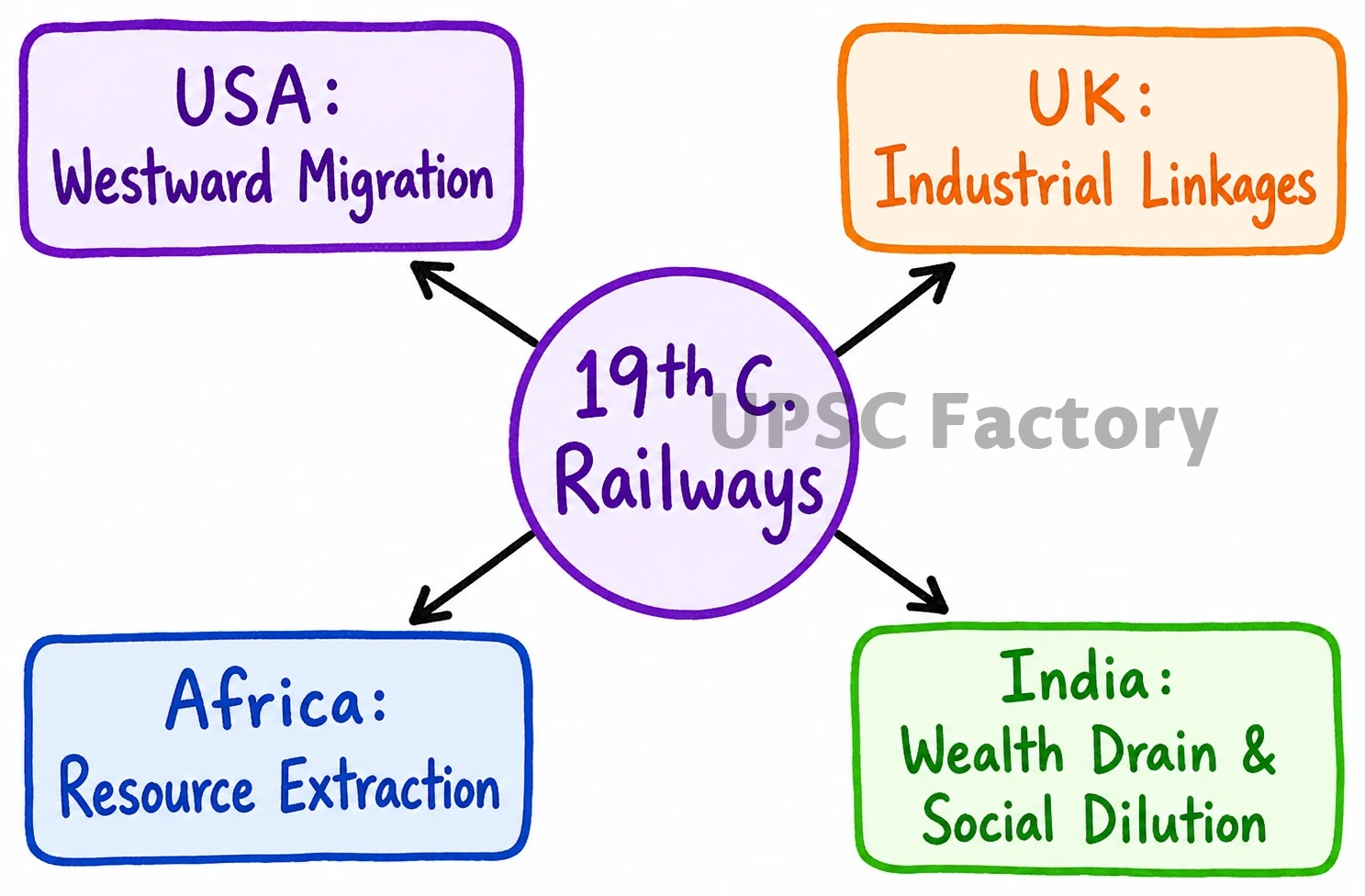
The 19th-century railway revolution catalyzed global “time-space compression,” transforming both industrialized and colonized nations through profound, yet distinct, socio-economic paradigm shifts.
Economic Effects
Industrial Linkages: Drove immense forward/backward linkages, rapidly accelerating coal, iron, and heavy engineering sectors (Britain’s Industrial Revolution).
Colonial Extraction: Acted as imperial tools for the “drain of wealth,” funneling cheap interior raw materials to global ports (Africa’s Cape-to-Cairo project, India).
Social Effects
Demographic Shifts: Accelerated massive urbanization, inland migration, and new town settlements (USA Westward expansion, Siberian colonization).
Social Dilution: Unintentionally eroded rigid traditional hierarchies and prejudices through shared public transit spaces (Caste system dilution in India).
Indigenous Displacement: Enabled military mobility that rapidly marginalized aboriginal populations and appropriated native lands (Native Americans, African tribes).
Labor Mobilization: Triggered the large-scale intercontinental movement of cheap, often exploited, workforces (Chinese labor on US railroads).
While railways decisively accelerated modern capitalist globalization and national integration, they simultaneously entrenched colonial underdevelopment and indigenous marginalization across the globe.
Q. What was the difference between Mahatma Gandhi and Rabindranath Tagore in their approach towards education and nationalism?
Question from UPSC Mains 2023 GS1 Paper
Model Answer:
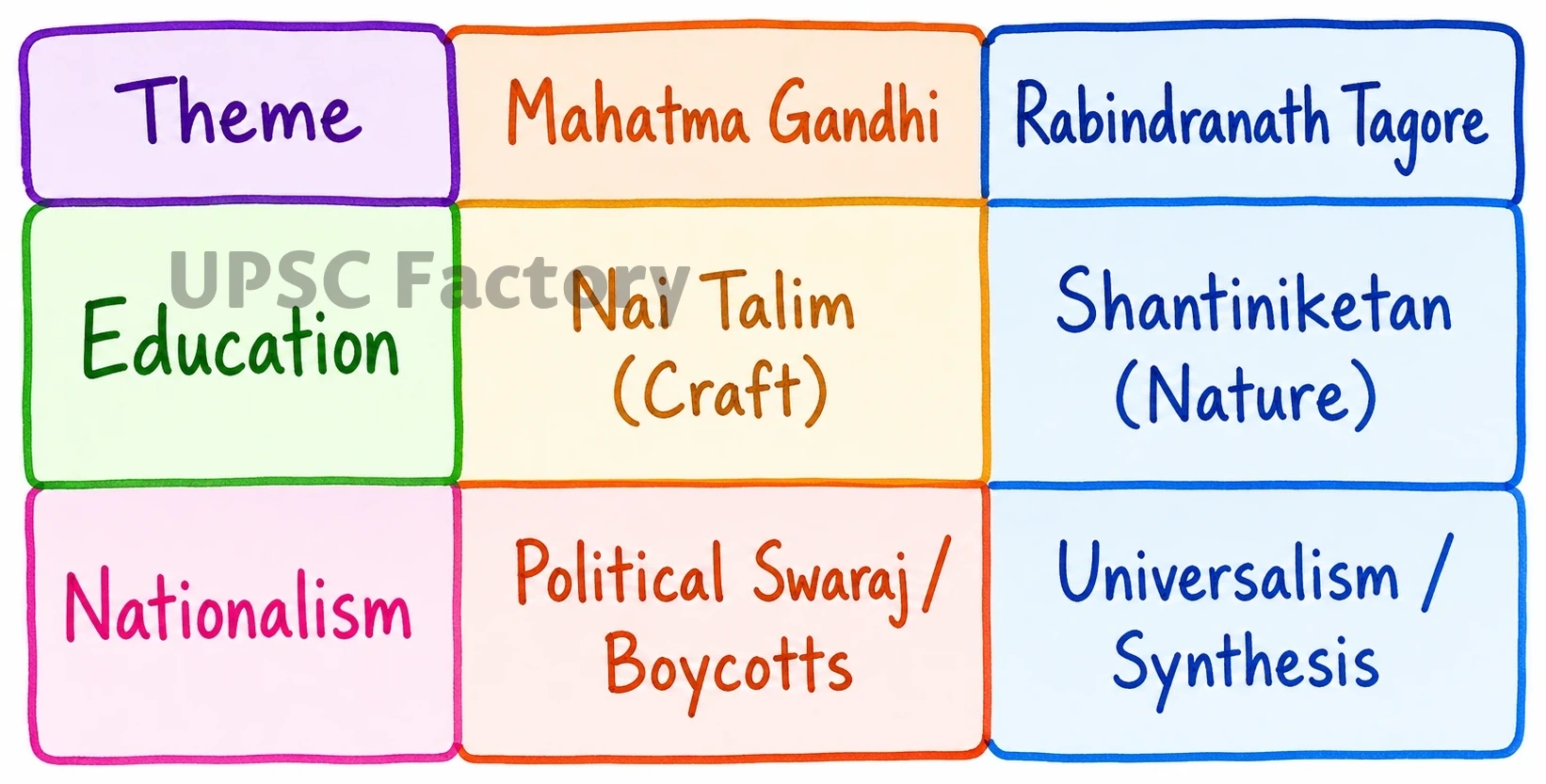
Mahatma Gandhi and Rabindranath Tagore shared the ultimate goal of India’s emancipation but diverged significantly in their ideological frameworks regarding education and nationalism.
1. Differences in Approach to Education
Pedagogical Core: Gandhi championed Nai Talim (craft-based, vocational learning) for self-reliance; Tagore favored naturalistic, open-air learning centered on aesthetics (Shantiniketan).
Utility vs. Creativity: Gandhi viewed education primarily as a tool for rural upliftment and moral character; Tagore emphasized unhindered creative and spiritual freedom.
Global Integration: Gandhi strictly advocated vernacular mediums to ground students locally; Tagore supported blending Indian traditions with global sciences and cultures (Visva-Bharati).
2. Differences in Approach to Nationalism
Political vs. Universal: Gandhi focused on political Swaraj and anti-colonial mobilization; Tagore fiercely critiqued narrow territorial nationalism, championing cosmopolitanism and universal humanism.
Protest Tactics: Gandhi utilized non-cooperation and boycotts; Tagore opposed boycotting schools and burning foreign cloth, famously critiquing these in “The Cult of the Charkha”.
Cultural Identity: Gandhi emphasized indigenous cultural pride to combat imperialism; Tagore warned against xenophobia, seeking a harmonious East-West synthesis.
Despite methodological divergences, both visionaries complementarily shaped India’s modern identity—Gandhi through grassroots political mobilization, and Tagore through a cultural and intellectual renaissance.
Q. Explain the role of geographical factors towards the development of Ancient India.
Question from UPSC Mains 2023 GS1 Paper
Model Answer:
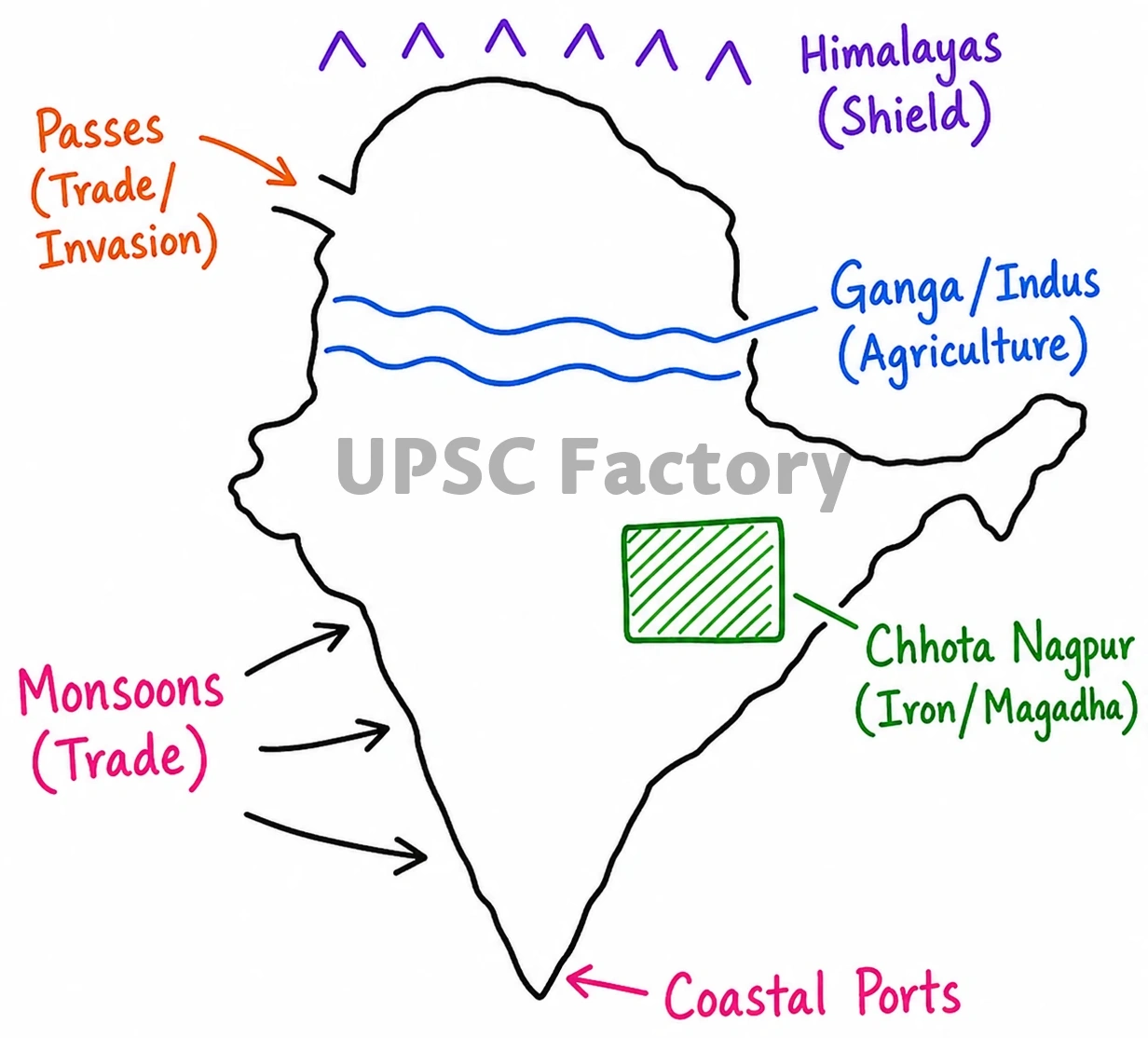
Ancient India’s historical, economic, and cultural trajectory was profoundly shaped by geographical determinism, acting simultaneously as a protective barrier and a facilitator of civilization.
1. Role of Mountains and Terrains
Himalayan Shield: Blocked cold Siberian winds and major northern military invasions, fostering indigenous cultural continuity.
North-Western Passes: Khyber and Bolan passes acted as gateways for trade, migration, and cultural synthesis (Indo-Greeks, Kushanas).
Vindhyan Divide: Geographically segmented the subcontinent, nurturing distinct but interacting Indo-Aryan (North) and Dravidian (South) socio-linguistic traditions.
Mineral Wealth: Proximity to dense forests and Chhota Nagpur iron ore directly catalyzed the political and military dominance of Magadha.
2. Impact of Rivers, Monsoons and Coasts
Riverine Basins: The fertile Indus and Ganga-Yamuna doabs provided agricultural surplus, driving the First and Second urbanizations (Harappa, Mahajanapadas).
Monsoon Dynamics: Understanding seasonal wind patterns (Hippalus’ discovery, 46 AD) revolutionized robust maritime trade with the Roman and Arab worlds.
Peninsular Coastlines: Long coastlines fostered thriving port cities (Lothal, Muziris, Arikamedu) and facilitated naval supremacy and Southeast Asian cultural exports (Cholas).
Thus, India’s diverse physical geography dictated its settlement patterns, trade routes (Uttarapatha/Dakshinapatha), and defense, forging the socio-economic foundation of a highly resilient and syncretic civilization.