Q. Do you think digital technology promotes social empowerment? Explain with examples.
Question from UPSC Mains 2026 GS1 Paper
Model Answer:
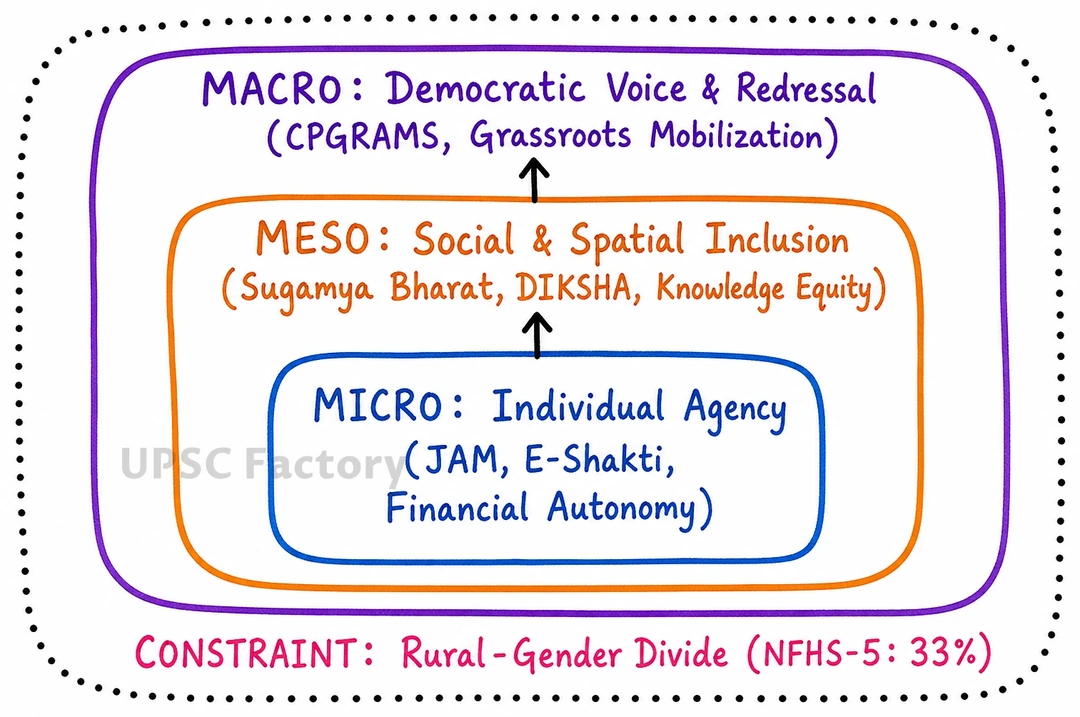
Digital technology acts as a social equalizer, enhancing individual agency and inclusion by eliminating structural information asymmetries (Faheema Shirin case: Internet access under Article 21).
Digital Technology as an Instrument of Empowerment
Disability & Spatial Inclusion: Assistive digital platforms and accessible interfaces break physical and institutional barriers (Sugamya Bharat App, screen-reading tools).
Democratic Voice & Redressal: Decentralized networks facilitate grassroots mobilization and transparent citizen grievance redressal (CPGRAMS, digital civil rights campaigns).
Democratization of Knowledge: Open-source platforms bridge rural-urban educational divides for marginalized youth (DIKSHA, PM e-VIDYA).
Fault Lines Limiting Equitable Empowerment
Gender & Rural Divide: Deep-rooted socio-cultural barriers restrict device ownership and digital literacy (NFHS-5: only 33% rural women accessed internet).
Safety & Online Harassment: Rising cyber-crimes and targeted abuse disproportionately restrict women’s free digital participation (NCRB cybercrime data).
True social empowerment requires bridging the digital divide by pairing universal connectivity (BharatNet) with community-level digital literacy (PMGDISHA).
Q. How do you understand disability? Substantiate the need for inclusive policy framework in India in this regard.
Question from UPSC Mains 2026 GS1 Paper
Model Answer:
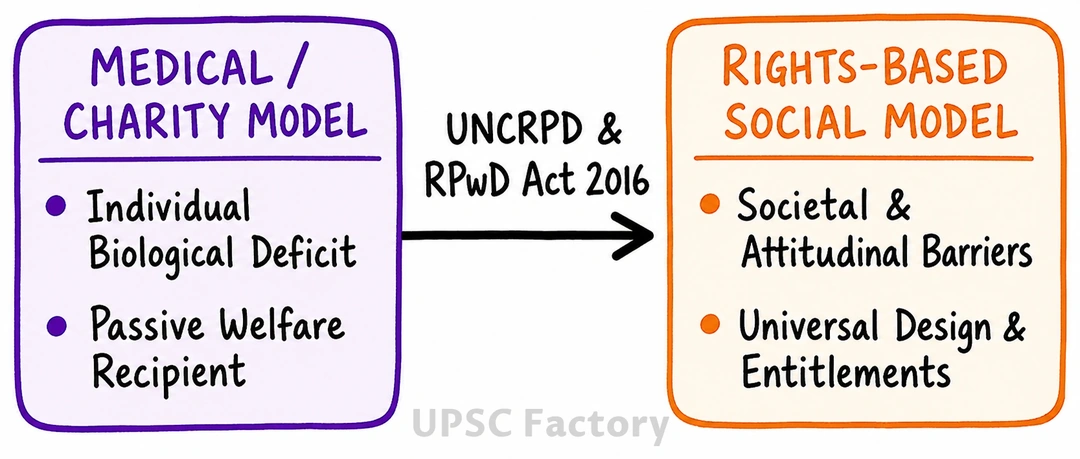
Disability is not merely a biological impairment, but a social construct resulting from the interaction between personal health conditions and environmental, institutional, and attitudinal barriers (UNCRPD, Article 1).
Conceptual Shift: From Medical Deficit to Rights-Based Model
Charity to Rights Approach: Shifts focus from welfare dependency to legally enforceable socio-economic entitlements (RPwD Act, 2016).
Universal Design Paradigm: Treats societal barriers, not individual anatomy, as the core determinant of exclusion.
Imperatives for an Inclusive Policy Framework in India
Demographic Footprint: Over 2.68 crore individuals (Census 2011) face exclusion, compounded by the undercounting of 21 recognized disabilities.
Economic Empowerment: Bridges severe workforce deficits through targeted skilling and accessible workspaces (PM-DAKSH Yojana).
Built & Digital Accessibility: Eliminates structural barriers across public infrastructure and digital portals (Sugamya Bharat Abhiyan).
Intersectional Vulnerabilities: Addresses double marginalization faced by rural persons with disabilities (PwDs) and disabled women regarding education and healthcare.
Constitutional & Global Commitments: Upholds fundamental rights (Articles 14, 21) and advances SDG 10 (Reduced Inequalities).
Mainstreaming universal accessibility transforms persons with disabilities from passive aid beneficiaries into active drivers of nation-building, realizing genuine social justice.
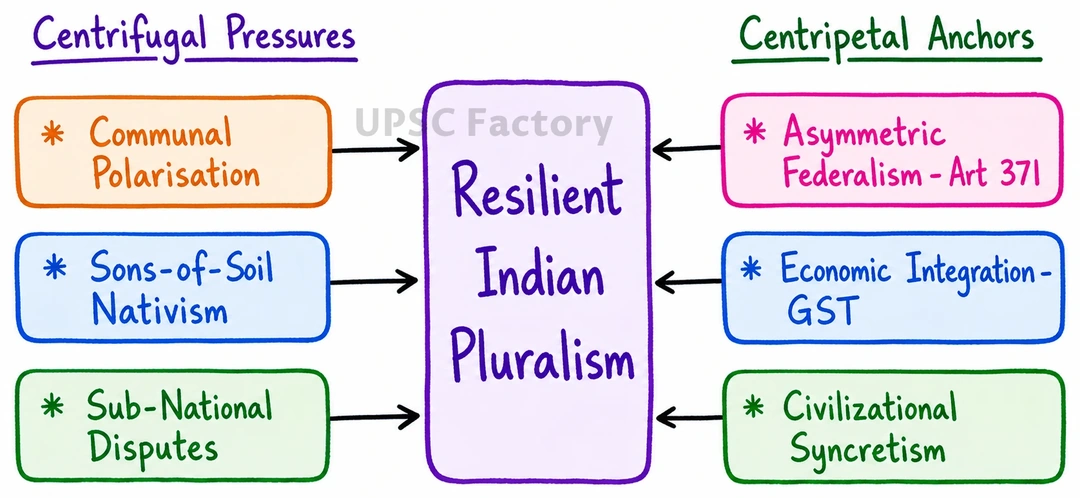
Q. Unity in diversity remains the defining feature of Indian society despite the challenges from communalism and regionalism. Comment.
Question from UPSC Mains 2026 GS1 Paper
Model Answer:
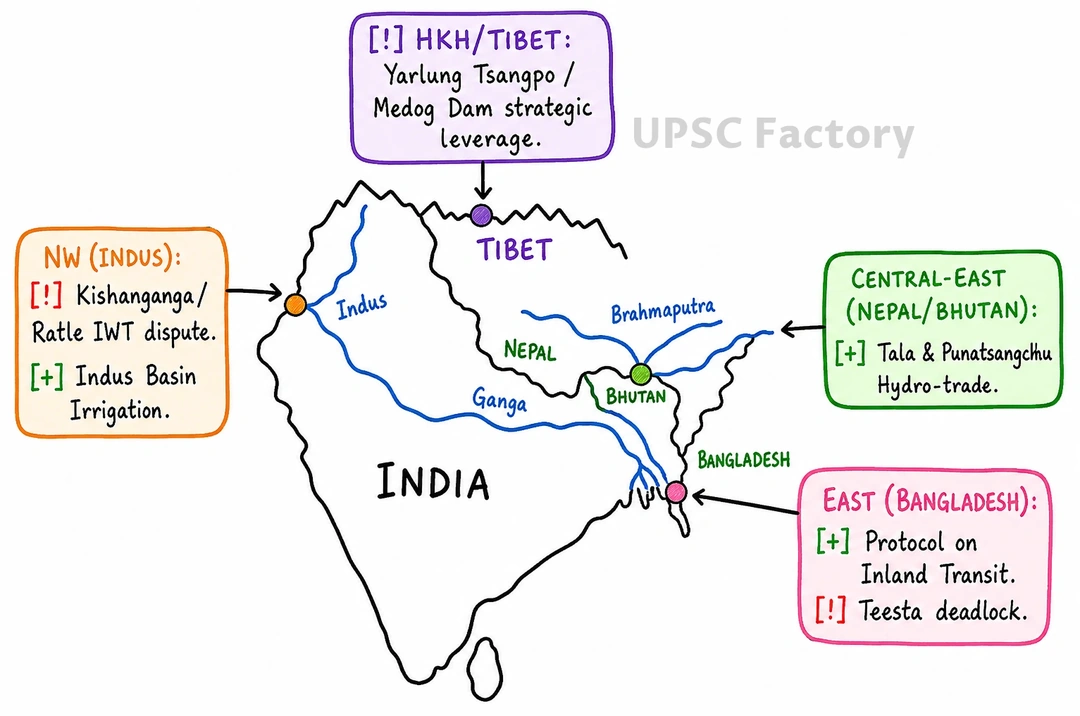
South Asia’s transboundary river systems (Indus, Ganga-Brahmaputra-Meghna) support 1.9 billion people, acting simultaneously as vital drivers of regional economic growth and focal points of geopolitical friction.
Clean Hydro-Energy Integration: Drives clean power generation and bilateral energy trade (e.g., India-Bhutan Tala/Punatsangchhu, India-Nepal hydro agreements).
Transboundary Navigation: Facilitates cost-effective, low-carbon regional transport and trade connectivity (e.g., Indo-Bangladesh Protocol on Inland Water Transit and Trade).
2. Water as a Catalyst for Conflict
Upper-Riparian Control: Unilateral dam construction creates downstream ecological stress and strategic leverage (e.g., Chinese mega-dams on the Yarlung Tsangpo/Brahmaputra).
Apportionment Disputes & Treaty Strains: Structural disputes over water sharing and technical designs challenge bilateral frameworks (e.g., Kishanganga/Ratle impasse under Indus Waters Treaty; Teesta River deadlock).
Climate Stress & Resource Scarcity: Hindu Kush-Himalayan glacial melt and erratic monsoons intensify zero-sum competition over depleting lean-season river flows.
Transitioning from narrow hydro-nationalism to data-transparent, basin-wide multilateral governance is essential for South Asia’s collective ecological and economic security.
Q. “Water resources are both an asset and a source of conflict in South Asia.” Examine this statement giving examples.
Question from UPSC Mains 2026 GS1 Paper
Model Answer:
South Asia’s transboundary river systems (Indus, Ganga-Brahmaputra-Meghna) support 1.9 billion people, acting simultaneously as vital drivers of regional economic growth and focal points of geopolitical friction.
Clean Hydro-Energy Integration: Drives clean power generation and bilateral energy trade (e.g., India-Bhutan Tala/Punatsangchhu, India-Nepal hydro agreements).
Transboundary Navigation: Facilitates cost-effective, low-carbon regional transport and trade connectivity (e.g., Indo-Bangladesh Protocol on Inland Water Transit and Trade).
2. Water as a Catalyst for Conflict
Upper-Riparian Control: Unilateral dam construction creates downstream ecological stress and strategic leverage (e.g., Chinese mega-dams on the Yarlung Tsangpo/Brahmaputra).
Apportionment Disputes & Treaty Strains: Structural disputes over water sharing and technical designs challenge bilateral frameworks (e.g., Kishanganga/Ratle impasse under Indus Waters Treaty; Teesta River deadlock).
Climate Stress & Resource Scarcity: Hindu Kush-Himalayan glacial melt and erratic monsoons intensify zero-sum competition over depleting lean-season river flows.
Transitioning from narrow hydro-nationalism to data-transparent, basin-wide multilateral governance is essential for South Asia’s collective ecological and economic security.
Q. Discuss the role of aeolian processes in desertification and land degradation.
Question from UPSC Mains 2026 GS1 Paper
Model Answer:
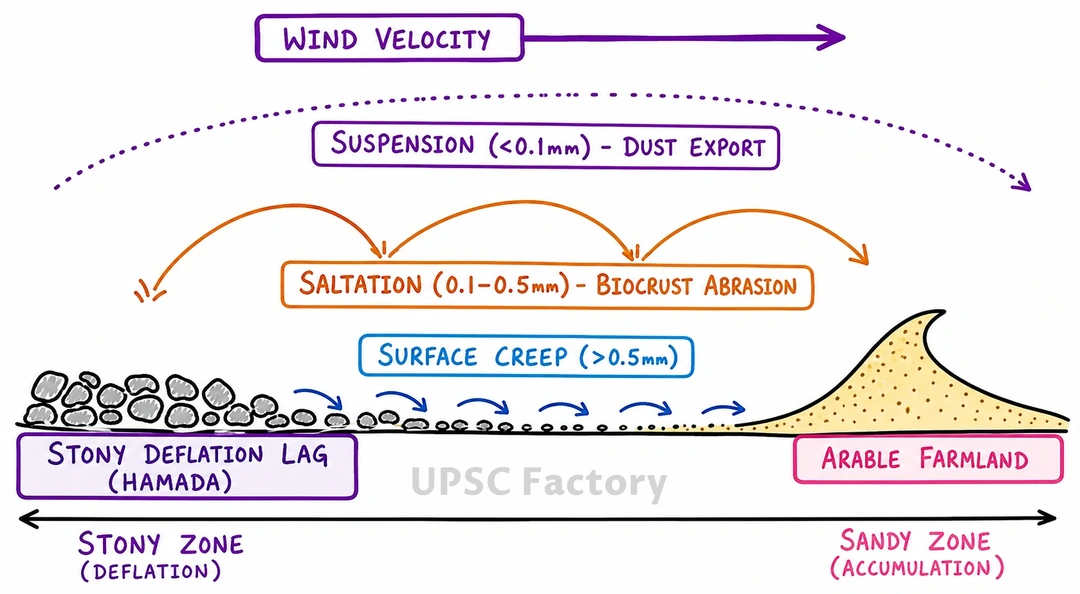
Aeolian processes—encompassing wind erosion, transport, and deposition—are primary geomorphic drivers of land degradation in arid and semi-arid zones, accelerating desertification by stripping productive soil and destabilizing fragile dryland ecosystems.
1. Mechanisms of Aeolian-Induced Degradation
Deflation & Nutrient Depletion: High-velocity winds lift and export light organic matter and fine silt, leaving behind barren, stony desert pavements (e.g., Hamada formation).
Dune Migration & Sand Encroachment: Shifting sand dunes (barchans, seifs) smother fertile agricultural fields, grazing pastures, and water bodies (e.g., Thar Desert fringes in Rajasthan).
Atmospheric Dust Loading: Suspension of fine particles creates severe dust storms, depleting regional hydrological retention and soil moisture (e.g., Bodélé Depression, Sahel).
2. Spatial Mitigation Strategies
Vegetative Buffers: Establishing shelterbelts, windbreaks, and agroforestry to reduce surface wind shear (e.g., Great Green Wall of Africa).
Mechanical Fixation: Constructing straw checkerboard barriers and sand fences to immobilize active dunes (e.g., Kubuqi Desert reclamation).
Institutional Synergy: Enforcing Land Degradation Neutrality targets under UNCCD COP14 (Delhi Declaration) and SDG 15.3.
Mitigating aeolian degradation through vegetative stabilization and integrated dryland management is vital to check desert advance and preserve global arid ecology.
Q. “Tundra regions are ecologically fragile but economically important.” Examine this statement critically.
Question from UPSC Mains 2026 GS1 Paper
Model Answer:
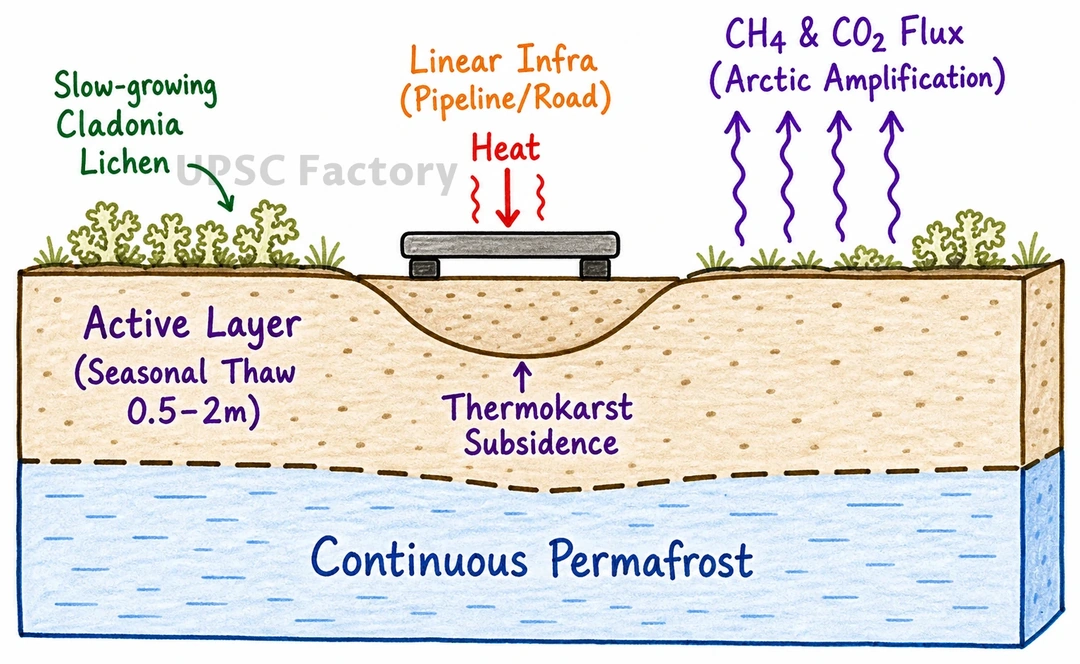
Tundra biomes, defined by continuous permafrost and low thermal energy, present an acute paradox between severe biophysical fragility and escalating global resource exploitation.
1. Drivers of Extreme Ecological Fragility
Cryospheric Sensitivity: Permafrost degradation triggers thermokarst formation, ground subsidence, and methane release under Arctic Amplification.
Slow Biotic Regeneration: Extremely short growing seasons impede vegetation recovery following physical disturbances (e.g., slow-growing Cladonia lichens).
Truncated Food Webs: Low species diversity creates hyper-vulnerable trophic chains susceptible to systemic collapse (e.g., caribou, lemmings).
Nutrient-Poor Pedology: Thin, acidic, waterlogged soils limit soil-microbial buffering capacity against chemical pollutants.
Critical Minerals: High concentrations of nickel, copper, and rare earths (e.g., Norilsk mining) cause extensive acid drainage and heavy metal pollution.
Commercial Navigation: Melting sea ice opens the Northern Sea Route (NSR), reducing shipping distances while increasing black carbon deposition.
Geostrategic Infrastructure: Linear infrastructure (pipelines, roads) fragments migratory corridors and destabilizes permafrost foundations.
Sustainable utilization requires shifting from reckless extraction to conservation, governed by the Arctic Council protocols and indigenous-led ecological co-management frameworks.
Q. What is the Fujiwhara effect? Explain its impact on the movement and intensity of tropical cyclones.
Question from UPSC Mains 2026 GS1 Paper
Model Answer:
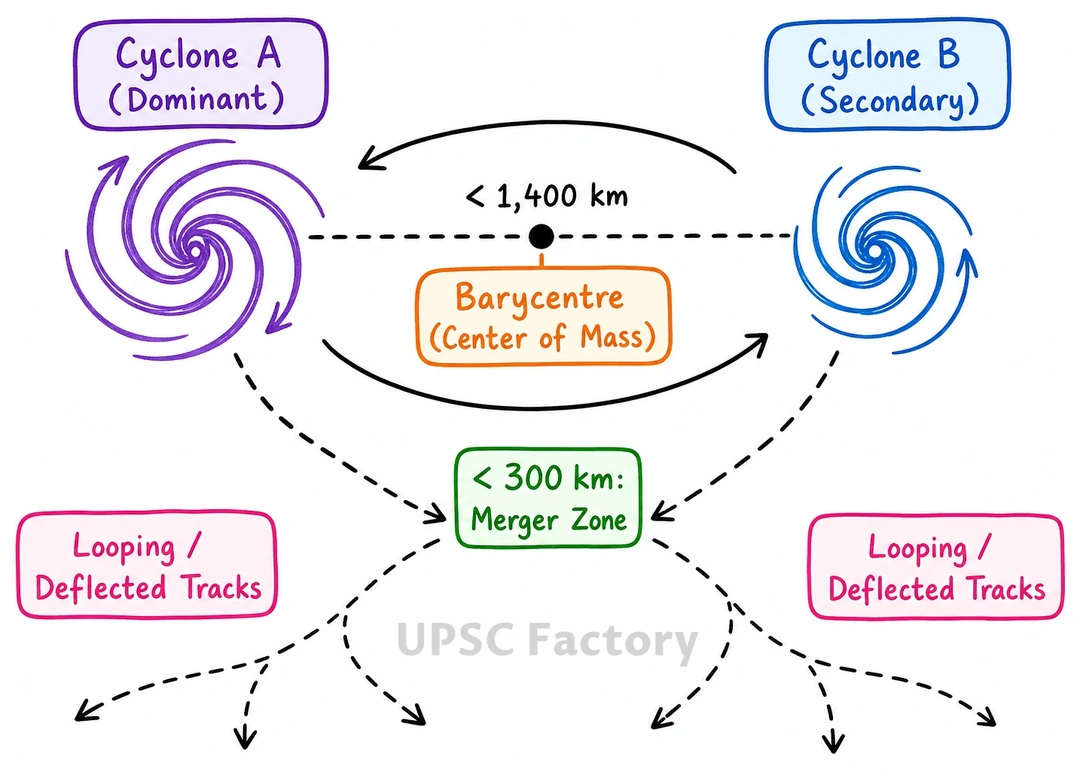
The Fujiwhara effect is a binary atmospheric phenomenon occurring when two tropical cyclones approach within ~1,400 km of each other, interacting dynamically and orbiting around a shared central barycentre.
Impact on Cyclonic Movement (Track Trajectory)
Mutual Barycentric Orbit: Both systems rotate cyclonically around a common mass centre (counter-clockwise in the Northern Hemisphere).
Erratic Track Deflection: Interaction causes sharp track deviations, stalls, and looping paths, complicating landfall predictions (Cyclones Seroja and Odette, 2021).
Cannibalization (Merger): The larger vortex completely absorbs the smaller cyclone if separation reduces to under ~300 km (Typhoons Parma and Melor, 2009).
Impact on Cyclonic Intensity (Strength & Dynamics)
Vertical Wind Shear: Outflow from the dominant storm induces strong shear over the weaker system, decapitating its convective core.
Vorticity & Moisture Transfer: The stronger vortex strips latent heat and angular momentum, leading to rapid weakening of the secondary storm.
Post-Merger Intensification: Merged cores can consolidate into an expanded, high-intensity cyclonic system with a broader gale-force wind radius.
As ocean warming increases the frequency of simultaneous cyclogenesis, modeling Fujiwhara dynamics is critical for precise early warning and coastal disaster mitigation.
Q. The significance of the Gandhian movements lay in the masses they mobilized. Elucidate.
Question from UPSC Mains 2026 GS1 Paper
Model Answer:
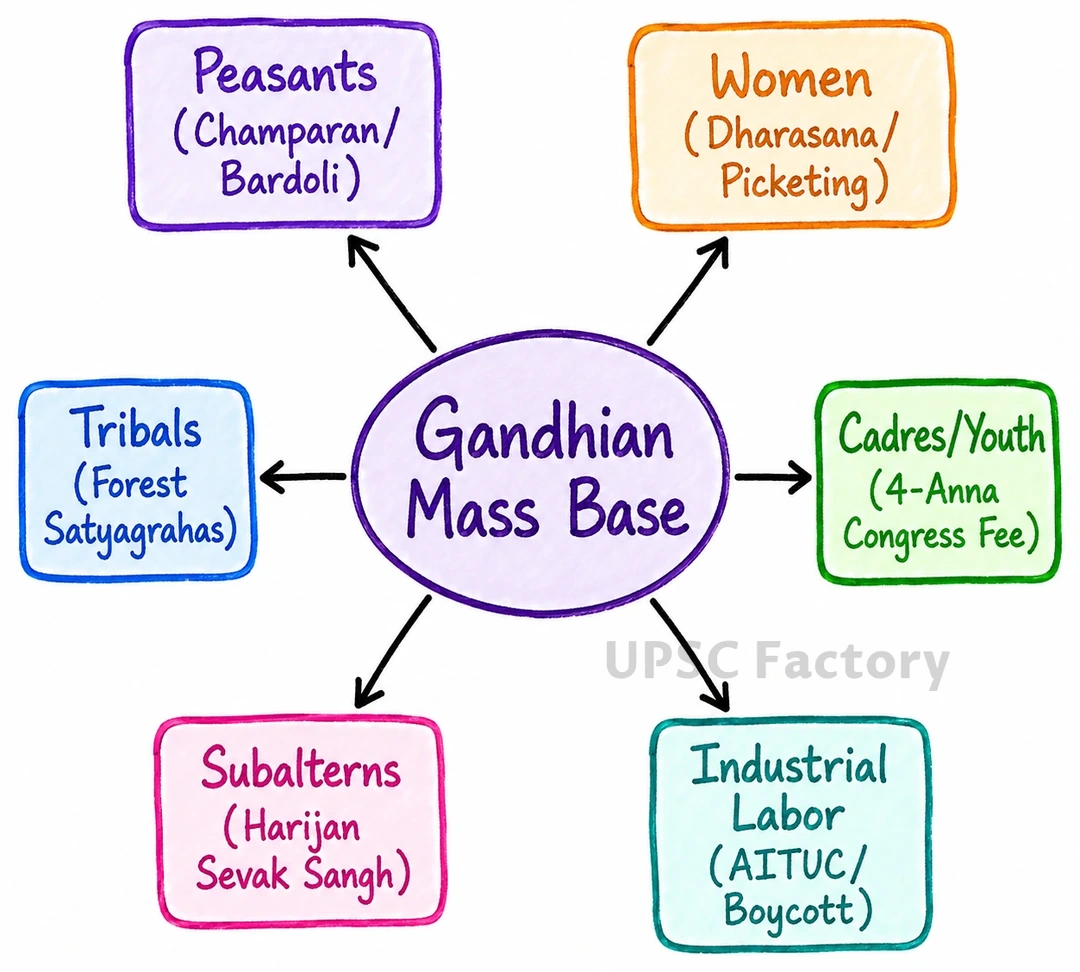
Gandhian movements marked a paradigm shift in the freedom struggle, transitioning Indian nationalism from elite constitutionalism into an all-inclusive, pan-Indian mass movement.
Social Democratization Across Strata
Agrarian Mobilization: Integrated peasant grievances directly into national politics, creating a formidable rural base (e.g., Champaran, Bardoli Satyagraha).
Women’s Agency: Mobilized women from domestic confines into active public defiance through picketing and salt manufacturing (e.g., Dharasana Satyagraha).
Subaltern & Tribal Integration: Activated marginalized sections through constructive social programs and forest satyagrahas (e.g., Tana Bhagat movement, Harijan Sevak Sangh).
Strategic & Anti-Imperial Significance
Institutional Democratization: The 1920 Nagpur Congress reduced membership fees to 4 annas, transforming the party into a mass-cadre organization.
Erosion of Colonial Hegemony: Broad-based non-violent defiance dismantled the moral legitimacy of British rule (Bipan Chandra’s Gramscian counter-hegemony).
Sustained Political Capacity: The Struggle-Truce-Struggle (S-T-S) model utilized non-active phases for mass constructive work, sustaining long-term anti-imperial resistance.
Ultimately, mass mobilization transformed passive subjects into active political agents, rendering British rule structurally, morally, and administratively unsustainable.
Q. Discuss the impact of Macaulay’s Minute on colonial administration and education in India.
Question from UPSC Mains 2026 GS1 Paper
Model Answer:
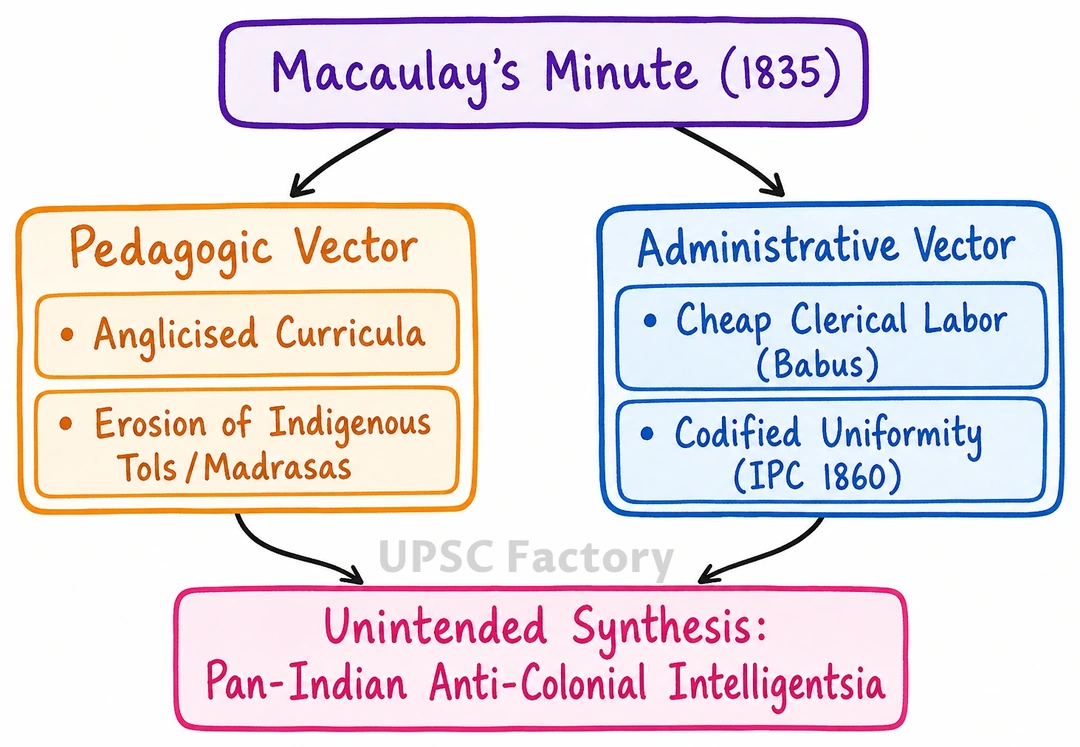
Lord Macaulay’s Minute (1835) resolved the Anglicist-Orientalist debate by enacting the English Education Act, fundamentally reorienting Indian pedagogy and colonial statecraft.
Impact on Education
Anglicisation of Curriculum: Replaced indigenous knowledge systems with Western science and humanities, subordinating traditional institutions (Sanskrit College, Calcutta Madrasa).
Downward Filtration Theory: Concentrated resources on an urban elite, severely starving mass primary and vernacular education of state patronage.
Socio-Linguistic Divide: Created a bifurcated society, privileging an English-speaking intellectual minority over the vast vernacular-educated populace.
Impact on Colonial Administration
Subordinate Bureaucracy: Cultivated a cost-effective, loyal clerical class (“babus”) to staff the expanding lower tiers of the colonial machinery.
Cultural Hegemony: Engineered an intermediary social buffer—“Indian in blood and colour, but English in taste”—to anchor and legitimise British rule.
Administrative Uniformity: Facilitated centralised bureaucratic communication and codified legal administration across diverse provinces (e.g., Indian Penal Code 1860).
Though designed to entrench colonial subordination, Macaulay’s system inadvertently unified educated Indians, providing the linguistic and ideological tools for the modern anti-colonial freedom struggle.
Q. Analyze the importance of Ashokan inscriptions for reconstructing Mauryan history.
Question from UPSC Mains 2026 GS1 Paper
Model Answer:
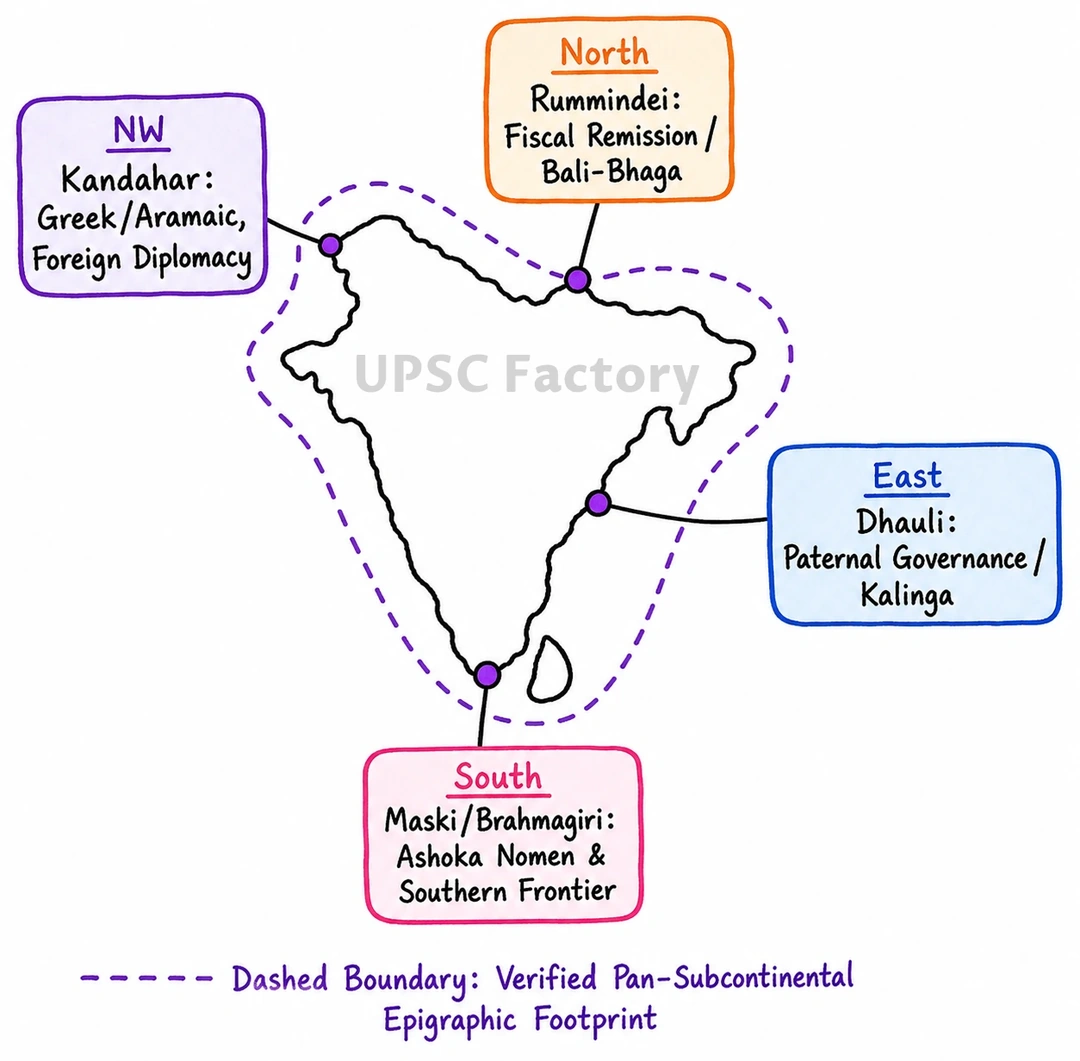
Deciphered by James Prinsep (1837), Ashoka’s edicts—composed in Prakrit, Greek, and Aramaic—provide the earliest authentic epigraphic records for reconstructing the political, fiscal, and ethical matrix of the Mauryan Empire.
Key Historical Dimensions Reconstructed
Geographical Extent & Foreign Relations: Defines imperial frontiers (Kandahar to Karnataka) and external Hellenistic diplomacy with rulers like Antiochus II (Major Rock Edict XIII).
Administrative Hierarchy: Documents administrative tiers (Yuktas, Rajjukas) and specialized welfare cadres (Dhamma-mahamattas) enforcing administrative equity (Major Rock Edict III & V).
Fiscal Architecture: Provides concrete evidence of agrarian tax structures and royal remissions (Rummindei Pillar: Bali exempted, Bhaga reduced to 1/8th).
Ideology & Governance: Articulates a paternalistic state model (“All men are my children”) and non-sectarian ethical code of Dhamma(Separate Kalinga Edicts).
Historiographical Limitations
Normative Idealism: Portrays top-down imperial self-representation and moral aspirations rather than ground-level administrative realities.
Contextual Voids: Omits operational details on urban guild systems, military logistics, and ordinary social stratifications, requiring literary corroboration (Arthashastra, Megasthenes’ Indica).
Despite imperial subjectivity, Ashokan epigraphs remain the primary empirical anchor that transitions Mauryan historiography from textual tradition into verifiable chronological history.