UPSC Mains 2026 GS1 Model Answer

Q. Evaluate the impact of globalization on Indian youths with reference to social, political, economic and cultural spheres.

Q. Evaluate the impact of globalization on Indian youths with reference to social, political, economic and cultural spheres.

Question from UPSC Mains 2026 GS1 Paper

Model Answer: 

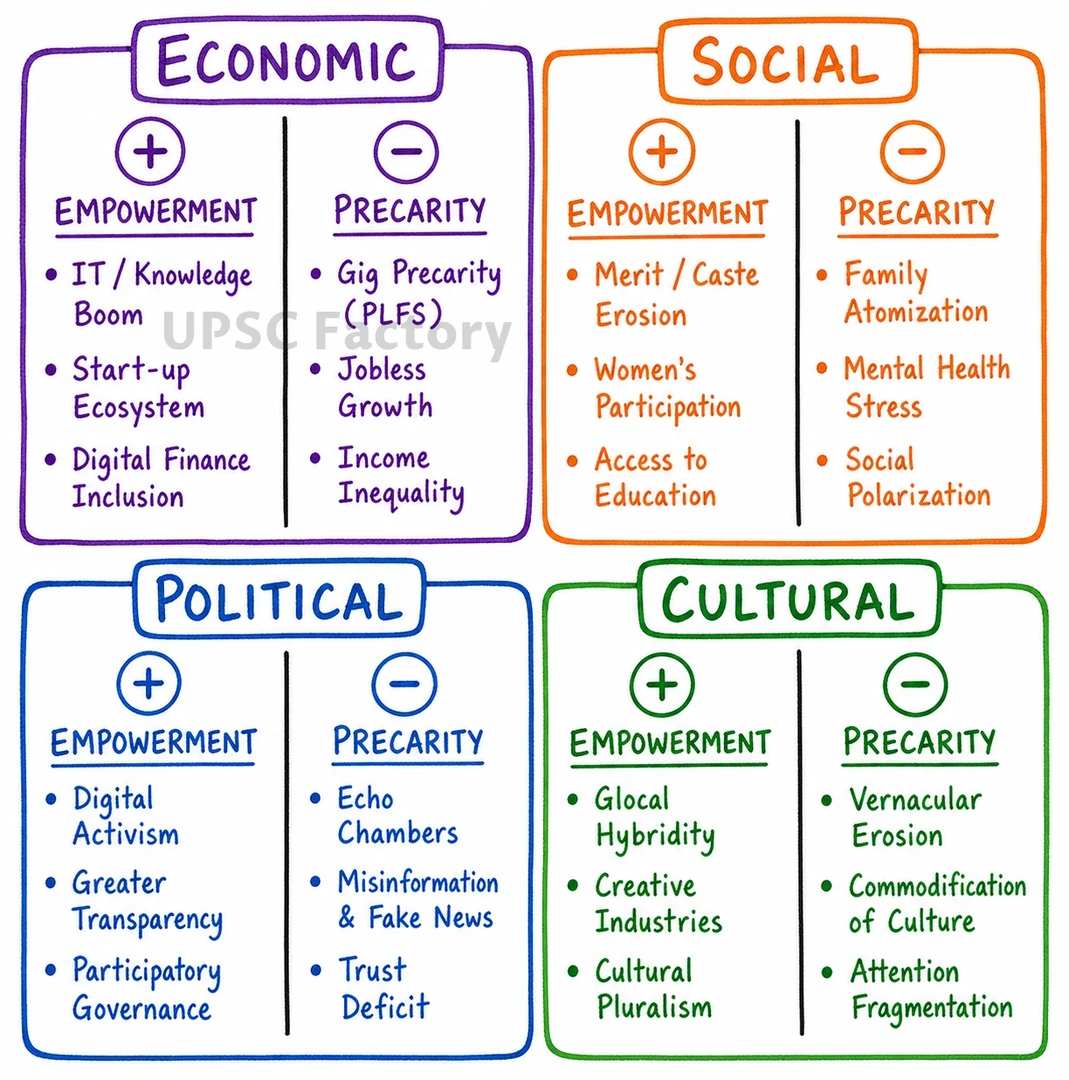
Globalization has restructured India’s 370-million-strong youth demographic, serving as a powerful catalyst for modernization while simultaneously introducing socio-economic precarity and cultural ambivalence.

Progressive Empowerment Across Spheres

  • Social Mobility: Weakens traditional caste-gender orthodoxies through meritocratic urban workspaces and cosmopolitan networks (Draft National Youth Policy).
  • Economic Avenues: Expands employment via the IT/services boom, knowledge economy, and borderless remote work (NASSCOM talent indices).
  • Political Consciousness: Fosters decentralized digital activism, human rights awareness, and climate consciousness (e.g., #FridaysForFuture campaigns).
  • Cultural Glocalization: Facilitates creative hybridity, blending global pop-culture with indigenous art forms to project soft power (e.g., Coke Studio, Indian indie-music).
Disruptions and Structural Vulnerabilities

  • Economic Precarity: Proliferates gig-economy informality, underemployment, and an unprotected youth “precariat” lacking social security (PLFS data).
  • Social Atomization: Induces hyper-individualism, erosion of joint-family safety nets, and escalating youth mental health crises (CSDS-KAS Youth Survey).
  • Political Polarization: Algorithms create ideological echo chambers, radicalizing youth and promoting post-truth polarization over nuanced civic engagement.
  • Cultural Disorientation: Accelerates westernized consumerism and linguistic erosion of vernaculars, fostering identity crises and cultural alienation.
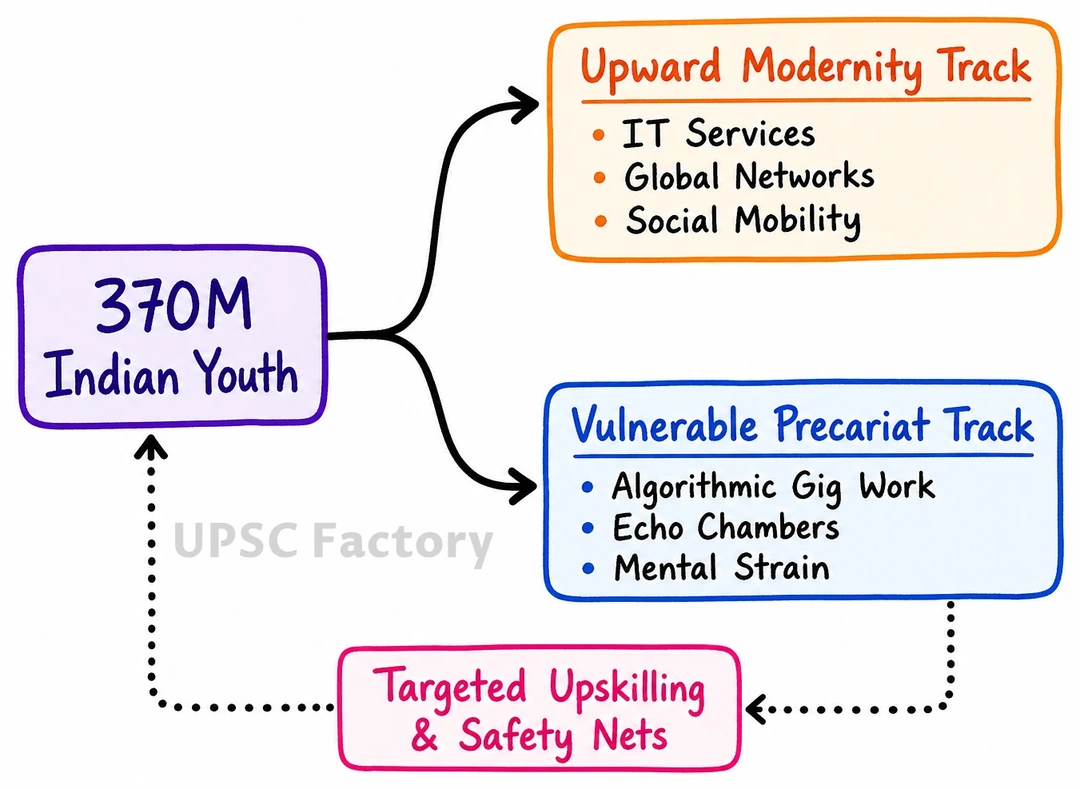

Maximizing the demographic dividend requires targeted upskilling, robust gig-worker safety nets, and value-based education to synthesize global competitiveness with indigenous social cohesion.
Q. Evaluate the impact of globalization on Indian youths with reference to social, political, economic and cultural spheres. Read More »

Q. Is caste disappearing in urban India? Illustrate your answer with examples.

Q. Is caste disappearing in urban India? Illustrate your answer with examples.

Question from UPSC Mains 2026 GS1 Paper

Model Answer: 

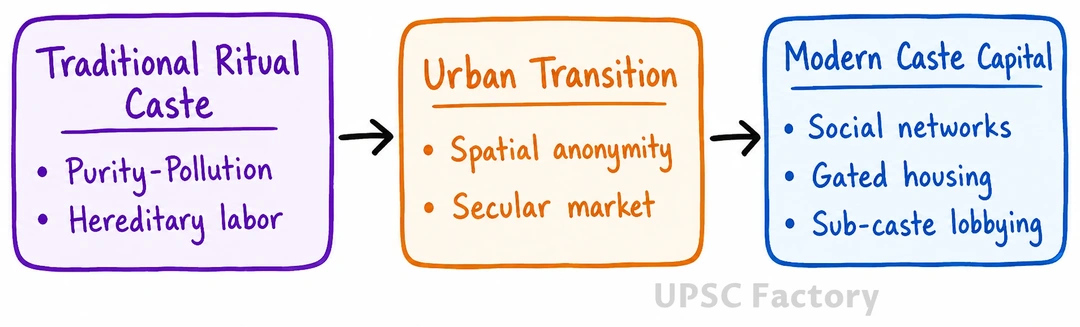
Urbanization has weakened traditional ritual purity-pollution hierarchies, yet caste has not disappeared; rather, it has adapted into modern structural networks of social, economic, and political capital.

1. Facets of Caste Dilution in Urban Spaces

  • Occupational Secularization: Market forces and service economies prioritize skills over hereditary occupations (e.g., IT, retail, gig economy).
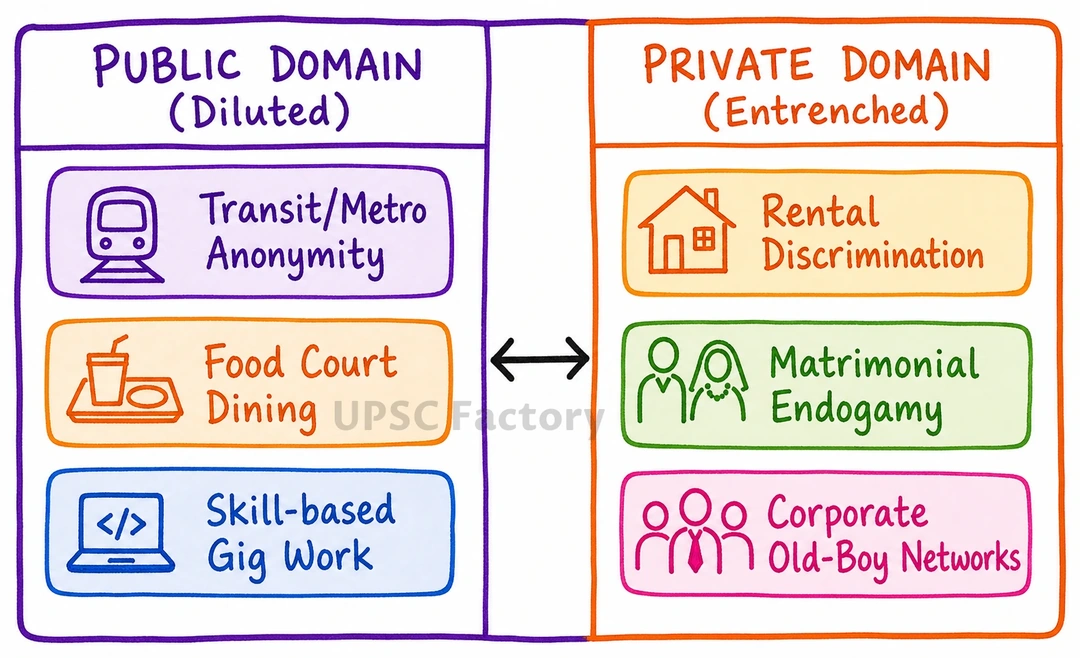
  • Spatial Anonymity: Shared public infrastructure, dining, and transit erode ritual distance and untouchability (e.g., Metro networks, food courts).
  • Legal and Civic Assertiveness: Urban literacy and access to judicial machinery empower marginalized groups against overt discrimination (Articles 15 and 17).
  • Emergence of Class Stratification: Modern consumerism and professional identities partially cross-cut traditional ritual status.

2. Mutations and Resilience of Caste

  • Spatial Segregation: Urban rental markets and gated communities practice covert exclusion based on caste and dietary habits (e.g., Thorat’s housing discrimination audit).
  • Digitalized Endogamy: Matrimonial algorithms and community platforms modernize sub-caste exclusivity (e.g., IHDS data showing ~5% inter-caste marriages).
  • Corporate “Caste Capital”: Informal caste networks dominate private sector hiring and boardrooms lacking affirmative action (Satish Deshpande’s study on meritocracy).
  • Ghettoization of Sanitation Labor: Manual scavenging and municipal sanitation work remain strictly caste-coded (e.g., 90%+ Safai Karamcharis from Dalit sub-castes).
  • Urban Community Mobilization: Caste associations and community bhavans serve as urban networks for political lobbying and resource pooling.

Caste in urban India has evolved from an overt ritual hierarchy to an invisible, institutionalized social network, requiring comprehensive anti-discrimination housing laws and economic democratization to overcome.

Q. Is caste disappearing in urban India? Illustrate your answer with examples. Read More »

Q. Critically examine the challenges of demographic transition in contemporary India.

Q. Critically examine the challenges of demographic transition in contemporary India.

Question from UPSC Mains 2026 GS1 Paper

Model Answer: 

India’s demographic transition has reached a below-replacement Total Fertility Rate (TFR) of 2.0 (NFHS-5), opening a narrow demographic dividend window amid complex structural socio-economic vulnerabilities.

1. Structural Challenges of Demographic Transition

  • Youth Underemployment & Skill Deficit: Only ~5% of the workforce is formally skilled, creating a mismatch between economic growth and job creation (PLFS 2023).
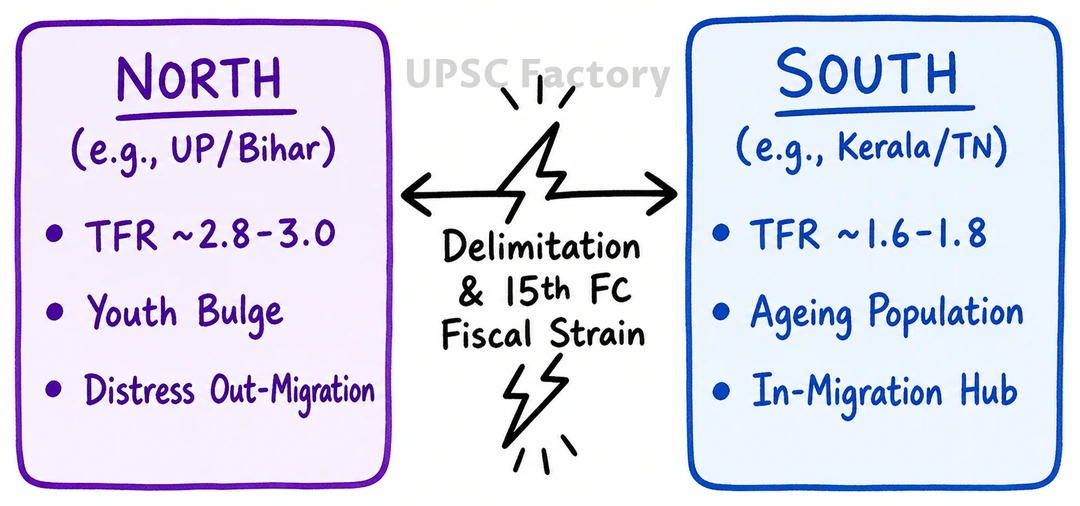
  • Regional Demographic Divergence: Stark fertility divides between the youth-heavy North (Bihar TFR 2.98) and rapidly ageing South (Kerala TFR 1.8) strain federal fiscal transfers and upcoming political delimitation.

  • Accelerating Geriatric Dependency: The elderly cohort will constitute ~15% of the population by 2036, stressing non-inclusive public healthcare systems (Longitudinal Ageing Study in India).
  • Depressed Female Labour Force Participation (FLFPR): Subdued female formal employment (~37%) limits potential GDP gains and entrenches gender inequality (World Bank).
  • Informality and Social Insecurity: Over 80% of employment remains informal (e-Shram data), leaving transitioning workers without pensions or social safety nets.
  • Unplanned Urbanization: Rural-to-urban distress migration overwhelms civic infrastructure, breeding urban poverty traps and informal settlements.

2. Strategic Imperatives

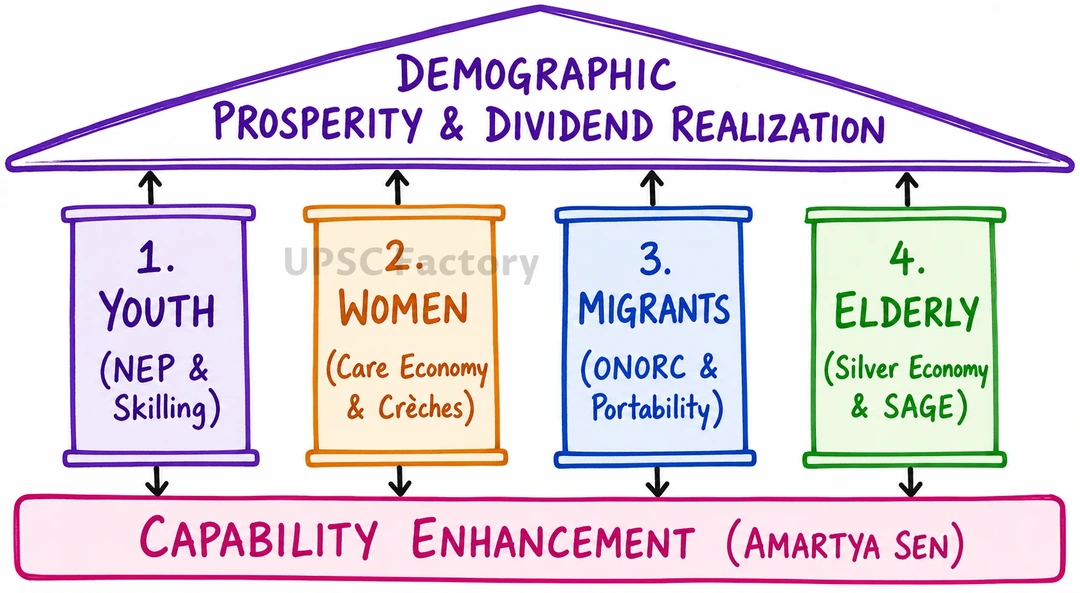
  1. Human Capital Optimization: Modernize technical education and scale industry-aligned apprenticeships (NEP 2020, Skill India Mission).
  2. Promoting the Silver Economy: Develop specialized geriatric healthcare and elder-care ecosystems (SAGE Portal, Atal Vayo Abhyuday Yojana).
  3. Gender-Inclusive Labour Frameworks: Incentivize workplace crèches, formalize care work, and ensure equal wages to unlock female labour reserves.
  4. Inter-State Coordination: Create a national migration architecture with portable social security (One Nation One Ration Card).


Transforming demographic transition into sustained economic prosperity requires shifting policy focus from numerical population control to qualitative human capability enhancement.

Q. Critically examine the challenges of demographic transition in contemporary India. Read More »

Q. Analyze the major drivers of human-induced land-use changes in India and their geographical consequences.

Q. Analyze the major drivers of human-induced land-use changes in India and their geographical consequences.

Question from UPSC Mains 2026 GS1 Paper

Model Answer: 

Anthropogenic Land-Use and Land-Cover (LULC) changes, driven by India’s demographic and economic expansion, have drastically altered physical landscapes, with ISRO’s Desertification Atlas recording 29.7% of India’s Total Geographical Area (TGA) under degradation.

Major Drivers of Human-Induced Land-Use Changes

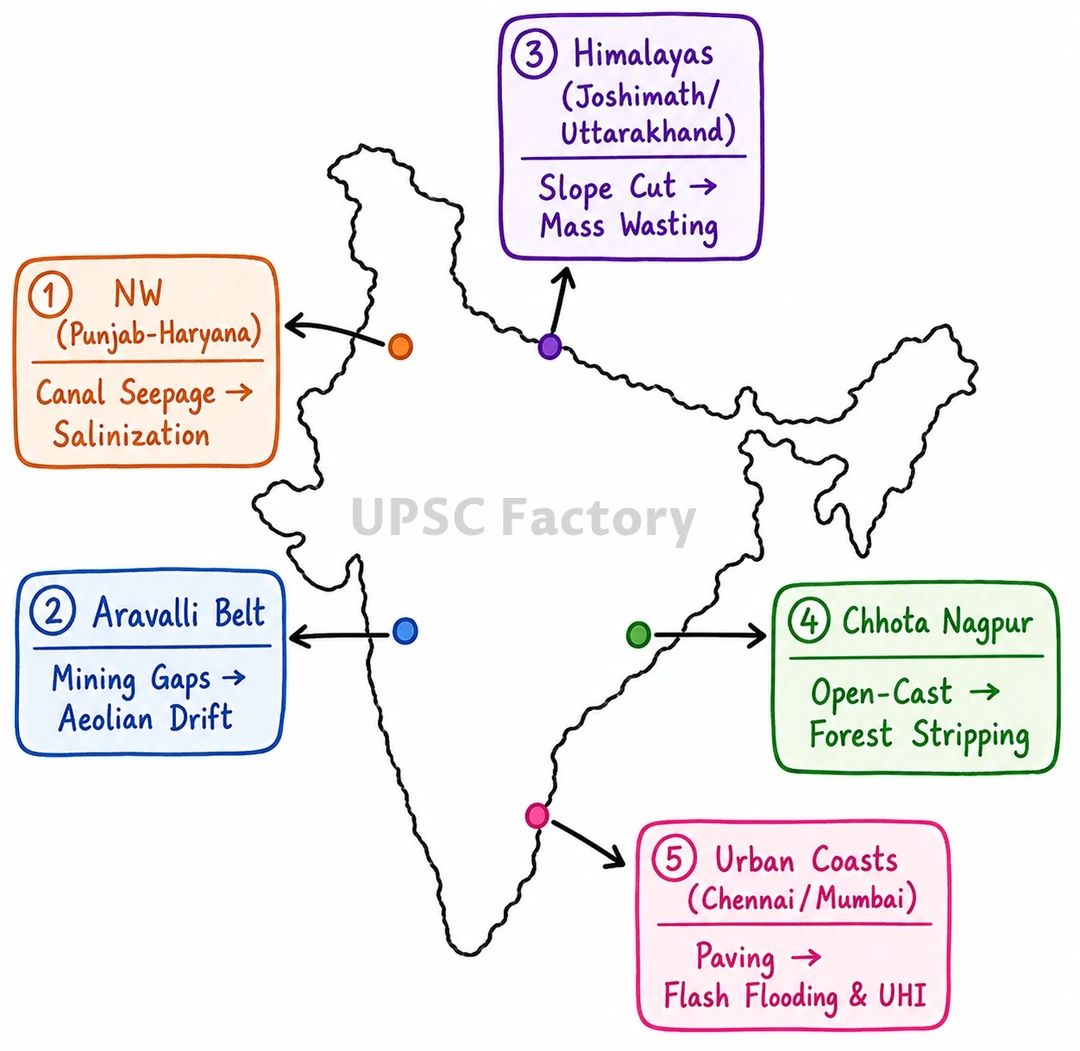
  1. Agricultural Intensification & Encroachment: Conversion of virgin forests and common grasslands into intensive monocultures (e.g., Terai belt clearing; shorten fallow cycles in Jhum areas).
  2. Unplanned Peri-Urban Sprawl: Unregulated conversion of fertile agricultural tracts and natural wetlands into built-up zones (e.g., East Kolkata Wetlands, Bengaluru lake beds).
  3. Linear Infrastructure & Hydro-Projects: Heavy engineering, tunneling, and slope-cutting through ecologically fragile biomes (e.g., Char Dham Highway in the Himalayas).
  4. Extractive Mining & Quarrying: Large-scale open-cast operations stripping overburden and forest canopies (e.g., Chhota Nagpur plateau; illegal sand and stone mining in Aravallis).

Geographical Consequences

  1. Geomorphological Instability: Slope destabilization and accelerated mass wasting, triggering devastating debris flows and subsidence (e.g., Joshimath sinking; 2024 Wayanad landslides).
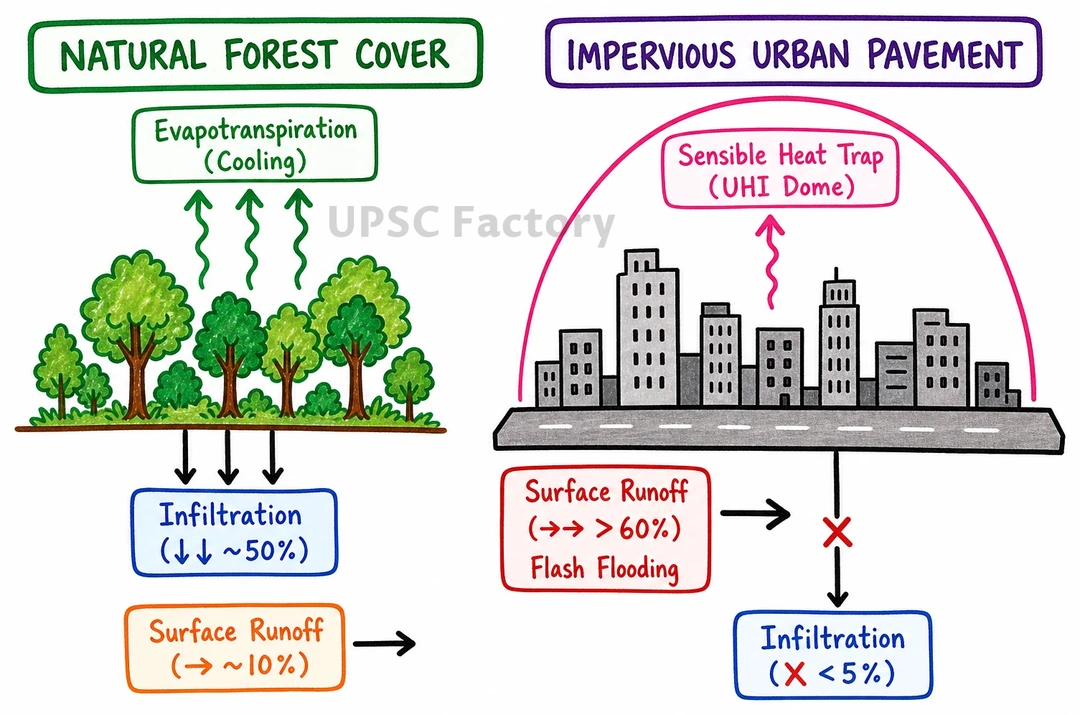
  2. Hydrological Regime Disruption: Surface impermeabilization reduces groundwater recharge, increases surface runoff, and triggers recurring urban flash floods (e.g., Chennai and Mumbai floods).
  3. Micro-Climatic Shifts: Replacement of vegetation with concrete lowers surface albedo and increases sensible heat flux, intensifying the Urban Heat Island (UHI) effect (e.g., Delhi-NCR).

  1. Pedological Deterioration: Extensive canal irrigation and deforestation induce severe soil salinization, waterlogging, and soil organic carbon depletion (e.g., Green Revolution belt of Punjab-Haryana).
  2. Desertification & Aeolian Drift: Mining-induced gaps in the Aravalli range act as conduits for windward sand transport, accelerating Thar desertification eastward.

Achieving Land Degradation Neutrality (SDG 15.3) necessitates integrated spatial planning, stringent eco-sensitive zoning, and catchment-level ecological restoration to meet India’s target of restoring 26 million hectares by 2030.


Q. Analyze the major drivers of human-induced land-use changes in India and their geographical consequences. Read More »

Q. “The centre of global trade is gradually shifting from the Atlantic region to the Indo-Pacific region.” Examine this statement.

Q. “The centre of global trade is gradually shifting from the Atlantic region to the Indo-Pacific region.” Examine this statement.

Question from UPSC Mains 2026 GS1 Paper

Model Answer: 

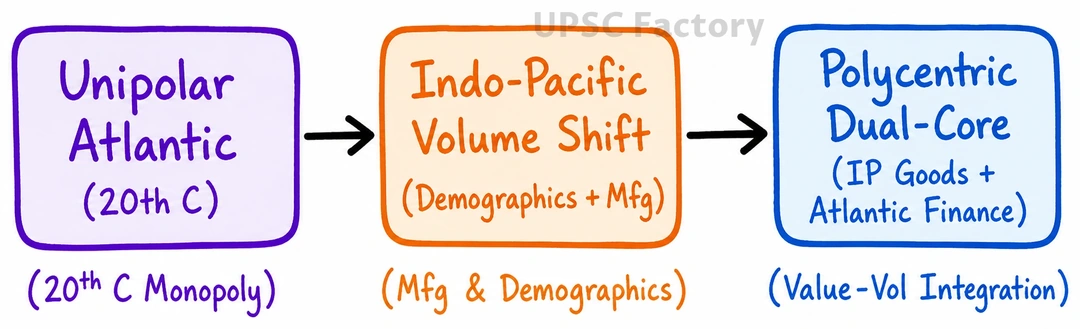
Global economic geography is experiencing a structural pivot as the historical Transatlantic trade axis yields volume and growth primacy to the Indo-Pacific maritime realm.

1. Spatial Drivers of the Indo-Pacific Trade Pivot

  1. Shift in Demographic Gravity: Rapid urbanisation and expanding middle-class consumption in Developing Asia drive global import demand (India, ASEAN).
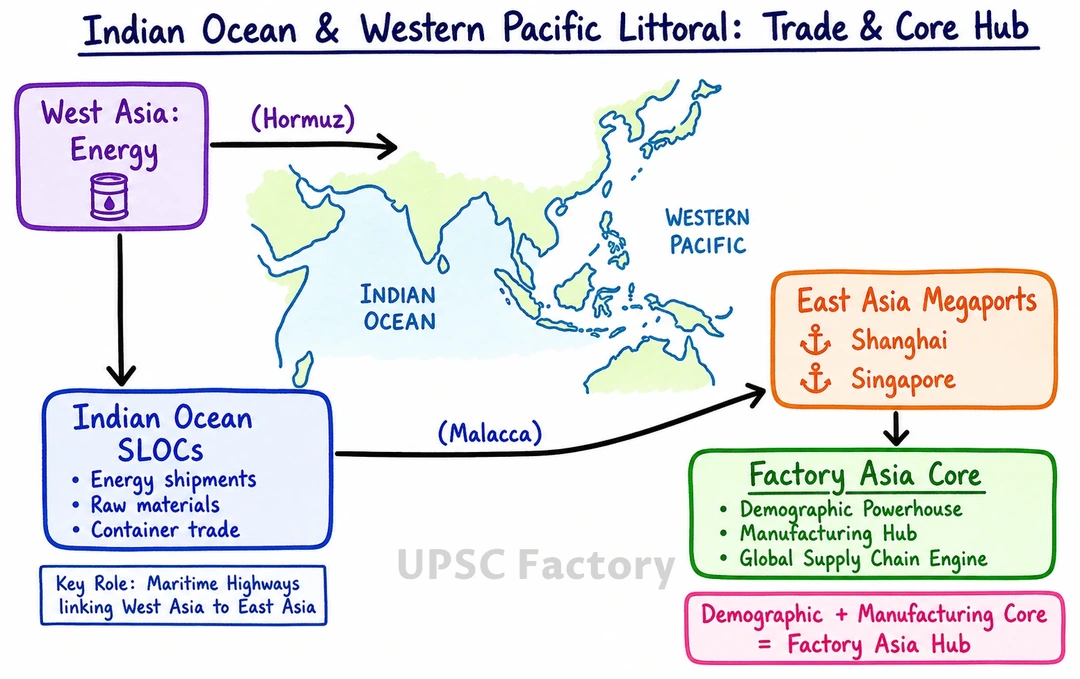
  2. Manufacturing & Value-Chain Clustering: “Factory Asia” benefits from intermediate-goods trade and mega-regional trade agreements (RCEP, CPTPP).
  3. Maritime Freight Dominance: The region hosts over 60% of global maritime trade and 9 of the world’s 10 busiest container ports (Shanghai, Singapore, Ningbo-Zhoushan — UNCTAD).
  4. Energy Sea Lines of Communication (SLOCs): Primary hydrocarbon transit routes connect West Asian suppliers to East Asian industrial nodes (Straits of Hormuz and Malacca).
  5. Infrastructure Connectivity: Outward infrastructure expansion integrates Eurasian and littoral hinterlands (Belt and Road Initiative, IMEC, SAGAR).

2. Bottlenecks and Enduring Atlantic Primacy

  1. Maritime Chokepoint Vulnerability: Extreme geographical concentration creates acute systemic exposure to regional militarisation and territorial friction (Taiwan Strait, South China Sea).
  2. High-Value Trade & Innovation Hegemony: The Transatlantic axis retains structural dominance in high-tech, services trade, intellectual property, and advanced capital goods (US–EU bilateral trade).
  3. Institutional and Financial Architecture: Western institutions govern global trade settlement, maritime insurance (Lloyd’s Register), and trade norms (EU CBAM).
  4. Nearshoring and Friendshoring: Geopolitical de-risking redirects critical supply chains toward Atlantic-proximate trade blocs (USMCA, Western Hemisphere nearshoring).

While Indo-Pacific dominance in physical goods volume is undisputed, global geoeconomics remains polycentric—anchored by Asian manufacturing density and Atlantic financial, regulatory, and technological control.

Q. “The centre of global trade is gradually shifting from the Atlantic region to the Indo-Pacific region.” Examine this statement. Read More »

Q. Analyze the role of satellite-based technologies in achieving climate-smart agriculture and food security in India.

Q. Analyze the role of satellite-based technologies in achieving climate-smart agriculture and food security in India.

Question from UPSC Mains 2026 GS1 Paper

Model Answer: 

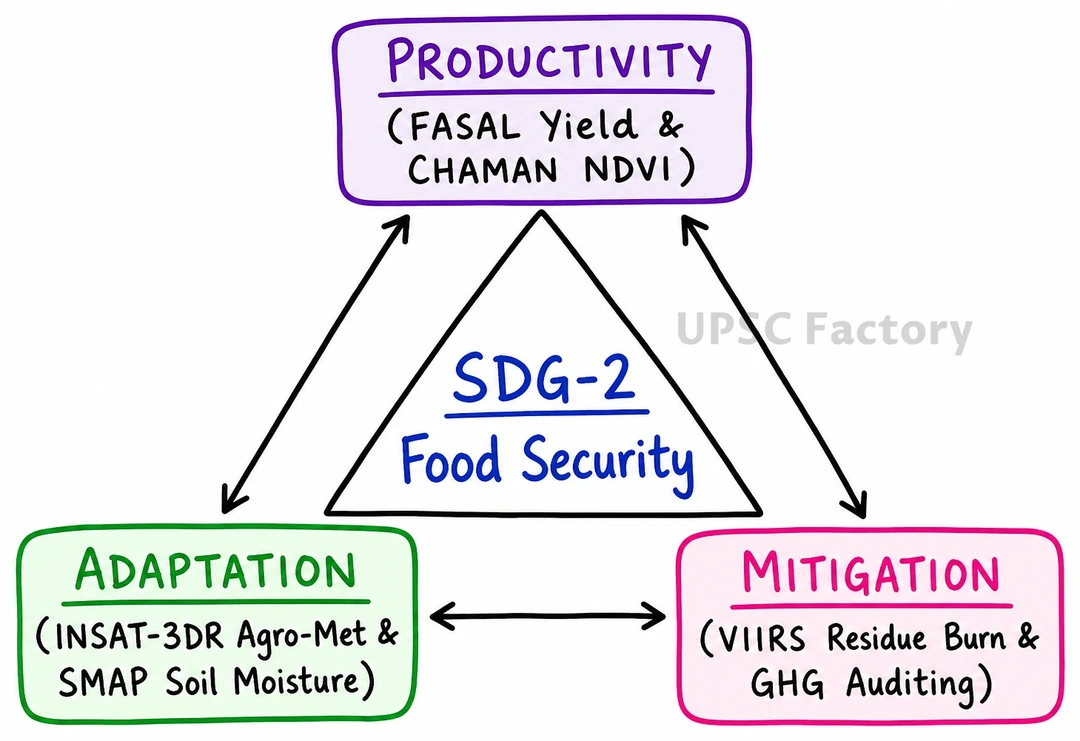
Satellite-based Earth Observation (EO) operationalizes the three pillars of Climate-Smart Agriculture (CSA)—productivity, adaptation, and mitigation—anchoring India’s national food and nutritional security amid intensifying climate risks.

Enabling Climate-Smart Agriculture (CSA)

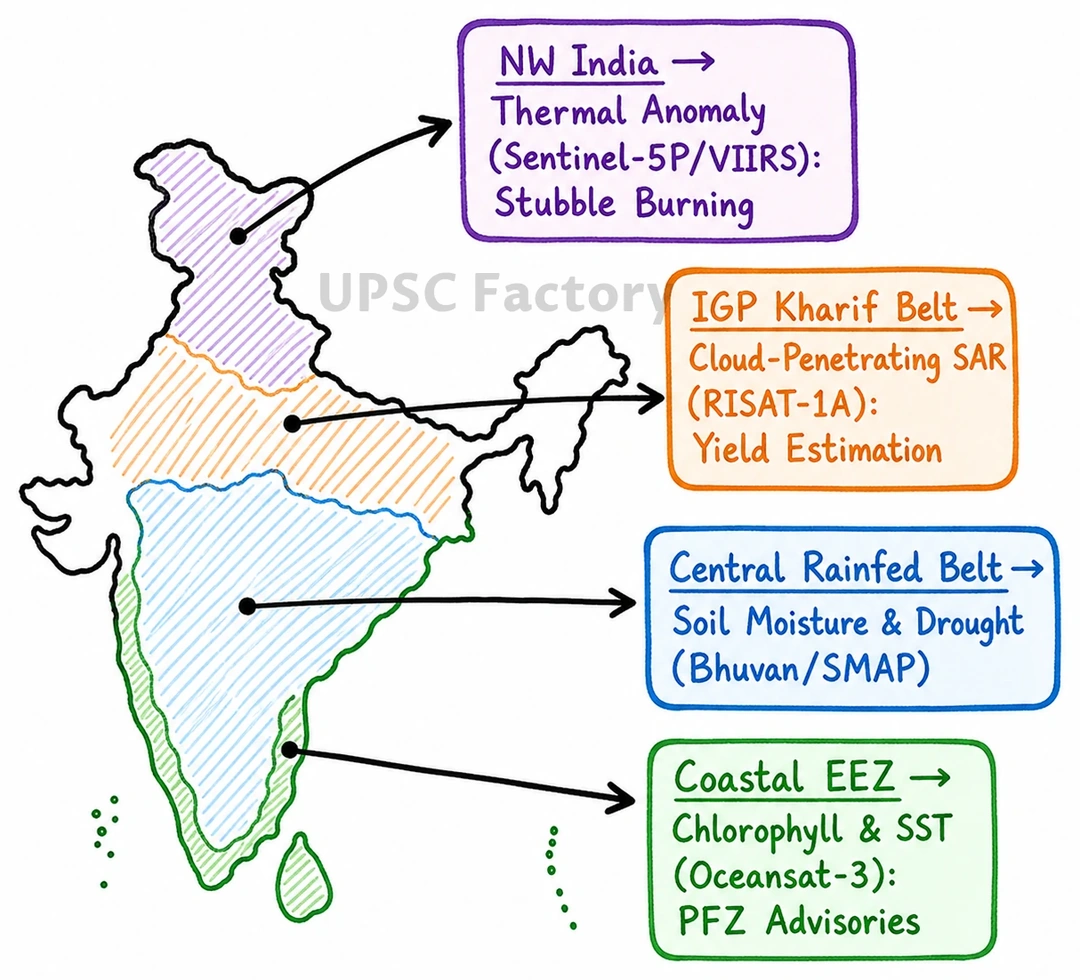
  • Precision Water Management: Estimates evapotranspiration and root-zone soil moisture, driving micro-irrigation efficiency (NISAR, SMAP data).
  • Agro-Meteorological Adaptation: Provides weather indexation and real-time drought surveillance for dynamic crop advisories (Bhuvan-Drought, INSAT-3DR).
  • Mitigation & Residue Tracking: Monitors active crop-residue burning and greenhouse gas emissions via thermal anomalies (Sentinel-5P, S-NPP VIIRS).
  • Crop Phenology & Zonation: Delineates suitable agro-climatic zones and monitors horticultural canopy health (CHAMAN Project, NDVI mapping).

Bolstering Food Security & Policy Delivery

  • Yield & Supply Forecasting: Generates pre-harvest national crop production estimates to stabilize buffer stocking and PDS supply chains (FASAL Project, MNCFC).
  • Objective Risk Settlement: Eliminates disputed manual crop-cutting experiments through satellite-driven yield estimation (PMFBY YES-TECH, WINDS portal).
  • Nutritional Marine Security: Maps chlorophyll concentration and sea surface temperature to delineate Potential Fishing Zones (INCOIS Oceansat-3).
  • Addressing Structural Bottlenecks: Overcomes plot fragmentation challenges through high-resolution Synthetic Aperture Radar for cloud-penetrating Kharif surveillance (RISAT-1A).

Integrating satellite tele-sensing with village-level artificial intelligence will de-risk smallholder farming, ensuring systemic climate resilience and sustainable zero hunger (SDG 2).

Q. Analyze the role of satellite-based technologies in achieving climate-smart agriculture and food security in India. Read More »

Q. Compare the Loo, Chinook and Foehn winds with respect to their regions of prevalence, their nature and climatic impacts.

Q. Compare the Loo, Chinook and Foehn winds with respect to their regions of prevalence, their nature and climatic impacts.

Question from UPSC Mains 2026 GS1 Paper

Model Answer: 

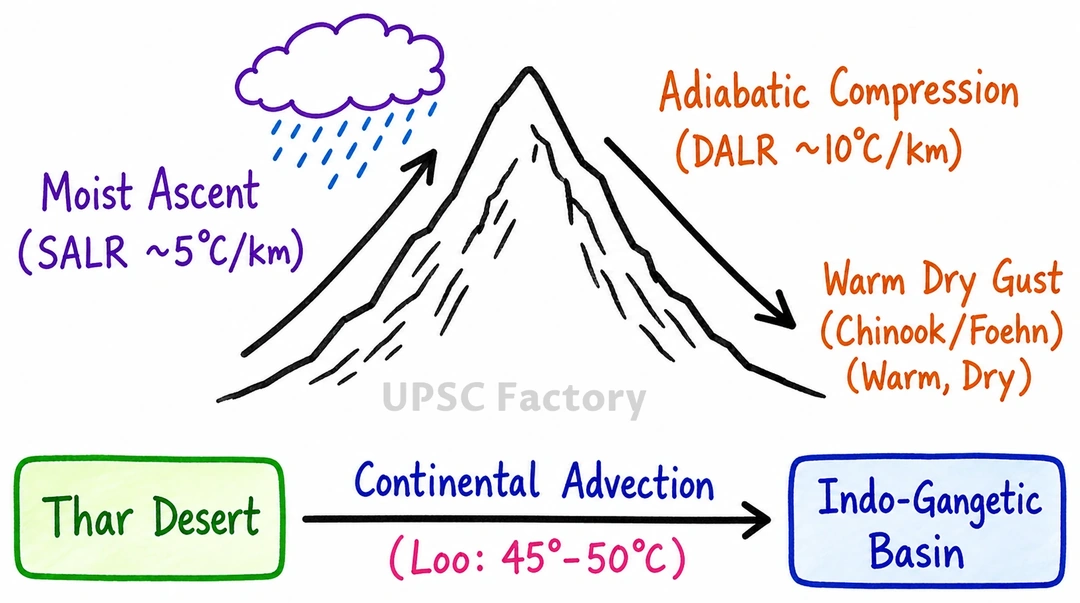
Local winds are mesoscale atmospheric circulations driven by regional topography and pressure gradients, differing distinctly in their thermodynamic genesis, geographical domains, and ecological consequences.

Comparative Matrix: Regional Prevalence and Physical Nature

ParameterLooChinook (“Snow Eater”)Foehn
Geographic DomainIndo-Gangetic Plains (Northern India and Pakistan).Eastern leeward slopes of the Rocky Mountains (USA, Canada).Northern leeward valleys of the European Alps (Switzerland, Austria).
Thermodynamic GenesisContinental advective heating from the Thar Desert during summer.Adiabatic compression (DALR: ~10°C/km) down the leeward slope.Adiabatic warming post-orographic condensation and latent heat release.
Thermal & Moisture ProfileScorching (45°C–50°C), extremely dry, and dust-laden (May–June).Warm, dry, gusty; causes rapid winter temperature surges (Δ 15°C–20°C).Warm, dry, and turbulent; prevalent in autumn and spring.

Divergent Climatic and Socio-Economic Impacts

  • Agro-Pastoral Dynamics:
    • Chinook: Melts rangeland snowpack, keeping Canadian/US Prairies open for winter livestock grazing.
    • Foehn: Accelerates grape ripening and viticulture on Alpine valley terraces, extending the vegetative season.
    • Loo: Induces rapid soil moisture desiccation, withering standing Zaid crops and degrading topsoil.
  • Hydrological and Hazard Implications:
    • Chinook & Foehn: Rapid snow ablation triggers spring avalanches and flash floods, but replenishes early seasonal runoff.
    • Loo: Triggers severe dust storms (Andhis), drops relative humidity below 10%, and exacerbates drought conditions.
  • Biometeorological & Health Effects:
    • Loo: Creates severe public health emergencies via fatal heatstrokes, dehydration, and hyperthermia.
    • Foehn / Chinook: Rapid barometric fluctuations cause migraines, respiratory distress, and physiological stress (Foehn sickness).

While the Chinook and Foehn act as microclimatic assets facilitating temperate agriculture despite seasonal avalanche risks, the Loo functions as a severe climatological hazard across tropical South Asia.

Q. Compare the Loo, Chinook and Foehn winds with respect to their regions of prevalence, their nature and climatic impacts. Read More »

Q. The model of planned economy was adopted in India to address the regional imbalances left behind by colonial rule. Comment.

Q. The model of planned economy was adopted in India to address the regional imbalances left behind by colonial rule. Comment.

Question from UPSC Mains 2026 GS1 Paper

Model Answer:

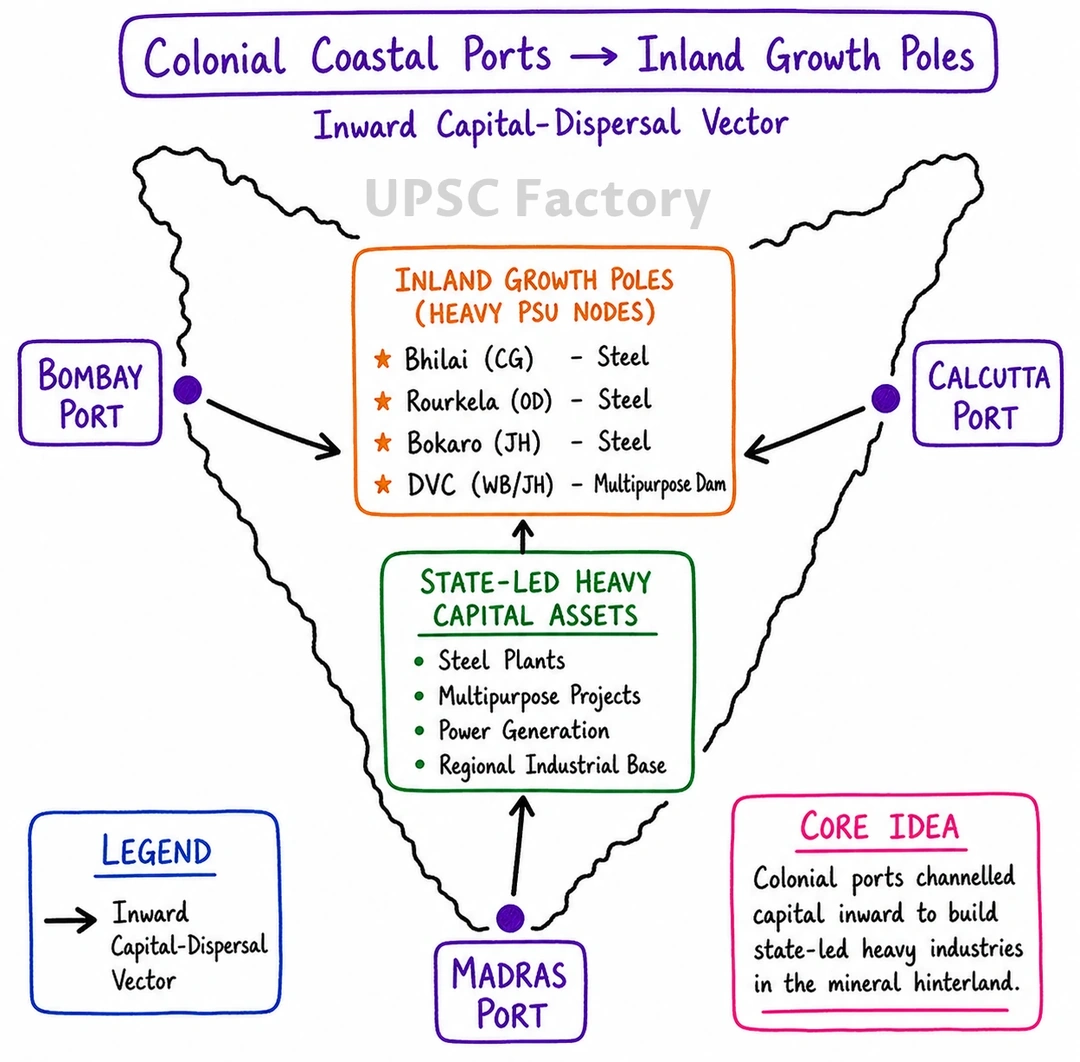
Colonial economic policy created asymmetric, port-centric enclaves (Bombay, Calcutta, Madras) geared for raw material extraction. Post-independence planning utilized the state-led Mahalanobis framework to engineer geographic parity and inclusive national development.

Planned Interventions to Rectify Colonial Imbalances

  1. Growth-Pole Industrialization: Heavy capital-goods Public Sector Undertakings (PSUs) were deliberately established in underdeveloped, mineral-rich tribal hinterlands (e.g., Bhilai, Rourkela, Bokaro steel plants).
  2. Industrial Policy Resolution (IPR) 1956: Deployed industrial licensing mechanisms to incentivize private factories in backward regions via tax holidays and subsidized land.
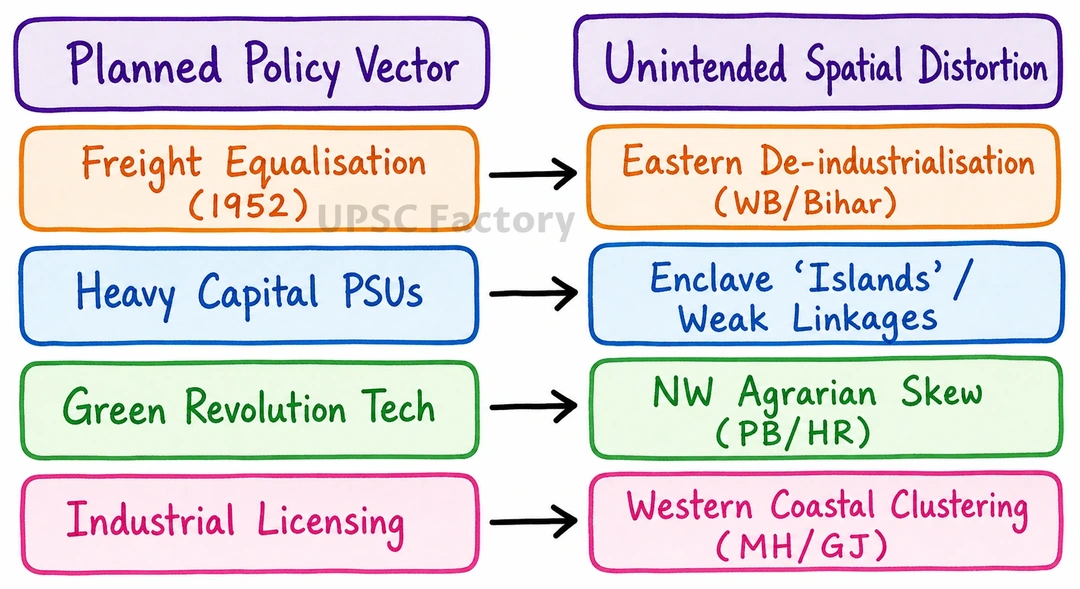
  3. Freight Equalisation Policy (1952): Subsidized rail freight for coal and steel to equalize raw material prices nationwide, encouraging decentralized manufacturing.
  4. Agrarian Infrastructure Dispersal: Large-scale multipurpose river valley projects targeted chronically drought-prone and flood-hit interiors (e.g., Damodar Valley Corporation, Hirakud Dam).
  5. Progressive Fiscal Allocation: Progressively weighted formulas under the Planning Commission prioritized low-income and special-category states for central capital assistance (e.g., Gadgil-Mukherjee Formula).

Critical Appraisal: Unintended Divergences and Limitations

  1. Erosion of Eastern Advantage: Freight equalisation stripped eastern states of their natural comparative advantage without equalizing other inputs, triggering de-industrialization in Bihar and West Bengal.
  2. Green Revolution Disparity: The urgency for food self-sufficiency concentrated technology and price support in well-irrigated north-western pockets, bypassing eastern and dryland tracts (e.g., Punjab, Haryana vs. Eastern UP, Bihar).
  3. Limited Local Multipliers: Capital-intensive PSUs operated as isolated “islands of prosperity,” failing to develop dynamic forward-backward linkages with the local subsistence economy.
  4. License-Permit Distortions: Regulatory discretion led to private capital clustering in commercially mature coastal states (e.g., Maharashtra, Gujarat) due to superior proximity to capital and decision-makers.

While planned development established a nationwide industrial infrastructure and prevented extreme territorial Balkanization, enduring spatial inequalities underscore the transition from top-down central planning to localized, cluster-based competitive federalism (e.g., Aspirational Districts Programme).

Q. The model of planned economy was adopted in India to address the regional imbalances left behind by colonial rule. Comment. Read More »

Q. Linguistic reorganization of Indian States was driven by popular pressure from below. Comment.

Q. Linguistic reorganization of Indian States was driven by popular pressure from below. Comment.

Question from UPSC Mains 2026 GS1 Paper

Model Answer: 

While post-colonial leadership initially feared balkanisation, intense grassroots mobilisations compelled the Union government to abandon administrative status-quoism and restructure internal boundaries along linguistic lines.

Grassroots Impetus: Popular Mobilisation from Below

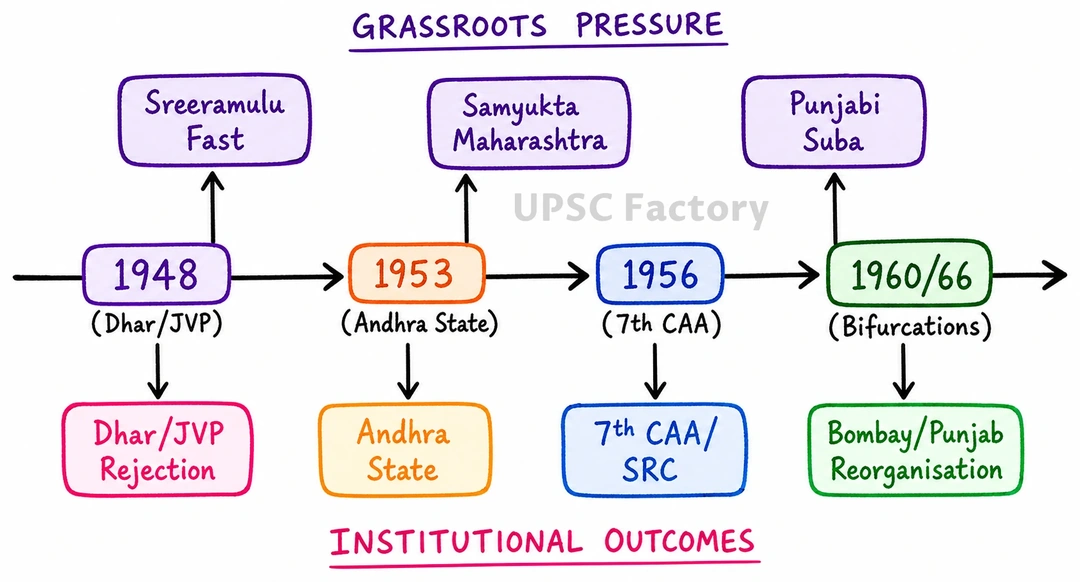
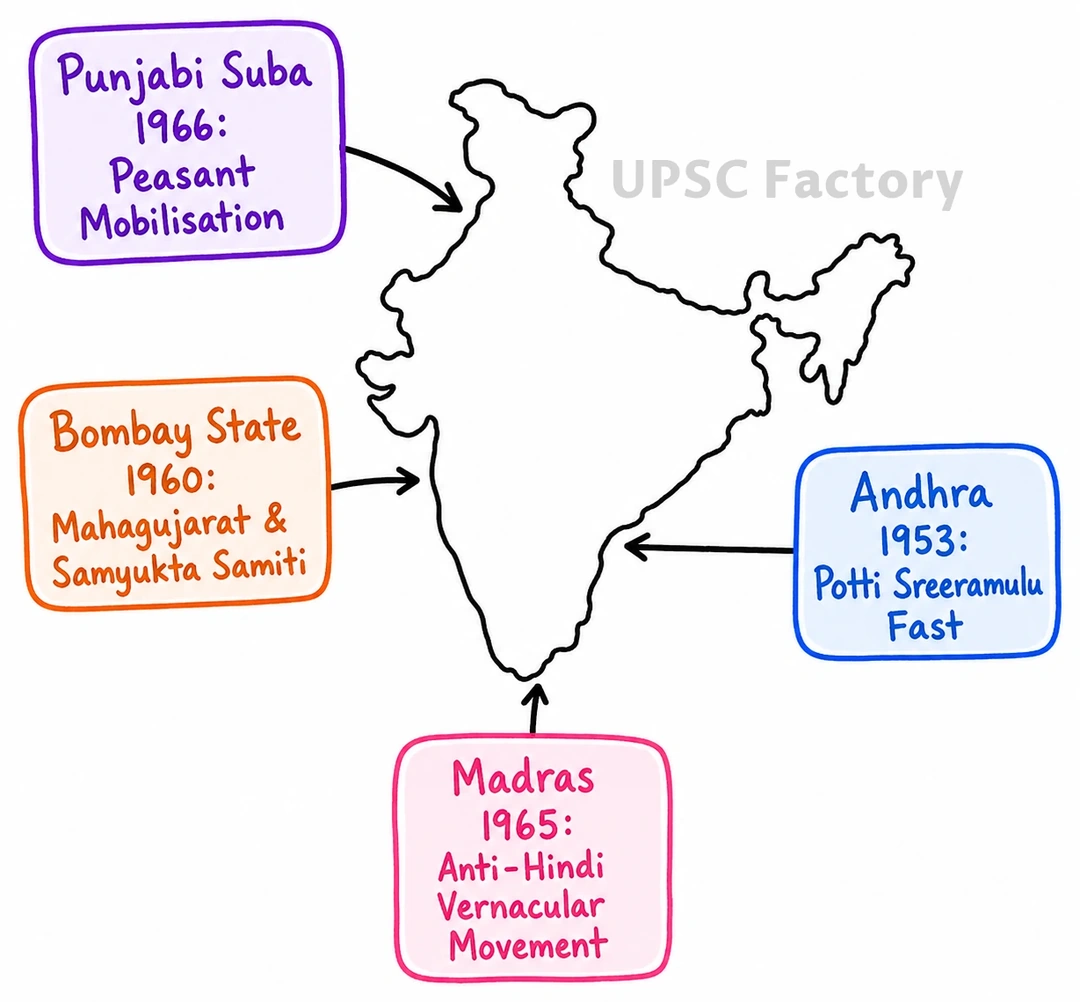
  1. Martyrdom and Mass Agitation: Potti Sreeramulu’s 58-day fast-unto-death galvanized widespread civil unrest, compelling the immediate creation of Andhra State (1953).
  2. Multi-Class Regional Coalitions: Mass public mobilisations by the Samyukta Maharashtra Samiti and Mahagujarat Andolan forcibly dismantled the composite Bombay State (1960).
  3. Ethno-Linguistic Identity Assertions: The Akali Dal-led Punjabi Suba movement mobilized rural peasantry, resulting in the trifurcation of East Punjab (1966).
  4. Anti-Hegemonic Mobilisation: Dravidian language movements in Tamil Nadu resisted northern linguistic dominance, entrenching vernacular assertion against centralized Hindi imposition (1965).
  5. Aspiration for Democratic Access: Regional vernacular presses and local elites mobilized masses demanding administration and education in the mother tongue.

Institutional Mediation: Top-Down Caution and Accommodation

  1. Initial Central Reluctance: The Dhar Commission (1948) and JVP Committee rejected linguistic division, prioritizing post-Partition security, administrative viability, and economic cohesion over regional sentiment.
  2. Institutionalised Redirection: The Fazal Ali Commission (SRC, 1953) pragmatically absorbed bottom-up demands, institutionalizing linguistic federalism via the 7th Constitutional Amendment Act (1956).
  3. Conditional Concessions: The Union ensured boundary redrawings rejected the rigid “one language, one state” doctrine, incorporating linguistic minority safeguards (Articles 350A and 350B).

Linguistic reorganization demonstrated the resilience of Indian federalism, proving that accommodating bottom-up democratic aspirations strengthened national integration rather than fracturing sovereignty.


Q. Linguistic reorganization of Indian States was driven by popular pressure from below. Comment. Read More »

Q. Vijayanagara architecture exemplifies the amalgamation of past traditions with contemporary practices. Elucidate with examples.

Q. Vijayanagara architecture exemplifies the amalgamation of past traditions with contemporary practices. Elucidate with examples.

Question from UPSC Mains 2026 GS1 Paper

Model Answer: 

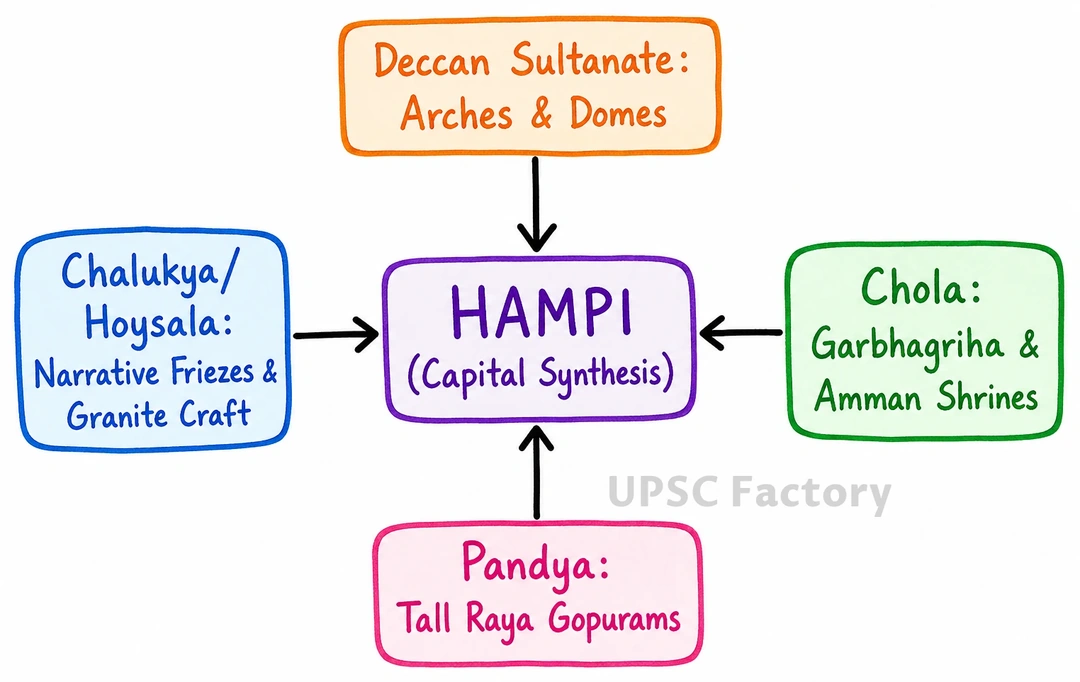
Vijayanagara architecture (14th–16th century CE) represents a vibrant synthesis of southern dynastic legacies (Dravida style) with contemporary socio-religious needs and Deccan Indo-Islamic architectural idioms.

1. Assimilation of Past Dynastic Traditions

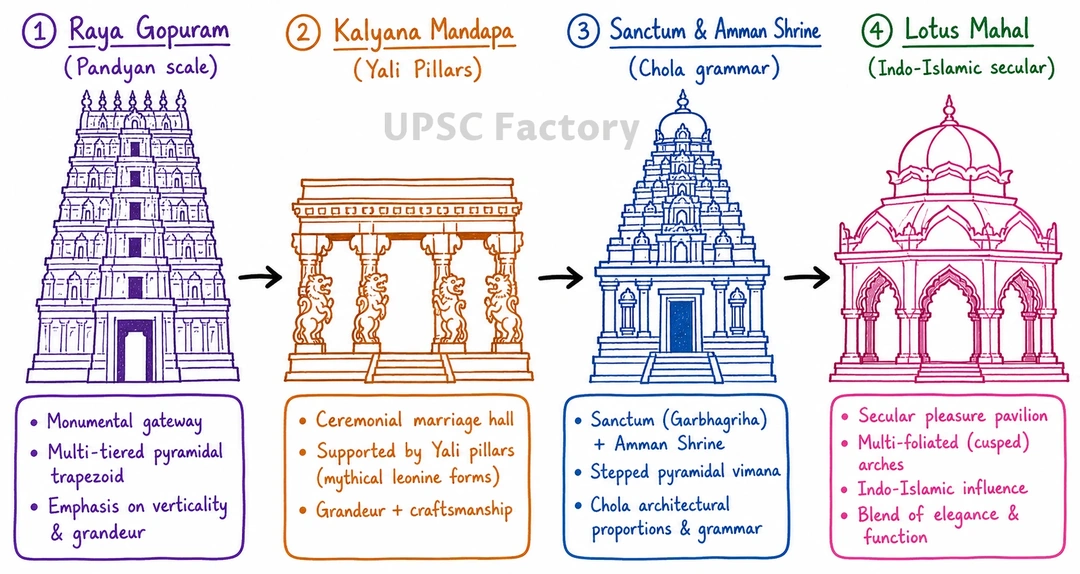
  1. Pandyan Gateway Focus: Constructed monumental entrance towers (Raya Gopurams) that dwarfed the central sanctum (e.g., Virupaksha Temple, Hampi).
  2. Chola Structural Grammar: Retained standard Dravidian layouts, axial pillared halls, and separate shrines for the consort goddess (Amman shrine).
  3. Hoysala-Chalukya Reliefs: Adopted continuous, narrative stone relief bands depicting the Ramayana and court scenes on plinths (e.g., Hazara Rama Temple).
  4. Granite Craftsmanship: Mastered hard local granite masonry for structural frameworks, echoing early Western Chalukyan construction techniques (e.g., Lepakshi Veerabhadra Temple).

2. Contemporary Innovations and Synthesis

  1. Elaborate Ceremonial Pavilions: Introduced specialized spaces like Kalyana Mandapas (marriage halls) and Utsava Mandapas to support expanding temple rituals (e.g., Vittala Temple complex).
  2. Monolithic Yali Pillars: Engineered composite piers featuring rearing mythical beasts (Yalis), cavalry motifs, and acoustic musical pillars (e.g., Vittala Ranga Mandapa).
  3. Indo-Islamic Secular Synthesis: Integrated cusped arches, squinches, stucco decoration, and ribbed vaults in civic buildings (e.g., Lotus Mahal, Elephant Stables).
  4. Fortified Temple-City Design: Merged sacred zones with secular administrative spaces, massive defensive concentric walls, and stepped stone aqueducts (e.g., Hampi Stepped Tank / Pushkarini).

By harmonizing classical Dravidian heritage with innovative structural forms and Islamic techniques, Vijayanagara architecture created an imperial idiom that redefined South Indian artistic traditions.

Q. Vijayanagara architecture exemplifies the amalgamation of past traditions with contemporary practices. Elucidate with examples. Read More »