2024 Sociology Paper 1

Q. Explain G.H. Mead’s idea of development of ‘self’ through the ‘generalised other’.

Q. Explain G.H. Mead’s idea of development of ‘self’ through the ‘generalised other’.

UPSC Sociology 2024 Paper 1

Model Answer:

Rooted in the Chicago School of Symbolic Interactionism, G.H. Mead advanced C.H. Cooley’s “Looking Glass Self” in Mind, Self, and Society to explain how societal norms are internalized into human consciousness.

Mechanism of Self-Formation

The “Self” is not innate but emerges through sequential social role-taking:

  • Preparatory Stage: Meaningless behavioral imitation of immediate others.
  • Play Stage: Role-taking of specific individuals (e.g., playing a teacher).
  • Game Stage: Internalizing the “Generalized Other”—the organized expectations, attitudes, and rules of the entire community.

The Dialectic of “I” and “Me”

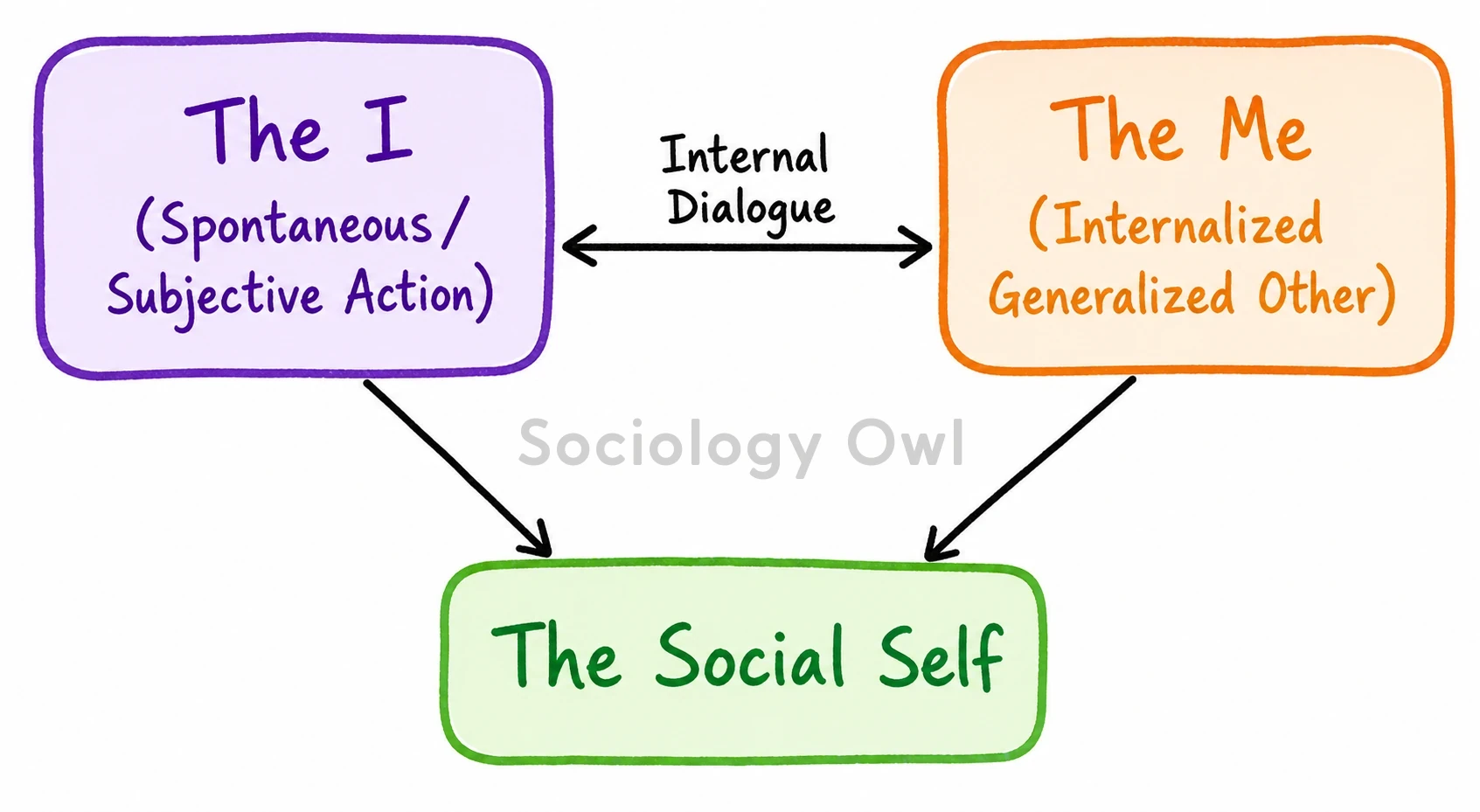
Internalizing the “Generalized Other” constitutes the “Me” (the objectively socialized self). True selfhood develops via a continuous internal dialogue between the socially regulated “Me” and the subjective, spontaneous “I”.
Social media algorithms and “cancel culture” act as a global “Digital Generalized Other”, where individuals reflexively self-regulate their virtual identities anticipating widespread public reaction.

Conclusion

While Marxists critique Mead for ignoring how macro-structural power dynamics shape the “Generalized Other”, his work remains phenomenally influential, directly inspiring Erving Goffman’s theories of Impression Management.

Q. Explain G.H. Mead’s idea of development of ‘self’ through the ‘generalised other’. Read More »

Q. Modern families have not just become nuclear and neo-local, but also filiocentric. How do you explain this trend?

Q. Modern families have not just become nuclear and neo-local, but also filiocentric. How do you explain this trend?

UPSC Sociology 2024 Paper 1

Model Answer:

Modern families are transitioning from gerontocratic (elder-dominated) extended units to neo-local (independent households) and nuclear structures. Concurrently, they have become filiocentric—placing children at the center of the family’s power dynamics and emotional economy, prioritizing their development over adult leisure.

Sociological Drivers of Filiocentrism

Industrialization & Demography: William J. Goode (World Revolution and Family Patterns) argued industrial capitalism demands a mobile, neo-local nuclear family. Consequent lower fertility rates allow parents to concentrate vast resources into fewer children.

Evolution of Childhood: Philippe Ariès (Centuries of Childhood) highlighted that modernity transformed childhood from a phase of miniature adulthood into a distinct, protected stage requiring intense adult supervision.

Class Reproduction: Through a conflict lens, Pierre Bourdieu argues modern parents heavily invest in children’s education and extracurriculars to accumulate cultural capital, securing their child’s future class status in a hyper-competitive capitalist economy.

Emotional Anchoring: While Talcott Parsons emphasized the family’s functional role in emotional stabilization, Ulrich Beck and Elisabeth Beck-Gernsheim (The Normal Chaos of Love) argue that amid high divorce rates and fragile adult relationships in late modernity, “the child is the final anchor” for unconditional emotional stability.

Critical Analysis and Context

Class Disparities: Annette Lareau contrasts middle-class “concerted cultivation” (intense, child-centric scheduling) with working-class “accomplishment of natural growth,” demonstrating that intense filiocentrism is largely an upper/middle-class privilege.

Psychological Toll: Extreme focus breeds “Helicopter Parenting”, which places immense performance pressure on children while contributing to the institutionalization of childhood.

China’s “Little Emperor Syndrome,” born from the One-Child Policy intersecting with neo-local urbanization, exemplifies extreme global filiocentrism where the entire household’s consumption and goals revolve entirely around a single child.

Conclusion

While the shift towards neo-local and filiocentric families reflects the adaptive capacity of kinship to late modernity, it profoundly transforms children from traditional economic assets into highly precious emotional assets, introducing unprecedented care alongside modern anxieties.

Q. Modern families have not just become nuclear and neo-local, but also filiocentric. How do you explain this trend? Read More »

Q. Do you think ‘objectivity’ is an over-hyped idea in sociological research? Discuss the merits and demerits of non-positivist methods.

Q. Do you think ‘objectivity’ is an over-hyped idea in sociological research? Discuss the merits and demerits of non-positivist methods.

UPSC Sociology 2024 Paper 1

Model Answer:

Objectivity in sociology implies studying phenomena without letting personal biases, prejudices, or values influence the research (Robert Bierstedt). Rooted in the Positivist tradition of Comte and Durkheim, it sought to model sociology on the natural sciences. However, treating pure objectivity as an absolute ideal is increasingly considered over-hyped.

The Myth of Absolute Objectivity

Inherent Value-Bias: Gunnar Myrdal argued that researchers’ values inevitably dictate topic selection. Similarly, Alvin Gouldner, in his essay Anti-Minotaur: The Myth of a Value-Free Sociology, dismissed absolute objectivity as an impossible illusion.

Masking Subjectivity: Feminist Standpoint Theory (Dorothy Smith) asserts that classical “objectivity” is frequently just male subjectivity disguised as universal truth.

Constructed “Facts”: While Durkheim championed statistical objectivity in Le Suicide, phenomenologists like J.D. Douglas demonstrated that suicide statistics are actually social constructs shaped by coroners’ interpretations, proving that purely objective data is often a mirage.

Merits and Demerits of Non-Positivist Methods

Recognizing these limitations, non-positivist paradigms (Interpretivism, Phenomenology) emerged to capture subjective realities.

Merits: They provide deep, contextualized insights through Max Weber’s Verstehen (interpretative understanding) and Clifford Geertz’s Thick Description. Instead of feigning absolute neutrality, they actively manage bias through Pierre Bourdieu’s “Reflexive Sociology”.

Demerits: These methods suffer from a Lack of Reliability, as deep qualitative data is difficult to standardize and replicate. Furthermore, heavy immersion risks the Hawthorne Effect, where the researcher’s presence alters the subjects’ natural behavior.

When studying gig economy workers, purely objective positivist data (e.g., algorithmic income statistics) fails to capture their complete reality. Non-positivist ethnography is required to uncover the lived experiences, meaning, and alienation associated with precarious labor.

Conclusion

While pure objectivity is unattainable, methodological rigor remains vital. Following Max Weber, sociologists distinguish between Value-Relevance (values guiding topic selection) and Value-Neutrality (impartial data collection). Ultimately, contemporary research balances these paradigms through Methodological Pluralism and Triangulation (Alan Bryman) to capture complete sociological truths.

Q. Do you think ‘objectivity’ is an over-hyped idea in sociological research? Discuss the merits and demerits of non-positivist methods. Read More »

Q. How do you view and assess the increasing trend of digital ethnography and use of visual culture in sociological research?

Q. How do you view and assess the increasing trend of digital ethnography and use of visual culture in sociological research?

UPSC Sociology 2024 Paper 1

Model Answer:

Digital Ethnography and Visual Culture in Modern Sociology

Traditional ethnography emphasized physical immersion, or “being there,” as championed by Bronisław Malinowski. Today, sociologists utilize Digital Ethnography (or Netnography) and visual culture, marking an epistemological shift toward “being with” subjects in mediated cyber-spaces to decode modern digital interactions.

Epistemological Opportunities in Digital Ethnography

Netnography & Virtual Worlds: Coined by Robert Kozinets, this methodology studies online cultures. Tom Boellstorff, in Coming of Age in Second Life, demonstrated that virtual environments are rich, legitimate sites of cultural inquiry.

Hyperreality: Through a postmodern lens, Jean Baudrillard’s concepts of Simulacra and Hyperreality explain how digital spaces allow sociologists to research artificially constructed, yet socially impactful, virtual realities.

Integrating Visual Culture

Visual Ethnography: Pioneered by Sarah Pink, sensory methodologies use visual materials to capture nuanced cultural norms and power dynamics missed by textual data.

Semiotics & Dramaturgy: Roland Barthes used Semiotics to decode visual culture. In the digital age, Erving Goffman’s Dramaturgical Analysis is critical for decoding highly curated “front-stage” visual performances on platforms like Instagram.

Methodological Limitations

Surveillance Risks: Applying Michel Foucault’s Panopticon, the extraction of digital data risks blurring the line between sociological research and corporate/state surveillance.

Crisis of Representation: Methodological validity is threatened by deepfakes and algorithmic biases. The Hawthorne Effect persists in digital spaces; subjects hyper-curate their identities, knowing they are constantly perceived.

Sociologists increasingly employ “Hashtag Ethnography” to study the visual framing of modern social movements like #BlackLivesMatter or the Farmers’ Protest. Additionally, marginalized indigenous tribes use participatory video to document ecological destruction, linking visual culture directly to Action Sociology.

Conclusion

As the boundary between physical and virtual realities blurs into a “phygital” world, relying solely on traditional observation is insufficient. Researchers must embrace Methodological Pluralism—combining digital, visual, and classical qualitative methods—to capture the holistic reality of modern human society while rigorously navigating emerging ethical complexities.

Q. How do you view and assess the increasing trend of digital ethnography and use of visual culture in sociological research? Read More »

Q. Discuss the nature of Sociology. Highlight its relationship with Social Anthropology.

Q. Discuss the nature of Sociology. Highlight its relationship with Social Anthropology.

UPSC Sociology 2024 Paper 1

Model Answer:

Nature of Sociology

Sociology emerged from Modernity as the scientific study of society. Its nature centers on analyzing objective “Social Facts” (Emile Durkheim) and the “Interpretative Understanding” of social action (Max Weber) within complex, industrial societies.

Relationship with Social Anthropology

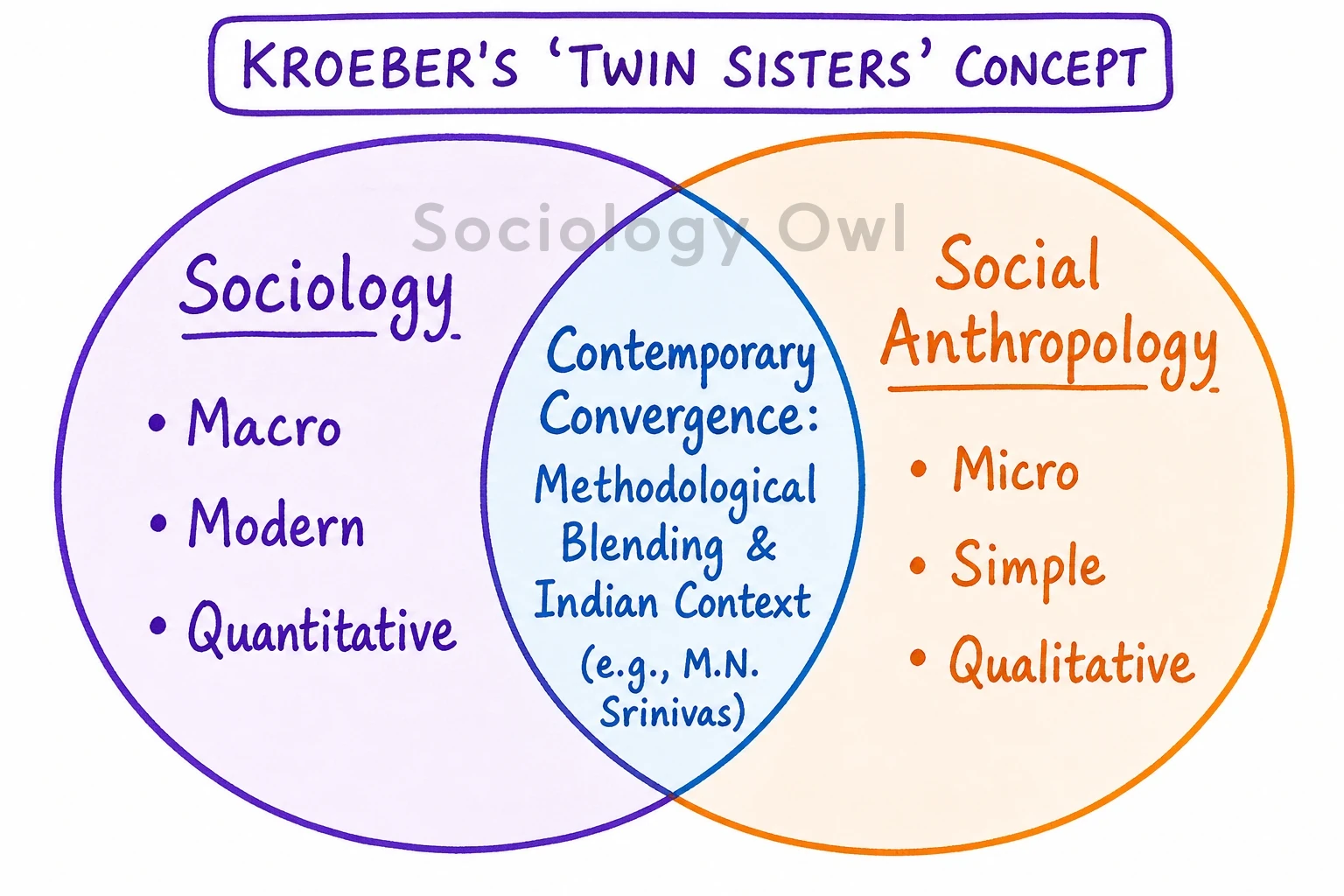
  • Convergence: A.L. Kroeber famously termed the disciplines “twin sisters.” Theoretically, British anthropologists like A.R. Radcliffe-Brown heavily utilized sociology’s Structural-Functionalism. In India, boundaries blur seamlessly; M.N. Srinivas applied anthropological Participant Observation to study macro-sociological caste dynamics in The Remembered Village.
  • Divergence: Traditionally, sociology analyzed macro-structures in modern societies using quantitative surveys. Conversely, social anthropology focused on pre-literate or “simple” societies, relying on micro-level, qualitative Participant Observation pioneered by Bronislaw Malinowski.

Social Anthropology

Today, studying complex phenomena like urban slums (e.g., Dharavi) or tribal displacement requires blending sociological macro-analysis of state policies with anthropological micro-analysis of kinship and cultural trauma.

As Anthony Giddens argues, late-stage globalization has rendered the traditional “modern” versus “primitive” dichotomy obsolete, increasingly dissolving methodological boundaries and forging a unified, holistic sociological anthropology.

Q. Discuss the nature of Sociology. Highlight its relationship with Social Anthropology. Read More »

Q. Sociology is the product of European enlightenment and renaissance. Critically examine this statement.

Q.Sociology is the product of European enlightenment and renaissance. Critically examine this statement.

UPSC Sociology 2024 Paper 1

Model Answer:

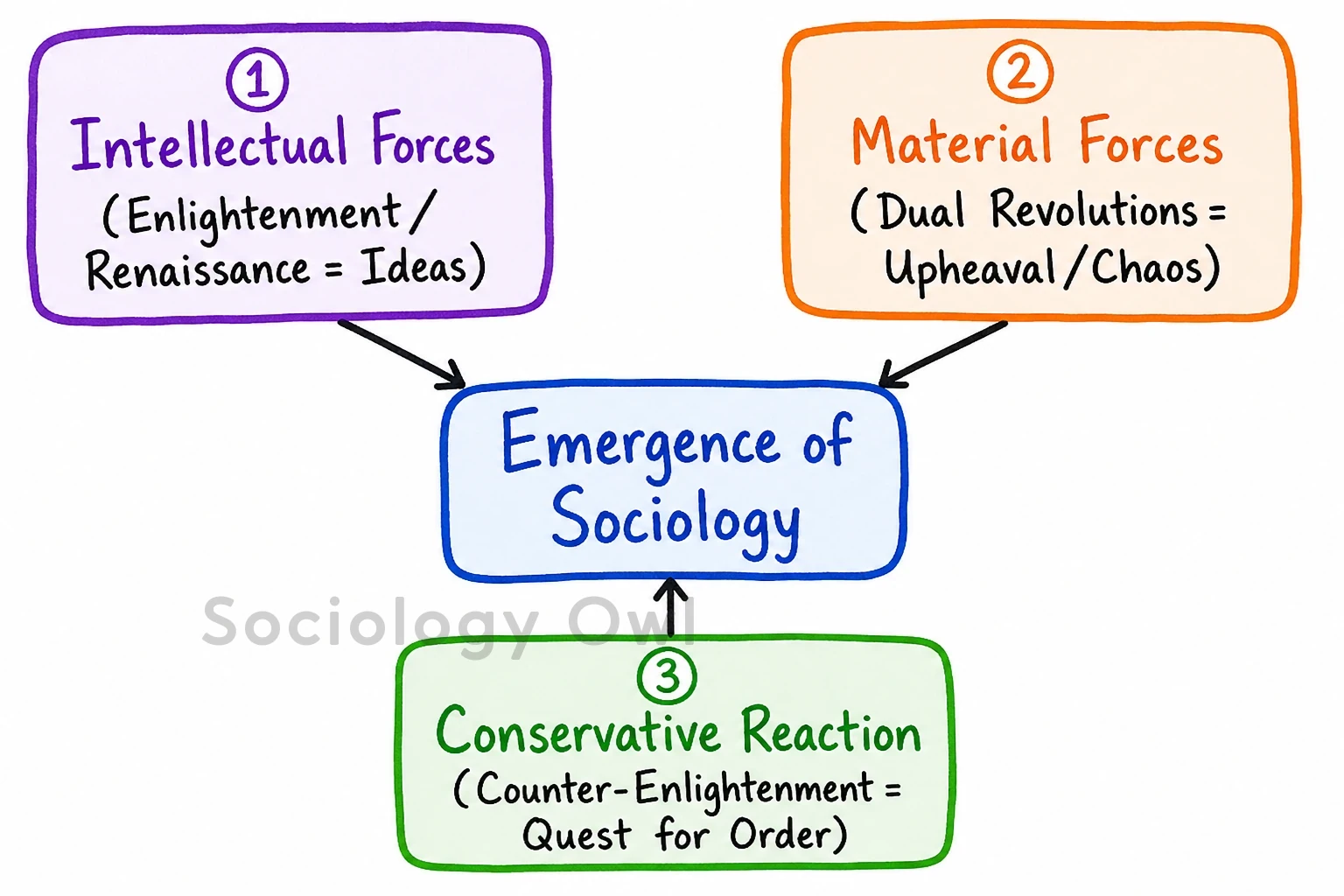
The emergence of sociology marked an epistemological shift from “Theodicy” (explaining society through divine will) to “Sociodicy” (rational understanding of society). The Renaissance birthed Humanism, while the Enlightenment introduced Reason and Positivism, providing the primary intellectual bedrock for the discipline.

Intellectual Foundations: Enlightenment and Renaissance

Rationalism and Positivism

Thinkers like Montesquieu (The Spirit of the Laws) pioneered comparative methods, while the Enlightenment belief that society is governed by discoverable laws inspired Auguste Comte’s Positivism.

Humanism and Secularization

The Renaissance shifted the analytical focus to human-centric studies, empowering Karl Marx’s historical materialism and critique of capitalism over religious dogmas.

Sociology Europe

Critical Examination: Catalysts, Reactions, and Eurocentrism

The Conservative Reaction

The Counter-Enlightenment heavily shaped classical sociology. Thinkers like Louis de Bonald and Joseph de Maistre rejected extreme Enlightenment individualism. Emile Durkheim drew from this, scientifically studying the breakdown of community and diagnosing modernity’s “Anomie”.

Material and Political Catalysts

Enlightenment provided the ideas, but the French Revolution and Industrial Revolution provided the chaos. Sociology emerged fundamentally as a quest for “Social Order” amid these upheavals.

Critique of Enlightenment Optimism

Max Weber challenged the unbridled celebration of reason, warning of modernity’s “Iron Cage of Rationality” and the consequent “Disenchantment of the World”.

The Eurocentric Blindspot

Raewyn Connell (Southern Theory) and Gurminder K. Bhambra argue classical sociology ignored how colonialism built “modernity.” Furthermore, Ibn Khaldun’s 14th-century work on “Asabiyyah” (social cohesion) significantly predates European sociology.

Contemporary Relevance

The ongoing global movement of “Decolonizing the Curriculum” actively challenges sociology’s Eurocentric origins. By integrating Indigenous, African (Ubuntu), and Asian epistemologies, modern universities are transforming sociology into a truly multipolar discipline.

Conclusion

While the Renaissance and Enlightenment supplied the crucial intellectual raw materials of reason and empiricism, sociology was fundamentally forged in the furnace of 19th-century socio-political crises. Today, the discipline continuously evolves past its European birth to critically analyze diverse global realities.

Q. Sociology is the product of European enlightenment and renaissance. Critically examine this statement. Read More »

Q. Describe various characteristics of a ‘social fact’. How is rate of suicide a social fact according to Durkheim?

Q. Describe various characteristics of a ‘social fact’. How is rate of suicide a social fact according to Durkheim?

UPSC Sociology 2024 Paper 1

Model Answer:

Social Facts

Social facts, a concept introduced by Emile Durkheim, are fundamental to sociological understanding. These are collective ways of acting, thinking, and feeling that exist outside individual consciousness and exert a coercive force on individuals.

Key characteristics of social facts include:

1. Externality: They exist independently of individual actions or thoughts.
2. Constraint: They exert pressure on individuals to conform.
3. Generality: They are widespread within a society or social group.
4. Objectivity: They can be studied empirically, like natural phenomena.

Durkheim used the rate of suicide as an exemplar of a social fact. He argued that suicide, seemingly a personal act, is influenced by social forces:

• Suicide rates remain relatively stable within societies over time.
• Different societies have consistently different suicide rates.
• Rates vary with social conditions (e.g., economic crises, wars).

Durkheim considered suicide rates a social fact because:

1. They are collective, existing beyond individual cases.
2. They exert an external force on individuals through social conditions.
3. They are measurable and show consistent patterns across groups.
4. They respond to social changes, demonstrating their connection to broader societal forces.

Conclusion:
By analyzing suicide as a social fact, Durkheim illustrated how personal actions are shaped by collective forces, establishing a foundation for sociological inquiry.

Q. Describe various characteristics of a ‘social fact’. How is rate of suicide a social fact according to Durkheim? Read More »

Q. Critically explain the salient features of ‘alienation’ as propounded by Karl Marx.

Q. Critically explain the salient features of ‘alienation’ as propounded by Karl Marx.

UPSC Sociology 2024 Paper 1

Model Answer:

Karl Marx’s concept of alienation is a fundamental aspect of his critique of capitalism and industrial society. This theory explores how workers become estranged from various aspects of their human nature and productive activity under capitalist conditions.

Key features of Marx’s concept of alienation include:

1. Alienation from the product of labor:
• Workers do not own or control the goods they produce
• The products of their labor become alien objects, owned by capitalists
• This leads to a sense of powerlessness and disconnection from one’s creations

2. Alienation from the act of production:
• Work becomes an external, coerced activity rather than a fulfilling expression of human creativity
• Workers have little control over the production process or working conditions
• Labor is reduced to a means of survival rather than a source of self-realization

3. Alienation from human nature (species-being):
• Capitalist labor inhibits the expression of essential human characteristics like creativity and social cooperation
• Workers are unable to fully develop their potential as human beings
• Marx argued that work should be a way to express our humanity, not suppress it

4. Alienation from other humans:
• Competitive capitalist relations replace cooperative social bonds
• Workers are alienated from capitalists who exploit their labor
• Even relationships among workers become instrumentalized and commodified

Marx viewed alienation as a structural feature of capitalism, not merely a psychological state. He argued that overcoming alienation would require fundamental changes to the economic system and social relations of production.

Critics have questioned whether Marx’s concept of human nature is too essentialist or whether alienation is as pervasive as he claimed. Nonetheless, his analysis remains influential in understanding the human costs of modern industrial and post-industrial labor.

Conclusion: Marx’s theory of alienation provides a powerful critique of how capitalism can dehumanize workers, offering insights that remain relevant to contemporary labor issues and social inequality.

Q. Critically explain the salient features of ‘alienation’ as propounded by Karl Marx. Read More »