2024 Sociology Paper 1

Q. How do you understand the phenomena of the mushrooming of sects and cults in contemporary society? Discuss the factors responsible for the trend.

Q. How do you understand the phenomena of the mushrooming of sects and cults in contemporary society? Discuss the factors responsible for the trend.

UPSC Sociology 2024 Paper 1

Model Answer:

Sociologically, the mushrooming of sects and cults falls under the study of New Religious Movements (NRMs) (Eileen Barker). Max Weber and Ernst Troeltsch define sects as exclusive, breakaway groups existing in high tension with broader society. Conversely, Howard Becker defines cults as loosely structured, highly individualistic groups centered on novel mystical experiences outside dominant religious traditions.

Structural and Post-modern Perspectives

Loss of the Sacred Canopy: Peter Berger argues modernity and secularization have collapsed the overarching “Sacred Canopy”, leaving individuals in a state of meaninglessness (Anomie). Cults provide a new, rigid moral framework.

Relative Deprivation Theory: Charles Glock and Rodney Stark emphasize that people join NRMs not just due to economic poverty, but due to psychic, organismic, or ethical deprivation. This explains the affluent, middle-class appeal of movements like Osho or Scientology.

Charismatic Leadership: As per Max Weber, during periods of societal crisis, leaders with Charismatic Authority emerge to offer revolutionary, customized salvation that contrasts with bureaucratic established religions.

Religious Market Theory: Rodney Stark and William Bainbridge argue that secularization creates a “spiritual marketplace.” Here, sects and cults act as entrepreneurial firms competing for adherents by offering tailored “religious compensators.”

Liquid Modernity: Following Jean-François Lyotard’s thesis on the decline of grand narratives, Zygmunt Bauman argues that in “Liquid Modernity,” individuals reject traditional orthodoxy to create “do-it-yourself” micro-religions.

The Cultic Milieu: Colin Campbell notes that contemporary society possesses a deep cultural openness to mysticism and alternative healing, creating fertile ground for cults.

Globally, the internet fosters algorithm-driven virtual cults (e.g., QAnon). In India, the rise of Dera culture is a structural response to agrarian alienation and mainstream caste rigidities. This sparks an academic debate: Bryan Wilson argues sectarianism proves Secularization as religion fragments into marginalized niches. Conversely, post-secularists invoke Mircea Eliade’s concept of Homo Religiosus in The Sacred and the Profane, asserting religion is merely transforming, not dying.

Conclusion

Ultimately, the proliferation of sects and cults reflects Grace Davie’s concept of “believing without belonging.” As trust in orthodox religious institutions wanes, individuals seek alternative, personalized avenues for spiritual consumption, identity, and community in a fragmented world.
Q. How do you understand the phenomena of the mushrooming of sects and cults in contemporary society? Discuss the factors responsible for the trend. Read More »

Q. Describe the main idea of Max Weber’s book, ‘The Protestant Ethic and the Spirit of Capitalism’ as a critique of Marxism.

Q. Describe the main idea of Max Weber’s book, ‘The Protestant Ethic and the Spirit of Capitalism’ as a critique of Marxism.

UPSC Sociology 2024 Paper 1

Model Answer:

Max Weber’s The Protestant Ethic and the Spirit of Capitalism is often described by scholars like Albert Salomon as a “dialogue with the ghost of Karl Marx.” It offers a fundamental critique of Marx’s Historical Materialism, demonstrating how non-material ideological forces can drive profound economic transformations.

Weber’s Critique of Marxist Economic Determinism

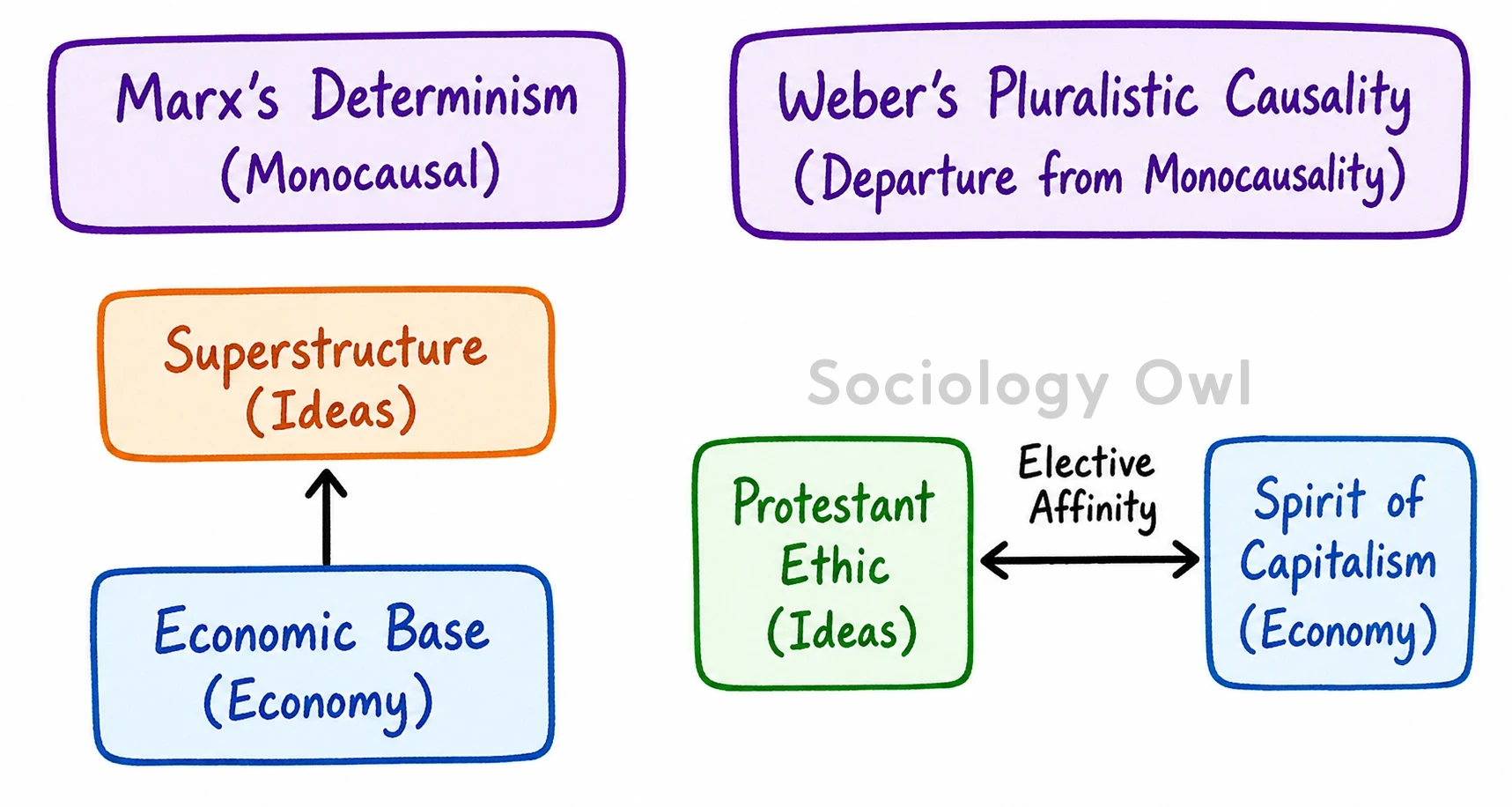
Inverting the Base-Superstructure Model: While Marx argued that the economic “base” strictly determines the ideological “superstructure,” Weber demonstrated that ideas can shape economies. He highlighted how Calvinism fostered the Spirit of Capitalism.

Elective Affinity over Strict Causality: Rejecting mechanical determinism, Weber proposed an Elective Affinity (Wahlverwandtschaft) between the Doctrine of Predestination and modern capitalism. The anxiety of salvation was resolved through Inner-worldly asceticism—treating rational labor and wealth accumulation as a religious “calling.”

Pluralistic Causality: Weber rejected Marxist monocausality. He explicitly clarified that his goal was not to replace a “one-sided materialistic” explanation of history with an equally flawed “one-sided spiritualistic” one, but to show their interplay via Social Action.

Critiques and Theoretical Extensions

Materialist Pushback: R.H. Tawney countered Weber, arguing that the technological and economic foundations of capitalism preceded Protestantism, which merely adapted to existing material realities.

Alternative Cultural Origins: Werner Sombart argued that the Jewish ethic, rather than Protestantism, was the true catalyst for capitalist development.

Neo-Marxist Critique: Immanuel Wallerstein argued that capitalism emerged not from religious ethics, but from historical colonialism and structural exploitation of the Global South.

Shared Structural Pessimism: Despite debating its origins, both thinkers despised capitalism’s outcomes. Marx condemned Alienation, while Weber warned of a secularized, bureaucratic “Iron Cage of Rationality.”

Weber’s framework remains vital today. Sociologist Tu Weiming utilized it to explain the rapid rise of the “Asian Tigers,” attributing their success to a Confucian Work Ethic. Furthermore, modern “hustle culture” in Silicon Valley mirrors a hyper-rationalized, secularized descendant of Weber’s Protestant ethic.

Conclusion

Weber provided a necessary corrective to crude economic determinism. By establishing that cultural meanings shape economic structures, he permanently cemented the sociological axiom that while material realities are crucial, ideas frequently act as the “switchmen of history.”

Q. Describe the main idea of Max Weber’s book, ‘The Protestant Ethic and the Spirit of Capitalism’ as a critique of Marxism. Read More »

Q. How does a multicultural society accommodate diversities of all kinds—ethnic, linguistic and religious? Discuss its major challenges.

Q. How does a multicultural society accommodate diversities of all kinds—ethnic, linguistic and religious? Discuss its major challenges.

UPSC Sociology 2024 Paper 1

Model Answer:

Multicultural Society

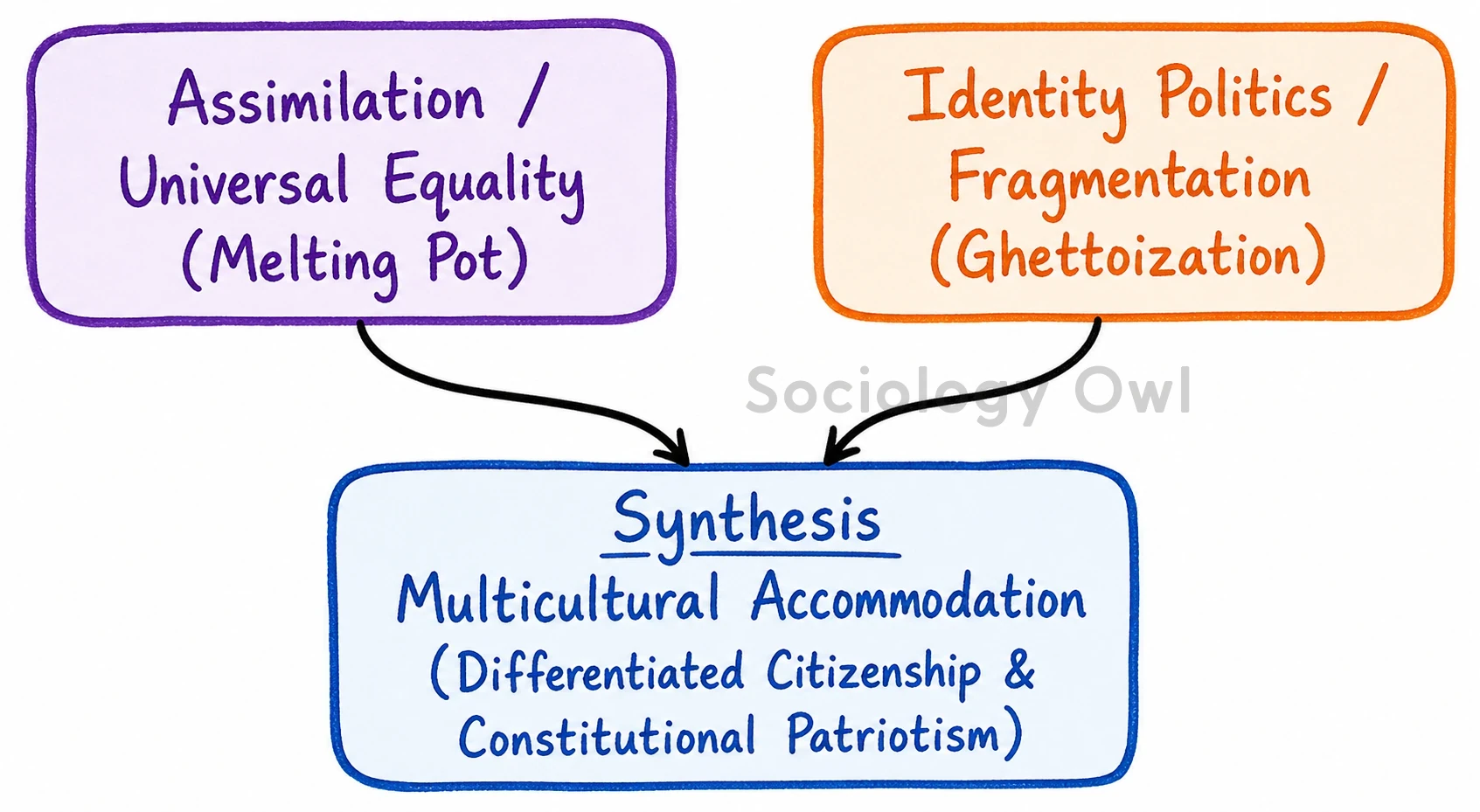
Multiculturalism represents both a sociological reality and a normative political ideology, shifting societies from an assimilationist “Melting Pot” to a pluralistic “Salad Bowl” model. Charles Taylor, in his “Politics of Recognition”, posits that accommodating diversity is essential because human identity is fundamentally shaped by social recognition of one’s distinct culture.

Mechanisms of Accommodating Diversities

Societies institutionalize pluralism by moving beyond uniform equality to specialized frameworks:

  • Differentiated Citizenship Rights: Will Kymlicka argues that true accommodation requires group-specific rights. This includes polyethnic rights (funding minority cultural/religious practices), special representation rights (affirmative action in politics), and self-government rights (autonomy for indigenous groups).
  • Consociational Democracy: Arend Lijphart highlights accommodation through institutionalized power-sharing, mutual vetoes, and proportional representation among ethnic or religious elites.
  • Dialogical Approach: Bhikhu Parekh emphasizes establishing a formal “dialogue between cultures” where no single dominant culture acts as the universal benchmark for legal and educational policies.

Major Sociological Challenges

  • The Feminist Critique: In Is Multiculturalism Bad for Women?, Susan Moller Okin argues that granting special group rights often shields and reinforces deeply rooted patriarchal practices within minority communities.
  • Recognition vs. Redistribution: Scholars like Nancy Fraser and Slavoj Žižek argue that an overemphasis on identity politics and cultural recognition obscures underlying systemic economic inequalities and class struggles.
  • Social Capital Deficit: Robert Putnam’s research indicates that, in the short term, high ethnic diversity can cause communities to “hunker down,” leading to ghettoization and a reduction in civic solidarity and social trust.

Globally, accommodation models vary. Canada pioneered the “Cultural Mosaic” via official state multiculturalism. Conversely, France’s assimilationist Laïcité (secularism) struggles to accommodate religious diversity, evident in hijab bans. Today, perceived integration failures have sparked a Western European backlash, fueling right-wing populism.

Conclusion

To prevent individuals from being trapped in rigid cultural boxes, Amartya Sen advocates recognizing fluid “Plural Identities”. Ultimately, sustainable multiculturalism requires Jürgen Habermas’s “Constitutional Patriotism,” where social cohesion is anchored in shared democratic values rather than a homogenized majority culture.

Q. How does a multicultural society accommodate diversities of all kinds—ethnic, linguistic and religious? Discuss its major challenges. Read More »

Q. What are the ‘basic and irreducible’ functions of the family as proposed by Talcott Parsons? Explain.

Q. What are the ‘basic and irreducible’ functions of the family as proposed by Talcott Parsons? Explain.

UPSC Sociology 2024 Paper 1

Model Answer:

Talcott Parsons’ Basic and Irreducible Functions of the Family

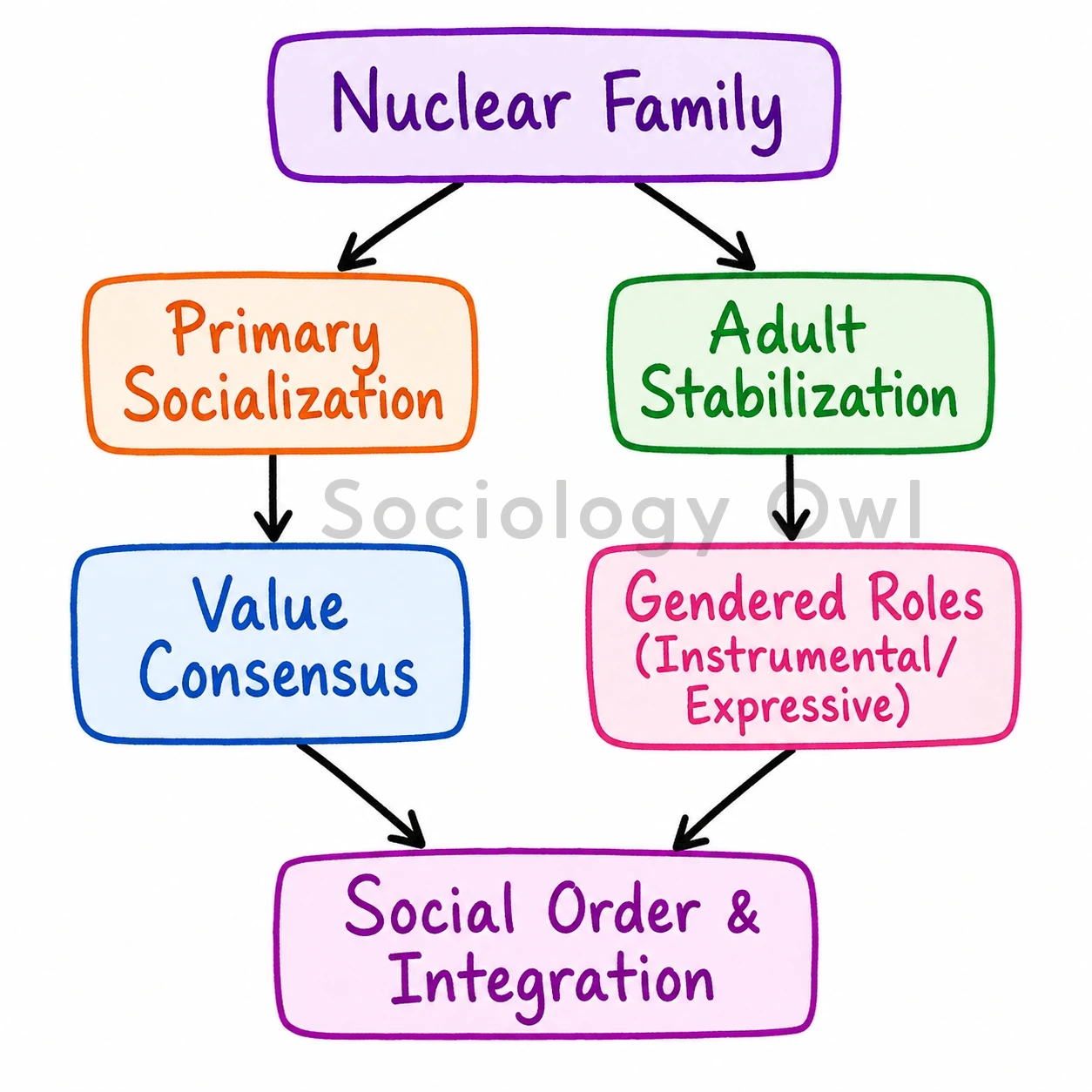
Operating from a Structural Functionalist perspective in his work Family, Socialization and Interaction Process, Talcott Parsons argued that industrialization led to Structural Differentiation. As institutions like schools and hospitals absorbed traditional familial roles, the nuclear family was left with two basic and irreducible functions. These fulfill the Latency (Pattern Maintenance) prerequisite within his AGIL paradigm.

Basic and Irreducible Functions

  • Primary Socialization of Children: The family ensures the “internalization of society’s culture” into a child’s emerging personality. Parsons argued this creates a “value consensus,” which is essential for social integration and long-term societal order.
  • Stabilization of Adult Personalities: Parsons introduced the “Warm Bath Theory”, positing that the family acts as a soothing sanctuary against the alienating stress of the industrial workplace. For this stabilization to occur, he proposed a strict gendered division of labor: men performing the Instrumental Role (breadwinner) and women the Expressive Role (emotional caretaker).

Sociological Critiques

  • Marxist Critique: Eli Zaretsky argued that these functions benefit capitalism rather than the individual, utilizing the family to reproduce and pacify an exploited workforce.
  • Feminist Critique: Ann Oakley dismissed the instrumental/expressive divide as a patriarchal construct. Furthermore, Fran Ansley dismantled the “warm bath theory,” arguing that wives absorb capitalist-induced frustrations, rendering women the “takers of shit.”
  • Alternative Functionalism: Ronald Fletcher argued the family has not lost functions but gained new ones, such as becoming an essential unit of economic consumption.

During the COVID-19 lockdowns, the family’s “stabilization” role was tested globally. While it acted as a primary buffer against pandemic stress, surging domestic violence simultaneously validated feminist critiques of the “warm bath.” Additionally, in the digital age, the family’s monopoly on primary socialization is heavily contested by social media and virtual peer networks.

Conclusion

While Parsons is widely critiqued for idealizing the white, middle-class “cereal packet family” and ignoring family diversity, his framework remains a foundational sociological baseline for analyzing how institutional shifts impact family dynamics in modern industrial societies.

Q. What are the ‘basic and irreducible’ functions of the family as proposed by Talcott Parsons? Explain. Read More »

Q. What is social mobility? Critically examine the classification of ‘closed’ and ‘open’ models of social stratification.

Q. What is social mobility? Critically examine the classification of ‘closed’ and ‘open’ models of social stratification.

UPSC Sociology 2024 Paper 1

Model Answer:

Social mobility, systematically conceptualized by Pitirim Sorokin (Social Mobility), is the vertical or horizontal movement of individuals across a society’s stratification hierarchy.

Open and Closed Models: A Critical Examination

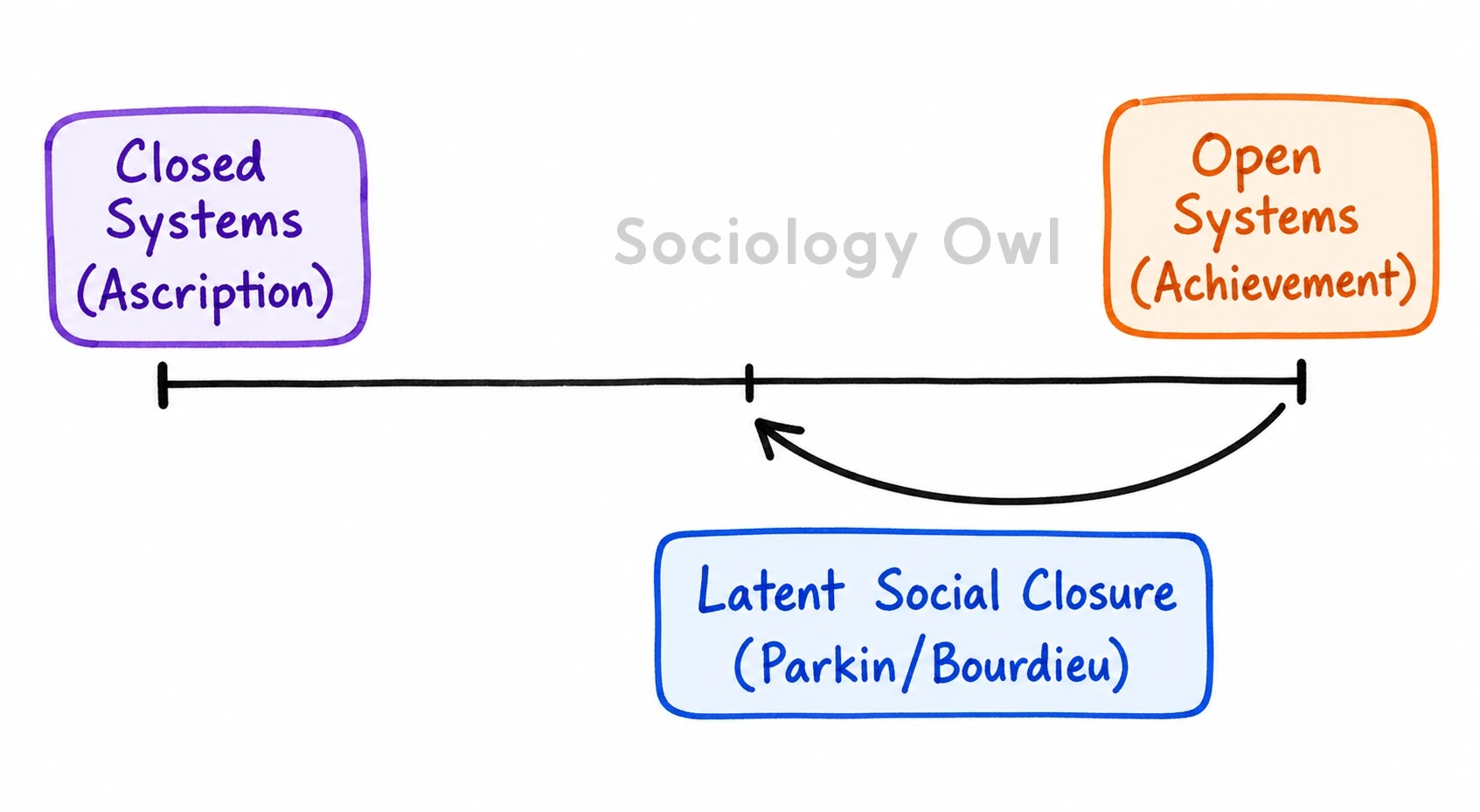
  • Closed Models: Feature ascription-based rigidity. Louis Dumont (Homo Hierarchicus) views the Indian caste system as archetypal, while Max Weber notes such status groups ensure strict social reproduction.
  • Open Models: Grounded in achievement. Functionalists like Davis & Moore argue they efficiently allocate roles via meritocracy.

  • Sociological Critique: The binary dichotomy is highly contested:
    • Social Closure: Frank Parkin notes privileged groups in “open” systems still monopolize resources using credentials.
    • Myth of Meritocracy: Marxists like Bowles and Gintis argue “open” systems merely legitimize structural inequality.
    • Hidden Barriers: Pierre Bourdieu asserts that Cultural Capital covertly restricts mobility regardless of formal openness.
    • Relative vs. Absolute Mobility: John Goldthorpe demonstrated that despite economic expansion (absolute mobility), relative mobility (comparative chances of a working-class child rising) remains rigidly restricted.

The “Great Gatsby Curve” empirically proves that highly unequal “open” capitalist societies (e.g., the USA) paradoxically exhibit low social mobility, functionally resembling closed systems.

Conclusion

Rather than a rigid binary, societies exist on a continuum. Recognizing the latent closures within theoretically “open” systems is essential for understanding the true complexities of contemporary social stratification.

Q. What is social mobility? Critically examine the classification of ‘closed’ and ‘open’ models of social stratification. Read More »

Q. Discuss the concept of animism and differentiate it from naturism.

Q. Discuss the concept of animism and differentiate it from naturism.

UPSC Sociology 2024 Paper 1

Model Answer:

Animism and Naturism

Animism and Naturism are early theories from the evolutionary school of religion, attempting to explain the origins of primitive belief systems.

Concepts and Differences

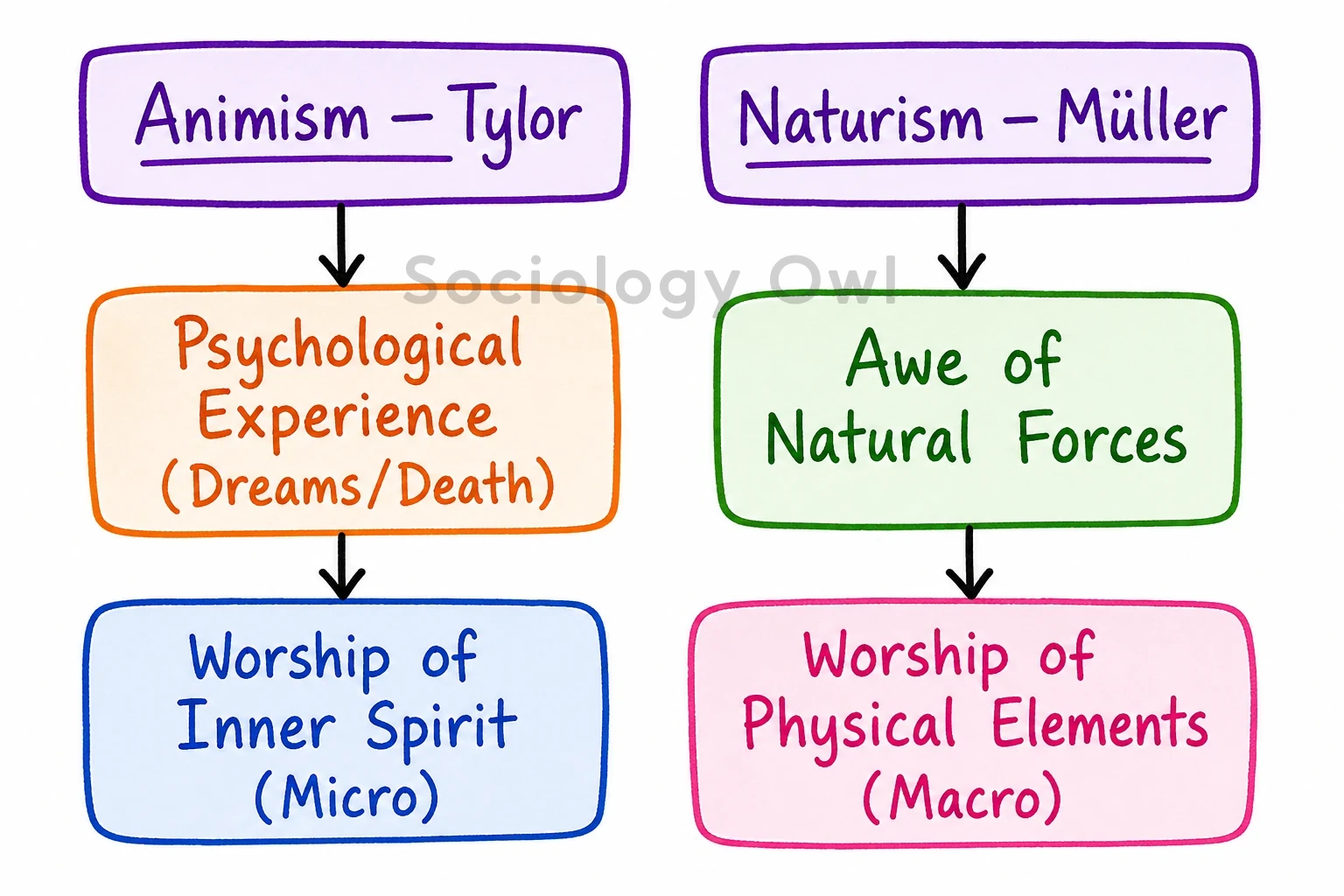
  • Animism (E.B. Tylor): Rooted in primitive psychological experiences of dreams and death, it posits that all entities possess a dual existence and a soul (“anima”).
  • Naturism (Max Müller): Stems from early man’s awe and fear of infinite natural forces. Through a “disease of language,” these abstract forces were gradually personified into deities.
  • Core Difference: Animism venerates the hidden spirit inside specific objects, while Naturism worships the macro physical forces (like the sun or wind) themselves.

Emile Durkheim (The Elementary Forms of Religious Life) famously critiqued both theories, arguing that enduring social institutions like religion cannot stem from mere “illusions” or fear. Today, indigenous practices blending both—like India’s tribal Sarna religion—drive modern eco-spirituality and the conservation of sacred groves.

Conclusion

Though classically criticized for ethnocentric bias, Animism and Naturism remain foundational sociological frameworks, functionally validated today by their latent role in promoting ecological harmony.

Q. Discuss the concept of animism and differentiate it from naturism. Read More »

Q. Discuss the dimensions of power in the construction and maintenance of social hierarchies in a society.

Q. Discuss the dimensions of power in the construction and maintenance of social hierarchies in a society.

UPSC Sociology 2024 Paper 1

Model Answer:

Dimensions of Power in Social Hierarchies

Defined by Max Weber as realizing one’s will despite resistance, power stratifies society. Steven Lukes identifies three core dimensions—decision-making, agenda-setting, and ideological control—that are central to constructing and maintaining social hierarchies.

Mechanisms of Social Hierarchy

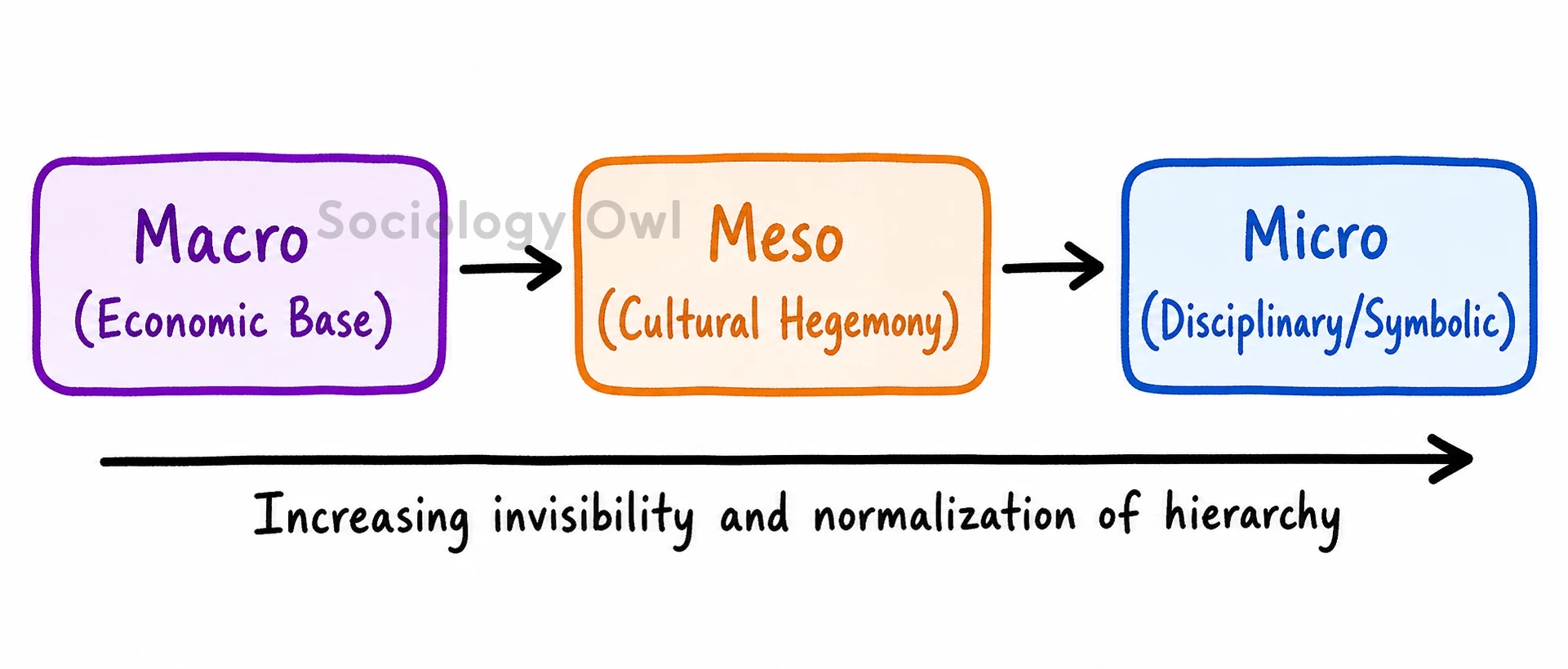
  • Political Economy: Karl Marx ties power directly to owning the means of production, establishing baseline class hierarchies.
  • Ideological Control: Antonio Gramsci explains hierarchy maintenance through Cultural Hegemony, where ruling classes normalize their worldview as common sense.
  • Symbolic & Discursive Power: Pierre Bourdieu argues that Cultural Capital and Symbolic Violence legitimize and reproduce class privileges. Similarly, Michel Foucault highlights Disciplinary Power, which maintains hierarchy through surveillance and the Power/Knowledge nexus.
  • Intersectionality: Patricia Hill Collins describes a “Matrix of Domination” where overlapping identities (race, class, gender) compound social stratification.

  • Critique: Conversely, functionalist Talcott Parsons views power not as domination, but as a “variable-sum game” and a systemic resource for collective goals.

In India, English language fluency acts as Cultural Capital, reinforcing historic caste and class divides in corporate hiring. Globally, algorithmic management in the gig economy exemplifies modern Disciplinary Power.

Conclusion

Hierarchies are sustained through intertwined economic, ideological, and discursive dimensions of power. Yet, as Foucault observed, “where there is power, there is resistance,” ensuring that social stratification remains dynamic and continuously contested by subaltern groups.

Q. Discuss the dimensions of power in the construction and maintenance of social hierarchies in a society. Read More »

Q. What do you understand by ‘mixed method’? Discuss its strengths and limitations in social research.

Q. What do you understand by ‘mixed method’? Discuss its strengths and limitations in social research.

UPSC Sociology 2024 Paper 1

Model Answer:

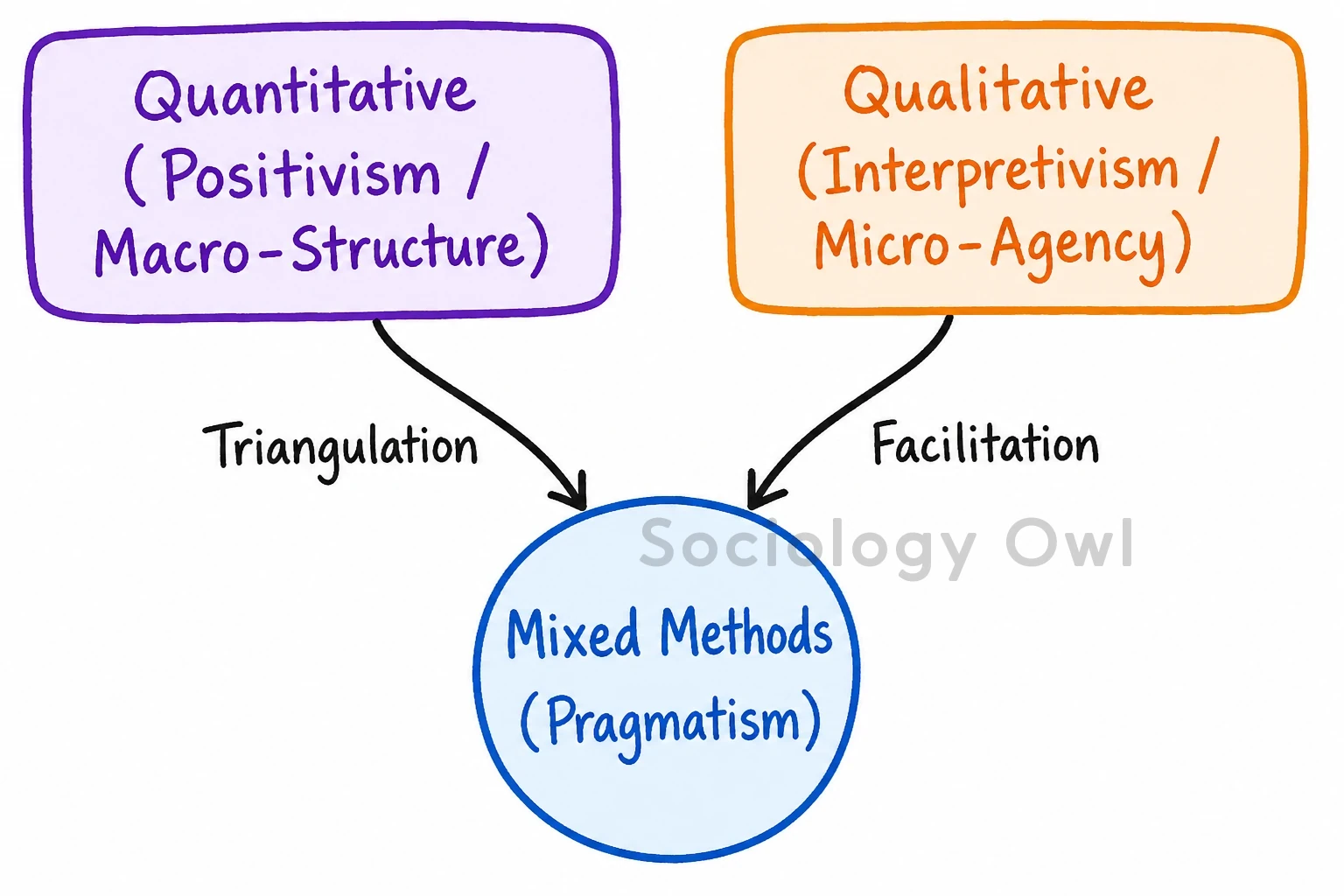
The “Mixed Method”, termed the “Third Methodological Movement” by John W. Creswell, integrates quantitative and qualitative techniques within a single study. It emerged to resolve the historical “paradigm wars” between Positivism (macro/objective) and Interpretivism (micro/subjective). Rooted in the philosophy of Pragmatism (Tashakkori and Teddlie), it argues that the research question dictates methodology, overriding dogmatic adherence to a single paradigm.

Strengths of Mixed Methods

  • Methodological Triangulation: Norman Denzin argues that deploying multiple methods on a single research object enhances validity by cross-verifying structural data with lived experiences.
  • Macro-Micro Linkage: It bridges the Structure-Agency divide. Alan Bryman highlights that quantitative methods establish structural regularities, while qualitative methods explain the subjective mechanisms driving them.
  • Facilitation: One method sequentially aids another. For instance, qualitative focus groups often inform the design of a robust quantitative survey.
  • Classical Precedents: Informally, classical thinkers utilized this. Max Weber masterfully combined statistical historical data with Verstehen (empathetic understanding) in The Protestant Ethic and the Spirit of Capitalism.

Limitations of Mixed Methods

  • Incommensurability Thesis: Radical methodologists argue Positivism and Interpretivism possess fundamentally incompatible Ontologies (nature of reality) and Epistemologies (knowledge gathering). A socially constructed reality cannot seamlessly “mix” with an objective, observable one.
  • Epistemological Dilution: Critics warn of superficial application, where qualitative research is stripped of its deep interpretive essence merely to align with statistical metrics.
  • Resource Intensity: Executing dual paradigms requires specialized epistemological expertise, significantly increasing time and funding constraints.

Matthew Desmond’s Pulitzer-winning study Evicted exemplifies mixed methodology. He synthesized massive quantitative datasets (court eviction records) to map the macro-scale housing crisis, alongside immersive ethnographic interviews to capture the micro-level trauma of poverty.

Conclusion

In complex, postmodern societies, no single methodological lens sufficiently captures dynamic social realities. Aligning with Geoff Payne’s advocacy for Methodological Pluralism, mixed methods signify the maturing of sociological research, enabling scholars to synthesize structural constraints with individual agency for truly holistic insights.

Q. What do you understand by ‘mixed method’? Discuss its strengths and limitations in social research. Read More »

Q. Discuss various theories of social change. Explain the limitations of unilinear theory of social change.

Q. Discuss various theories of social change. Explain the limitations of unilinear theory of social change.

UPSC Sociology 2024 Paper 1

Model Answer:

Sociology emerged to comprehend massive disruptions caused by the “Twin Revolutions.” Conceptually, Anthony Giddens defines social change as the “alteration of underlying structures,” while MacIver and Page describe it as a process responsive to shifting social relationships.

Theories of Social Change

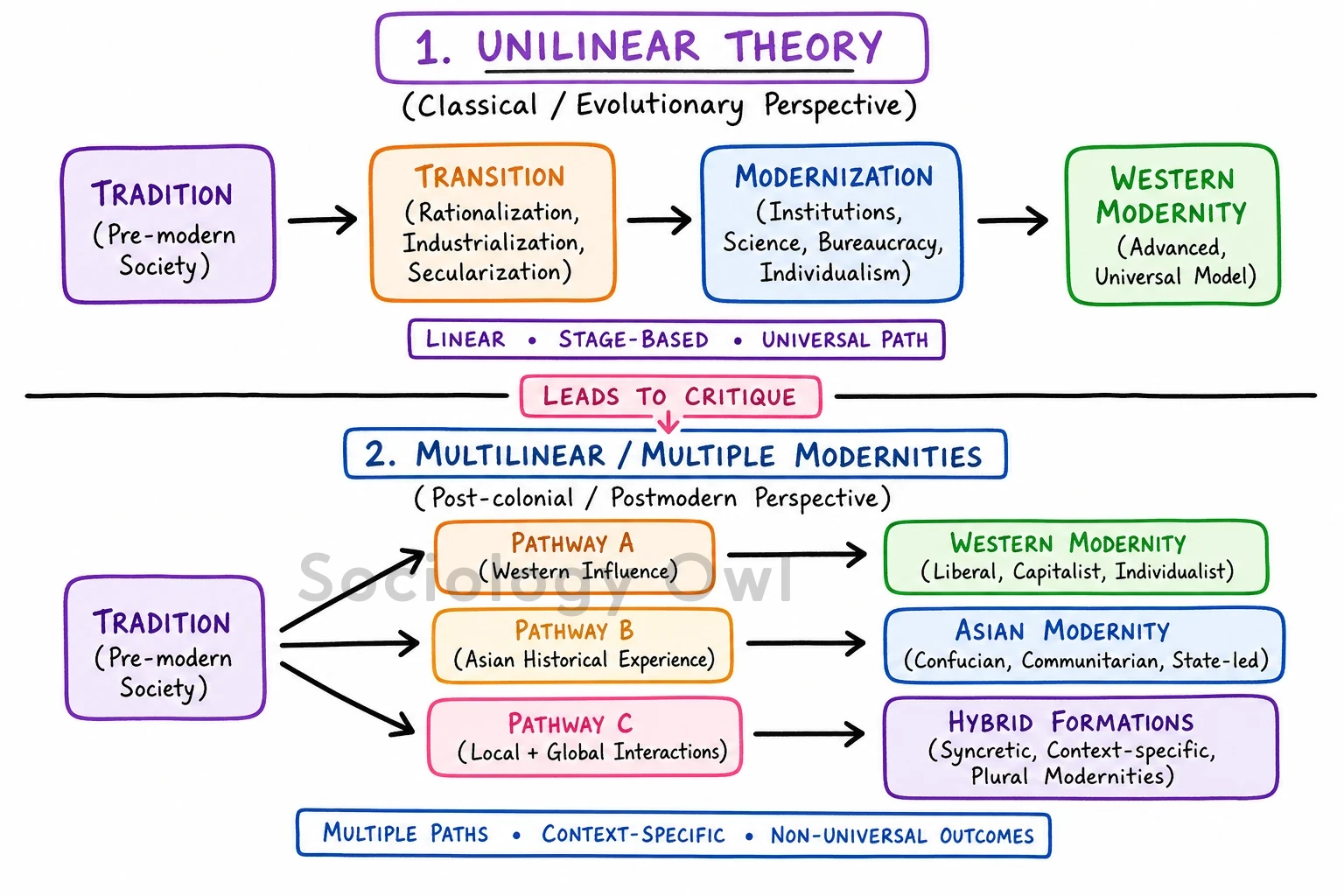
  • Evolutionary Theory: Auguste Comte and Herbert Spencer posited unilinear progress. Classic sociology also includes Emile Durkheim, who analyzed the shift from Mechanical to Organic solidarity driven by “dynamic density.”
  • Functionalist Theory: Moving beyond static models, Talcott Parsons explained change through “Moving Equilibrium” and “Structural Differentiation,” where shifts in one subsystem compel systemic evolutionary adaptation.
  • Conflict Theory: Karl Marx argued Historical Materialism and class struggle drive dialectical change. Later, Ralf Dahrendorf emphasized change via conflict over authority in “imperatively coordinated associations.”
  • Cyclical Theory: Pitirim Sorokin theorized macro-historical pendulum swings between Sensate (material) and Ideational (spiritual) cultures. Vilfredo Pareto highlighted historical cycles through the “Circulation of Elites.”

Limitations of Unilinear Theory

  • Ethnocentrism & Dependency: A.G. Frank and Immanuel Wallerstein critiqued unilinear models (like Rostow’s stages) via Dependency Theory, arguing Western progress actively caused Third-World underdevelopment.
  • Alternative Trajectories: S.N. Eisenstadt’s framework of “Multiple Modernities” proves that non-Western nations (e.g., India, Japan) modernize without fully Westernizing.
  • Postmodern Critique: Jean-Fran2ois Lyotard rejected unilinear progress as an obsolete “Grand Meta-narrative,” arguing societies are too fragmented for a single trajectory.
  • Societal Regression: Unilinear theory fails to explain regression through ecological collapse, wars, or democratic backsliding.

“Digital leapfrogging” in the Global South—such as India adopting Digital Public Infrastructure (UPI) to bypass traditional Western banking stages—and the global resurgence of religious traditionalism heavily defy unilinear, secular-progressive predictions.

Conclusion

While unilinear theories provided foundational frameworks, contemporary sociology relies on multidimensional, globalized perspectives—such as Ulrich Beck’s Risk Society or Arjun Appadurai’s “Scapes”—to analyze the non-linear, unpredictable nature of modern social transformations.

Q. Discuss various theories of social change. Explain the limitations of unilinear theory of social change. Read More »

Q. How is ‘power’ different from ‘authority’? Discuss various types of authorities as theorized by Max Weber.

Q. How is ‘power’ different from ‘authority’? Discuss various types of authorities as theorized by Max Weber.

UPSC Sociology 2024 Paper 1

Model Answer:

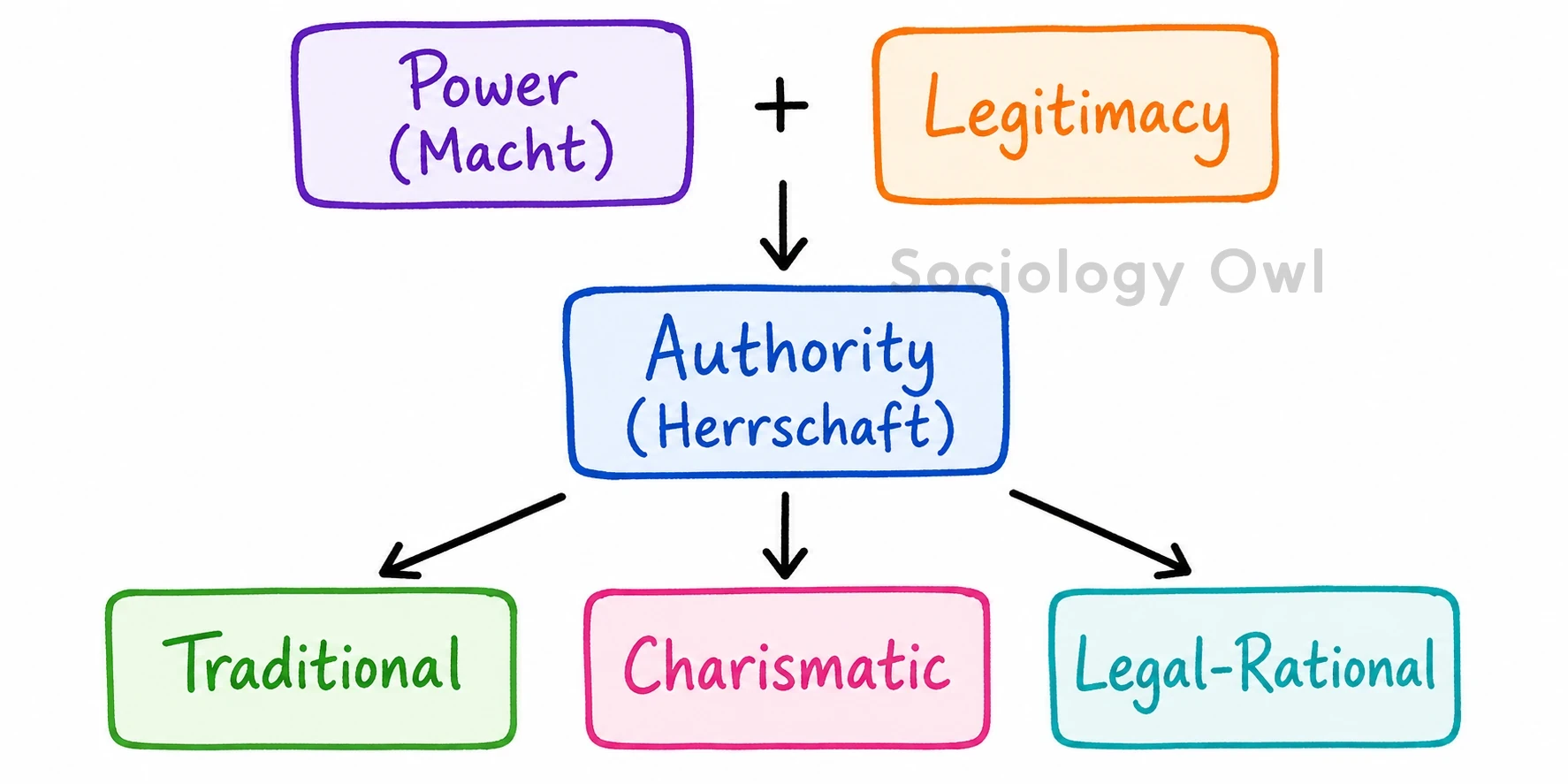
Max Weber distinguishes power (Macht) as the ability to impose one’s will even against resistance, from authority (Herrschaft), which is power validated by legitimacy (voluntary compliance based on a belief in the ruler’s right to rule).

Types of Authority

Weber conceptualized three Ideal Types of authority, corresponding to his typology of social action:

  • Traditional Authority: Rooted in long-standing customs and habit (Traditional action).
  • Charismatic Authority: Based on devotion to a leader’s exceptional personal qualities (Affective action). Upon the leader’s absence, it inevitably undergoes the Routinization of Charisma.
  • Legal-Rational Authority: Grounded in formal, codified rules and laws (Zweckrational action).

Critique

  • Michel Foucault countered Weber by arguing that power is not a possession held by leaders, but is “capillary” and omnipresent.
  • Robert Michels argued that even democratic legal-rational structures inevitably succumb to the Iron Law of Oligarchy.

Modern populist politics often demonstrate an overlap of types, where leaders utilize Legal-Rational Authority (elected via constitutions) but govern leveraging Charismatic Authority (building personality cults via social media).

Conclusion

Despite Marxist critiques that legal authority merely masks capitalist control, Weber’s typology remains a seminal framework in political sociology for analyzing the shift from pre-modern to modern statecraft.

Q. How is ‘power’ different from ‘authority’? Discuss various types of authorities as theorized by Max Weber. Read More »