Prelims Solution

Paragraph: According to the Food and Agriculture Organization, one-third of food produced for human consumption is lost or wasted globally.

Paragraph:

According to the Food and Agriculture Organization, one-third of food produced for human consumption is lost or wasted globally.

Food is lost or wasted throughout the supply chain, from initial agricultural production to final household consumption. The increasing wastage also results in land degradation by about 45%, mainly due to deforestation, unsustainable agricultural practices, and excessive groundwater extraction. The energy spent over wasted food results in about 3.5 billion tonnes of carbon dioxide production every year. Decay also leads to harmful emissions of other gases in the atmosphere. Addressing the loss and wastage of food in all forms is critical to complete the cycle of food efficiency and food sustainability.

Q1. Which of the following statements best reflect the most logical and rational inferences that can be made from the passage?
1. The current methods of food distribution are solely responsible for the loss and wastage of food.
2. Land productivity is adversely affected by the prevailing trend of food loss and wastage.
3. Reduction in the loss and wastage of food results in lesser carbon footprint.
4. Post-harvest technologies to prevent or reduce the loss and wastage of food are not available.
Select the correct answer using the code given below.
a) 1, 2 and 3
b) 2 and 3 only
c) 1, 3 and 4
d) 1, 2 and 4
Correct answer: b) 2 and 3 only

Q2. Based on the above passage, the following assumptions have been made:
1. The food distribution mechanism needs to be reimagined and made effective to reduce the loss and wastage of food.
2. Ensuring the reduction of wastage and loss of food is a social and moral responsibility of all citizens.

Which of the assumptions given above is/are valid?
a) 1 only
b) 2 only
c) Both 1 and 2
d) Neither 1 nor 2
Correct answer: c) Both 1 and 2

Question from UPSC Prelims 2024 CSAT

Explanation : 

Q1: Let’s examine each statement and compare with the passage:

1. “Current methods of food distribution are solely responsible” – The passage mentions wastage occurs “throughout the supply chain, from initial agricultural production to final household consumption.” So this statement is incorrect as it’s not solely distribution.

2. “Land productivity is adversely affected” – The passage states “wastage results in land degradation by about 45%,” so this is a valid inference.

3. “Reduction in loss and wastage results in lesser carbon footprint” – Since the passage mentions wasted food leads to 3.5 billion tonnes of CO2 production, reducing waste would logically reduce the carbon footprint. This is valid.

4. “Post-harvest technologies are not available” – The passage makes no mention of post-harvest technologies, so this cannot be inferred.

Therefore, only statements 2 and 3 are valid inferences. Answer (b) is correct.

Q2: Let’s examine the assumptions:

Assumption 1: “The food distribution mechanism needs to be reimagined and made effective to reduce the loss and wastage of food.”

This assumption is valid. The passage clearly highlights that food wastage occurs throughout the supply chain, from agricultural production to household consumption. Thus, it implicitly suggests that improving the food distribution mechanism is necessary to reduce wastage.

Assumption 2: “Ensuring the reduction of wastage and loss of food is a social and moral responsibility of all citizens.”

This assumption is also valid. The passage emphasizes the critical importance of addressing food wastage for food efficiency and sustainability. It implicitly suggests that reducing food wastage is not just an economic or environmental issue but also a social and moral responsibility for everyone involved.

Hence, both assumptions are valid.
Paragraph: According to the Food and Agriculture Organization, one-third of food produced for human consumption is lost or wasted globally. Read More »

Q. Consider the following statements: Statement-I: The Indian Flying Fox is placed under the “vermin” category in the Wild Life (Protection) Act, 1972.

Q. Consider the following statements:

Statement-I: The Indian Flying Fox is placed under the “vermin” category in the Wild Life (Protection) Act, 1972.
Statement-II: The Indian Flying Fox feeds on the blood of other animals.

Which one of the following is correct in respect of the above statements?
(a) Both Statement-I and Statement-II are correct and Statement-II explains Statement-I
(b) Both Statement-I and Statement-II are correct, but Statement-II does not explain Statement-I
(c) Statement-I is correct, but Statement-II is incorrect
(d) Statement-I is incorrect, but Statement-II is correct
Correct answer: (c) Statement-I is correct, but Statement-II is incorrect

Question from UPSC Prelims 2024 GS Paper

Explanation : 

UPSC cancelled this question.

1. Statement-I is correct:

– Under the Wildlife (Protection) Act, 1972, animals are classified into different schedules based on their status and level of protection needed
– Schedule V of the Act includes “vermin” species – animals that are considered as pests/nuisance and receive least protection
– The Indian Flying Fox (Pteropus giganteus) is listed in Schedule V as “vermin”
– This classification allows these animals to be hunted or captured without restrictions
– The reason for this classification is primarily due to their perceived damage to fruit orchards and crops

2. Statement-II is incorrect:

– The Indian Flying Fox is a frugivorous bat species
– Their diet consists mainly of ripe fruits, flower nectar, and pollen
– They do not feed on blood of other animals
– Blood-feeding (hematophagy) is a characteristic of vampire bats, which are a different family of bats found in the Americas

Therefore, option (c) is the correct answer as Statement-I accurately describes the legal status of Indian Flying Fox, while Statement-II incorrectly describes its feeding habits.

Q. Consider the following statements: Statement-I: The Indian Flying Fox is placed under the “vermin” category in the Wild Life (Protection) Act, 1972. Read More »

Q. In the context of India, which of the following is/are considered to be practice(s) of eco-friendly agriculture?

Q. In the context of India, which of the following is/are considered to be practice(s) of eco-friendly agriculture?

1.Crop diversification
2.Legume intensification
3.Tensiometer use
4.Vertical farming

Select the correct answer using the code given below:
a) 1, 2 and 3 only
b) 3 only
c) 4 only
d) 1, 2, 3 and 4
Correct Answer : a) 1, 2 and 3 only

Question from UPSC Prelims 2020 GS Paper

Explanation:

Official UPSC Answer: a) 1, 2 and 3 only

1. Crop diversification: This is widely practiced in India as an eco-friendly approach that reduces pest pressure, improves soil health, and increases resilience to climate fluctuations.

2. Legume intensification: This is an eco-friendly practice in India where farmers incorporate more leguminous crops (like pulses) that naturally fix nitrogen in the soil, reducing the need for chemical fertilizers.

3. Tensiometer use: This is considered eco-friendly in Indian agriculture as it helps farmers monitor soil moisture levels accurately, leading to more efficient water use and irrigation scheduling, particularly important in water-stressed regions.

4. Vertical farming: While this is an eco-friendly practice globally, it has limited widespread adoption in India’s agricultural landscape, being mostly confined to urban settings and specialized operations rather than being considered a traditional eco-friendly practice in Indian agriculture.

Q. In the context of India, which of the following is/are considered to be practice(s) of eco-friendly agriculture? Read More »

Q. A has some coins. He gives half of the coins and 2 more to B. B gives half of the coins and 2 more to C. C gives half of the coins and 2 more to D. The number of coins D has now, is the smallest two- digit number. How many coins does A have in the beginning?

Q. A has some coins. He gives half of the coins and 2 more to B. B gives half of the coins and 2 more to C. C gives half of the coins and 2 more to D. The number of coins D has now, is the smallest two- digit number. How many coins does A have in the beginning?

a. 76
b. 68
c. 60
d. 52
Correct Answer: d. 52

Question from UPSC Prelims 2022 CSAT Paper

Explanation : 

A has some coins

Let’s solve this step by step:

1. Initial Condition:
– A has x coins
– A gives half of coins plus 2 to B

2. After first transfer (A to B):
– A has: x/2 – 2 coins
– B has: x/2 + 2 coins

3. After second transfer (B to C):
– B gives half plus 2 to C
– B has: (x/2 + 2)/2 – 2 = x/4 – 1 coins
– C has: (x/2 + 2)/2 + 2 = x/4 + 3 coins

4. After third transfer (C to D):
– C gives half plus 2 to D
– C has: (x/4 + 3)/2 – 2 = x/8 – 1/2 coins
– D has: (x/4 + 3)/2 + 2 = x/8 + 7/2 coins

5. Given condition:
– D has smallest two-digit number (10)
– Therefore: x/8 + 7/2 = 10

6. Solve for x:
– x/8 + 7/2 = 10
– x/8 = 10 – 7/2
– x/8 = 6.5
– x = 52

Verification:
– A starts with 52 coins
– B gets 28 coins (26 + 2), A keeps 24
– C gets 16 coins (14 + 2), B keeps 12
– D gets 10 coins (8 + 2), C keeps 6

Answer: A had 52 coins initially

Q. A has some coins. He gives half of the coins and 2 more to B. B gives half of the coins and 2 more to C. C gives half of the coins and 2 more to D. The number of coins D has now, is the smallest two- digit number. How many coins does A have in the beginning? Read More »

Q. On one side of a 1.01 km long road, 101 plants are planted at equal distance from each other. What is the total distance between 5 consecutive plants?

Q. On one side of a 1.01 km long road, 101 plants are planted at equal distance from each other. What is the total distance between 5 consecutive plants?

a. 40 m
b. 40.4 m
c. 50 m
d. 50.5 m
Correct Answer: b. 40.4 m

Question from UPSC Prelims 2022 CSAT Paper

Explanation : 

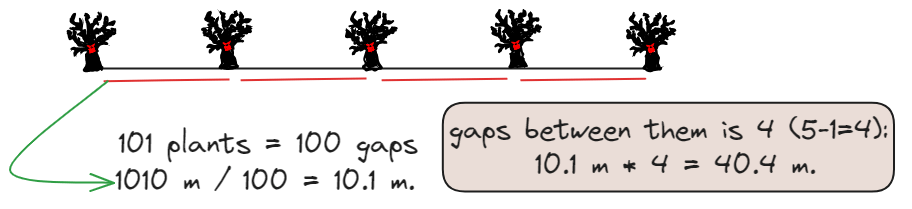
101 plants on a 1.01 km road

Given information:
– Road length: 1.01 km = 1010 meters
– Total plants: 101
– Plants are equally spaced
– First plant at 0 meters
– Last plant at 1010 meters

Solution steps:

1. Find total gaps between plants:
– Total gaps = Total plants – 1
– Total gaps = 101 – 1 = 100 gaps

2. Find distance between consecutive plants:
– Distance = Total length ÷ Number of gaps
– Distance = 1010 ÷ 100 = 10.1 meters

3. Find distance for 5 consecutive plants:
– Number of gaps = Number of plants – 1
– Number of gaps = 5 – 1 = 4 gaps
– Total distance = Distance per gap × Number of gaps
– Total distance = 10.1 × 4 = 40.4 meters

Answer: The distance between 5 consecutive plants is 40.4 meters

On one side of a 1.01 km long road

Q. On one side of a 1.01 km long road, 101 plants are planted at equal distance from each other. What is the total distance between 5 consecutive plants? Read More »

How many 3-digit natural numbers (without repetition of digits) are there such that each digit is odd and the number is divisible by 5?

Q. How many 3-digit natural numbers (without repetition of digits) are there such that each digit is odd and the number is divisible by 5?

a. 8
b. 12
c. 16
d. 24
Correct Answer: b.12

Question from UPSC Prelims 2022 CSAT Paper

Explanation : 

How many 3 digit natural numbers ??

Given conditions:
– Must be a 3-digit number
– All digits must be odd
– No repetition of digits allowed
– Number must be divisible by 5

Solution steps:

1. For divisibility by 5:
– Last digit must be either 0 or 5
– Since only odd digits allowed, last digit must be 5

2. Available odd digits: 1, 3, 5, 7, 9
– 5 is already used in units place
– Remaining digits for other positions: 1, 3, 7, 9

3. Filling other positions:
– Hundreds place: 4 choices (1, 3, 7, 9)
– Tens place: 3 choices (remaining digits after hundreds place)

4. Total possible numbers:
– Using multiplication principle
– 4 × 3 = 12 different numbers

Answer: 12 three-digit numbers possible

How many 3-digit natural numbers (without repetition of digits) are there such that each digit is odd and the number is divisible by 5? Read More »

Question: Is x an integer? Statement-1: x/3 is not an integer. Statement-2: 3x is an integer.

Q. Consider the Question and two Statements given below:

Question: Is x an integer?
Statement-1: x/3 is not an integer.
Statement-2: 3x is an integer.

Which one of the following is correct in respect of the Question and the Statements?
a.    Statement-1 alone is sufficient to answer the Question
b.   Statement-2 alone is sufficient to answer the Question
c.    Both Statement-1 and Statement-2 are sufficient to answer the Question
d.   Both Statement-1 and Statement-2 are not sufficient to answer the Question
Correct Answer: d.   Both Statement-1 and Statement-2 are not sufficient to answer the Question

Question from UPSC Prelims 2022 CSAT Paper

Explanation : 

Is x an integer?

Statement-1: x/3 is not an integer

– This tells us x cannot be evenly divided by 3
– Examples: x could be 2/3 (not an integer) or 4 (integer)
– Statement-1 alone is not sufficient

Statement-2: 3x is an integer

– This means x could be an integer or a fraction multiple of 1/3
– Examples: if 3x = 6, then x = 2 (integer)
if 3x = 2, then x = 2/3 (not integer)
– Statement-2 alone is not sufficient

Combined Analysis:
– Statement-1: x cannot be evenly divided by 3
– Statement-2: 3x is an integer
– Together they tell us x must be a fraction multiple of 1/3
– Still cannot determine if x is definitely an integer

Answer: Both Statement-1 and Statement-2 are not sufficient to answer the Question.

Question: Is x an integer? Statement-1: x/3 is not an integer. Statement-2: 3x is an integer. Read More »

Q. A man completes 7/8 of a job in 21 days. How many more days will it take him to finish the job if quantum of work is further increased by 50%

Q. A man completes 7/8 of a job in 21 days. How many more days will it take him to finish the job if quantum of work is further increased by 50%

(a) 24
(b) 21
(c) 18
(d) 15
Correct Answer: (d) 15

Question from UPSC Prelims 2021 CSAT Paper

Explanation : 

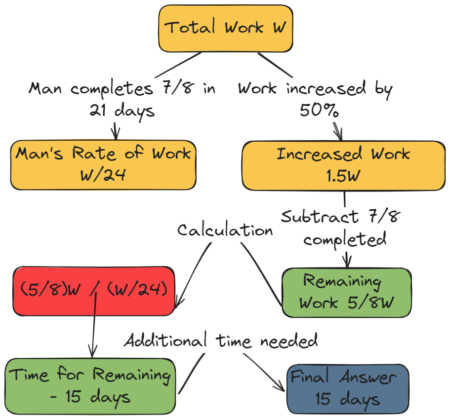
A man completes 7/8 of a job in 21 days ….

Given:
– Man completes 7/8 of work in 21 days
– Work increases by 50%

Step 1: Find Rate of Work
– Total work = W
– Rate = (7/8)W ÷ 21 = W/24 per day

Step 2: Calculate New Work
– Increased work = 1.5W
– Already completed = 7/8W
– Remaining = 1.5W – 7/8W = 5/8W

Step 3: Calculate Days Required
– Time = Remaining work ÷ Rate
– = (5/8W) ÷ (W/24)
– = 15 days

Answer: 15 additional days required

Man completes 7/8 work in 21 days

Q. A man completes 7/8 of a job in 21 days. How many more days will it take him to finish the job if quantum of work is further increased by 50% Read More »

Q. In India, the objective of macroeconomics policy is to enhance the economic welfare of the people, and any one wing of such macro policy, monetary or fiscal, cannot independently work without active support of another.

Q. In India, the objective of macroeconomics policy is to enhance the economic welfare of the people, and any one wing of such macro policy, monetary or fiscal, cannot independently work without active support of another.

Q 1. Which one of the following statements best reflects the corollary to the passage given above?

(a) The central bank cannot work independently of the Government.
(b) Government should regulate financial markets and institutions closely.
(c) Market economy is not compatible with the socialist policies of the Government.
(d) Financial sector reforms are required for enhancing the economic welfare of the people.

Question from UPSC Prelims 2021 CSAT Paper

Explanation : 

Q1: Correct Answer – (a) The central bank cannot work independently of the Government.

Explanation – (a) The central bank cannot work independently of the Government: This option suggests that the central bank and the government must work together in order to achieve their objectives. In the context of the passage, this means that monetary and fiscal policies must be coordinated in order to enhance the economic welfare of the people.

(b) Government should regulate financial markets and institutions closely: This option suggests that it is important for the government to closely monitor and regulate financial markets and institutions. While this may be a valid statement in general, it does not directly follow from the passage.

c) Market economy is not compatible with socialist policies of the Government: This option suggests that there is a conflict between a market economy and socialist policies implemented by the government. While this may be a topic for debate, it does not directly follow from the passage.

(d) Financial sector reforms are required for enhancing economic welfare of people: This option suggests that reforms in the financial sector are necessary in order to improve economic welfare. While this may be true, it does not directly follow from the passage which focuses on coordination between monetary and fiscal policies.

Q. In India, the objective of macroeconomics policy is to enhance the economic welfare of the people, and any one wing of such macro policy, monetary or fiscal, cannot independently work without active support of another. Read More »

Q. The resolution of bankruptcy cases of Indian banks under the Insolvency and Bankruptcy Code should help bring non-performing assets (NPA) situation under some control.

Q. The resolution of bankruptcy cases of Indian banks under the Insolvency and Bankruptcy Code should help bring non-performing assets (NPA) situation under some control.

Despite the slow pace of resolution by the National Company Law Tribunal, the Code can be helpful in cleaning up bank books in future credit cycles. The recapitalization of public sector banks too can help increase the capital cushion of banks and induce them to lend more and boost economic activity. But bad debt resolution and recapitalization are only a part of the solution as they, by themselves, can do very little to rein in reckless lending that has pushed the Indian banking system to its current sorry state. Unless there are systemic reforms that address the problem of unsustainable lending, future credit cycles will continue to stress the banking system.

Q 1. Which one of the following statements best reflects the most logical, rational and practical suggestion implied by the passage given above?
(a) Lending by the banks should be closely monitored and regulated by the central Government.
(b) Interests rates should be kept low so as to induce banks to lend more, promote credit growth and thereby boost economic activity.
(c) Merger of many banks into a few large banks alone in the long-term solution to make them viable and prevent their bad performance.
(d) Indian banking system requires structural reforms as a long-term solution for bad loans problem.

Question from UPSC Prelims 2021 CSAT Paper

Explanation : 

Q1: Correct Answer – (d) Indian banking system requires structural reforms as a long-term solution for bad loans problem.

Explanation – The most logical, rational and practical suggestion implied by the passage given above is that the Indian banking system requires structural reforms as a long-term solution for bad loans problem (option d). The passage suggests that while resolution of bankruptcy cases and recapitalization of public sector banks can help in cleaning up bank books and increasing their capital cushion, they are only a part of the solution. Systemic reforms that address the problem of unsustainable lending are necessary to prevent future credit cycles from stressing the banking system.

Q. The resolution of bankruptcy cases of Indian banks under the Insolvency and Bankruptcy Code should help bring non-performing assets (NPA) situation under some control. Read More »