Prelims Solution

Q. A number N is formed by writing 9 for 99 times. What is the remainder if N is divided by 13?

Q. A number N is formed by writing 9 for 99 times. What is the remainder if N is divided by 13?

(a) 11
(b) 9
(c) 7
(d) 1
Correct Answer: (a) 11

Question from UPSC Prelims 2023 CSAT

Explanation : 

Number n is formed by writing 9 for 99 times

Group the given number into sets of 3 starting from the right, or the units place. From the rightmost group of 3 digits apply the subtraction and addition operations alternatively and find the result. If the result is either a 0 or it can be divided by 13 completely without leaving a remainder, then the number is divisible by 13.

For example, in the number 1,139,502 applying the subtraction and addition operations alternatively from the rightmost group of 3 digits, we get 502 – 139 + 1 = 364. 364/13 gives 28 as quotient and 0 as remainder. Therefore, 1139502 is divisible by 13.

Similarly,

To determine if the number formed by writing the digit 9 ninety-nine times is divisible by 13

We can use a method that involves grouping the digits and applying alternating addition and subtraction operations. Here’s a step-by-step explanation:

1. Form the Number

The number in question is composed of the digit 9 repeated 99 times.

2. Group the Digits

We group the digits into sets of three, starting from the rightmost digit. This results in 33 groups of ‘999’.

3. Apply Operations

Starting from the rightmost group, we apply alternating subtraction and addition operations to these groups. This method is based on a divisibility rule for 13, which states that if you take the last three digits of a number, subtract the next three digits, add the next three, and so on, and if the resulting number is divisible by 13, then the original number is also divisible by 13.

4. Calculate

For our number, the calculation would look like this:

999 – 999 + 999 – 999 + … + 999 (33 times in total).

5. Simplify the Calculation

Since each ‘999’ is either added or subtracted, and there are an odd number of these groups (33), the calculation simplifies to just one ‘999’ (because 32 of them will cancel each other out).

6. Check Divisibility

Now, we check if 999 is divisible by 13:

999 ÷ 13 = 76 remainder 11.

Since there is a remainder when 999 is divided by 13, the original number (composed of 99 nines) is not divisible by 13.
Q. A number N is formed by writing 9 for 99 times. What is the remainder if N is divided by 13? Read More »

Q22. consider the following pairs: State Well known for 1. Besnagar : Shaivite cave shrine 2. Bhaja : Buddhist cave shrine 3. Sittanavasal : Jain cave shrine

Q22. Consider the following pairs:
Site – Well known for

1. Besnagar : Shaivite cave shrine
2. Bhaja : Buddhist cave shrine
3. Sittanavasal : Jain cave shrine

How many of the above pairs are correctly matched?
a. Only one
b. Only two
c. All three
d. None

Question from UPSC Prelims 2023 GS Paper

Explanation : 

Correct Answer – b

Besnagar Cave

Besnagar is an archaeological site in Madhya Pradesh, India. While it is not particularly well-known for a Shaivite cave shrine, it is famous for the Heliodorus Pillar, an ancient Garuda Pillar dedicated to Lord Vishnu. The Udayagiri Caves, which are located nearby, do contain ancient Hindu and Jain sculptures, but they are not specifically known as a Shaivite cave shrine.

Bhaja Cave

Bhaja Caves are a group of 22 rock-cut caves located in Maharashtra, India, and are well known for their Buddhist architecture and sculptures. They date back to the 2nd century BCE and are an important example of early Buddhist cave art in India.

Sittanavasal Cave

Sittanavasal is a small village in Tamil Nadu, India, famous for its Jain cave shrine known as Sittanavasal Cave. The cave contains ancient Jain frescoes and inscriptions dating back to the 7th-9th centuries CE.

Q22. consider the following pairs: State Well known for 1. Besnagar : Shaivite cave shrine 2. Bhaja : Buddhist cave shrine 3. Sittanavasal : Jain cave shrine Read More »

Q. What is the value of X in the sequence 20, 10, 10, 15, 30, 75, X?

Q. What is the value of X in the sequence 20, 10, 10, 15, 30, 75, X?

a. 105
b. 120
c.  150
d. 225
Correct Answer: d. 225

Question from UPSC Prelims 2022 CSAT Paper

Explanation :

20,10,10,15,30,75

1 20 x 0.5 = 10
2 10 x 1.0 = 10
3 10 x 1.5 = 15
4 15 x 2.0 = 30
5 30 x 2.5 = 75
6 75 x 3.0 = 225

We can see that to obtain X, we need to multiply the previous term (75) by 3. Therefore, the value of X is:

X = 75 x 3 = 225
Therefore, the correct answer is (d) 225.

Q. What is the value of X in the sequence 20, 10, 10, 15, 30, 75, X? Read More »

Q100.Consider the following statements: Statement-I: The Supreme Court of India has held in some judgements that the reservation policies made under Article 16(4) of the Constitution of India would be limited by Article 335 for maintenance of efficiency of administration.

Q100.Consider the following statements:

Statement-I: The Supreme Court of India has held in some judgements that the reservation policies made under Article 16(4) of the Constitution of India would be limited by Article 335 for maintenance of efficiency of administration.

Statement-II: Article 335 of the Constitution of India defines the term ‘efficiency of administration’.

Which one of the following is correct in respect of the above statements?
a. Both Statement-I and Statement-II are correct and Statement-II is the correct explanation for Statement-I
b. Both Statement-I and Statement-II are correct and Statement-II is not the correct explanation for Statement-I
c. Statement-I is correct but Statement-II is incorrect
d. Statement-I is incorrect but Statement-II is correct

Question from UPSC Prelims 2023 GS Paper

Explanation : 

c. Statement-I is correct but Statement-II is incorrect

Supreme Court Judgments on Reservation Policies

The Supreme Court of India has held in some judgments that the reservation policies made under Article 16(4) of the Constitution of India would be limited by Article 335 for the maintenance of efficiency of administration. This means that while providing reservation to certain groups, the efficiency of administration should not be compromised.

  1. N.M. Thomas vs. State of Kerala (1976): The Supreme Court upheld the state government’s decision to extend reservation to SC and ST candidates in promotional posts. The court argued that such reservations were a way to ensure equality of opportunity, stating that Article 335 should not be interpreted in a manner that undermines the purpose of Article 16(4).

  2. Indra Sawhney vs. Union of India (1992): Often referred to as the Mandal Commission case, this judgment declared that reservations could be valid but should not exceed 50% of the available positions, considering it essential to maintain an efficient administration as mandated by Article 335. The court also stated that the concept of ‘efficiency’ is not merely numerical but should be understood as an overall efficiency including the representation of backward classes.

  3. M. Nagaraj & Others vs. Union of India & Others (2006): This case re-affirmed that reservations in promotions can be constitutionally valid but should be applied cautiously, with the state needing to show quantifiable data to justify such reservations. The court ruled that any reservation policy should not disturb the efficiency of administration, reiterating the balance mandated by Article 335.

Article 335 of the Constitution of India

Article 335 of the Constitution of India does not define the term ‘efficiency of administration.’ Article 335 states that the claims of the Scheduled Castes and the Scheduled Tribes shall be taken into consideration, consistently with the maintenance of efficiency of administration, in the making of appointments to services and posts in connection with the affairs of the Union or of a State.

Article 335 in Constitution of India (indiankanoon.org)

Q100.Consider the following statements: Statement-I: The Supreme Court of India has held in some judgements that the reservation policies made under Article 16(4) of the Constitution of India would be limited by Article 335 for maintenance of efficiency of administration. Read More »

Q2. With reference to Central Bank digital currencies, consider the following statements:

Q2. With reference to Central Bank digital currencies, consider the following statements:

1. It is possible to make payments in a digital currency without using US dollar or SWIFT system.
2. A digital currency can be distributed with a condition programmed into it such as a time-frame for spending it.

With of the statements given above is/are correct?
a. 1 only
b. 2 only
c. Both 1 and 2
d. Neither 1 nor 2

Question from UPSC Prelims 2023 GS Paper

Explanation : 

c. Both 1 and 2

What is Central Bank Digital Currencies (CBDCs) ?

CBDCs are digital versions of a country’s fiat currency, issued and controlled by the central bank. They can be used for transactions without involving the US dollar or the SWIFT system. The SWIFT system is an international network for financial messaging and communication between banks. CBDCs can potentially bypass this system, allowing for more direct transactions between countries and reducing reliance on the US dollar as the global reserve currency.

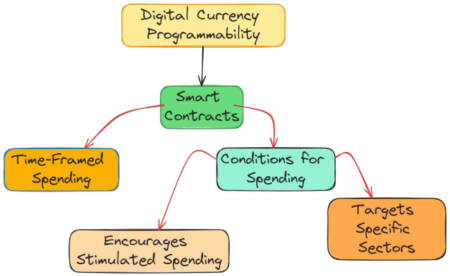
Digital Currency Programmability

A digital currency can be programmed with specific conditions, such as a time-frame for spending it. This is possible because digital currencies are built on blockchain technology, which allows for programmable money. Smart contracts can be used to define the conditions under which the digital currency can be spent, such as a specific time-frame or other criteria. This feature can be useful for various purposes, such as encouraging spending to stimulate the economy or targeting specific sectors for financial support.

Central Bank digital currencies - Digital Currency Programmability

Q2. With reference to Central Bank digital currencies, consider the following statements: Read More »

Q96. Consider the following statements: 1. If the election of the President of India is declared void by the Supreme Court of India, all acts done by him/her in the performance of duties of his/her office of President before the date of decision become invalid.

Q96. Consider the following statements:

1. If the election of the President of India is declared void by the Supreme Court of India, all acts done by him/her in the performance of duties of his/her office of President before the date of decision become invalid.

2. Election for the post of the President of India can be postponed on the ground that some legislative Assemblies have been dissolved and elections are yet to take place.

3. When a Bill is presented to the President of India, the Constitution prescribes time limits within which he/she has to declare his/her assent.

How many of the above statements are correct?
a. Only one
b. Only two
c. All three
d. None

Question from UPSC Prelims 2023 GS Paper

Explanation : 

d. None

1. The acts done by the President before the date of the decision of the Supreme Court do not become invalid if the election of the President is declared void.

2. The election for the post of the President of India cannot be postponed on the ground that some legislative Assemblies have been dissolved and elections are yet to take place.

3. The Constitution does not prescribe any time limit within which the President has to declare his/her assent when a Bill is presented to him/her.

Q96. Consider the following statements: 1. If the election of the President of India is declared void by the Supreme Court of India, all acts done by him/her in the performance of duties of his/her office of President before the date of decision become invalid. Read More »

Q95. Consider the following organization/bodies in India: 1. The National Commission for Backward Classes 2. The National Human Rights Commission 3. The National Law Commission 4. The National Consumer Disputes Redressal Commission

Q95. Consider the following organization/bodies in India:

1. The National Commission for Backward Classes
2. The National Human Rights Commission
3. The National Law Commission
4. The National Consumer Disputes Redressal Commission

How many of the above are constitutional bodies?
a. Only one
b. Only two
c. Only three
d. All four

Question from UPSC Prelims 2023 GS Paper

Explanation : 

a. Only One

1. The National Commission for Backward Classes – This body is a constitutional body as per Article 338B of the Indian Constitution, which was added through the 102nd Constitutional Amendment Act, 2018.

2. The National Human Rights Commission – This body is not a constitutional body. It is a statutory body established under the Protection of Human Rights Act, 1993.

3. The National Law Commission –  There is a Law Commission of India, which is neither a constitutional body nor a statutory body. It is an ad-hoc and advisory body constituted by the Government of India from time to time.

4. The National Consumer Disputes Redressal Commission – This body is not a constitutional body. It is a statutory body established under the Consumer Protection Act, 1986.

Q95. Consider the following organization/bodies in India: 1. The National Commission for Backward Classes 2. The National Human Rights Commission 3. The National Law Commission 4. The National Consumer Disputes Redressal Commission Read More »

Q93. Which one of the following statements best reflects the Chief purpose of the ‘Constitution’ of a country?

Q93. Which one of the following statements best reflects the Chief purpose of the ‘Constitution’ of a country?

a. It determines the objective for the making of necessary laws.
b. It enables the creation of political offices and a government.
c. It defines and limits the powers of government.
d. It secures social justice, social equality and social security.

Question from UPSC Prelims 2023 GS Paper

Explanation : 

c. It defines and limits the powers of government.

Purpose of a Constitution

The chief purpose of a constitution is to define and limit the powers of government. It establishes the structure, functions, and principles of a government, as well as the rights and responsibilities of its citizens. While a constitution may also serve other purposes, such as determining objectives for lawmaking, creating political offices, and securing social justice, its primary function is to provide a framework for governance and to ensure that government power is exercised within the bounds of the constitution. This helps to maintain a balance of power and prevent the abuse of authority.

Q93. Which one of the following statements best reflects the Chief purpose of the ‘Constitution’ of a country? Read More »

Q92. Consider the following statements: Statement-I: In India, prisons are managed by State Governments with their own rules and regulations for the day-to-day administration of prisons.

Q92. Consider the following statements:

Statement-I: In India, prisons are managed by State Governments with their own rules and regulations for the day-to-day administration of prisons.

Statement-II: In India, prisons are governed by the Prisons Act, 1894 which expressly kept the subject of prisons in the control of Provincial Governments.

Which one of the following is correct in respect of the above statements?
a. Both Statement-I and Statement-II are correct and Statement-II is the correct explanation for Statement-I
b. Both Statement-I and Statement-II are correct and Statement-II is not the correct explanation for Statement-I
c. Statement-I is correct but Statement-II is incorrect
d. Statement-I is incorrect but Statement-II is correct

Question from UPSC Prelims 2023 GS Paper

Explanation : 

Correct Answer : a. Both Statement-I and Statement-II are correct and Statement-II is the correct explanation for Statement-I

In India, prisons are managed by State Governments, and each state has its own rules and regulations for the day-to-day administration of prisons. This is because prisons are governed by the Prisons Act, 1894, which expressly kept the subject of prisons in the control of Provincial Governments (now State Governments). Therefore, both statements are correct, and Statement-II is the correct explanation for Statement-I.
Prisons in India – Wikipedia

Q92. Consider the following statements: Statement-I: In India, prisons are managed by State Governments with their own rules and regulations for the day-to-day administration of prisons. Read More »

Q90. By which one of the following Acts was the Governor General of bengal designated as the Governor General of India?

Q90. By which one of the following Acts was the Governor General of bengal designated as the Governor General of India?

a. The Regulating Act
b. The Pitt’s India Act
c. The Charter Act of 1793
d. The Charter Act of 1833

Question from UPSC Prelims 2023 GS Paper

Explanation : 

d. The Charter Act of 1833

Governor-General of India

Governor-General of Bengal was designated as the Governor-General of India by the Charter Act of 1833. This act centralized the British administration in India by consolidating the control of the British East India Company’s territories under a single authority. The Governor-General of India became the highest-ranking British official in India, responsible for directing and controlling all the company’s affairs in the country. This change in designation marked a crucial step in the process of establishing a centralized British administration in India.

Government of India Act 1833 – Wikipedia

Q90. By which one of the following Acts was the Governor General of bengal designated as the Governor General of India? Read More »