Q24. Consider the following statements in respect of the National Flag of India according to the Flag Code of India, 2002:
Statement-I: One of the standard sizes of the National Flag of India is 600 mm * 400 mm.
Statement-II: The ratio of the length to the height (width) of the Flag shall be 3:2.
Which one of the following is correct in respect of the above statements? a. Both Statement-I and Statement-II are correct and Statement-II is the correct explanation for Statement-I b. Both Statement-I and Statement-II are correct and Statement-II is not the correct explanation for Statement-I c. Statement-I is correct but Statement-II is incorrect d. Statement-I is incorrect but Statement-II is correct
Question from UPSC Prelims 2023 GS Paper
Explanation :
Correct Answer: d. Statement-I is incorrect but Statement-II is correct
Flag Code of India
According to the Flag Code of India, 2002, the standard sizes of the National Flag are not 600 mm * 400 mm. The correct standard sizes are 6300 mm x 4200 mm, 3600 mm x 2400 mm, 2700 mm x 1800 mm, 1800 mm x 1200 mm, 1350 mm x 900 mm, 900 mm x 600 mm, 450 mm x 300 mm, 225 mm x 150 mm, and 150 mm x 100 mm.
Statement-II is correct as the ratio of the length to the height (width) of the Flag shall be 3:2.
Statement-I: 7th August is declared as the National Handloom Day. Statement-II: It was in 1905 that the Swadeshi Movement was launched on the same day.
Which one of the following is correct in respect of the above statements?
a. Both Statement-I and Statement-II are correct and Statement-II is the correct explanation for Statement-I b. Both Statement-I and Statement-II are correct and Statement-II is not the correct explanation for Statement-I c. Statement-I is correct but Statement-II is incorrect d. Statement-I is incorrect but Statement-II is correct
Question from UPSC Prelims 2023 GS Paper
Explanation :
Correct Answer: a. Both Statement-I and Statement-II are correct and Statement-II is the correct explanation for Statement-I
National Handloom Day is observed on 7th August every year to honor the handloom weavers and the rich handloom traditions of India. This day was chosen as it commemorates the launch of the Swadeshi Movement in 1905, which aimed at reviving domestic products and production processes, including handlooms.
The Swadeshi Movement played a significant role in promoting the handloom industry and encouraging the use of Indian handloom products.
Q20. ‘Microsatellite DNA’ is used in the case of which one of the following?
a. Studying the evolutionary relationships among various species of fauna b. Stimulating ‘stem cells’ to transform into diverse functional tissues c. Promoting clonal propagation of horticultural plants d. Assessing the efficacy of drugs by conducting series of drug trials in a population
Question from UPSC Prelims 2023 GS Paper
Explanation :
a. Studying the evolutionary relationships among various species of fauna
Microsatellite DNA and its Importance
Microsatellite DNA, also known as short tandem repeats (STRs), consists of short repeating sequences of nucleotides (usually 2-6 base pairs) found throughout the genome. These repetitive sequences are highly variable among individuals and populations, making them useful for studying the evolutionary relationships among various species of fauna. By comparing the microsatellite DNA patterns of different individuals or species, researchers can infer genetic diversity, population structure, and evolutionary relationships. Microsatellite DNA is not directly involved in stem cell stimulation, clonal propagation of plants, or drug trial assessments.
Q19. ‘Aerial metagenomics’ best refers to which one of the following situations?
a. Collecting DNA samples from air in a habitat at one go b. Understanding the genetic makeup of avian species of a habitat c. Using air-borne devices to collect blood samples from moving animals d. Sending drones to inaccessible areas to collect plant and animal samples from land surfaces and water bodies
Question from UPSC Prelims 2023 GS Paper
Explanation :
Correct Answer: a. Collecting DNA samples from air in a habitat at one go
Aerial Metagenomics UPSC
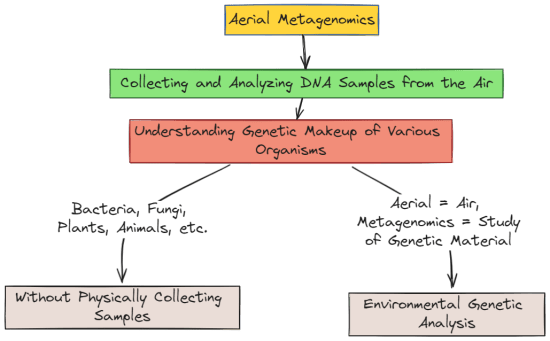
Aerial metagenomics refers to the process of collecting and analyzing DNA samples from the air in a specific habitat. This method helps in understanding the genetic makeup of various organisms (including bacteria, fungi, plants, and animals) present in the environment without having to physically collect samples from each organism. The term “aerial” refers to the air, and “metagenomics” refers to the study of genetic material from multiple species within a community.
Q17. “Wolbachia method’ is sometimes talked about with reference to which one of the following?
a. Controlling the viral diseases spread by mosquitoes b. Converting crop residues into packing material c. Producing biodegradable plastics d. Producing biochar from thermo-chemical conversion of biomass
Question from UPSC Prelims 2023 GS Paper
Explanation :
a. Controlling the viral diseases spread by mosquitoes
Wolbachia Method: Natural Solution to Mosquito-Borne Viral Diseases
The Wolbachia method refers to the innovative use of Wolbachia bacteria to control the spread of viral diseases transmitted by mosquitoes. These diseases include dengue, Zika, chikungunya, and yellow fever. Wolbachia is a naturally occurring bacterium found in a high percentage of insect species, particularly in some mosquito species.
How Does the Wolbachia Method Work?
When introduced into mosquito populations, Wolbachia has a significant impact on reducing the mosquitoes’ ability to transmit viruses to humans. This reduction in transmission risk is achieved through two main mechanisms:
Shortening the mosquito’s lifespan, thereby reducing the likelihood of transmitting the virus.
Directly inhibiting the replication of the virus within the mosquito itself.
By releasing mosquitoes infected with Wolbachia into the environment, researchers aim to create a sustainable and effective method to reduce the transmission of these dangerous mosquito-borne diseases.
1. In a seismograph, P waves are recorded earlier than S waves. 2. In P waves, the individual particles vibrate to and fro in the direction of wave propagation whereas in S waves, the particles vibrate up and down at right angles to the direction of wave propagation.
Which of the statements given above is/are correct? a. 1 only b. 2 only c. Both 1 and 2 d. Neither 1 nor 2
Question from UPSC Prelims 2023 GS Paper
Explanation :
c. Both 1 and 2
P Waves vs. S Waves
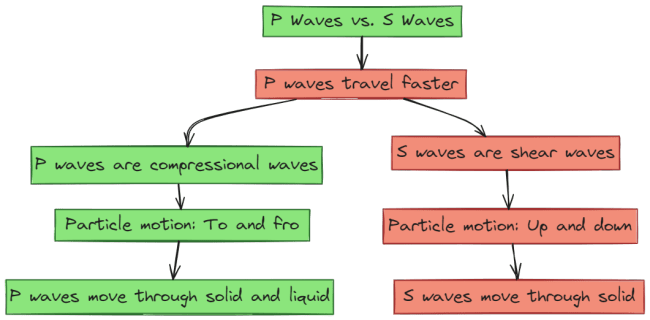
In a seismograph, P waves (Primary waves) are recorded earlier than S waves (Secondary waves) because P waves travel faster through the Earth’s interior than S waves. This is due to the fact that P waves are compressional waves that can travel through both solid and liquid materials, while S waves are shear waves that can only travel through solid materials.
Characteristics of P Waves and S Waves
In P waves, the individual particles vibrate to and fro in the direction of wave propagation, which means they move back and forth along the same direction as the wave is traveling. In S waves, the particles vibrate up and down at right angles to the direction of wave propagation, which means they move perpendicular to the direction in which the wave is traveling. This difference in particle motion is what distinguishes P waves from S waves and contributes to their different speeds and abilities to travel through various materials.
Statements-I: The soil in tropical rain forests is rich in nutrients. Statements-II: The high temperature and moisture of tropical rain forests cause dead organic matter in the soil to decompose quickly.
Which one of the following is correct in respect of the above statements? a. Both Statement-I and Statement-II are correct and Statement-II is the correct explanation for Statement-I b. Both Statement-I and Statement-II are correct and Statement-II is not the correct explanation for Statement-I c. Statement-I is correct but Statement-II is incorrect d. Statement-I is incorrect but Statement-II is correct
Question from UPSC Prelims 2023 GS Paper
Explanation :
Correct Answer- d. Statement-I is incorrect but Statement-II is correct
Tropical rain forests
The soil in tropical rain forests is not rich in nutrients. This is because the high temperature and moisture of tropical rain forests cause dead organic matter in the soil to decompose quickly, as mentioned in Statement-II. This rapid decomposition leads to the nutrients being quickly absorbed by the plants, leaving the soil relatively nutrient-poor.
Q12. With reference to the Earth’s atmosphere, which one of the following statements is correct?
a. The total amount of insolation received at the equator is roughly about 10 times of that received at the poles. b. Infrared rays constitute roughly two-thirds of insolation. c. Infrared waves are largely absorbed by water vapour that is concentrated in the lower atmosphere. d. Infrared waves are a part of visible spectrum of electromagnetic waves of solar radiation.
Question from UPSC Prelims 2023 GS Paper
Explanation : Explanation :
Correct Answer – c
Characteristics of Infrared Waves
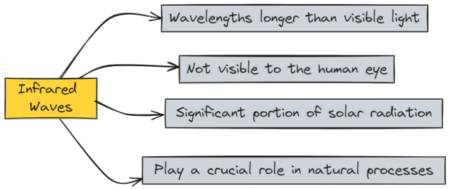
Infrared waves are a type of electromagnetic radiation with wavelengths longer than visible light. Unlike the visible spectrum, infrared waves are not visible to the human eye. They represent a significant portion of solar radiation and play a crucial role in various natural processes.
Infrared Radiation and Atmospheric Absorption
One of the key characteristics of infrared waves is their interaction with water vapor in the Earth’s lower atmosphere. These waves are largely absorbed by water vapor, leading to the warming of the Earth’s surface and lower atmosphere. This absorption is a vital component in understanding the Earth’s climate and weather patterns.
Misconceptions About Infrared Radiation and Insolation
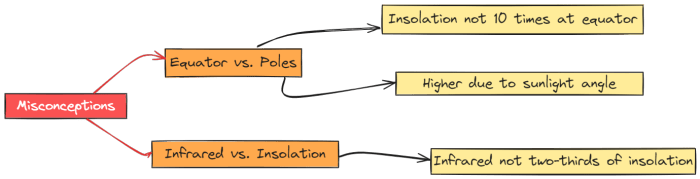
Contrary to some beliefs, the total amount of insolation received at the equator is not 10 times that at the poles. However, it is significantly higher due to the angle of sunlight incidence. Additionally, while infrared rays do not constitute two-thirds of insolation, they are a substantial part of the total solar radiation that the Earth receives, influencing the global climate.
Q10. Consider the following statements in respect of election to the President of India:
1. The members nominated to either House of the Parliament or the Legislative Assemblies of States are also eligible to be included in the Electoral College. 2. Higher the number of elective Assembly seats, higher is the value of vote of each MLA of that State. 3. The Value of vote of each MLA of Madhya Pradesh is greater than that of Kerala 4. The value of vote of each MLA of Puducherry is higher than that of Arunachal Pradesh because the ratio of total population to total number of elective seats in Puducherry is greater as compared to Arunachal Pradesh.
How many of the above statements are correct?
a. Only one b. Only two c. Only three d. All four
Question from UPSC Prelims 2023 GS Paper
Explanation :
Correct Answer – a
Election to the President of India
Statement 1 is false. Members nominated to either House of Parliament or the Legislative Assemblies of States are not eligible to be included in the Electoral College for the election of the President of India. Only elected members of both Houses of Parliament and the Legislative Assemblies of States are part of the Electoral College.
Statement 2 is false. The value of the vote of each MLA is not directly proportional to the number of elective Assembly seats. It is determined based on the population of the State and the number of elected seats in the Assembly. The formula to calculate the value of the vote of an MLA is:
Value of vote of an MLA = Total population of the State / Total number of elected members of the Assembly
Therefore, the value of the vote of each MLA is determined by the population of the State and not by the number of elective Assembly seats.
Vote MLA of MP – 131, Kerala ,152, Puducherry – 12, Arunachal – 8