Parsons Theory of Social Change
Historical Context and Intellectual Roots
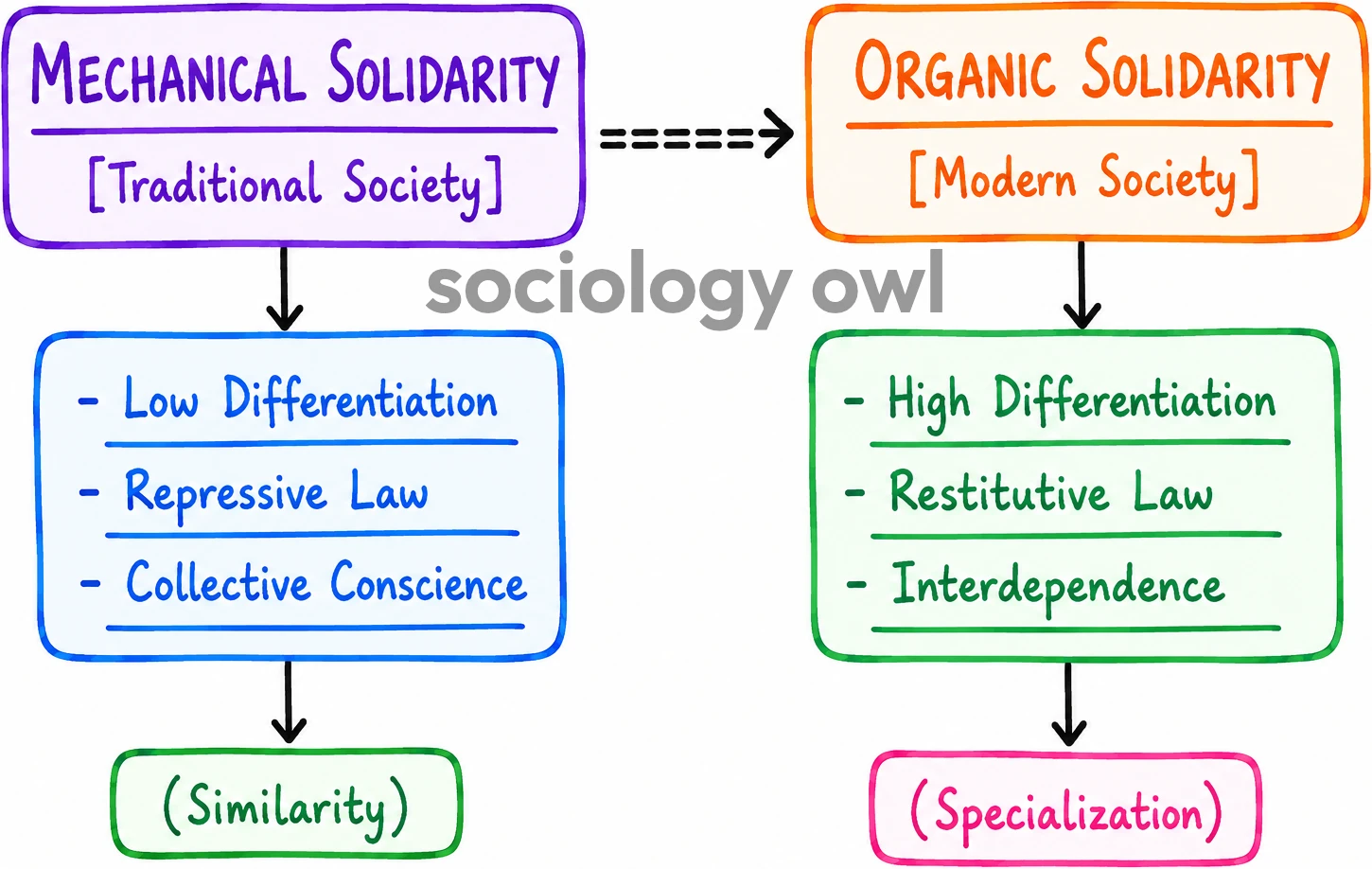
Talcott Parsons, the architect of Structural-Functionalism, initially faced severe criticism for presenting a static model of society in his seminal work, “The Social System” (1951). Critics argued his focus on social order, homeostasis, and the AGIL paradigm (Adaptation, Goal attainment, Integration, Latency) left no room for social change. In response, during the 1960s—a period of massive global decolonization and the American Civil Rights Movement—Parsons shifted his focus. Drawing heavily from Herbert Spencer’s evolutionary biology, Emile Durkheim’s division of labor, and Max Weber’s rationalization, Parsons detailed his neo-evolutionary theory of change in his books “Societies: Evolutionary and Comparative Perspectives” (1966) and “The System of Modern Societies” (1971).
Foundations of Parsons’ Theory of Change
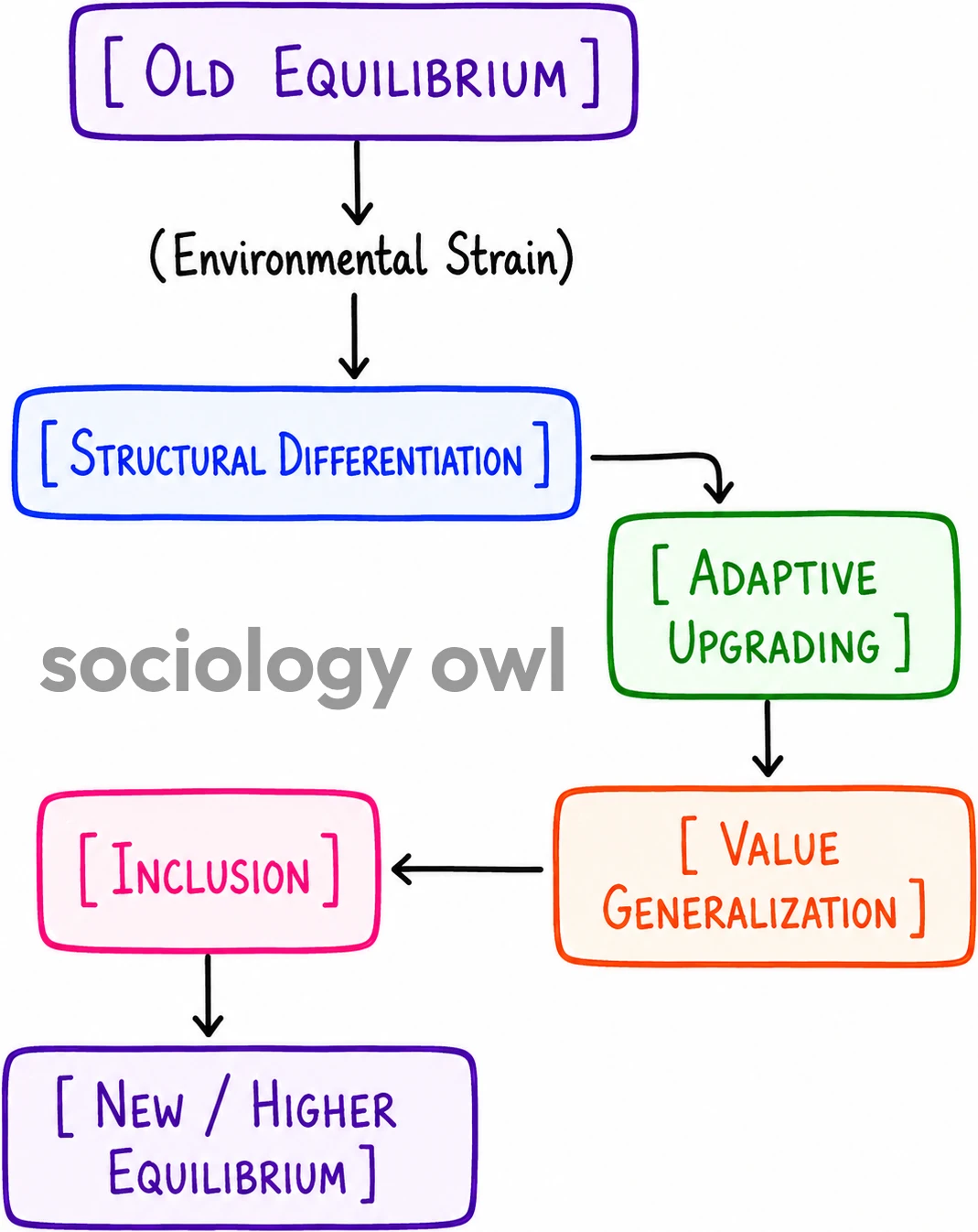
Parsons conceptualized social change not as a destructive force, but as a “moving equilibrium.” When a social system faces disturbances (internal tensions or external environmental shifts), it does not collapse; rather, it adapts to reach a higher state of equilibrium. He outlined a four-stage evolutionary paradigm of social change:
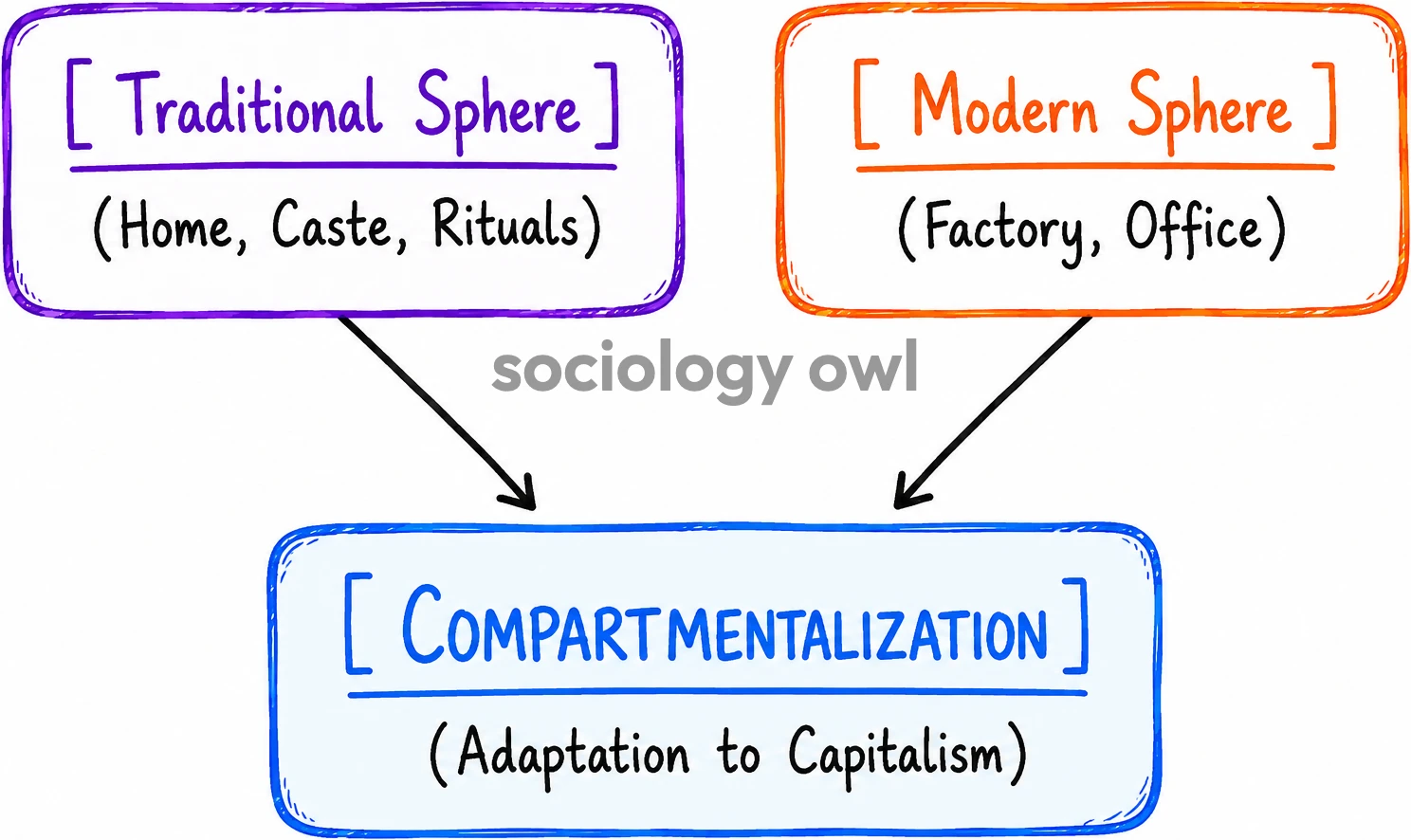
- Structural Differentiation: As society grows complex, single institutions that performed multiple functions split into specialized structures. (e.g., The traditional family’s educational and economic functions are differentiated into schools and factories).
- Adaptive Upgrading: The newly differentiated structures must be more efficient than the older ones. Society enhances its capacity to cope with the environment, expanding its resource base.
- Value Generalization: As society becomes highly differentiated and diverse, older, narrow value systems (like specific religious dogmas) must evolve into broader, more abstract, and secular values to maintain social solidarity (e.g., moving from religious morality to constitutional law).
- Inclusion: The progressive integration of previously marginalized or excluded groups into the mainstream societal fabric, granting them full citizenship and rights.
The Concept of Evolutionary Universals
Parsons introduced “Evolutionary Universals,” referring to structural innovations that are so crucial for survival that any society aspiring to advance must develop them. Once invented, they increase the society’s adaptive capacity. Examples include language, kinship systems, social stratification, bureaucratic organization, money/markets, and universalistic legal systems.
Evolutionary Stages of Societal Development
Parsons categorized human history into three major evolutionary stages, marked by the breakthrough of specific evolutionary universals:
| Stage of Society | Key Characteristics & Evolutionary Universals | Historical Examples |
|---|---|---|
| Primitive Societies | Rely on fundamental universals: Kinship organization, basic religion, language, and rudimentary technology. Change is extremely slow. | Aboriginal tribes, early hunter-gatherers. |
| Intermediate Societies | Marked by the emergence of written language and social stratification. Cultural legitimation of authority begins. | Feudal Europe, Ancient Egypt, traditional agrarian empires. |
| Modern Societies | Driven by advanced universals: bureaucratic administration, money and market systems, universalistic legal frameworks, and democratic associations. | Post-Industrial Revolution nation-states, contemporary democracies. |
The Indian Context: Application and Analysis
Parsons’ grand theory offers profound insights when applied to the modernization and transformation of Indian society (Paper 2 integration):
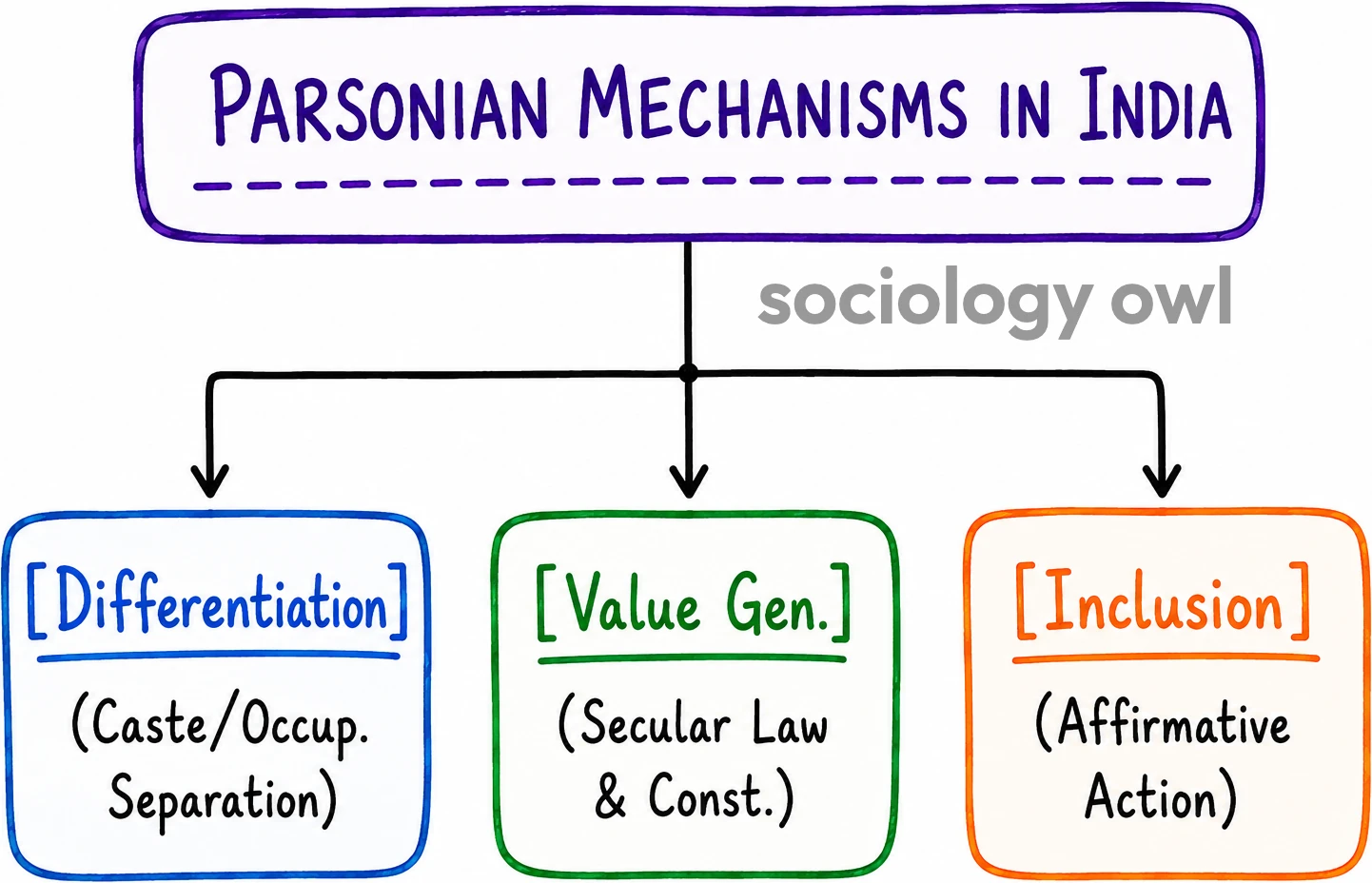
- Yogendra Singh on Modernization: In his book “Modernization of Indian Tradition,” Singh’s analysis reflects Parsons’ theory. He notes that Indian society is undergoing Structural Differentiation (e.g., separation of caste from occupation) and Value Generalization (adoption of a secular Constitution), yet it maintains its equilibrium by synthesizing tradition with modernity.
- M.N. Srinivas and Adaptive Upgrading: Srinivas’s concepts of Westernization and secularization can be seen as India’s process of Adaptive Upgrading. The adoption of modern bureaucratic and educational systems has increased India’s adaptive capacity in a globalized world.
- Andre Beteille on Inclusion: Beteille’s study in Sripuram, highlighting the shift from “cumulative inequalities” (Brahmins holding land, caste, and political power) to “dispersed inequalities” (power moving to dominant castes/classes), perfectly illustrates Parsons’ concept of Inclusion and differentiation of the political sphere from the ritual sphere.
- Dalit and Backward Class Movements: The Constitutional provisions for affirmative action (Articles 15, 16, 17) and the political rise of marginalized castes represent the Parsonian mechanism of Inclusion, bringing excluded groups into the core of the societal system.
Contemporary Relevance
In the 21st century, Parsons’ theory provides a robust framework to understand global mega-trends:
- Globalization: The spread of global financial markets and international law perfectly exemplifies the spread of Evolutionary Universals.
- Technological Adaptation (AI & Cybernetics): Societies are currently undergoing massive Adaptive Upgrading through Artificial Intelligence and digital economies to manage the complexity of modern populations.
- Multiculturalism and Climate Change: As nations become more diverse, there is a push for higher Value Generalization (e.g., global human rights, environmentalism) to integrate diverse groups and manage ecological tensions, maintaining the global systemic equilibrium.
Critiques of Parsons’ Theory
Despite its macro-sociological brilliance, the theory has faced severe criticism:
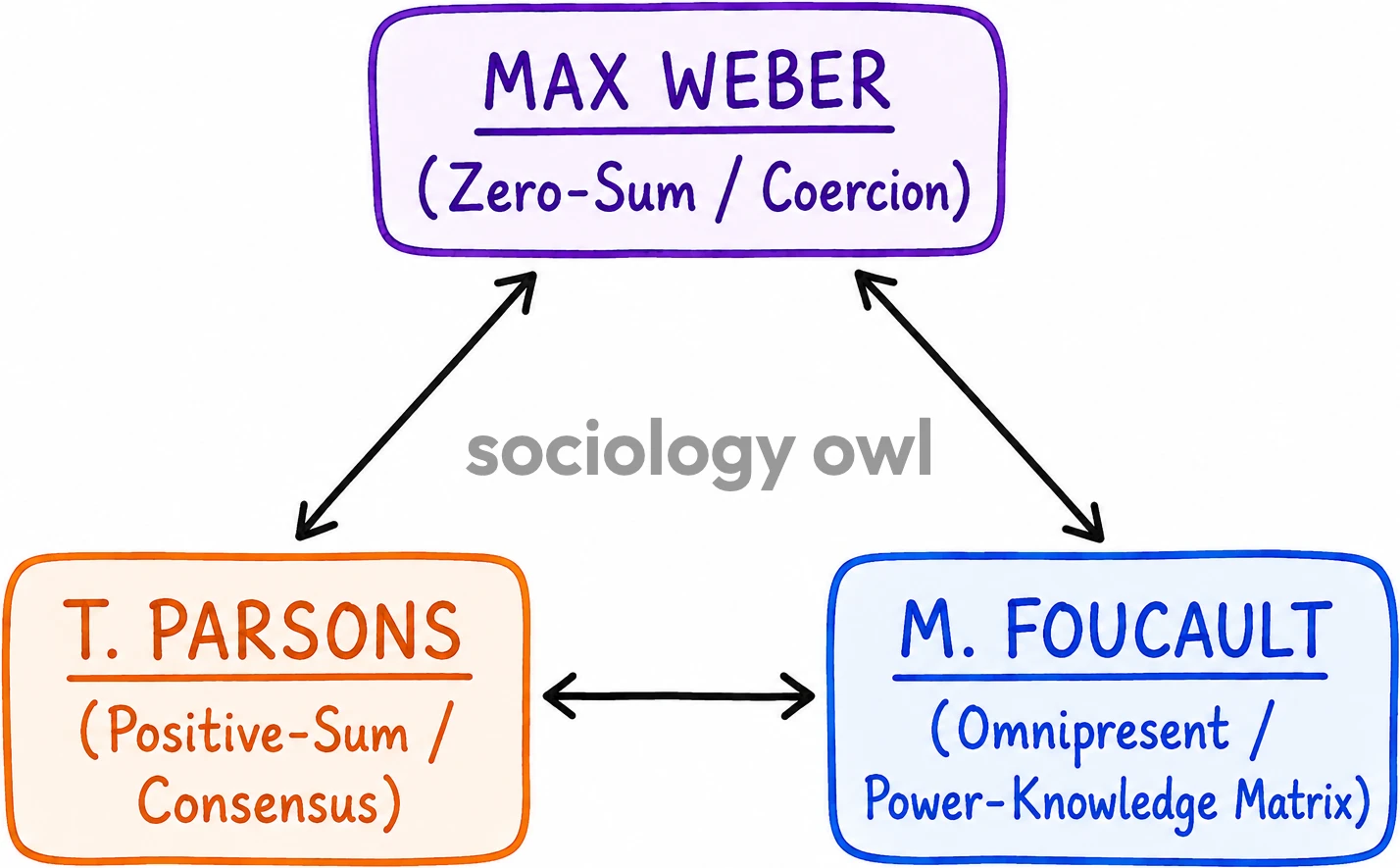
- Conflict Theorists (Ralf Dahrendorf, Lewis Coser): Criticized Parsons for an over-obsession with consensus and equilibrium. They argue change is rarely a smooth, adaptive process; it is usually the result of violent class conflict and coercion.
- C. Wright Mills: Dismissed Parsons’ work as “Grand Theory,” criticizing it for being highly abstract, overly jargonized, and disconnected from the empirical, day-to-day realities of power and exploitation.
- Anthony Giddens & Ethnocentric Bias: Critics argue Parsons’ evolutionary model is highly teleological and ethnocentric, implicitly suggesting that the mid-20th-century American democratic-capitalist system is the ultimate pinnacle of human evolution.
- Robert K. Merton: A fellow functionalist, Merton rejected Parsons’ idea of universal functional prerequisites, advocating instead for Middle-Range Theories that focus on specific, testable societal phenomena.
Conclusion
While Talcott Parsons was often criticized for viewing society through a conservative, status-quo-ist lens, his evolutionary theory remains one of the most ambitious attempts to systematically map the trajectory of human history. By integrating structural differentiation with cultural values, he successfully bridged micro-actions with macro-structures. As Neo-Functionalist Jeffrey Alexander aptly notes, despite its flaws, Parsons’ theoretical architecture is so vast and comprehensive that modern sociology still operates largely in the shadow of his systemic vision, making it indispensable for analyzing continuous, institutional change in complex modern societies.
Parsons Theory of Social Change Read More »