Max Weber: Rationality and Rationalisation
Max Weber, a foundational figure in sociology, placed the concepts of Rationality and Rationalisation at the very core of his sociological enterprise. Historically, these concepts emerged against the backdrop of the Enlightenment and the Industrial Revolution. Weber sought to explain the unique trajectory of modern Western society, which was rapidly moving away from religious dogma and traditionalism toward reason, calculation, and scientific mastery over nature.
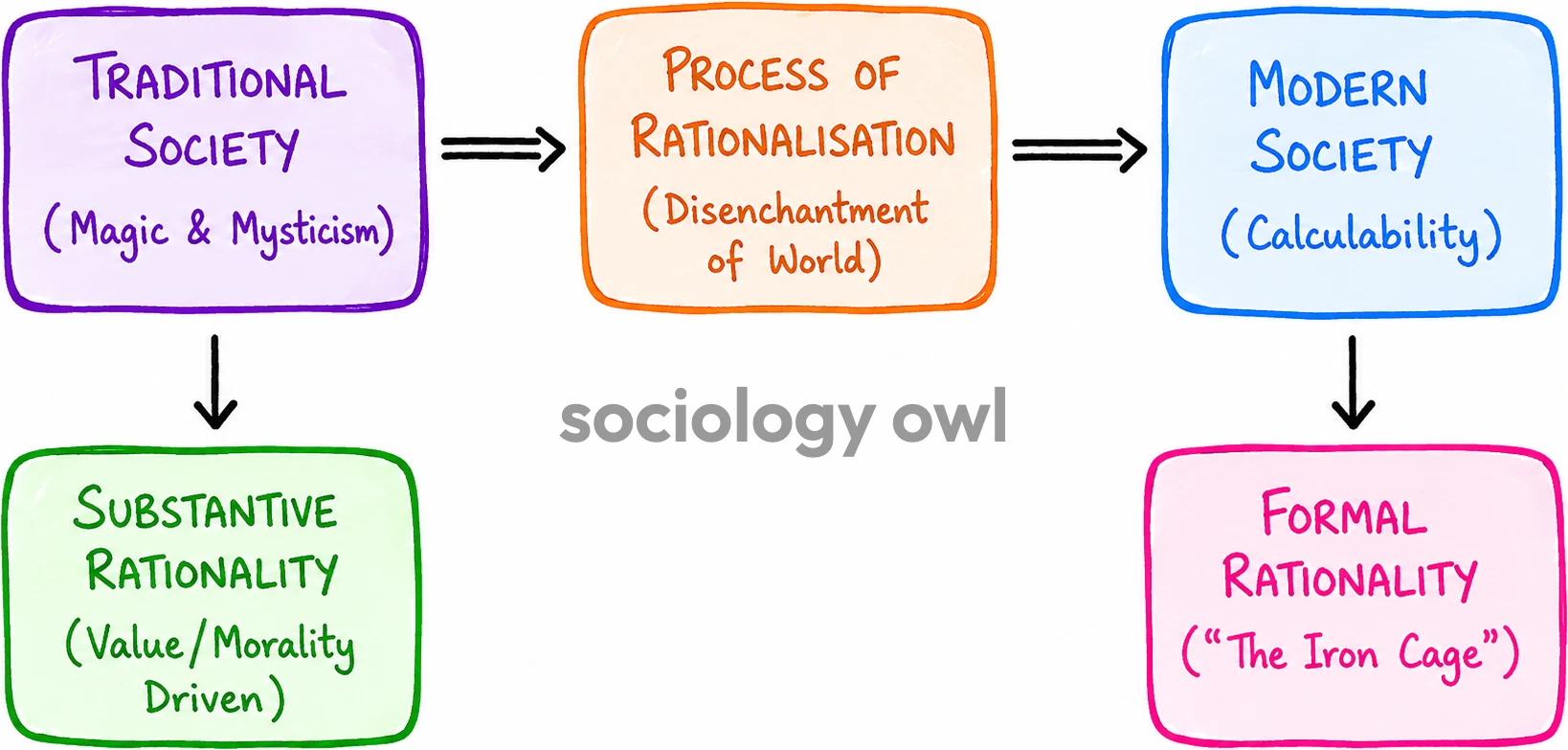
In his magnum opus, Economy and Society, Weber describes rationalisation as the master trend of the modern world, leading to the Disenchantment of the World (Entzauberung)—a state where magical and mystical beliefs are replaced by logical, calculable, and scientific reasoning.
Understanding Rationality and Rationalisation
In Weberian sociology, these two terms, though interrelated, have distinct analytical meanings:
- Rationality: Refers to a state of mind or a specific logic of social action that is logically coherent, empirically driven, and calculable. It is the underlying motive behind human behavior that prioritizes efficiency and predictability.
- Rationalisation: Refers to the macro-sociological, historical process through which rationality permeates various institutions of society (law, religion, economy, music, architecture). It involves secularisation of thought, formalisation of rules, and the demystification of beliefs.
Types of Rationality
While Weber’s original notes were complex, American sociologist Stephen Kalberg systematically categorized Weber’s rationality into four types, which represent a major upgrade for UPSC answers:
- Practical Rationality: The mundane, day-to-day calculation used by individuals to solve practical problems (e.g., finding the shortest route to work).
- Theoretical Rationality: The cognitive effort to master reality through abstract concepts, logical deduction, and theoretical models (e.g., philosophers and scientists conceptualizing the universe).
- Substantive Rationality (Wertrationalität): Action driven by a cluster of values (religious, ethical, or moral). The rationality lies in remaining true to a value system, regardless of the outcome’s efficiency.
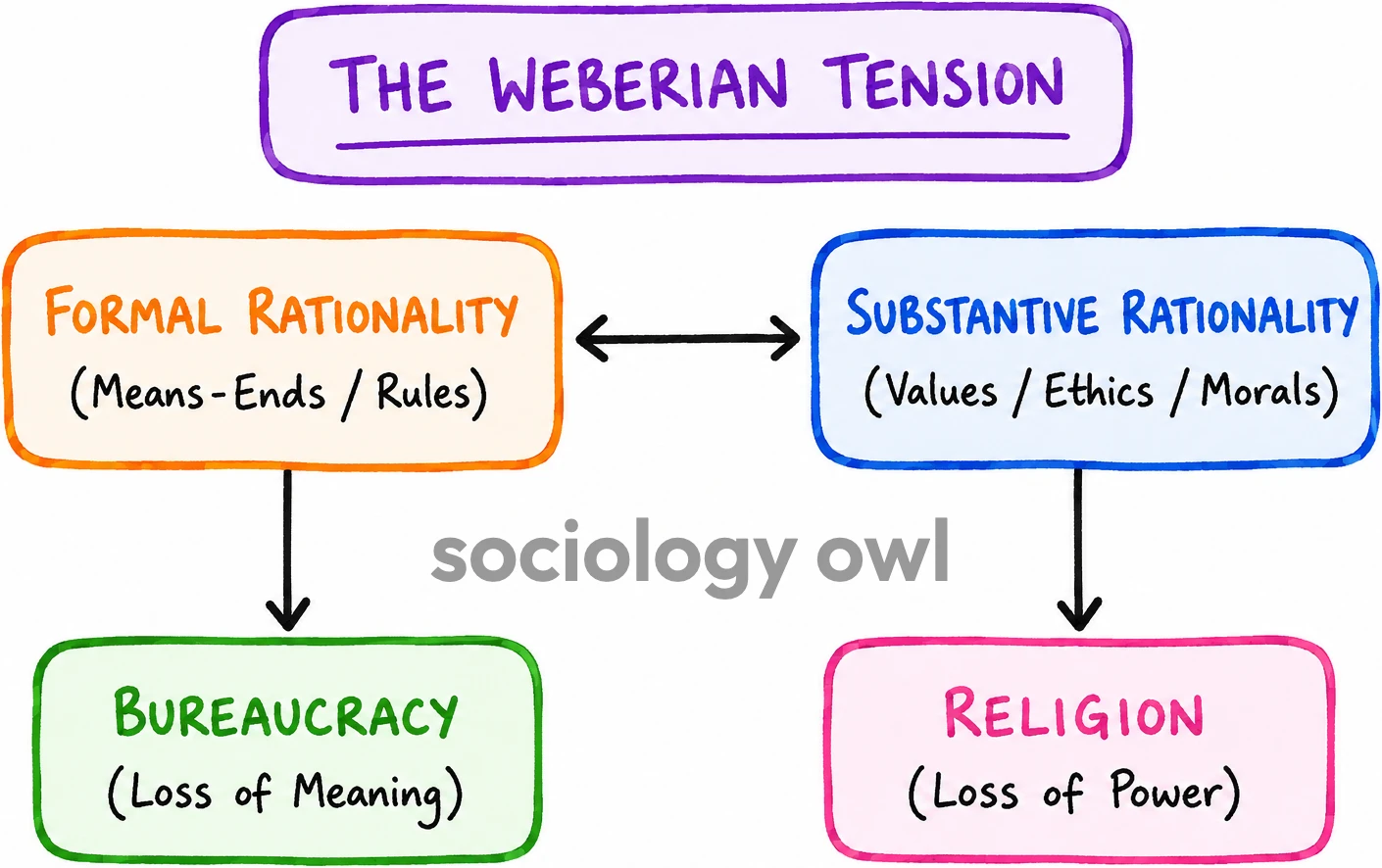
- Formal Rationality (Zweckrationalität): The most consequential type for modern society. It involves means-ends calculation based on universally applied rules, laws, and regulations. It prioritizes efficiency, predictability, and calculability above all else.
Comparison: Formal vs. Substantive Rationality
| Feature | Formal Rationality (Zweckrationalität) | Substantive Rationality (Wertrationalität) |
|---|---|---|
| Focus | Means to achieve an end (Efficiency) | The intrinsic value of the end itself (Morality) |
| Basis | Universal rules, laws, and quantification | Values, ethics, religion, and human ideals |
| Dominant Era | Modern Capitalist Society | Traditional and Feudal Societies |
| Example | Bureaucratic administration, Corporate capitalism | Donating to charity based on religious duty |
Weber’s Application of Rationality to Key Institutions
1. Protestantism and the Spirit of Capitalism
In his seminal work, The Protestant Ethic and the Spirit of Capitalism, Weber demonstrated how religious ideas inadvertently fueled economic rationalisation. The Calvinist doctrine of predestination created “salvation anxiety,” which led believers to seek signs of God’s favor through this-worldly asceticism and relentless hard work. This substantive rationality (religious duty) unintentionally gave birth to the formal rationality of modern Rational Capitalism—characterized by the reinvestment of profits and commercialization.
2. Bureaucracy and Rational-Legal Authority
Weber viewed modern Bureaucracy as the purest institutional manifestation of formal rationality. Bureaucracies operate on rational-legal authority, characterized by a hierarchical structure, strict written rules, specialization, and impersonal relationships. However, Weber famously warned that extreme formal rationality would lead to an Iron Cage (Stahlhartes Gehäuse), trapping individuals in teleological systems devoid of human emotion or substantive meaning.
Critiques and Sociological Extensions
- George Ritzer: Expanded Weber’s concept into McDonaldization, arguing that modern society is dominated by efficiency, calculability, predictability, and control (via non-human technology), ultimately leading to the “irrationality of rationality.”
- Jürgen Habermas: Criticized the dominance of formal rationality, arguing for Communicative Rationality. He warned about the “colonization of the lifeworld” by systemic instrumental rationality.
- Frankfurt School (Herbert Marcuse): In One-Dimensional Man, Marcuse argued that technological rationality has become a tool of domination and social control in late-capitalist societies.
The Indian Context (Paper 2 Integration)
Applying Weber’s rationalisation to Indian society reveals a unique trajectory, distinct from the Western experience. The interaction between traditional Indian value systems and Western formal rationality has been studied by several Indian sociologists:
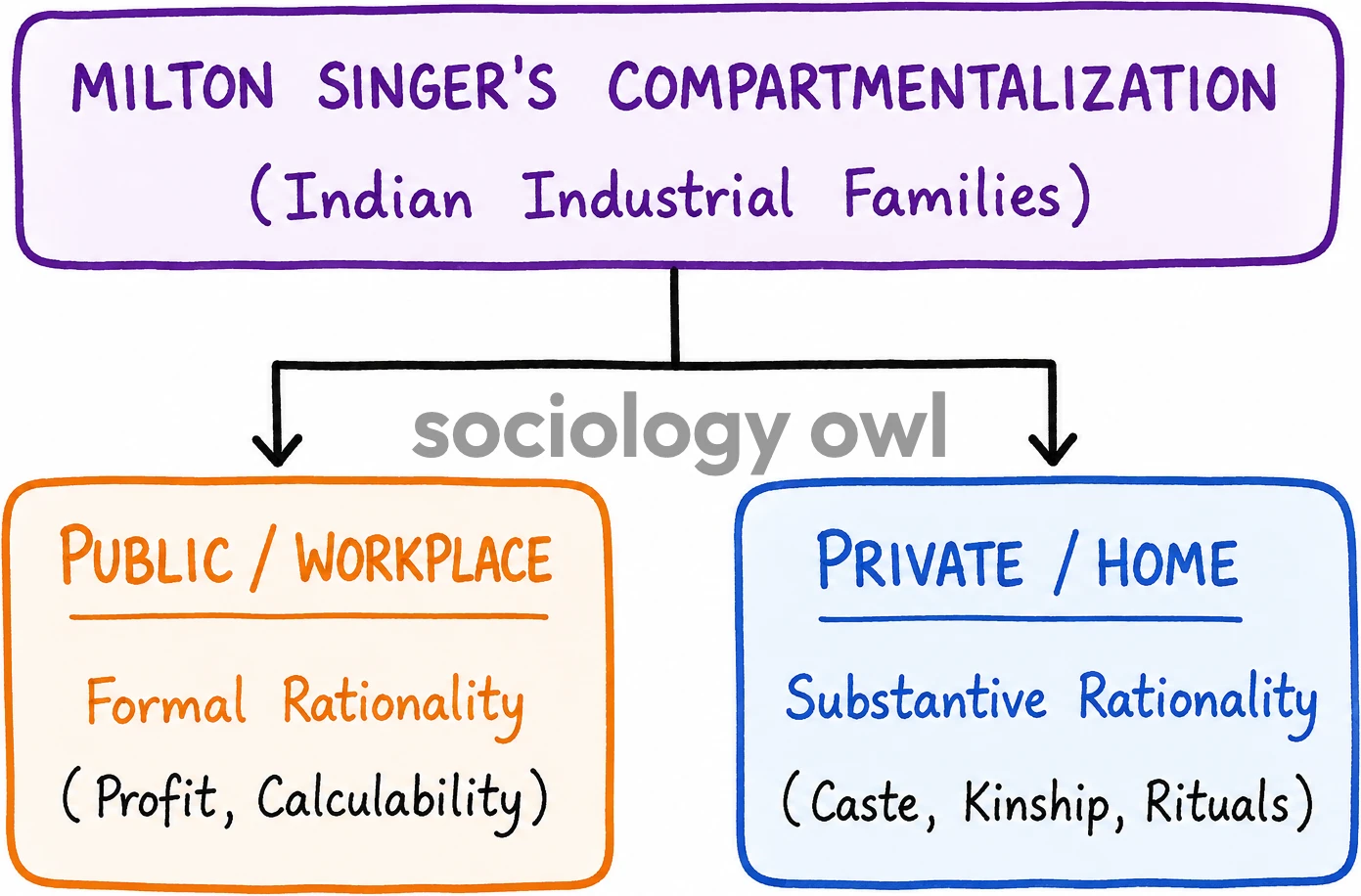
- Milton Singer: In his study of industrial families in Madras (When a Great Tradition Modernizes), Singer observed the phenomenon of Compartmentalization. Indian industrialists seamlessly blended formal rationality in their factories (calculable profit-seeking) with substantive rationality at home (traditional rituals and caste practices) without experiencing cognitive dissonance.
- Dipankar Gupta: In his concept of Mistaken Modernity, Gupta argues that India adopted the external symbols of formal rationality (technology, consumerism) but failed to internalize substantive democratic rationality (equality, human rights, civic sense).
- M.N. Srinivas: Discussed how the process of Westernization introduced rational-legal frameworks (courts, modern education) to India, while Sanskritization represented a parallel, traditional mobility process. Furthermore, the secularisation of caste—where caste transforms from a ritual system into a rational political pressure group—highlights the ongoing rationalisation of Indian politics.
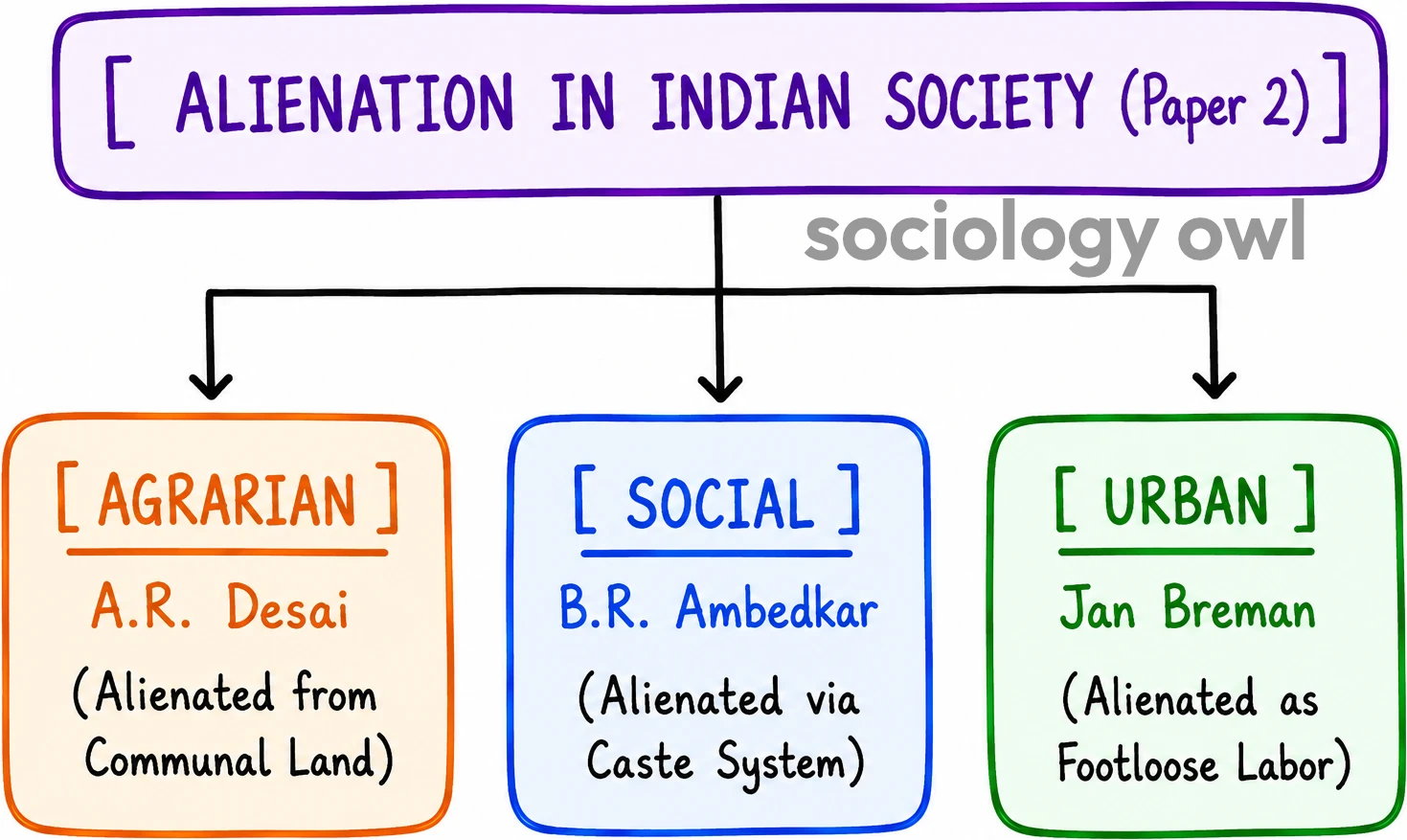
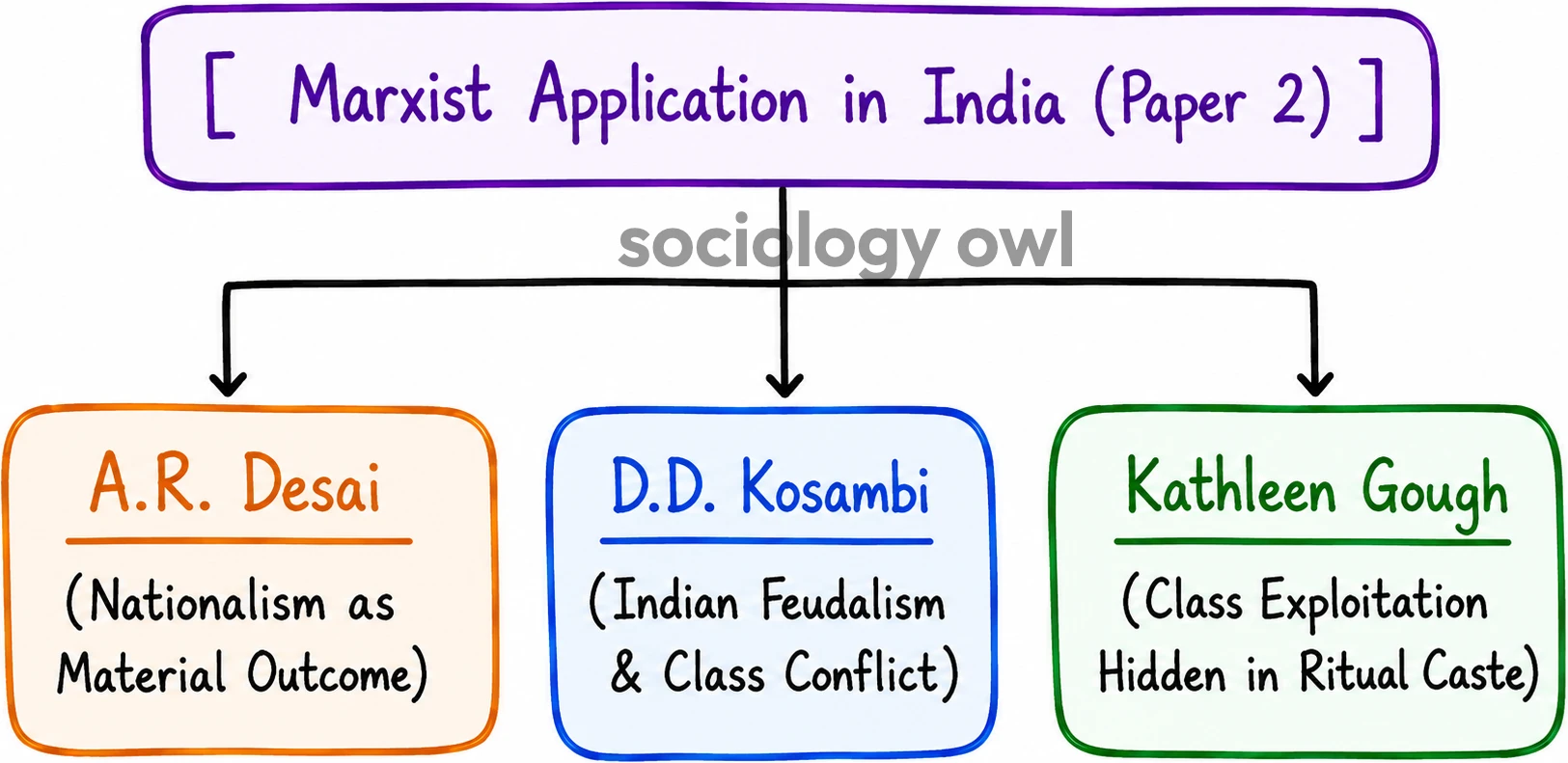
- A.R. Desai: Using a Marxist framework, Desai argued that the introduction of rational capitalism in India through colonial rule did not lead to progressive rationalisation, but rather to uneven development, structural contradictions, and mass poverty.
Contemporary Relevance
Weber’s thesis is profoundly relevant in the 21st-century era of globalization and digital technology. The modern Gig Economy, artificial intelligence, and algorithmic management represent the ultimate peak of Formal Rationality. Workers in Amazon fulfillment centers or drivers for Uber are subjected to extreme calculability, surveillance, and predictability. This hyper-rationalisation has amplified Weber’s fear of the “Iron Cage,” leading to increased alienation, mental health crises, and the stripping of substantive human values in favor of corporate efficiency metrics.
Conclusion
Max Weber’s framework of rationality and rationalisation provides a timeless diagnostic tool for understanding the trajectory of human society. While rationality has undoubtedly brought unprecedented material and scientific progress, it has also alienated humanity from meaning and ethics. As Weber profoundly lamented at the end of The Protestant Ethic, the unchecked march of formal rationality threatens to reduce modern humans to “Specialists without spirit, sensualists without heart; this nullity imagines that it has attained a level of civilization never before achieved.” Balancing formal efficiency with substantive human values remains the greatest sociological challenge of our time.
Max Weber: Rationality and Rationalisation Read More »