1. Theoretical Foundation & Mathematical Underpinnings
Formal Definition & Scope
Any integer N in the Base-10 (decimal) system is not a mere concatenation of digits, but a weighted polynomial expansion in powers of 10.
For an (n + 1)-digit number with digits dndn−1 … d1d0:
N = ∑i=0n di · 10i = dn · 10n + dn−1 · 10n−1 + … + d1 · 101 + d0 · 100
Domain Boundaries & Structural Constraints:
- di ∈ {0, 1, 2, 3, 4, 5, 6, 7, 8, 9} for all i ∈ {0, 1, …, n}
- Leading digit dn ≠ 0 (otherwise the effective digit-length collapses)
- For a 2-digit number N = 10x + y: x ∈ {1, …, 9} and y ∈ {0, …, 9}
- For a 3-digit number N = 100a + 10b + c: a ∈ {1, …, 9} and b, c ∈ {0, …, 9}
Fatal Translation Error: xy ≠ a two-digit number with digits x and y. In standard algebra, xy denotes the product x × y. The positional number is strictly 10x + y.
Place Value vs. Face Value
- Face Value: The intrinsic identity of the digit, independent of its position (e.g., in 8275, the face value of 2 is 2).
- Place Value: Face Value × 10n, where n is the positional index (n = 0 for units, n = 1 for tens, n = 2 for hundreds, etc.). In 8275, the place value of 2 is 2 × 102 = 200.
The “Why” Behind the Math: Proofs of Reversal Invariants
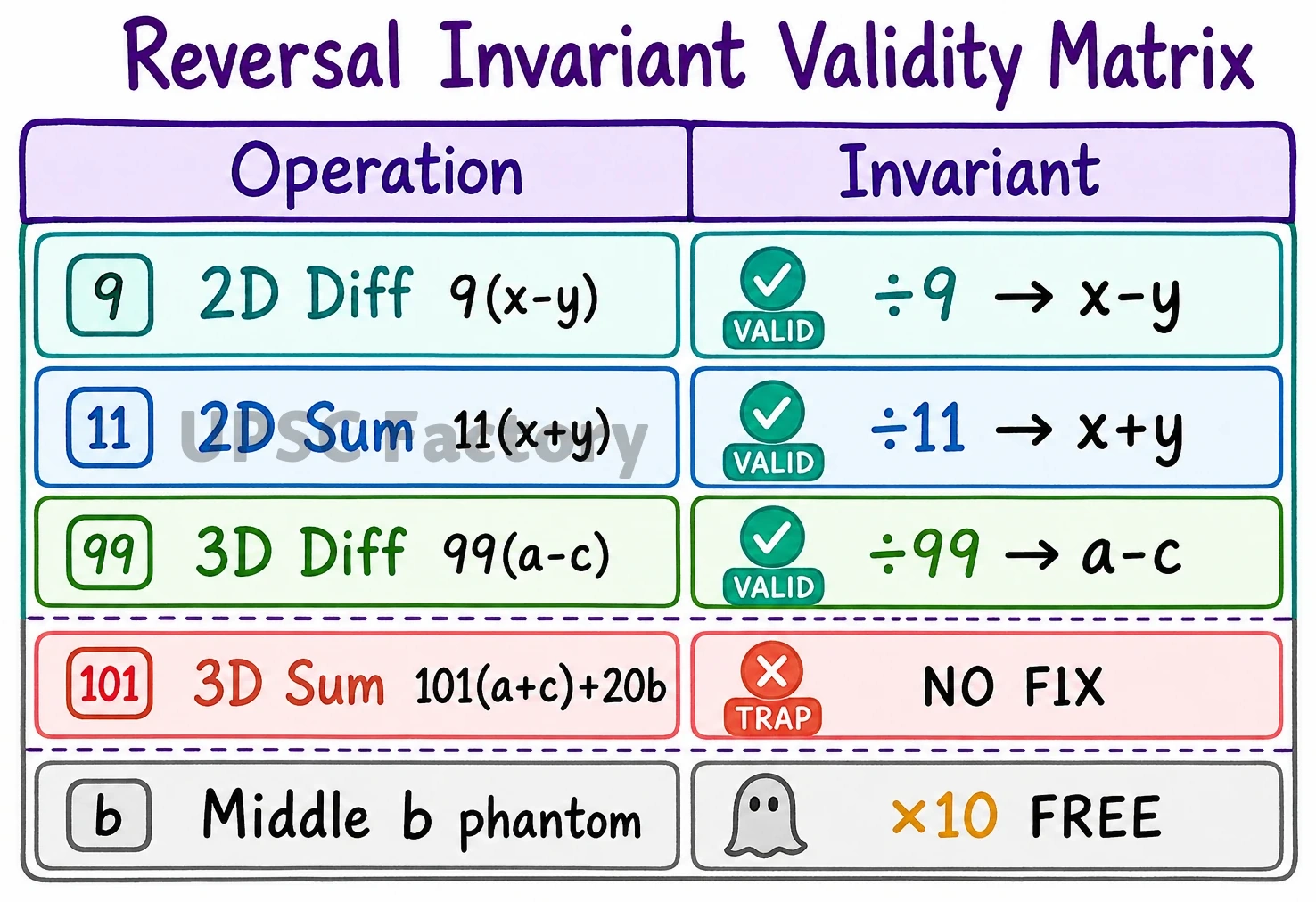
1. Why is N − Nrev for 2-digit numbers always a multiple of 9?
Let N = 10x + y and Nrev = 10y + x. Then:
N − Nrev = (10x + y) − (10y + x)
= 9x − 9y
= 9(x − y)
The positional coefficients cross-cancel to yield a factor of 9. Consequently:
- The difference is always divisible by 9.
- (N − Nrev)/9 = x − y gives the exact difference between the tens and units digits, reducing a two-variable expression to a simple single-digit relation.
2. Why is N + Nrev for 2-digit numbers always a multiple of 11?
N + Nrev = (10x + y) + (10y + x)
= 11x + 11y
= 11(x + y)
Therefore, (N + Nrev)/11 = x + y equals the sum of the digits.
3. Why does the middle digit vanish in the 3-digit difference?
Let N = 100a + 10b + c and Nrev = 100c + 10b + a. Then:
N − Nrev = (100a + 10b + c) − (100c + 10b + a)
= 99a − 99c
= 99(a − c)
The middle term 10b − 10b = 0. The tens digit b acts as a phantom variable: it has zero influence on the magnitude of the difference, but it multiplies the count of possible valid numbers by 10 (since b ∈ {0, 1, …, 9}).
4. The Modulo 9 Invariant (Digital Root)
For any integer N, N ≡ S(N) (mod 9), where S(N) represents the sum of the digits of N. Hence, N − S(N) is always divisible by 9. Because any permutation of digits preserves the digit sum S(N) = S(Nrev), the difference N − Nrev is always congruent to 0 (mod 9).
Key Theorems & Properties
- Theorem 1 (2-Digit Difference): N − Nrev = 9(x − y). Always divisible by 3 and 9. Range: |N − Nrev| ≤ 81, and |N − Nrev| ≤ 72 if Nrev is also constrained to be a 2-digit number (y ≠ 0).
- Theorem 2 (2-Digit Sum): N + Nrev = 11(x + y). Always divisible by 11. Range: 11 ≤ N + Nrev ≤ 198 in general, and 22 ≤ N + Nrev ≤ 198 if Nrev is a 2-digit number (y ≠ 0). Correspondingly, x + y ∈ [1, 18] in general, and x + y ∈ [2, 18] when y ≠ 0.
- Theorem 3 (3-Digit Difference): N − Nrev = 99(a − c). Always divisible by 9, 11, 33, 99. Completely independent of the tens digit b. Range: |a − c| ∈ [1, 9].
- Theorem 4 (3-Digit Sum): N + Nrev = 101(a + c) + 20b. Not a fixed multiple of 11 or 99.
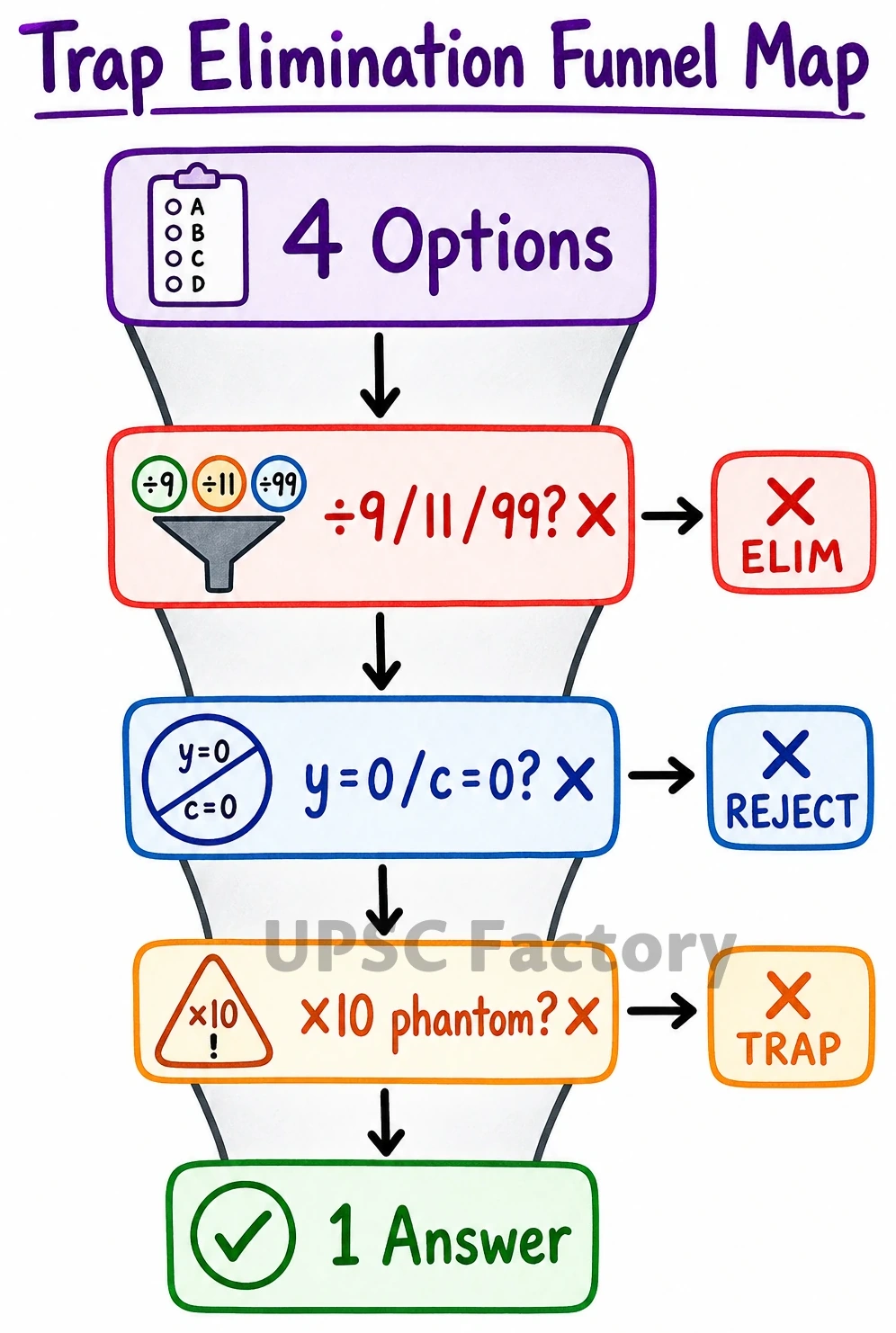
- Theorem 5 (Zero Collapse): If y = 0 in a 2-digit number N, Nrev collapses to a 1-digit number. If c = 0 in a 3-digit number N, Nrev collapses to a 2-digit number. Problem statements must explicitly mandate that Nrev is also a 2-digit or 3-digit number to eliminate y = 0 or c = 0.
2. Comparative Matrix & Conceptual Distinctions
Table 2.1: Face Value vs. Place Value vs. Number Value
| Concept | Definition | For Digit 0 in N = 5082 | Nature |
|---|---|---|---|
| Face Value | Intrinsic identity of the digit | 0 | Position-independent, ∈ [0, 9] |
| Place Value | Face Value × 10position | 0 × 102 = 0 | Positional, scales in powers of 10 |
| Number Value | Polynomial sum ∑ di10i | 5000 + 0 + 80 + 2 = 5082 | Collective magnitude of the integer |
Table 2.2: Reversal Invariants — Operational Summary
| Operation | Algebraic Form | Divisor Invariant | Result After Division | Common Pitfall |
|---|---|---|---|---|
| 2-Digit Difference (N − Nrev) | 9(x − y) | 9 | Digit difference (x − y) | Assuming x > y without checking for sign |
| 2-Digit Sum (N + Nrev) | 11(x + y) | 11 | Digit sum (x + y) | Assuming it is divisible by 9 |
| 3-Digit Difference (N − Nrev) | 99(a − c) | 99 | Outer digit difference (a − c) | Forgetting that middle digit b has 10 states |
| 3-Digit Sum (N + Nrev) | 101(a + c) + 20b | None | Non-factorable form | Attempting to divide by 99 or 11 |
Table 2.3: Algebraic Representation Pitfalls
| Invalid Setup | Correct Setup | Consequence of Error |
|---|---|---|
| Let number be xy | Let number be 10x + y | xy − yx = 0 (falsely implies difference is always zero) |
| Let number be abc | Let number be 100a + 10b + c | abc − cba = 0 |
| Reversed number is yx | Reversed number is 10y + x | Equation fails to represent positional place value |
3. High-Yield Data Anchors & Memorization Benchmarks
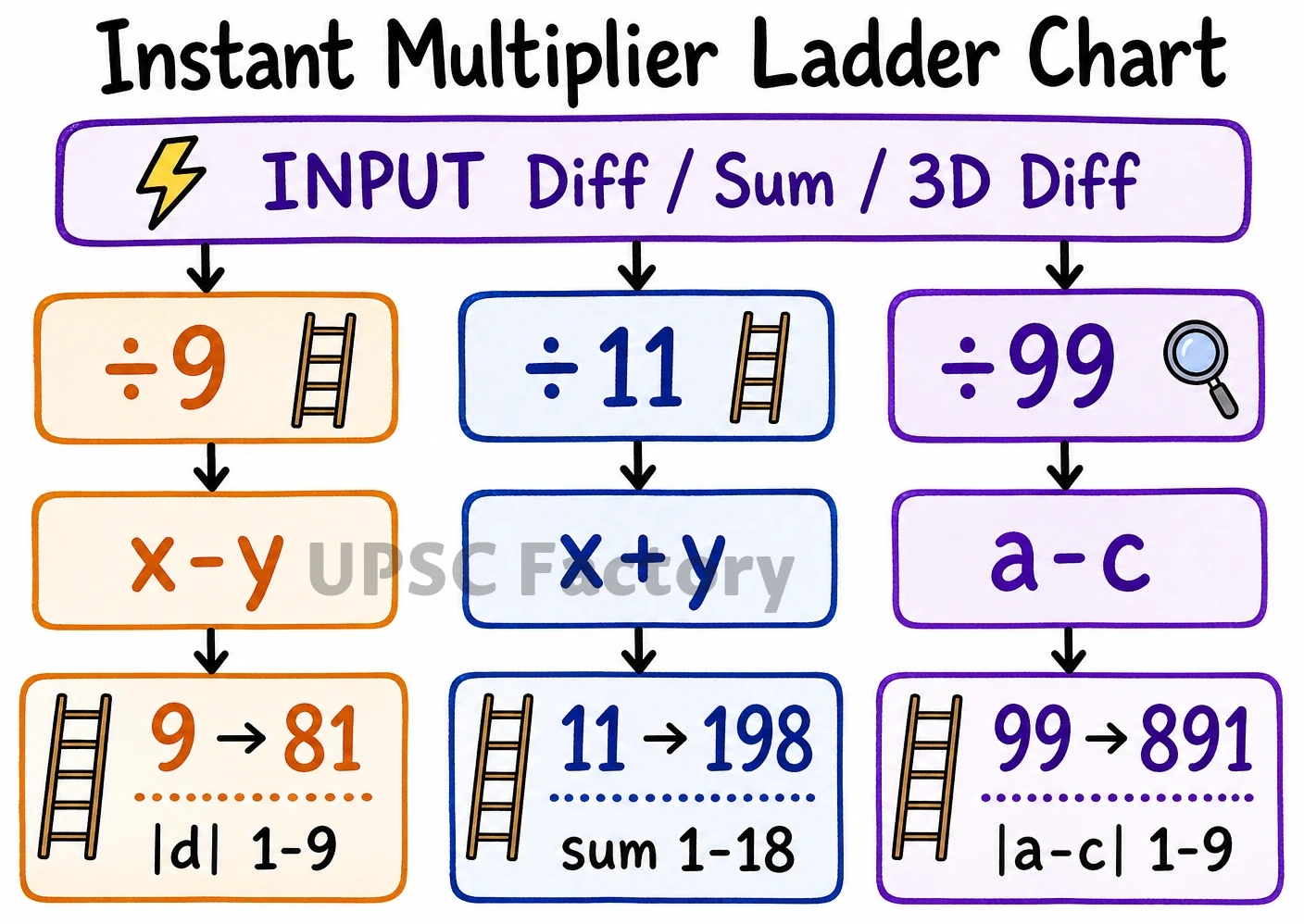
3.1 Instant Multiplier Matrix
For 2-Digit Difference: |N − Nrev| = 9|x − y|
| Given Difference | Instant |x − y| | Given Difference | Instant |x − y| |
|---|---|---|---|
| 9 | 1 | 54 | 6 |
| 18 | 2 | 63 | 7 |
| 27 | 3 | 72 | 8 |
| 36 | 4 | 81 | 9 (Maximum) |
| 45 | 5 | — | — |
For 2-Digit Sum: N + Nrev = 11(x + y)
Sum = 33 ⇒ x + y = 3
Sum = 77 ⇒ x + y = 7
Sum = 121 ⇒ x + y = 11
Sum = 143 ⇒ x + y = 13
Sum = 165 ⇒ x + y = 15
Sum = 187 ⇒ x + y = 17
For 3-Digit Difference: |N − Nrev| = 99|a − c|
Multiples of 99: {99, 198, 297, 396, 495, 594, 693, 792, 891} correspond directly to |a − c| ∈ {1, 2, 3, 4, 5, 6, 7, 8, 9}.
Elimination Trigger: If a 3-digit difference |N − Nrev| is stated as a non-multiple of 99 (e.g., 250), no such integer exists. Reject the case immediately.
3.2 Boundary Conditions for Digit Counting
- Fixed Sum x + y = S (x ∈ [1, 9], y ∈ [0, 9]): Example: S = 13 ⇒ (x, y) ∈ {(4, 9), (5, 8), (6, 7), (7, 6), (8, 5), (9, 4)} ⇒ 6 numbers. Pairs such as (3, 10) are invalid because y ≤ 9.
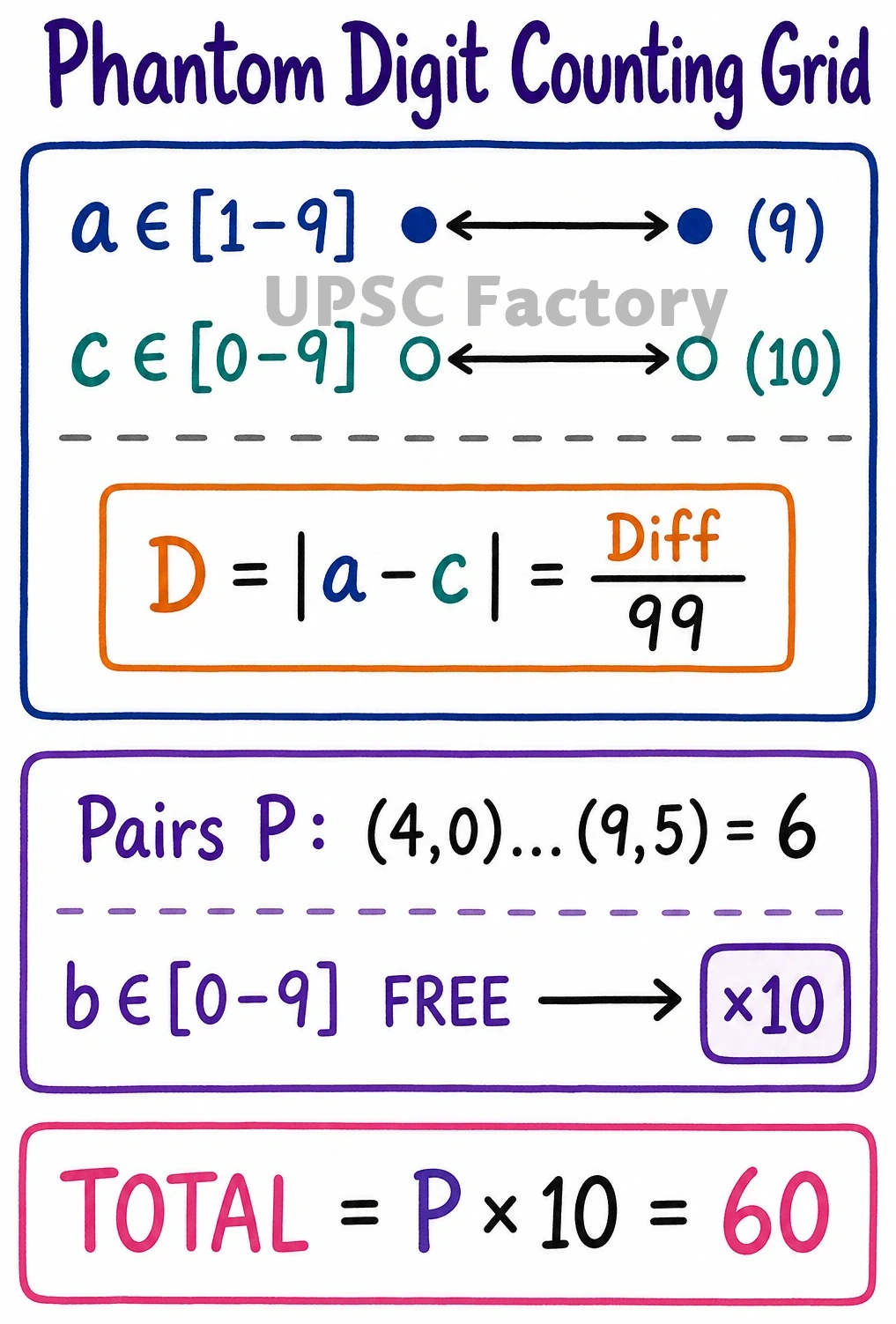
- Fixed Difference a − c = D (a ∈ [1, 9], c ∈ [0, 9]): Example: D = 4 ⇒ (a, c) ∈ {(4, 0), (5, 1), (6, 2), (7, 3), (8, 4), (9, 5)} ⇒ 6 pairs.
- The Phantom Multiplier: In 3-digit difference problems, each valid outer pair (a, c) yields 10 distinct integers corresponding to b ∈ {0, 1, 2, …, 9}, unless b is explicitly constrained.
4. Standard Algorithmic Protocols (Decision Logic)
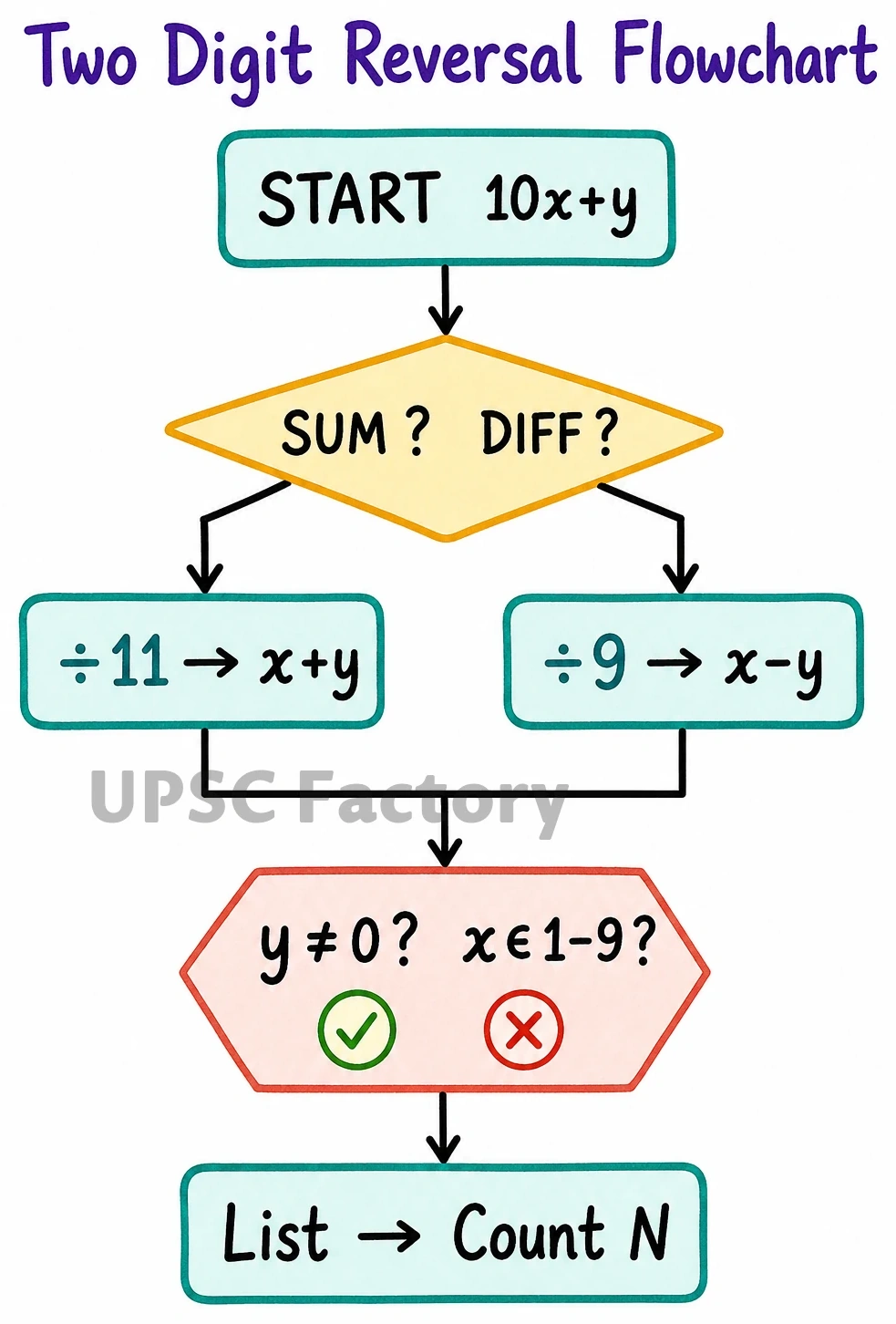
Protocol A: Universal 2-Digit Reversal Solver
Given a 2-digit number N = 10x + y with x ∈ {1, …, 9} and y ∈ {0, …, 9}, and its reversal Nrev = 10y + x:
- Identify the Given Operation:
- Branch 1 (Sum Given): Set N + Nrev = 11(x + y).
- Calculate x + y = Sum/11.
- Validity Check: If the given sum is not divisible by 11, no integer solution exists.
- Branch 2 (Difference Given): Set |N − Nrev| = 9|x − y|.
- Calculate |x − y| = Difference/9.
- Validity Check: If the given difference is not divisible by 9, no integer solution exists.
- Parity Property: Because 9 is odd, Parity(N − Nrev) = Parity(x − y).
- Branch 1 (Sum Given): Set N + Nrev = 11(x + y).
- Integrate Secondary Constraints & Solve:
- Combine with auxiliary conditions (e.g., product xy, parity constraints, prime restrictions).
- When both sum S = x + y and difference D = x − y are known:
x = (S + D)/2, y = (S − D)/2
(Note: S + D must be an even integer for x, y ∈ ℤ).
- Apply Boundary & Length Filters:
- Reversed Length Constraint: Does the problem state “the reversed number is also a 2-digit number”?
- Yes: Enforce y ≠ 0 (drop any pair with y = 0).
- No: y = 0 is permitted (Nrev becomes a single-digit integer).
- Distinct Digits Constraint: Unless stated “digits are distinct”, include the case x = y (where difference = 0).
- Reversed Length Constraint: Does the problem state “the reversed number is also a 2-digit number”?
- Output Count or Specific Values:
- Enumerate all valid integer pairs (x, y) within the valid domain.
- Construct N = 10x + y or report the total count.
Protocol B: 3-Digit Reversal Counter (The Phantom Digit Protocol)
Given a 3-digit number N = 100a + 10b + c (a ∈ {1, …, 9}, b, c ∈ {0, …, 9}) and its reversal Nrev = 100c + 10b + a:
- Classify Operation Type:
- Difference: Apply the invariant N − Nrev = 99(a − c).
- Sum: No single-variable invariant exists (N + Nrev = 101(a + c) + 20b). Expand directly without dividing by 99 or 11.
- Compute Outer Digit Gap:
- Set up |N − Nrev| = 99|a − c|.
- Determine D = |a − c| = |N − Nrev|/99.
- If the difference is not a multiple of 99, total possible numbers = 0.
- Enumerate Valid Outer Pairs (a, c):
- List all pairs (a, c) satisfying a − c = D or |a − c| = D subject to a ∈ {1, …, 9} and c ∈ {0, …, 9}.
- Length Filter: If Nrev must also be a 3-digit number, enforce c ≠ 0 (exclude (D, 0)).
- Let P be the number of valid (a, c) pairs.
- Apply the Middle Digit (b) Multiplier:
- Because 10b − 10b = 0, the tens digit b is unrestricted by the difference equation:
- Unconstrained b: b ∈ {0, 1, …, 9} ⇒ 10 choices per pair:
Total Valid Numbers N = P × 10
- Constrained b: Multiply P by the count of admissible values for b (e.g., b is prime, even, or distinct from a and c).
- Unconstrained b: b ∈ {0, 1, …, 9} ⇒ 10 choices per pair:
- Because 10b − 10b = 0, the tens digit b is unrestricted by the difference equation:
5. Standard Question Typologies & Analytical Solutions
Type A: Parity & Multi-Variable Constraints
Core Principle: Parity of N − Nrev = 9(x − y) matches the parity of (x − y) because 9 is odd.
Problem:
Consider a two-digit number N = 10x + y where x and y are prime digits (x, y ∈ {2, 3, 5, 7}). The number formed by reversing N is smaller than N by 36. Which of the following statements is/are necessarily true?
1. x and y are both odd.
2. x + y is divisible by 4.
Select the correct option:
A) 1 only
B) 2 only
C) Both 1 and 2
D) Neither 1 nor 2
Analytical Solution:
Step 1: Translate Constraints
N − Nrev = 36 ⇒ 9(x − y) = 36 ⇒ x − y = 4
Domain: x, y ∈ {2, 3, 5, 7} with x > y.
Step 2: Enumerate Admissible Digit Pairs
- If y = 2 ⇒ x = 2 + 4 = 6 (not prime; reject).
- If y = 3 ⇒ x = 3 + 4 = 7 (prime; accept ⇒ (x, y) = (7, 3)).
- If y = 5 ⇒ x = 5 + 4 = 9 (not prime; reject).
- If y = 7 ⇒ x = 7 + 4 = 11 (not a single digit; reject).
The unique solution is (x, y) = (7, 3), corresponding to N = 73.
Step 3: Evaluate Statements
- x = 7 (odd) and y = 3 (odd) ⇒ Statement 1 is true.
- x + y = 7 + 3 = 10, which is not divisible by 4 ⇒ Statement 2 is false.
Correct Answer: A) 1 only
Type B: Statement-Based / Data Sufficiency Archetype
Core Principle: The sum invariant 11(x + y) provides only the sum of digits. Symmetry in (x + y) and xy leads to non-unique ordered numbers unless an asymmetric condition is added.
Problem:
Consider a two-digit number N = 10x + y.
Statement I: The sum of N and its reversal is 110.
Statement II: The product of its digits is 24.
Is the data sufficient to determine N uniquely?
A) Statement I alone is sufficient
B) Statement II alone is sufficient
C) Both statements together are sufficient
D) Neither Statement I nor Statement II is sufficient
Analytical Solution:
Step 1: Analyze Statement I alone
N + Nrev = 110 ⇒ 11(x + y) = 110 ⇒ x + y = 10
Possible pairs (x, y):
(1, 9), (2, 8), (3, 7), (4, 6), (5, 5), (6, 4), (7, 3), (8, 2), (9, 1)
There are 9 candidates. Statement I alone is insufficient.
Step 2: Analyze Statement II alone
xy = 24 where x ∈ {1, …, 9}, y ∈ {0, …, 9}
Possible pairs (x, y): (3, 8), (4, 6), (6, 4), (8, 3).
There are 4 candidates. Statement II alone is insufficient.
Step 3: Combine Statements I and II
x + y = 10
xy = 24
Setting up the quadratic: t2 − 10t + 24 = 0 ⇒ (t − 4)(t − 6) = 0.
Thus, the unordered set of digits is {4, 6}. This yields two distinct valid numbers:
N = 46 or N = 64
Since N cannot be determined uniquely, both statements together are insufficient.
Correct Answer: D) Neither Statement I nor Statement II is sufficient
Type C: Existence & Counting Archetype
Core Principle: In 3-digit differences, N − Nrev = 99(a − c). The middle digit b contributes a multiplicative factor of 10.
Problem:
Let N be a three-digit number such that the difference between N and the number obtained by reversing its digits is 396. How many such numbers N exist?
A) 50
B) 60
C) 70
D) 80
Analytical Solution:
Step 1: Set Up the Invariant Equation
Let N = 100a + 10b + c. Assuming N > Nrev:
N − Nrev = 99(a − c) = 396 ⇒ a − c = 4
Step 2: Enumerate Admissible Outer Pairs (a, c)
Subject to a ∈ {1, …, 9} and c ∈ {0, …, 9}:
- c = 0 ⇒ a = 4
- c = 1 ⇒ a = 5
- c = 2 ⇒ a = 6
- c = 3 ⇒ a = 7
- c = 4 ⇒ a = 8
- c = 5 ⇒ a = 9
Total valid (a, c) pairs P = 6.
Step 3: Account for the Phantom Tens Digit b
The difference 99(a − c) is independent of b. Since no extra restrictions are placed on b, b ∈ {0, 1, 2, …, 9} provides 10 valid choices for each (a, c) pair:
Total Possible Values of N = 6 × 10 = 60
(Note: If the problem had added the constraint “and Nrev is also a three-digit number”, then c ≠ 0, excluding (4, 0), leading to 5 × 10 = 50 numbers).
Correct Answer: B) 60
Type D: Algebraic Expressions & Modulo 9 Invariants
Core Principle: N ≡ S(N) (mod 9). Any linear permutation difference is divisible by 9.
Problem:
For a three-digit number N = 100a + 10b + c, let S = a + b + c. Which of the following expressions is/are always divisible by 9?
1. N − S
2. N − Nrev
3. N + Nrev
Select the correct option:
A) 1 and 2 only
B) 2 and 3 only
C) 1 only
D) 1, 2, and 3
Analytical Solution:
Expression 1:
N − S = (100a + 10b + c) − (a + b + c) = 99a + 9b = 9(11a + b)
Since 11a + b is an integer, N − S is always divisible by 9. (True)
Expression 2:
N − Nrev = (100a + 10b + c) − (100c + 10b + a) = 99(a − c) = 9 · 11(a − c)
N − Nrev is always divisible by 99, and therefore always divisible by 9. (True)
Expression 3:
N + Nrev = 101(a + c) + 20b
Counterexample: Let N = 123 ⇒ Nrev = 321.
N + Nrev = 123 + 321 = 444.
444/9 = 49.333… ∉ ℤ. Thus, Expression 3 is not generally divisible by 9. (False)
Correct Answer: A) 1 and 2 only
Type E: Boundary & Zero-Constraint Analysis
Core Principle: Reversal with a trailing zero reduces the total digit length of Nrev.
Problem:
How many two-digit numbers N exist such that N − Nrev = 27 and Nrev is also a two-digit number?
A) 5
B) 6
C) 7
D) 8
Analytical Solution:
Step 1: Set Up the Base Equation
N − Nrev = 9(x − y) = 27 ⇒ x − y = 3
Step 2: Enumerate Integer Pairs (x, y)
With x ∈ {1, …, 9} and y ∈ {0, …, 9}:
(x, y) ∈ {(3, 0), (4, 1), (5, 2), (6, 3), (7, 4), (8, 5), (9, 6)} ⇒ 7 pairs
Step 3: Apply the Length Constraint
The problem mandates that Nrev = 10y + x must be a two-digit number ⇒ y ≠ 0.
Eliminating the pair (3, 0) (where N = 30 and Nrev = 03 = 3):
Remaining Valid Pairs = 7 − 1 = 6
Correct Answer: B) 6
Type F: Deterministic Value Extraction
Core Principle: Combining sum invariant 11(x + y) and difference invariant 9(x − y) creates an orthogonal linear system solvable via elementary algebra.
Problem:
The sum of a two-digit number and its reversal is 121, and the difference between its tens digit and units digit is 3. What is the value of the original number?
A) 74
B) 85
C) 96
D) Cannot be determined
Analytical Solution:
Step 1: Formulate the Linear System
N + Nrev = 121 ⇒ 11(x + y) = 121 ⇒ x + y = 11
x − y = 3
Step 2: Solve for x and y
Adding the two equations:
(x + y) + (x − y) = 11 + 3 ⇒ 2x = 14 ⇒ x = 7
Substituting x = 7 into the sum equation:
7 + y = 11 ⇒ y = 4
Step 3: Verify Domain and Boundaries
x = 7 ∈ [1, 9] and y = 4 ∈ [0, 9].
Original number N = 10(7) + 4 = 74.
Check: 74 + 47 = 121 and 7 − 4 = 3. Both conditions are satisfied.
Correct Answer: A) 74
6. The Examiner Trap Matrix
| Common Pitfall | Underlying Mathematical Reality | Counterexample / Edge Case |
|---|---|---|
| 1. Representing digits as products (xy) | xy = x × y, whereas positional value is 10x + y. | If x = 4, y = 7, xy = 28, but 10x + y = 47. Writing xy − yx = 0 incorrectly asserts the difference is always zero. |
| 2. Assuming reversal preserves digit length | Reversal of 40 is 04 = 4 (a 1-digit number). | For N = 40, Nrev = 4. N − Nrev = 36, but y = 0 violates conditions requiring Nrev to remain 2-digit. |
| 3. Assuming digits must be distinct | Unless specified, x = y is valid. | For N = 77, Nrev = 77 ⇒ N + Nrev = 154 = 11 × 14. The pair (7, 7) is fully valid. |
| 4. Factoring middle digit into 3-digit difference | In N − Nrev = 99(a − c), the tens digit b cancels completely. | 825 − 528 = 297 and 805 − 508 = 297. The choice of b does not alter the difference magnitude. |
| 5. Assuming 2-digit reversal sum divides by 9 | Sum is 11(x + y), which is divisible by 11, not necessarily by 9. | 12 + 21 = 33, which is divisible by 11 but not by 9. |
| 6. Overcounting digit pairs | For x + y = S, values of x, y are strictly bounded by 9. | For x + y = 13, (3, 10) is invalid because y ≤ 9. Only 6 pairs exist: (4, 9) through (9, 4). |
| 7. Omitting phantom digit multiplier | Outer pairs (a, c) must be scaled by 10 for unconstrained b. | a − c = 4 gives 6 outer pairs, but 6 × 10 = 60 total three-digit numbers. |
| 8. Assuming 3-digit reversal sum divides by 99 | N + Nrev = 101(a + c) + 20b has no fixed integer divisor. | 102 + 201 = 303, which is not divisible by 99 or 11. |
7. Golden Rules & Instant Exam Triggers
| # | Trigger | Mathematical Rule |
|---|---|---|
| 1 | “Two-Digit Number” Setup | Instantly write N = 10x + y with x ∈ {1, …, 9}, y ∈ {0, …, 9} and Nrev = 10y + x. Never use product notation xy. |
| 2 | Difference of 2-Digit Number & Reversal | Compute |N − Nrev|/9 = |x − y|. Parity Check: An even difference implies x and y share the same parity. |
| 3 | Sum of 2-Digit Number & Reversal | Compute (N + Nrev)/11 = x + y. The sum must be a multiple of 11. |
| 4 | Difference of 3-Digit Number & Reversal | Compute |N − Nrev|/99 = |a − c|. Remember that the tens digit b is unconstrained; multiply outer pair counts by 10 unless b is restricted. |
| 5 | “Reversed Number is also an n-Digit Number” | Impose y ≠ 0 (for 2-digit numbers) or c ≠ 0 (for 3-digit numbers) and exclude boundary pairs containing zero. |
| 6 | Permutation Subtraction (N − Digit Permutation) | The expression is always congruent to 0 (mod 9). Use this to eliminate incorrect multiple-choice options immediately. |
| 7 | Determining Valid Ordered Pairs | Check both lower and upper bounds: x ≥ 1, y ≥ 0, and x, y ≤ 9. |
| 8 | Simultaneous Sum and Difference (S = x + y, D = x − y) | Ensure S + D is even. If S + D is odd, no integer digits exist, allowing immediate elimination of the case. |
Pedagogical Note: Digit mechanics problems test algebraic invariant recognition rather than arithmetic computation. Master the primary divisors (9, 11, 99) and the phantom variable b to solve standard digit reversal problems systematically and efficiently.