1. Theoretical Foundation & Mathematical Underpinnings
1.1 Formal Definition & Scope
- Prime Number (p): An integer p > 1 that has exactly two distinct positive divisors: {1, p}.
- Set Notation: P = { p ∈ ℤ+ | d(p) = 2 }, where d(p) denotes the number of positive divisors.
- Boundary Condition: 1 is neither prime nor composite because d(1) = 1. Negative integers and 0 are excluded from primality definitions in standard arithmetic.
- Fundamental Theorem of Arithmetic: Every integer N > 1 can be uniquely factored into a product of prime powers:
N = p1a1 · p2a2 … pkak
where each pi is a distinct prime and each ai ≥ 1. Primes serve as the foundational building blocks of the integers.
- Perfect Number (N): An integer equal to the sum of its proper positive divisors:
N = ∑ dproper(N) = σ(N) – N
where σ(N) is the sum of all positive divisors.
- Examples: 6 = 1 + 2 + 3, 28 = 1 + 2 + 4 + 7 + 14, followed by 496 and 8128.
- Euclid-Euler Theorem: Every even perfect number takes the form:
N = 2p-1(2p – 1)
where both p and (2p – 1) are prime numbers (the term 2p – 1 being a Mersenne prime).
- Co-Prime / Relatively Prime Pair (a, b): Two integers a and b satisfying gcd(a, b) = 1 or HCF(a, b) = 1. Their prime factorizations share no common prime bases.
- Scope: Co-primality is a relational property between numbers, not an intrinsic property of an individual number.
- Twin Primes: A pair of primes of the form (p, p + 2).
- Examples: (3, 5), (5, 7), (11, 13), (17, 19), (29, 31), (41, 43).
1.2 The “Why” Behind the Math — Short Proofs
Why is 2 the only even prime?
If an integer p > 2 is even, it can be written as p = 2k where k > 1. The divisor set of p must include at least {1, 2, 2k}, which means d(p) ≥ 3. Thus, p is composite. Consequently, every prime p > 2 must be odd.
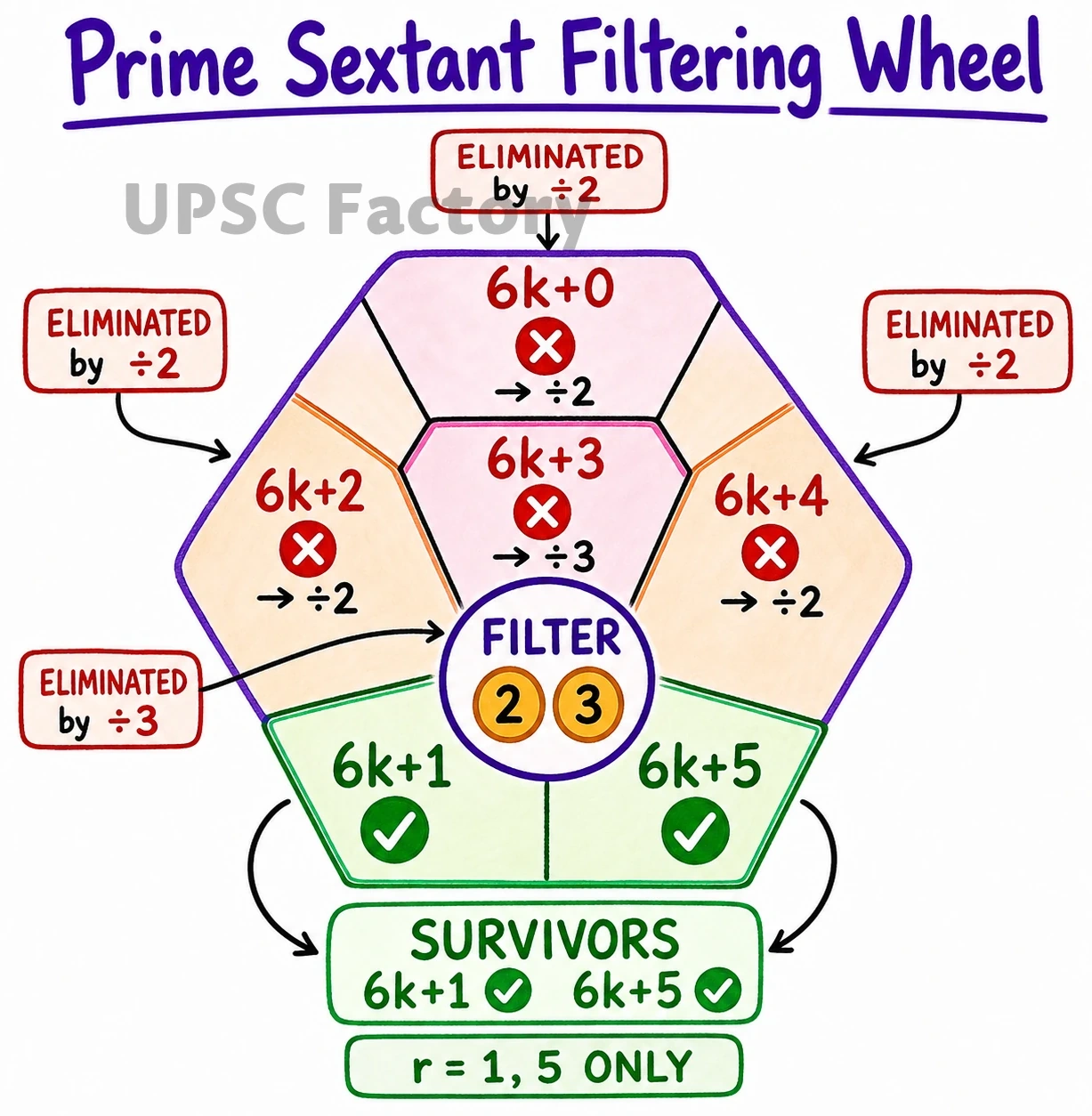
Why does every prime p > 3 satisfy p = 6k ± 1?
By the Division Algorithm, any integer N can be expressed in one of six forms modulo 6:
N ∈ {6k, 6k + 1, 6k + 2, 6k + 3, 6k + 4, 6k + 5}
Evaluating each residue class for primality:
- 6k, 6k + 2 = 2(3k + 1), 6k + 4 = 2(3k + 2) are all divisible by 2 and thus composite for k ≥ 1.
- 6k + 3 = 3(2k + 1) is divisible by 3 and thus composite for k ≥ 1.
- The only remaining candidates are 6k + 1 and 6k + 5 ≡ 6k – 1.
Critical Distinction (Necessary vs. Sufficient): The condition p = 6k ± 1 is necessary for primes > 3, but not sufficient. It acts as an elimination filter. For instance, 25 = 6(4) + 1 = 52 and 35 = 6(6) – 1 = 5 × 7 satisfy the form, yet both are composite.
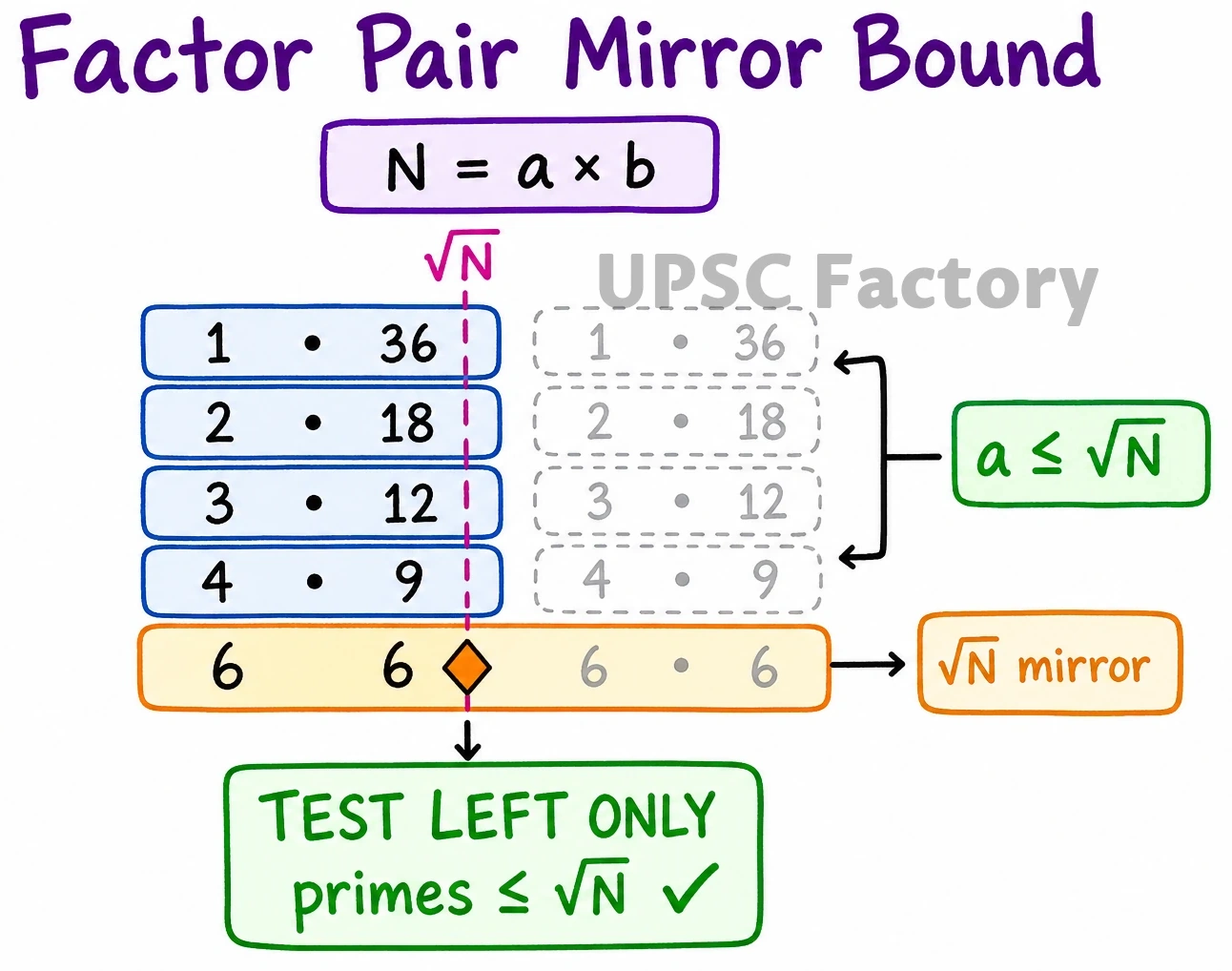
Why do we test divisors only up to √N for primality?
Let N = a × b with 1 < a ≤ b < N. If a > √N, then:
a × b > √N × √N = N
This creates a contradiction. Therefore, in any non-trivial factor pair (a, b), the smaller factor must satisfy a ≤ √N.
- Contrapositive: If an integer N has no prime factor p ≤ √N, it cannot have any factor q > √N. Hence, checking prime divisors up to ⌊√N⌋ is mathematically sufficient to prove primality.
Why is the integer between twin primes (p > 3) always divisible by 6?
Let the twin prime pair be (p, p + 2) with p > 3. The intermediate integer is m = p + 1.
- Divisibility by 3: Among any three consecutive integers {p, p + 1, p + 2}, exactly one is divisible by 3. Since p and p + 2 are primes strictly greater than 3, neither is divisible by 3. Therefore, m = p + 1 must be divisible by 3.
- Divisibility by 2: Since p is an odd prime, m = p + 1 is an even integer and divisible by 2.
Because gcd(2, 3) = 1, it follows that m is divisible by 2 × 3 = 6.
Why are consecutive integers always co-prime?
Let d = gcd(n, n + 1). By the properties of divisibility:
d | (n + 1) and d | n ⇒ d | ((n + 1) – n) ⇒ d | 1
Since d is a positive integer, d = 1. Thus, gcd(n, n + 1) = 1 for all n ∈ ℤ+.
1.3 Key Theorems & Invariant Properties
- Parity Theorem for Primes:
- Prime + Prime = Odd ⇒ One of the primes must be 2.
- If the sum of an odd number of primes is even, then at least one prime in the set must be 2.
- Example: If p + q + r = 50 (sum of 3 primes is even), the sum Odd + Odd + Odd = Odd fails; hence, one prime must be even (⇒ p = 2).
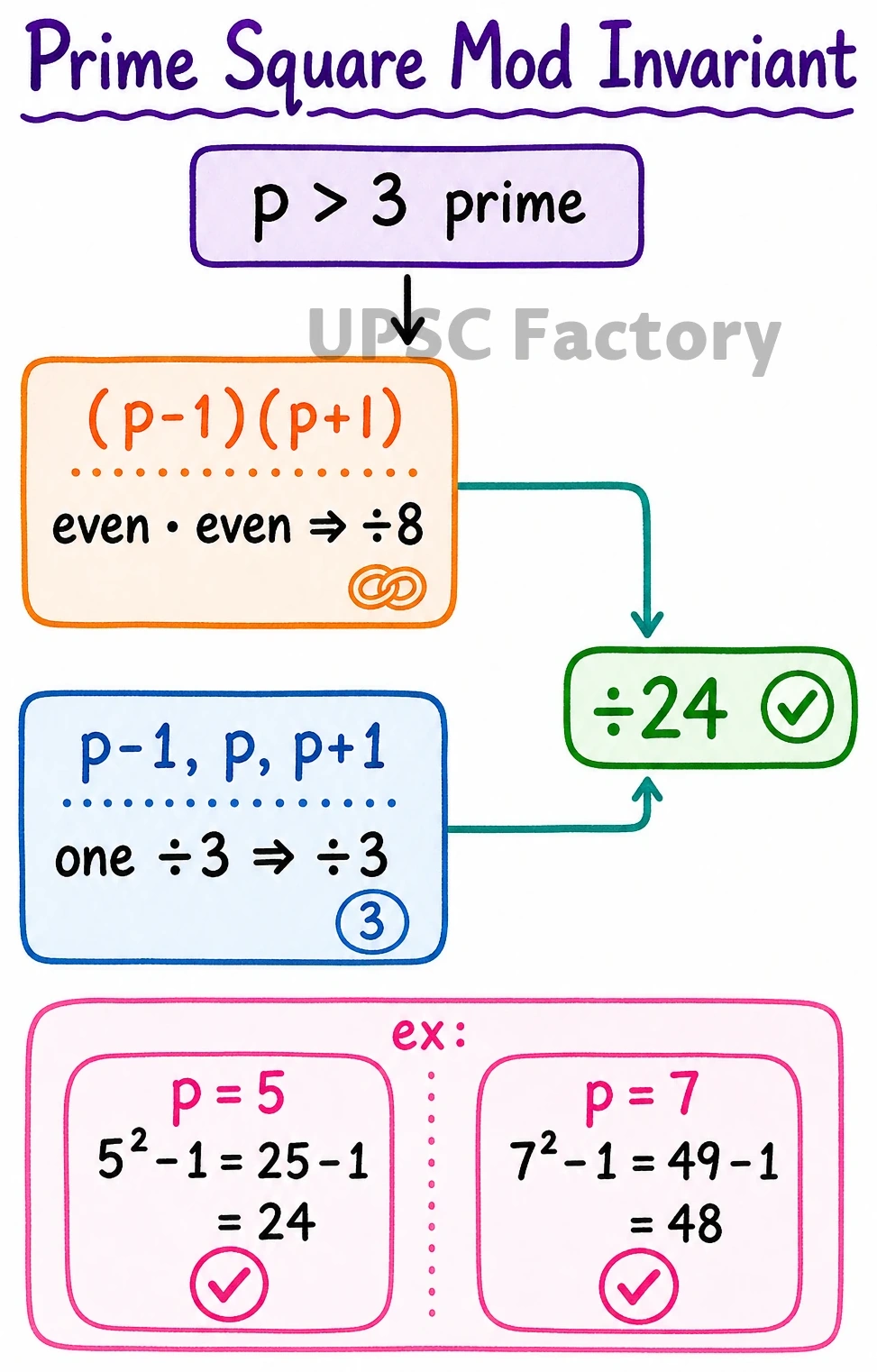
- Prime Square Invariant:
For any prime p > 3:p2 ≡ 1 (mod 24) ⇔ 24 | (p2 – 1)
Proof Outline: Factor p2 – 1 = (p – 1)(p + 1). Since p is an odd prime, (p – 1) and (p + 1) are consecutive even integers, making one a multiple of 4 and the other a multiple of 2 (⇒ 8 | (p2 – 1)). Additionally, one of the three consecutive integers {p – 1, p, p + 1} is divisible by 3; since p > 3 is prime, 3 | (p – 1)(p + 1). Since gcd(8, 3) = 1, 24 | (p2 – 1).
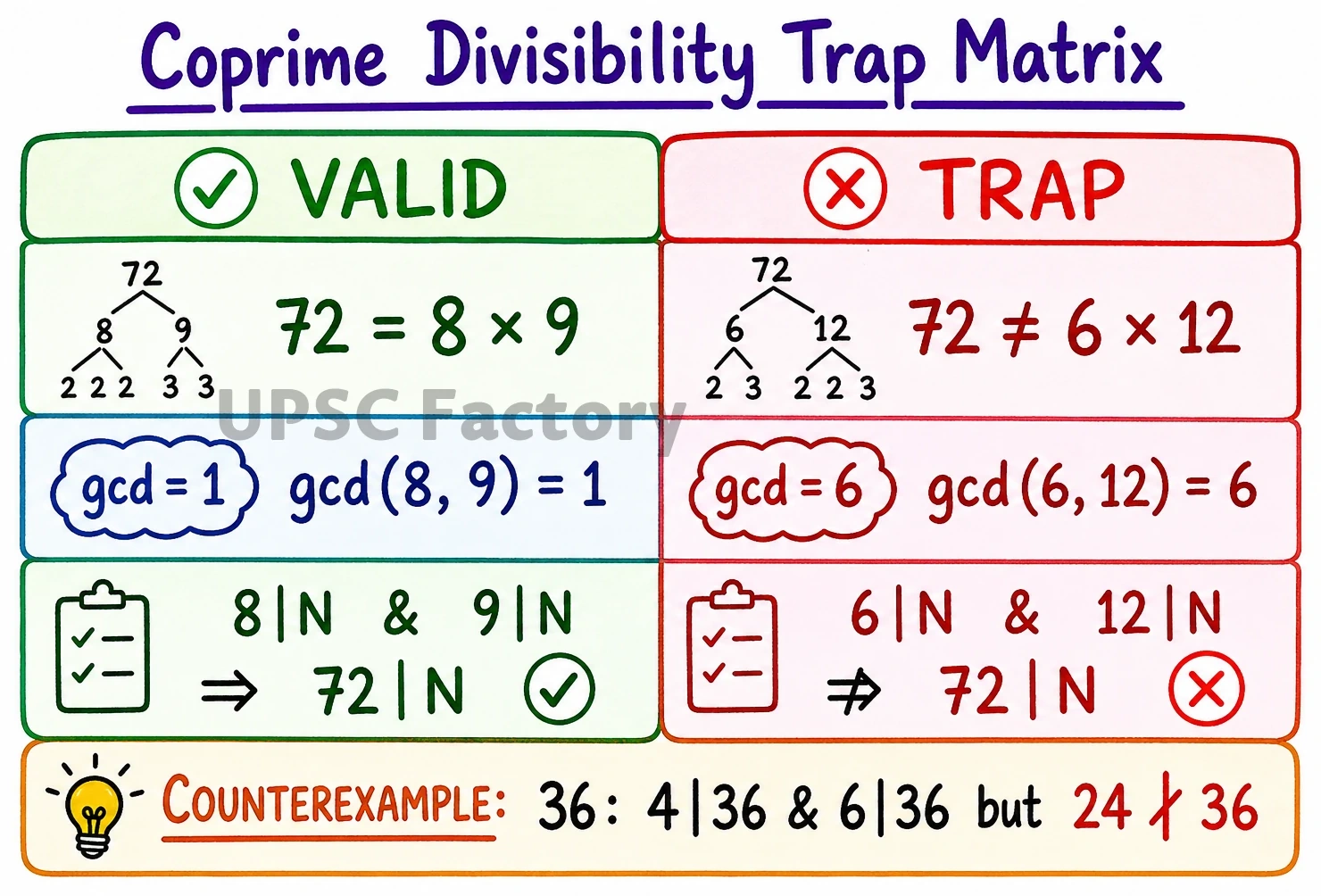
- Co-prime Divisibility Theorem:
If a | N, b | N, and gcd(a, b) = 1, then:(a × b) | N
Caution: If gcd(a, b) ≠ 1, the conclusion does not hold.
- Valid: 8 | N and 9 | N ⇒ 72 | N (since gcd(8, 9) = 1).
- Invalid: 4 | 36 and 6 | 36, but 24 ∤ 36 (because gcd(4, 6) = 2 ≠ 1).
2. Comparative Matrix & Conceptual Distinctions
| Concept | Formal Definition | Relational Scope | Representative Example | Common Examiner Pitfall |
|---|---|---|---|---|
| Prime Number | p > 1 with exactly 2 distinct positive divisors | Intrinsic property of a single number | 2, 13, 79, 211 | Assuming 1 is prime (d(1) = 1), or treating 91 = 7 × 13 as prime |
| Co-Prime Pair | gcd(a, b) = 1 (no common prime factors) | Relational property between a pair | (8, 15), where 8 = 23, 15 = 3 × 5 | Assuming co-prime numbers must themselves be prime (e.g., neither 8 nor 15 is prime) |
| Twin Primes | Pair of primes (p, p + 2) | Property of a specific prime pair | (11, 13), (41, 43) | Confusing with cousin primes (p, p + 4), or including pairs like (7, 9) where 9 is composite |
| Perfect Number | N = ∑ dproper(N) | Intrinsic property of a single number | 6, 28, 496, 8128 | Confusing with abundant numbers (12: proper sum = 16 ≠ 12) |
| Factor vs. Multiple | a is a factor of N if N = a · k; N is a multiple of a | Relational inverse properties | Factors of 12: {1, 2, 3, 4, 6, 12}; Multiples: {12, 24, 36, …} | Inverting the relationship: 36 is a multiple of 6, not a factor of 6 |
3. High-Yield Data Anchors & Benchmarks
A. Prime Frequency Distribution
| Interval | Number of Primes | Cumulative Primes | Strategic Insight |
|---|---|---|---|
| 1 – 25 | 9 | 9 | Highest density interval (36% prime) |
| 26 – 50 | 6 | 15 | Primes: 29, 31, 37, 41, 43, 47 |
| 51 – 100 | 10 | 25 | Exactly 25 primes in 1 – 100 |
| 101 – 200 | 21 | 46 | Primes in 1 – 200 = 46 |
| 1 – 1000 | 168 | 168 | Governed asymptotically by π(x) ≈ x/ln x |
Key Benchmark: When counting primes in the range 1 ≤ N ≤ 100, the total is strictly 25. Avoid the common error of counting 1.
B. High-Frequency Deceptive Composites (Prime Look-Alikes)
These numbers satisfy 6k ± 1 and have no obvious divisibility by 2, 3, or 5, making them standard trap options.
| Deceptive Integer | Prime Factorization | Structural Reason for Error |
|---|---|---|
| 91 | 7 × 13 | 91 = 6(15) + 1; frequently mistaken for prime |
| 51, 57, 87, 93 | 3 × 17, 3 × 19, 3 × 29, 3 × 31 | Look prime at a glance; digit sums are divisible by 3 |
| 119, 133, 161 | 7 × 17, 7 × 19, 7 × 23 | Non-obvious multiples of 7 |
| 121, 169, 289 | 112, 132, 172 | Perfect squares of primes; have exactly 3 positive divisors |
| 143, 221, 323, 391 | 11 × 13, 13 × 17, 17 × 19, 17 × 23 | Products of two close primes; require systematic trial division |
| 25, 35, 49, 55, 77 | 52, 5 × 7, 72, 5 × 11, 7 × 11 | All satisfy the 6k ± 1 filter |
C. Core Invariants & Algebraic Benchmarks
- For any prime p > 3: p ≡ ±1 (mod 6) and p2 ≡ 1 (mod 24).
- Consecutive Integer Product: n(n + 1) is always even, and gcd(n, n + 1) = 1.
- Three Consecutive Integers: n3 – n = (n – 1)n(n + 1) is always divisible by 6.
- Essential Benchmark Squares (⌊√N⌋ references):
112 = 121, 132 = 169, 152 = 225, 172 = 289, 192 = 361, 232 = 529
4. Standard Algorithmic Protocols
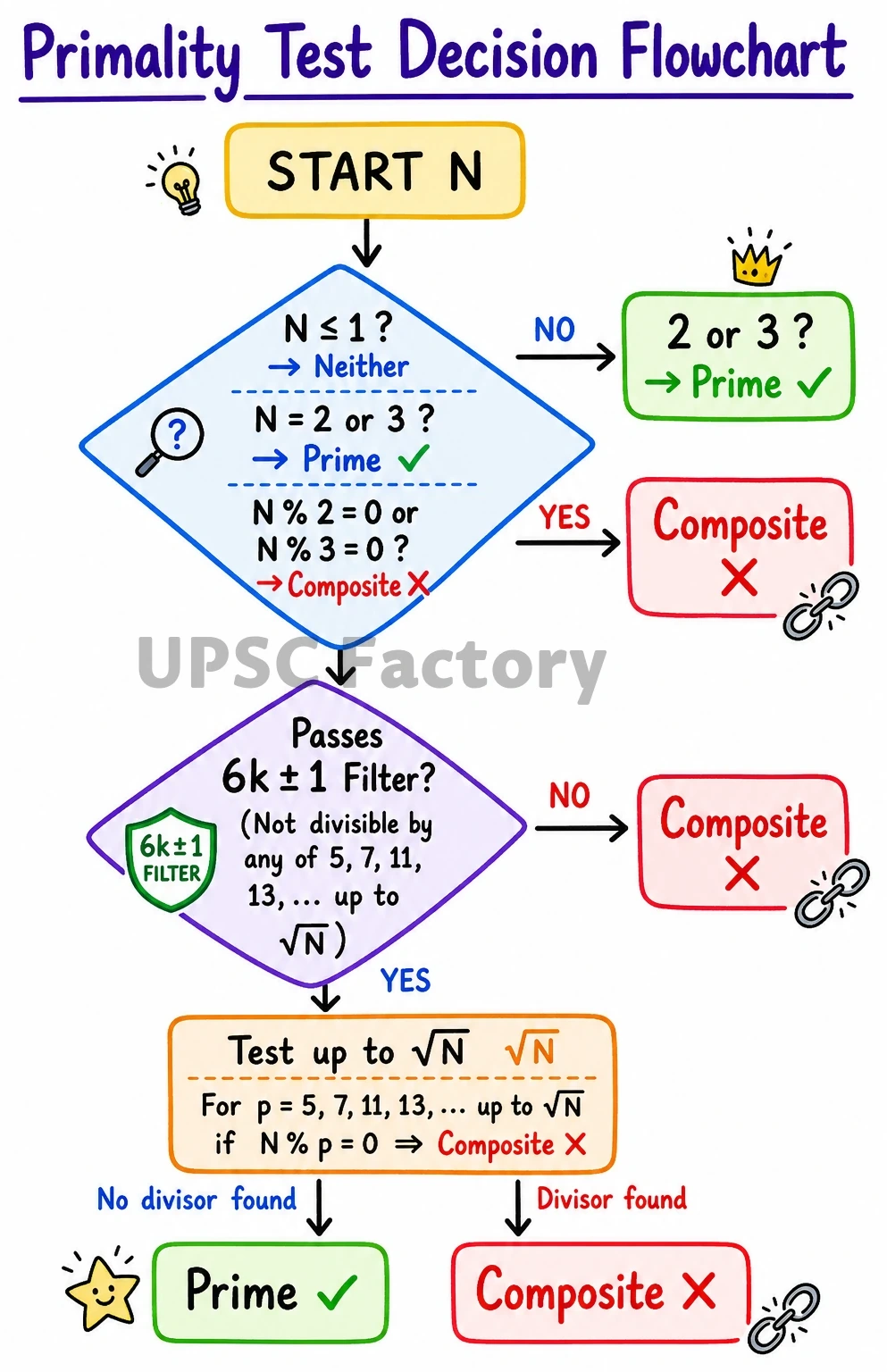
PROTOCOL 1: Systematic Primality Testing for an Integer N
- Boundary & Base Cases:
- If N ≤ 1 ⇒ Neither prime nor composite.
- If N ∈ {2, 3} ⇒ Prime.
- Filter Multiples of 2 and 3:
- If N > 3 and N mod 2 = 0 or N mod 3 = 0 ⇒ Composite.
- Otherwise, N must satisfy N = 6k ± 1. Proceed to Step 3.
- Establish the Square-Root Upper Bound:
- Determine k = ⌊√N⌋.
- Compile the list of all prime numbers p ≤ k.
- Trial Division by Primes Only:
- Test divisibility of N sequentially by each prime p ≤ k.
- If N mod p = 0 for any p ⇒ Composite (terminate).
- If no prime p ≤ k divides N ⇒ Certified Prime.
Working Example: Primality Test of N = 257
- 257 > 3, not divisible by 2 (odd) or 3 (digit sum = 14).
- Form check: 257 = 6(43) – 1 (passes filter).
- Upper bound: √257 ≈ 16.03 ⇒ k = 16.
- Primes to test: {5, 7, 11, 13}.
- 257 mod 5 = 2 ≠ 0
- 257 = 7 × 36 + 5 ⇒ Remainder 5 ≠ 0
- 257 = 11 × 23 + 4 ⇒ Remainder 4 ≠ 0
- 257 = 13 × 19 + 10 ⇒ Remainder 10 ≠ 0
- Conclusion: 257 is prime.
PROTOCOL 2: Divisibility by a Composite Modulus C
To establish whether C | N for a composite divisor C:
- Decompose C into Pairwise Co-prime Factors:
Find integers a, b > 1 such that:C = a × b with gcd(a, b) = 1
(Correct: 72 = 8 × 9 where gcd(8, 9) = 1. Incorrect: 72 = 6 × 12 where gcd(6, 12) = 6 ≠ 1.)
- Verify Sub-Divisibility:
- Evaluate if a | N. If false ⇒ C ∤ N.
- Evaluate if b | N. If false ⇒ C ∤ N.
- Synthesize Result:
If both conditions hold, then C | N.
Working Example: Check if N = 43,200 is divisible by C = 72.
- Factorize 72 = 8 × 9 with gcd(8, 9) = 1.
- Check 8 | 43,200: Last three digits are 200; 200 / 8 = 25 (✓).
- Check 9 | 43,200: Digit sum is 4 + 3 + 2 + 0 + 0 = 9, which is divisible by 9 (✓).
- Conclusion: Since both conditions are satisfied, 72 | 43,200.
5. Standard Question Typologies & Analytical Solutions
TYPE A: Parity & Multi-Variable Constraints
Problem Statement:
Let x, y, z be prime numbers such that x < y < z and x + y + z = 100. What is the maximum possible value of z?
(a) 79
(b) 83
(c) 89
(d) 97
Detailed Analytical Solution:
Step 1: Parity Analysis
The target sum 100 is even. For three positive integers:
Odd + Odd + Odd = Odd
Even + Odd + Odd = Even
Since the sum of three primes is even, at least one prime must be even. The only even prime is 2. Given the strict ordering x < y < z, we must set:
x = 2
Step 2: Algebraic Reduction & Optimization
Substitute x = 2 into the equation:
2 + y + z = 100 ⇒ y + z = 98 ⇒ z = 98 – y
To maximize z, we must minimize the odd prime y such that y > 2 and z is prime:
- Try y = 3 ⇒ z = 98 – 3 = 95 = 5 × 19 (Composite ×)
- Try y = 5 ⇒ z = 98 – 5 = 93 = 3 × 31 (Composite ×)
- Try y = 7 ⇒ z = 98 – 7 = 91 = 7 × 13 (Composite × — classic trap)
- Try y = 11 ⇒ z = 98 – 11 = 87 = 3 × 29 (Composite ×)
- Try y = 13 ⇒ z = 98 – 13 = 85 = 5 × 17 (Composite ×)
- Try y = 17 ⇒ z = 98 – 17 = 81 = 34 (Composite ×)
- Try y = 19 ⇒ z = 98 – 19 = 79 (Prime ✓)
Step 3: Verification
For x = 2, y = 19, and z = 79:
- 2 < 19 < 79 (Ordering satisfied)
- 2 + 19 + 79 = 100
- 79 is prime (divisors tested up to √79 < 9 ⇒ {2, 3, 5, 7}; none divide 79).
Correct Option: (a) 79
TYPE B: Statement-Based / Analytical Evaluation
Problem Statement:
Consider the following statements:
- Every prime number greater than 3 can be written in the form 6k ± 1 for some integer k.
- Every integer of the form 6k ± 1, where k is a positive integer, is a prime number.
- If p is a prime number greater than 3, then p2 – 1 is always divisible by 24.
Which of the statements given above is/are correct?
(a) 1 and 3 only
(b) 2 and 3 only
(c) 1 only
(d) 1, 2 and 3
Detailed Analytical Solution:
Step 1: Evaluate Statement 1
By the Division Algorithm modulo 6, all integers take one of the forms 6k, 6k ± 1, 6k ± 2, 6k + 3. Multiples of 2 and 3 cannot be prime for p > 3. Thus, every prime p > 3 must be of the form 6k ± 1. (Statement 1 is TRUE)
Step 2: Evaluate Statement 2
The condition 6k ± 1 is necessary, not sufficient. A single counterexample disproves universality: for k = 4, 6(4) + 1 = 25 = 52 (composite). Similarly, for k = 6, 6(6) – 1 = 35 = 5 × 7 (composite). (Statement 2 is FALSE)
Step 3: Evaluate Statement 3
Factor p2 – 1 = (p – 1)(p + 1). Because p is an odd prime > 3:
- (p – 1) and (p + 1) are consecutive even numbers ⇒ their product is divisible by 8.
- One of {p – 1, p, p + 1} is divisible by 3; since p is prime > 3, 3 | (p – 1)(p + 1).
- Since gcd(8, 3) = 1, 24 | (p2 – 1). (Statement 3 is TRUE)
Correct Option: (a) 1 and 3 only
TYPE C: Existence & Arithmetic Progression Archetype
Problem Statement:
How many prime triplets of the form (p, p + 2, p + 4) exist such that all three terms are prime numbers?
(a) Exactly one
(b) Exactly two
(c) Infinitely many
(d) None
Detailed Analytical Solution:
Step 1: Modulo 3 Analysis
Any prime p can be represented in one of three residue classes modulo 3:
p ≡ 0 (mod 3), p ≡ 1 (mod 3), or p ≡ 2 (mod 3)
Step 2: Evaluate Each Residue Class
- Case 1 (p ≡ 0 (mod 3)): Since p is prime, the only multiple of 3 that is prime is p = 3.
- Evaluating the triplet: (3, 3 + 2, 3 + 4) = (3, 5, 7). All three are prime. ⇒ Valid triplet.
- Case 2 (p ≡ 1 (mod 3)): Then p = 3k + 1.
- p + 2 = (3k + 1) + 2 = 3k + 3 = 3(k + 1).
- Since p > 3 ⇒ k ≥ 1, p + 2 is a multiple of 3 strictly greater than 3, making it composite.
- Case 3 (p ≡ 2 (mod 3)): Then p = 3k + 2.
- p + 4 = (3k + 2) + 4 = 3k + 6 = 3(k + 2).
- Since k ≥ 1, p + 4 is a multiple of 3 strictly greater than 3, making it composite.
Step 3: Conclusion
The only prime triplet of the form (p, p + 2, p + 4) is (3, 5, 7).
Correct Option: (a) Exactly one
TYPE D: Algebraic Expressions & Prime Invariants
Problem Statement:
Let p be a prime number strictly greater than 5. Consider the integer N = p2 – 1. Which of the following statements is always true?
(a) N is divisible by 12, but not necessarily by 24
(b) N is always divisible by 24
(c) N is always divisible by 120
(d) N is always an odd number
Detailed Analytical Solution:
Step 1: Structural Factorization
N = p2 – 1 = (p – 1)(p + 1)
Since p > 5 is prime, p is odd and not divisible by 2 or 3.
Step 2: Divisibility Analysis
- Divisibility by 8: Let p – 1 = 2k and p + 1 = 2k + 2 = 2(k + 1). Then:
N = 4k(k + 1)
Since k(k + 1) is the product of two consecutive integers, it is always even (2 | k(k + 1)). Hence, 8 | N.
- Divisibility by 3: Among the three consecutive integers {p – 1, p, p + 1}, exactly one is divisible by 3. Since p > 3 is prime, 3 ∤ p, forcing 3 | (p – 1)(p + 1).
- Combining Divisors: Because gcd(8, 3) = 1, N is always divisible by 8 × 3 = 24.
Step 3: Counterexample for 120
Test p = 7: N = 72 – 1 = 48. While 24 | 48, 120 ∤ 48. Thus, divisibility by 120 is not universally guaranteed.
Correct Option: (b) N is always divisible by 24
TYPE E: Divisibility & Co-Prime Factorization
Problem Statement:
A positive integer N is divisible by both 12 and 18. Which of the following statements must be true?
- N is divisible by 36.
- N is divisible by 216 (12 × 18).
Select the correct answer:
(a) 1 only
(b) 2 only
(c) Both 1 and 2
(d) Neither 1 nor 2
Detailed Analytical Solution:
Step 1: Prime Factor Decomposition
12 = 22 × 31, 18 = 21 × 32
For N to be divisible by both 12 and 18, the prime factorization of N must satisfy:
Power of 2 ≥ max(2, 1) = 2
Power of 3 ≥ max(1, 2) = 2
Step 2: Evaluate Statements
- Statement 1: The minimal integer satisfying these prime factor bounds is:
LCM(12, 18) = 22 × 32 = 36
Therefore, any common multiple of 12 and 18 must be a multiple of 36. ⇒ True.
- Statement 2: Since gcd(12, 18) = 6 ≠ 1, we cannot multiply the divisors directly. For instance, if N = 36, N is divisible by both 12 and 18, but 36 is not divisible by 216. ⇒ False.
Correct Option: (a) 1 only
TYPE F: Perfect Numbers & Factor Fingerprints
Problem Statement:
Consider the following statements regarding the integer 28:
- It is a perfect number.
- It can be expressed as the sum of the first 5 prime numbers.
Which of the statements given above is/are correct?
(a) 1 only
(b) 2 only
(c) Both 1 and 2
(d) Neither 1 nor 2
Detailed Analytical Solution:
Step 1: Verify Statement 1
Find all positive proper divisors of 28:
dproper(28) = {1, 2, 4, 7, 14}
Sum of proper divisors:
∑ dproper = 1 + 2 + 4 + 7 + 14 = 28
Since the sum equals the number itself, 28 is a perfect number. (Statement 1 is TRUE)
Step 2: Verify Statement 2
List the first 5 prime numbers: {2, 3, 5, 7, 11}.
Calculate their sum:
2 + 3 + 5 + 7 + 11 = 28
(Statement 2 is TRUE)
Correct Option: (c) Both 1 and 2
6. The Examiner Trap Matrix
| Common Candidate Fallacy | Underlying Mathematical Reality | Concrete Counterexample / Edge Case |
|---|---|---|
| “The number 1 is prime” | A prime requires exactly two distinct positive divisors. 1 has only one divisor (d(1) = 1). | Treating 1 as prime violates the Fundamental Theorem of Arithmetic (6 = 2 × 3 = 1 × 2 × 3). |
| “Every 6k ± 1 number is prime” | 6k ± 1 is a necessary filter, not a sufficient proof. It only eliminates multiples of 2 and 3. | 25 = 6(4) + 1, 35 = 6(6) – 1, 49 = 6(8) + 1, and 91 = 6(15) + 1 are all composite. |
| “Co-prime numbers must be individually prime” | Co-primality is a relational property (gcd(a, b) = 1), not an intrinsic property. | In the pair (8, 15), both 8 = 23 and 15 = 3 × 5 are composite, but gcd(8, 15) = 1. |
| “If a | N and b | N, then ab | N” | This product rule holds if and only if gcd(a, b) = 1. | 4 | 36 and 6 | 36, but 24 ∤ 36 because gcd(4, 6) = 2 ≠ 1. Use LCM(a, b) = 12. |
| “Primality testing requires checking divisors up to N/2” | Any non-trivial factorization N = a × b requires the smaller factor to satisfy a ≤ √N. | To test 397, one only needs to test primes p ≤ ⌊√397⌋ = 19. Testing up to 198 is redundant. |
| “Numbers like 91, 143, 221 are prime” | These are products of two primes close to each other, often disguised within the 6k ± 1 form. | 91 = 7 × 13, 143 = 11 × 13, 221 = 13 × 17, 323 = 17 × 19, 391 = 17 × 23. |
| “Twin primes contain an arbitrary integer between them” | The intermediate number between twin primes (p, p + 2) with p > 3 is always divisible by 6. | For (11, 13), middle value 12 = 6 × 2; for (17, 19), middle value 18 = 6 × 3. |
7. Core Rules & Instant Exam Deductions
| # | Trigger / Exam Scenario | Mathematical Rule & Actionable Deduction |
|---|---|---|
| 1 | Even Sum of an Odd Number of Primes (∑i=12k+1 pi = 2M) | At least one prime must be 2. If p + q + r = 100 with p < y < z, immediately set the smallest prime p = 2. |
| 2 | Rapid Primality Screening for N > 3 | Compute N mod 6. If the remainder is 0, 2, 3, or 4, N is composite. If the remainder is 1 or 5, establish the bound k = ⌊√N⌋ and test only prime divisors p ≤ k. |
| 3 | Co-Prime Divisibility Synthesis (Composite Modulus C) | To test divisibility by composite C, decompose C = a × b where gcd(a, b) = 1 (e.g., 72 = 8 × 9, 45 = 5 × 9). Never split composite moduli into non-co-prime factors (e.g., 72 ≠ 6 × 12). |
| 4 | Prime Square Invariant (p > 3) | p2 ≡ 1 (mod 24) ⇒ p2 – 1 = 24k. Use this invariant to evaluate polynomial expressions, algebraic divisibility, and remainder problems. |
| 5 | Small Bound Optimization for N ≤ 400 | Since √N ≤ 20, the test set of prime divisors is strictly bounded by Ptest = {2, 3, 5, 7, 11, 13, 17, 19}. (e.g., for N = 391, trial division by 17 yields 391 / 17 = 23 ⇒ composite in under 15 seconds). |
| 6 | Product of Three Consecutive Integers | (n – 1)n(n + 1) = n3 – n ≡ 0 (mod 6). Always divisible by 6 because it must contain at least one multiple of 2 and exactly one multiple of 3. |
Summary: Problem design in prime number theory frequently revolves around edge-case constraints: recognizing that 2 is the unique even prime, using 6k ± 1 as an elimination sieve rather than a generator, testing only up to ⌊√N⌋, and checking prime factors for composite look-alikes such as 91, 143, and 221.