1. Theoretical Foundation & Mathematical Underpinnings
Formal Definition & Scope
For integers, divisibility is absolute. For rationals, we must extend the definition appropriately.
- Divisibility for Rationals: A rational number r1 divides r2 if and only if:
r2/r1 ∈ ℤ
i.e., r2 is an integer multiple of r1.
- HCF of Fractions/Decimals (Hf): The largest positive rational Hf such that Hf divides each given number. Hence:
Hf ≤ min(r1, r2, …, rn)
- LCM of Fractions/Decimals (Lf): The smallest positive rational Lf such that each given number divides Lf. Hence:
Lf ≥ max(r1, r2, …, rn)
- Domain Constraint: We operate strictly with fractions in the form:
ri = pi/qi, pi, qi ∈ ℤ+, qi ≠ 0, gcd(pi, qi) = 1
and for decimals:
ri = Ni/10k, Ni ∈ ℤ+, k ∈ ℤ≥ 0
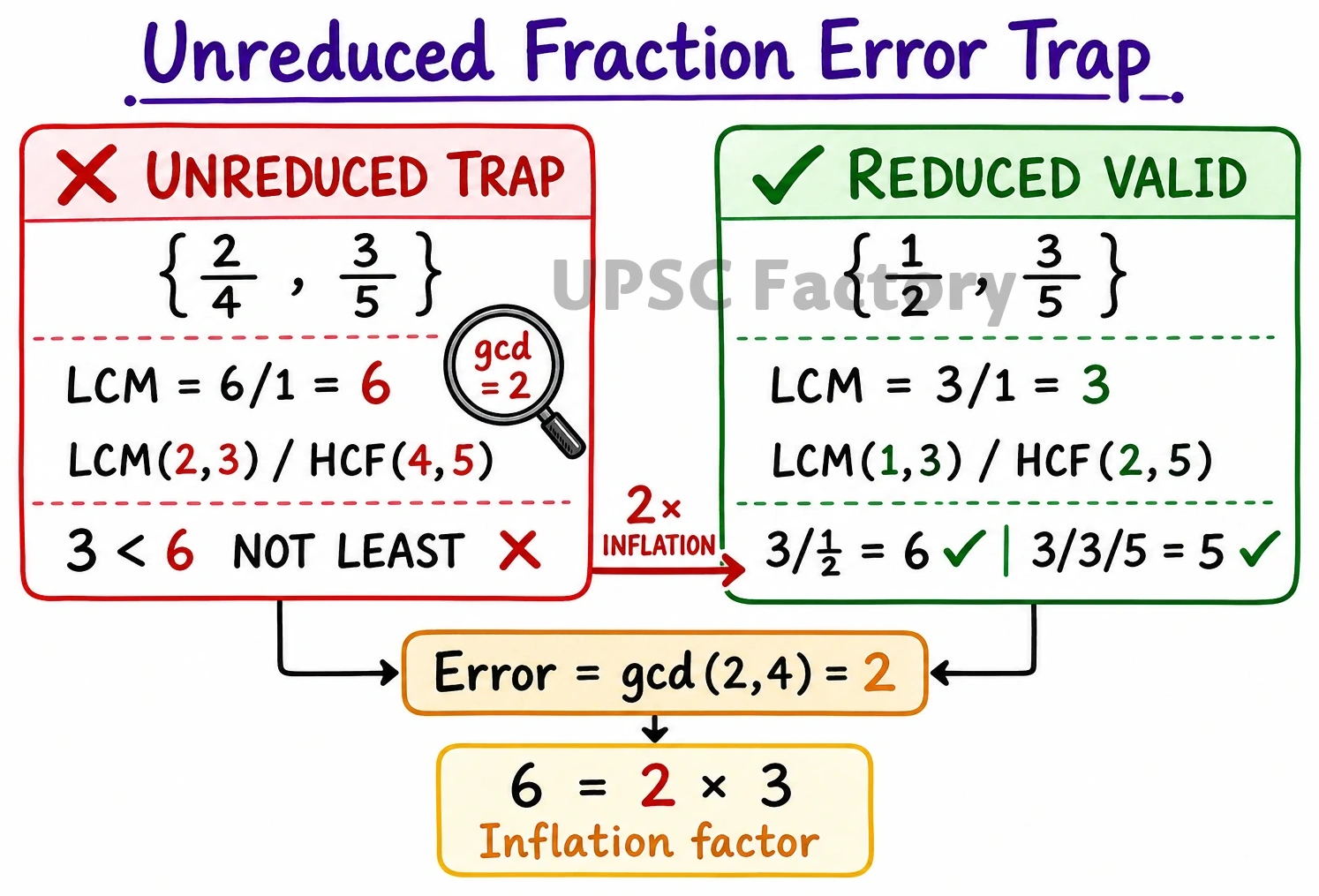
Absolute Pre-condition: A fraction is not merely an isolated pair of integers (p, q); it represents a rational equivalence class. For example, 2/4 = 1/2 represents the same value. All HCF/LCM formulas are valid only when fractions are expressed in their canonical lowest terms where gcd(pi, qi) = 1. Computing on unreduced fractions silently inflates denominators or numerators with common factors, corrupting the result.
The “Why” Behind the Math
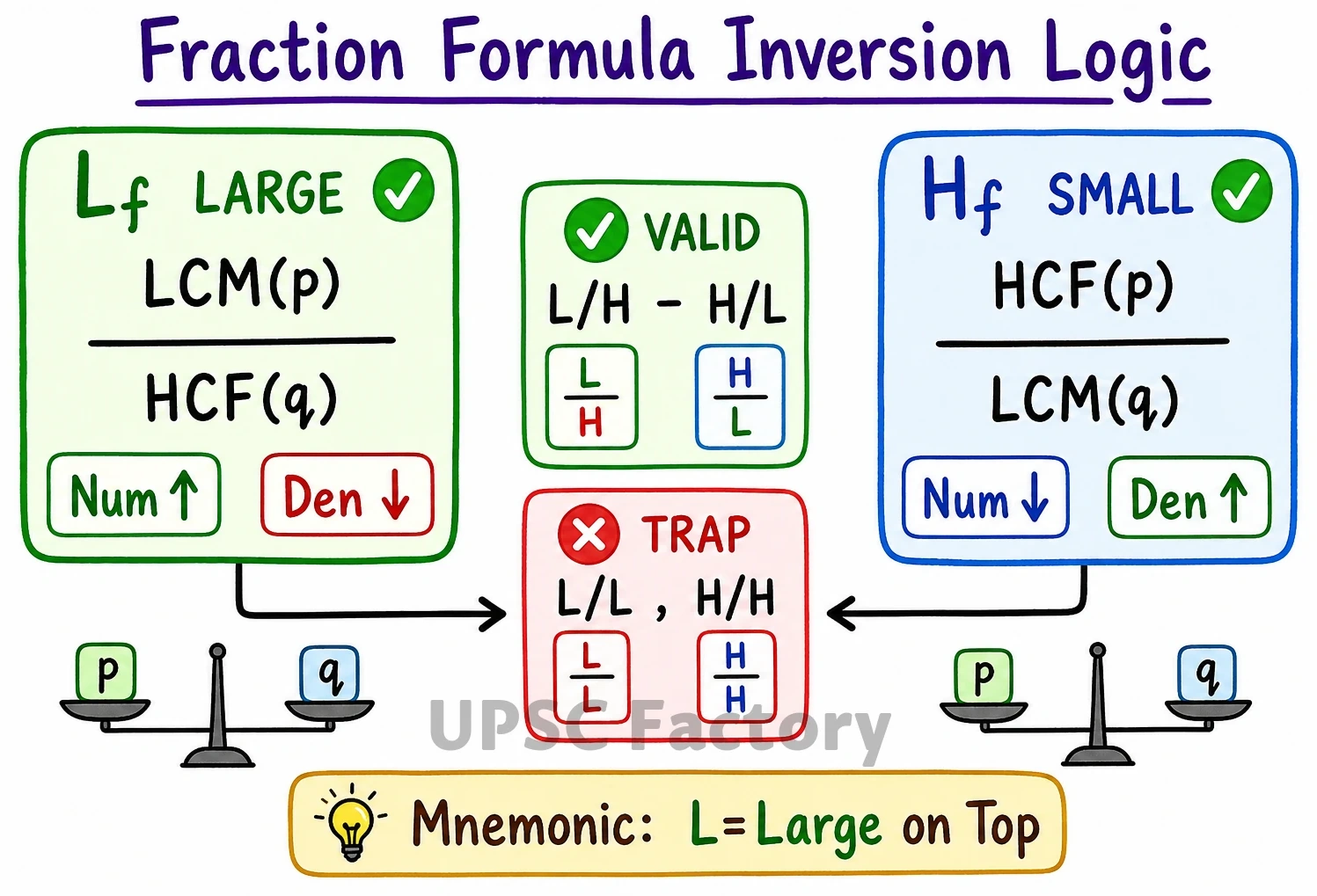
Why is LCM of fractions = LCM of Numerators/HCF of Denominators?
Proof Sketch:
Let S = {p1/q1, p2/q2} be a set of fractions reduced to lowest terms. Define:
L = Ln/Hd where Ln = LCM(p1, p2), Hd = HCF(q1, q2)
For L to be a common multiple, we require L/(pi/qi) ∈ ℤ for each i. Evaluating for i = 1:
L/(p1/q1) = (Ln/Hd) · (q1/p1) = (Ln/p1) × (q1/Hd)
- By definition, p1 | Ln, so Ln/p1 ∈ ℤ.
- By definition, Hd | q1, so q1/Hd ∈ ℤ.
The product of two integers is always an integer; hence, L is a valid common multiple.
To guarantee that L is the least common multiple:
- The numerator must be minimized while remaining divisible by every pi ⇒ LCM(pi).
- The denominator must be maximized while dividing every qi ⇒ HCF(qi) (maximizing the denominator minimizes the overall fraction value).
The dual logic applies to the HCF:
- LCM seeks a large value: Numerator is maximized (LCM) and denominator is minimized (HCF of denominators maximizes total fractional magnitude).
- HCF seeks a small value: Numerator is minimized (HCF) and denominator is maximized (LCM of denominators minimizes total fractional magnitude).
Hence, for any set in lowest terms:
Lf = LCM(pi)/HCF(qi), Hf = HCF(pi)/LCM(qi)
Why Must Fractions Be Reduced?
The formula relies on the denominator q being strictly coprime to p. If unreduced, an uncancelled factor gcd(p, q) > 1 distorts the least common multiple or highest common factor.
Example: Consider 2/4 unreduced (true value 1/2) and 3/5.
Using unreduced terms:
LCM(2/4, 3/5)unreduced = LCM(2, 3)/HCF(4, 5) = 6/1 = 6
However, 6 is not the least common multiple. The integer 3 is also a common multiple:
3/(1/2) = 6 ∈ ℤ, 3/(3/5) = 5 ∈ ℤ
Since 3 < 6, 6 fails minimality. Reducing the set to {1/2, 3/5} yields:
Lf = LCM(1, 3)/HCF(2, 5) = 3/1 = 3
The unreduced formula caused an error factor of gcd(2, 4) = 2.
Why Decimal Equalization Works (Scaling Invariance)
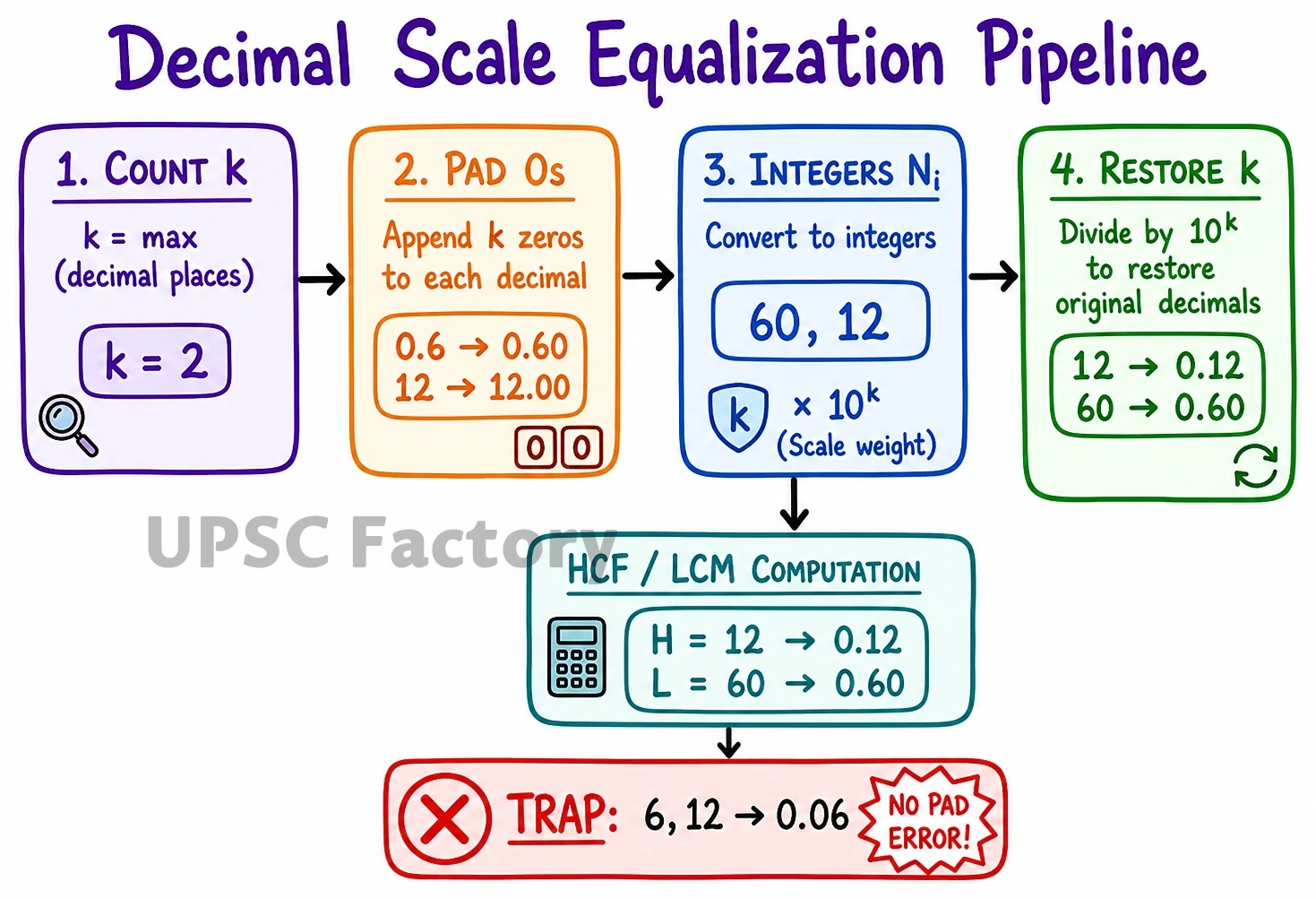
Let d1 = 0.6 and d2 = 0.12. The maximum number of decimal places is k = max(1, 2) = 2.
Express both numbers with a uniform base scale of 10k = 100:
d1 = 60/100, d2 = 12/100
For any positive scalar c > 0:
HCF(c · a, c · b) = c · HCF(a, b)
LCM(c · a, c · b) = c · LCM(a, b)
Setting c = 10–k = 1/100:
HCF(0.60, 0.12) = 1/102 × HCF(60, 12) = 12/100 = 0.12
LCM(0.60, 0.12) = 1/102 × LCM(60, 12) = 60/100 = 0.60 = 0.6
Padding decimals with trailing zeros establishes a common integer scale. Stripping decimal points without uniform padding applies mixed scales (10-1 vs 10-2), invalidating the scalar distributive property.
Key Theorems & Properties
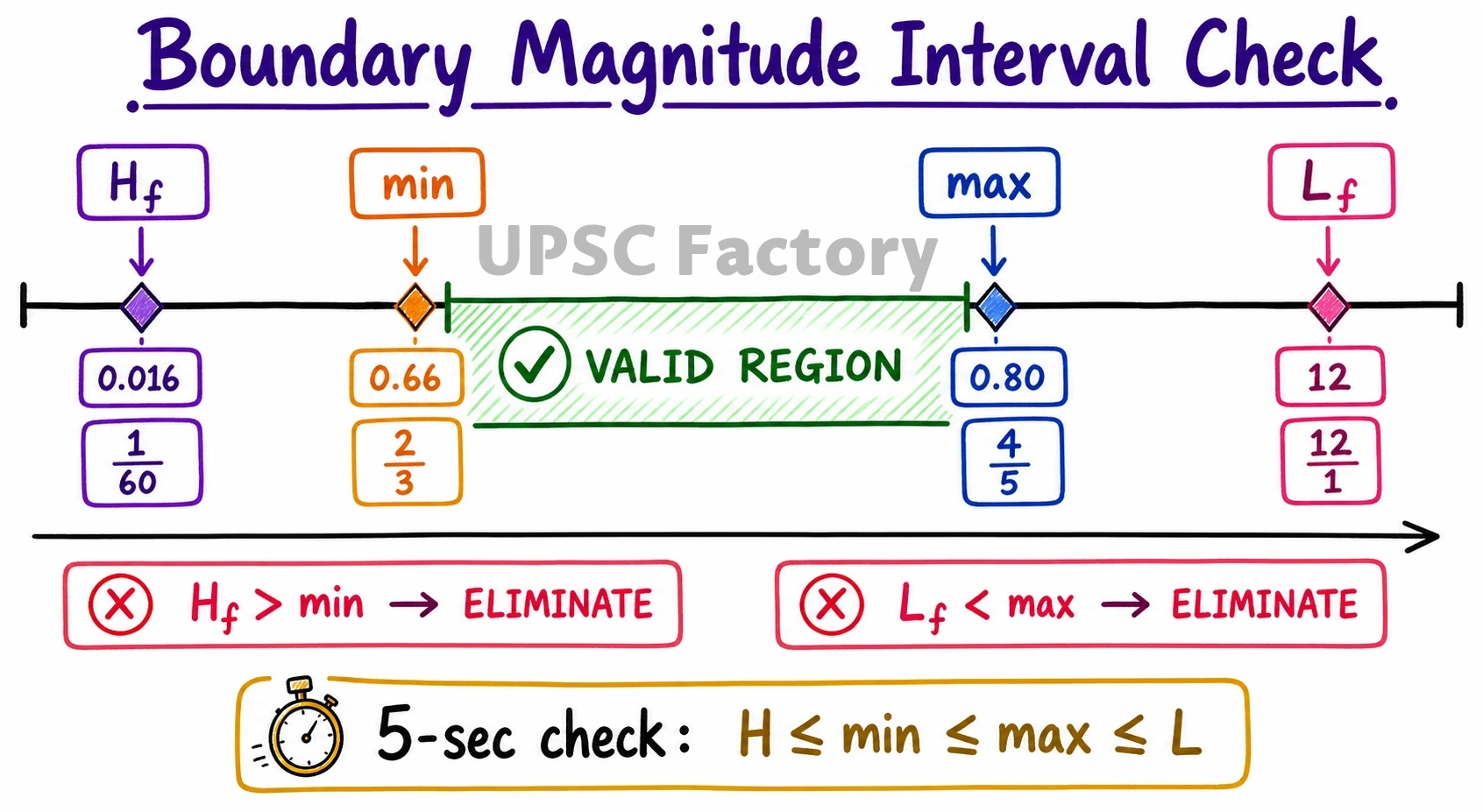
- Boundary Theorem: For any set S:
Hf ≤ min(S) ≤ max(S) ≤ Lf
Any calculated HCF greater than the minimum element, or LCM smaller than the maximum element, is mathematically impossible.
- Product Invariant Rule: For exactly two numbers, the standard product identity holds:
Hf × Lf = r1 × r2
Proof:
Hf × Lf = HCF(p1, p2)/LCM(q1, q2) × LCM(p1, p2)/HCF(q1, q2) = p1p2/q1q2 = r1 × r2
For three or more numbers (n ≥ 3), this relationship fails. Never apply H × L = Product when n ≥ 3.
Counter-example for n = 3: Let r1 = 1/2, r2 = 1/3, r3 = 1/4.
Hf = HCF(1, 1, 1)/LCM(2, 3, 4) = 1/12, Lf = LCM(1, 1, 1)/HCF(2, 3, 4) = 1/1 = 1
Hf × Lf = 1/12 × 1 = 1/12 ≠ 1/24 = (1/2 × 1/3 × 1/4)
- Coprimality Preservation: If all denominators qi are pairwise coprime, LCM(qi) = ∏ qi. Consequently, Hf becomes significantly small—a useful order-of-magnitude sanity check.
2. Comparative Matrix & Conceptual Distinctions
| Dimension | Integers a, b ∈ ℤ | Fractions p/q, gcd(p, q) = 1 | Decimals N/10k |
|---|---|---|---|
| Divisor Definition | a | b ⇔ b/a ∈ ℤ | r1 | r2 ⇔ r2/r1 ∈ ℤ | Same as rational definition |
| HCF Formula | Prime Factorization / Euclidean Algorithm | HCF(pi)/LCM(qi) | 1/10k · HCF(Ni) after equalization |
| LCM Formula | Prime Factorization | LCM(pi)/HCF(qi) | 1/10k · LCM(Ni) after equalization |
| Core Operation | Direct integer arithmetic | Cross-operation: LCM on num, HCF on den (and vice-versa) | Scale to uniform integers, compute, descale |
| Mandatory Pre-step | None | Reduce all fractions to lowest terms | Pad to equal decimal places: k = max(ki) |
| Common Pitfall | Arithmetic miscalculations | Operating on unreduced fractions | Operating across mismatched decimal scales |
3. High-Yield Data Anchors & Memorization Benchmarks
A. The Reduction Fingerprint
| Deceptive Unreduced Form | True Lowest Form | Impact of Failing to Reduce |
|---|---|---|
| 28/35, 42/56, 14/21 | 4/5, 3/4, 2/3 | Coincidentally yields matching values due to symmetric cancellation; standard sets produce errors proportional to gcd(p, q). |
| 6/8, 9/12 | Both equal 3/4 | For 2 terms: unreduced LCM = 18/4 = 4.5 vs. true value 0.75 (6× distortion). |
| 18/27, 24/36 | Both equal 2/3 | Calculating with unreduced numerators {18, 24} corrupts both scale and primality. |
B. Decimal Scale Anchors
- k = 1 (tenths): Scale by 101 = 10
- k = 2 (hundredths): Scale by 102 = 100
- k = 3 (thousandths): Scale by 103 = 1000
- Uniform Scale Rule: k = max(decimal places in the set). For {0.6, 9.6, 0.12}, k = 2 applies to all three numbers (0.60, 9.60, 0.12).
C. Magnitude Check (Rapid Option Elimination)
To evaluate HCF(0.6, 0.12):
- Boundary check: Hf ≤ min(0.6, 0.12) = 0.12. Any option > 0.12 is eliminated immediately.
- Equalize: k = 2 ⇒ 60, 12 ⇒ HCF(60, 12) = 12.
- Descale: 12/100 = 0.12.
- For LCM: Lf ≥ max(0.6, 0.12) = 0.6. Any option < 0.6 is eliminated immediately.
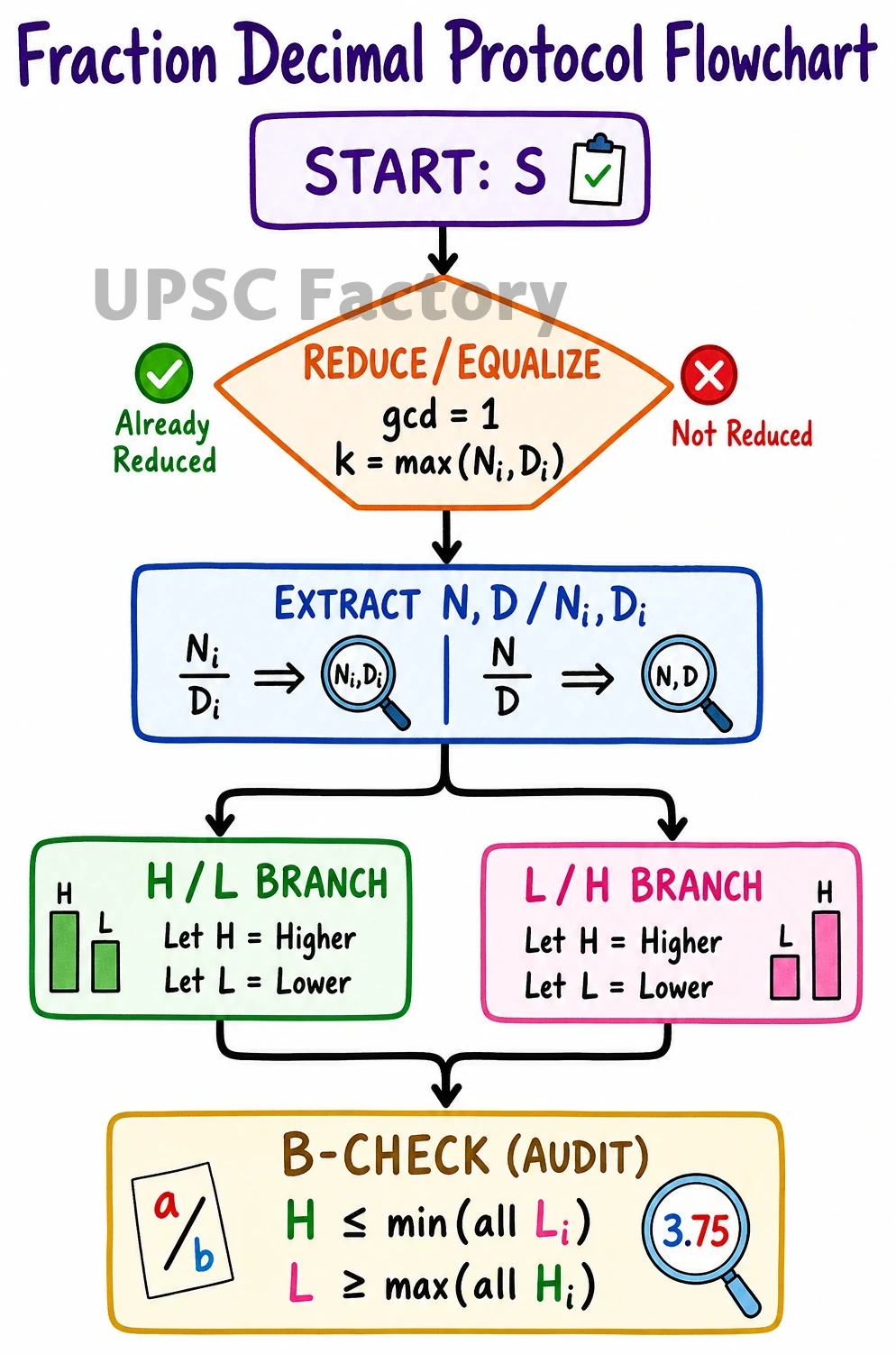
4. Standard Algorithmic Protocols
Protocol A: Computing HCF and LCM of Fractions
- Input: A set of rational numbers p1/q1, p2/q2, …, pn/qn.
- Canonical Reduction: If gcd(pi, qi) ≠ 1, reduce each fraction to its lowest terms.
- Array Extraction: Separate terms into two sets:
- Numerators: N = {p1, p2, …, pn}
- Denominators: D = {q1, q2, …, qn}
- Formula Execution:
- For HCF:
Hf = HCF(N)/LCM(D)
- For LCM:
Lf = LCM(N)/HCF(D)
- For HCF:
- Boundary Verification: Confirm that Hf ≤ min(S) and Lf ≥ max(S).
- Result: Express as a simplified proper or improper fraction.
Protocol B: Computing HCF and LCM of Decimals (Equalization Method)
- Count Decimal Digits: Determine the number of decimal digits ki for each term di.
- Find Global Scale: Determine k = max(k1, k2, …, kn).
- Pad Trailing Zeros: Append zeros to equalize all terms to k decimal places.
Example: For 0.6 and 0.12 with k = 2, write 0.60 and 0.12. - Transform to Integers: Multiply by 10k (remove decimal point) to obtain integers Ni.
Example: 0.60 &to; 60, 0.12 &to; 12. - Compute Integer Metric: Calculate HCF(Ni) or LCM(Ni) directly.
- Descale: Shift the decimal point k places to the left (divide by 10k).
Example: HCF(60, 12) = 12 ⇒ 12/100 = 0.12. - Boundary Verification: Confirm H ≤ min(di) and L ≥ max(di).
Operational Warning: Avoid converting decimals into mixed fractions such as 12/10 and 45/100 before applying Protocol A without thorough cross-reduction. The differing powers of 10 require normalization; Protocol B eliminates this redundancy.
5. Standard Question Typologies & Analytical Solutions
Type A: Parity & Hidden Factor Constraint (Fractional HCF)
Question:
Find the HCF of the set of fractions 14/21, 28/35, and 36/48.
(a) 1/140
(b) 1/105
(c) 2/105
(d) 1/60
Analytical Solution:
Step 1 — Pre-condition Audit:
Check whether gcd(pi, qi) = 1 for all terms. All three fractions share common factors and must be reduced.
Step 2 — Reduction to Canonical Form:
14/21 = 2/3, 28/35 = 4/5, 36/48 = 3/4
Extract the integer sets:
N = {2, 4, 3} ⇒ HCF(N) = 1
D = {3, 5, 4} ⇒ LCM(D) = 3 × 5 × 4 = 60
Step 3 — Compute HCF:
Hf = HCF(N)/LCM(D) = 1/60
Step 4 — Boundary Check:
min(S) = 2/3 ≈ 0.667. Since 1/60 ≈ 0.0167 ≤ 2/3, the result satisfies the boundary constraint.
Correct Option: (d) 1/60
Type B: Statement-Based Conceptual Assessment (Algorithm Integrity)
Question:
Consider the following statements:
- Statement I: The HCF of 0.5 and 0.05 is found by computing the HCF of 5 and 5 and placing the decimal point two places to the left.
- Statement II: To find the LCM of fractions, computing LCM of unreduced numerators/HCF of unreduced denominators produces a valid least common multiple.
Which of the above statements is/are correct?
(a) I only
(b) II only
(c) Both I and II
(d) Neither I nor II
Analytical Solution:
Evaluation of Statement I:
The maximum decimal places is k = max(1, 2) = 2.
Equalizing gives 0.50 and 0.05 ⇒ integers 50 and 5.
HCF(50, 5) = 5 ⇒ 5/100 = 0.05.
While taking HCF(5, 5) = 5 &to; 0.05 matches by coincidence here, the method fails generally (e.g., for 0.6 and 0.12, unpadded inputs yield HCF(6, 12) = 6 &to; 0.06, whereas the true HCF is 0.12). The algorithmic statement is conceptually false.
Evaluation of Statement II:
As demonstrated in Section 1, unreduced fractions leave uncancelled factors that artificially inflate the resulting value, producing a common multiple that is not the least. Statement II is false.
Correct Option: (d) Neither I nor II
Type C: Existence & Parameter Counting
Question:
Let S be the set of all fractions p/q in lowest terms such that p < q ≤ 5, with p, q ∈ ℤ+. How many fractions in S yield an HCF of 1/60 when grouped with the set {4/5, 3/4}?
(a) 1
(b) 2
(c) 3
(d) 4
Analytical Solution:
Step 1 — Group Evaluation:
Let r = p/q ∈ S. The HCF of the combined set is:
HCF(4/5, 3/4, p/q) = HCF(4, 3, p)/LCM(5, 4, q) = 1/60
Step 2 — Numerator Analysis:
Since HCF(4, 3) = 1, we have HCF(1, p) = 1 for any positive integer p. The numerator constraint is universally satisfied.
Step 3 — Denominator Analysis:
We require:
LCM(20, q) = 60
Prime factorizations:
20 = 22 × 5, 60 = 22 × 3 × 5
Thus, q must contain 31 as a factor and must divide 60. Given q ≤ 5, testing possible integer values:
- If q = 1 ⇒ LCM(20, 1) = 20 ≠ 60
- If q = 2 ⇒ LCM(20, 2) = 20 ≠ 60
- If q = 3 ⇒ LCM(20, 3) = 60 (Valid)
- If q = 4 ⇒ LCM(20, 4) = 20 ≠ 60
- If q = 5 ⇒ LCM(20, 5) = 20 ≠ 60
Hence, q = 3 is the unique solution for the denominator.
Step 4 — Enumerating Valid Numerators:
With q = 3, the condition p < q and gcd(p, 3) = 1 yields:
p ∈ {1, 2}
The valid fractions are 1/3 and 2/3 (Total = 2).
Correct Option: (b) 2
Type D: Algebraic Invariants & Product Identities
Question:
For the decimal numbers a = 0.6 and b = 0.12, evaluate the following statements:
- Statement I: HCF(a, b) × LCM(a, b) = a × b
- Statement II: LCM(a, b) = 0.6 and HCF(a, b) = 0.12
Which of the statements is/are correct?
(a) I only
(b) II only
(c) Both I and II
(d) Neither I nor II
Analytical Solution:
Step 1 — Compute HCF and LCM:
Set k = max(1, 2) = 2.
Scaled integers: N1 = 60, N2 = 12.
- HCF(60, 12) = 12 ⇒ HCF(a, b) = 0.12
- LCM(60, 12) = 60 ⇒ LCM(a, b) = 0.60 = 0.6
Statement II is true.
Step 2 — Verify Product Invariant:
a × b = 0.6 × 0.12 = 0.072
HCF(a, b) × LCM(a, b) = 0.12 × 0.6 = 0.072
Because n = 2, the product identity holds rigorously. Statement I is true.
Correct Option: (c) Both I and II
Type E: Joint Multi-Term Fraction Evaluation
Question:
Determine the HCF and LCM of the set {28/35, 42/56, 14/21}.
(a) HCF = 1/60, LCM = 12
(b) HCF = 1/30, LCM = 6
(c) HCF = 7/840, LCM = 84
(d) HCF = 2/105, LCM = 12
Analytical Solution:
Step 1 — Mandatory Reduction:
28/35 = 4/5, 42/56 = 3/4, 14/21 = 2/3
Step 2 — Compute HCF:
Hf = HCF(4, 3, 2)/LCM(5, 4, 3) = 1/60
Step 3 — Compute LCM:
Lf = LCM(4, 3, 2)/HCF(5, 4, 3) = 12/1 = 12
Correct Option: (a) HCF = 1/60, LCM = 12
Type F: Multi-Term Decimal Evaluation
Question:
Find the LCM of 0.6, 9.6, and 0.12.
(a) 9.6
(b) 0.12
(c) 28.8
(d) 0.6
Analytical Solution:
Step 1 — Equalize Decimals:
Number of decimal places: k1 = 1, k2 = 1, k3 = 2 ⇒ k = 2.
Equalized values: 0.60, 9.60, 0.12.
Step 2 — Integer Mapping:
N = {60, 960, 12}
Step 3 — Integer LCM Calculation:
Notice that 12 | 60 and 60 | 960 (960 / 60 = 16).
Since 12 and 60 both divide 960, LCM(60, 960, 12) = 960.
Step 4 — Descale:
L = 960/102 = 9.60 = 9.6
Correct Option: (a) 9.6
6. The Examiner Trap Matrix
| Candidate Fallacy | Mathematical Reality | Concrete Counter-Example |
|---|---|---|
| 1. Unreduced Fraction Trap | Formulas require coprime pairs gcd(p, q) = 1. Hidden factors distort results. | LCM(2/4, 3/5): unreduced formula gives 6; true canonical LCM is 3 (2× error). |
| 2. Asymmetric Decimal Trap | Decimal scaling factor 10–k must be uniform across the entire set. | For {1.2, 0.04}, setting k = 2 gives LCM(120, 4) = 120 &to; 1.20. Without padding, LCM(12, 4) = 12 &to; 0.12 (10× error). |
| 3. Raw Fraction Conversion | Converting decimals directly to unreduced fractions mixes base-10 powers with unsimplified terms. | 0.45 = 45/100. Without reduction to 9/20, cross-fraction formulas yield incorrect intermediate denominators. |
| 4. Formula Inversion | LCM requires maximizing the fraction (LCM/HCF); HCF requires minimizing (HCF/LCM). | For {4/5, 3/4}, inverted LCM gives HCF(4,3)/LCM(5,4) = 1/20 = 0.05, violating L ≥ max(S). |
| 5. Trailing Zero Descaling Error | The shift count k is fixed by the initial maximum decimal places, not the result’s digits. | Scaled integer LCM = 960 with k = 2 ⇒ 9.60. Miscounting positions gives 96 or 0.96. |
| 6. Multi-Term Product Extension | H × L = Product holds only for n = 2 terms; it fails for n ≥ 3. | For {1/2, 1/3, 1/4}: H = 1/12, L = 1 ⇒ H × L = 1/12 ≠ 1/24 = ∏ ri. |
7. Golden Rules & Instant Exam Triggers
| # | Trigger | Mathematical Rule |
|---|---|---|
| 1 | Fractions &to; Reduce First | Always verify gcd(pi, qi) = 1. If any numerator and denominator share common prime factors (2, 3, 5, 7), simplify completely before applying formulas. |
| 2 | Decimals &to; Equalize Scale | Set k = max(ki). Append trailing zeros to align all numbers to the same number of decimal places before removing the decimal point. |
| 3 | LCM of Fractions &to; Maximize Value | LCM = LCM(Numerators)/HCF(Denominators) |
| 4 | HCF of Fractions &to; Minimize Value | HCF = HCF(Numerators)/LCM(Denominators) |
| 5 | Boundary Constraint Check | Eliminate invalid answer options rapidly using: Hf ≤ min(S) and Lf ≥ max(S). |
| 6 | Decimal Restoration Rule | Keep k fixed from Step 1. Shift the decimal point k places to the left on the final integer result (divide by 10k). |
| 7 | Product Rule Scope | Apply H × L = r1 × r2 strictly when n = 2. Never apply it for sets of 3 or more numbers. |
Key Pedagogical Takeaway: Fraction problems test reduction discipline; decimal problems test scale equalization. Most errors stem from skipping these initial formatting steps rather than the core LCM/HCF calculations. Verifying canonical form at the outset guarantees accuracy.