1. Theoretical Foundation & Mathematical Underpinnings
Formal Definition & Scope
For a, b, N ∈ ℤ+ and N > 1:
- Factor / Divisor: d is a factor of N if ∃ k ∈ ℤ+ such that N = d · k, i.e., d | N with zero remainder. The set of factors is finite and bounded by N.
- Multiple: M is a multiple of N if ∃ k ∈ ℤ+ such that M = N · k, i.e., N | M. The set of multiples is countably infinite and unbounded.
- Highest Common Factor (HCF) / gcd(a, b): The largest D ∈ ℤ+ such that D | a and D | b. Mathematically:
a = D · p, b = D · q where gcd(p, q) = 1 - Least Common Multiple (LCM) / lcm(a, b): The smallest M ∈ ℤ+ such that a | M and b | M. Mathematically:
M = a · k1 = b · k2 for some k1, k2 ∈ ℤ+
Operational Scope: HCF and LCM are defined strictly for positive integers. In quantitative problem solving, always standardize all measurements to the lowest common integer base unit (e.g., seconds, centimeters, milliliters) before performing any factor or multiple operations.
Mathematical Proofs & Core Intuition
1. Why LCM is the Earliest Synchronization Point
Consider two periodic events recurring at intervals of a and b starting from T = 0. Their occurrence timestamps form arithmetic progressions:
A = {a, 2a, 3a, …} and B = {b, 2b, 3b, …}
A simultaneous occurrence occurs at timestamp T ∈ A ∩ B, meaning T is a common multiple of a and b.
By the Well-Ordering Principle of Natural Numbers, the non-empty set of common multiples contains a unique minimum element. This element is lcm(a, b). All subsequent simultaneous points recur at exact integer multiples of this base interval:
Tk = k · lcm(a, b), k ∈ ℤ+
Thus, LCM represents forward periodic projection.
2. Why HCF is the Largest Uniform Measuring Unit
To divide or cut elements of size x and y into identical partitions of size D without remainder or waste, D must satisfy D | x and D | y.
Therefore, D belongs to the finite set of common divisors:
C = {d ∈ ℤ+ : d | x and d | y}
The total number of partitions generated is:
N = x/D + y/D
To minimize the total count (N), the unit size (D) must be maximized. The maximum element in set C is gcd(x, y). Thus, HCF represents backward analytical decomposition.
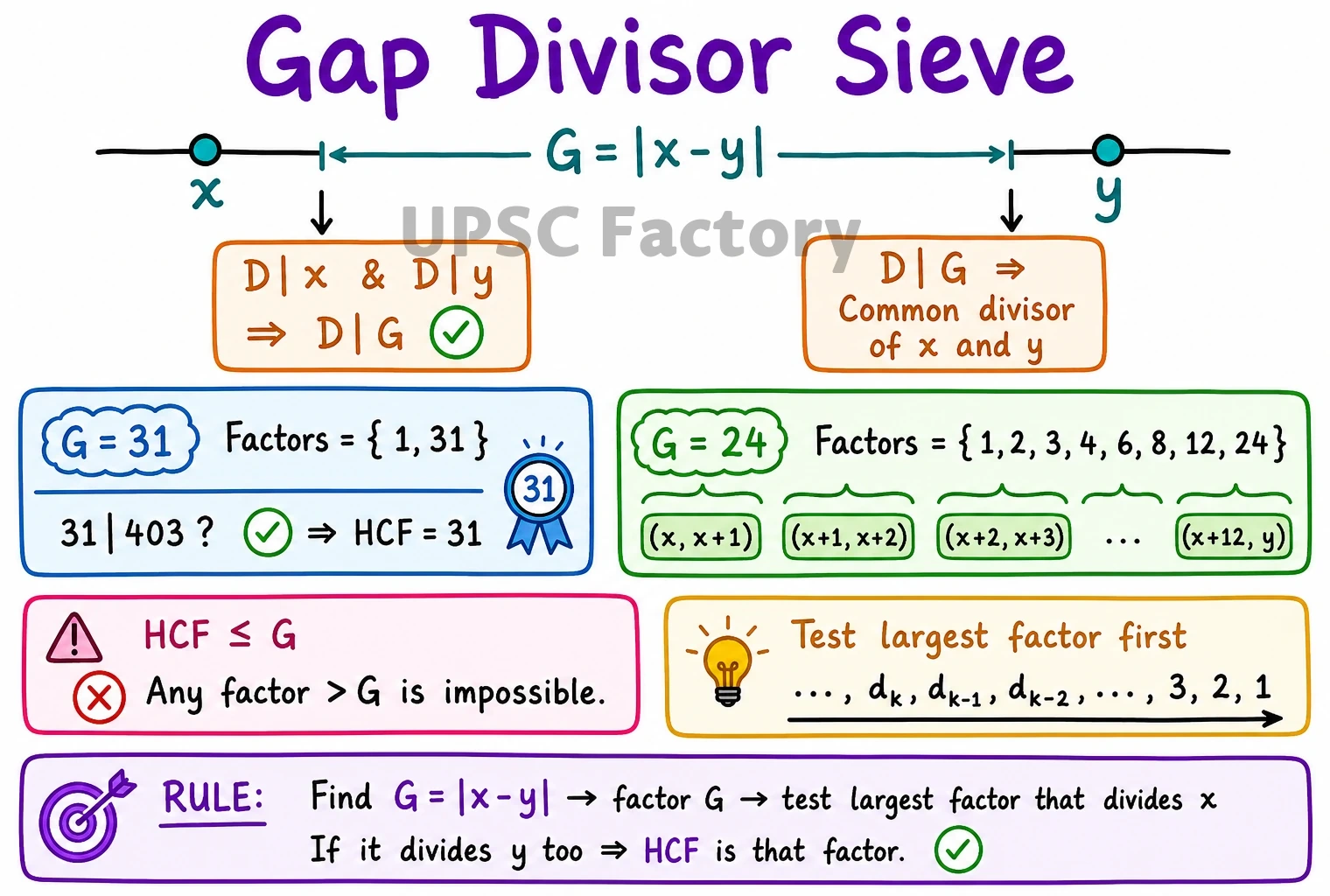
3. Why the “Gap Method” Works — The Divisor Difference Theorem
Theorem: If D | x and D | y, then D | (x – y).
Proof:
Let x = D · p and y = D · q (p, q ∈ ℤ)
⇒ x – y = D · p – D · q
= D(p – q)
Since (p – q) ∈ ℤ, it follows directly that D | (x – y).
Implication: Any common divisor (and consequently the HCF) of two numbers must divide their absolute difference. Therefore, for x ≠ y:
gcd(x, y) | |x – y| ⇒ gcd(x, y) ≤ |x – y|
Thus, gcd(x, y) is guaranteed to be a factor of |x – y|. This property enables rapid mental elimination of invalid divisor options.
Key Theorems & Fundamental Properties
- Fundamental Product Relation (Restricted to Exactly Two Numbers):
gcd(a, b) × lcm(a, b) = a × b
Numerical Verification: For a = 12, b = 18:
gcd(12, 18) = 6, lcm(12, 18) = 36 ⇒ 6 × 36 = 216 = 12 × 18Examiner Trap Warning: For three or more numbers, gcd(a, b, c) × lcm(a, b, c) ≠ a × b × c.
Counterexample: For (2, 3, 4): gcd = 1, lcm = 12. Here, 1 × 12 = 12 ≠ 2 × 3 × 4 = 24. - Euclidean Invariance:
gcd(a, b) = gcd(a – b, b) = gcd(a mod b, b) - Magnitude Bounding Property:
gcd(a, b) ≤ min(a, b) and lcm(a, b) ≥ max(a, b) - Co-primality Invariant: Let D = gcd(a, b), with p = a/D and q = b/D. Then gcd(p, q) = 1. If gcd(a, b) = 1, then lcm(a, b) = a × b.
- Factor Pairing Property: If d | N, then (N/d) | N. Factors occur in symmetric pairs around √N, meaning factor and primality verification never requires testing divisors beyond √N.
2. Comparative Matrix & Conceptual Distinctions
Table 1: LCM (Synthesis) vs HCF (Analysis) — Core Analytical Filter
| Analytical Dimension | LCM (Least Common Multiple) | HCF (Highest Common Factor) |
|---|---|---|
| Mathematical Nature | Forward Synthesis, Aggregation | Backward Analysis, Decomposition |
| Physical Action | To meet, synchronize, accumulate | To cut, divide, measure, pack |
| Relative Magnitude | ≥ largest input number | ≤ smallest input number |
| Set-Theoretic Logic | Intersection of Multiples: A ∩ B | Intersection of Divisors: A ∩ B |
| Keyword Triggers | together, simultaneous, coincide, common multiple, at the same time, periodic cycle, minimum required to be measured by | maximum, greatest, largest size/capacity, exactly divisible, longest tape, no remainder/waste, identical batches |
| Result Meaning | Yields the interval or point of synchronization | Yields the size of one unit; requires a secondary division step to obtain total count |
| Typical Question Stem | “After what duration will they meet again?” | “What is the maximum piece length, and how many total pieces are obtained?” |
Table 2: Factor vs Multiple — Structural Comparison
| Concept | Formal Definition | Case Study for N = 12 | Critical Distinction |
|---|---|---|---|
| Factor | An integer d that divides N with zero remainder (d | N) | {1, 2, 3, 4, 6, 12} | Finite set. N is always a factor of itself. |
| Multiple | An integer M formed by multiplying N by an integer k (N | M) | {12, 24, 36, 48, …} | Infinite set. N is always the smallest positive multiple of itself. |
3. High-Yield Data Anchors & Memorization Benchmarks
A. Unit Standardization Anchor
Examiners intentionally introduce mixed units to cause calculation errors. Apply this pre-processing step before performing any HCF or LCM computation:
| Given Quantities | Standardized Base Unit | Pre-processing Conversion |
|---|---|---|
| 3.78 m, 5.25 m | 378 cm, 525 cm | Multiply by 100 |
| 4 min 30 sec, 6 min | 270 sec, 360 sec | (4 × 60) + 30 = 270 sec |
| 2 hr, 45 min | 120 min, 45 min | Convert to lowest unit referenced |
B. The Gap Method Reference Benchmarks
If |a – b| = G, then gcd(a, b) ∈ Divisors(G)
- Prime Gap (G = 31): gcd(a, b) ∈ {1, 31}.
- Composite Gap (G = 24): gcd(a, b) ∈ {1, 2, 3, 4, 6, 8, 12, 24}.
- Composite Gap (G = 60): gcd(a, b) ∈ {1, 2, 3, 4, 5, 6, 10, 12, 15, 20, 30, 60}.
Application Anchor: For the numbers 403, 434, 465:
434 – 403 = 31 and 465 – 434 = 31
Since 31 is prime, the HCF must be either 1 or 31. A single divisibility check (403 = 31 × 13) confirms gcd = 31 immediately.
C. High-Frequency LCM Reference Values
- lcm(1, 2, 3, 4, 5, 6, 7, 8, 9, 10) = 2520
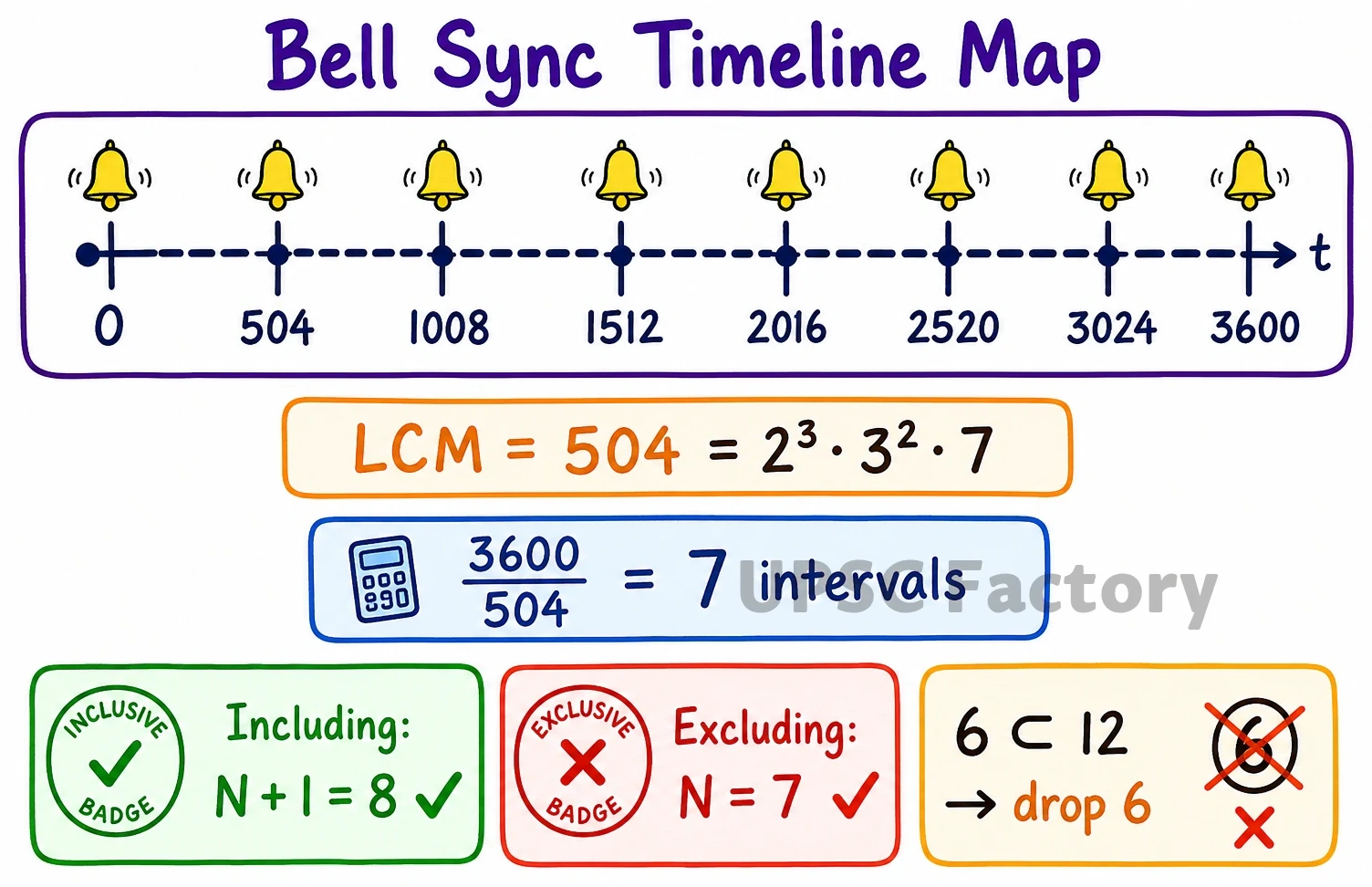
- lcm(6, 7, 8, 9, 12) = 504 sec = 8 min 24 sec (Standard Bell Synchronization Anchor)
- Prime Power Redundancy: When computing LCM, drop lower prime powers if a higher power is present (e.g., in {6, 8, 12}, eliminate 6 because 6 | 12, and replace 8 and 12 with their prime factor forms 23 and 22 · 3).
D. Core Algebraic Formulas
1. Dimensional Partition Rule (Total Count from HCF)
Ntotal = ∑i=1n (Qi/D) = (∑ Qi/D), where D = gcd(Q1, Q2, …, Qn)
2. Minimum Tile Inversion Formula (2D Plane Tiling)
s = gcd(L, B), Nmin = (L × B)/s2
where s is the side length of the largest uniform square tile that tiles a rectangular region of dimensions L × B completely without cutting.
4. Standard Algorithmic Protocols (Decision Logic)
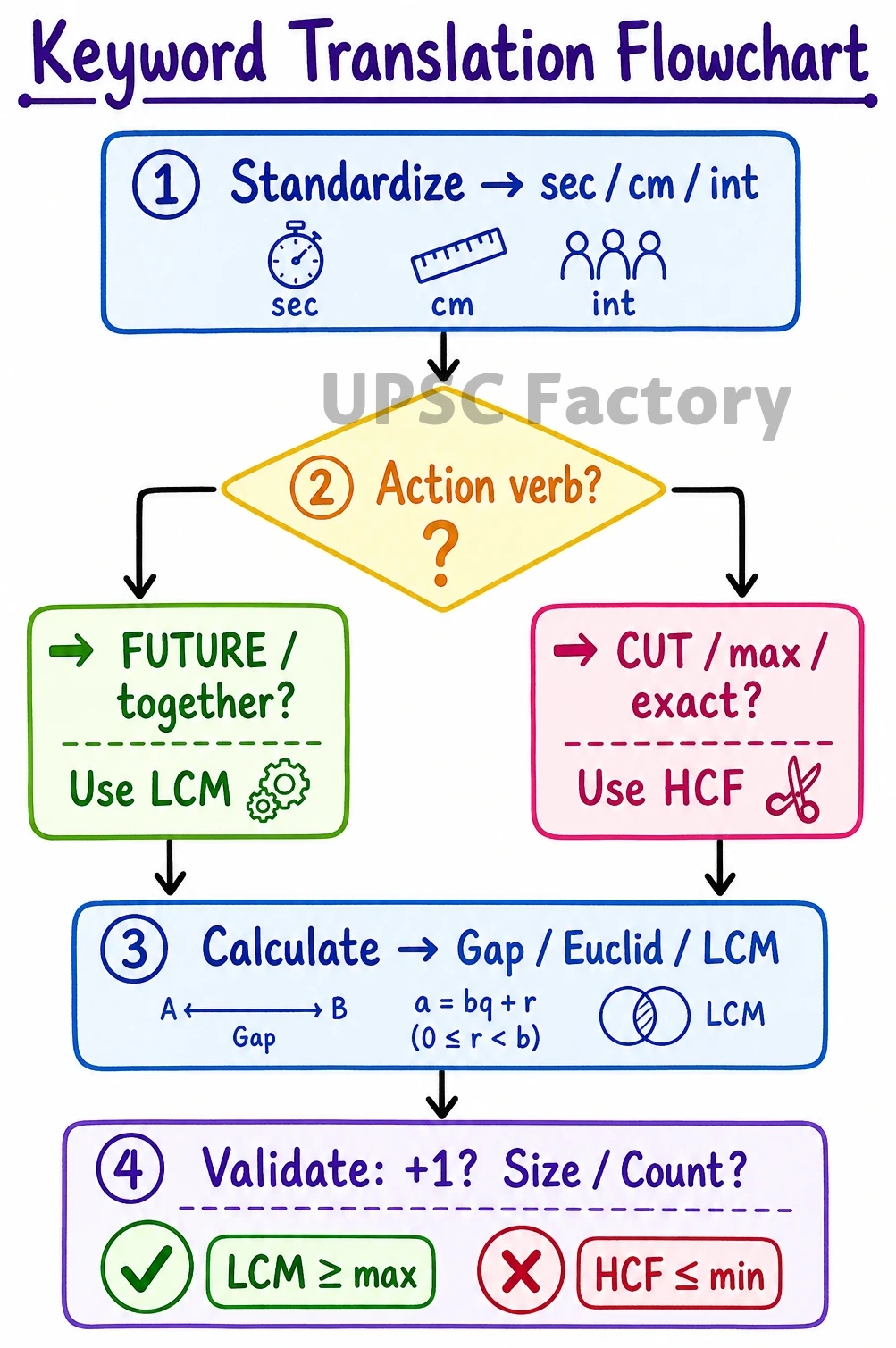
Protocol A: Systematic Problem Classification & Execution
[Phase 0: Input Sanitization]
  └── Convert all numbers to identical integer base units (e.g., m -> cm, min -> sec).

[Phase 1: Action Classification]
  ├── FORWARD / SYNCHRONIZATION (Events repeating to coincide)
  │     └── Keywords: together, simultaneously, cycle, bells, lights, lap times
  │     └── Core Operation: LCM
  │
  └── BACKWARD / DECOMPOSITION (Quantities divided, cut, or packed)
        └── Keywords: maximum size, longest tape, equal containers, no waste
        └── Core Operation: HCF

[Phase 2: Mathematical Computation]
  ├── For LCM: Extract highest prime powers; eliminate factor subsets.
  └── For HCF: Compute minimum pairwise difference |a - b|; test its descending factors.

[Phase 3: Contextual Boundary Validation]
  ├── LCM Periodic Count: N = ⌊ T_total / LCM ⌋
  │     ├── If problem specifies "including starting point" ──> Total = N + 1
  │     └── If problem specifies "excluding starting point" ──> Total = N
  │
  └── HCF Unit Count:
        ├── If question asks for "Maximum Size"  ──> Output = D = gcd
        └── If question asks for "Minimum Count" ──> Output = ∑ Q_i / D
Protocol B: Rapid HCF via Hybrid Gap–Euclidean Algorithm
To find gcd(a, b, c):
- Step 1: Calculate the smallest pairwise absolute difference:
G = min(|a – b|, |b – c|, |a – c|) - Step 2:
- If G is prime or small (G < 50), test divisibility of the numbers by G. If true, gcd = G. If false, test descending factors of G.
- If G is large or composite with many factors, execute the Euclidean chain:
gcd(a, b) = gcd(b, a mod b)
Worked Euclidean Example: gcd(378, 525)
gcd(525, 378) = gcd(378, 525 mod 378) = gcd(378, 147)
gcd(378, 147) = gcd(147, 378 mod 147) = gcd(147, 84)
gcd(147, 84) = gcd(84, 147 mod 84) = gcd(84, 63)
gcd(84, 63) = gcd(63, 84 mod 63) = gcd(63, 21)
gcd(63, 21) = gcd(21, 63 mod 21) = gcd(21, 0) ⇒ gcd = 21
5. Standard Question Typologies & Analytical Solutions
TYPE A: Periodic Synchronization & Counting (LCM Archetype)
Core Lever: Forward projection to the least common multiple of periodic intervals, combined with boundary-inclusive/exclusive interval counting.
Problem Statement:
Five bells commence tolling together and subsequently toll at intervals of 6, 7, 8, 9, and 12 seconds respectively. How many times will they toll together in one hour, excluding the simultaneous toll at the start?
(a) 7
(b) 8
(c) 5
(d) 9
Analytical Solution:
- Step 1: Terminology & Redundancy Analysis
The trigger terms “intervals” and “toll together” specify an LCM operation.
Notice that 6 | 12; therefore, 6 is redundant and can be omitted. - Step 2: Prime Power Factorization
7 = 71
8 = 23
9 = 32
12 = 22 × 31
Taking the highest power of each prime present:
lcm(7, 8, 9, 12) = 23 × 32 × 71 = 8 × 9 × 7 = 504 seconds - Step 3: Interval Division & Boundary Evaluation
Total time window = 1 hour = 3600 seconds.
N = ⌊ 3600/504 ⌋ = ⌊ 7.1428 ⌋ = 7
Because the question specifies excluding the simultaneous toll at T = 0, no adjustment is added.
Final Count = 7
Correct Option: (a)
TYPE B: Statement-Based Sufficiency & Divisibility Properties
Core Lever: Verification of multivariable LCM–HCF identities and the Gap Theorem.
Problem Statement:
Consider the following statements:
Statement I: For any three positive integers a, b, c, the identity gcd(a, b, c) × lcm(a, b, c) = a × b × c always holds.
Statement II: If three positive integers have pairwise differences equal to 31, their HCF must be either 31 or 1.
Which of the statements given above is/are correct?
(a) I only
(b) II only
(c) Both I and II
(d) Neither I nor II
Analytical Solution:
- Evaluation of Statement I:
Test with counterexample a = 2, b = 4, c = 8:
gcd(2, 4, 8) = 2, lcm(2, 4, 8) = 8
gcd(a, b, c) × lcm(a, b, c) = 2 × 8 = 16
a × b × c = 2 × 4 × 8 = 64
Since 16 ≠ 64, Statement I is incorrect. - Evaluation of Statement II:
Let D = gcd(a, b, c). By the Divisor Difference Theorem:
D | (a – b) ⇒ D | 31
Since 31 is prime, its only positive divisors are 1 and 31. Therefore, D ∈ {1, 31}. Statement II is correct.
Correct Option: (b)
TYPE C: Capacity Partitioning & Container Minimization (HCF Archetype)
Core Lever: Decomposition of discrete volumes into identical units to minimize total container count.
Problem Statement:
A dairy distributor has three batches of milk measuring 403 L, 434 L, and 465 L. Determine the minimum number of identical casks required to store all the milk without mixing batches.
(a) 42
(b) 41
(c) 45
(d) 31
Analytical Solution:
- Step 1: Operational Identification
“Minimum number of casks” requires maximizing cask capacity. Thus, container size D = gcd(403, 434, 465). - Step 2: Gap Method Evaluation
|434 – 403| = 31 and |465 – 434| = 31
Since 31 is a prime number, test divisibility directly:
403/31 = 13, 434/31 = 14, 465/31 = 15
All quotients are integers, so D = 31 L. - Step 3: Total Container Calculation
Apply the Dimensional Partition Rule:
N = 403/31 + 434/31 + 465/31 = 13 + 14 + 15 = 42 casks
Correct Option: (a)
TYPE D: Geometric Grid Fitting (2D Inversion Formula)
Core Lever: Partitioning continuous 2D surface areas using uniform square units.
Problem Statement:
A rectangular courtyard measuring 3.78 m in length and 5.25 m in width is to be paved entirely with identical square tiles without cutting. What is the maximum side length of such a tile?
(a) 14 cm
(b) 21 cm
(c) 42 cm
(d) 84 cm
Analytical Solution:
- Step 1: Base Unit Standardization
L = 3.78 m = 378 cm, W = 5.25 m = 525 cm - Step 2: HCF Computation via Successive Division
525 = 378 × 1 + 147
378 = 147 × 2 + 84
147 = 84 × 1 + 63
84 = 63 × 1 + 21
63 = 21 × 3 + 0 ⇒ gcd(378, 525) = 21 cm - Step 3: Area Tile Verification (Sanity Check)
Nmin = (378 × 525)/(21 × 21) = 18 × 25 = 450 tiles
Correct Option: (b)
TYPE E: Statement-Based Analytical Classification
Core Lever: Determining whether an applied scenario requires synthesis (LCM) or decomposition (HCF).
Problem Statement:
Consider the following scenarios:
1. Finding the time when three traffic signals blinking at intervals of 24, 36, and 54 seconds will blink simultaneously again.
2. Finding the maximum length of a measuring rod that can measure distances of 120 cm, 144 cm, and 204 cm exactly.
Which of the scenarios given above requires the computation of LCM?
(a) 1 only
(b) 2 only
(c) Both 1 and 2
(d) Neither 1 nor 2
Analytical Solution:
- Scenario 1: Involves periodic events recurring over time to reach a common future synchronization point. This requires synthesis ⇒ lcm(24, 36, 54) = 216 seconds.
- Scenario 2: Involves finding the largest common measure to divide discrete lengths without remainder. This requires decomposition ⇒ gcd(120, 144, 204) = 12 cm.
Therefore, only Scenario 1 requires LCM.
Correct Option: (a)
TYPE F: Algebraic Co-primality & Set Quotients
Core Lever: Utilizing the invariant property that dividing quantities by their HCF leaves mutually co-prime quotients.
Problem Statement:
Three storage reservoirs contain 120 L, 144 L, and 204 L of chemical solution. What is the maximum capacity of a flask that can empty each reservoir in an exact integer number of pours, and what is the total number of pours required?
(a) 12 L capacity, 39 pours
(b) 24 L capacity, 17 pours
(c) 6 L capacity, 78 pours
(d) 12 L capacity, 29 pours
Analytical Solution:
- Step 1: Determine Maximum Flask Size (D)
Pairwise differences:
|144 – 120| = 24, |204 – 144| = 60
gcd(24, 60) = 12
Verify divisibility by 12:
120/12 = 10, 144/12 = 12, 204/12 = 17
Since 10, 12, and 17 share no common factor greater than 1, gcd(120, 144, 204) = 12 L. - Step 2: Total Pours (N)
N = 10 + 12 + 17 = 39 pours
Correct Option: (a)
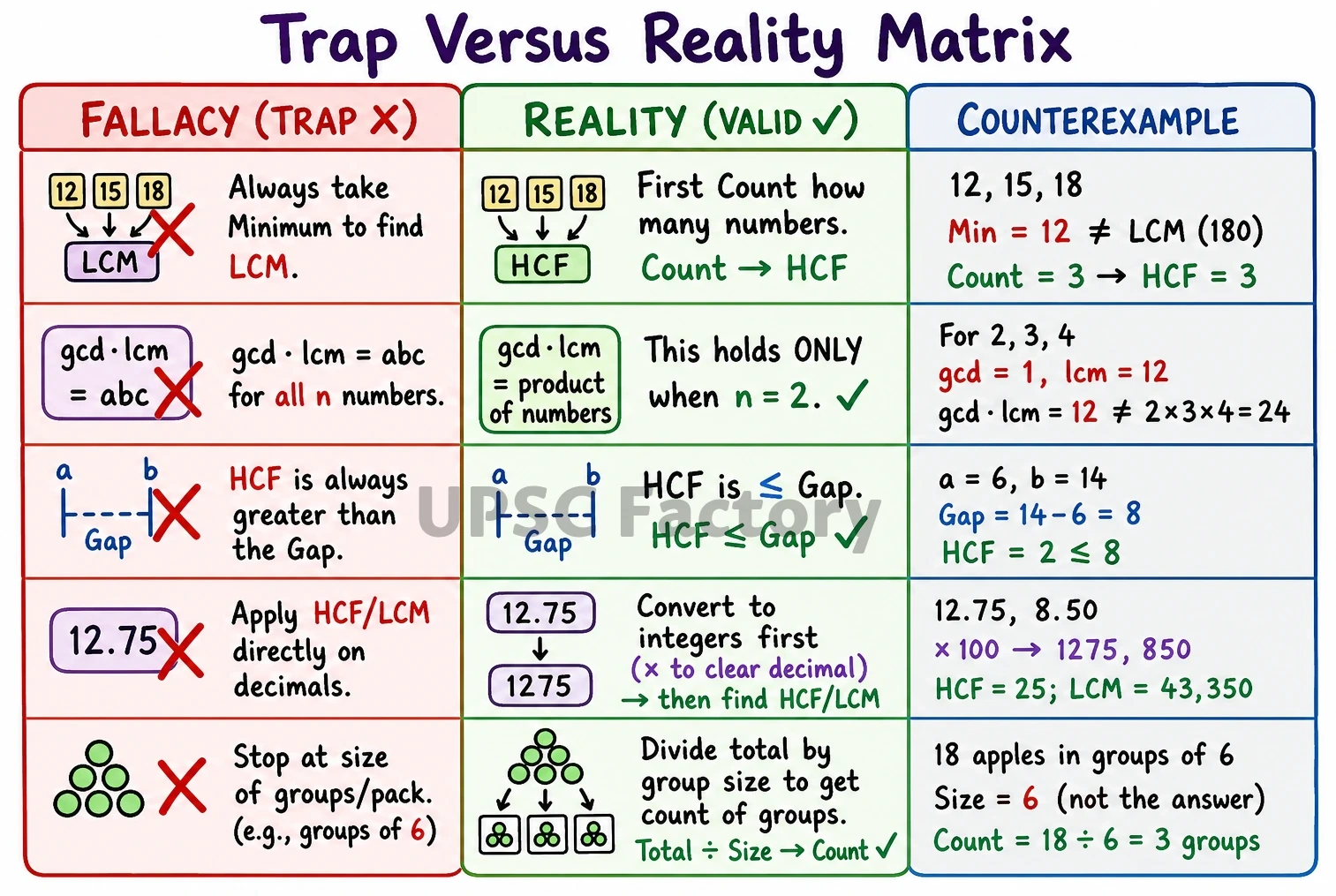
6. The Examiner Trap Matrix
| Common Pitfall | Mathematical Reality | Concrete Counterexample / Prevention Protocol |
|---|---|---|
| Assuming “minimum” always implies LCM | “Minimum number of containers/tiles” requires maximizing unit size (HCF) first, then dividing. | In container problems, calculating lcm(403, 434, 465) yields an astronomical value. Find gcd = 31, then calculate ∑ Qi / 31 = 42. |
| Extending the product formula to n ≥ 3 numbers | gcd(a, b, c) × lcm(a, b, c) = a · b · c is mathematically invalid for n > 2. | For (2, 3, 4), gcd = 1 and lcm = 12. gcd × lcm = 12 ≠ 24. |
| Assuming HCF can exceed the difference between numbers | For any distinct integers a ≠ b, gcd(a, b) ≤ |a – b|. | For inputs 403 and 434, difference is 31. The HCF cannot exceed 31. |
| Skipping unit standardization | HCF/LCM operations assume consistent integer units. | If dimensions are 3.78 m and 5.25 m, convert to 378 cm and 525 cm before calculating divisors. |
| Off-by-One error in periodic synchronization | ⌊ T / lcm ⌋ counts elapsed intervals, not initial state points. | For events recurring every 504 s over 3600 s: count is 7 if excluding T = 0, and 7 + 1 = 8 if including T = 0. |
| Selecting HCF when count is requested | HCF gives individual unit size, not total item count. | For vats of 120, 144, 204 L, gcd = 12 L is the unit size; total containers required = 10 + 12 + 17 = 39. |
7. Golden Rules & Instant Exam Triggers
| # | Trigger / Scenario | Mathematical Rule & Protocol |
|---|---|---|
| 1 | Simultaneous Recurrence “together again”, “synchronize”, “toll simultaneously”, “circular track lap times” | Compute LCM (Synthesis). Forward projection to common future synchronization point: T = lcm(t1, t2, …). |
| 2 | Maximum Partitioning “maximum capacity”, “longest measuring rod”, “largest uniform tile”, “no waste” | Compute HCF (Decomposition). Backward analysis to greatest common unit measure: D = gcd(Q1, Q2, …). |
| 3 | Minimum Units / Containers “minimum number of casks / tiles / boxes / bottles” | Two-Step Protocol: Maximize unit size first (D = gcd), then compute total count using N = ∑ (Qi/D). |
| 4 | Mixed Units & Decimals Dimensions with decimals (e.g., 3.78 m) or mixed time (e.g., 4 min 30 sec) | Convert to Base Integer Units. Standardize to lowest common unit (378 cm, 270 sec) before performing factor or multiple operations. |
| 5 | Dense Values with Small Gaps Large numbers clustered closely (e.g., 403, 434, 465) | Apply the Gap Method. Compute difference G = |a – b|. Since gcd | G, test only the descending factors of G. |
| 6 | Periodic Counting in Time Window Calculating occurrences within a duration Ttotal | Interval Division & Boundary Check: N = ⌊ Ttotal/lcm ⌋. • If “excluding start” ⇒ Output = N • If “including start” ⇒ Output = N + 1 |
| 7 | Multi-Variable Product Relations Statements asserting gcd(a,b,c) × lcm(a,b,c) = a × b × c | Unconditionally False for n ≥ 3. The product rule gcd × lcm = a × b holds strictly and exclusively for exactly two numbers. |
Summary Checklist:
• SYNTHESIS (Forward Meeting) → LCM
• DECOMPOSITION (Partitioning / Measuring) → HCF