
1. Theoretical Foundation & Mathematical Underpinnings
Formal Definition & Scope
For a, b ∈ ℤ+ where a, b > 1:
- HCF (Highest Common Factor) / gcd(a, b) = H: The greatest integer H such that H | a and H | b. It contains only the common prime factors at their minimum exponent.
- LCM (Least Common Multiple) / lcm(a, b) = L: The smallest integer L such that a | L and b | L. It contains all prime factors of a and b at their maximum exponent.
Domain Constraint: By definition,
H | a, H | b, a | L, b | L
and crucially,
H | L
If L mod H ≠ 0, the dataset is impossible — no such pair (a, b) exists.
The “Why” Behind The Math
Theorem 1: The Co-Prime Decomposition
Any two numbers can be decomposed with respect to their HCF.
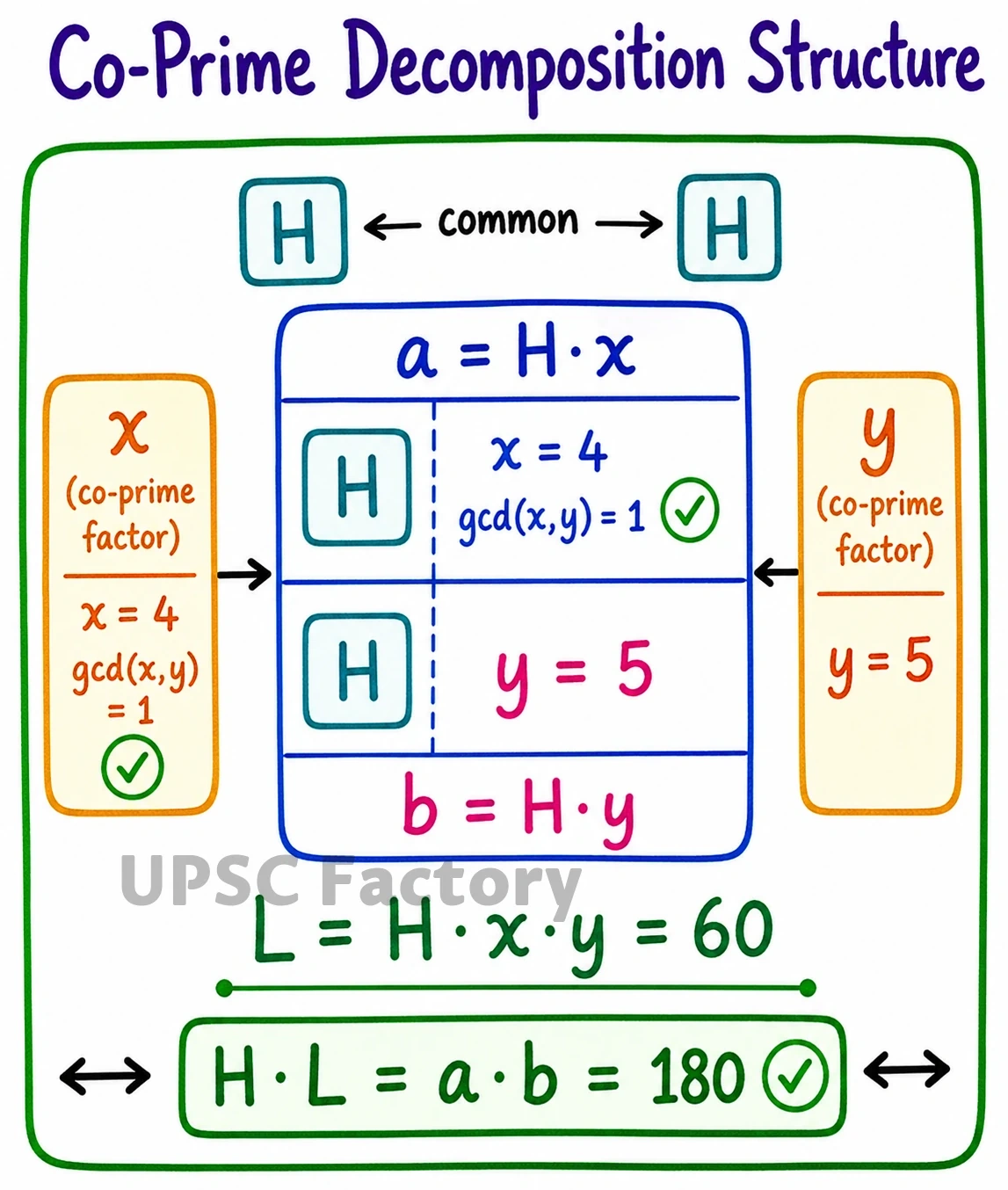
Let H = gcd(a, b). Then there exist unique x, y ∈ ℤ+ such that:
a = Hx, b = Hy where gcd(x, y) = 1
Why must gcd(x, y) = 1? — Proof by Contradiction:
Suppose gcd(x, y) = d > 1. Then x = dx′ and y = dy′ for some x′, y′ ∈ ℤ+.
Substituting these back:
a = H(dx′) = (Hd)x′
b = H(dy′) = (Hd)y′
This implies Hd is a common divisor of a and b. Since d > 1, we have Hd > H, which contradicts the premise that H is the Highest Common Factor. Hence d must equal 1, proving (x, y) is strictly co-prime.
Corollary:
a/b = Hx/Hy = x/y
The ratio in lowest terms is the co-prime pair (x, y).
Theorem 2: The Two-Variable Product Invariant
For exactly two numbers, the foundational identity holds:
H × L = a × b
Proof 1 — Via Co-Prime Structure (Intuitive):
From Theorem 1, the least common multiple must contain the common base H alongside all distinct non-common factors x and y:
L = Hxy
Multiplying by H:
H × L = H × (Hxy)
H × L = H2xy
Expanding the product of the original numbers:
a × b = (Hx) × (Hy)
a × b = H2xy
Thus, H × L = a × b.
Proof 2 — Via Prime Factorization (Rigorous):
Let the prime factorizations of a and b be:
a = ∏ piαi
b = ∏ piβi
By definition:
H = ∏ pimin(αi, βi)
L = ∏ pimax(αi, βi)
Since for any two real numbers min(αi, βi) + max(αi, βi) = αi + βi:
H × L = ∏ pimin(αi, βi) + max(αi, βi)
H × L = ∏ piαi + βi
H × L = (∏ piαi) (∏ piβi)
H × L = a × b
Worked Verification:
Let a = 12 and b = 15.
• H = gcd(12, 15) = 3
• 12 = 3 × 4 ⇒ x = 4
• 15 = 3 × 5 ⇒ y = 5
• gcd(4, 5) = 1 is satisfied.
• L = Hxy = 3 × 4 × 5 = 60Verifying the invariant:
H × L = 3 × 60 = 180
a × b = 12 × 15 = 180
Key Theorems & Properties
- Divisibility Invariant: H | L always. If L/H ∉ ℤ+, no valid integer pair (a, b) exists.
Example: H = 14, L = 200 ⇒ 200/14 ∉ ℤ ⇒ Zero valid pairs exist. - Co-Prime Quotient Invariant: L/H = xy where gcd(x, y) = 1. This quotient serves as the core computational engine for all pair-counting problems.
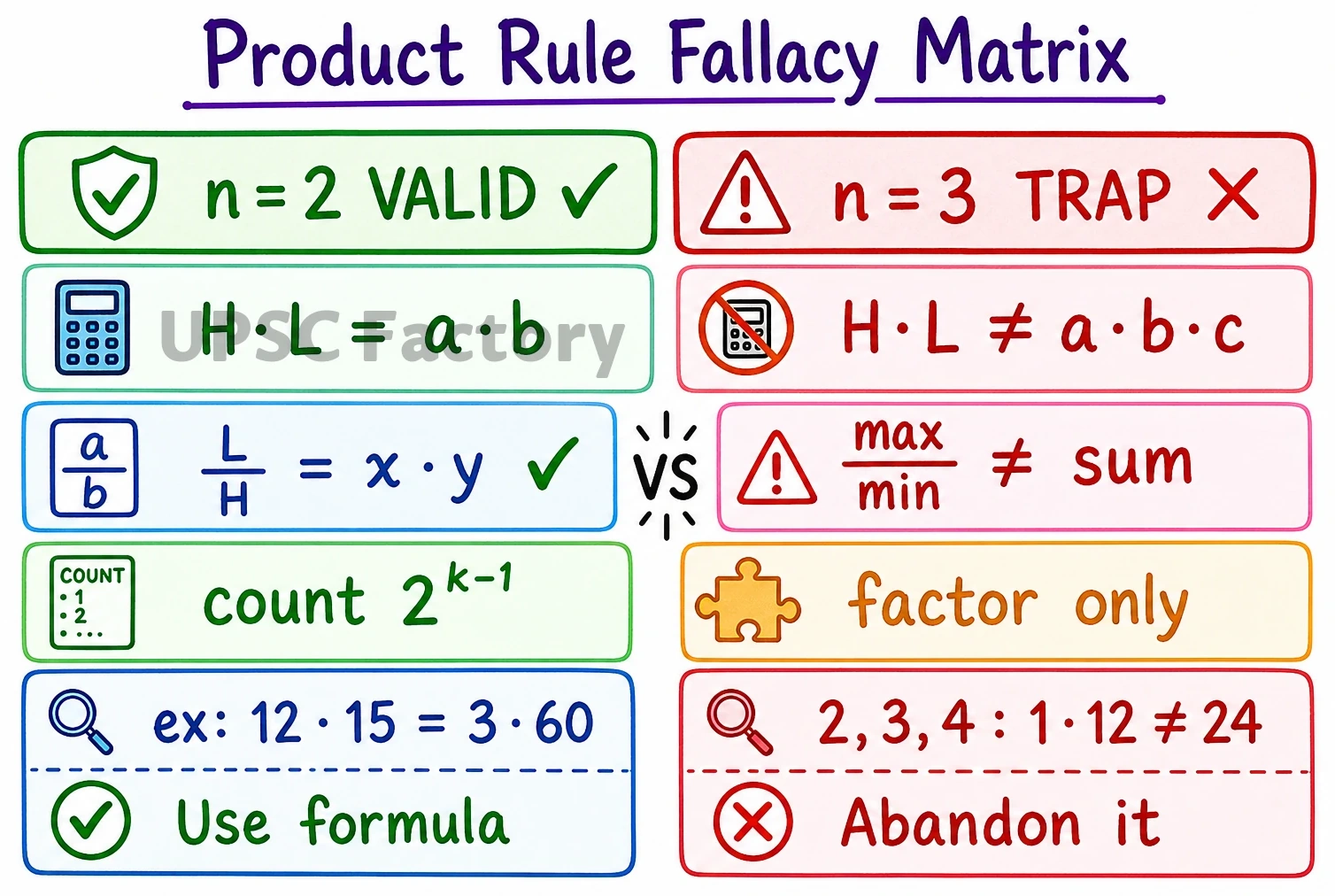
- Exponent Complementarity Rule: For two numbers, min(αi, βi) + max(αi, βi) = αi + βi. This confirms why the product rule strictly holds for n = 2.
- Structural Breakdown for n ≥ 3: For three numbers a, b, c:
H = ∏ pimin(αi, βi, γi)
L = ∏ pimax(αi, βi, γi)
Because min(αi, βi, γi) + max(αi, βi, γi) ≠ αi + βi + γi, the identity fails:
H × L ≠ a × b × c - Ratio Invariance: If a/b = p/q in lowest terms, then a = Hp and b = Hq.
2. Comparative Matrix & Conceptual Distinctions
Table 1: HCF vs. LCM — Structural Duality
| Feature | HCF (H = gcd(a, b)) | LCM (L = lcm(a, b)) |
|---|---|---|
| Mathematical Definition | Greatest common divisor of both numbers | Smallest common multiple of both numbers |
| Prime Factor Power | min(αi, βi) | max(αi, βi) |
| Magnitude Boundary | H ≤ min(a, b) | L ≥ max(a, b) |
| Structural Role | Factor contained inside a and b | Multiple that contains a and b |
| Core Formula | H = (a × b)/L | L = Hxy |
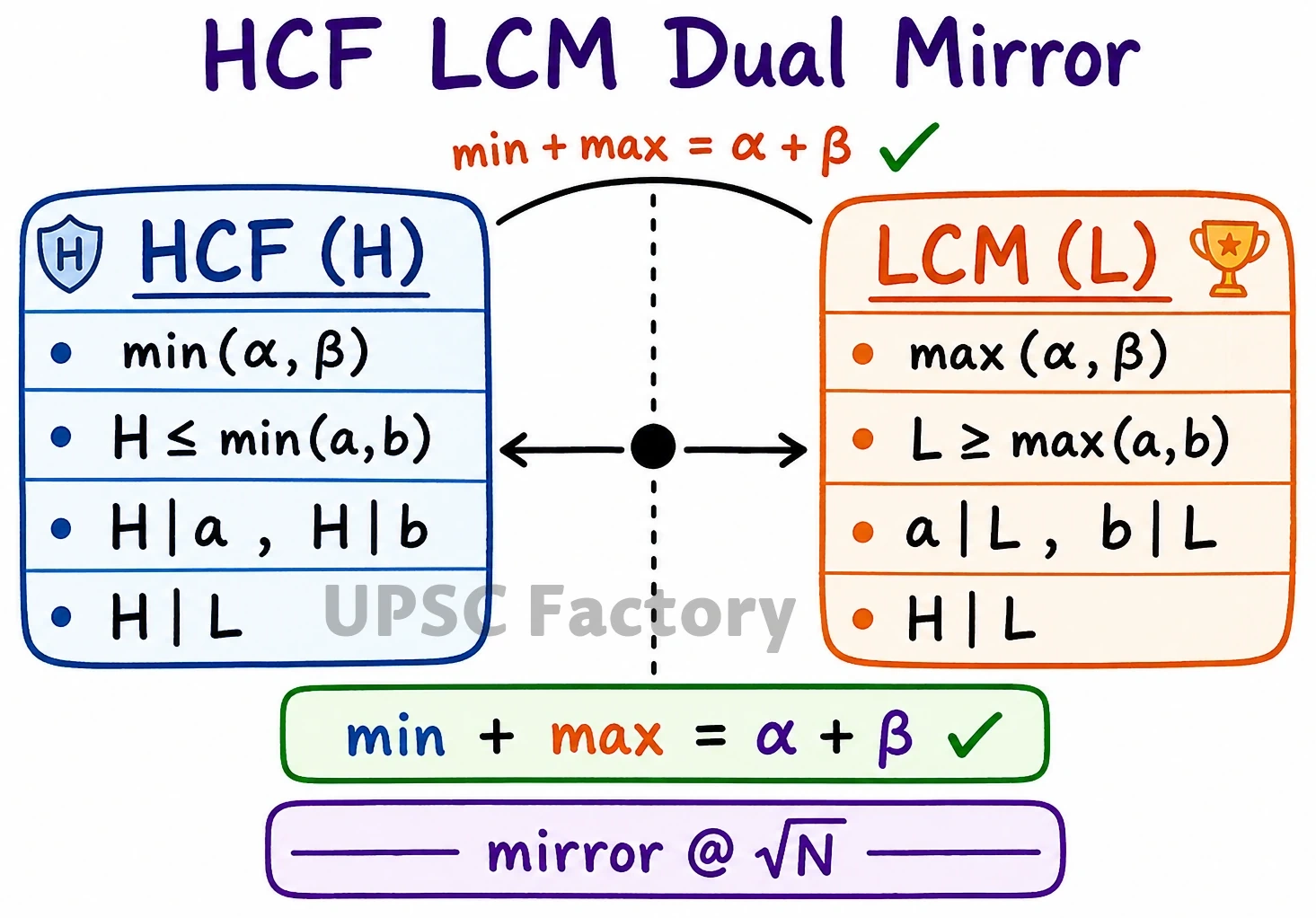
Table 2: Comparative Analysis — Two Numbers vs. Three Numbers
| Mathematical Aspect | For n = 2 Numbers (a, b) | For n = 3 Numbers (a, b, c) |
|---|---|---|
| Product Rule | Valid: H × L = a × b | Invalid: H × L ≠ a × b × c |
| Quotient Evaluation | L/H = xy (where gcd(x, y) = 1) | L/H does not resolve to a simple product xyz |
| Analytical Method | Set a = Hx, b = Hy | Use prime factor matrices: a = ∏ piαi |
| Examiner Trap | Direct formula substitution is safe | Questions lure candidates to use c = (H × L)/(a × b) |
3. High-Yield Data Anchors & Memorization Benchmarks
Anchor 1: The Divisibility Filter
Before executing full algebraic calculations, evaluate whether L mod H = 0. If the remainder is non-zero, the configuration is invalid, yielding zero valid pairs.
Anchor 2: The Co-Prime Distribution Law
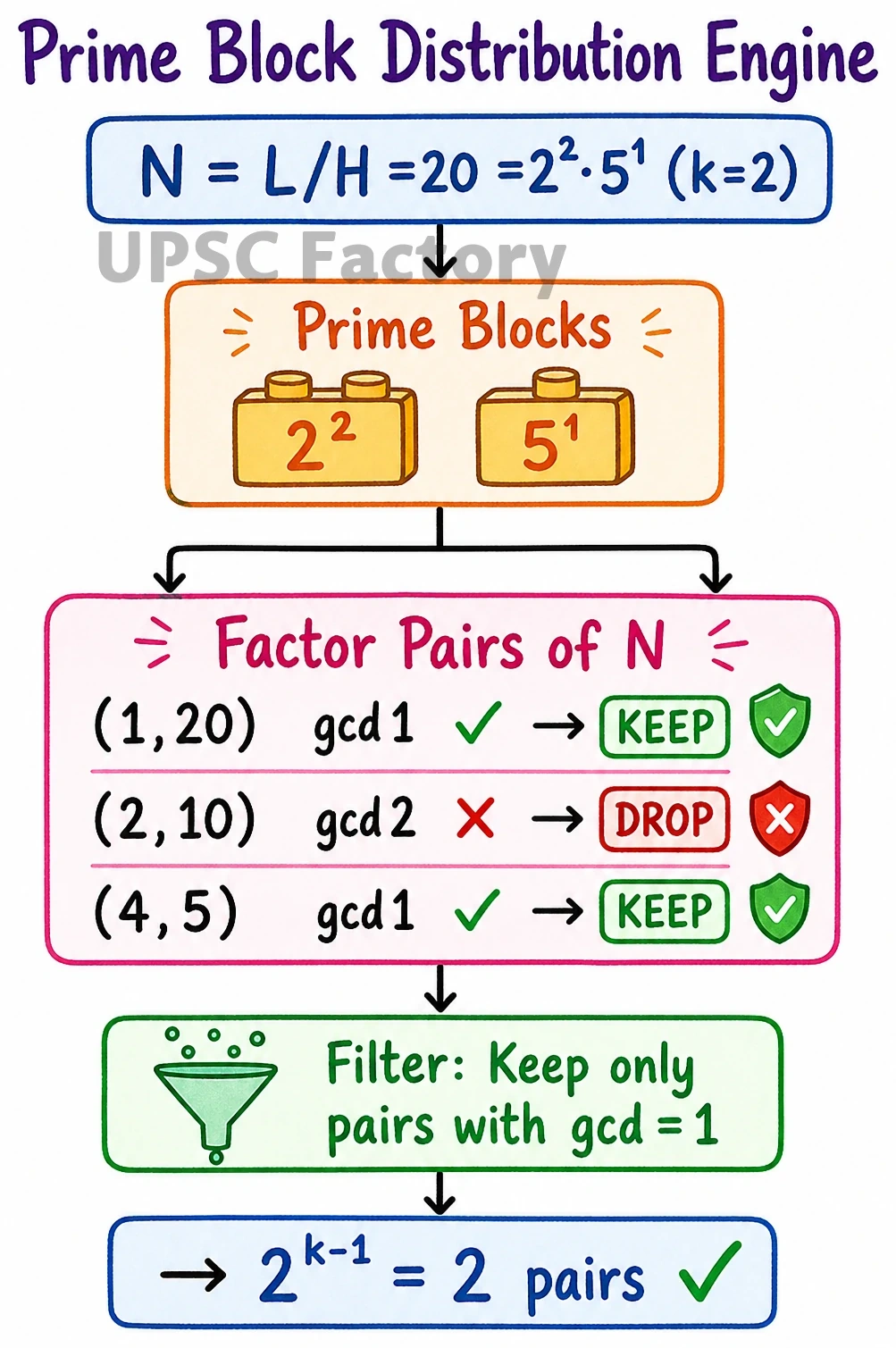
Let N = L/H = xy with the strict constraint gcd(x, y) = 1.
Let k be the number of distinct prime factors of N.
Formula Benchmarks:
• Number of unordered pairs {x, y} (and thus {a, b}) = 2k-1
• Number of ordered pairs (x, y) = 2k
(For N = 1 where L = H, there is exactly 1 pair: a = b = H. The formula 2k-1 applies for all k ≥ 1.)
| Prime Factorization of N = L/H | Distinct Primes (k) | Unordered Co-Prime Pairs (2k-1) | Valid (a, b) Configurations |
|---|---|---|---|
| N = pa (e.g., 8, 9, 16) | 1 | 21-1 = 1 | Only (1, N) |
| N = paqb (e.g., 12, 20, 77) | 2 | 22-1 = 2 | (1, N) and one prime-split pair |
| N = paqbrc (e.g., 30, 60, 84) | 3 | 23-1 = 4 | 4 co-prime combinations |
| N = paqbrcsd | 4 | 24-1 = 8 | 8 co-prime combinations |
- Example 1:
H = 12, L = 924 ⇒ N = 924/12 = 77 = 71 × 111.
Here k = 2, so number of pairs = 22-1 = 2. - Example 2:
H = 15, L = 300 ⇒ N = 300/15 = 20 = 22 × 51.
Here k = 2, so number of pairs = 22-1 = 2.
The factor pairs of 20 are (1, 20) and (4, 5). The pair (2, 10) is rejected because gcd(2, 10) = 2 ≠ 1.
Anchor 3: Common Non-Co-Prime Quotient Traps
- N = 12: Divisor factor pairs are (1, 12), (2, 6), and (3, 4).
The pair (2, 6) is invalid because gcd(2, 6) = 2.
⇒ Exactly 2 valid pairs remain: (1, 12) and (3, 4). - N = 36: Divisor factor pairs are (1, 36), (2, 18), (3, 12), (4, 9), and (6, 6).
Pairs (2, 18), (3, 12), and (6, 6) share common divisors.
⇒ Exactly 2 valid pairs remain: (1, 36) and (4, 9).
4. Standard Algorithmic Protocols
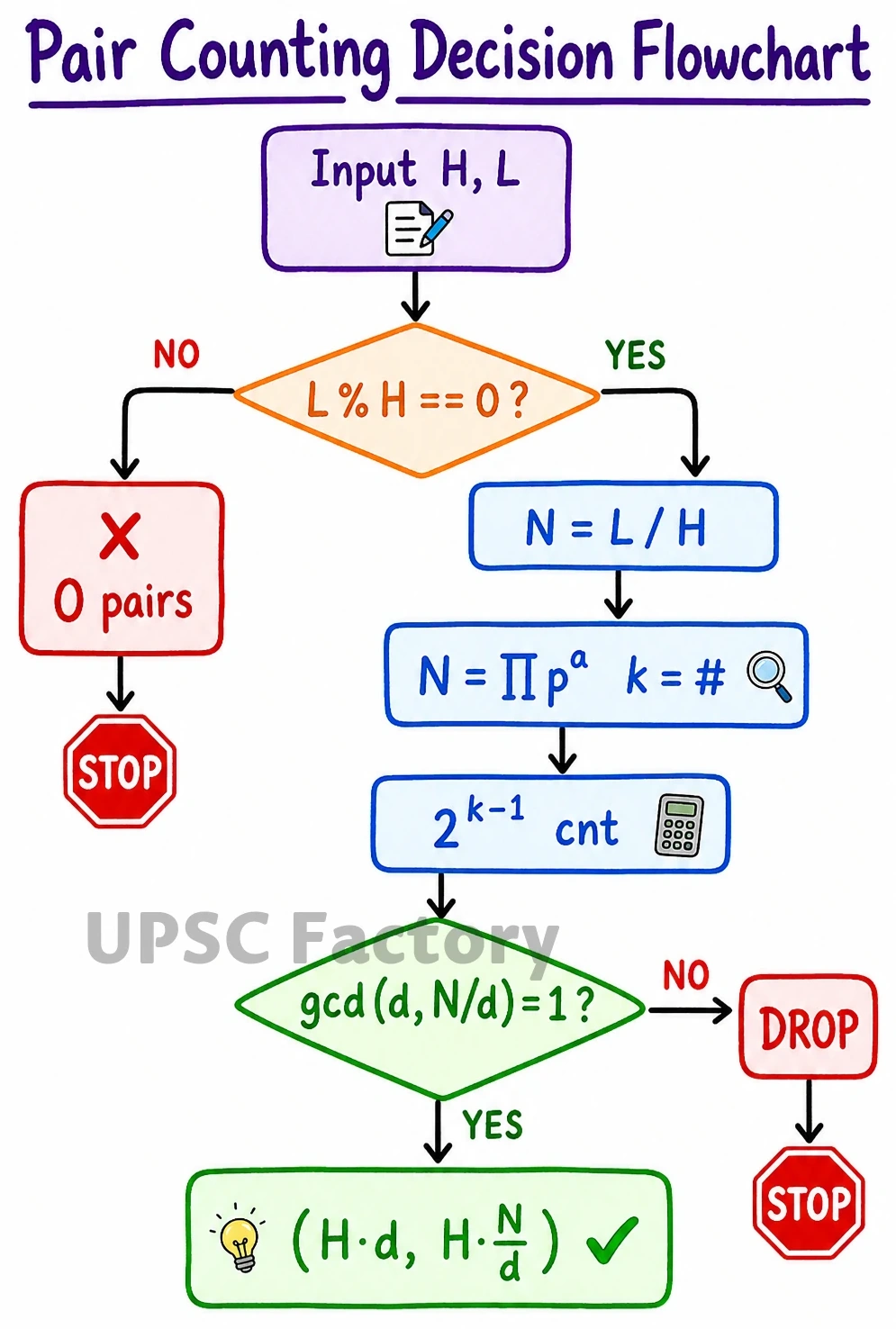
Protocol A: Systematically Finding Pairs Given H and L
Step-by-Step Procedure
- Divisibility Verification: Check if L mod H = 0.
- If No: Terminate. Zero valid pairs exist.
- If Yes: Proceed to Step 2.
- Calculate Quotient: Compute N = L/H.
- Prime Factorization: Express N = p1a1 · p2a2 ··· pkak and identify k (the count of distinct prime bases).
- Count Configurations:
Unordered pairs = 2k-1, Ordered pairs = 2k - Reconstruct Numbers (if required):
- Enumerate all factor pairs (d, N/d) such that gcd(d, N/d) = 1.
- Multiply each component by H to get (Hd, H · (N/d)).
Numerical Execution
Find all pairs of natural numbers with H = 18 and L = 540.
- Step 1: 540 mod 18 = 0 (Valid).
- Step 2: N = 540/18 = 30.
- Step 3: 30 = 21 × 31 × 51 ⇒ k = 3.
- Step 4: Total unordered pairs = 23-1 = 4.
- Step 5: The co-prime pairs (x, y) summing to product 30 are:
(1, 30), (2, 15), (3, 10), (5, 6)
Multiplying by H = 18 yields the actual number pairs:
(18, 540), (36, 270), (54, 180), (90, 108)
Protocol B: Prime Exponent Matching for Three Numbers
For three numbers a, b, c, avoid the false product formula H × L = a × b × c. Use prime exponent bounding:
- Factorize all known terms:
a = ∏ piαi, b = ∏ piβi
H = ∏ piHi, L = ∏ piLi - Apply boundary conditions per prime:
min(αi, βi, γi) = Hi
max(αi, βi, γi) = Li - Determine constraints on c = ∏ piγi:
- If neither αi nor βi reaches Li, then γi must equal Li.
- If neither αi nor βi drops to Hi, then γi must equal Hi.
- Otherwise, γi can be any integer such that Hi ≤ γi ≤ Li.
5. Standard Question Typologies & Analytical Solutions
Type A: Parity & Multi-Variable Constraints
Core Principle: When a = Hx and b = Hy, the algebraic parity of a and b is directly governed by H. If H is even, both a and b must be even.
Question: The HCF of two natural numbers is 12 and their LCM is 360. If one number is even and the sum of the numbers is odd, which of the following must be true?
(a) Both x and y are odd
(b) One of x, y is even, the other is odd
(c) Both x and y are even
(d) No such pair exists
Analytical Solution:
Step 1 — Structural Formulation:
Let the numbers be a = 12x and b = 12y, where gcd(x, y) = 1 and:
xy = L/H = 360/12 = 30
Step 2 — Parity Evaluation:
The sum of the numbers is:
a + b = 12x + 12y = 12(x + y) = 2 · [6(x + y)]
Since 12 is even, 12(x + y) is strictly even for all integers x, y. Therefore, an odd sum is mathematically impossible.
Step 3 — Conclusion:
Although factor pairs for xy = 30 exist, none can satisfy the condition that a + b is odd.
Correct Option: (d)
Quick Check: If H is even, then both a and b are even, making their sum and difference unconditionally even.
Type B: Multi-Statement Analytical Questions
Core Principle: Validate statements independently by calculating N = L/H, applying co-prime filtering, and summing real pairs.
Question: Consider two natural numbers whose HCF is 15 and LCM is 300.
Statement I: There are exactly two possible pairs of numbers.
Statement II: The sum of the numbers in one valid pair is 135.
Which of the statements given above is/are correct?
(a) I only
(b) II only
(c) Both I and II
(d) Neither I nor II
Analytical Solution:
Step 1 — Quotient and Factorization:
N = L/H = 300/15 = 20 = 22 × 51
Step 2 — Co-Prime Factor Pair Extraction:
The factor pairs of 20 are:
(1, 20) ⇒ gcd(1, 20) = 1 (Valid)
(2, 10) ⇒ gcd(2, 10) = 2 ≠ 1 (Invalid)
(4, 5) ⇒ gcd(4, 5) = 1 (Valid)
There are exactly 2 valid co-prime pairs. Statement I is correct.
Step 3 — Reconstructing the Values:
• Pair 1: (15 × 1, 15 × 20) = (15, 300) ⇒ Sum = 315
• Pair 2: (15 × 4, 15 × 5) = (60, 75) ⇒ Sum = 135
Statement II is correct.
Correct Option: (c)
Type C: Pair Counting & Existence Archetypes
Core Principle: The number of unordered co-prime pairs depends directly on 2k-1, where k is the count of distinct prime factors of L/H.
Question: The HCF and LCM of two natural numbers are 12 and 924 respectively. How many such distinct pairs of numbers are possible?
(a) 1
(b) 2
(c) 3
(d) 4
Analytical Solution:
Step 1 — Compute Quotient:
N = L/H = 924/12 = 77
Step 2 — Distinct Prime Counting:
77 = 71 × 111 ⇒ k = 2
Step 3 — Calculate Unordered Pairs:
Number of distinct pairs = 2k-1 = 22-1 = 2
The valid pairs are (x, y) ∈ {(1, 77), (7, 11)}, yielding (a, b) ∈ {(12, 924), (84, 132)}.
Correct Option: (b)
Type D: Ratio Invariance & Multiplier Logic
Core Principle: A simplified ratio a : b = p : q directly defines the co-prime pair x = p and y = q.
Question: Two numbers a and b have an HCF of 6. Their ratio in simplest form is 4 : 5. What is their LCM?
(a) 60
(b) 120
(c) 180
(d) 240
Analytical Solution:
Step 1 — Base Formulation:
Since 4 : 5 is irreducible, gcd(4, 5) = 1.
Thus, x = 4 and y = 5.
Step 2 — Calculate LCM:
L = H × x × y = 6 × 4 × 5 = 120
Alternatively, find the numbers first:
a = 6 × 4 = 24, b = 6 × 5 = 30
L = (a × b)/H = (24 × 30)/6 = 120
Correct Option: (b)
Type E: Factor Splitting & Structural Validity
Core Principle: Prime powers in N = L/H cannot be split across both x and y; each prime power block must reside entirely within one term.
Question: The HCF of two numbers is 18 and their LCM is 324. Which of the following cannot be the values of the two numbers?
(a) 18 and 324
(b) 36 and 162
(c) 54 and 108
(d) 72 and 81
Analytical Solution:
Step 1 — Factor Constraints:
N = L/H = 324/18 = 18 = 21 × 32
To preserve gcd(x, y) = 1:
- The factor 21 must go entirely to x or y.
- The factor 32 must go entirely to x or y.
Valid (x, y) pairs are strictly (1, 18) and (2, 9).
Valid number pairs are (18, 324) and (36, 162).
Step 2 — Option Audit:
- Option (a): (18, 324) ⇒ (x, y) = (1, 18) with gcd(1, 18) = 1 (Valid).
- Option (b): (36, 162) ⇒ (x, y) = (2, 9) with gcd(2, 9) = 1 (Valid).
- Option (c): (54, 108) ⇒ (x, y) = (3, 6) with gcd(3, 6) = 3 ≠ 1 (Invalid — prime 3 is split).
- Option (d): 81 is not divisible by H = 18 (Fails basic divisibility H | b).
Both (c) and (d) are mathematically invalid; option (c) represents the classic co-prime factorization trap.
Intended Option: (c)
Type F: The Three-Variable Constraint Model
Core Principle: For three variables, prime factors missing from two numbers must be fully supplied by the third number to achieve the target LCM.
Question: The HCF of three numbers a, b, c is 4 and their LCM is 240. If a = 12 and b = 16, which of the following could be the value of c?
(a) 5
(b) 10
(c) 15
(d) 20
Analytical Solution:
Step 1 — Prime Factorization:
a = 12 = 22 × 31 × 50
b = 16 = 24 × 30 × 50
H = 4 = 22 × 30 × 50
L = 240 = 24 × 31 × 51
Step 2 — Prime Exponent Constraints on c = 2γ1 × 3γ2 × 5γ3:
• Prime 5: max(0, 0, γ3) = 1 ⇒ γ3 = 1 (Factor of 5 is mandatory).
• Prime 2: min(2, 4, γ1) = 2 and max(2, 4, γ1) = 4 ⇒ 2 ≤ γ1 ≤ 4 (Must be a multiple of 22 = 4).
• Prime 3: min(1, 0, γ2) = 0 and max(1, 0, γ2) = 1 ⇒ 0 ≤ γ2 ≤ 1.
Step 3 — Minimum Feasible Value:
cmin = 22 × 30 × 51 = 20
Checking options:
- (a) 5: Not divisible by H = 4.
- (b) 10: Divisible by 2, but not by 4.
- (c) 15: Not divisible by 4.
- (d) 20 = 22 × 51: Satisfies all constraints.
Correct Option: (d)
6. The Examiner Trap Matrix
| Common Pitfall | Underlying Mathematical Reality | Concrete Counterexample |
|---|---|---|
| 1. Over-Counting Factor Pairs Treating every divisor pair of L/H as valid. | Only pairs with gcd(x, y) = 1 are valid. Shared factors violate the designated HCF. | For H = 15, L = 300 ⇒ N = 20. The pair (2, 10) yields (30, 150), but gcd(30, 150) = 30 ≠ 15. Total valid pairs = 2, not 3. |
| 2. Three-Number Product Error Using H × L = a × b × c. | Identity is valid only for n = 2. For n ≥ 3, minimum and maximum exponents do not sum to the total. | For {2, 3, 4}, H = 1 and L = 12. H × L = 12, but a × b × c = 24. |
| 3. Ignoring the Divisibility Gate Assuming any given (H, L) pair can form numbers. | A valid integer system strictly requires H | L. | H = 14, L = 200. Since 200 mod 14 = 4 ≠ 0, no such integers exist (Answer = 0 pairs). |
| 4. Unordered vs. Ordered Pair Confusion Double-counting sets of solutions. | Standard examination formats usually ask for distinct numerical sets {a, b} (unordered). | For H = 12, L = 924, the ordered pairs are 4, but the distinct sets {a, b} are only 2. |
| 5. Using Unreduced Ratios Directly multiplying non-reduced ratio terms by H. | Ratios must be simplified to lowest terms (gcd(p, q) = 1) before assigning x and y. | Given ratio 6 : 9 and H = 10, using 60 and 90 yields gcd = 30. Simplifying 6 : 9 &to; 2 : 3 gives the correct values: 20 and 30. |
7. Golden Rules & Instant Problem Triggers
| # | Trigger | Mathematical Rule |
|---|---|---|
| 1 | Given H and L | Immediately compute N = L/H. If N ∉ ℤ, mark “No such pair exists” / “Data Inconsistent”. |
| 2 | “How many pairs exist?” | Prime factorize N = L/H into k distinct primes. Compute 2k-1 for unordered pairs (2k for ordered pairs). |
| 3 | Expressing numbers as Hx and Hy | Always enforce gcd(x, y) = 1. Discard any factor pair sharing common prime terms. |
| 4 | Given an even HCF (H) | Deduce that a and b are both even. Consequently, a + b, a − b, and L must all be even. |
| 5 | Given ratio p : q alongside H | Reduce p : q to lowest terms. Then a = Hp, b = Hq, and L = Hpq. |
| 6 | Three numbers given alongside H and L | Do not use H × L = a × b × c. Use prime factor bounds: min(α, β, γ) = Hi and max(α, β, γ) = Li. |
| 7 | L/H is a prime number p | Exactly one unordered pair exists: {H, Hp}. (Example: H = 12, L = 60 ⇒ N = 5 ⇒ Pair is (12, 60)). |
