1. Theoretical Foundation & Mathematical Underpinnings
Formal Definition & Scope
A rational number is any number expressible in the form p/q where p ∈ ℤ, q ∈ ℤ+, gcd(p, q) = 1.
Every rational number possesses a decimal expansion belonging to exactly one of the following categories:
- Terminating: The decimal expansion terminates after a finite sequence of n digits:
x = A.a1a2…an - Pure Recurring (Pure Repetend): The repeating cycle begins immediately following the decimal point:
x = A.b1b2…br, r ≥ 1
Examples: 0.27, 2.142857 - Mixed Recurring (Mixed Repetend): A non-repeating block of n ≥ 1 digits precedes a recurring block of r ≥ 1 digits:
x = A.c1…cnb1…br
Examples: 0.16, 0.235
Scope Boundary — The 0.9 = 1 Exception: 0.9 is not strictly less than 1; it is an identical mathematical representation of 1. This represents the only non-unique decimal representation among real numbers and serves as a classic examiner trap. Consequently, every terminating decimal can also be expressed as an expansion ending in 9 (e.g., 0.5 = 0.49).
The “Why” Behind the Math
Why Infinite Tail Cancellation Works:
Any recurring decimal can be formulated as an infinite geometric series. For a 2-digit repetend xy:
x = 0.xy
x = xy/102 + xy/104 + xy/106 + ···
This is a geometric series with first term a = xy/100 and common ratio r = 1/100 < 1:
S = a/(1 − r) = (xy / 100)/(1 − 1/100) = (xy / 100)/(99 / 100) = xy/99
The algebraic technique of scaling by powers of 10 and subtracting cancels the infinite tails. Multiplying by 10r (where r is the repetend length) shifts the decimal point by exactly one full repeating period, rendering the non-terminating tails identical.
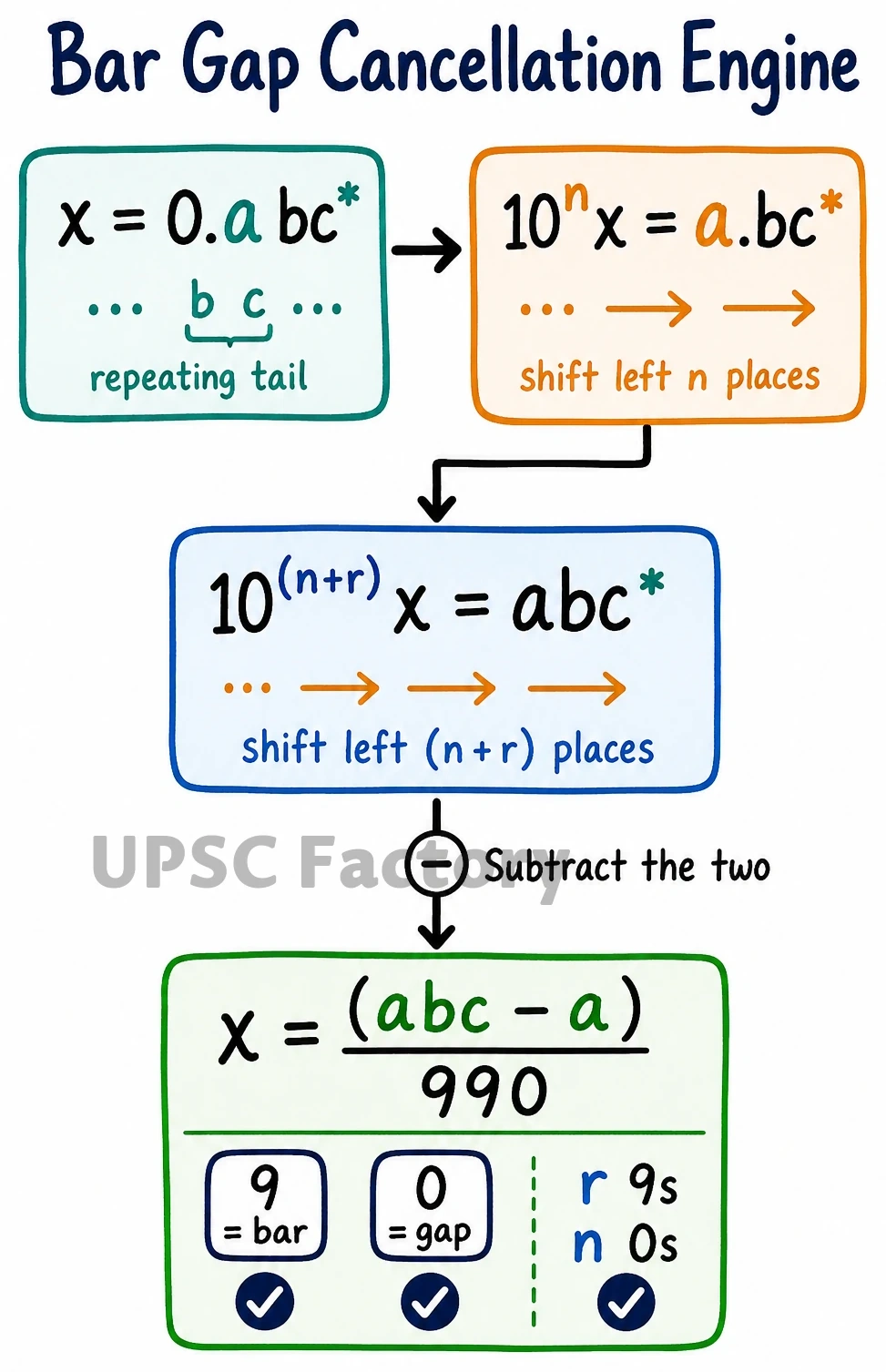
Proof for Mixed Recurring Decimals: Let x = 0.abc where n = 1 and r = 2:
x = 0.abc
10nx = 10x = a.bc — (Eq. 1) [Repetend starts at decimal point]
10n+rx = 1000x = abc.bc — (Eq. 2) [Shifted by one full period]
Subtracting Eq. 1 from Eq. 2:
(10n+r − 10n)x = abc − a
990x = abc − a
⇒ x = (abc − a)/990
(where abc represents the integer formed by the concatenation of digits a, b, c).
General Master Theorem:
For any decimal of the form x = A.c1…cnb1…br:
x = A + [(c1…cnb1…br) − (c1…cn)] / [99…9 (r times) 00…0 (n times)]
- If n = 0 (Pure Recurring): x = A + (b1…br) / [99…9 (r times)]
- If r = 0 (Terminating): x = A + (c1…cn) / 10n
Retention Anchor: 9 for Bar, 0 for Gap — The denominator takes r nines followed by n zeros. The numerator is the entire sequence of digits after the decimal minus the non-repeating prefix.
Key Theorems & Properties
- Termination Criterion: A rational number p/q in irreducible form (gcd(p, q) = 1) is terminating if and only if the prime factorization of q contains no primes other than 2 and 5:
q = 2a5b (a, b ∈ ℕ0)
Otherwise, the expansion is recurring.- Example: 13/40 = 13/(23 · 5) ⇒ Terminating (0.325).
- Example: 13/30 = 13/(2 · 3 · 5) ⇒ Mixed recurring (0.43) due to the prime factor 3.
- Reduction Warning: For 6/90, reducing to lowest terms yields 1/15 = 1/(3 · 5). Because the denominator still contains 3, the decimal is recurring (0.06). Always reduce the fraction before factoring the denominator.
x
- The 0.9 = 1 Identity: Let x = 0.9 ⇒ 10x = 9.9 ⇒ 9x = 9 ⇒ x = 1.
- Period Length Theorem: For p/q with gcd(q, 10) = 1, the length r of the repetend divides Euler’s totient φ(q) and is the smallest positive integer r satisfying:
10r ≡ 1 (mod q)
For instance, the period length of 1/7 is 6 because 106 ≡ 1 (mod 7) and no smaller positive integer exponent satisfies the congruence. - Factor Pairing Property: If x = N/99…9, then N plus its 9’s complement equals 99…9. Consequently, 1/11 = 0.09 and 10/11 = 0.90.
2. Comparative Matrix & Conceptual Distinctions
| Feature | Terminating | Pure Recurring | Mixed Recurring | Irrational |
|---|---|---|---|---|
| Decimal Form | A.a1…an | A.b1…br | A.c1…cnb1…br | Non-terminating, non-repeating |
| Denominator q (gcd(p, q) = 1) | q = 2a5b | gcd(q, 10) = 1 | q = 2a5b · k, k > 1, gcd(k, 10) = 1 | Cannot be written as p/q |
| Conversion Denominator | 10n | 99…9 (r nines) | 99…9 (r nines) 00…0 (n zeros) | Non-convertible |
| Standard Example | 0.35 = 35/100 = 7/20 | 0.45 = 45/99 = 5/11 | 0.235 = (235 − 2)/990 = 233/990 | π, √2, e |
| Examiner Trap Risk | Moderate (0.49 conversion) | High (direct addition errors) | Critical (omitting prefix subtraction) | Low |
Diagnostic Rule: A prime denominator does not ensure a recurring expansion. Denominators q = 2 and q = 5 produce strictly terminating values.
3. High-Yield Data Anchors & Memorization Benchmarks
A. The Instant Conversion Invariants
| Family | Fraction ↔ Decimal | Key Invariant |
|---|---|---|
| Denominator 9 (1-digit repetend) | 1/9 = 0.1, 4/9 = 0.4, 8/9 = 0.8 | 0.p = p/9 |
| Denominator 11 (2-digit repetend) | 1/11 = 0.09, 5/11 = 0.45, 7/11 = 0.63 | Repetend is (9 × Numerator). Ex: 5/11 = 45/99 |
| Denominators 3 & 6 (Mixed forms) | 1/3 = 0.3, 1/6 = 0.16, 5/6 = 0.83 | 0.16 = 1/6, 0.83 = 5/6 |
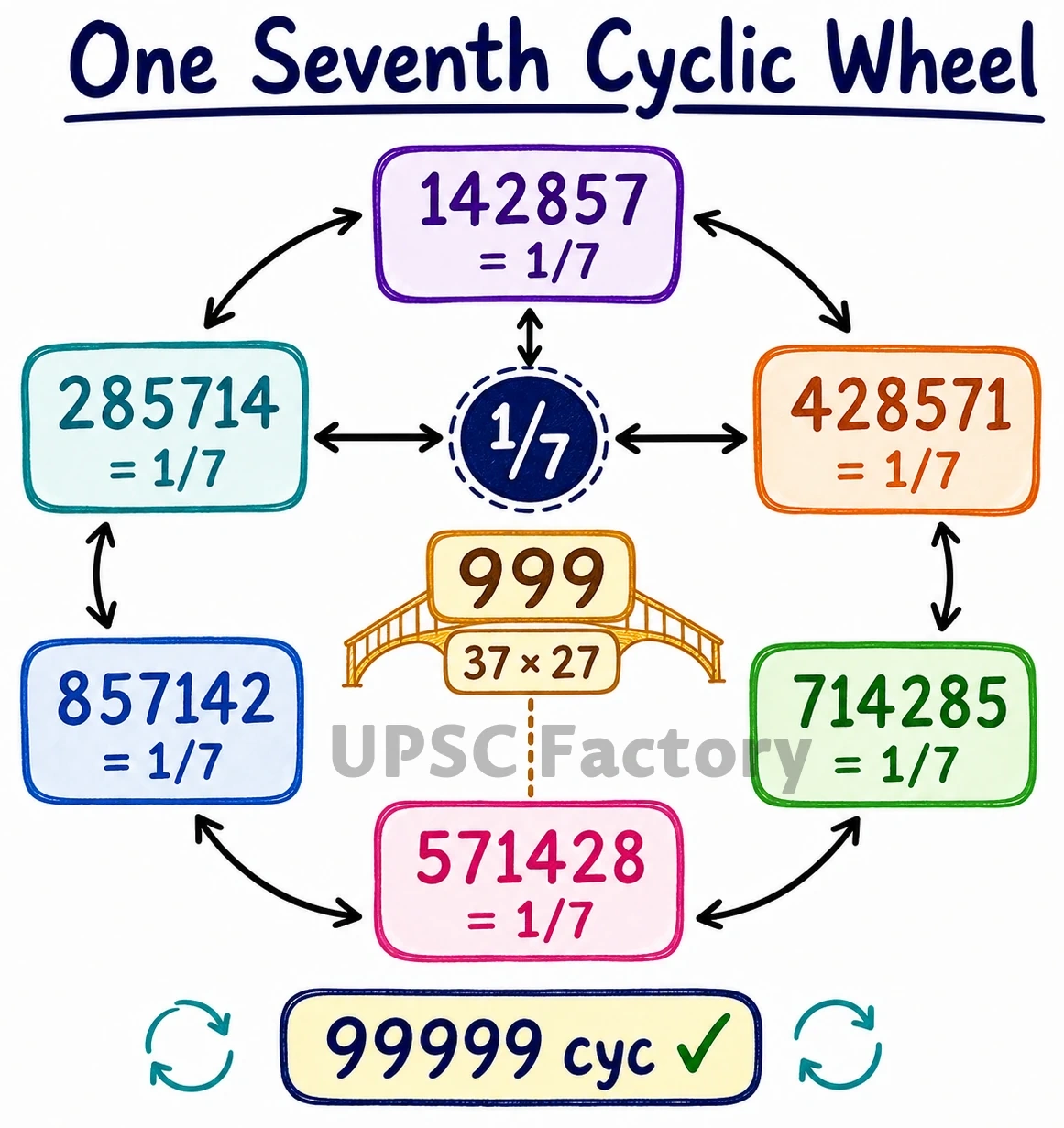
| Denominator 7 (Cyclic 6-digit repetend) | 1/7 = 0.142857, 2/7 = 0.285714, 3/7 = 0.428571 | Cyclic sequence: 142857; 142857 × 7 = 999999 |
| Denominator 27 / 37 | 0.037 = 1/27, 0.074 = 2/27 | 37 × 27 = 999 ⇒ 0.037 = 37/999 |
B. Deceptive Composites & Digit Misalignments
- 0.1666… = 0.16 = (16 − 1)/90 = 1/6. Do not evaluate this as 16/99. Note that 0.16 and 0.166 are mathematically identical (0.1666…), whereas 0.16 = 0.161616… = 16/99.
- 0.090909… = 0.09 = 1/11, which is distinct from 0.099 = 0.1000… = 0.1.
- 0.9 = 1, whereas 0.09 = 0.0999… = (09 − 0)/90 = 9/90 = 0.1.
C. Algebraic Invariant Anchors for Fast Simplification
- 99 = 9 × 11
- 999 = 27 × 37
- 9999 = 9 × 1111 = 9 × 11 × 101
- 99999 = 9 × 11111 = 9 × 41 × 271
Pattern Trigger: If the numerator features values such as 37, 74, or 111, anticipate factorization against denominators containing 999 or 9999.
4. Standard Algorithmic Protocols (Decision Logic)
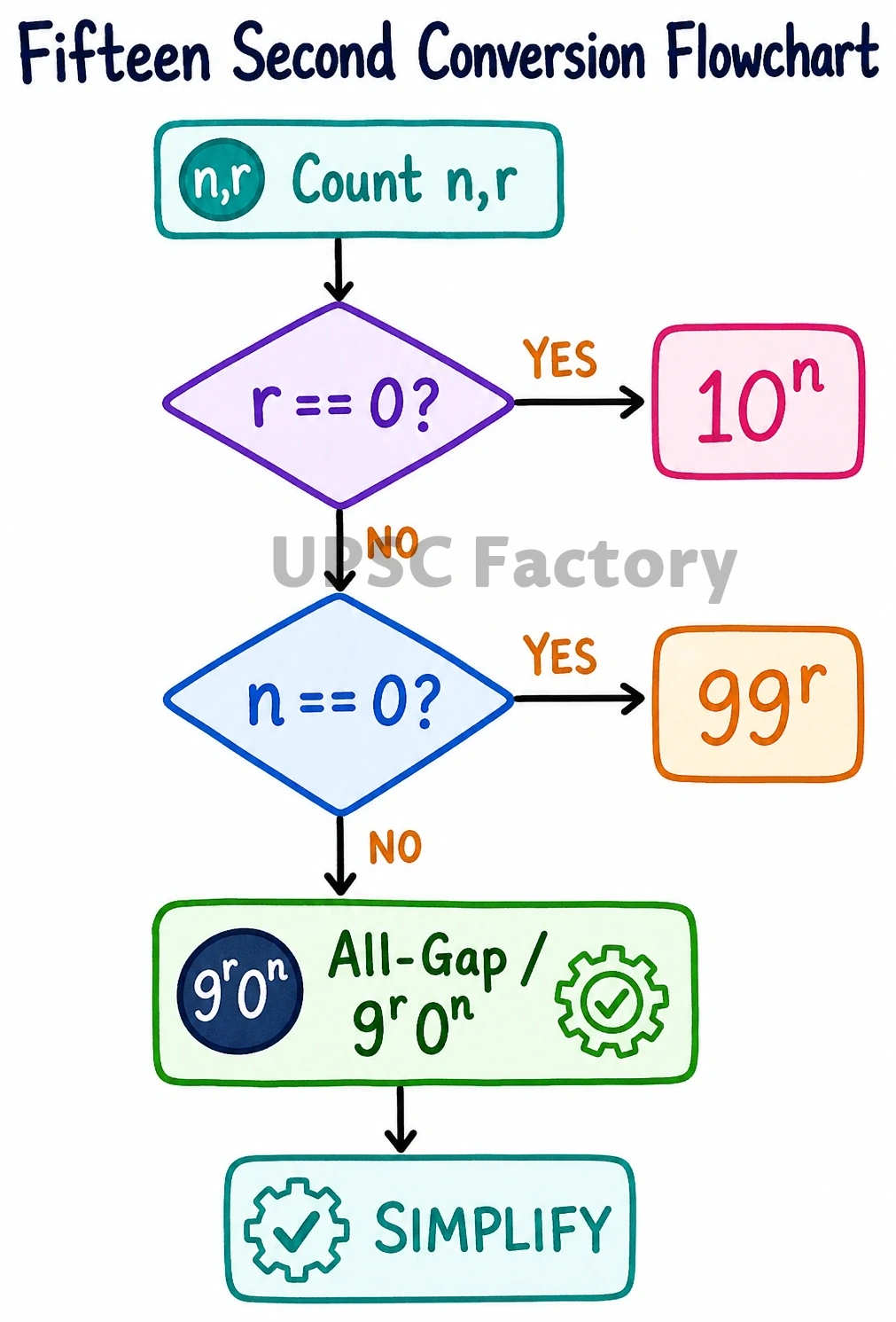
Fast Decimal-to-Fraction Protocol (≤ 15 Seconds)
To convert any decimal value D into an irreducible rational fraction p/q, follow this 4-step sequence:
- Step 1: Isolate the Integer Component
D = A + Decimal Part
(Separating the integer component A prevents handling unwieldy numerators during factorization). - Step 2: Determine Repetend and Non-Repetend Counts
- Identify n = number of non-repeating digits after the decimal point (Gap).
- Identify r = number of repeating digits under the repetend bar (Bar).
- Step 3: Construct the Fractional Quotient
- Case I: Terminating (r = 0)
Fraction = (All digits after decimal) / 10n - Case II: Pure Recurring (n = 0, r ≥ 1)
Fraction = (Repetend digits) / [99…9 (r nines)] - Case III: Mixed Recurring (n ≥ 1, r ≥ 1)
Fraction = [(All digits after decimal) − (Non-repeating prefix)] / [99…9 (r nines) 00…0 (n zeros)]
- Case I: Terminating (r = 0)
- Step 4: Recombine and Simplify
D = A + Numerator/Denominator → (Reduce by gcd) → p/q
Step-by-Step Worked Demonstration Models
Model 1: Terminating Decimal (r = 0)
Convert D = 0.375 to p/q:
- A = 0, n = 3, r = 0
- Fraction = 375/103 = 375/1000
- Divide numerator and denominator by gcd(375, 1000) = 125:
(375 ÷ 125) / (1000 ÷ 125) = 3/8
Model 2: Pure Recurring Decimal (n = 0)
Convert D = 0.45 to p/q:
- A = 0, n = 0, r = 2 (repeating block: 45)
- Denominator = 99 (2 nines)
- Fraction = 45/99
- Divide numerator and denominator by gcd(45, 99) = 9:
(45 ÷ 9) / (99 ÷ 9) = 5/11
Model 3: Mixed Recurring Decimal with Zero Integer (A = 0, n ≥ 1)
Convert D = 0.1635 to p/q:
- A = 0, n = 2 (non-repeating digits 16), r = 2 (repeating block 35)
- Numerator = 1635 − 16 = 1619
- Denominator = 9900 (r = 2 nines, n = 2 zeros)
- D = 1619/9900
(Since gcd(1619, 9900) = 1, the fraction is in simplest form).
Model 4: Mixed Recurring with Non-Zero Integer Part (A > 0)
Convert D = 1.42 to p/q:
- Method A (Integer Separation):
- A = 1, n = 1 (digit 4), r = 1 (digit 2)
- Numerator = 42 − 4 = 38
- Denominator = 90 (1 nine, 1 zero)
- D = 1 + 38/90 = 1 + 19/45 = (45 + 19)/45 = 64/45
- Method B (Direct Single-Fraction Conversion):
- Numerator = (Entire number without decimal) − (Digits before bar) = 142 − 14 = 128
- Denominator = 90
- D = 128/90 = 64/45
5. Standard Question Typologies & Analytical Solutions
Type A: Parity & Multi-Variable Constraints
Archetype: Pure recurring fractions of the form m/9 and n/99 subject to range constraints.
Problem: Consider the numbers x = 0.a and y = 0.b, where a and b are single non-zero digits (1 ≤ a, b ≤ 9). If x + y = 0.c, where c is also a single digit, find the number of distinct ordered pairs (a, b) that satisfy this equation.
Analytical Solution:
Step 1: Convert to Fractional Form
x = a/9, y = b/9 ⇒ x + y = (a + b)/9
The target sum is 0.c = c/9, where 1 ≤ c ≤ 9.
Step 2: Establish Boundary Constraints
For the sum (a + b)/9 to remain strictly in the form 0.c, the sum of the digits must satisfy:
a + b = c ≤ 9
If a + b > 9, the sum becomes 1 + (a + b − 9)/9 = 1.a + b − 9, which is no longer of the form 0.c.
Step 3: Count Valid Integer Pairs
For each integer k = a + b such that 2 ≤ k ≤ 9, the number of valid pairs (a, b) with a, b ≥ 1 is (k − 1):
Total Pairs = ∑k=29 (k − 1) = 1 + 2 + 3 + 4 + 5 + 6 + 7 + 8 = 36
Step 4: Boundary Evaluation on c = 9
- If c = 9 is permissible (0.9 = 1), there are 36 pairs.
- If the problem strictly defines 0.c < 1 (excluding c = 9), then a + b ≤ 8:
∑k=28 (k − 1) = 1 + 2 + ··· + 7 = 28 pairs
Exam Shortcut: In additions involving pure single-digit repetends 0.a + 0.b, convert directly to denominators of 9. The non-carry condition a + b ≤ 9 governs validity.
Type B: Statement Evaluation & Conceptual Validity
Archetype: Validating termination properties and the 0.9 = 1 identity.
Problem: Consider the following statements:
- The value of 0.9 is strictly less than 1.
- The rational equivalent of 1.42 in lowest terms has a denominator divisible by 3.
- Every fraction with a denominator of 40 yields a terminating decimal expansion.
Which of the above statements are correct?
Analytical Solution:
Statement 1:
Let x = 0.9 ⇒ 10x = 9.9 ⇒ 9x = 9 ⇒ x = 1. Thus, 0.9 = 1 exactly. (Incorrect)
Statement 2:
1.42 = 1 + (42 − 4)/90 = 1 + 38/90 = 128/90 = 64/45
The simplified denominator is 45 = 32 × 5, which is divisible by 3. (Correct)
Statement 3:
The prime factorization of the denominator is 40 = 23 × 51. Since the prime factors are exclusively from the set {2, 5}, any fraction p/40 will simplify to a denominator of the form 2a5b. Consequently, the expansion always terminates. (Correct)
Correct Answer: Statements 2 and 3 are correct.
Type C: Existence & Combinatorial Counting
Archetype: Counting distinct rational outputs generated by digit combinations.
Problem: How many distinct rational numbers of the form 0.pq can be formed where p and q are distinct non-zero single digits (p, q ∈ {1, 2, …, 9} with p ≠ q)?
Analytical Solution:
Step 1: Algebraic Representation
0.pq = (10p + q − p)/90 = (9p + q)/90
Step 2: Injectivity & Uniqueness Check
We evaluate whether two distinct digit pairs (p1, q1) ≠ (p2, q2) can yield the same value:
9p1 + q1 = 9p2 + q2 ⇒ 9(p1 − p2) = q2 − q1
Because q1, q2 ∈ {1, …, 9}, the difference |q2 − q1| ≤ 8.
The only multiple of 9 in this range is 0, meaning p1 − p2 = 0 ⇒ p1 = p2 and q1 = q2.
Thus, every distinct ordered pair (p, q) generates a unique numerator 9p + q.
Step 3: Combinatorial Computation
Selecting 2 distinct digits from 9 without replacement:
P(9, 2) = 9 × 8 = 72 distinct rational values
Type D: Algebraic Simplification with Cyclics
Archetype: Factor cancellation using 999 and prime period properties.
Problem: Evaluate the exact value of:
E = (0.037 × 27) + 0.83
Analytical Solution:
Step 1: Convert Individual Terms
0.037 = 37/999
Recall the algebraic identity 999 = 27 × 37:
0.037 × 27 = (37 × 27)/999 = 999/999 = 1
Step 2: Convert the Mixed Recurring Term
0.83 = (83 − 8)/90 = 75/90 = 5/6
Step 3: Sum the Terms
E = 1 + 5/6 = 11/6 = 1.83
Type E: Modular Periodicity & Co-Prime Denominators
Archetype: Counting coprime period lengths and irreducible fractions.
Problem: Let N = 0.ab where ab is a two-digit integer (10 ≤ ab ≤ 99). When expressed as an irreducible fraction p/q, the denominator is given by q = 99/gcd(ab, 99). How many two-digit integers ab ∈ [10, 99] are co-prime to 99?
Analytical Solution:
Step 1: Factorization and Totient Function
99 = 32 × 11
The number of integers in [1, 99] co-prime to 99 is given by Euler’s totient function φ(99):
φ(99) = 99 × (1 − 1/3) × (1 − 1/11) = 99 × 2/3 × 10/11 = 60
Step 2: Exclude Single-Digit Values
The single-digit values in [1, 9] co-prime to 99 are 1, 2, 4, 5, 7, 8 (a total of 6 values).
Step 3: Compute the Target Count
Count = φ(99) − 6 = 60 − 6 = 54
(For these 54 values, the denominator remains strictly q = 99).
Type F: Composite Arithmetic & Denominator LCM
Archetype: Addition of mixed and pure recurring decimals with fractional reduction.
Problem: Evaluate the sum S = 0.16 + 0.27. Express the result as an irreducible fraction p/q and find (q − p).
Analytical Solution:
Step 1: Fractional Conversion
0.16 = (16 − 1)/90 = 15/90 = 1/6
0.27 = 27/99 = 3/11
Step 2: Compute the Sum
S = 1/6 + 3/11 = (11 + 18)/66 = 29/66
Step 3: Evaluate Invariant
Since gcd(29, 66) = 1, we have p = 29 and q = 66:
q − p = 66 − 29 = 37
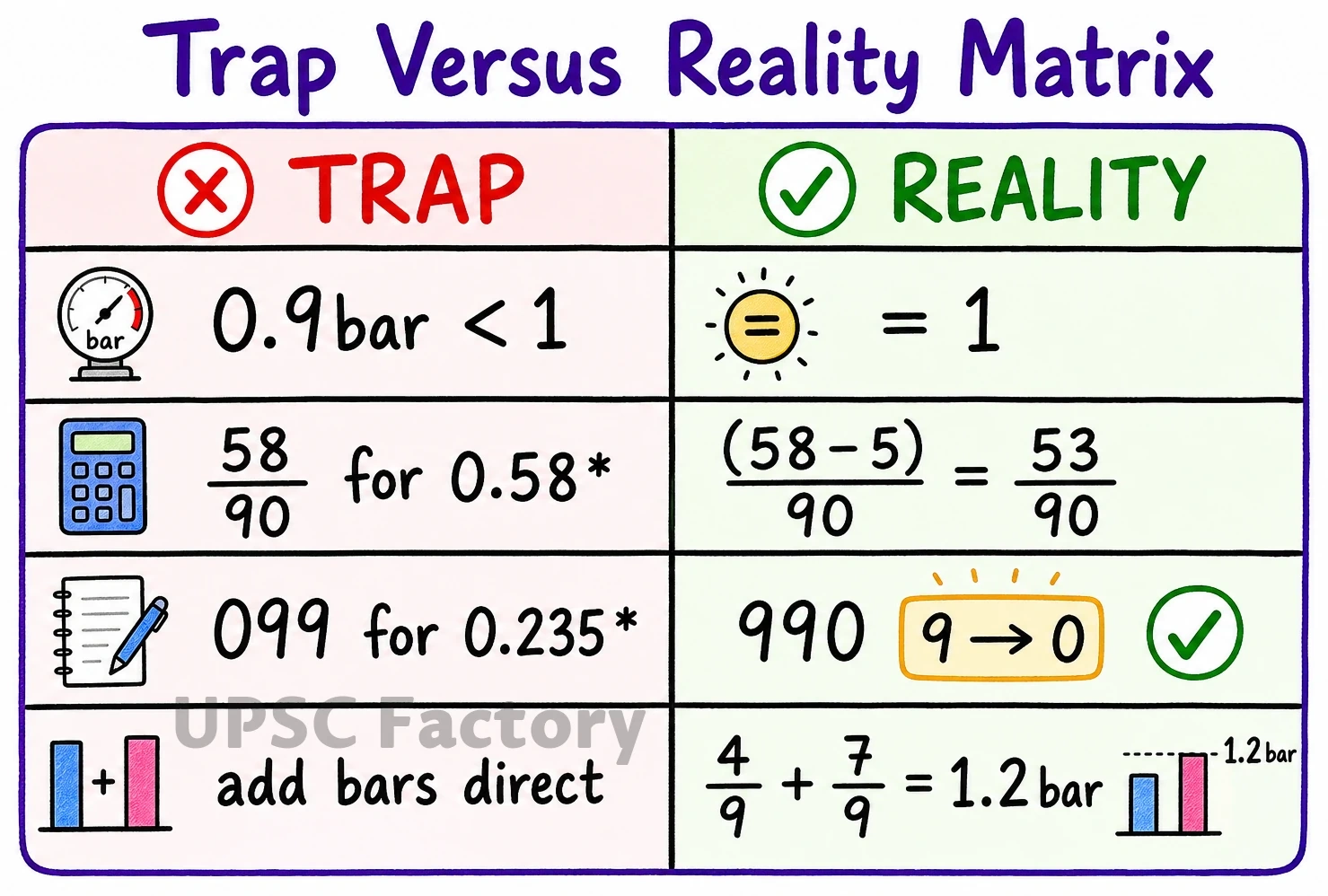
6. The Examiner Trap Matrix
| Candidate Fallacy | Mathematical Fact | Counterexample & Verification |
|---|---|---|
| Assuming 0.9 < 1 | 0.9 = 1 identically | 1 − 0.9 = 0. The statement “0.9 < 1″ is strictly false. |
| Direct digit-by-digit bar addition: 0.4 + 0.7 = 1.1 | Bar notation is non-linear across base carries | 4/9 + 7/9 = 11/9 = 1.2 ≠ 1.1 |
| Incorrect mixed numerator: 0.58 = 58/90 | Must subtract the non-repeating prefix | Correct: (58 − 5)/90 = 53/90. Note that 58/90 = 0.64. |
| Inverting denominator structure: For 0.235, writing 900 or 099 | Rule: Place r nines first, followed by n zeros | 0.235 = (235 − 2)/990 = 233/990. |
| Omitting final reduction | Fraction options are always presented in irreducible form | 75/90 → 5/6; 27/99 → 3/11. Always factor out common terms. |
| Ignoring bar start position: 0.16 = 0.16 | Repetend start index fundamentally changes the value | 0.16 = 1/6 = 0.1666… whereas 0.16 = 16/99 = 0.161616… |
7. Golden Rules & Instant Exam Triggers
| # | Trigger | Mathematical Rule |
|---|---|---|
| 1 | Encountering 0.9, 1.9, or k.9 | Immediately replace with 1, 2, or k + 1. This is exact equality, not an approximation. |
| 2 | Arithmetic operations on recurring decimals (+, −, ×, ÷) | Never add or multiply repetend digits directly. Convert every term to its rational fraction p/q first. |
| 3 | Single-digit repetend (0.a) or Two-digit repetend (0.ab) | Instantly write as a/9 or ab/99. |
| 4 | Mixed recurring pattern (0.pq) | Instantly apply [(10p + q) − p]/90 = (9p + q)/90. |
| 5 | Denominator termination checks | Reduce the fraction to lowest terms, then factor q. If q = 2a5b, it terminates; if any other prime factor exists, it recurs. |
| 6 | Recognizing cyclic numbers (142857, 037, 285714) | 0.142857 = 1/7, 0.037 = 1/27. |
| 7 | Evaluating expressions like (q − p) or (p + q) | Always ensure gcd(p, q) = 1 before calculating the final sum or difference. |
Final Retention Formula: “9 for Bar, 0 for Gap, Subtract the Prefix”
Rational Fraction = [(All digits after decimal) − (Non-repeating prefix)] / [99…9 (Length of Bar) 00…0 (Length of Gap)]