1. Theoretical Foundation & Mathematical Underpinnings
Formal Definition & Scope
The quantitative framework rests upon the Real Number System (ℝ) — the set of all quantities representable on a one-dimensional continuous number line. It forms a mutually exclusive and exhaustive partition:
ℝ = ℚ ∪ ℚc and ℚ ∩ ℚc = ∅
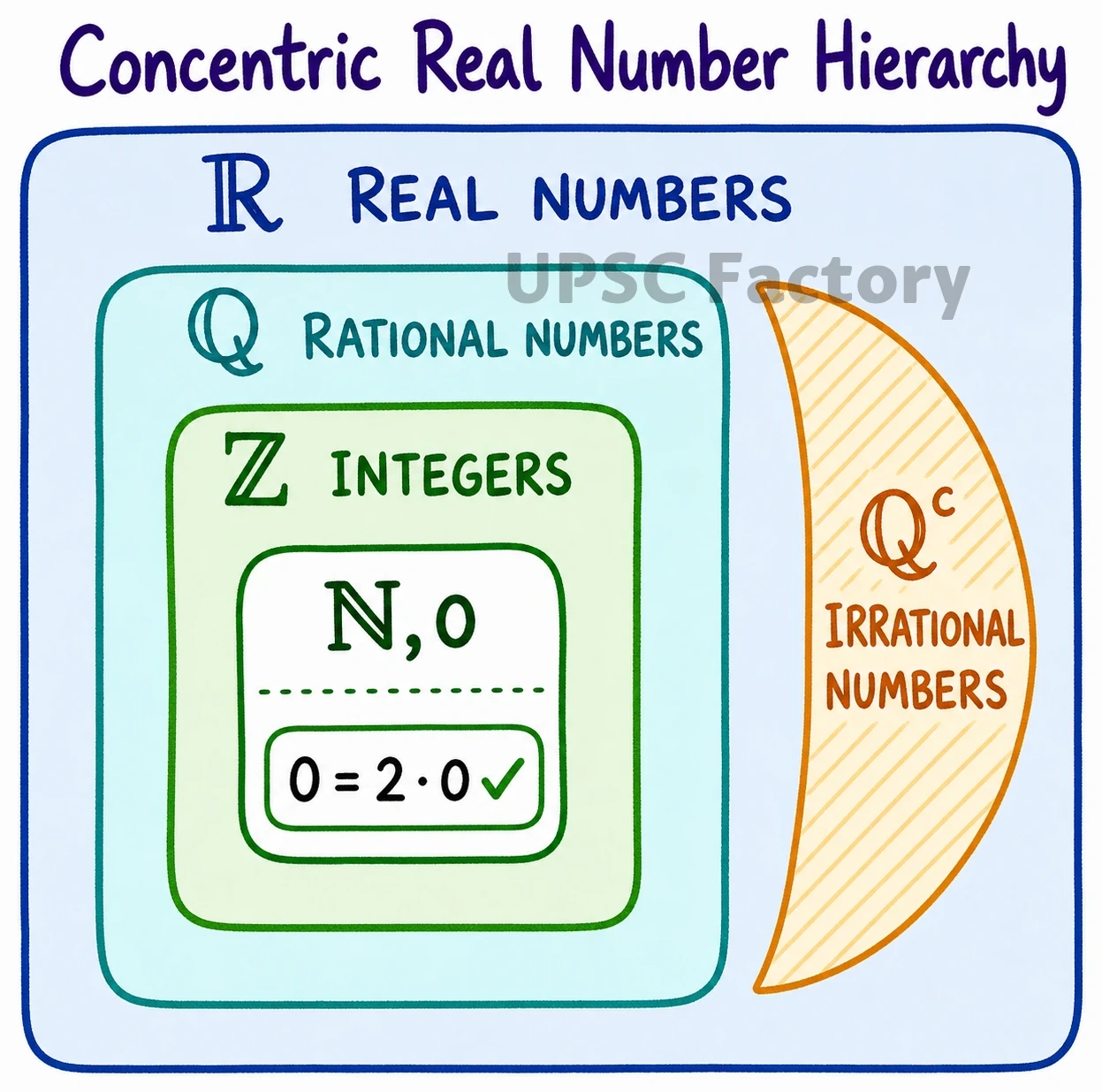
where ℚ denotes the set of Rational Numbers, and ℚc denotes the set of Irrational Numbers (ℝ \ ℚ).
1. Rational Numbers (ℚ):
ℚ = { p/q | p, q ∈ ℤ, q ≠ 0 }
A real number is rational if and only if its decimal expansion is either Terminating or Non-Terminating but Repeating (Recurring).
- Terminating: 1/2 = 0.5, 7/8 = 0.875, 13/400 = 0.0325
- Repeating: 1/3 = 0.3, 1/7 = 0.142857, 1/6 = 0.16
2. Irrational Numbers (ℚc):
Numbers that cannot be expressed in the form p/q where p, q ∈ ℤ and q ≠ 0. Defining property: the decimal expansion is Non-Terminating and Non-Repeating. No finite sequence of digits recurs indefinitely.
- Canonical Examples: √2, √3, √5, √7, … (surds of non-perfect squares); transcendental constants such as π, e; and constructed decimals such as 0.101001000100001…
3. Integers (ℤ):
A critical subset of ℚ where the denominator in reduced form is q = 1.
ℤ = {…, -3, -2, -1, 0, 1, 2, 3, …}
ℤ+ = {1, 2, 3, …} (Natural Numbers / Positive Integers)
ℤ– = {-1, -2, -3, …} (Negative Integers)
The “Why” Behind the Math — Proofs for Retention
Why 1: Why does a rational number always terminate or repeat?
When dividing an integer p by a positive integer q, the remainder at each step of standard long division must strictly belong to the set:
R ∈ {0, 1, 2, …, q – 1}
This yields at most q distinct possible remainders:
- If the remainder becomes 0 at any step, the division process halts, producing a terminating decimal.
- If the remainder never reaches 0, then by the Pigeonhole Principle, a remainder must recur within at most q subsequent division steps. Once a remainder repeats, the exact sequence of quotient digits generated thereafter repeats identically.
Hence, every rational representation yields a periodic or finite decimal, whereas irrationality corresponds to an infinite, non-repeating sequence of remainders.
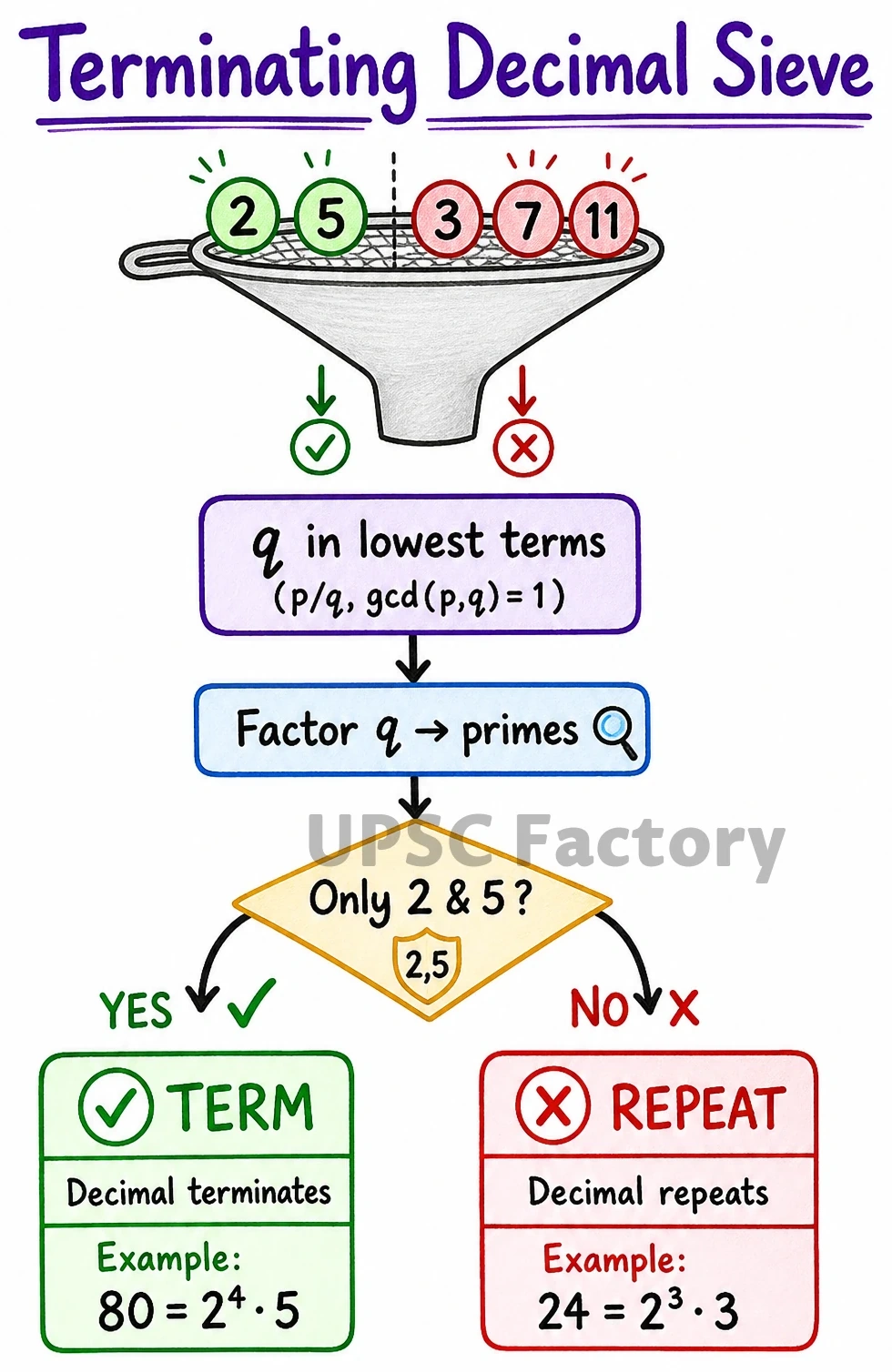
Why 2: Why is a rational decimal terminating if and only if its reduced denominator contains only prime factors of 2 and 5?
Any terminating decimal with k decimal places can be expressed as a base-10 fraction:
N/10k = N/(2 · 5)k = N/(2k · 5k)
for some integer N and non-negative integer k ≥ 0. After cancelling all common factors between numerator and denominator:
p/q = (N / gcd(N, 10k))/(10k / gcd(N, 10k))
The simplified denominator q cannot contain any prime factors other than 2 and 5.
Verification Test:
- 7/40 = 7/(23 · 5) ⇒ Denominator has only primes 2 and 5 ⇒ Terminating (0.175).
- 5/14 = 5/(2 · 7) ⇒ Denominator contains the prime factor 7 ⇒ Non-terminating repeating (0.3571428).
Note: This test is valid only after the fraction is reduced to its lowest terms.
Why 3: Why is Rational + Irrational = Irrational always true?
Proof by Contradiction:
Let r ∈ ℚ and s ∈ ℚc. Assume, for contradiction, that their sum is rational:
r + s = t where t ∈ ℚ
Isolating the irrational term yields:
s = t – r
Because the set of rational numbers ℚ is closed under subtraction, the difference of two rational numbers (t – r) must be rational:
(t – r) ∈ ℚ ⇒ s ∈ ℚ
This directly contradicts the initial premise that s ∈ ℚc. Thus, the sum t must be irrational.
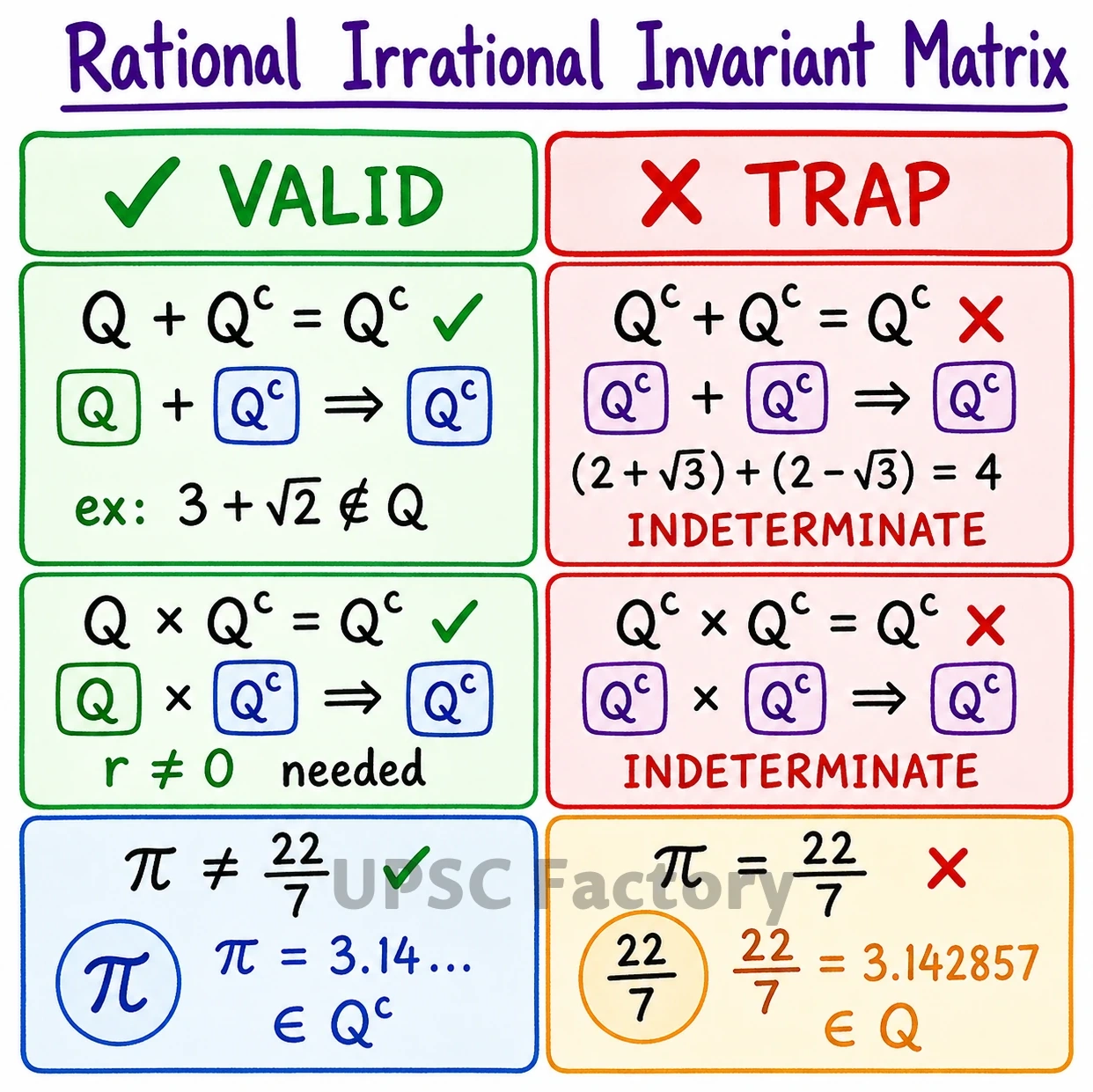
Corollary Trap: This closure property does not extend to the sum of two irrational numbers (ℚc + ℚc). The set of irrational numbers is not closed under addition:
(2 + √3) + (2 – √3) = 4 ∈ ℚ
Why 4: Why is Zero (0) Even? Two Rigorous Proofs
- Algebraic Definition: An integer n is even if there exists an integer k ∈ ℤ such that n = 2k. Setting k = 0:
2k = 2(0) = 0 ⇒ 0 ∈ 2ℤ (Even) - Sequential Parity Invariance: Parity strictly alternates across consecutive integers on the number line:
…, -3 (Odd), -2 (Even), -1 (Odd), 0 (?), 1 (Odd), 2 (Even), …
To preserve strict alternating parity (Odd ↔ Even), 0 must be Even.
Consequence: Zero (0) is an even integer, but it is neither positive nor negative; it serves as the neutral sign boundary on ℝ.
Key Theorems & Properties
- Closure Properties:
- ℚ + ℚ = ℚ and ℚ × ℚ = ℚ (Closed under addition and multiplication)
- If r ∈ ℚ \ {0} and s ∈ ℚc, then r · s ∈ ℚc
- ℚc + ℚc = Indeterminate (ℚ or ℚc)
- ℚc × ℚc = Indeterminate (ℚ or ℚc)
- Parity Arithmetic (0 is Even):
- Addition / Subtraction:
Even ± Even = Even, Odd ± Odd = Even, Even ± Odd = Odd - Multiplication:
Even × (Any Integer) = Even, Odd × Odd = Odd
(An odd product requires every factor in the product to be odd.) - Operational Examples:
4 (Even) + 0 (Even) = 4 (Even)
(-3) (Odd) × 0 (Even) = 0 (Even)
- Addition / Subtraction:
- Independence of Sign and Parity: Sign and parity are independent mathematical properties. For instance, -4 is Negative and Even, while -3 is Negative and Odd.
2. Comparative Matrix & Conceptual Distinctions
Table 1: Rational vs. Irrational — The Decisive Divide
| Parameter | Rational Numbers (ℚ) | Irrational Numbers (ℚc) |
|---|---|---|
| Formal Definition | Can be expressed as p/q where p, q ∈ ℤ, q ≠ 0 | Cannot be expressed as p/q with integer terms |
| Decimal Representation | Terminating OR Non-Terminating Recurring | Non-Terminating and Non-Repeating |
| Representative Examples | 22/7 = 3.142857, 0.5, -4, 0 | π ≈ 3.14159…, √2 ≈ 1.4142…, e |
| Common Exam Trap | 0.9 = 1 (Strictly Rational) | √4 = 2 is Rational, not Irrational |
Table 2: Integer Terminology Spectrum — The Zero Boundary
| Term in Problem Statement | Mathematical Set Notation | Includes 0? | Risk Level / Pitfall Frequency |
|---|---|---|---|
| Natural / Positive Integer | {1, 2, 3, …} (x > 0) | NO | Moderate |
| Non-Negative Integer | {0, 1, 2, 3, …} (x ≥ 0) | YES | Critical |
| Negative Integer | {-1, -2, -3, …} (x < 0) | NO | Moderate |
| Non-Positive Integer | {0, -1, -2, -3, …} (x ≤ 0) | YES | Critical |
| Whole Number | {0, 1, 2, 3, …} | YES | High |
| Even Integer | {…, -4, -2, 0, 2, 4, …} | YES | High |
Key Takeaway: In standardized competitive examinations, problem stems frequently distinguish between Positive and Non-Negative to test boundary-condition awareness.
Table 3: The π versus 22/7 Fallacy
| Mathematical Property | The Constant π | The Fraction 22/7 |
|---|---|---|
| Classification | Irrational (ℚc) | Rational (ℚ) |
| Decimal Behavior | 3.14159265… (Infinite, non-periodic) | 3.142857 (Period length = 6) |
| Value Precision | Exact transcendental circle ratio | Rational approximation (22/7 – π ≈ 0.00126) |
| Statement Truth Value | “π is rational” ⇒ FALSE | “22/7 is irrational” ⇒ FALSE |
3. High-Yield Data Anchors & Memorization Benchmarks
A. Terminating Decimal Test (Denominator Factorization)
Given a rational fraction p/q in irreducible form (gcd(p, q) = 1):
- If q = 2a · 5b for non-negative integers a, b ≥ 0 ⇒ Terminating Decimal
- If q contains any prime factor pk ∉ {2, 5} ⇒ Non-Terminating Repeating Decimal
Examples:
- 3/80 ⇒ 80 = 24 · 51 ⇒ Terminates (0.0375)
- 9/44 ⇒ 44 = 22 · 111 ⇒ Repeats (0.2045)
B. High-Frequency Deceptive Numbers
| Number / Expression | Common Misconception | Actual Mathematical Classification | Underlying Proof / Rationale |
|---|---|---|---|
| 0 | Sign-less, hence parity-less | Even Integer, Rational | 0 = 0/1 = 2(0) with k = 0 ∈ ℤ |
| √4, √9, √0.25 | Radical symbol implies irrationality | Rational | Exact integer/fraction evaluations: 2, 3, 0.5 |
| 0.1010010001… | Looks periodic due to zeros and ones | Irrational | The zero-run length increases monotonically; no fixed period |
| 3.142857 | Looks like irrational π | Rational | Identical to 22/7; period repeats infinitely |
| π + (-π) | Sum of two irrationals | Rational (0) | Sum of additive inverses yields integer zero |
C. Algebraic Parity Invariants
- Square Invariant: n2 ≡ n (mod 2) (An integer and its square share the identical parity).
- Consecutive Pair Invariant: n(n + 1) is always Even for all n ∈ ℤ (Every pair of consecutive integers contains at least one factor of 2).
- Consecutive Triplet Invariant: n3 – n = (n – 1)n(n + 1) is always divisible by 6 (Contains at least one multiple of 2 and one multiple of 3).
4. Standard Algorithmic Protocols (Decision Logic)
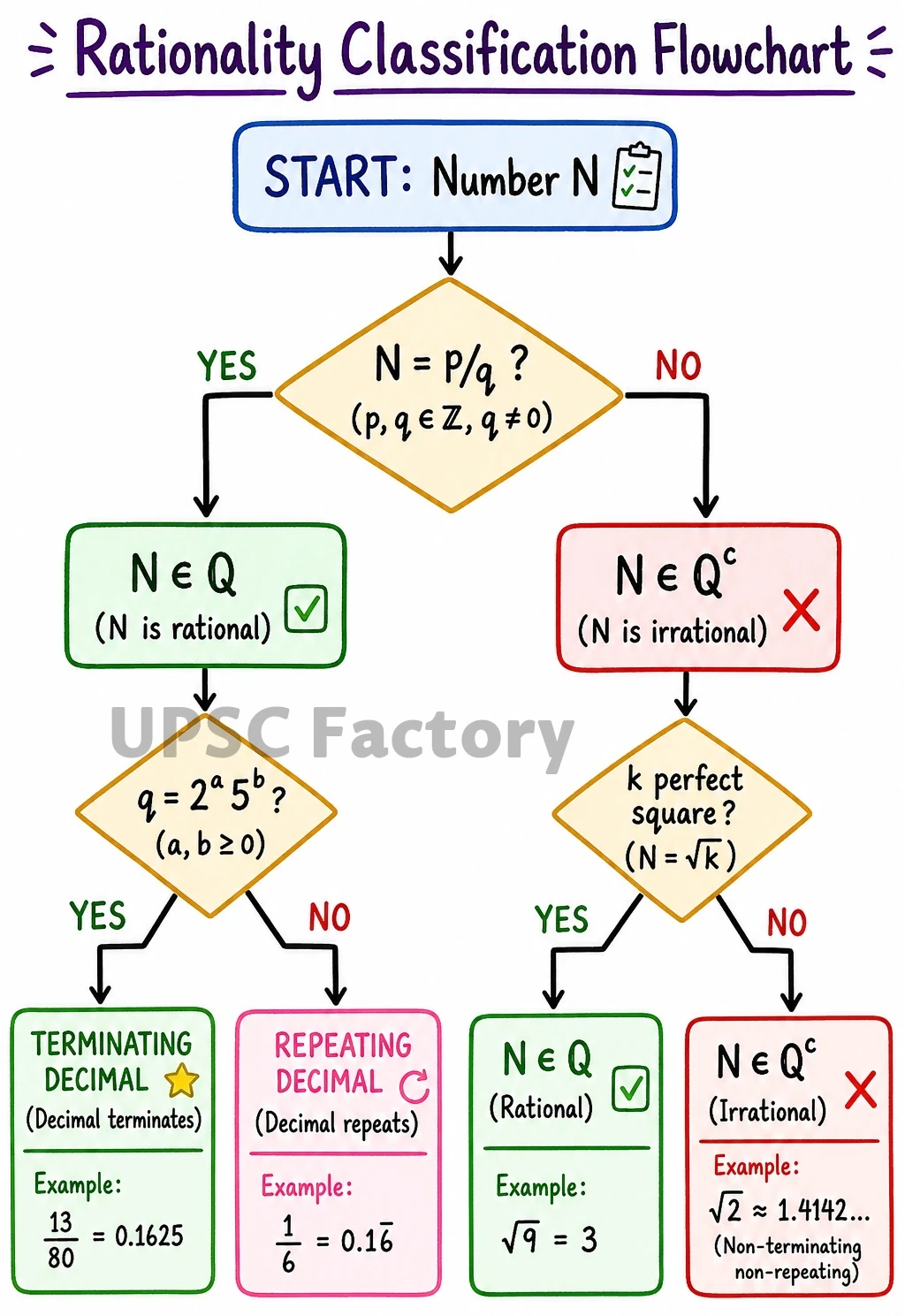
Protocol 1: Systematic Rationality & Decimal Classification
When analyzing any given number N:
- Algebraic Representation Check:
- Can N be represented as p/q with p, q ∈ ℤ and q ≠ 0?
- Yes: N ∈ ℚ (Rational). Proceed to Step 2.
- No: N ∈ ℚc (Irrational). Proceed to Step 3.
- Rational Decimal Expansion Analysis:
- Reduce p/q completely such that gcd(p, q) = 1.
- Factor the denominator: q = 2a · 5b · k.
- If k = 1, the decimal expansion is Terminating.
- If k > 1 (contains prime factors other than 2 or 5), the decimal expansion is Non-Terminating Recurring.
- Irrational / Radical Form Analysis:
- If N = √k for an integer k:
- If k = m2 for some m ∈ ℤ, then N = m ∈ ℚ (Rational).
- If k is not a perfect square, N ∈ ℚc (Irrational).
Step-by-Step Numerical Example:
Classify the value N = 21/280.
- Step 1: Reduce to lowest terms: gcd(21, 280) = 7 ⇒ (21/7)/(280/7) = 3/40.
- Step 2: Factor the simplified denominator: 40 = 23 · 51.
- Step 3: Since all prime factors belong to {2, 5}, N produces a terminating decimal (0.075).
Protocol 2: Parity and Zero-Product Consecutive Integer Resolution
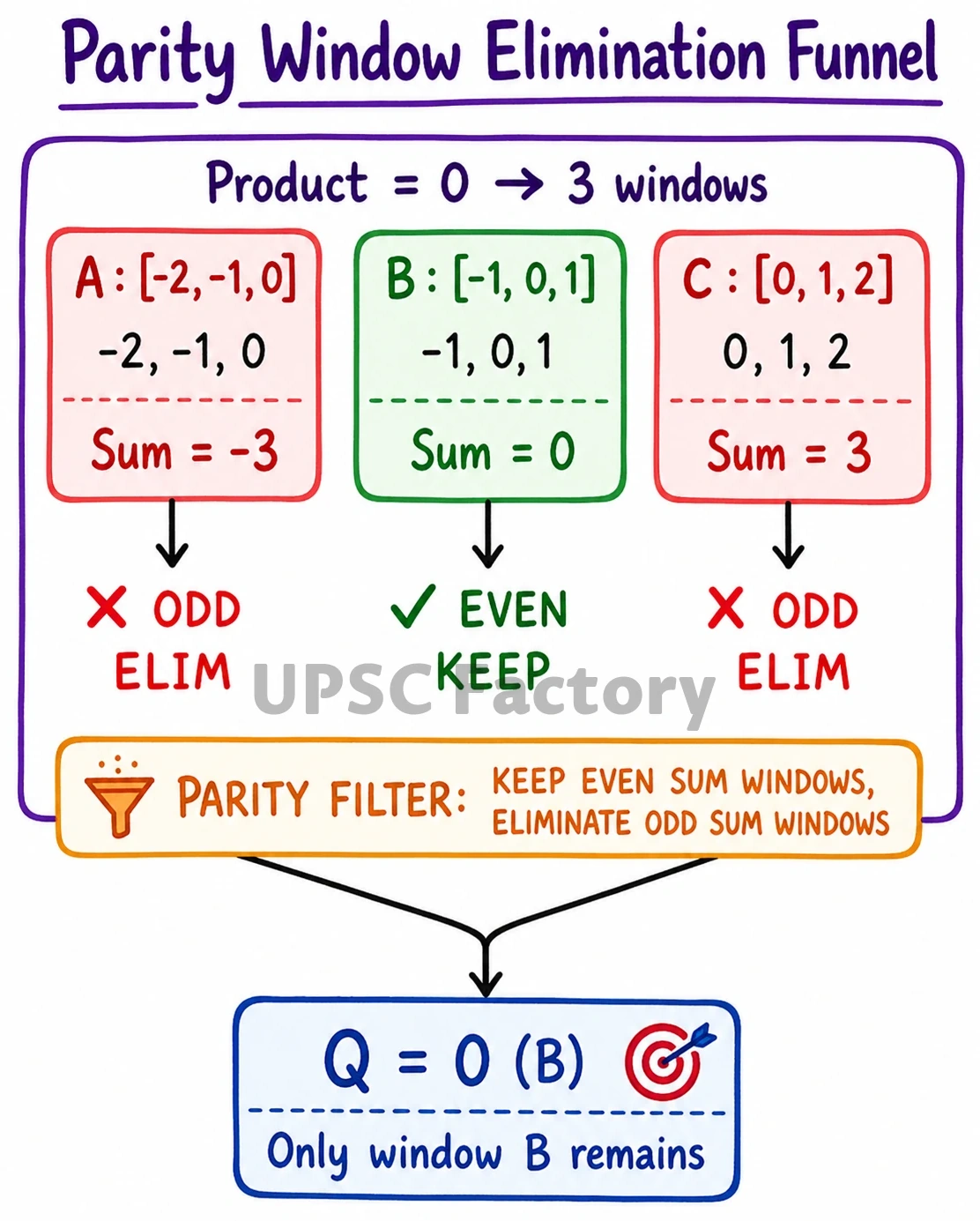
For problems constrained by P × Q × R = 0 over consecutive integers P < Q < R:
- Zero-Product Condition:
P · Q · R = 0 ⇒ 0 ∈ {P, Q, R} - Enumerate Feasible Consecutive Triplets:
- Case 1 (R = 0): Triple A = {-2, -1, 0}
- Case 2 (Q = 0): Triple B = {-1, 0, 1}
- Case 3 (P = 0): Triple C = {0, 1, 2}
- Evaluate Parity Constraints on the Sum:
- Sum(A) = -2 + (-1) + 0 = -3 (Odd)
- Sum(B) = -1 + 0 + 1 = 0 (Even)
- Sum(C) = 0 + 1 + 2 = 3 (Odd)
- Parity Elimination:
Match the required sum parity (remembering that 0 is Even) to select the unique valid set.
Step-by-Step Numerical Example:
Find three consecutive integers whose product is 0 and whose sum is strictly odd and positive.
- Step 1: Identify the three candidate triplets: {-2, -1, 0}, {-1, 0, 1}, and {0, 1, 2}.
- Step 2: Calculate the sums: -3, 0, and +3.
- Step 3: Apply the constraint (Sum > 0 and Sum is Odd) ⇒ triplet {0, 1, 2} is the unique solution with P = 0, Q = 1, R = 2.
Protocol 3: Quantitative Terminology Decoder
To avoid boundary-value errors when translating word problems into algebraic domains:
- Look for the Prefix “Non-“:
- Non-Negative: Condition is x ≥ 0 ⇒ Includes 0 ({0, 1, 2, …}).
- Non-Positive: Condition is x ≤ 0 ⇒ Includes 0 ({0, -1, -2, …}).
- Check for Strict Positivity / Negativity:
- Positive: Condition is x > 0 ⇒ Excludes 0 ({1, 2, 3, …}).
- Negative: Condition is x < 0 ⇒ Excludes 0 ({-1, -2, -3, …}).
- Check Parity Descriptors:
- Even Integer: Condition is x ∈ 2ℤ ⇒ Includes 0 ({…, -2, 0, 2, …}).
5. Standard Question Typologies & Analytical Solutions
Type A: Parity & Multi-Variable Constraints
Core Principle: Zero is Even; Parity of Consecutive Integers
Question:
Let P, Q, R be three consecutive integers such that P < Q < R. If P × Q × R = 0 and P + Q + R is an even integer, what is the value of Q?
(a) -1
(b) 0
(c) 1
(d) Cannot be determined
Analytical Solution:
- Step 1 (Constraint Setup): Since P, Q, R are consecutive integers and their product is zero, the number 0 must be one of the three integers.
- Step 2 (Exhaustive Case Listing):
Window 1: P = -2, Q = -1, R = 0
Window 2: P = -1, Q = 0, R = 1
Window 3: P = 0, Q = 1, R = 2 - Step 3 (Sum and Parity Evaluation):
Window 1: P + Q + R = -2 + (-1) + 0 = -3 (Odd)
Window 2: P + Q + R = -1 + 0 + 1 = 0 (Even, since 0 = 2 × 0)
Window 3: P + Q + R = 0 + 1 + 2 = 3 (Odd) - Step 4 (Conclusion): Only Window 2 satisfies the condition that the sum is an even integer. In this window, the middle integer is Q = 0.
Correct Answer: (b) 0
Exam Strategy: When a product of consecutive integers is 0, immediately list the three potential triplets containing 0. Evaluate the parity of the sums to eliminate invalid windows in seconds.
Type B: Statement Evaluation & Set Closure
Core Principle: Set Inclusions and Irrational Counterexamples
Question:
Consider the following statements:
1. Every integer is a rational number, but every rational number is not an integer.
2. The sum of two irrational numbers is always an irrational number.
3. π is an irrational number, whereas 22/7 is a rational number.
Which of the statements given above is/are correct?
(a) 1 and 2 only
(b) 1 and 3 only
(c) 3 only
(d) 1, 2, and 3
Analytical Solution:
- Evaluation of Statement 1: Any integer z ∈ ℤ can be written as z/1, where z, 1 ∈ ℤ and 1 ≠ 0, so ℤ ⊂ ℚ. Conversely, fractions such as 1/2 ∈ ℚ do not belong to ℤ. Statement 1 is Correct.
- Evaluation of Statement 2: Consider the two irrational numbers x = 3 + √5 and y = 3 – √5.
x + y = (3 + √5) + (3 – √5) = 6 = 6/1 ∈ ℚ
Because the sum can be rational, the sum of two irrationals is not always irrational. Statement 2 is Incorrect. - Evaluation of Statement 3: π is non-terminating and non-repeating (transcendental irrational), whereas 22/7 is explicitly a ratio of two integers with a repeating decimal expansion (3.142857). Statement 3 is Correct.
Correct Answer: (b) 1 and 3 only
Exam Strategy: Statements containing universal quantifiers like “always” or “never” regarding irrational operations can frequently be disproven using conjugate pairs (a + √b) and (a – √b).
Type C: Boundary Counting & Non-Negative Constraints
Core Principle: Zero Inclusion in Non-Negative Sets
Question:
If x and y are non-negative integers such that x + y = 3, how many distinct ordered pairs (x, y) are possible?
(a) 2
(b) 3
(c) 4
(d) Infinite
Analytical Solution:
- Step 1 (Domain Interpretation): The term “non-negative integers” means x, y ∈ {0, 1, 2, 3, …}.
- Step 2 (Systematic Enumeration):
(x, y) ∈ {(0, 3), (1, 2), (2, 1), (3, 0)}
This gives exactly 4 distinct ordered pairs. - Step 3 (Trap Analysis): If the stem had specified “positive integers”, x, y ≥ 1, which would leave only (1, 2) and (2, 1) (2 pairs). The inclusion of zero provides 2 additional boundary pairs.
Correct Answer: (c) 4
Exam Strategy: For equations of the form x + y = n:
• Number of solutions in non-negative integers = n + 1
• Number of solutions in positive integers = n – 1
Type D: Algebraic Expressions & Rational-Irrational Invariants
Core Principle: Preservation of Irrationality Under Non-Zero Operations
Question:
Let a be a non-zero rational number and b be an irrational number. Consider the following statements:
1. a + b is irrational.
2. a × b is irrational.
3. b2 is always irrational.
Which of the statements given above is/are correct?
(a) 1 and 2 only
(b) 1 and 3 only
(c) 2 and 3 only
(d) 1, 2, and 3
Analytical Solution:
- Statement 1: If a + b = q ∈ ℚ, then b = q – a ∈ ℚ, which contradicts b ∈ ℚc. Thus, a + b ∈ ℚc. Statement 1 is Correct.
- Statement 2: If a · b = q ∈ ℚ, then since a ≠ 0, we have b = q/a ∈ ℚ, which is a contradiction. Thus, a · b ∈ ℚc. Statement 2 is Correct.
- Statement 3: Let b = √3 ∈ ℚc. Then:
b2 = (√3)2 = 3 ∈ ℚ
Since b2 can be rational, Statement 3 is Incorrect.
Correct Answer: (a) 1 and 2 only
Key Invariant: Operations between ℚ \ {0} and ℚc yield irrational outcomes (ℚ ± ℚc = ℚc and ℚ* × ℚc = ℚc). However, operations within ℚc itself (ℚc ± ℚc or ℚc × ℚc) are indeterminate.
Type E: Parity Proofs & Definitions
Core Principle: Structural Form of Even Numbers and Parity of Zero
Question:
Consider the following statements:
• Statement-I: If n is an even integer, then n2 + n is always even.
• Statement-II: Zero is not an even integer but is a whole number.
Which one of the following options is correct?
(a) Both Statement-I and Statement-II are correct
(b) Statement-I is correct but Statement-II is incorrect
(c) Statement-I is incorrect but Statement-II is correct
(d) Both Statement-I and Statement-II are incorrect
Analytical Solution:
- Analysis of Statement-I: Let n = 2k where k ∈ ℤ.
n2 + n = (2k)2 + 2k = 4k2 + 2k = 2(2k2 + k)
Since (2k2 + k) ∈ ℤ, the expression n2 + n is divisible by 2 and is therefore always even. (Alternatively, Even2 + Even = Even + Even = Even). Statement-I is Correct. - Analysis of Statement-II: 0 = 2(0), so 0 satisfies the definition of an even integer. It is also a whole number ({0, 1, 2, …}). The assertion that “Zero is not an even integer” is false. Statement-II is Incorrect.
Correct Answer: (b) Statement-I is correct but Statement-II is incorrect
Type F: Terminating Decimal Recognition
Core Principle: Denominator Prime Factorization
Question:
Which of the following fractions will produce a terminating decimal expansion?
1. 13/80
2. 7/24
3. 3/160
Select the correct answer:
(a) 1 and 2 only
(b) 1 and 3 only
(c) 2 and 3 only
(d) 1, 2, and 3
Analytical Solution:
Ensure all fractions are reduced, then factor each denominator:
- 13/80: gcd(13, 80) = 1. The denominator factors as 80 = 24 · 51. Prime factors are exclusively from {2, 5} ⇒ Terminating (0.1625).
- 7/24: gcd(7, 24) = 1. The denominator factors as 24 = 23 · 31. Contains the prime factor 3 ⇒ Non-terminating recurring (0.2916).
- 3/160: gcd(3, 160) = 1. The denominator factors as 160 = 25 · 51. Prime factors are exclusively from {2, 5} ⇒ Terminating (0.01875).
Correct Answer: (b) 1 and 3 only
6. The Examiner Trap Matrix
| Common Candidate Fallacy | Mathematical Reality | Concrete Counterexample / Edge Case |
|---|---|---|
| π = 22/7 exactly | π ∈ ℚc, whereas 22/7 ∈ ℚ. 22/7 – π ≈ 0.00126 ≠ 0 | The statement “π is a rational number because it equals 22/7” is mathematically false. |
| Zero is parity-neutral or odd | Zero satisfies 2k with k = 0; alternating number line parity demands 0 be even | If x is even and -2 < x < 2, then x = 0 is a valid solution. |
| “Positive integer” includes 0 | Positive ≡ x > 0; Non-negative ≡ x ≥ 0 | Counting pairs for x + y = 3: Positive → 2 pairs; Non-negative → 4 pairs. |
| Sum or product of two irrationals is always irrational | The set ℚc is not closed under addition or multiplication | (2 + √3) + (2 – √3) = 4 ∈ ℚ; √8 × √2 = 4 ∈ ℚ. |
| Every radical expression represents an irrational number | A radical is irrational only if the radicand is not a perfect power | √9 = 3, √0.25 = 0.5, ∛27 = 3 are all rational. |
| Long or pattern-like decimals are always irrational | Non-terminating repeating decimals are rational | 0.090909… = 0.09 = 1/11 ∈ ℚ. |
7. Golden Rules & Instant Exam Triggers
| # | Trigger | Mathematical Rule / Exam Strategy |
|---|---|---|
| 1 | Problem states “Non-negative” or “Non-positive” | Immediately include 0 in the candidate set (x ≥ 0 or x ≤ 0). For x + y = n, there are (n + 1) non-negative integer solutions versus (n – 1) positive integer solutions. |
| 2 | Product of terms equals zero (a · b · c = 0) | Immediately deduce that at least one variable is 0. For consecutive integers, list the candidate triplets: {-2, -1, 0}, {-1, 0, 1}, and {0, 1, 2}. |
| 3 | Statement asserts “The sum/product of two irrationals is ALWAYS…” | Mark FALSE immediately. Disprove using conjugate pairs: (a + √b) + (a – √b) = 2a ∈ ℚ and (a + √b)(a – √b) = a2 – b ∈ ℚ. |
| 4 | Constraint specifies “Even integer” | Include 0, -2, -4 as valid test values. Zero is often the simplest even test value to evaluate or eliminate answer choices. |
| 5 | Theoretical question mentions π and 22/7 | Treat π ≠ 22/7 strictly. π is an irrational transcendental constant; 22/7 is a rational approximation. |
| 6 | Fraction classification (Terminating vs. Recurring) | Reduce to lowest terms and inspect the prime factors of the denominator. Denominator contains only 2 and 5 ⇒ Terminating. Any other prime factor ⇒ Recurring. |
| 7 | Parity of polynomial expressions (n2, n3 – n, n(n + 1)) | Apply standard parity invariants: n(n + 1) is always Even; n2 shares the parity of n; n3 – n is always a multiple of 6. |