Q. “BRICS acts as a powerful counterweight in global governance, actively amplifying the voice and influence of the Global South.” Explain the role of BRICS in projecting itself as an alternative to other groupings.
Question from UPSC Mains 2026 GS2 Paper
Model Answer:
BRICS+ represents ~45% of the world population and over 35% of global GDP (PPP), emerging as a primary institutional platform amplifying Global South agency against Western-dominated multilateralism.
1. Mechanisms Projecting BRICS as an Alternative to Western Blocs
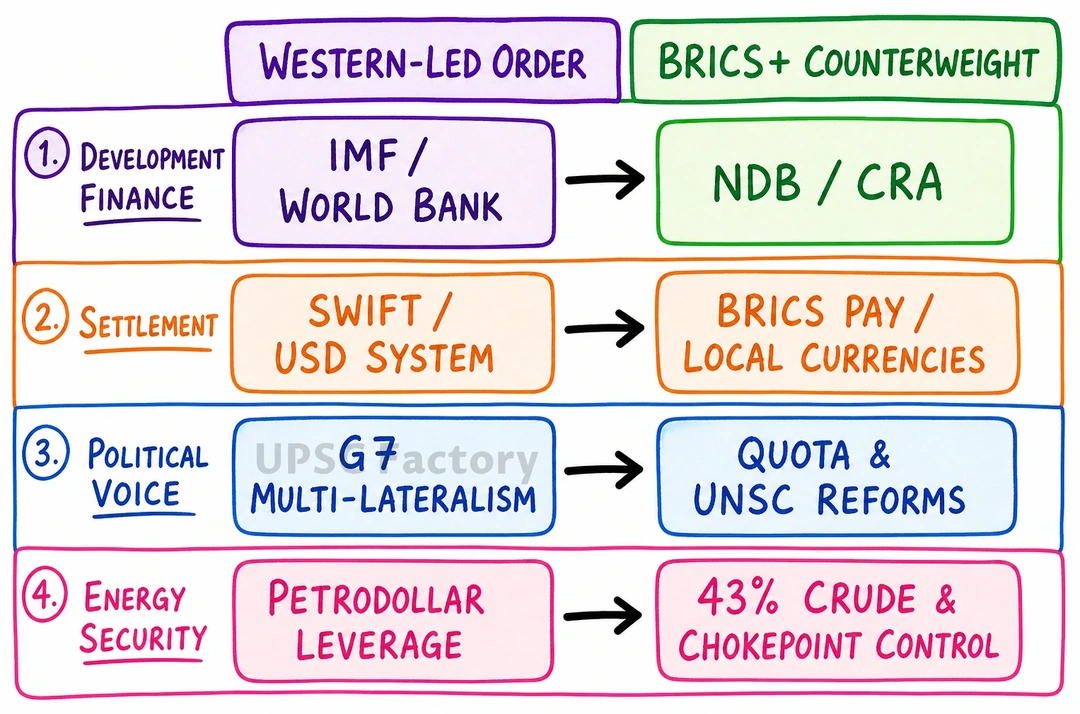
Alternative Financial Architecture: Challenges Bretton Woods conditionalities through the New Development Bank (NDB) and the Contingent Reserve Arrangement (CRA).
De-dollarization & Trade Mechanisms: Facilitates cross-border settlements in local currencies and interoperable payment systems (BRICS Pay), reducing vulnerability to unilateral sanctions (Kazan Declaration 2024).
Reforming Global Governance: Champions democratized multilateralism, demanding quota reforms in the IMF/World Bank and expansion of the UN Security Council.
Geoeconomic Resource Leverage: BRICS+ consolidation aggregates critical energy reserves (~43% of global crude oil) and vital trade choke points (Strait of Hormuz, Suez Canal).
2. Structural Challenges Limiting its Efficacy
Ideological Divergence: Split between an “anti-Western” revisionist stance (China, Russia, Iran) and a “non-Western” multi-alignment approach (India, Brazil, South Africa).
Q. “IPMDA (Indo-Pacific Partnership for Maritime Domain Awareness) bridges the gap between India’s SAGAR (Security and Growth for All in the Region) vision and the Quad’s collective Indo-Pacific strategy.” Make a critical assessment of the statement focusing on IPMDA.
Question from UPSC Mains 2026 GS2 Paper
Model Answer:
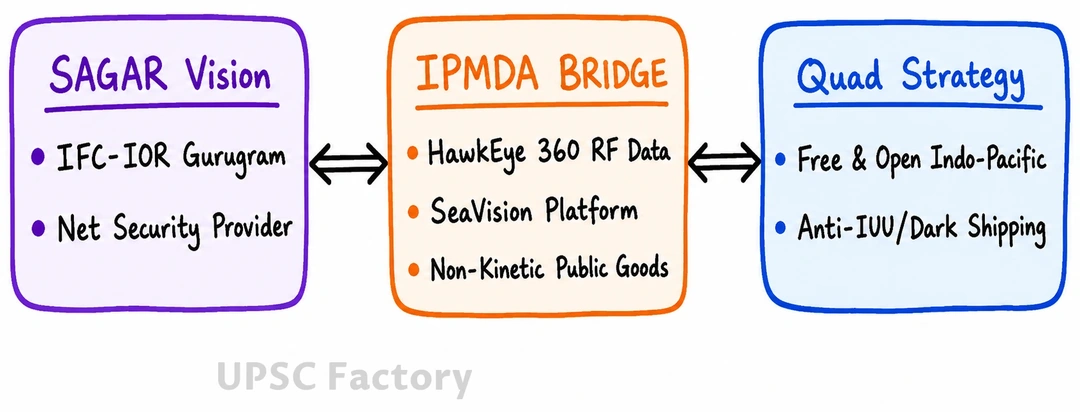
Announced at the 2022 Tokyo Quad Summit, the Indo-Pacific Partnership for Maritime Domain Awareness (IPMDA) harnesses commercial satellite data to enhance shared surveillance, directly operationalizing India’s SAGAR vision within the Quad’s regional architecture.
1. Synergies: Aligning SAGAR with Quad Strategy
Institutional Interoperability: Integrates India’s IFC-IOR (Gurugram) with regional nodes, solidifying India’s position as a preferred security partner.
Non-Traditional Security: Tracks “dark vessels” and IUU fishing via RF satellite tracking (e.g., HawkEye 360), advancing SAGAR’s economic and ecological goals.
Maritime Public Goods: Democratizes low-cost, unclassified situational data (SeaVision platform) to littoral states without forcing strategic alignment.
HADR Integration: Facilitates coordinated, real-time responses to maritime natural disasters and marine ecological hazards.
2. Strategic and Operational Limitations
Enforcement Asymmetry: Detects illicit activities but lacks an integrated kinetic enforcement mechanism for interdiction under international law (UNCLOS Art. 73).
Intelligence Ceilings: Reliance on unclassified, commercial feeds limits its utility against sophisticated, gray-zone military incursions.
Regional Hesitancy: ASEAN centrality concerns and Pacific islanders’ wariness of Quad-led militarization impede comprehensive data-sharing.
IPMDA successfully translates SAGAR’s collaborative ethos into multilateral action; supplementing shared data with littoral capacity-building is vital to securing a free and open Indo-Pacific.
Q. Analyse the advantages and limitations of the generalist structure of the Indian Civil Services in contemporary governance.
Question from UPSC Mains 2026 GS2 Paper
Model Answer:
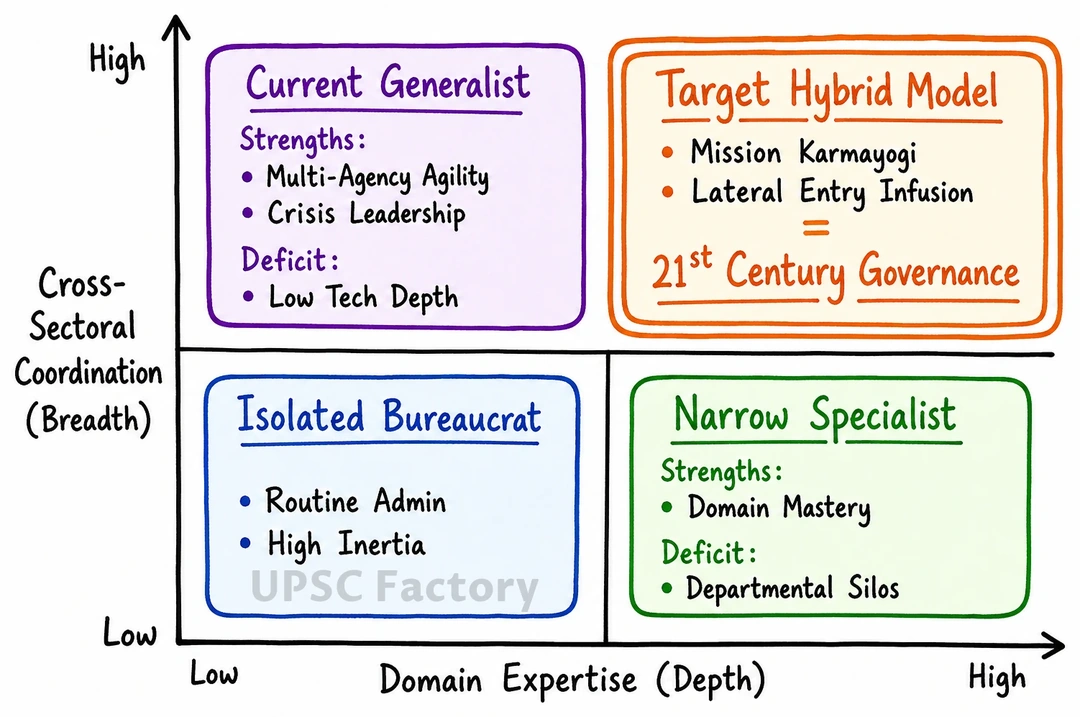
Rooted in Article 312 and colonial administrative design, India’s generalist civil services provide unified, cross-sectoral leadership across diverse socio-economic domains.
Advantages of Generalist Administration
Cross-Sectoral Coordination: Synthesizes multi-departmental mandates, breaking administrative silos and aligning policy implementation across tiers of government.
Crisis Leadership & Adaptability: Displays agility in mobilising multi-agency resources during complex field emergencies (e.g., District Disaster Management).
Democratic Interface: Functions as a neutral, broad-based mediator balancing technical inputs with citizen welfare and socio-political realities.
National Integration: Fosters an all-India administrative ethos, preventing narrow parochialism in state and central policy execution.
Contemporary Limitations
Techno-Managerial Deficits: Lacks deep domain expertise needed for modern regulatory landscapes (e.g., AI governance, green finance, cyber-security).
Tenure Instability: Rapid rotations and short tenures impede subject mastery, weakening long-term institutional memory and accountability.
To navigate modern governance complexities, implementing 2nd ARC recommendations by institutionalizing lateral entry and operationalizing Mission Karmayogi will effectively bridge the generalist-specialist divide.
Q. Malnutrition in India is not merely a public health concern; it is also a challenge of social equity, human development and effective welfare governance. Discuss.
Question from UPSC Mains 2026 GS2 Paper
Model Answer:
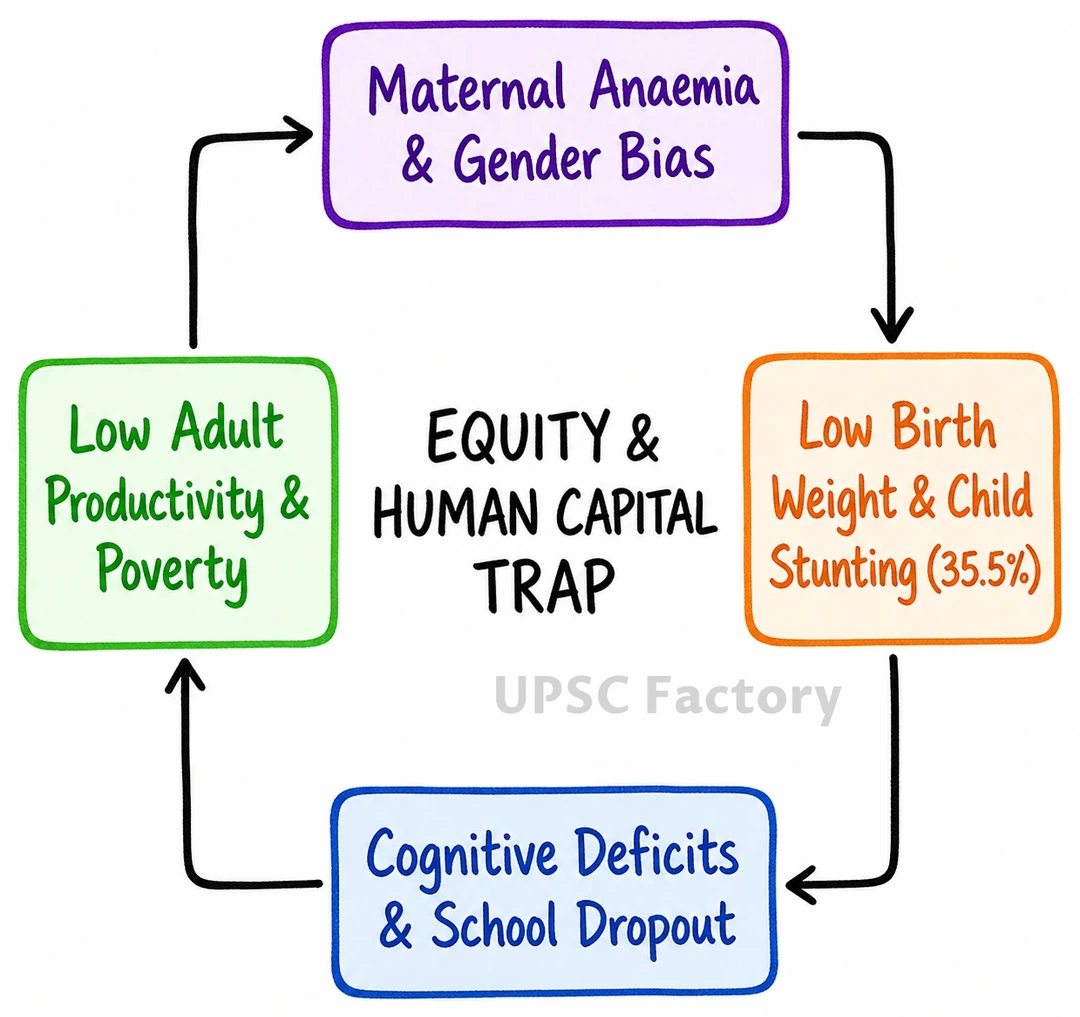
Malnutrition (NFHS-5: 35.5% stunting, 57% women anaemic) violates the constitutional mandate of raising nutrition levels (Article 47), transcending clinical health into a multi-dimensional structural deficit.
Challenge of Social Equity & Human Development
Gender Inequity: Intra-household food discrimination and early childbearing perpetuate an intergenerational cycle of undernutrition.
Marginalized Vulnerability: Higher stunting rates among SC/ST populations reflect structural poverty and socio-economic exclusion.
Human Capital Depletion: Chronic undernutrition causes irreversible cognitive deficits, lowering adult earning capacity and threatening India’s demographic dividend.
Spatial Disparity: Aspirational districts and tribal belts bear an unequal burden due to regional development imbalances.
Welfare Governance Bottlenecks & Reform Needs
Cereal-Centric PDS: Heavy focus on wheat-rice ignores dietary diversity, driving hidden hunger (e.g., Odisha Millets Mission).
Administrative Silos: Lack of convergence between sanitation (Swachh Bharat), drinking water (JJM), and childcare (ICDS).
Data & Monitoring Gaps: Under-utilization of real-time monitoring tools (e.g., Poshan Tracker) hampers localized targeting.
Achieving SDG-2 (Zero Hunger) requires transforming POSHAN 2.0 into a decentralized Jan Andolan, converging welfare delivery with targeted social justice interventions.
Q. Does India’s tribal development policy reflect the aspirations for a socially grounded and equity-based governance? Justify your answer.
Question from UPSC Mains 2026 GS2 Paper
Model Answer:
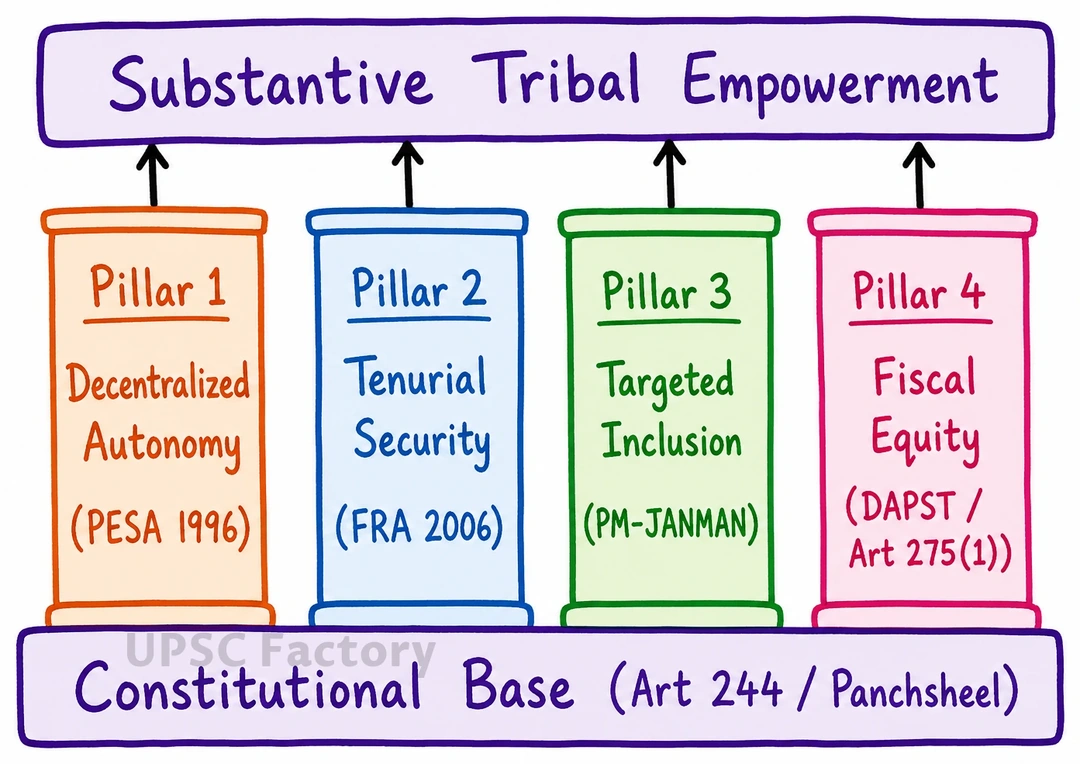
India’s tribal policy has evolved from welfare paternalism to a rights-based framework, operationalizing constitutional safeguards (Articles 244, 275(1)) and Nehru’s Tribal Panchsheel for self-determined, equity-based development.
Alignment with Socially Grounded and Equity-Based Governance
Decentralized Autonomy: Empowers customary self-governance and community-led resource management through statutory grassroots institutions (PESA 1996; Niyamgiri Gram Sabha).
Tenurial Security: Recognizes individual and community forest rights, correcting historical developmental injustices (FRA 2006; Community Forest Resource titles).
Targeted Affirmative Action: Directs saturation-mode socio-economic development toward the most vulnerable groups (PM-JANMAN for PVTGs; Van Dhan Vikas Kendras).
Fiscal Equity: Ensures proportionate resource allocation for socio-economic infrastructure via the Development Action Plan for Scheduled Tribes (DAPST).
Structural Faultlines and Implementation Gaps
Dilution of Consent: Regulatory changes frequently bypass mandatory Gram Sabha concurrence for industrial and conservation diversion (Forest Conservation Amendment Act 2023).
Disproportionate Displacement: Tribes constitute a skewed proportion of project-displaced populations without equitable rehabilitation (Xaxa Committee Report).
Institutional Subversion: Weak functioning of Tribes Advisory Councils (TACs) and bureaucratic paternalism undermine local self-rule.
Achieving substantive equity demands operationalizing Xaxa Committee recommendations by institutionalizing absolute Gram Sabha sovereignty and rights-based, culturally congruent governance.
Q. Do constitutional bodies like the National Commission for Scheduled Castes (NCSC) and the National Commission for Scheduled Tribes (NCST) possess adequate enforcement powers to secure substantive social equality? Suggest measures to enhance their institutional effectiveness.
Question from UPSC Mains 2026 GS2 Paper
Model Answer:
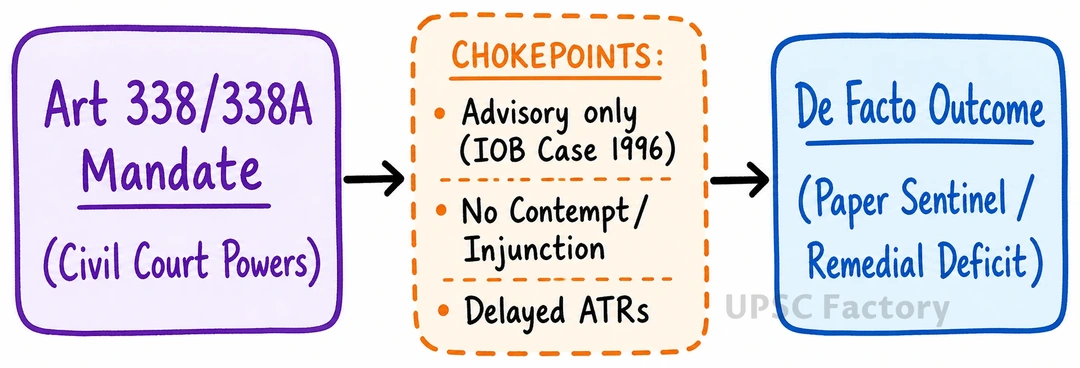
The NCSC (Article 338) and NCST (Article 338A) serve as constitutional sentinels, yet lack binding enforcement mechanisms to secure substantive socio-economic equality.
Advisory Nature: Recommendations lack binding legal force; commissions cannot issue injunctions or direct relief (Indian Overseas Bank Case, 1996).
Constrained Civil Powers: Powers under Articles 338(8)/338A(8) are restricted to summoning and discovery, lacking prosecutorial or contempt authority.
Executive Apathy: Chronic delays in tabling Annual and Action Taken Reports (ATRs) dilute legislative accountability.
Capacity Deficits: Severe budgetary and staffing shortages force reliance on state police machinery for field investigations.
Strategic Measures to Enhance Institutional Effectiveness
Quasi-Judicial Enforcement: Grant limited contempt and execution powers to enforce compliance on atrocities and service safeguards (2nd ARC).
Statutory Deliberation Timelines: Mandate a 3-month statutory ceiling for tabling ATRs in legislatures with obligatory discussion.
Autonomous Investigative Wing: Establish an independent, dedicated cadre of investigators to ensure unbiased fact-finding.
Enforceable Policy Consultation: Operationalize mandatory prior consultation on major policy matters impacting SC/STs (Articles 338(9)/338A(9)).
Transforming NCSC and NCST from advisory bodies into empowered constitutional adjudicators is vital to realizing Dr. B.R. Ambedkar’s vision of substantive social democracy.
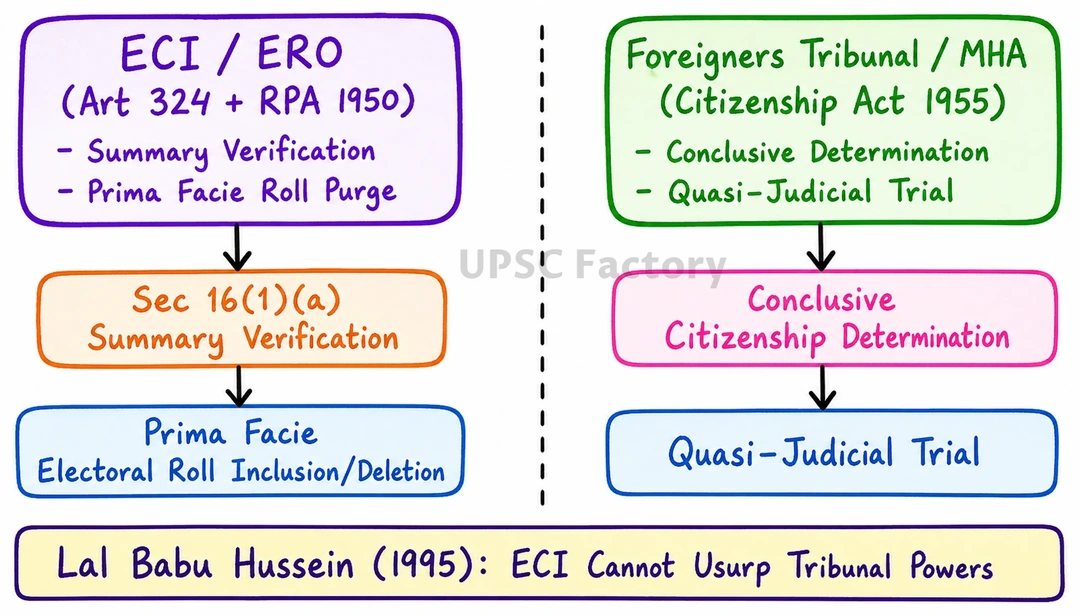
Q. Is the right to vote a fundamental right? Discuss the position of the Election Commission of India while undertaking the revision of electoral rolls. Can it also examine the question of citizenship of voters?
Question from UPSC Mains 2026 GS2 Paper
Model Answer:
The Speaker’s sole adjudicatory authority under the Tenth Schedule has exposed this constitutional office to partisan pressures, undermining legislative impartiality.
Vulnerabilities Under Anti-Defection Regime
Discretionary Delays: Absence of time limits enables selective inertia, often protecting ruling-coalition defectors (Keisham Meghachandra Case, 2020).
Conflict of Interest: Retaining active party links while functioning as a quasi-judicial tribunal breaches procedural neutrality (Kihoto Hollohan, 1992).
Subversion of Mandates: Partisan adjudication facilitates political instability through engineered defections and weaponised resignations (Nabam Rebia Case, 2016).
Institutional Reforms for Neutrality
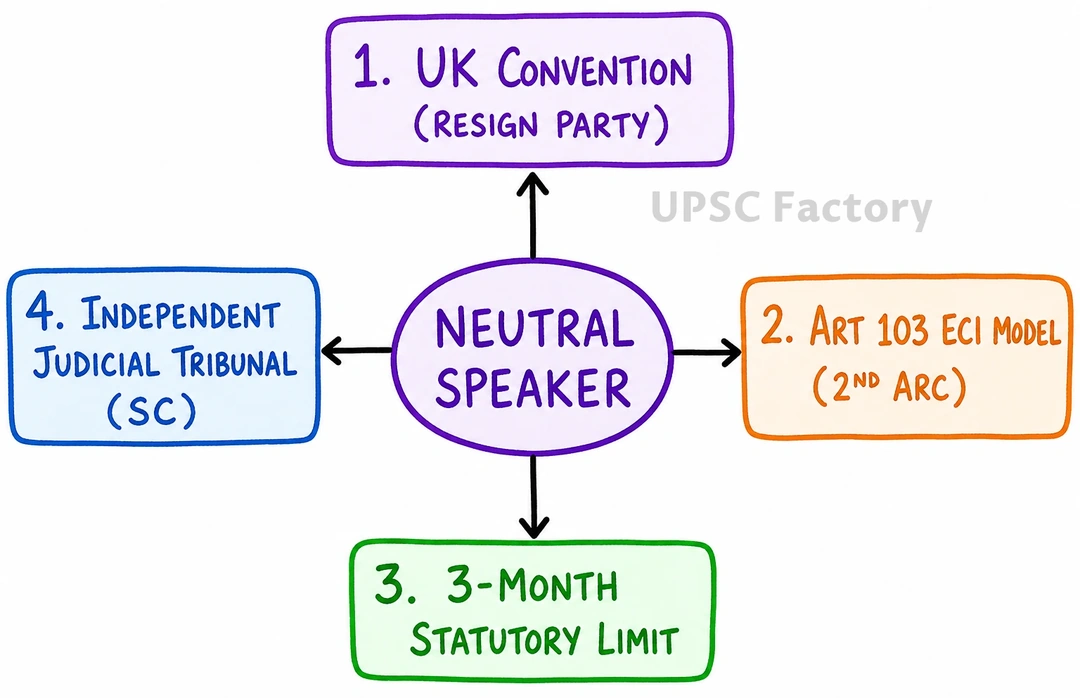
Independent Tribunal: Transfer Tenth Schedule adjudication from the Speaker to an independent tribunal headed by retired judges (Supreme Court recommendation).
ECI-Led Adjudication: Vest disqualification powers in the President acting on binding Election Commission advice (2nd ARC; Law Commission 255th Report).
UK Convention: Adopt the rule of “Once a Speaker, always a Speaker”, requiring formal resignation from political party upon election.
Statutory Timelines: Enforce a strict 3-month outer limit to decide defection petitions.
Depoliticising the Speaker’s adjudicatory role is imperative to uphold constitutional morality and preserve the integrity of a polarised Parliament.
Q. Examine whether the constitutional office of the Lok Sabha Speaker has become vulnerable to partisan politics under the current anti-defection regime. What institutional changes are required to ensure the neutrality of the Lok Sabha Speaker in managing a polarised House?
Question from UPSC Mains 2026 GS2 Paper
Model Answer:
The Speaker’s sole adjudicatory authority under the Tenth Schedule has exposed this constitutional office to partisan pressures, undermining legislative impartiality.
Vulnerabilities Under Anti-Defection Regime
Discretionary Delays: Absence of time limits enables selective inertia, often protecting ruling-coalition defectors (Keisham Meghachandra Case, 2020).
Conflict of Interest: Retaining active party links while functioning as a quasi-judicial tribunal breaches procedural neutrality (Kihoto Hollohan, 1992).
Subversion of Mandates: Partisan adjudication facilitates political instability through engineered defections and weaponised resignations (Nabam Rebia Case, 2016).
Institutional Reforms for Neutrality
Independent Tribunal: Transfer Tenth Schedule adjudication from the Speaker to an independent tribunal headed by retired judges (Supreme Court recommendation).
ECI-Led Adjudication: Vest disqualification powers in the President acting on binding Election Commission advice (2nd ARC; Law Commission 255th Report).
UK Convention: Adopt the rule of “Once a Speaker, always a Speaker”, requiring formal resignation from political party upon election.
Statutory Timelines: Enforce a strict 3-month outer limit to decide defection petitions.
Depoliticising the Speaker’s adjudicatory role is imperative to uphold constitutional morality and preserve the integrity of a polarised Parliament.
Q. “Women as a class neither belong to a minority group nor are they regarded as forming a backward class.” In the light of this statement, discuss the evolution of women’s reservation from local bodies to Parliament.
Question from UPSC Mains 2026 GS2 Paper
Model Answer:
Women constitute a cross-cutting demographic rather than a socio-religious minority, requiring affirmative action grounded in substantive equality (Article 15(3)) rather than compensatory backwardness.
Conceptual Shift: Cross-Cutting Category vs. Backward Class
Universal Intersectionality: Women span all caste, class, and religious divides, requiring horizontal rather than vertical, communal reservation.
Democratic Parity: Focuses on overcoming structural political exclusion to achieve equal citizenship, not socio-economic backwardness alone.
Evolutionary Trajectory: From Grassroots to Parliament
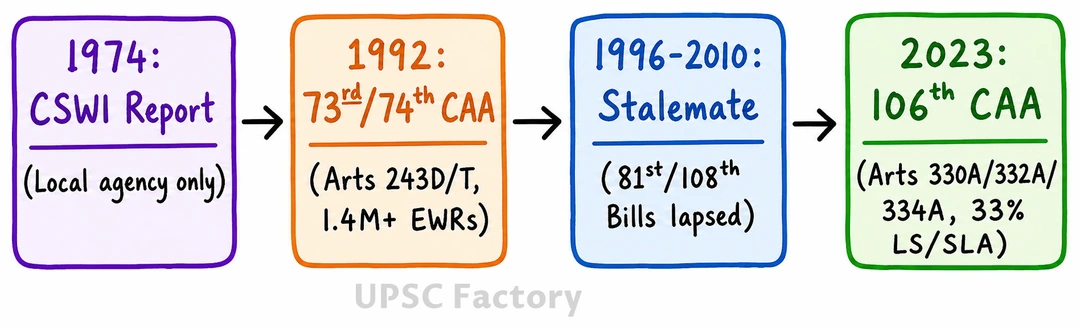
CSWI Report / Towards Equality (1974): Rejected legislative quotas fearing political ghettoisation, but recommended reservation in local bodies to build grassroots agency.
73rd and 74th Constitutional Amendments (1992):
Mandated ≥33% reservation in Panchayats and ULBs (Articles 243D and 243T).
Created over 1.4 million elected women representatives; 21 states expanded this to 50% (e.g., Bihar, 2006).
Decades of Legislative Stalemate (1996–2010): The 81st (1996) and 108th (2008) Amendment Bills lapsed due to demands for sub-quotas (OBC/minority representation).
106th Constitutional Amendment Act (2023):
Enacted the Nari Shakti Vandan Adhiniyam, inserting Articles 330A, 332A, and 334A.
Mandates 33% horizontal reservation in the Lok Sabha and State Legislative Assemblies for 15 years, operational post-delimitation.
Extending quotas from local bodies to Parliament shifts women’s role from grassroots proxy politics (Sarpanch Pati) to direct, institutional national policymaking.
Q. Right to privacy relating to self-identity is very dear to every human being and well protected under Article 21 of the Constitution. In this context, examine the effect of the amendment in 2026, to the Transgender Persons (Protection of Rights) Act, 2019.
Question from UPSC Mains 2026 GS2 Paper
Model Answer:
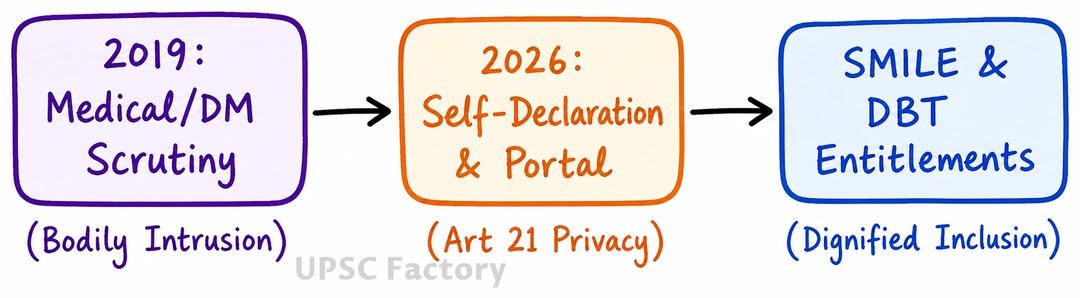
In NALSA v. UOI (2014) and K.S. Puttaswamy (2017), the Supreme Court anchored gender self-determination and bodily autonomy within the fundamental right to privacy under Article 21.
Alignment with Article 21 and Privacy Rights
Elimination of Invasive Gatekeeping: Abolishes mandatory surgical/medical certificates to affirm identity, securing bodily integrity and dignity (NALSA mandate).
Self-Determined Identification: Decouples identity recognition from discretionary District Magistrate scrutiny, institutionalizing self-declaration (Article 21).
Enhanced Informational Privacy: Mandates strict confidentiality of transition records on administrative platforms (National Portal for Transgender Persons).
Direct Welfare Convergence: Facilitates seamless linkage to socio-economic entitlements without intrusive verification barriers (SMILE Scheme).
Residual Challenges in Implementation
Binary Civil Laws: Substantive rights regarding marriage, adoption, and succession remain largely unharmonized with non-binary identities.
Bureaucratic & Digital Barriers: Ground-level administrative inertia and digital literacy deficits persist among marginalized rural transgender persons.
Way Forward
Comprehensive Legal Harmonization: Amend personal laws to ensure gender-neutral civil rights in succession and family law.
Institutional Sensitization: Conduct mandatory human rights and gender-affirmative training for local administration and law enforcement.
The 2026 amendment reinforces constitutional morality by safeguarding self-identity; however, realizing substantive equality requires comprehensive civil law reforms and widespread administrative sensitization.