2025 Sociology Paper 1

Q. How do theories of Marx, Weber and Durkheim differ in understanding religion? Explain.

Q. How do theories of Marx, Weber and Durkheim differ in understanding religion? Explain.

UPSC Sociology 2025 Paper 1

Model Answer:

Classical sociology analyzes religion’s distinct societal impact. Karl Marx, Max Weber, and Emile Durkheim offer contrasting comparative lenses, analyzing it through economic conflict, interpretive social action, and functional integration, respectively.

Diverging Perspectives on Religion

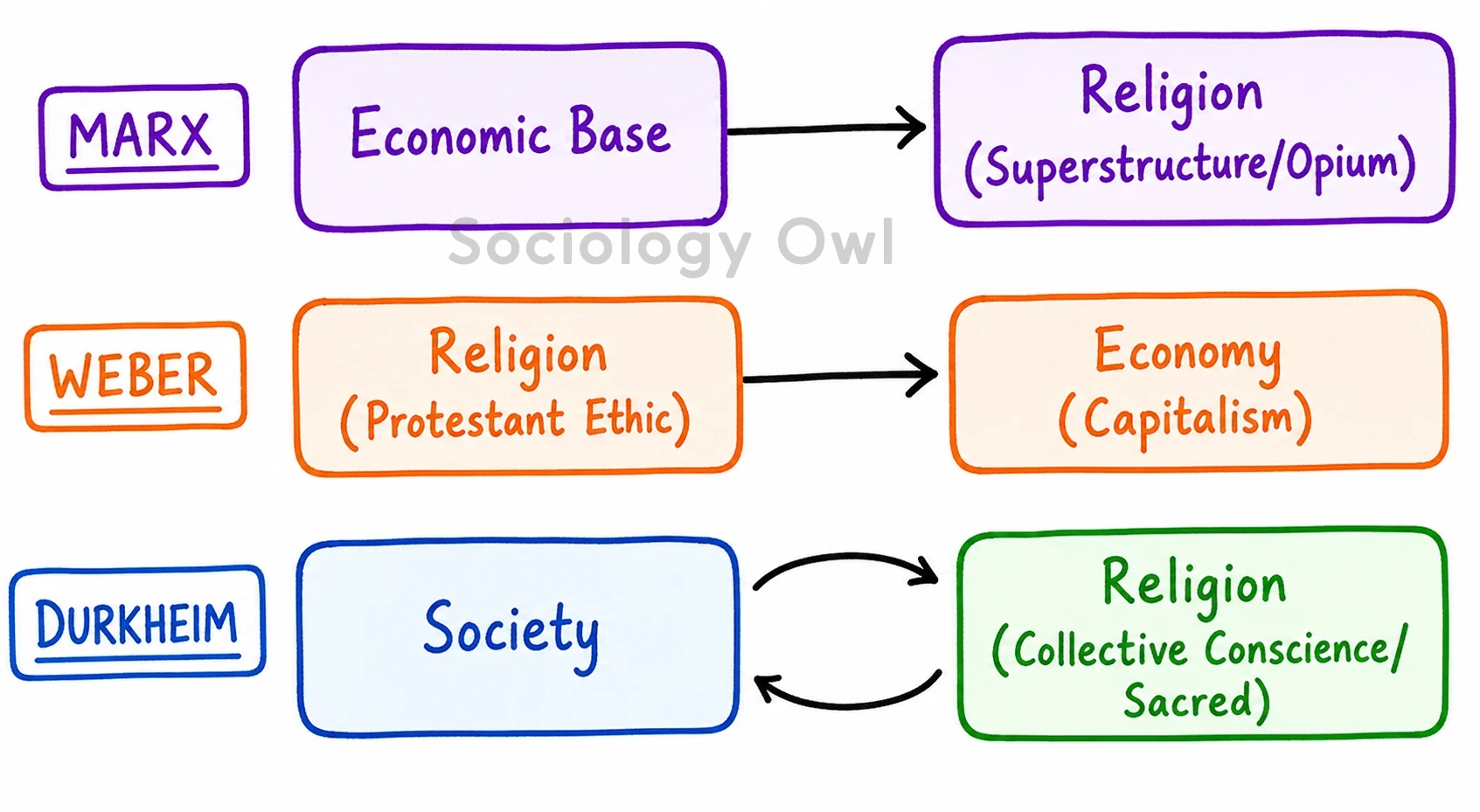
  • Karl Marx (Conflict Perspective): Viewed religion as an ideological superstructure rooted in economic Alienation (“the sigh of the oppressed”). As the “Opium of the Masses,” it generates False Consciousness to legitimize exploitation, predicting its eventual withering away under communism.
  • Max Weber (Interpretive Perspective): Challenged Marxist determinism, arguing religion independently catalyzes economic change. In The Protestant Ethic and the Spirit of Capitalism, he demonstrated an Elective Affinity between Calvinist asceticism and capitalism. While offering a Theodicy of Disprivilege, religion faces inevitable secularization via Disenchantment.
  • Emile Durkheim (Functionalist Perspective): Located religion’s origin in society itself. In The Elementary Forms of Religious Life, he conceptualized religion via the Sacred and Profane dichotomy, arguing it unites followers into a Moral Community (Church) and reinforces the Collective Conscience.
Critiques and Counter-Perspectives

  • Critique of Marx: Liberation Theology in Latin America proves religion can inspire proletarian revolution, aligning with Antonio Gramsci‘s view of counter-hegemony.
  • Critique of Weber: R.H. Tawney reversed the causal arrow, arguing that material forces and early capitalism predated Protestantism.
  • Critique of Durkheim: His functionalism struggles to explain communal conflict and polarization in multi-religious modern societies.
  • Marxian Application: The Prosperity Gospel in global megachurches validates wealth, serving ruling-class economic interests.
  • Weberian Application: The rapid spread of Pentecostalism in the Global South actively promotes upward mobility and a modern capitalist ethic.
  • Durkheimian Application: Robert Bellah’s concept of “Civil Religion” explains how secular rituals (nationalistic parades) replace declining traditional faith to ensure social solidarity.

Conclusion

Ultimately, these classical theories are not mutually exclusive but complementary. Today, religion acts simultaneously as a site of political hegemony, a driver of globalized economic networks, and a vital anchor for identity in increasingly fragmented modern societies.
Q. How do theories of Marx, Weber and Durkheim differ in understanding religion? Explain. Read More »

Q. Can Merton’s reference group theory be relevant in understanding ‘identity making’ in digital world? Explain.

Q. Can Merton’s reference group theory be relevant in understanding ‘identity making’ in digital world? Explain.

UPSC Sociology 2025 Paper 1

Model Answer:

Merton’s Reference Group Theory and Digital Identity Formation

Coined by Herbert Hyman and developed by Robert K. Merton, Reference Group Theory explains self-concept evaluation. Today, digital identity-making is a fluid negotiation against online reference groups.

Comparative Function & Relative Deprivation

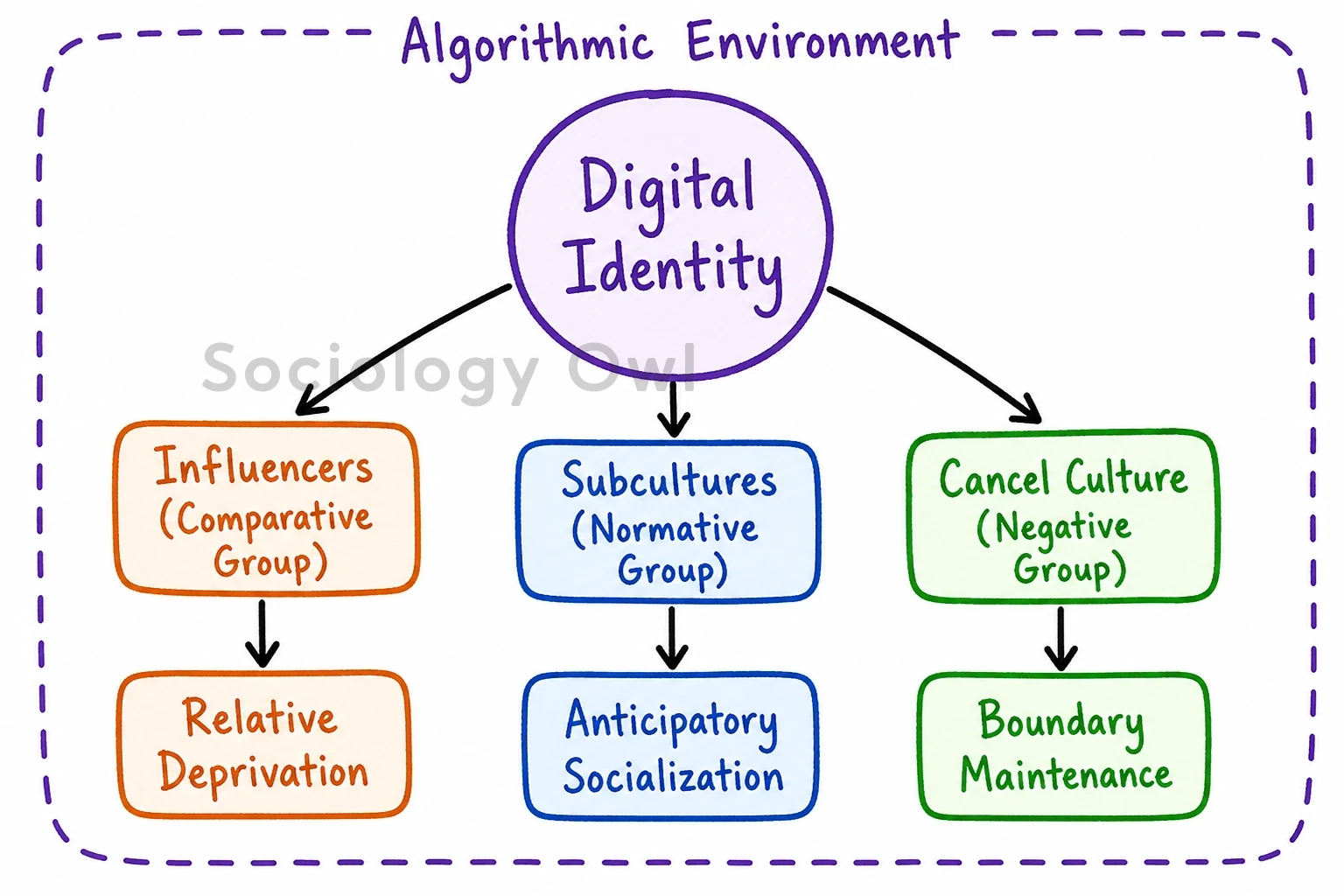
Users compare themselves to curated influencer lifestyles, breeding status anxiety (Relative Deprivation) and shaping the digital looking-glass self (Charles Cooley).

Normative & Negative Groups

Online subcultures dictate behavioral norms. Conversely, Negative Reference Groups solidify identity through active opposition, visible in digital “cancel culture.”

Anticipatory Socialization

Users adopt the language of desired groups, like mirroring industry leaders on LinkedIn, utilizing “front stage” impression management (Erving Goffman).

Merton assumed individuals choose their reference groups. Today, algorithms dictate these groups, creating “echo chambers.” Furthermore, digital identities remain transient, reflecting Zygmunt Bauman’s Liquid Modernity, often built on superficial parasocial relationships rather than substantive community ties.

Conclusion

Despite its pre-digital origins, Merton’s structural framework successfully decodes the complex pathways of aspiration, validation, and comparison that drive modern digital identity construction.

Q. Can Merton’s reference group theory be relevant in understanding ‘identity making’ in digital world? Explain. Read More »

Q. What is common sense? How are common knowledge and sociology related to each other? Explain.

Q. What is common sense? How are common knowledge and sociology related to each other? Explain.

UPSC Sociology 2025 Paper 1

Model Answer:

Common sense is the routine, “taken-for-granted reality” navigating daily life. Antonio Gramsci viewed it as fragmented wisdom often reflecting ruling-class ideological hegemony.

Sociology Transcending Common Sense

Positivist and critical traditions argue sociology systematically debunks uncritical everyday knowledge:

  • Emile Durkheim challenged individualistic common-sense views in Suicide, proving its structural, social roots.
  • C. Wright Mills utilized the Sociological Imagination to elevate isolated “personal troubles” into structural “public issues.”

Sociology Relying on Common Sense

Interpretivists treat everyday knowledge not as an error, but as essential subject matter:

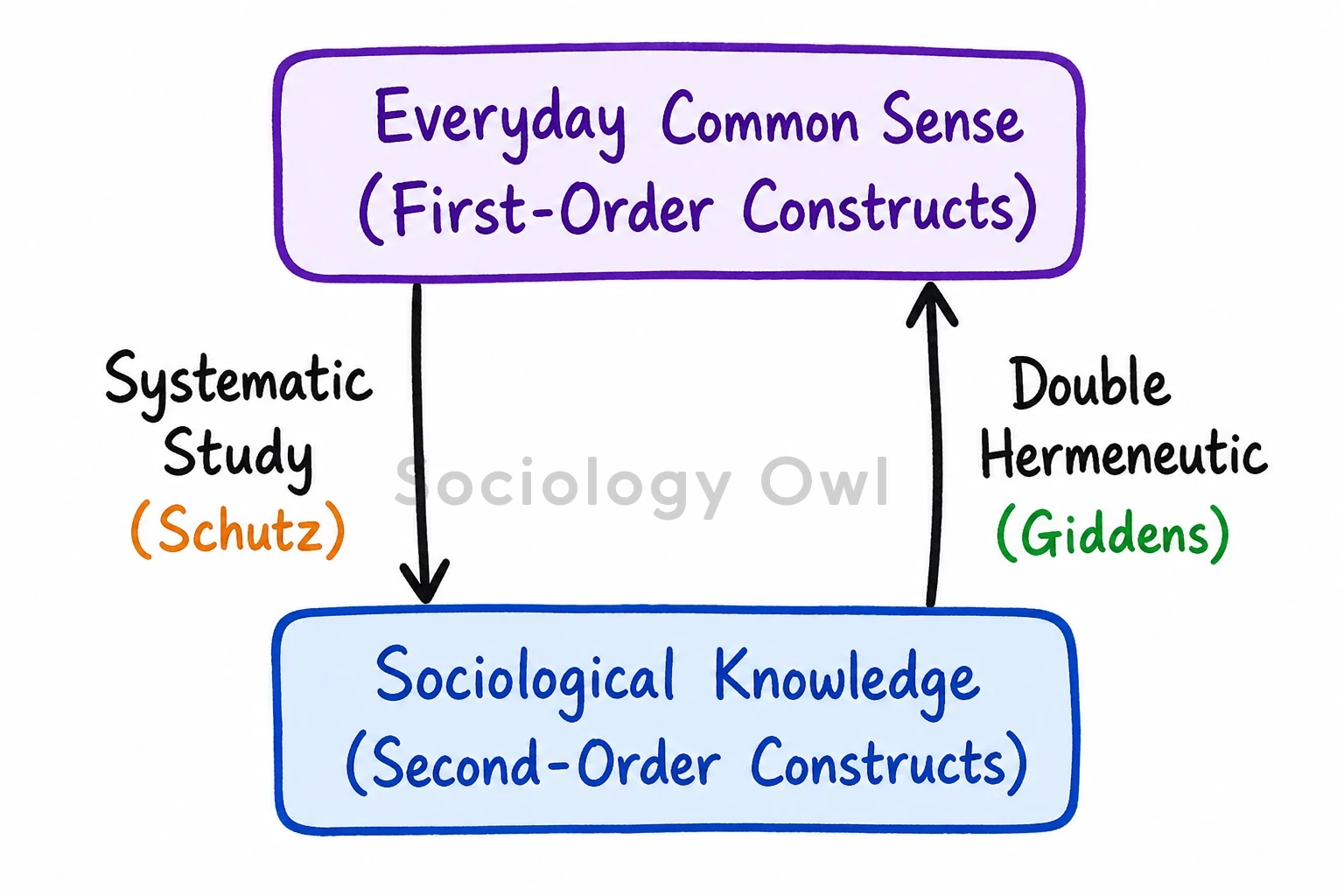
  • Alfred Schutz argued individuals use “first-order constructs” (common sense), which sociologists systematically organize into “second-order constructs.”
  • Harold Garfinkel‘s Ethnomethodology studies the practical methods people use to actively construct and maintain everyday common sense.

While common sense often labels gig-economy drivers as “flexible independent freelancers,” sociological analysis reveals hidden structures of algorithmic control and economic precarity.

common sense

Conclusion

The relationship is dialectical. Through Anthony Giddens‘ concept of the Double Hermeneutic, sociological discoveries (e.g., “patriarchy” or “introversion”) continuously filter back into society, evolving into tomorrow’s common sense.

Q. What is common sense? How are common knowledge and sociology related to each other? Explain. Read More »

Q. What is positivism? Critically analyze the major arguments against it.

Q. What is positivism? Critically analyze the major arguments against it.

UPSC Sociology 2025 Paper 1

Model Answer:

Positivism, rooted in Enlightenment rationality and pioneered by Auguste Comte, asserts that sociology must adopt natural science methods to discover universal laws of human behavior. Emile Durkheim operationalized this by advocating treating “social facts as things” in The Rules of Sociological Method, establishing an objective, empirical basis for sociology.

Critiques of Positivism

Ontological and Epistemological Critiques:

  • Neglect of Subjective Meaning: Max Weber argued humans possess consciousness and agency. His interpretivist approach emphasizes Verstehen (empathetic understanding) to grasp internal motivations, contrasting with natural matter that merely reacts.
  • Reflexivity: Anthony Giddens formulated the Double Hermeneutic. Unlike natural objects, humans interpret sociological theories and alter their behavior accordingly, rendering law-like prediction impossible.
  • Scientific Fallibility: Karl Popper rejected positivist verification in favor of Falsification. Furthermore, Thomas Kuhn demonstrated through Paradigm Shifts that science itself is a socially constructed, subjective enterprise rather than purely objective.

Axiological and Structural Critiques:

  • Myth of Value-Neutrality: Alvin Gouldner argued complete objectivity is impossible. During the Positivist Dispute, the Frankfurt School (Jurgen Habermas) argued that positivism legitimizes the oppressive status quo by masking structural inequalities as “value-neutral” facts.
  • Reductionism: Phenomenologists like Alfred Schutz argue positivism reduces inter-subjective social realities into mechanical variables. Interpretivists argue this necessitates Clifford Geertz’s “Thick Description” to capture cultural depth.

Postivism
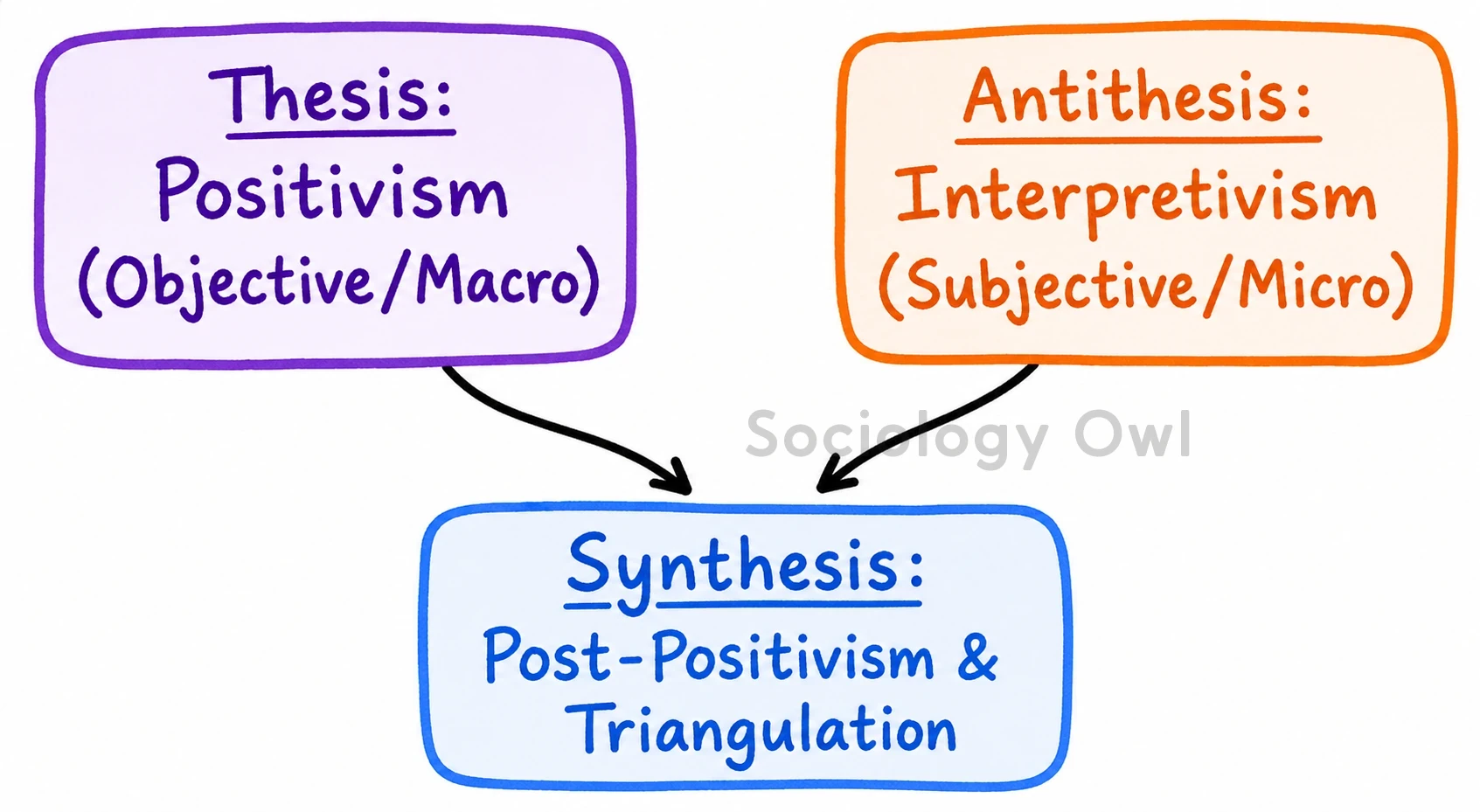
Critical Evaluation of the Anti-Positivist Critiques: Extreme anti-positivism or postmodernism risks radical relativism—if no objective truth exists, sociological policy-making becomes impossible. Consequently, sociology has shifted toward Post-Positivism (e.g., Roy Bhaskar’s Critical Realism), which accepts that while absolute objectivity is unattainable, rigorous empirical observation remains vital when conducted with reflexivity.

Contemporary Relevance: Today’s reliance on Big Data and algorithmic governance represents modern hyper-positivism. However, predictive AI in criminal justice often reproduces structural biases (racism, classism). This proves that quantitative data lacking contextual Verstehen fails to capture complex human realities.

Conclusion

The historical hostility between positivism and its critics has matured into methodological pluralism. Modern sociologists embrace Alan Bryman’s concept of Triangulation, synergizing quantitative and qualitative methods to comprehensively capture both macro-structural patterns and micro-level human experiences.

Q. What is positivism? Critically analyze the major arguments against it. Read More »

Q. Highlight the main features of historical materialism as propounded by Marx. How far is this theory relevant in understanding contemporary societies? Explain.

Q. Highlight the main features of historical materialism as propounded by Marx. How far is this theory relevant in understanding contemporary societies? Explain.

UPSC Sociology 2025 Paper 1

Model Answer:

Historical Materialism, the cornerstone of Karl Marx’s sociological thought, posits that material and economic conditions are the primary drivers of societal evolution. Marx constructed this methodology by inverting Georg Hegel’s dialectics (replacing idealism with materialism) and integrating Ludwig Feuerbach’s materialism.

Main Features of Historical Materialism

  • Base-Superstructure Model: The economic base, comprising the Forces of Production (FOP) and Relations of Production (ROP), determines the ideological superstructure (politics, law, religion). As Marx wrote in A Contribution to the Critique of Political Economy, “social existence determines consciousness.”
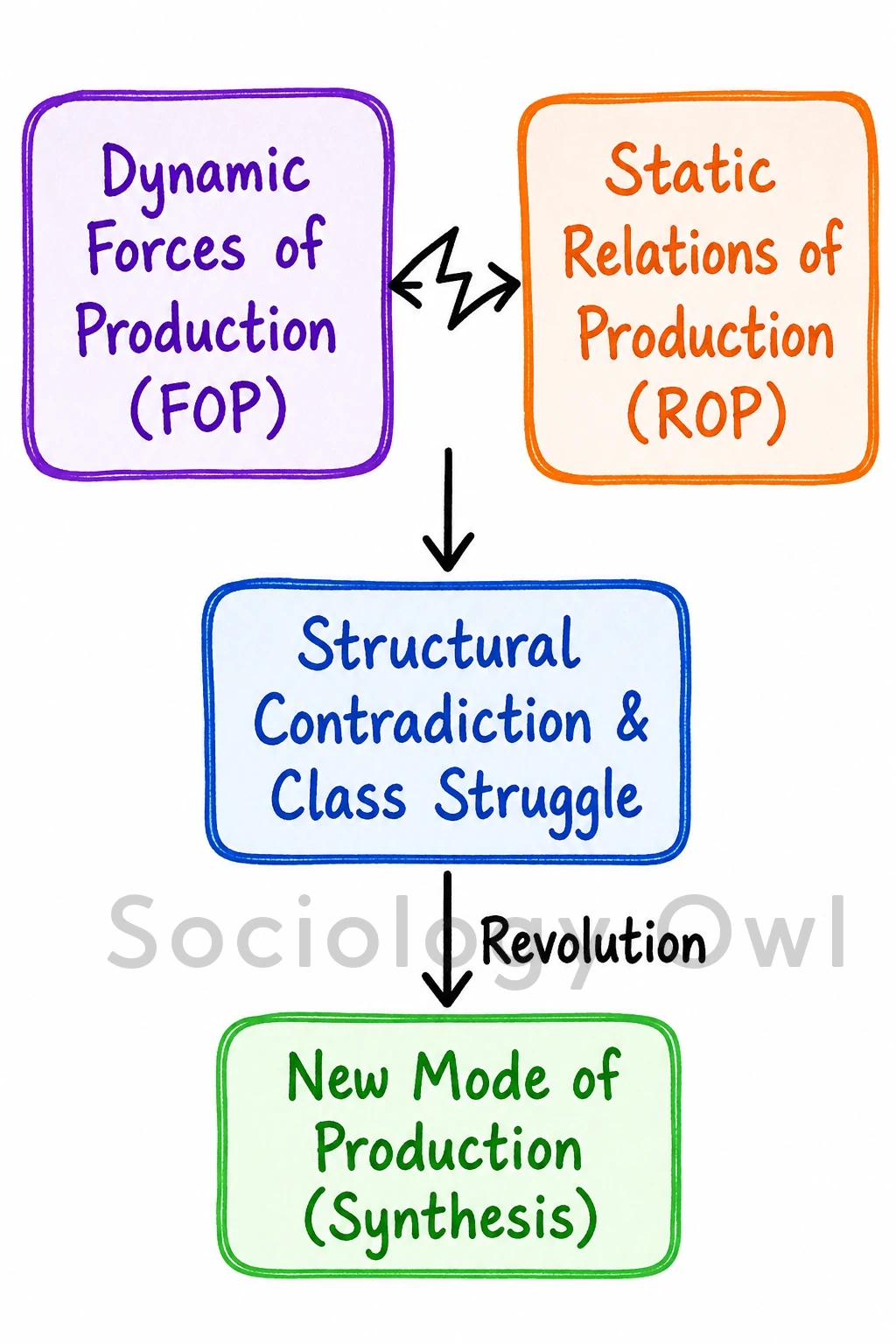
  • Dialectical Contradiction: Historical change occurs when dynamic FOP (technology, labor methods) outgrow static ROP (property and class laws). This structural contradiction generates class struggle, culminating in revolutionary transformation.
    Karl Marx
  • Evolutionary Stages: History progresses through distinct modes of production driven by class antagonism: Primitive Communism → Ancient Mode (Slavery) → Feudalism → Capitalism → Socialism/Communism.

Contemporary Relevance

  • Global Capitalism: Immanuel Wallerstein’s World Systems Theory validates Marx globally, explaining neocolonial exploitation where Core nations extract surplus from the Periphery. Contemporary Oxfam reports on wealth concentration echo Marx’s capital accumulation thesis.
  • Ideological Control: Antonio Gramsci’s Cultural Hegemony and Louis Althusser’s Ideological State Apparatus explain how modern capitalism survives not just by economic force, but by manufacturing consent through media and algorithms.
  • Worker Alienation: Gig economy precarity highlights ongoing worker commodification and Alienation.
  • Limitations and Critiques: Herbert Marcuse (Frankfurt School) noted that capitalism pacified the working class by creating “false needs” through consumerism. Ralf Dahrendorf criticized Marx for missing the “decomposition of capital”—the rise of a salaried middle class and institutionalized union conflict. Furthermore, feminists like Heidi Hartmann argue the theory is “sex-blind,” ignoring patriarchy’s independent structural force.

Conclusion

While strict Economic Determinism is challenged today, Historical Materialism remains an indispensable analytical tool. Adapted by Neo-Marxists, it continues to anchor critical sociology and environmental sociology, notably utilizing concepts like the “Metabolic Rift” to critique capitalist-driven ecological crises.

Q. Highlight the main features of historical materialism as propounded by Marx. How far is this theory relevant in understanding contemporary societies? Explain. Read More »

Q. What do you understand by gender-based domestic division of labour? Is it undergoing a change in the wake of increasing participation of women in formal employment? Clarify your answer with illustrations.

Q. What do you understand by gender-based domestic division of labour? Is it undergoing a change in the wake of increasing participation of women in formal employment? Clarify your answer with illustrations.

UPSC Sociology 2025 Paper 1

Model Answer:

Gender-based domestic division of labour refers to the socially constructed allocation of unpaid household work based on sex. This system traditionally assigns women to the private sphere for routine, repetitive tasks like cooking, cleaning, and childcare (what Talcott Parsons termed “expressive roles”), while men occupy the public sphere of paid work (“instrumental roles”). Ann Oakley demonstrated this division is not natural but a social construct that institutionalizes women’s economic dependence and perpetuates gender inequality.

Changes with Women’s Formal Employment

The ‘Dual Burden’ Phenomenon:
Rather than equitable redistribution, women’s employment has created what Arlie Hochschild calls the “second shift.” Women now shoulder dual responsibilities—paid work plus domestic labour. Their entry into the public sphere hasn’t been matched by men’s equivalent participation in the private sphere.

– Illustration: A female software engineer works 10-hour days but returns home to manage cooking, children’s homework, and household planning, while her husband enjoys leisure time after work.

Limited Male Participation:
Urban, educated dual-earner households show marginal increases in male involvement, particularly in childcare and weekend tasks. However, this participation remains peripheral rather than fundamental.

– Illustration: Husbands may help with weekend grocery shopping or playing with children, but daily time-intensive responsibilities—meal preparation, cleaning, emotional labour—remain predominantly women’s domain.

Class-Based Outsourcing:
Affluent families increasingly outsource domestic work to paid help, resolving couple conflicts without challenging gendered assumptions. This creates new intersections of class and gender inequality, as domestic work management still remains women’s responsibility.

– Example: Upper-middle-class working women supervise domestic workers, plan meals, and coordinate household schedules, perpetuating their role as household managers.

Conclusion:

While women’s workforce participation has initiated conversations about domestic equality, fundamental transformation remains elusive. The patriarchal ideology underlying domestic division adapts to economic realities rather than being dismantled, resulting in role-conflict and the persistence of gender inequality within households.

Q. What do you understand by gender-based domestic division of labour? Is it undergoing a change in the wake of increasing participation of women in formal employment? Clarify your answer with illustrations. Read More »

Q. In what way is the scope of sociology unique? Explain.

Q. In what way is the scope of sociology unique? Explain.

UPSC Sociology 2025 Paper 1

Model Answer:

Sociology’s distinctiveness lies not merely in studying society but in its holistic perspective, relational focus, and ability to connect different levels of social reality.

Holistic and Synthesizing Approach

Unlike other social sciences focusing on specific domains, sociology examines society in its entirety:

• Economics studies markets while Political Science examines power, but sociology synthesizes all social dimensions.
• Auguste Comte envisioned it as the “queen of sciences,” integrating knowledge across disciplines.
• When studying poverty, sociology examines economic factors alongside caste, gender, education, and family structures, providing comprehensive analysis.

Focus on Social Facts and Relationships

Sociology uniquely emphasizes social structures over individual behavior:

• Emile Durkheim’s ‘social facts’ concept identifies phenomena external to individuals yet shaping their actions.
• His suicide study revealed how this personal act is influenced by social forces like integration and regulation.
• This collective focus distinguishes sociology from psychology’s individual-centered approach.

Bridging Micro-Macro Divide

C. Wright Mills’ ‘sociological imagination’ captures sociology’s unique analytical capability:

• It connects “personal troubles” (individual unemployment) with “public issues” (economic recession).
• This framework links micro-level individual agency with macro-level social structures.
• This perspective distinguishes sociology from history’s event-specific focus and psychology’s individual emphasis.

Conclusion:

Sociology’s scope is unique due to its holistic viewpoint, emphasis on social structures, and powerful framework connecting individual experiences to broader social transformations.

Q. In what way is the scope of sociology unique? Explain. Read More »

Q. What is the relationship (similarities and differences) between sociology and history in terms of their area of study and methodology? Discuss.

Q. What is the relationship (similarities and differences) between sociology and history in terms of their area of study and methodology? Discuss.

UPSC Sociology 2025 Paper 1

Model Answer:

Relationship Between Sociology and History

Sociology and history are deeply intertwined disciplines studying human social life. As G.E. Howard noted, “History is past Sociology, and Sociology is present History,” highlighting their complementary nature.

Similarities and Interdependence

Area of Study:
• Both examine human society, social institutions, and transformations
• Study social processes like revolutions, modernization, and social movements
• C. Wright Mills’ “Sociological Imagination” explicitly links personal biographies with historical context

Methodological Overlap:
• Both use comparative analysis and documentary research
• History provides empirical data for sociological analysis (e.g., studying caste system requires historical texts)
• Sociology offers theoretical frameworks for historical interpretation (e.g., Weber’s concepts of authority to analyze Mughal empire)

Key Differences

Focus and Approach:
• History: Idiographic – describes unique, particular events (specific causes of French Revolution)
• Sociology: Nomothetic – establishes general laws and patterns (general causes of revolutions)

Methodology:
• History: Primarily analyzes primary sources, archives, manuscripts for chronological reconstruction
• Sociology: Employs surveys, interviews, participant observation, statistical analysis for contemporary study

Time Orientation:
• History: Past-oriented, concerned with chronological narration
• Sociology: Present-oriented, studying contemporary structures while using historical context for deeper understanding

This interdependence makes both disciplines essential for comprehensive social understanding.

Q. What is the relationship (similarities and differences) between sociology and history in terms of their area of study and methodology? Discuss. Read More »