
2025 Sociology Paper 1
Q. What is the nature of relationship between science and religion in modern society? Analyze with suitable examples.
Model Answer:
Introduction
Science (Karl Popper’s focus on empiricism) and religion (Emile Durkheim’s focus on the sacred) interact not as a zero-sum game, but through a complex modern spectrum.
Conflict and Coexistence
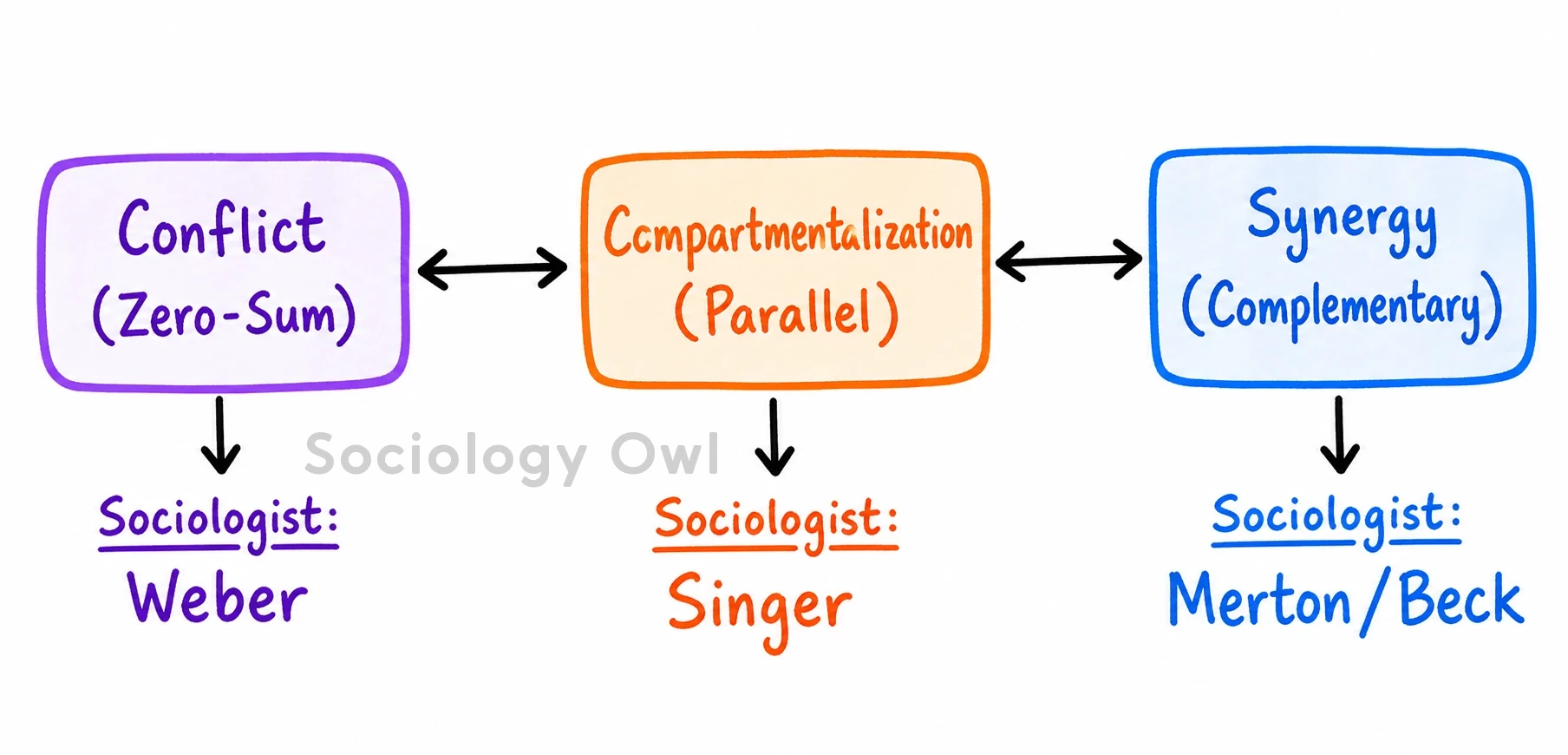
Disenchantment: Max Weber argued scientific rationality would inevitably replace faith, causing a “disenchantment of the world.”
Conflict: This friction remains visible in evolution-creationism debates and bioethical disputes (e.g., stem-cell research).
Dual Needs: Bronislaw Malinowski noted that humans inherently require both practical science and religious comfort.
Compartmentalization: Milton Singer explains how modern individuals separate cognitive domains. For instance, ISRO scientists seamlessly perform traditional religious rituals before deploying advanced space technology.
Synergy and Risk: Robert Merton noted historical synergies (Puritan Ethos). Today, Ulrich Beck argues that science-induced crises (“Risk Society”) trigger religious revivalism as people seek secure anchors.
Global Example: Pope Francis’s encyclical Laudato Si successfully integrates climate science with theological moral stewardship.
Conclusion
Science and religion remain complementary frameworks in modern society. While science explains the empirical ‘how’ of the universe, religion continues to provide the existential ‘why’ and fundamental moral anchoring.
Q. Does the structural-functionalist perspective on social stratification promote a status quo? Give reasons for your answer.
Model Answer:
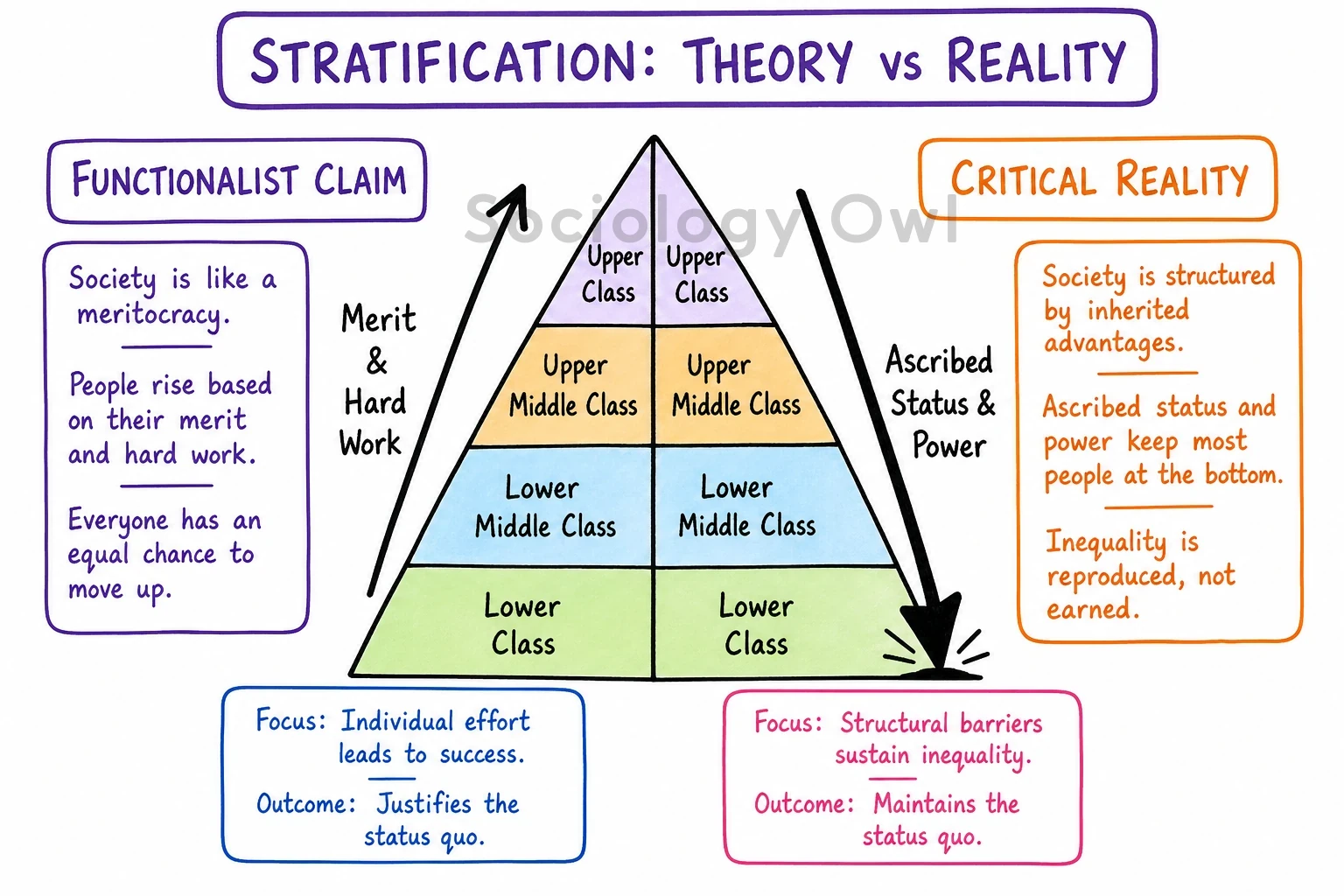
The Davis-Moore thesis (structural-functionalism) posits that stratification is a universal necessity to fill critical societal roles via differential rewards. Critics, however, argue it functions as a conservative ideology promoting the status quo.
Mechanisms Defending the Status Quo
- Value Consensus: Talcott Parsons argues stratification reflects shared societal values, naturally legitimizing existing elite dominance.
- “Myth of Meritocracy”: Michael Young and Melvin Tumin argue functionalism ignores ascribed statuses—like inherited wealth or India’s traditional Caste System—falsely assuming equal opportunity.
- Ideological Shield: Marxists dismiss functionalism as a “bourgeois ideology” manufacturing “false consciousness” to mask exploitation.
Functionalist logic is often weaponized to justify extreme wealth concentration (e.g., tech billionaires in the Oxfam Inequality Report) as mere rewards for “functional importance,” deliberately ignoring structural monopolies.
Conclusion
As Alvin Gouldner critiqued, while functionalism highlights motivational needs in complex societies, its blindness to power dynamics and unequal starting lines makes it an apologist tool perpetuating existing hierarchies.
Q. What is hypothesis? Critically evaluate the significance of hypothesis in social research.
Model Answer:
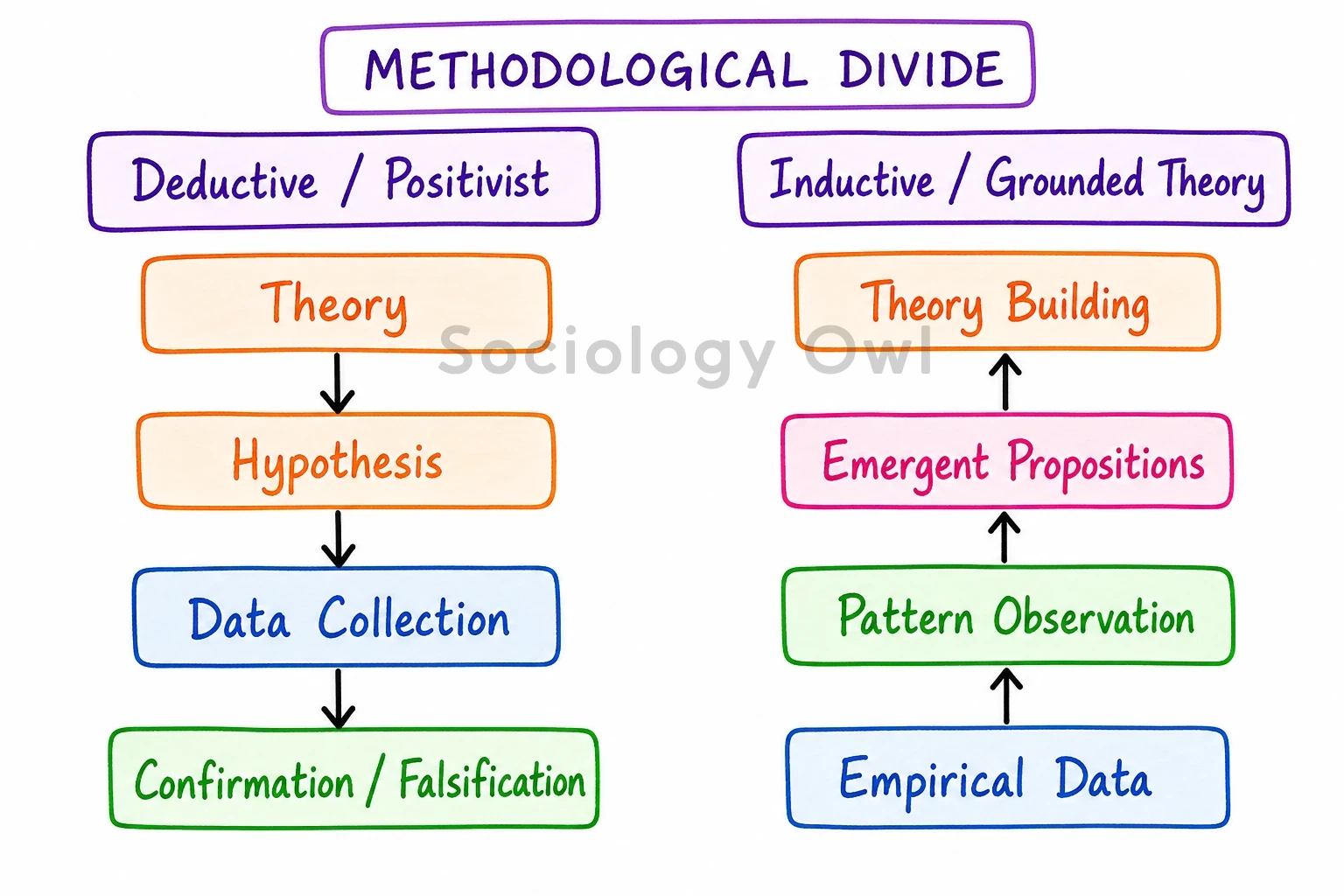
A hypothesis is a tentative, testable proposition linking variables. Goode and Hatt define it as a proposition tested for validity. Rooted in deductive logic, Karl Popper emphasizes its scientific value lies in falsifiability (testing the Null Hypothesis).
Significance of Hypothesis
- Methodological Rigor: It guides precise data collection, prevents irrelevant data accumulation, and ensures objectivity in positivist research.
- Theory Building: It bridges abstract theory and empirical reality. Robert K. Merton notes that testing hypotheses often reveals a “Serendipity Pattern”—anomalous, strategic data that sparks new theories.
Critical Evaluation
- Methodological Imposition: Max Weber (Verstehen) and Feminist scholars argue pre-formulated hypotheses impose rigid, top-down frameworks, obscuring subjective lived meanings.
- Inductive Preference: Glaser and Strauss (Grounded Theory) prefer generating propositions directly from data rather than pre-testing them, avoiding “self-fulfilling” researcher bias.
Today, researchers empirically test modern hypotheses to validate classical theories, such as testing the Marxist premise: “Participation in the global gig economy increases worker alienation.”
Conclusion
While hypotheses drive deductive-positivist research, sociology’s methodological pluralism demands combining them with inductive approaches to truly capture dynamic human complexities.
Q. Critically analyze the sociological significance of informal sector in the economy of developing societies.
Model Answer:
The Informal Sector
Coined by Keith Hart, the informal sector encompasses unregulated, untaxed economic activities. In developing societies, it presents a profound sociological paradox: functioning as a survival mechanism while institutionalizing precarity.
Safety Valve and Grassroots Dynamism
- Functionalist View: It acts as an economic buffer, absorbing surplus rural migrants and integrating them into urban spaces via kinship and caste networks.
- Legalist Perspective: Hernando de Soto views informality not as exploitation, but as a rational “grassroots rebellion” by micro-entrepreneurs against excessive state bureaucracy.
Structural Exploitation and Precarity
- Structuralist View: Manuel Castells and Marxists argue capitalists deliberately use informality to bypass labour laws, creating a cheap reserve army of labour.
- Formal-Informal Continuum: Jan Breman challenges economic dualism, noting that formal sectors structurally exploit “Footloose Labour” through subcontracting chains.
- Social Stratification: The sector reflects the Feminization of labour, disproportionately trapping women and lower castes in precarious, low-wage cycles.

The global gig economy highlights the Platformization of Labour, transforming traditional informality into modern “digital precarity” via algorithmic management in sectors like food delivery.
Conclusion
Rather than viewing informality merely as a developmental lag, developing societies must focus on extending legal and social protections to vulnerable workers, aligning with the ILO’s Decent Work agenda.
Q. Are pressure groups a threat to or a necessary element of democracy? Explain with suitable illustrations.
Model Answer:
According to Gabriel Almond and Bingham Powell, pressure groups act as “aggregators of interests,” striving to influence public policy without seeking political office. Their role in democracies is paradoxical, oscillating between facilitating civic engagement and enabling elite capture.
Pressure Groups as a Democratic Necessity
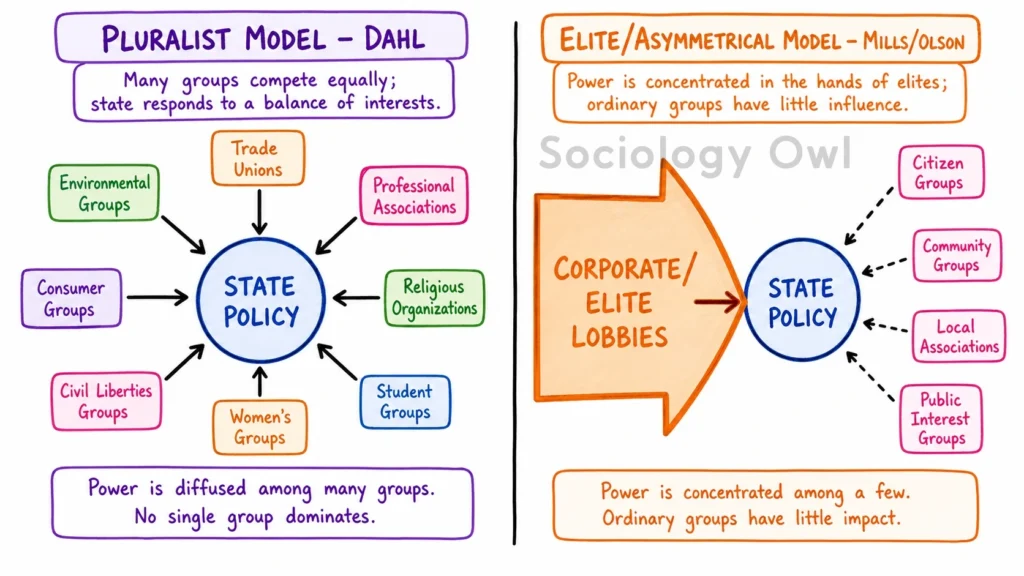
Robert Dahl’s pluralist theory posits that pressure groups are vital for articulating diverse socio-economic interests, acting as the lifeblood of plural representation.
- Buffer Against State Power: Alexis de Tocqueville, in Democracy in America, argued that civic associations act as a crucial buffer between the individual and the centralized state, preventing the “tyranny of the majority.”
- Global Watchdogs: Specialized groups provide technical input and hold governments accountable. For instance, global groups like Greenpeace articulate marginalized environmental interests, fostering robust grassroots participation outside traditional party structures.
Pressure Groups as a Democratic Threat
Conversely, critical theorists warn that pressure groups can distort democratic equality.
- Capitalist Hegemony: Building on C. Wright Mills’ elite theory, Neo-Marxist Ralph Miliband argued that wealthy business lobbies serve as instruments to maintain capitalist dominance, subverting true political equality.
- Asymmetrical Influence: Mancur Olson’s “Logic of Collective Action” explains that small, well-funded corporate lobbies are highly organized, while larger citizen groups suffer from the “free-rider problem.” Consequently, groups like the National Rifle Association (NRA) in the USA can hijack public policy against majoritarian will.
- Internal Oligarchy: Applying Robert Michels’ “Iron Law of Oligarchy”, even pressure groups fighting for democratic rights inevitably bureaucratize, becoming ruled by an unaccountable elite leadership detached from grassroots members.
In the digital age, Manuel Castells observes the rise of “Network Societies”. Decentralized, internet-mediated movements (like #MeToo or global climate strikes) act as democratized pressure mechanisms, challenging and bypassing traditional, opaque lobbying structures.
Conclusion
Pressure groups remain an indispensable yet volatile element of democracy. To prevent elite capture and ensure true pluralism, modern societies must realize Jrgen Habermas’ ideal of a “Public Sphere” and “Deliberative Democracy”, where policies are shaped by transparent public discourse rather than the financial muscle of oligarchic lobbies.
Q. Give an account of the recent trends of marriage in the Indian context. How are these different from traditional practices?
Model Answer:
Marriage is a socially sanctioned sexual and economic union. K.M. Kapadia defined traditional Hindu marriage as a sacred sacrament emphasizing Dharma (duty), Praja (progeny), and Rati (pleasure). Today, modernization and globalization are profoundly reshaping its contours.
Recent Trends in Indian Marriage
- Hybrid Modernities: Patricia Uberoi observes a shift toward ‘love-cum-arranged’ unions. Matrimonial algorithms expand partner pools while blending individual choice with family consent.
- Individualization: Applying Ulrich Beck, youth navigate marriage as personal choice, seeking companionship and “Confluent Love” (Anthony Giddens) over institutional obligation.
- Commodification: Patricia Uberoi notes globalization has catalyzed conspicuous consumption, transforming marriages into status-displaying “Big Fat Indian Weddings.”
- Kinship Linkages: A.M. Shah highlights that while households fragment, functional “jointness” persists through parental funding in marriages.
- Alternative Unions: Live-in relationships and legal debates on same-sex marriage reflect expanding normative boundaries.
Departure from Traditional Practices
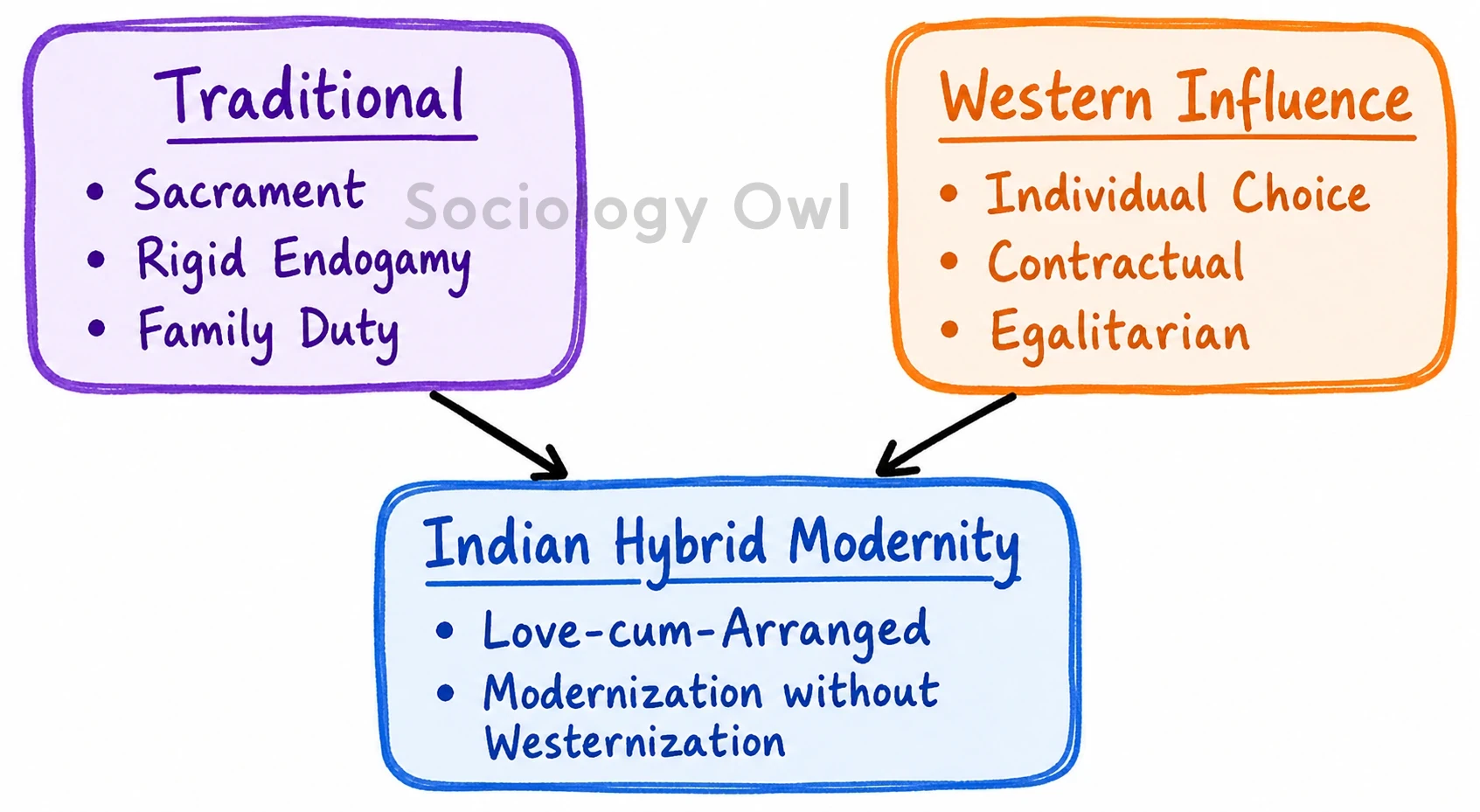
- Nature of the Bond: Shifting from an indissoluble sacrament to a legalistic Social Contract, evidenced by rising mutual-consent divorces.
- Mate Selection: Rigid endogamy prescribed by Dharmashastras is weakening. However, a paradox exists; via Sanskritization (M.N. Srinivas), dowry has spread to subaltern groups historically practicing bride-price.
- Power Dynamics: Patriarchal authority faces egalitarian aspirations. Yet, feminists argue modern marriages create a “Second Shift” (Arlie Hochschild) for working women, driving delayed marriages.
- Subaltern Critique: The “homogeneous traditional marriage” reflects upper-caste bias. Historically, Dalit and Tribal traditions were secular, permitting divorce and remarriage.
Unlike Japan’s celibacy syndrome, Indian marriage remains near-universal, demonstrating structural resilience (Talcott Parsons) despite functional transformations in a globalized era.
Conclusion
Indian marriage exemplifies “Modernization without Westernization” (Yogendra Singh). Transitioning from a rigid institution to a relationship, the persistent structural scaffolding of caste ensures it remains a uniquely Indian hybrid, balancing modern individual agency with collective tradition.
Q. What would you identify as the similarities and differences in the elite theories of Mosca, Michels and Pareto? Discuss their main/crucial issues.
Model Answer:
The classical elite theories of Vilfredo Pareto, Gaetano Mosca, and Robert Michels—the “Machiavellian School”—emerged as critiques of Marxist classlessness and mass democracy. They assert every society is ruled by an organized minority holding disproportionate power.
Core Similarities and Differences
Core Similarities
- Inevitability of Minority Rule: Power is a zero-sum game. They shared an elitist epistemology, viewing masses as apathetic and incapable of self-rule.
- Critique of Democracy and Marxism: Popular sovereignty is deemed a myth masking elite domination. They argued Marxist revolutions merely replace old rulers with a new bureaucratic elite.
Key Differences in Analysis
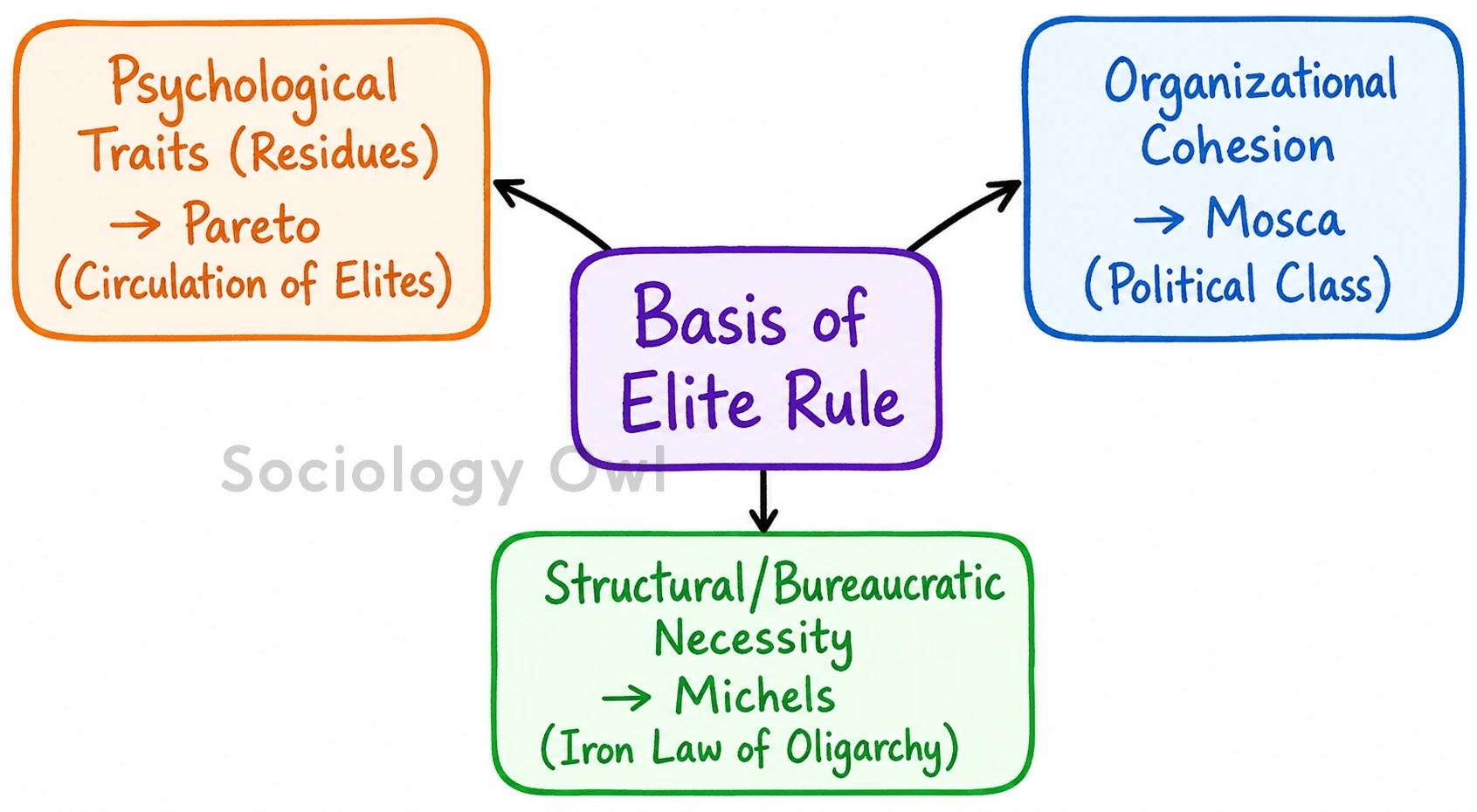
- Vilfredo Pareto (Psychological): Emphasized innate psychological “residues”. History is a “graveyard of aristocracies” marked by the circulation of elites—occurring when “Lions” (using force) lack the cunning of “Foxes” (using manipulation) to manage crises.
- Gaetano Mosca (Organizational): Focused on a “political class” dominating an unorganized majority, legitimized by a “political formula” (e.g., popular will). Unlike Pareto, Mosca argued this class is relatively open and can assimilate the masses.
- Robert Michels (Structural): Formulated the “Iron Law of Oligarchy.” Analyzing socialist parties, he demonstrated that bureaucratic necessities in complex institutions inevitably create detached, self-serving oligarchies.
Crucial Issues and Criticisms
These theorists highlighted the “Problem of Democracy” and “Bureaucratic Scale,” but faced significant scholarly critique:
- Pluralism: Robert Dahl (Who Governs?) argued power is dispersed among competing pressure groups, not monopolized by a single elite.
- Institutional Shift: C. Wright Mills (The Power Elite) argued modern elite power stems from institutional positions (corporate, military, political), not innate psychological traits.
- Specialization: Suzanne Keller proposed “Strategic Elites,” replacing monolithic models with multiple, specialized elites.
Michels’ Iron Law of Oligarchy persists in highly centralized political party high-commands today. Moreover, entities like the World Economic Forum or Big Tech Oligarchs resemble a modern political class, using globalization as their legitimizing political formula.
Conclusion
Despite deterministic biases, classical elite theories remain indispensable. Alongside modern adaptations like “Democratic Elitism,” they provide a vital sociological reality check against the utopian claims of modern representative democracies.