Model Answer

Do you think I and Me are central terms in Mead’s work.

Model Answers

Q: Do you think I and Me are central terms in Mead's work.

Question asked in UPSC Sociology 2018 Paper 1. Download our app for last 20 year question with model answers.

Model Answer:

In Mind, Self, and Society, G.H. Mead resolves the classic Structure vs. Agency debate through the central concepts of the “I” and “Me”, illustrating how the “Self” emerges dynamically via Social Behaviourism.

The Internal Dialogue of the Self

The “Me” (Social Control): The internalized attitudes of society formed through the Play Stage and Game Stage. It represents the Generalized Other, ensuring structural conformity and institutional reproduction.

The “I” (Human Agency): The spontaneous, unpredictable response to the “Me”. It acts as the source of creativity, deviance, and sociological innovation.

Dialectical Process: Their continuous dialogue forms a fluid personality, anticipating Herbert Blumer’s Symbolic Interactionism and contrasting Emile Durkheim’s macro-structural coercion by locating control internally.

In the digital age, algorithmic surveillance and ‘cancel culture’ act as a hyper-vigilant Generalized Other enforcing the normative “Me”, while viral, disruptive meme-creation showcases the spontaneity of the “I”.

Conclusion

While Marxists critique Mead for overestimating the “I”‘s freedom against systemic power structures, these concepts remain indispensable for explaining the continuous, dynamic balance between macro-social order and micro-level change.

Do you think I and Me are central terms in Mead’s work. Read More »

What is ‘Ageing’ ? Discuss the major problems of aged people in India.

Model Answers

Q: What is 'Ageing' ? Discuss the major problems of aged people in India.

Question asked in UPSC Sociology 2023 Paper 2. Download our app for last 20 year question with model answers.

Model Answer:

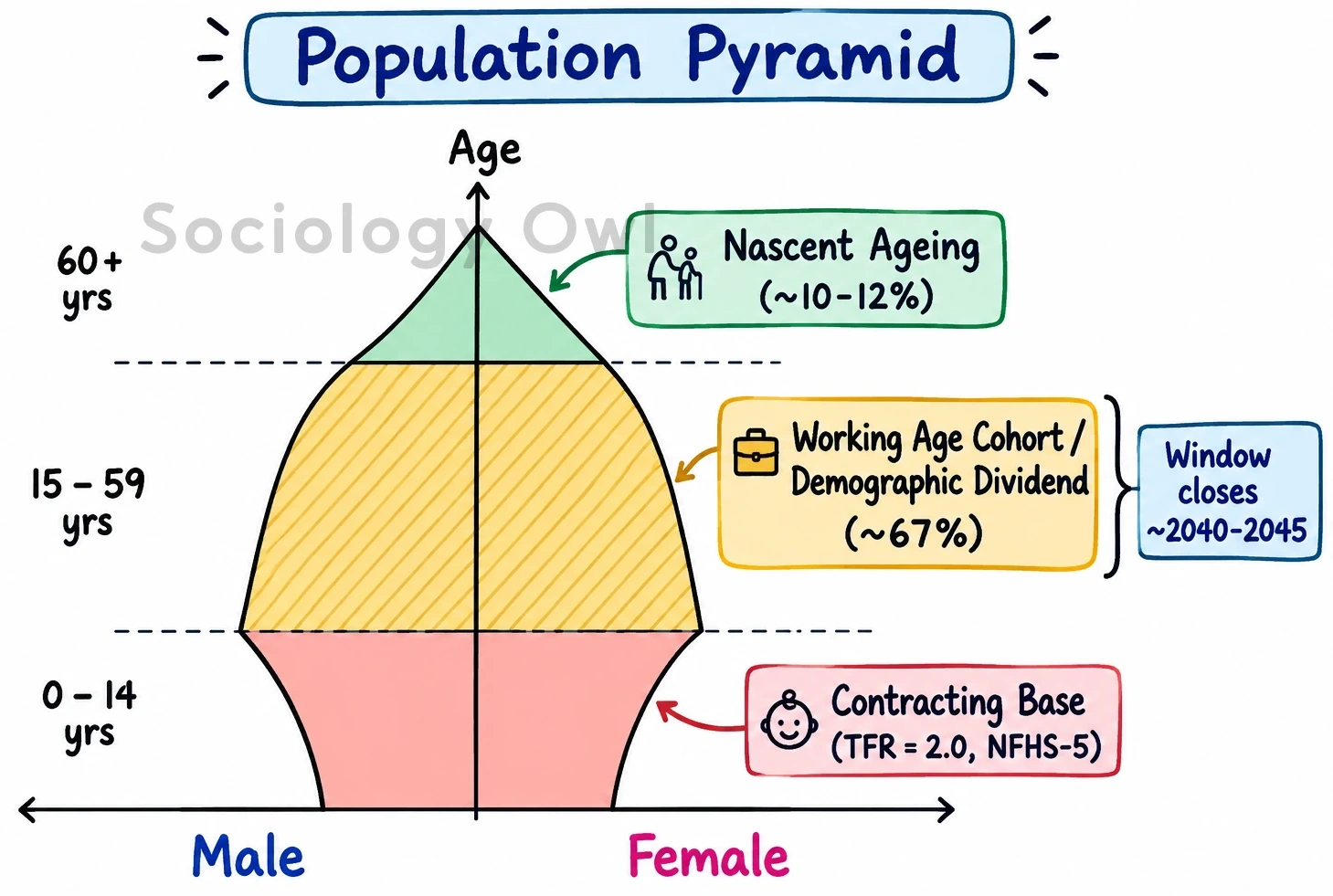
Ageing is a social construct redefining social roles, status, and power. Driven by the Demographic Transition Theory, India is shifting from a traditional Gerontocracy (where age equaled authority) to the modern marginalization of its elderly population.

Sociological Problems of Ageing

  • Economic Marginalization: Sylvia Vatuk notes the transition to an urban wage-labor economy strips elders of traditional productive roles and economic authority, causing profound status loss.
  • Kinship & Care Deficit: A.M. Shah argues that despite persisting functional jointness in families, nuclear living and youth migration create a physical “care deficit”, fundamentally altering the traditional intergenerational contract.
  • Intersectionality: S. Irudaya Rajan highlights the “Feminization of Ageing,” where elderly widows face a “Triple Jeopardy” of age, gender discrimination, and lack of property rights.

The LASI report reveals rampant elderly multi-morbidity and pension exclusion. Consequently, the MWPSC Act, 2007 attempts to legally enforce filial piety, exposing severe strains in modern kinship structures.

Conclusion

Addressing India’s ageing crisis requires shifting from a charity-based welfare model to a rights-based framework, integrating the elderly as active participants in society rather than passive dependents.

What is ‘Ageing’ ? Discuss the major problems of aged people in India. Read More »

How do you view the growth of informal sector in india ?

Model Answers

Q: How do you view the growth of informal sector in india ?

Question asked in UPSC Sociology 2022 Paper 2. Download our app for last 20 year question with model answers.

Model Answer:

Coined by Keith Hart, the informal sector employs nearly 90% of India’s workforce. Sociologically, it is not merely an economic anomaly but a structural feature of post-colonial capitalism.

Sociological Dimensions of Informality

  • Structural Reality: Kalyan Sanyal (Rethinking Capitalist Development) frames informality as a survivalist “need economy” coexisting with formal accumulation. Furthermore, Jan Breman highlights how agrarian distress generates highly precarious “footloose labour”.
  • Social Stratification: Barbara Harriss-White (India Working) argues informal markets are socially regulated by primary identities. The enduring caste-class nexus pushes Dalits into hazardous jobs, while the feminization of informal labor marginalizes women in invisible, home-based roles.

The gig economy’s “Uberization” has created a new class of vulnerable workers—what Guy Standing calls the “Precariat”. Their extreme precarity was exposed during the COVID-19 reverse migration, prompting state integration efforts like the e-Shram Portal.

Conclusion

The informal sector is a permanent social reality, not an economic waiting room. Sustainable urbanization requires extending robust social security and dismantling the socio-cultural hierarchies that regulate Indian labor.

How do you view the growth of informal sector in india ? Read More »

Does women’s education help to eradicate patriarchal discriminations? Reflect with illustrations.

Model Answers

Q: Does women’s education help to eradicate patriarchal discriminations? Reflect with illustrations.

Question asked in UPSC Sociology 2023 Paper 1. Download our app for last 20 year question with model answers. 

Model Answer:

Patriarchy is a structure where men dominate women (Sylvia Walby). Education acts as both an emancipatory catalyst and a site reproducing patriarchal norms.

The Dual Role of Education

Education as an Emancipatory Tool:

Liberal Feminism: Formal education yields economic independence, challenging traditional gender roles.

“Conscientization” (Paulo Freire): Fosters critical awareness to resist oppression.

Illustration: Globally, higher female literacy consistently correlates with delayed marriage and lower fertility rates.

Education as a Reproducer of Patriarchy:

“Hidden Curriculum”: Implicitly socializes girls into passive roles and “pink-collar” tracks.

Cultural Reproduction (Pierre Bourdieu): Schools reinforce patriarchal cultural capital rather than dismantling it.

“Second Shift” (Arlie Hochschild): Educated career women still bear the dual burden of unpaid domestic labor.

Intersectionality (Kimberlé Crenshaw): Overlapping caste-class matrices dilute educational gains (e.g., educated Dalit women facing exclusion—Sharmila Rege).

Despite high educational parity globally, a “Leaky Pipeline” persists in STEM leadership. In India, higher female education paradoxically coexists with declining labor participation due to status-driven withdrawal (SanskritizationM.N. Srinivas).

Conclusion

Education is a necessary but insufficient condition for gender justice. Eradicating patriarchy requires complementing educational empowerment with structural reforms to dismantle deep-rooted systemic and cultural inequalities.

Does women’s education help to eradicate patriarchal discriminations? Reflect with illustrations. Read More »

Elucidate the main problems and challenges faced by the migrant labourers in the recent ‘Lockdown period’.

Model Answers

Q: Elucidate the main problems and challenges faced by the migrant labourers in the recent 'Lockdown period'.

Question asked in UPSC Sociology 2021 Paper 1. Download our app for last 20 year question with model answers.

Model Answer:

The COVID-19 lockdown exposed the acute vulnerabilities of what Jan Breman terms “Footloose Labour.” The crisis shattered the Functionalist view of migration as a simple equilibrating mechanism (Everett Lee’s push-pull theory), instead validating the Marxist perspective that capitalist urban economies rely on cheap, disposable labour where employers externalize the social costs of reproduction.

Dimensions of Precarity and Crisis

The Precariat and Alienation: The lockdown epitomized Guy Standing’s concept of “The Precariat.” Instant job losses and wage theft highlighted Marxian alienation, where migrant “city-makers” were abruptly alienated from the very urban spaces they built, functioning merely as a reserve army of labour.

Resource Exclusion: Evictions and non-portable welfare destroyed Weberian “life chances.” The severing of livelihoods from social protections perfectly illustrated Karl Polanyi’s concept of disembedded markets.

Anomie and Social Capital: The sudden halt of transport and livelihoods triggered profound normlessness, echoing Emile Durkheim’s anomie. To survive the long march home, migrants relied entirely on “bonding social capital” (kinship networks) as they completely lacked “linking social capital” (connections to the state), referencing Robert Putnam.

Stigma and Othering: Migrants were frequently labelled as disease “carriers,” demonstrating Erving Goffman’s stigma and the cultural marginalization of outsiders.

Intersectional Harms: Feminist perspectives highlight how female migrants faced dual burdens of job loss and intensified unpaid care work, alongside rising domestic violence.

This marginalization is a global feature of neoliberal capitalism, not just a local administrative failure. The plight of Indian migrants paralleled the strict lockdowns of migrant dormitories in Singapore and the vulnerabilities of workers under the Middle Eastern Kafala system. ILO and SWAN (Stranded Workers Action Network) reports sociologically documented this universal surge in severe food insecurity and wage distress.

Conclusion

The lockdown revealed migrants’ structural invisibility within informal capitalism. While institutional responses like the e-Shram portal aim to create visibility, durable protection necessitates a shift from welfare-as-charity to T.H. Marshall’s framework of Social Citizenship, ensuring enforceable labour rights, portable welfare, and inclusive urban governance.

Elucidate the main problems and challenges faced by the migrant labourers in the recent ‘Lockdown period’. Read More »

Do you think that the decades of Dalit political mobilizations and movements have helped in strengthening India’s democracy? Substantiate your arguments with facts.

Model Answers

Q: Do you think that the decades of Dalit political mobilizations and movements have helped in strengthening India’s democracy? Substantiate your arguments with facts.

Question asked in UPSC Sociology 2023 Paper 2. Download our app for last 20 year question with model answers.

Model Answer:

Dalit political mobilization has transformed India’s polity from a procedural democracy to a substantive democracy. Rajni Kothari conceptualizes this as the “politicization of caste,” where caste transitioned from a tool of traditional stratification into a vital instrument of democratic assertion.

  • The Silent Revolution: Christophe Jaffrelot argues that the transfer of political power to lower castes fundamentally democratized the Indian polity, weakening orthodox Brahmanical hierarchies.
  • Electoral Participation: Yogendra Yadav highlights the “Second Democratic Upsurge” of the 1990s, substantiated by electoral data showing Scheduled Caste (SC) voter turnout frequently matching or exceeding the general population.
  • State Power: Sudha Pai notes that mobilizations led by the Bahujan Samaj Party shifted the focus from mere social reform to capturing state machinery, converting numerical strength into legislative power.
  • Social Dignity: Gopal Guru asserts that these movements provided Dalits not just constitutional safeguards, but crucial psychological empowerment and agency.

Critical Evaluation and Limitations

  • Elite Capture: Anand Teltumbde critiques that electoral mobilization has largely benefited a “creamy layer,” leaving rural, landless Dalits alienated from democratic dividends.
  • Sub-caste Fragmentation: Collective bargaining is increasingly weakened by internal divisions, such as the Malas vs. Madigas conflict in Telangana.
  • Ideological Dilution: The radical assertion of early movements like the Dalit Panthers has often been replaced by opportunistic electoral alliances.

Modern movements like the Bhim Army and the Una protests demonstrate a shift towards youth-led, social-media-driven democratic assertion outside traditional party politics. Furthermore, university-level mobilizations, such as the Rohith Vemula protests, have expanded the discourse of democratic rights into institutional spaces.

Conclusion

While Dalit mobilizations have modernized Indian politics through structural representation, B.R. Ambedkar famously warned that political democracy (“one man, one vote”) cannot survive without social democracy (“one man, one value”). The ultimate strengthening of Indian democracy requires translating this political mobilization into the total eradication of socio-economic hierarchies.

Do you think that the decades of Dalit political mobilizations and movements have helped in strengthening India’s democracy? Substantiate your arguments with facts. Read More »

Q. Democracy needs a vibrant culture of civil society in order to strengthen its foundation of citizenship. Comment.

Q. Democracy needs a vibrant culture of civil society in order to strengthen its foundation of citizenship. Comment.

UPSC Sociology 2024 Paper 1

Model Answer:

Sociologically, civil society is the voluntary, autonomous realm between the family and the state (Larry Diamond). It is the vital arena where individuals translate formal legal status into substantive lived citizenship, which T.H. Marshall defines as a claim to full membership in a community encompassing civil, political, and social rights.

Civil Society as the Catalyst for Active Citizenship

A vibrant civil society transforms democratic subjects into active citizens through:

  • Civic Engagement: In Democracy in America, Alexis de Tocqueville argued that voluntary associations act as “schools of democracy,” cultivating civic virtues and serving as a bulwark against the “tyranny of the majority.”
  • Rational-Critical Debate: Jürgen Habermas conceptualized civil society as the “Public Sphere”, a communicative space free from state coercion where citizens deliberate, ensuring democratic accountability and rights awareness.
  • Cultivating Trust: Robert Putnam, in Bowling Alone, highlighted that civic associations generate “bonding and bridging social capital,” fostering the interpersonal trust essential for a functioning polyarchy (Robert Dahl).

Critical Sociological Perspectives

However, civil society is not inherently egalitarian:

  • Gramscian Critique: Antonio Gramsci argued that civil society serves as an arena of Hegemony, where the ruling elite manufactures consent through institutions like corporatized NGOs, pacifying genuine citizenship.
  • Post-Colonial View: Partha Chatterjee distinguishes between bourgeois “Civil Society” and the “Political Society”, where marginalized masses actually negotiate with the state, highlighting its exclusionary nature in developing nations.

Global civil society movements, such as #MeToo and Fridays for Future, act as modern Public Spheres, dynamically expanding the boundaries of civil and social citizenship rights on an international scale.

Conclusion

While susceptible to elite capture and hegemonic control, a decentralized and inclusive civil society remains indispensable. It transforms formal democratic institutions into a “Substantive Democracy” (Amartya Sen), ensuring citizenship operates as an active, continuous practice rather than a passive legal status.

Q. Democracy needs a vibrant culture of civil society in order to strengthen its foundation of citizenship. Comment. Read More »

Explain the thematic linkages between ‘Patriarchy’ and ‘Honour killing’ in India, citing some recent cases.

Model Answers

Q: Explain the thematic linkages between ‘Patriarchy’ and ‘Honour killing’ in India, citing some recent cases.

Question asked in UPSC Sociology 2023 Paper 2. Download our app for last 20 year question with model answers.

Model Answer:

Honour killings in India are coercive social mechanisms enforcing endogamy and patrilineality. Patriarchy operationalizes itself through the cultural construct of Izzat (honour), where family and caste prestige are disproportionately located in the bodies and sexual purity of women.

Uma Chakravarti’s concept of “Brahmanical patriarchy” highlights how controlling female sexuality is central to maintaining caste purity.

Leela Dube’s “Seed and Earth” metaphor explains that Hindu patriarchy violently protects patrilineal “purity” against Pratiloma (hypogamous) marriages, which threaten the social order by inverting both caste and gender hierarchies.

B.R. Ambedkar emphasized that caste is fundamentally sustained by controlling women. Consequently, patriarchy violently resists inter-caste marriages to prevent the annihilation of caste.

Political Economy and Community Enforcement

Prem Chowdhry argues that honour killings, often orchestrated by Khap Panchayats, are deeply tied to land and property rights, ensuring inherited wealth does not pass outside the clan.

Such violence is also a reaction to a crisis of masculinity among dominant-caste youths who, facing agrarian distress, reassert dominance through a violent backlash against modern female educational and economic agency.

The 2018 Pranay Kumar case (a Dalit man murdered for marrying an upper-caste woman) and the Manoj-Babli case exemplify this caste-gender nexus.

In Shakti Vahini vs. Union of India (2018), the Supreme Court outlawed Khap interference in adult marriages, prompting progressive state responses like the Rajasthan Prohibition of Interference with the Freedom of Matrimonial Alliances Bill (2019).

Conclusion

Honour killings represent the violent death throes of a traditional patriarchal order resisting the constitutional morality of modern India. Eradicating this violence requires the structural dismantling of the caste-class-patriarchy nexus, fulfilling Ambedkar’s vision of a true social democracy.

Explain the thematic linkages between ‘Patriarchy’ and ‘Honour killing’ in India, citing some recent cases. Read More »

Write short note on Manifest and latent functions.

Model Answers

Q: Write short note on Manifest and latent functions.

Question asked in UPSC Sociology 2001 Paper 1. Download our app for last 20 year question with model answers.

Model Answer:

Manifest and Latent Functions

Robert K. Merton introduced the concepts of Manifest and Latent functions in his seminal work, Social Theory and Social Structure (1949), to refine the early structural-functionalist approach. Merton argued that early functionalists (like Malinowski) wrongly assumed that all social institutions have universally positive and intended purposes. To correct this, he proposed separating the subjective dispositions (motives) of individuals from the objective consequences (functions) of their actions.

1. Manifest Functions:

  • Definition: These are the objective consequences of a social action or institution that are intended and recognized by the participants in the system.
  • Nature: They are consciously deliberately planned to achieve a specific goal and are easily observable.
  • Classic Example: In the Hopi tribe’s Rain Dance, the manifest function is the conscious intent to appease the gods and bring rain for their crops.

2. Latent Functions:

  • Definition: These are the objective consequences of a social action that are unintended and unrecognized by the participants.
  • Nature: They are by-products of social activities. Merton argued that discovering latent functions is the true task of the sociologist, as it goes beyond mere “common sense.”
  • Classic Example: In the Hopi Rain Dance, the latent function is the reinforcement of group solidarity and social cohesion during times of ecological crisis, even if it doesn’t actually rain.

Significance in Sociological Analysis:

  • Explains “Irrational” Practices: It helps explain why seemingly irrational or harmful practices survive. For example, Merton showed how corrupt “political machines” in the US survived because their latent function was providing immediate welfare to destitute immigrants, which formal government agencies failed to do.
  • Overcomes Naïve Functionalism: It forces sociologists to look beneath the surface-level goals of institutions (e.g., the latent function of a prison might be acting as a “school for crime” rather than its manifest goal of rehabilitation).
  • Value-Neutrality: It prevents sociologists from making moral judgments, focusing instead on objective sociological realities.

Conclusion

Merton’s dichotomy, along with his introduction of Manifest and Latent Dysfunctions (negative consequences), transformed functionalism from a rigid, conservative ideology into a flexible, dynamic analytical tool that is still used today to analyze modern phenomena, such as the latent impacts of social media on human psychology.

Write short note on Manifest and latent functions. Read More »

Write short note on Social system and the Pattern Variables.

Model Answers

Q: Write short note on Social system and the Pattern Variables.

Question asked in UPSC Sociology 2003 Paper 1. Download our app for last 20 year question with model answers.

Model Answer:

Talcott Parsons’ Social System and Pattern Variables

Talcott Parsons, in his General Theory of Action, conceptualized the Social System as a plurality of individual actors interacting with each other in a shared cultural and physical environment. It is a macro-sociological framework maintained by shared norms, values, and institutions. For a social system to survive, it must fulfill four functional prerequisites, known as the AGIL paradigm (Adaptation, Goal-attainment, Integration, and Latency).

However, in any social system, actors face “role dilemmas” before performing an action. To explain how actors resolve these dilemmas and navigate role expectations, Parsons introduced the Pattern Variables. These are five sets of dichotomous (binary) choices that map the transition of actions from traditional to modern societies:

  • 1. Affectivity vs. Affective Neutrality (The Emotional Dilemma):
    • Affectivity involves seeking emotional gratification in interactions (e.g., a mother-child relationship).
    • Affective Neutrality demands emotional detachment and rationality (e.g., a doctor-patient relationship, where a surgeon cannot let emotions interfere with a surgery).
  • 2. Self-Orientation vs. Collectivity-Orientation (The Value Dilemma):
    • Self-orientation prioritizes individual interests and profit (e.g., a capitalist businessman).
    • Collectivity-orientation prioritizes the common good or societal values (e.g., a soldier sacrificing his life for the nation, or a social worker).
  • 3. Universalism vs. Particularism (The Normative Dilemma):
    • Universalism applies general, objective rules to everyone equally (e.g., a judge applying the law impartially).
    • Particularism judges individuals based on specific relationships or emotional ties (e.g., a father showing favoritism to his own son).
  • 4. Ascription vs. Achievement (The Status Dilemma): (Also called Quality vs. Performance)
    • Ascription assigns roles based on birth, race, or caste (e.g., the traditional Indian Jajmani system).
    • Achievement assigns roles based on merit, skills, and hard work (e.g., clearing the UPSC examination to become an IAS officer).
  • 5. Specificity vs. Diffuseness (The Scope Dilemma):
    • Specificity entails a limited, clearly defined relationship (e.g., a customer and a shopkeeper).
    • Diffuseness involves broad, undefined, and holistic obligations (e.g., a husband-wife relationship, which encompasses financial, emotional, and social duties).

Sociological Significance and Critique

Parsons used Pattern Variables to explain social change. Traditional societies generally exhibit Particularism, Ascription, Diffuseness, Affectivity, and Collectivity. Conversely, Modern/Industrial societies lean towards Universalism, Achievement, Specificity, Affective Neutrality, and Self-orientation.

However, sociologists like Robert Merton criticized Parsons for being highly abstract and ignoring the deviance within social systems. Furthermore, Conflict theorists argue that this framework focuses too much on stability and consensus, completely ignoring power dynamics and class struggles. Despite these critiques, Parsons’ framework remains a foundational tool for analyzing institutional structures and human behavior.

Write short note on Social system and the Pattern Variables. Read More »