Model Answer:
India’s “quasi-federal” framework makes the continuous interplay between centralizing national parties and autonomy-seeking regional parties a defining feature of its political landscape.
National Parties and the Push for Centralisation
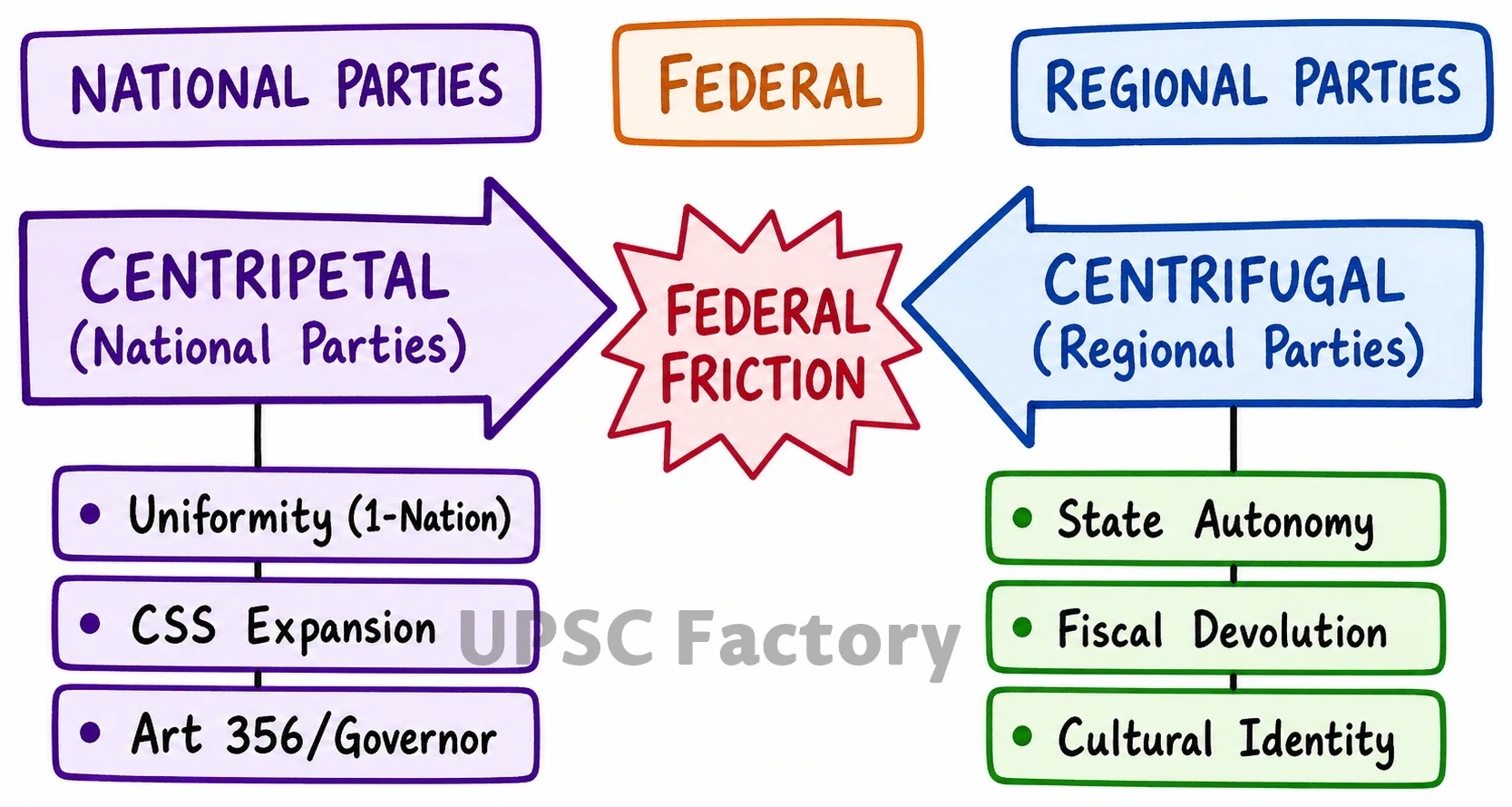
National parties typically favor a strong Centre to ensure macro-economic stability, national security, and uniform governance.
- Drive for Uniformity: Pushing pan-India policies to build national cohesion (One Nation-One Election, One Nation-One Ration Card).
- Constitutional Centralisation: Historically shifting State subjects to the Concurrent List (42nd Amendment transferred Education and Forests).
- Fiscal Dominance: Expanding Centrally Sponsored Schemes (CSS) with strict conditions, reducing states’ un-tied funds.
- Institutional Leverage: Historical tendency to utilize the Governor’s office and President’s Rule (Article 356) to control political narratives.
- Security Overreach: Expanding central law enforcement jurisdictions unilaterally (BSF jurisdiction extension in Punjab and West Bengal).
Regional Parties Championing State Autonomy
Regional parties derive their mandate from localized identity politics, necessitating robust defense of state rights.
- Ideological Assertions: Historically institutionalizing autonomy demands through formal channels (Anandpur Sahib Resolution, Rajamannar Committee).
- Fiscal Federalism Demands: Persistent advocacy for higher devolution and Special Category Status (Andhra Pradesh, Bihar).
- Legislative Resistance: Passing state assembly resolutions against central policies deemed encroaching (opposition to Farm Laws, NEP 2020).
- Cultural Preservation: Resisting cultural homogenization, such as perceived linguistic imposition (Dravidian parties opposing Hindi).
Nuances in the Dichotomy (The Reality)
The binary is not absolute; political expediency often blurs these lines:
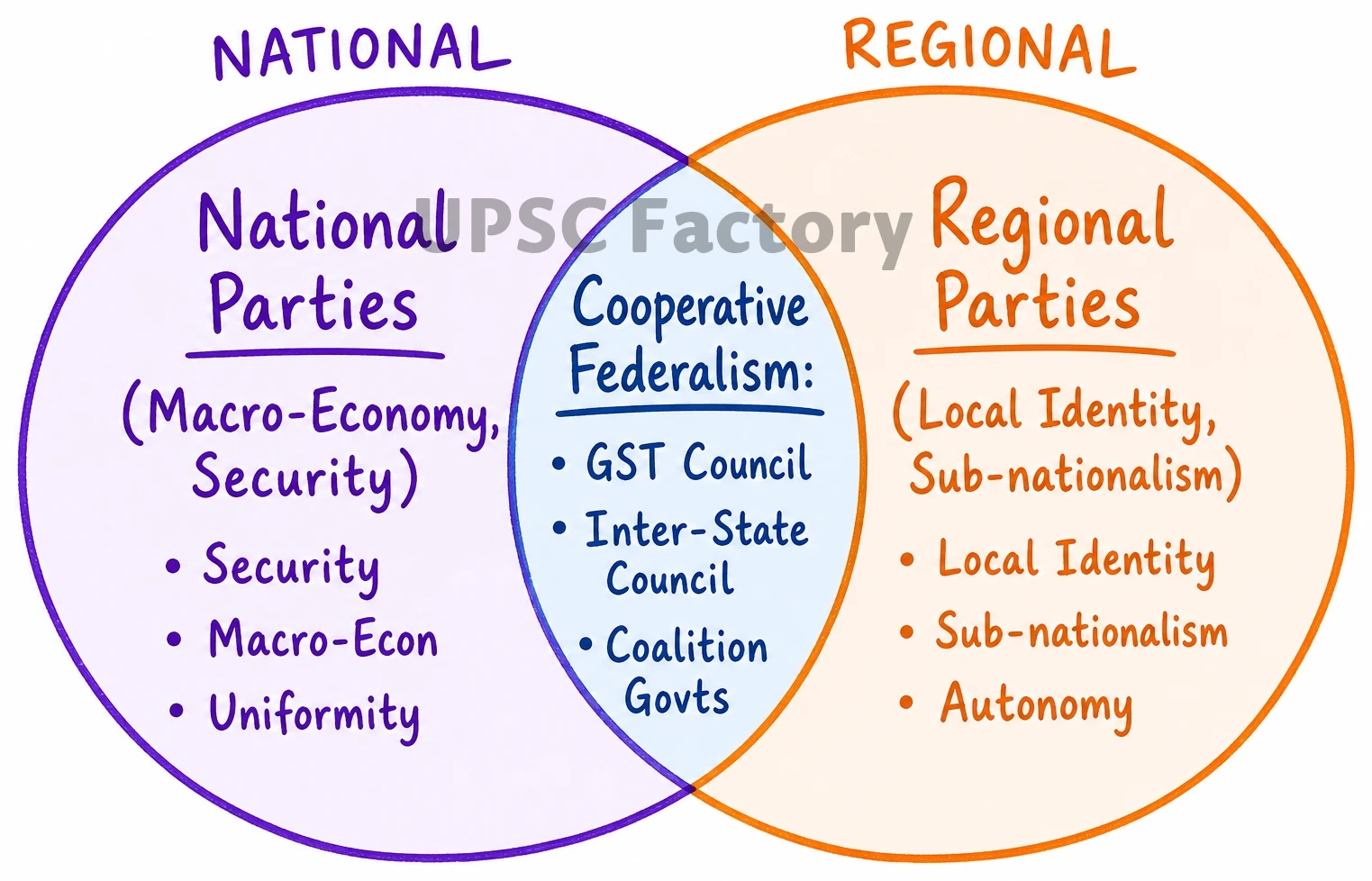
- Coalition Era Dynamics: Regional parties actively participated in centralizing power when part of Union coalitions (1989–2014).
- Role Reversal at State Level: State units of national parties often champion local autonomy on regional issues (inter-state river water disputes).
- Collaborative Federalism: Both factions routinely cooperate on essential national economic restructuring (establishment and functioning of the GST Council).
While political posturing drives the centralization-autonomy debate, bridging this trust deficit via institutional mechanisms like the Inter-State Council (Sarkaria Commission recommendations) is essential for harmonious cooperative federalism.