Misc

Do you think I and Me are central terms in Mead’s work.

Model Answers

Q: Do you think I and Me are central terms in Mead's work.

Question asked in UPSC Sociology 2018 Paper 1. Download our app for last 20 year question with model answers.

Model Answer:

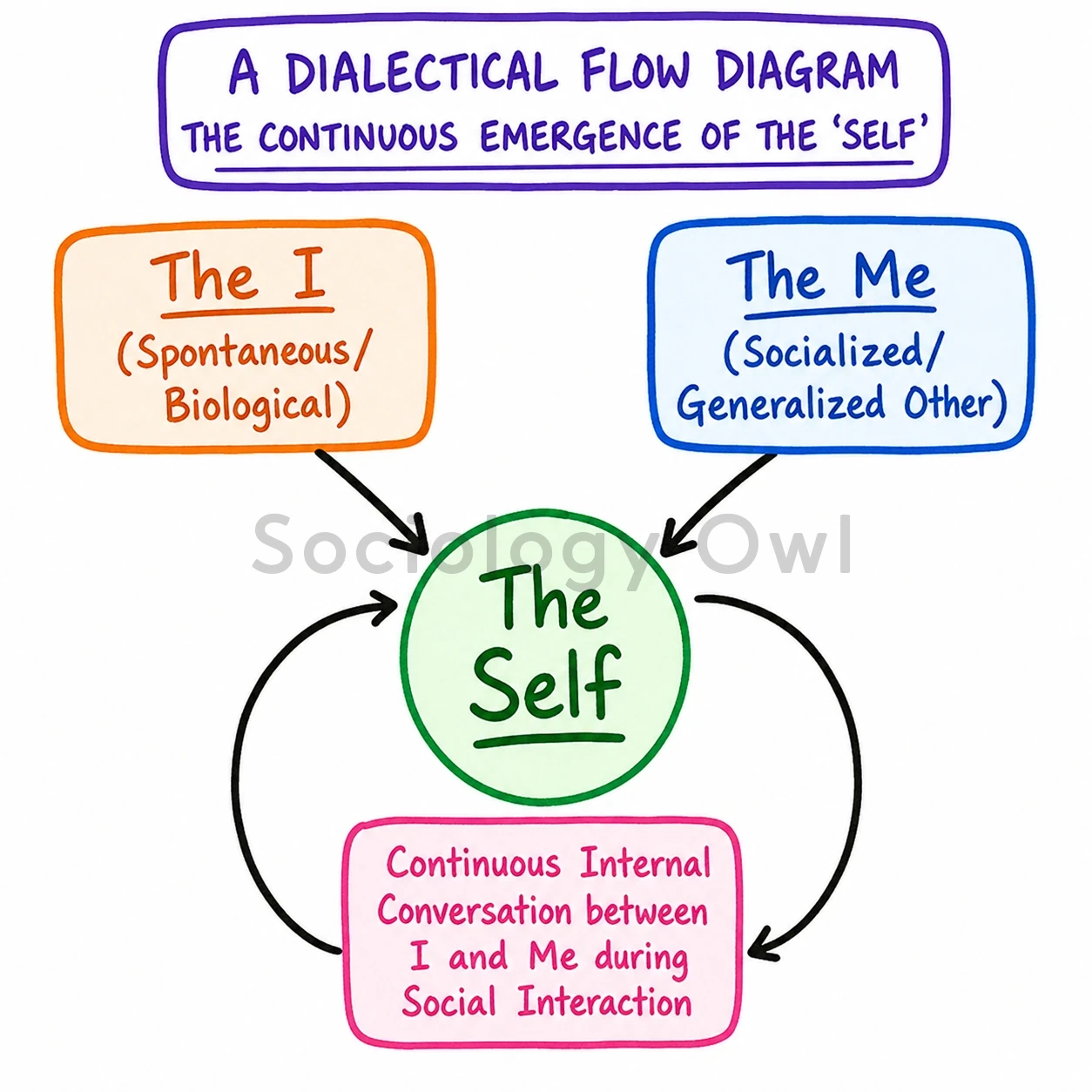
In Mind, Self, and Society, G.H. Mead resolves the classic Structure vs. Agency debate through the central concepts of the “I” and “Me”, illustrating how the “Self” emerges dynamically via Social Behaviourism.

The Internal Dialogue of the Self

The “Me” (Social Control): The internalized attitudes of society formed through the Play Stage and Game Stage. It represents the Generalized Other, ensuring structural conformity and institutional reproduction.

The “I” (Human Agency): The spontaneous, unpredictable response to the “Me”. It acts as the source of creativity, deviance, and sociological innovation.

Dialectical Process: Their continuous dialogue forms a fluid personality, anticipating Herbert Blumer’s Symbolic Interactionism and contrasting Emile Durkheim’s macro-structural coercion by locating control internally.

In the digital age, algorithmic surveillance and ‘cancel culture’ act as a hyper-vigilant Generalized Other enforcing the normative “Me”, while viral, disruptive meme-creation showcases the spontaneity of the “I”.

Conclusion

While Marxists critique Mead for overestimating the “I”‘s freedom against systemic power structures, these concepts remain indispensable for explaining the continuous, dynamic balance between macro-social order and micro-level change.

Do you think I and Me are central terms in Mead’s work. Read More »

Write short note on Manifest and latent functions.

Model Answers

Q: Write short note on Manifest and latent functions.

Question asked in UPSC Sociology 2001 Paper 1. Download our app for last 20 year question with model answers.

Model Answer:

Manifest and Latent Functions

Robert K. Merton introduced the concepts of Manifest and Latent functions in his seminal work, Social Theory and Social Structure (1949), to refine the early structural-functionalist approach. Merton argued that early functionalists (like Malinowski) wrongly assumed that all social institutions have universally positive and intended purposes. To correct this, he proposed separating the subjective dispositions (motives) of individuals from the objective consequences (functions) of their actions.

1. Manifest Functions:

  • Definition: These are the objective consequences of a social action or institution that are intended and recognized by the participants in the system.
  • Nature: They are consciously deliberately planned to achieve a specific goal and are easily observable.
  • Classic Example: In the Hopi tribe’s Rain Dance, the manifest function is the conscious intent to appease the gods and bring rain for their crops.

2. Latent Functions:

  • Definition: These are the objective consequences of a social action that are unintended and unrecognized by the participants.
  • Nature: They are by-products of social activities. Merton argued that discovering latent functions is the true task of the sociologist, as it goes beyond mere “common sense.”
  • Classic Example: In the Hopi Rain Dance, the latent function is the reinforcement of group solidarity and social cohesion during times of ecological crisis, even if it doesn’t actually rain.

Significance in Sociological Analysis:

  • Explains “Irrational” Practices: It helps explain why seemingly irrational or harmful practices survive. For example, Merton showed how corrupt “political machines” in the US survived because their latent function was providing immediate welfare to destitute immigrants, which formal government agencies failed to do.
  • Overcomes Naïve Functionalism: It forces sociologists to look beneath the surface-level goals of institutions (e.g., the latent function of a prison might be acting as a “school for crime” rather than its manifest goal of rehabilitation).
  • Value-Neutrality: It prevents sociologists from making moral judgments, focusing instead on objective sociological realities.

Conclusion

Merton’s dichotomy, along with his introduction of Manifest and Latent Dysfunctions (negative consequences), transformed functionalism from a rigid, conservative ideology into a flexible, dynamic analytical tool that is still used today to analyze modern phenomena, such as the latent impacts of social media on human psychology.

Write short note on Manifest and latent functions. Read More »

Write short note on Social system and the Pattern Variables.

Model Answers

Q: Write short note on Social system and the Pattern Variables.

Question asked in UPSC Sociology 2003 Paper 1. Download our app for last 20 year question with model answers.

Model Answer:

Talcott Parsons’ Social System and Pattern Variables

Talcott Parsons, in his General Theory of Action, conceptualized the Social System as a plurality of individual actors interacting with each other in a shared cultural and physical environment. It is a macro-sociological framework maintained by shared norms, values, and institutions. For a social system to survive, it must fulfill four functional prerequisites, known as the AGIL paradigm (Adaptation, Goal-attainment, Integration, and Latency).

However, in any social system, actors face “role dilemmas” before performing an action. To explain how actors resolve these dilemmas and navigate role expectations, Parsons introduced the Pattern Variables. These are five sets of dichotomous (binary) choices that map the transition of actions from traditional to modern societies:

  • 1. Affectivity vs. Affective Neutrality (The Emotional Dilemma):
    • Affectivity involves seeking emotional gratification in interactions (e.g., a mother-child relationship).
    • Affective Neutrality demands emotional detachment and rationality (e.g., a doctor-patient relationship, where a surgeon cannot let emotions interfere with a surgery).
  • 2. Self-Orientation vs. Collectivity-Orientation (The Value Dilemma):
    • Self-orientation prioritizes individual interests and profit (e.g., a capitalist businessman).
    • Collectivity-orientation prioritizes the common good or societal values (e.g., a soldier sacrificing his life for the nation, or a social worker).
  • 3. Universalism vs. Particularism (The Normative Dilemma):
    • Universalism applies general, objective rules to everyone equally (e.g., a judge applying the law impartially).
    • Particularism judges individuals based on specific relationships or emotional ties (e.g., a father showing favoritism to his own son).
  • 4. Ascription vs. Achievement (The Status Dilemma): (Also called Quality vs. Performance)
    • Ascription assigns roles based on birth, race, or caste (e.g., the traditional Indian Jajmani system).
    • Achievement assigns roles based on merit, skills, and hard work (e.g., clearing the UPSC examination to become an IAS officer).
  • 5. Specificity vs. Diffuseness (The Scope Dilemma):
    • Specificity entails a limited, clearly defined relationship (e.g., a customer and a shopkeeper).
    • Diffuseness involves broad, undefined, and holistic obligations (e.g., a husband-wife relationship, which encompasses financial, emotional, and social duties).

Sociological Significance and Critique

Parsons used Pattern Variables to explain social change. Traditional societies generally exhibit Particularism, Ascription, Diffuseness, Affectivity, and Collectivity. Conversely, Modern/Industrial societies lean towards Universalism, Achievement, Specificity, Affective Neutrality, and Self-orientation.

However, sociologists like Robert Merton criticized Parsons for being highly abstract and ignoring the deviance within social systems. Furthermore, Conflict theorists argue that this framework focuses too much on stability and consensus, completely ignoring power dynamics and class struggles. Despite these critiques, Parsons’ framework remains a foundational tool for analyzing institutional structures and human behavior.

Write short note on Social system and the Pattern Variables. Read More »

Critically analyze the concept of Anomie. Elaborate, with suitable examples, the theoretical relationship between nature of Anomie and types of Social Deviations as have been formulated by R.K. Merton.

Model Answers

Q: Critically analyze the concept of Anomie. Elaborate, with suitable examples, the theoretical relationship between nature of Anomie and types of Social Deviations as have been formulated by R.K. Merton.

Question asked in UPSC Sociology 2003 Paper 1. Download our app for last 20 year question with model answers.

Model Answer:

The concept of Anomie broadly refers to a state of “normlessness” or social instability caused by the breakdown of standards and values. Initially coined by Emile Durkheim in his study Suicide (1897), he viewed anomie as a pathological state arising from rapid social change (like sudden economic booms or depressions), where collective consciousness fails to regulate human desires.

However, R.K. Merton, in his seminal work “Social Structure and Anomie” (1938), transformed the concept from a temporary societal breakdown into a permanent, structurally induced condition.

Critical Analysis of the Concept of Anomie

While Durkheim viewed anomie as a result of unregulated human appetites during rapid transitions, Merton argued that anomie is deeply embedded in the very structure of stable societies. He proposed Strain Theory, asserting that society itself causes deviance.

However, the concept of Anomie has been critically analyzed and challenged by later sociologists:

  • Albert Cohen (Delinquent Subcultures): Critiqued Merton for focusing only on utilitarian crime (crime for financial gain). Cohen argued Merton’s anomie fails to explain non-utilitarian deviance like vandalism or gang violence, which stem from “status frustration” rather than financial goals.
  • Cloward and Ohlin: Pointed out that Merton assumed everyone who faces strain has equal access to illegitimate means. They argued that just as legitimate opportunities are unequal, illegitimate opportunity structures are also unequally distributed (e.g., not everyone can become a successful mafia boss).
  • Marxist Critique: Marxists argue that Merton takes the “cultural goal” of wealth accumulation for granted, ignoring that this goal is an ideological construct of Capitalism designed to exploit the working class.
  • Pluralist/Postmodern Critique: Sociologists like Frank Valier argue that Merton falsely assumes a society shares a single set of cultural goals. In modern pluralistic societies, goals are diverse and highly subjective.

Merton’s Relationship between Anomie and Types of Social Deviations

Despite the critiques, Merton’s framework remains highly influential. He theorized that anomic strain occurs when there is a mismatch or disproportionate emphasis on “Cultural Goals” (e.g., the American Dream, wealth, status) and a lack of access to “Institutionalized Means” (e.g., quality education, fair employment) to achieve them.

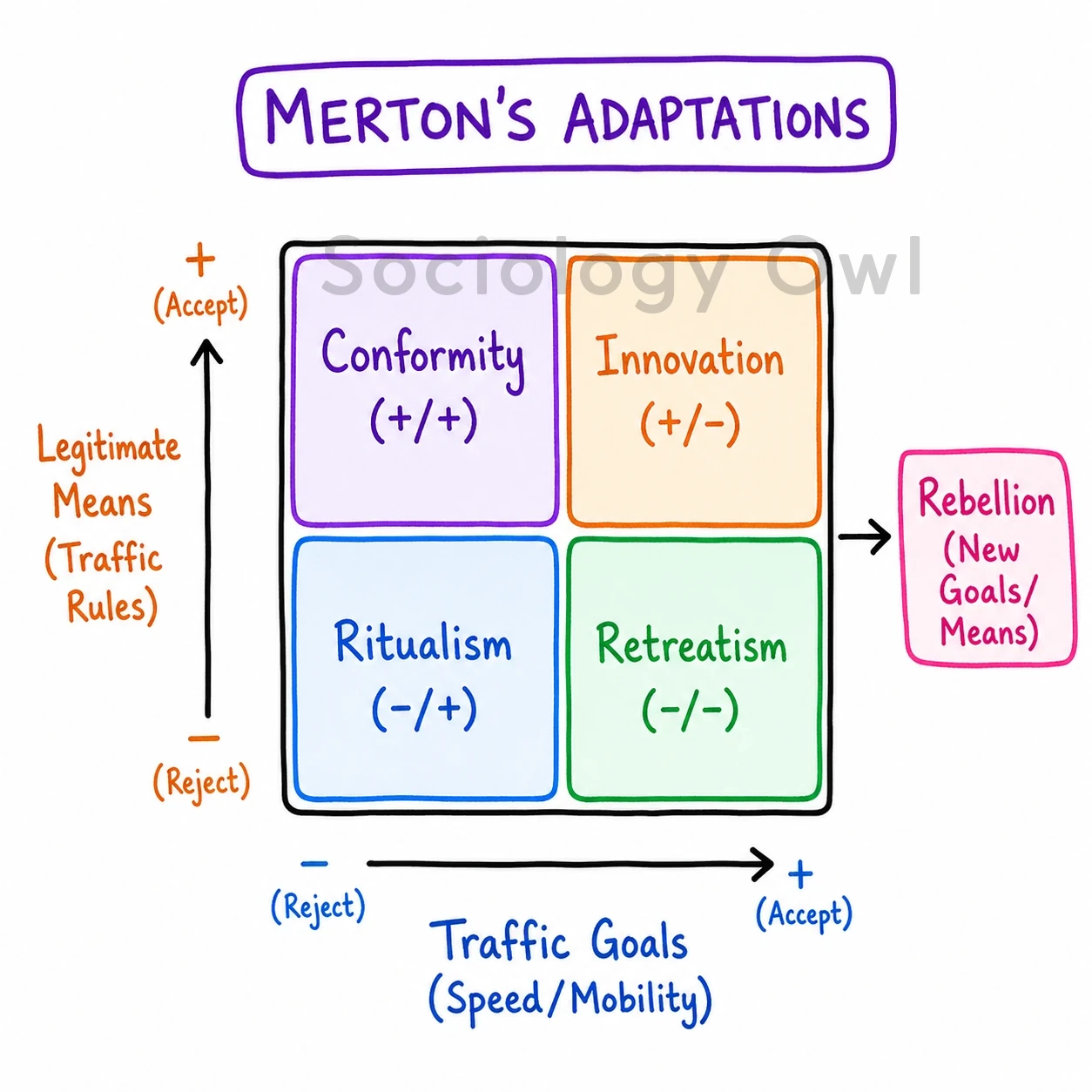
When individuals face this structural strain, they adapt in different ways. Merton formulated a typology of five adaptations, four of which lead to social deviance:

1. Conformity (Accepts Goals, Accepts Means)

  • Concept: The individual internalizes both the socially prescribed goals and the legitimate means to achieve them. (This is the only non-deviant adaptation).
  • Example: A youth from a poor background who studies hard, cracks the UPSC examination, and achieves social mobility through legal, institutionalized routes.

2. Innovation (Accepts Goals, Rejects Means) – Deviant

  • Concept: The individual strongly desires the cultural goal of success/wealth but lacks access to, or rejects, legitimate means. They innovate new, often illegal, methods to achieve the goal.
  • Example: White-collar criminals, such as those involved in the Harshad Mehta stock market scam, or youth joining organized crime syndicates to acquire rapid wealth. Cheating in exams (e.g., the Vyapam scam) to secure a job is also an innovative deviance.

3. Ritualism (Rejects Goals, Accepts Means) – Deviant

  • Concept: The individual realizes they cannot achieve the grand cultural goals and abandons them. However, they rigidly stick to the institutionalized rules to the point where the rules become an end in themselves.
  • Example: A hyper-bureaucratic government clerk who obsessively focuses on red-tapism and paperwork, forgetting the actual goal of public service. They find security in the routine.

4. Retreatism (Rejects Goals, Rejects Means) – Deviant

  • Concept: The individual gives up on both the goals of society and the means to achieve them. Merton described them as being “in society but not of it.”
  • Example: Chronic drug addicts (e.g., the youth crisis highlighted in Udta Punjab), alcoholics, vagrants, or severe recluses who withdraw entirely from the social rat race.

5. Rebellion (Rejects and Replaces Goals, Rejects and Replaces Means) – Deviant

  • Concept: The individual not only rejects the existing goals and means but actively attempts to overthrow the system to establish a new social order with different goals and different means.
  • Example: The Naxalite movement in India, which rejects the capitalist democratic structure and attempts to establish a communist society through armed struggle. Radical environmentalist groups also fit this category.

Conclusion

Merton’s greatest contribution through his theory of Anomie was shifting the blame for deviant behavior from biological or psychological pathology to the social structure itself. By highlighting how structural inequalities breed deviance, Merton’s anomie remains highly relevant today, especially in developing economies where hyper-consumerism constantly elevates cultural goals, but structural bottlenecks (unemployment, poor education) restrict legitimate institutional means.

Critically analyze the concept of Anomie. Elaborate, with suitable examples, the theoretical relationship between nature of Anomie and types of Social Deviations as have been formulated by R.K. Merton. Read More »

According to Mead, “We play a key role in our own socialization.”

Model Answers

Q: According to Mead, “We play a key role in our own socialization.”

Question asked in UPSC Sociology 2019 Paper 1. Download our app for last 20 year question with model answers.

Model Answer:

G.H. Mead, rooted in American Pragmatism, developed the foundations of Symbolic Interactionism in his posthumous work Mind, Self, and Society. Unlike macro-theorists like Emile Durkheim or Talcott Parsons, who viewed socialization as society passively molding a blank slate (tabula rasa) to maintain order, Mead argued socialization is a continuous, dialectical process where individuals exercise active agency.

Mechanisms of Active Socialization

Mead posited that we are not passive sponges; rather, we actively negotiate reality through specific mechanisms:

  • The Dialectic of “I” and “Me”: The self is formed through the dynamic interplay of the “Me” (the conforming, internalized societal norms) and the “I” (the spontaneous, creative, and active response to the “Me”). This agency allows individuals to evaluate and react to social expectations.
  • Role-Taking: Advancing C.H. Cooley’s “Looking Glass Self”, Mead argued individuals develop by imagining themselves in others’ positions through three distinct stages:
    • Preparatory Stage: Meaningless imitation without understanding.
    • Play Stage: Taking the role of specific others (e.g., playing doctor).
    • Game Stage: Comprehending complex rules and anticipating multiple players’ actions, leading to the internalization of the “Generalized Other” (collective societal attitudes).

Critiques of the Agency-Centric View

  • Marxist Critique: Structuralists like Louis Althusser argue Mead overestimates human agency, contending that institutions (Ideological State Apparatuses) coercively impose socialization based on class structures.
  • Dramaturgical Extension: Erving Goffman advanced Mead’s theory via Impression Management, emphasizing that individuals actively manipulate social situations rather than just internally negotiating them.

In the digital age, the “Generalized Other” has expanded globally via social media. Individuals actively shape their online personas by anticipating the reactions (likes/comments) of a digital audience, while their “I” exercises agency in deciding what unique content to publish.

Conclusion

Mead profoundly shifted the sociological gaze from macro-determinism to micro-level human agency. By emphasizing the dialectic of the self and symbolic communication, he established socialization not as a top-down imposition, but as a lifelong, participatory project.

According to Mead, “We play a key role in our own socialization.” Read More »

What are the uses of Bogardus social distance scale and of Likert scale? Discuss.

Model Answers

Q: What are the uses of Bogardus social distance scale and of Likert scale? Discuss.

Question asked in UPSC Sociology 2010 Paper 1. Download our app for last 20 year question with model answers.

Model Answer:

In sociological research, quantifying qualitative human emotions, attitudes, and prejudices is a major challenge. To overcome this, positivist researchers utilize psychometric scaling techniques. The Bogardus Social Distance Scale and the Likert Scale are two prominent tools used to measure and quantify subjective attitudes, though they differ significantly in their mechanics and specific applications.

Bogardus Social Distance Scale

Developed by Emory S. Bogardus in 1925, this is a cumulative scale (similar to a Guttman scale) designed to measure the degree of psychological and social intimacy people are willing to accept with members of distinct social, racial, or ethnic groups.

Uses of Bogardus Scale in Sociology:

  • Measuring Prejudice and Ethnocentrism: It quantifies the level of acceptance or rejection of out-groups. Example: Asking respondents if they would accept a specific immigrant group as a citizen, a neighbor, a friend, or a spouse.
  • Studying Caste Dynamics in India: Sociologists have adapted this scale to study inter-caste relations in India, measuring “caste distance” (e.g., willingness to share a meal, fetch water from the same well, or engage in inter-caste marriage).
  • Assessing Social Integration & Segregation: It helps policymakers identify fault lines in a society by measuring the social distance between religious communities (e.g., measuring communal harmony or islamophobia).
  • Longitudinal Studies of Attitude Shift: By administering the scale across different decades, sociologists can track how social distance toward marginalized groups (e.g., LGBTQ+ community) has reduced over time.

Likert Scale

Developed by Rensis Likert in 1932, this is a summated rating scale. It presents respondents with a series of declarative statements and asks them to indicate their level of agreement, typically on a 5- or 7-point continuum (from “Strongly Agree” to “Strongly Disagree”).

Uses of Likert Scale in Sociology:

  • Measuring Intensity of Attitudes: Unlike binary (Yes/No) questions, the Likert scale captures the intensity of feelings regarding complex social issues like feminism, capital punishment, or globalization.
  • Macro-Survey Research: It is widely used in large-scale quantitative surveys (e.g., by organizations like the NSSO or Pew Research) because the ordinal data it generates can be easily coded and statistically analyzed using tools like SPSS.
  • Political and Economic Sociology: Used to gauge voting behaviors, ideological leanings, or consumer trust in economic institutions.
  • Organizational Sociology: Used to measure phenomena such as worker alienation (Marxist perspective), job satisfaction, or institutional commitment in modern bureaucracies.

Critical Discussion & Limitations

While highly useful, both scales face critical scrutiny from interpretivist and phenomenological sociologists:

  • Social Desirability Bias: In both scales, respondents may hide their true prejudices and give politically correct answers, skewing the data.
  • Context Stripping (Reductionism): Interpretivists argue that reducing complex human emotions into a numerical score (1 to 5) strips away the subjective meaning and context behind the attitude.
  • Methodological Flaws: The Bogardus scale assumes a linear progression of intimacy (e.g., assuming if you want someone as a neighbor, you naturally want them as a citizen), which may not hold true across all cultures. The Likert scale often suffers from the Central Tendency Bias, where respondents repeatedly choose the “Neutral” option to avoid cognitive effort.

Conclusion

Despite these limitations, the Bogardus and Likert scales remain indispensable tools in the sociological toolkit. In contemporary research, sociologists often employ a mixed-methods approach (Triangulation), using these quantitative scales to identify macro-trends, followed by qualitative interviews to understand the deeper meanings behind those trends.

What are the uses of Bogardus social distance scale and of Likert scale? Discuss. Read More »

Critically analyse the contributions of G.H. Mead to symbolic interactionism.

Model Answers

Q: Critically analyse the contributions of G.H. Mead to symbolic interactionism.

Question asked in UPSC Sociology 2013 Paper 1. Download our app for last 20 year question with model answers.

Model Answer:

George Herbert Mead, influenced by Pragmatism and Social Behaviorism, revolutionized sociology by shifting focus from macro-structural determinism to micro-level individual agency. His lectures, compiled posthumously in Mind, Self, and Society (1934), laid the foundational framework for Symbolic Interactionism, a term later coined by his student Herbert Blumer.

Core Contributions to Symbolic Interactionism

  • The Dialectic of Self (“I” and “Me”): Mead argued the self emerges strictly through social interaction. The “I” represents the spontaneous, impulsive, and biological aspect of the individual. The “Me” represents the socialized self, formed by internalizing the attitudes and expectations of society.
  • Stages of Self-Development: Mead mapped how cognitive self-awareness evolves:
    • Preparatory Stage: Simple, meaningless imitation of others.
    • Play Stage: Role-taking of specific Significant Others (e.g., parents, teachers).
    • Game Stage: Understanding complex social rules and internalizing the Generalized Other (the broader cultural norms of society as a whole).
  • Role of Symbols and Language: Humans uniquely use shared symbols to communicate. Language enables individuals to mentally “take the role of the other,” a concept that effectively operationalized Charles Horton Cooley’s “Looking Glass Self”.

Critique

  • Marxist/Structuralist: Critics argue Mead completely ignores macro-structures like class inequality and institutional power. The Generalized Other falsely assumes a societal consensus that does not exist in stratified societies.
  • Feminist: The internalized Generalized Other often represents a patriarchal standard, neglecting how gendered power dynamics constrain the “Me”.
  • Post-Modernist: Thinkers like Michel Foucault argue that symbols and language are not merely neutral tools of interaction, but instruments of surveillance and power.

Mead’s dialectic of the self perfectly explains digital identity creation. On social media, the “Me” is the meticulously curated digital avatar shaped by algorithmic expectations and peer validation (likes), while the “I” is the spontaneous, authentic user reacting behind the screen.

Conclusion

While limited by its neglect of macro-structures, Mead’s profound micro-sociological insights restored agency to the individual. His conceptualization of human interaction remains foundational, having directly inspired later paradigms like Erving Goffman’s “Dramaturgical Analysis” and Howard Becker’s “Labeling Theory”.

Critically analyse the contributions of G.H. Mead to symbolic interactionism. Read More »

Write short note on Nomothetic and Idiographic Methods.

Model Answers

Q: Write short note on Nomothetic and Idiographic Methods.

Question asked in UPSC Sociology 2010 Paper 1. Download our app for last 20 year question with model answers.

Model Answer:

Nomothetic and Idiographic Methods

The terms Nomothetic and Idiographic were coined by Neo-Kantian philosopher Wilhelm Windelband to describe two distinct epistemological approaches to knowledge. In sociology, these methods represent the fundamental debate between building universal laws (Positivism) and understanding unique subjective realities (Interpretivism/Non-Positivism).

1. Nomothetic Method (The Generalizing Approach)

  • Etymology & Focus: Derived from the Greek word ‘Nomos’ (law). It aims to discover universal, generalizable laws and patterns of human behavior that apply across different societies and times.
  • Epistemological Basis: Rooted in Positivism and macro-sociology. It assumes that social reality is objective and can be studied much like the natural sciences.
  • Methodology: Emphasizes deductivism, quantitative data, large sample sizes, surveys, and statistical correlations to establish cause-and-effect relationships.
  • Sociological Application: Émile Durkheim’s study of Suicide is a classic nomothetic study. He used statistical data to establish a universal law that suicide rates are inversely proportional to the degree of social integration.

2. Idiographic Method (The Individualizing Approach)

  • Etymology & Focus: Derived from the Greek word ‘Idios’ (own/private). It focuses on understanding the unique, particular, and contextual aspects of specific social phenomena, individuals, or historical events.
  • Epistemological Basis: Rooted in Interpretivism, Phenomenology, and micro-sociology. It argues that humans have consciousness, and therefore, social reality is subjective and constructed.
  • Methodology: Emphasizes inductivism, qualitative data, participant observation, in-depth interviews, and ethnography. The goal is not to predict, but to achieve profound meaning and understanding.
  • Sociological Application: Max Weber’s study of The Protestant Ethic and the Spirit of Capitalism relies heavily on an idiographic approach to understand the unique historical and cultural conditions that gave rise to Western capitalism.

While historically viewed as mutually exclusive, contemporary sociology views them as complementary. Max Weber bridged this gap by using Ideal Types—a nomothetic tool (general conceptual framework) used to understand idiographic realities (specific historical events). Similarly, R.K. Merton advocated for middle-range theories that avoid extreme nomothetic grand generalizations and extreme idiographic micro-descriptions, finding a balanced middle ground.

Conclusion

Relying solely on nomothetic methods strips human behavior of its complex meanings, while relying only on idiographic methods prevents the development of predictive sociological theories. Therefore, modern researchers advocate for Triangulation (Methodological Pluralism)—combining both quantitative and qualitative methods to capture a holistic picture of social reality.

Write short note on Nomothetic and Idiographic Methods. Read More »

How could one use Merton’s concept of deviance to understand the traffic problem in urban India?

Model Answers

Q: How could one use Merton's concept of deviance to understand the traffic problem in urban India?

Question asked in UPSC Sociology 2014 Paper 1. Download our app for last 20 year question with model answers.

Model Answer:

Robert K. Merton’s Strain Theory locates deviance in the Anomic gap between culturally approved goals (speed, mobility) and institutionally legitimate means (infrastructure). In urban India, this structural strain generates predictable traffic deviance rather than mere individual indiscipline.

Modes of Traffic Adaptation

Commuters and officials adapt to this structural strain through five predictable patterns:

  • Conformity: Rule-following despite delays (e.g., stopping at red lights).
  • Innovation: Using illegitimate means (signal-jumping, wrong-side driving) to achieve speed.
  • Ritualism: Abandoning the goal of traffic flow but rigidly adhering to micro-means (e.g., police obsessively checking papers while ignoring massive bottlenecks).
  • Retreatism: Relinquishing driving entirely to avoid peak-hour stress.
  • Rebellion: Contesting car-centric norms through organized cycling movements.

Platform algorithms (like Zomato or Uber) institutionalize Innovation, forcing gig-workers into reckless driving to meet targets. Additionally, applying Howard Becker’s Labeling Theory reveals biased policing: auto-rickshaws are routinely labeled “deviants,” whereas illegally parked luxury SUVs are often overlooked.

Conclusion

Merton shows traffic disorder is not an individual pathology but a symptom of structural Anomie. Resolving it requires aligning the prescribed goals of mobility with structurally accessible means through efficient public transit.

How could one use Merton’s concept of deviance to understand the traffic problem in urban India? Read More »

Define Ideal Type and explain Weber‘s concept of Verstehen for understanding social phenomena.

Model Answers

Q: Define Ideal Type and explain Weber‘s concept of Verstehen for understanding social phenomena.

Question asked in UPSC Sociology 2011 Paper 1. Download our app for last 20 year question with model answers.

Model Answer:

Max Weber developed these concepts during the late 19th-century German Methodenstreit (debate on methods). He sought a middle path between Positivism (which focused only on external, universal laws) and Historicism (which claimed human actions are entirely unique), aiming to create an objective science of subjective human action.

Weber’s Concept of Verstehen

Verstehen (interpretative understanding) is Weber’s methodological tool for grasping the subjective meaning (Sinn) that individuals attach to their social actions.

  • Empathic Liaison: The sociologist conceptually puts themselves in the actor’s shoes to comprehend their motives without personal bias.
  • Two Levels of Understanding:
    • Aktuelles Verstehen: Direct observational understanding (e.g., seeing someone chop wood).
    • Erklärendes Verstehen: Explanatory or motivational understanding (e.g., understanding why they are chopping wood—for wages or for warmth).

Defining Ideal Type

An Ideal Type is a heuristic device or analytical construct used as a measuring rod to analyze complex social realities.

  • Construction: It is formed through the one-sided accentuation of essential characteristics of a given phenomenon (e.g., Weber’s Ideal Type of Bureaucracy or the Protestant Ethic).
  • Nature: It is not a moral ideal, not a statistical average, and does not exist in pure form in reality. It is a logical blueprint used to measure deviations in the real world.

Methodological Contrast

ParameterPositivism (e.g., Emile Durkheim)Interpretivism (Max Weber)
Core FocusExternal Social Facts and statistical data.Internal motives (Verstehen) and Ideal Types.
ObjectiveDiscovering universal macro-laws.Understanding causal motives behind social action.

The Indian Context (Paper 2)

  • Louis Dumont: In Homo Hierarchicus, Dumont constructed an Ideal Type of the traditional Indian caste system, centered exclusively on the ideology of purity and pollution, to contrast it with Western egalitarianism.
  • Dipankar Gupta: Uses a Verstehen approach to argue against a single caste hierarchy. By understanding the subjective origin myths of different castes, he shows the existence of multiple, competing hierarchies in India.

In the age of Big Data, algorithms can predict what people do, but fundamentally lack Verstehen to explain why they do it. Furthermore, modern sociologists continually build new Ideal Types (e.g., the “Gig Worker” or “Digital Bureaucracy”) to make sense of rapidly changing globalized economies.

Conclusion

Verstehen and Ideal Types are complementary. Verstehen extracts the subjective motives of individuals, while Ideal Types abstract these motives into objective, comparative models. As sociologist Raymond Aron noted, this dual approach successfully established a rigorous “science of comprehensive action” for understanding complex social phenomena.

Define Ideal Type and explain Weber‘s concept of Verstehen for understanding social phenomena. Read More »