Misc

Write short note on Concept of Ideal Type and its limitations.

Model Answers

Q: Write short note on Concept of Ideal Type and its limitations.

Question asked in UPSC Sociology 2006 Paper 1. Download our app for last 20 year question with model answers.

Model Answer:

The concept of the Ideal Type was introduced by Max Weber in his seminal work, “The Methodology of the Social Sciences” (1949). The concept emerged against the backdrop of the Methodenstreit (debate on methods) in late 19th-century Germany. At the time, scholars were deeply divided between the positivist approach (which sought universal laws or nomothetic knowledge) and the historicist approach (which emphasized unique, unrepeatable historical events or idiographic knowledge). Influenced by Neo-Kantian philosophers like Heinrich Rickert and Wilhelm Windelband, Weber developed the Ideal Type as a methodological bridge. It allowed sociologists to extract general patterns from unique historical realities, thus making the scientific study of subjective social action (Verstehen) possible.

Understanding the ‘Ideal Type’

An Ideal Type is a mental construct (Gedankenbild) formed by the one-sided accentuation of one or more points of view. It synthesizes a great many diffuse and discrete individual phenomena into a unified analytical construct. It is important to note that the word “ideal” does not denote moral perfection or a normative goal, but rather logical purity.

Key Characteristics

  • Heuristic Device: It is an analytical tool used as a measuring rod to compare, analyze, and understand empirical reality.
  • Value-Neutrality: Ideal types are free from moral or ethical judgments. An ideal type of a brothel is as scientifically valid as an ideal type of a church.
  • Conceptual Construct: It is not a historical reality or a statistical average; rather, it is a deliberately exaggerated and simplified model.
  • Logical Coherence: While it exaggerates certain traits, the construct must make logical sense and reflect causal relationships.

Sociological Application of Ideal Types

Weber applied this methodology extensively to study various social phenomena. Below is a comparative table demonstrating how an Ideal Type functions as a benchmark against empirical reality:

ConceptWeber’s Ideal Type (Theoretical Construct)Empirical Reality (Real-World Observation)
BureaucracyStrict hierarchy, complete impersonal relations, purely merit-based recruitment, and comprehensive written rules.Nepotism may exist, informal networks influence decisions, and red tape slows down efficiency.
AuthorityPurely Traditional, Charismatic, or Rational-Legal forms of domination.A mix of types (e.g., a democratically elected leader who also possesses charismatic appeal).
CapitalismPurely rational pursuit of profit, completely free market exchange, absolute private ownership.State interventions, monopolies, and irrational speculative behaviors exist.

The Indian Context: Application and Critique

The concept of the Ideal Type is deeply relevant to Indian sociology (Paper 2), as Indian and Western scholars have frequently used idealized constructs to make sense of India’s complex social fabric.

  • Louis Dumont: In his book “Homo Hierarchicus”, Dumont constructed an Ideal Type of the Indian caste system based on the principles of purity and pollution. He contrasted this with “Homo Equalis” (the egalitarian West).
  • Critique of Dumont: Indian sociologists like Dipankar Gupta argue that Dumont’s Ideal Type oversimplifies reality by ignoring the material, economic, and power disparities inherent in the caste system, mistaking a Brahminical textual ideal for empirical reality.
  • M.N. Srinivas: Concepts like Sanskritization and the Dominant Caste function as heuristic devices (Ideal Types) to understand social mobility and power dynamics in rural India, even if no single village perfectly embodies all criteria of a dominant caste.
  • A.R. Desai: Using a Marxist lens, Desai rejected purely cultural ideal types of Indian society, arguing that such constructs obscure the actual class struggles and historical materialism shaping the Indian agrarian structure.

Limitations and Criticisms

While highly influential, Weber’s methodology has faced significant scrutiny from various sociological traditions:

  • Phenomenological Critique: Alfred Schutz criticized Weber for imposing the sociologist’s subjective ideal type onto the actors. Schutz argued that sociologists should focus on the “typifications” constructed by everyday people in their lived experiences, rather than artificial academic constructs.
  • Static Nature: Talcott Parsons noted that Ideal Types often fail to capture the dynamic, evolving nature of social systems. They provide a “snapshot” of a phenomenon but struggle to explain the mechanics of continuous social change.
  • Risk of Reification: There is a frequent danger of the Fallacy of Misplaced Concreteness, where researchers mistake the Ideal Type for a true description of reality, thereby forcing empirical data to fit preconceived models.
  • Cultural Bias: Marxist scholars argue that Weber’s ideal types (like Rational-Legal authority) carry an implicit Eurocentric bias, presenting Western modernization and capitalism as the ultimate standard of rationality.

Contemporary Relevance

In the modern, globalized world, the Ideal Type remains an indispensable tool for sociological inquiry. With the rise of the digital age, sociologists are constructing new ideal types to study emerging phenomena. For instance, analyzing the “Gig Economy” or “Algorithmic Bureaucracy” requires creating new ideal types to benchmark how artificial intelligence and platform capitalism deviate from traditional Weberian rational-legal bureaucracy. Furthermore, analyzing global phenomena like cyber-terrorism or virtual communities relies heavily on constructing updated heuristic models.

Conclusion

Despite its limitations, the Ideal Type remains a foundational pillar of sociological methodology. It prevents sociology from becoming a mere chronological listing of historical facts by providing a rigorously defined vocabulary for comparative analysis. As the prominent sociologist Lewis Coser aptly summarized, “The ideal type is a conceptual measuring rod… it is an analytical construct that enables the investigator to estimate the distance between the theoretical model and the empirical reality.” Thus, when used cautiously as a point of departure rather than an end in itself, the Ideal Type continues to drive profound sociological insights.

Write short note on Concept of Ideal Type and its limitations. Read More »
Examine epistemological foundations of qualitative methods of social research.

Model Answers

Q: Examine epistemological foundations of qualitative methods of social research.

Question asked in UPSC Sociology 2017 Paper 1. Download our app for last 20 year question with model answers.

Model Answer:

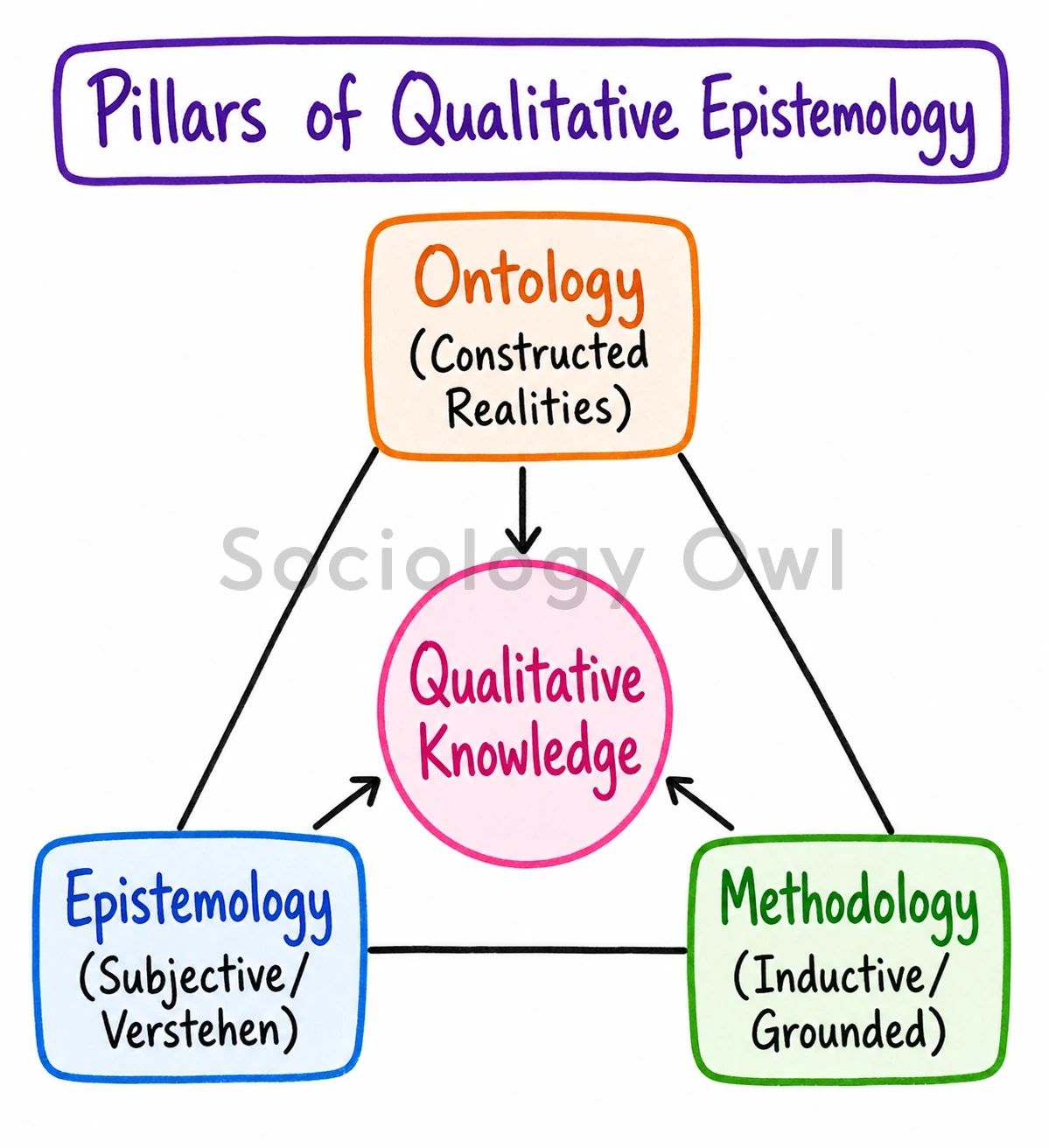
Epistemology (“how we know”) in qualitative research rejects Positivism’s search for objective laws. Rooted in Interpretivism, it argues that social reality is multiple and subjectively constructed.

Core Epistemological Principles

  • Interpretive Meaning: Max Weber’s Verstehen mandates the empathetic understanding of actors’ motives.
  • Constructed Knowledge: Symbolic Interactionism (G.H. Mead) asserts that knowledge emerges from context-bound, everyday interactions.
  • Inductive Logic: Rather than testing hypotheses, knowledge is generated bottom-up, exemplifying the Grounded Theory of Glaser and Strauss.
  • Reflexivity: Feminist sociologists like Ann Oakley argue that the researcher’s positionality inherently shapes knowledge production.

Epistemological Critiques

  • Positivist View: Emile Durkheim criticized qualitative epistemology for lacking reliability, generalizability, and objectivity.
  • Postmodern View: Highlights a “crisis of representation,” questioning whether researchers can ever authentically capture another’s subjective reality without imposing their own narrative.

Understanding modern gig-workers requires qualitative epistemology to grasp their subjective lived reality of algorithmic alienation, which objective income statistics miss.

Conclusion

Modern sociology transcends this epistemological divide through Methodological Pluralism and Triangulation (Alan Bryman), merging qualitative depth with quantitative breadth to capture holistic social realities.

Examine epistemological foundations of qualitative methods of social research. Read More »

Write short note on Class struggle as conceived by Karl Marx.

Model Answers

Q: Write short note on Class struggle as conceived by Karl Marx.

Question asked in UPSC Sociology 2005 Paper 1. Download our app for last 20 year question with model answers.

Model Answer:

Karl Marx’s Theory of Class Struggle: A Sociological Analysis

Karl Marx’s concept of class struggle is the cornerstone of his sociological framework, intricately linked to his theories of Historical Materialism and Social Change. In his seminal work, “The Communist Manifesto” (1848), co-authored with Friedrich Engels, Marx famously declared, “The history of all hitherto existing society is the history of class struggles.” For UPSC Sociology, understanding this concept requires moving beyond basic definitions to explore its historical origins, structural components, sociological critiques, and application to both Indian society and contemporary global dynamics.

Historical Context and Origins

Marx formulated his theory during the tumultuous era of the 19th-century Industrial Revolution in Europe. Witnessing the severe exploitation of factory workers, Marx inverted G.W.F. Hegel’s concept of “Dialectical Idealism” into Dialectical Materialism. He argued that it is not ideas, but material/economic conditions that drive history. He combined French socialist thought, British political economy, and German philosophy to posit that societal transformation occurs through the systemic conflict between economic classes.

Core Tenets of Marxian Class Struggle

  • Historical Materialism and Modes of Production: Marx argued that society’s Economic Base (infrastructure) determines its Superstructure (religion, law, state). As the Forces of Production (FOP) advance, they come into contradiction with the existing Relations of Production (ROP), sparking class conflict and pushing society into a new historical epoch (e.g., Feudalism to Capitalism).
  • Class Polarization: Capitalism inherently divides society into two mutually antagonistic camps: the Bourgeoisie (owners of the means of production) and the Proletariat (who possess only their labor-power). Marx predicted the absorption of the middle class (petty bourgeoisie) into the proletariat, a process known as Proletarianization.
  • From Class-in-Itself to Class-for-Itself: This is a crucial sociological transition. A Class-in-itself exists objectively as people sharing a common economic position. Through shared experiences of Alienation and Pauperization (extreme poverty), workers overcome False Consciousness and develop Class Consciousness, transforming into a Class-for-itself capable of revolutionary action.
  • The Revolutionary Resolution: The ultimate climax of this struggle is a violent revolution, leading to the Dictatorship of the Proletariat, and eventually culminating in a classless, stateless Communist society.

Comparative Analysis: Sociological Critiques and Refinements

Marx’s unidimensional, purely economic view of class was subsequently refined by later sociologists who recognized the complexities of modern stratification.

SociologistKey Concept / WorkDeparture from Marx’s Theory
Max WeberClass, Status, and PartyArgued that stratification is multi-dimensional. Economic class is important, but social prestige (Status) and political power (Party) also drive social conflict, preventing strict polarization.
Ralf DahrendorfClass and Class Conflict in Industrial SocietyReplaced the concept of property ownership with Authority. He argued that conflict in modern society occurs within Imperatively Coordinated Associations (ICAs) between order-givers and order-takers.
Antonio GramsciCultural HegemonyShifted focus to the Superstructure. Argued that the ruling class maintains dominance not just through economic force, but by manipulating culture and ideology to manufacture consent among the working class.

The Indian Context: Applying Marxist Class Struggle (Paper 2 Integration)

While traditional Indology focused heavily on Caste and Religion, several prominent Indian sociologists have successfully applied Marxist frameworks to understand Indian social realities:

  • A.R. Desai: In his seminal work “Social Background of Indian Nationalism”, Desai used a Marxist historical materialist approach to argue that Indian nationalism was not merely a political awakening, but a product of new class equations and class struggles emerging under British colonial capitalism.
  • Agrarian Class Structure: Scholars like D.N. Dhanagare and Kathleen Gough utilized the Marxist lens to study peasant uprisings in India (e.g., the Telangana and Naxalbari movements). They demonstrated how rural India is divided into landlords, rich peasants, and landless laborers, marked by intense class antagonism.
  • Caste and Class Intersection: Andre Beteille, in his study of a Tanjore village (“Caste, Class, and Power”), observed that the traditional congruence between caste and class is breaking down. However, Marxist scholars like Ranadive argue that in India, caste often acts as a proxy for class, and the Dalit struggle is inherently a class struggle against agrarian capitalism.
  • Jan Breman: Explored the plight of the informal sector and footloose labor in Gujarat, highlighting the hyper-exploitation and class struggle of the unorganized workforce in modern India.

Contemporary Relevance in the Globalized World

Marx’s predictions of extreme polarization and absolute pauperization did not materialize precisely as he envisioned in the West, largely due to the rise of the welfare state and trade unionism (as noted by T.H. Marshall). However, the essence of class struggle remains profoundly relevant today:

  • Wealth Inequality: Economist Thomas Piketty’s “Capital in the Twenty-First Century” empirically validates Marx’s theory that capitalism inherently concentrates wealth in the hands of a few, leading to widening global inequalities.
  • The Rise of the Precariat: Sociologist Guy Standing identifies a new dangerous class, the “Precariat”—gig economy workers (like Uber drivers and delivery agents) who lack job security, benefits, and occupational identity, reflecting modern-day Marxian alienation and exploitation.
  • Transnational Capitalist Class: Leslie Sklair highlights how globalization has created a global bourgeoisie that controls multinational corporations, leading to an internationalized class struggle against global labor forces.

Conclusion

While Karl Marx’s prophecy of an inevitable, global communist revolution remains unfulfilled, his analytical framework of class struggle endures as a vital heuristic tool in sociology. It provides an indispensable vocabulary for critiquing structural inequality, exploitation, and power dynamics. As modern society grapples with algorithmic management, gig-labor exploitation, and staggering wealth gaps, Marx’s assertion that structural contradictions breed social conflict remains as prescient as ever, reminding us that the struggle for equitable resource distribution is an ongoing historical process.

Write short note on Class struggle as conceived by Karl Marx. Read More »

Explain with examples, the explanatory and exploratory designs of social research.

Model Answers

Q: Explain with examples, the explanatory and exploratory designs of social research.

Question asked in UPSC Sociology 2018 Paper 1. Download our app for last 20 year question with model answers.

Model Answer:

Research design is a sociological study’s blueprint, reflecting the epistemological divide between Interpretivism and Positivism.

Comparative Analysis of Research Designs

  • Objective: Exploratory design generates new hypotheses regarding undefined phenomena via an Inductive approach. Explanatory design tests existing theories to establish cause-and-effect relationships via a Deductive approach.
  • Epistemology: Exploratory aligns with Interpretivism and micro-sociology, seeking Verstehen (empathic understanding). Explanatory relies on Positivism and macro-sociology to discover objective universal laws.
  • Methodology: Exploratory uses unstructured qualitative methods (e.g., ethnography); Explanatory uses structured quantitative tools (e.g., statistical surveys).
  • Sociological Examples: William Foote Whyte’s Street Corner Society explored hidden slum structures using participant observation. Conversely, Emile Durkheim’s Suicide used explanatory concomitant variation to causally link social integration and suicide.

Studying artificial intelligence’s impact on gig workers requires exploratory interviews to grasp new subjective nuances, followed by explanatory surveys to map structural employment trends.

Conclusion

Modern sociology rejects strict methodological binaries. By embracing Methodological Pluralism and Triangulation (Norman Denzin), researchers successfully combine exploratory depth with explanatory breadth to achieve holistic insights.

Explain with examples, the explanatory and exploratory designs of social research. Read More »

Write short note on Relevance of pattern variables in the study of social change.

Model Answers

Q: Write short note on Relevance of pattern variables in the study of social change.

Question asked in UPSC Sociology 2008 Paper 1. Download our app for last 20 year question with model answers.

Model Answer:

Pattern Variables and Social Change

The concept of Pattern Variables was introduced by the eminent American sociologist Talcott Parsons in his seminal work, The Social System (1951). Building upon the legacy of Ferdinand Tönnies (Gemeinschaft vs. Gesellschaft), Emile Durkheim (Mechanical vs. Organic Solidarity), and Max Weber (Traditional vs. Rational action), Parsons sought to create a grand theoretical framework to understand human action. Pattern variables are essentially five dichotomous dilemmas of choice that an actor must resolve before taking any social action. In the context of social change, these variables act as a structural-functional barometer to measure a society’s transition from traditional (expressive) to modern (instrumental) forms.

Framework of Pattern Variables in Social Change

To study social change, sociologists use Parsons’ five dichotomies to track how societal values evolve during the process of modernization and industrialization:

Pattern Variable DilemmaTraditional Society (Expressive Action)Modern Society (Instrumental Action)
Affectivity vs. Affective NeutralityHigh emotional involvement (e.g., joint family reliance)Emotional detachment (e.g., doctor-patient relationship)
Collectivity vs. Self-OrientationSacrificing for the group (e.g., tribal loyalty)Pursuit of individual goals (e.g., capitalist entrepreneurship)
Particularism vs. UniversalismJudging based on relationships (e.g., nepotism)Judging based on general rules (e.g., rule of law)
Ascription vs. AchievementStatus by birth (e.g., caste, royalty)Status by effort (e.g., merit-based civil services)
Diffuseness vs. SpecificityBroad, undefined obligations (e.g., patron-client ties)Narrow, contract-based obligations (e.g., gig economy worker)

Relevance in Analyzing Social Change

  • Measuring Economic Development: Sociologists like Bert F. Hoselitz and Neil Smelser applied pattern variables to study economic growth. They demonstrated that for a society to industrialize, its economic institutions must shift from ascription, particularism, and diffuseness towards achievement, universalism, and specificity.
  • Analyzing Institutional Differentiation: As societies change, institutions undergo structural differentiation. For example, education moves away from particularistic religious teachings (Gurukul system) to universalistic, standardized modern schooling.
  • Evaluating Role Expectations: Pattern variables map the increasing complexity of modern roles. The shift from a feudal serf (ascriptive, diffuse) to a modern factory worker (achievement-oriented, specific) highlights the macro-structural evolution of society.

The Indian Context: Application and Complexities (Paper 2 Integration)

In the Indian context, the application of pattern variables reveals that social change is rarely a linear shift from traditional to modern, but rather a complex synthesis.

  • Yogendra Singh on Modernization: In his book Modernization of Indian Tradition, Yogendra Singh uses a similar paradigm to show that India is experiencing a unique blend. While universalistic legal frameworks are adopted, particularistic structures like caste remain resilient by adapting to modern democracy (e.g., caste-based voting blocks).
  • M.N. Srinivas and Caste Resilience: Through concepts like Sanskritization and Westernization, M.N. Srinivas observed that while Indians adopt achievement-oriented modern professions, they often retain ascriptive and affective ties in private spheres (like marriage and family).
  • Dipankar Gupta’s “Mistaken Modernity”: Dipankar Gupta argues that India suffers from “mistaken modernity.” While we possess the superficial trappings of modern society (technology, consumerism), our underlying social relations remain heavily grounded in ascription and particularism rather than true universalism.
  • Lloyd and Susanne Rudolph: In The Modernity of Tradition, they argue that traditional structures (like caste associations) have become vehicles for modernization, blurring Parsons’ neat dichotomies. Traditional ascriptive identities are used to achieve modern political goals.

Contemporary Relevance in a Globalized World

In the 21st century, Parsons’ variables remain highly relevant for analyzing post-industrial and globalized societies. The rise of the Gig Economy represents extreme Specificity and Affective Neutrality, where human interactions are reduced to algorithmic contracts. Conversely, the concept of Glocalization (coined by Roland Robertson) shows how global corporations blend Universalism (global standard products) with Particularism (customizing menus for local tastes, like the McAloo Tikki in India). Furthermore, social media often blurs these boundaries, mixing specific professional networking with diffuse, affective personal sharing.

Conclusion

While critics like Jürgen Habermas and Anthony Giddens argue that Parsons’ structural-functionalism oversimplifies human agency and presents a Eurocentric view of modernization, the pattern variables remain an indispensable heuristic tool. As Talcott Parsons envisioned, they provide the necessary vocabulary to decode the DNA of social change. When adapted to specific historical and cultural realities—such as the resilient hybridity of Indian society—pattern variables allow sociologists to systematically measure the tensions, transitions, and trajectories of human civilization moving through time.

Write short note on Relevance of pattern variables in the study of social change. Read More »

Write short note on Class-in-itself and class-for-itself.

Model Answers

Q: Write short note on Class-in-itself and class-for-itself.

Question asked in UPSC Sociology 2003 Paper 1. Download our app for last 20 year question with model answers.

Model Answer:

Class in itself and class for itself

The concepts of Class-in-itself (Klasse an sich) and Class-for-itself (Klasse für sich) were formalized by Karl Marx in his 1847 work, The Poverty of Philosophy. Emerging during the height of the Industrial Revolution, Marx observed that the transition from feudalism to capitalism had thrown masses of displaced peasants into urban factories. While these workers shared immense suffering and identical material conditions, they initially lacked the solidarity and organization required to challenge the capitalist system. Marx developed these concepts to explain the trajectory of the working class from a fragmented, exploited aggregate into a revolutionary political force.

Core Concepts: The Marxist Perspective

Class-in-itself (Objective Reality)

This represents the objective economic dimension of social class. A group forms a “class-in-itself” when its members share a common relationship to the means of production.

  • It is an aggregate of individuals who occupy the same structural position in the economic system (e.g., wage laborers who own no property and must sell their labor).
  • At this stage, workers are highly atomized, viewing each other as competitors in the labor market rather than comrades.
  • The existence of the class is an objective fact, completely independent of whether the individuals possess a subjective awareness of their shared exploitation.

Class-for-itself (Subjective Awareness)

This represents the subjective and political dimension of social class. It occurs when a “class-in-itself” develops Class Consciousness—a collective awareness of their shared exploitation and common structural interests.

  • It marks the transformation from a passive socio-economic category into an active, self-conscious political agent.
  • Workers overcome false consciousness (the adoption of bourgeois ideologies) and recognize the bourgeoisie as their systemic antagonist.
  • This stage is characterized by collective action, the formation of trade unions, and ultimately, political mobilization aimed at structural revolution.

Comparative Analysis

Basis of DifferenceClass-in-itselfClass-for-itself
NatureObjective and structural.Subjective and psychological/political.
AwarenessLack of shared class awareness; presence of false consciousness.High degree of true class consciousness.
Inter-personal RelationsWorkers view each other as competitors for wages.Workers view each other as comrades in a shared struggle.
ActionPassive existence; unorganized and atomized.Active resistance; organized into unions and political parties.
Historical RoleVictims of capitalist exploitation.The “Vanguard of the Revolution” leading to socialism.

Sociological Critiques and Extensions

  • Max Weber: Criticized Marx’s deterministic view that a class-in-itself inevitably becomes a class-for-itself. Weber argued that shared “market situations” do not automatically translate into communal action, as workers may be divided by status groups (religion, ethnicity).
  • Georg Lukács: In his book History and Class Consciousness, Lukács emphasized that class consciousness is not a natural byproduct of economic conditions but must be actively cultivated by a revolutionary party.
  • Ralf Dahrendorf: Argued that in post-capitalist societies, the institutionalization of class conflict (via collective bargaining and labor laws) prevents the working class from ever becoming a revolutionary class-for-itself.

The Indian Context (Paper 2 Integration)

Applying Marxian class theory to India requires immense theoretical nuance, as the traditional Marxist binary is heavily complicated by the pervasive reality of caste, religion, and regionalism.

  • A.R. Desai: In his Marxist analysis of Indian nationalism, Desai argued that British colonialism created new objective classes (a class-in-itself) such as the industrial bourgeoisie, modern proletariat, and impoverished peasantry. However, their transition to a class-for-itself was uniquely channeled through the anti-colonial freedom struggle rather than a pure socialist revolution.
  • Andre Beteille: In his study of agrarian relations in Tanjore (Caste, Class, and Power), Beteille notes that while objective economic classes exist in Indian villages (landlords, tenants, landless laborers), subjective class consciousness is severely fragmented. A landless laborer’s loyalty is often tied to their caste or patron (Jajmani relations) rather than their economic class, preventing the emergence of a true class-for-itself.
  • Dipankar Gupta: Highlights that in India, caste identities often override class solidarity. Political mobilization frequently occurs along caste lines (e.g., dominant castes demanding reservations) rather than pure economic class lines, demonstrating the presence of a “class-in-itself” but an aborted “class-for-itself.”
  • Kathleen Gough: Contrary to Beteille, Gough found that in parts of South India (like Kerala and Tanjore), extreme polarization did lead agricultural laborers to develop strong class consciousness, acting as a class-for-itself through communist peasant movements.

Contemporary Relevance

In the modern, globalized world, Marx’s distinction remains highly relevant, albeit in new forms:

  • The Gig Economy and The Precariat: Sociologist Guy Standing identifies a new emerging class called the Precariat (gig workers, freelancers, Uber drivers). Due to algorithms and spatial isolation, they clearly form a highly exploited class-in-itself. However, their physical separation and lack of traditional factory floors make it incredibly difficult for them to organize into a class-for-itself.
  • Neo-Marxist perspective on Mass Media: Thinkers of the Frankfurt School, particularly Herbert Marcuse in One-Dimensional Man, argue that advanced capitalism uses consumerism, mass media, and the welfare state to placate the working class. This perpetually traps them in a state of false consciousness, preventing the transition to a class-for-itself.

Conclusion

The conceptual dichotomy of class-in-itself and class-for-itself remains a foundational tool in sociology for analyzing the gap between objective inequality and subjective political mobilization. As British Marxist historian E.P. Thompson famously argued in The Making of the English Working Class, class is not a “thing” but a “historical relationship.” The transformation into a class-for-itself is not a mechanical inevitability, but a complex historical process forged through shared struggles, culture, and active human agency.

Write short note on Class-in-itself and class-for-itself. Read More »

Social fact is to be treated as a thing. Discuss.

Model Answers

Q: Social fact is to be treated as a thing. Discuss.

Question asked in UPSC Sociology 2012 Paper 1. Download our app for last 20 year question with model answers.

Model Answer:

The methodological injunction that “social facts must be treated as things” is the bedrock of classical positivist sociology, formulated by Émile Durkheim in his seminal work, “The Rules of Sociological Method” (1895). Historically, late 19th-century sociology was struggling to establish its legitimacy. It was heavily overshadowed by philosophy (which was highly speculative) and psychology (which was highly individualistic). To establish sociology as an autonomous, empirical science, Durkheim argued that society has a reality of its own (Sui Generis), and its subject matter—Social Facts—must be studied with the same objective rigor as natural scientists study physical objects.

Decoding the Concept: Social Facts as “Things”

Durkheim defined social facts as “ways of acting, thinking, and feeling, external to the individual, and endowed with a power of coercion.” By instructing sociologists to treat them as “things,” Durkheim did not mean they are material entities, but rather that they possess properties requiring objective empirical investigation.

Key Characteristics of Treating Social Facts as Things

  • Objectivity and Eradication of Prenotions: Sociologists must abandon common-sense assumptions, biases, and ideological prejudices. Social phenomena must be observed from the outside, just like natural phenomena.
  • Exteriority: Social facts exist independently of individual will. For example, language, legal systems, and monetary networks exist before a person is born and continue after they die.
  • Coercion: They exert a normative pressure on individuals. Defying a social fact (like violating a social norm or law) invites sanctions, proving its “thing-like” resistance to individual manipulation.
  • Empirical Measurement: Because they are external realities, they can be measured using statistics and historical data. Durkheim famously demonstrated this in his book “Suicide” (1897), where he treated suicide rates as social facts rather than individual psychological failures.

The Indian Context: Integrating Paper 2

Applying Durkheim’s methodology to the Indian sociological context provides profound insights into the structural constraints of Indian society. Indian thinkers have frequently analyzed institutional realities that operate as coercive, external “things.”

  • The Caste System: As analyzed by Louis Dumont in “Homo Hierarchicus”, the ideology of purity and pollution operates as a macro-social fact. It dictates endogamy, commensality, and occupational choices, coercing individuals regardless of their personal beliefs.
  • Sanskritization: M.N. Srinivas conceptualized Sanskritization as a widespread social reality in India. The rigid, pre-existing structure of the caste hierarchy forces lower castes to adopt the customs of the “twice-born” castes to seek upward mobility, showcasing the coercive power of the caste structure.
  • Village Republics: A.R. Desai and S.C. Dube studied the Indian village and agrarian structures. For a marginalized landless laborer, the structural reality of agrarian class relations (a social fact) is as objective and coercive as a physical wall.

Comparative Analysis: Positivism vs. Interpretivism

Durkheim’s treatment of social facts as things established the macro-sociological tradition, but it is best understood when contrasted with micro-sociological critiques.

Aspect Durkheimian Positivism (Social Facts) Interpretivism (Weberian / Interactionist)
Subject Matter External, objective structures and institutions. Subjective meanings and internal motives.
Methodology Quantitative, statistical analysis, viewing society as a “thing”. Verstehen (empathetic understanding), Qualitative analysis.
View of Individual Passive; coerced by external structures (Determinism). Active; creator of social reality (Agency).
Key Thinkers Émile Durkheim, Talcott Parsons Max Weber, G.H. Mead, Herbert Blumer

Critiques of Durkheim’s Methodology

While revolutionary, the injunction to treat social facts as things has faced severe criticism from various sociological traditions:

  • Max Weber and Interpretivism: Weber argued that sociology is the study of Social Action, which is fundamentally driven by subjective meanings. Treating human behavior as mere “things” ignores human agency and consciousness.
  • Phenomenology and Ethnomethodology: Thinkers like Peter Berger, Thomas Luckmann, and Harold Garfinkel argue that social facts are not objective “things” waiting to be discovered. Instead, they are ongoing social constructions maintained through everyday human interactions.
  • Marxist Critique: While Marxists also look at macro-structures, they argue that Durkheim’s “things” are actually historically specific bourgeois constructs designed to maintain elite hegemony, rather than natural, inevitable facts.

Contemporary Relevance

In the modern, highly globalized, and digitalized world, Durkheim’s concept remains strikingly relevant. Today, Social Media Algorithms, Viral Trends, and Cancel Culture operate as perfect modern social facts. They are external to the individual user, operate collectively, and exert immense coercive power over modern behavior, often forcing individuals to conform to online normative standards or face digital ostracization.

Conclusion

Durkheim’s directive to treat social facts as things was the methodological breakthrough that successfully emancipated sociology from the shadows of philosophy and psychology. While modern sociology, particularly through the lens of Anthony Giddens’ Structuration Theory, seeks to balance this structural determinism with human agency, Durkheim’s core premise remains valid. As Durkheim aptly summarized, “Sociology is, then, not an auxiliary of any other science; it is itself a distinct and autonomous science… the science of institutions, their genesis, and their functioning.”

Social fact is to be treated as a thing. Discuss. Read More »

Explain the salient features of Weberian bureaucracy.

Model Answers

Q: Explain the salient features of Weberian bureaucracy.

Question asked in UPSC Sociology 2013 Paper 1. Download our app for last 20 year question with model answers.

Model Answer:

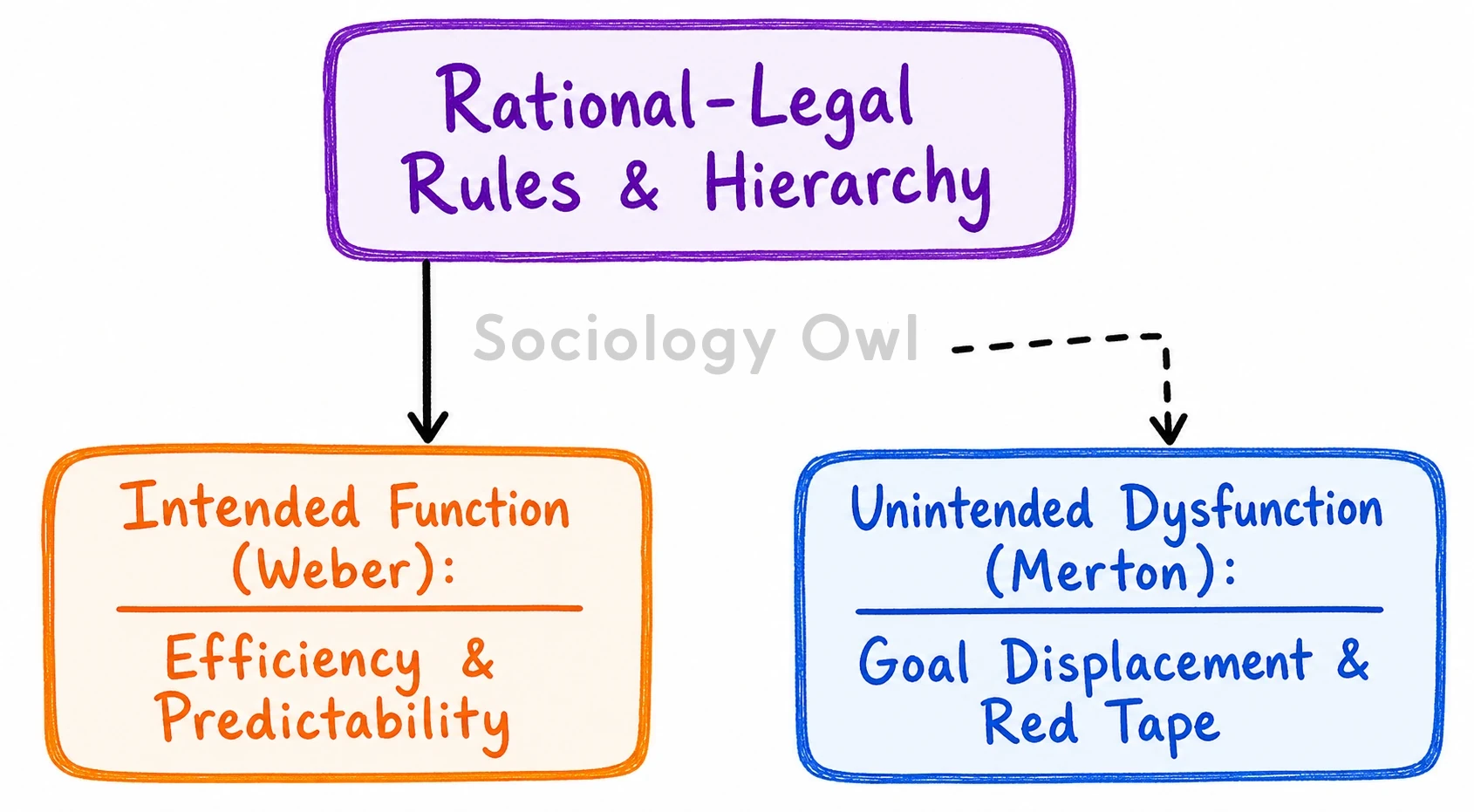
Max Weber defined bureaucracy as an “Ideal Type” of rational-legal authority, marking a historical shift from traditional patrimonial rule to formal, predictable organizations.

Salient Features of Bureaucracy

  • Structural Hierarchy: A graded chain of command with a strict division of labour based on technical competence.
  • Rule-bound Process: Administration is governed by exhaustive written rules and files, ensuring calculability and impersonality (decisions made without personal bias).
  • Professionalization: Features merit-based recruitment, fixed salaries, career orientation, and a strict separation of private and official property.

Critiques:

  • Max Weber himself feared this system traps individuals in a soulless “Iron Cage of Rationality”.
  • Robert Merton warned of “Goal Displacement” and the rigid “Bureaucratic Personality”, where blind rule-following supersedes organizational goals.

Weberian calculability and impersonality manifest today in algorithmic gig-economies and George Ritzer’s “McDonaldization”, even as modern tech firms attempt to shift towards flexible “Adhocracies”.

Conclusion

Despite dysfunctions like rigidity and oligarchic tendencies, the Weberian model remains the foundational bedrock of organizational sociology and the inescapable structural blueprint of global capitalism.

Explain the salient features of Weberian bureaucracy. Read More »

Examine ethnomethodological and phenomenological perspectives as critique of positivism

Model Answers

Q: Examine ethnomethodological and phenomenological perspectives as critique of positivism

Question asked in UPSC Sociology 2017 Paper 1. Download our app for last 20 year question with model answers.

Model Answer:

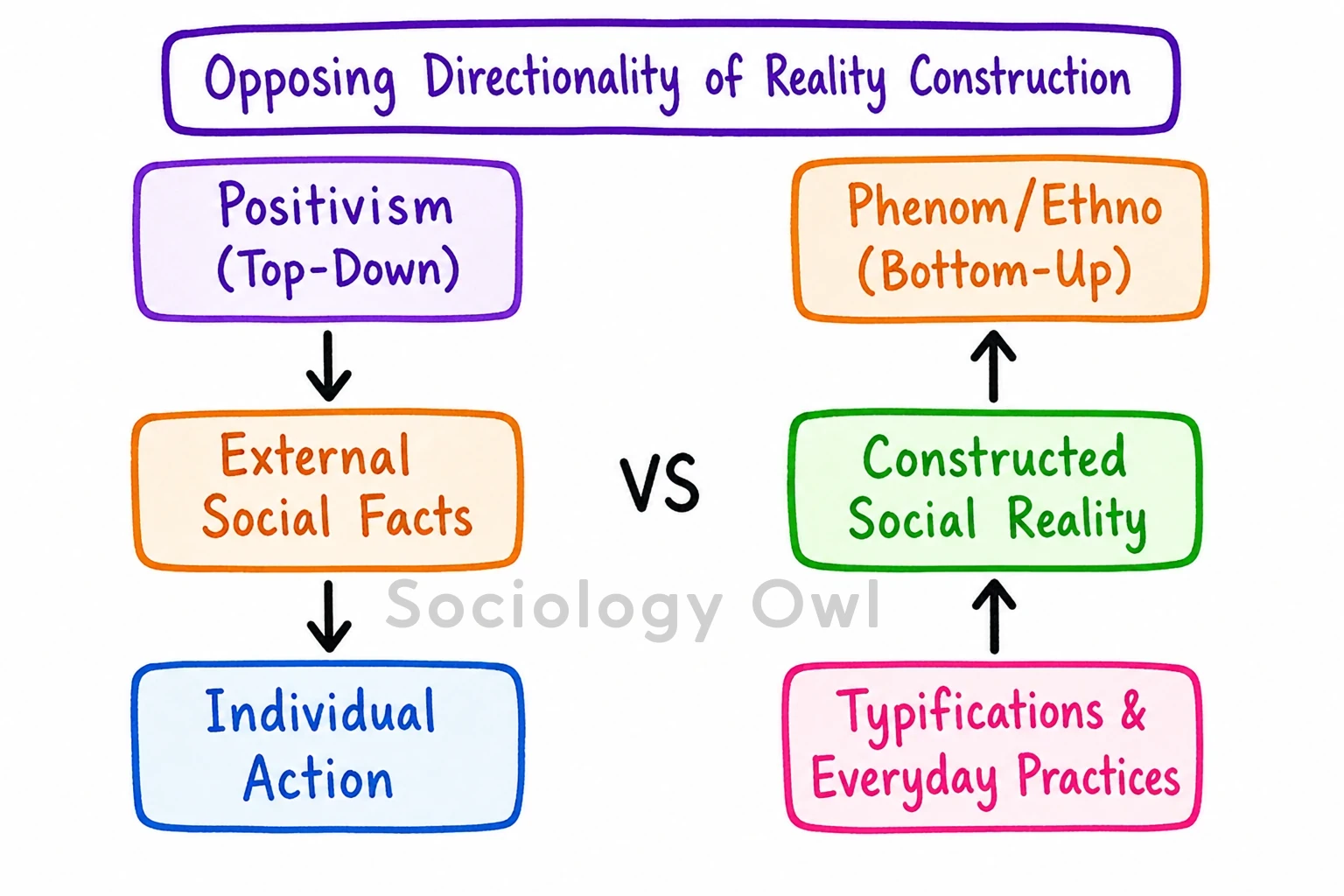
While Positivism (Emile Durkheim) treats society as a set of measurable “social facts,” Phenomenology and Ethnomethodology emerged as radical micro-sociological critiques, arguing that social reality is an inherently subjective construct.

Critiques of Positivism

Phenomenological Critique:

  • Subjective Meaning: Alfred Schutz argued that individuals construct reality using shared “typifications” (mental categories) and “intersubjectivity.”
  • Rejection of Objectivity: Positivism fails by ignoring the subjective “lifeworld,” falsely reducing human consciousness to mere quantifiable variables rather than understanding meanings.

Ethnomethodological Critique:

  • Order as an Accomplishment: Harold Garfinkel challenged positivism’s search for external, universal laws. Using “breaching experiments,” he proved social order is an ongoing, everyday accomplishment.
  • Contextual Reality: Concepts like “indexicality” (meaning depends on context) and “reflexivity” render positivist attempts at creating generalized, objective social laws impossible.

  • Application: Aaron Cicourel’s study on juvenile justice demonstrates that positivist crime statistics are not objective facts, but subjective constructs resulting from police typifications.
  • Counter-Critique: Marxists and Structuralists argue these micro-perspectives overcompensate, ignoring macro-objective realities like class inequality and institutional power dynamics.

Conclusion

While these perspectives successfully expose the limits of pure positivism, modern sociology demands a synthesis. Anthony Giddens’ Structuration Theory achieves this by effectively reconciling objective macro-structures with subjective micro-agency.

Examine ethnomethodological and phenomenological perspectives as critique of positivism Read More »

Discuss the importance and sources of hypothesis in social research.

Model Answers

Q: Discuss the importance and sources of hypothesis in social research.

Question asked in UPSC Sociology 2020 Paper 1. Download our app for last 20 year question with model answers.

Model Answer:

Importance of Hypothesis in Social Research

Understanding the Hypothesis in Sociology

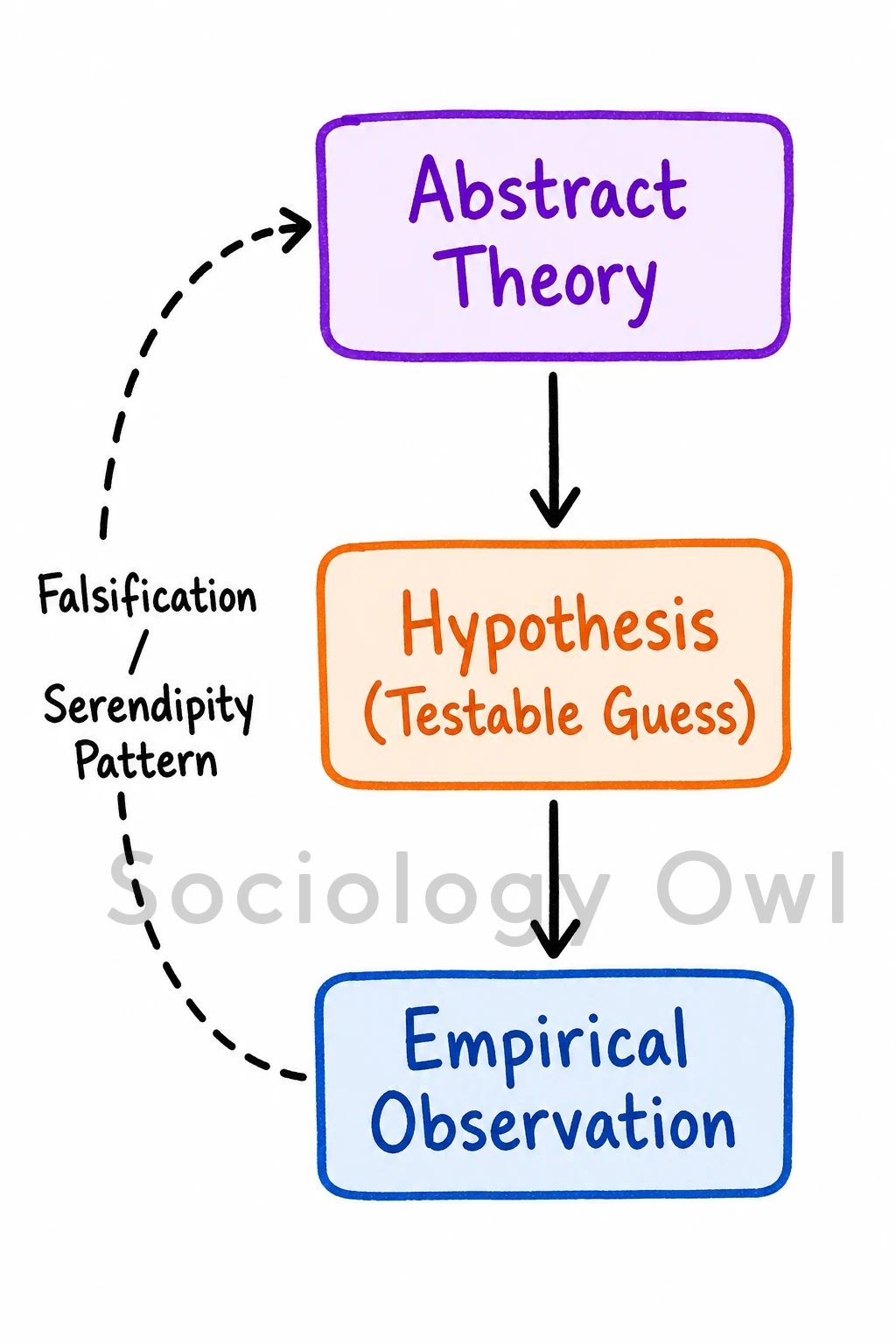
Goode and Hatt define a hypothesis as a “shrewd guess… provisionally adopted to explain observed facts.” It forms the bedrock of Positivist sociology and the Deductive method, linking abstract theory to empirical reality.

Importance of Hypothesis

Falsifiability: As Karl Popper notes, a good hypothesis allows for Falsification, ensuring scientific rigor and testability.

Objectivity: It restricts subjective bias, aiding Max Weber’s ideal of Value Neutrality by focusing the study.

Theory Building: It is crucial for formulating Robert K. Merton’s Middle-Range Theories. For example, Emile Durkheim’s hypothesis in Suicide empirically linked social solidarity to suicide rates.

Sources of Hypothesis

Existing Theory: Deriving specific testable variables from macro-theories (e.g., Marxism).

Observation: Merton’s concept of the “Serendipity Pattern,” where anomalous data sparks new hypotheses.

Culture and Folk Wisdom: Testing sociological validity of cultural common sense.

Previous Research: Literature reviews identifying empirical gaps.

Modern researchers often apply classical theories to formulate contemporary hypotheses, such as hypothesizing that algorithmic surveillance (independent variable) increases workplace Alienation (dependent variable) among gig economy workers.

Conclusion

While positivists rely on a priori hypotheses, Interpretivists reject them, advocating instead for Glaser and Strauss’s Grounded Theory, where hypotheses emerge inductively. Nonetheless, hypothesis formulation remains a vital tool for structured, empirical sociological inquiry.

Discuss the importance and sources of hypothesis in social research. Read More »