Misc

What is the Marxist concept of ‘fetishism of commodities’?

Model Answers

Q: What is the Marxist concept of ‘fetishism of commodities’?

Question asked in UPSC Sociology 2019 Paper 1. Download our app for last 20 year question with model answers.

Model Answer:

Commodity Fetishism and Its Evolution

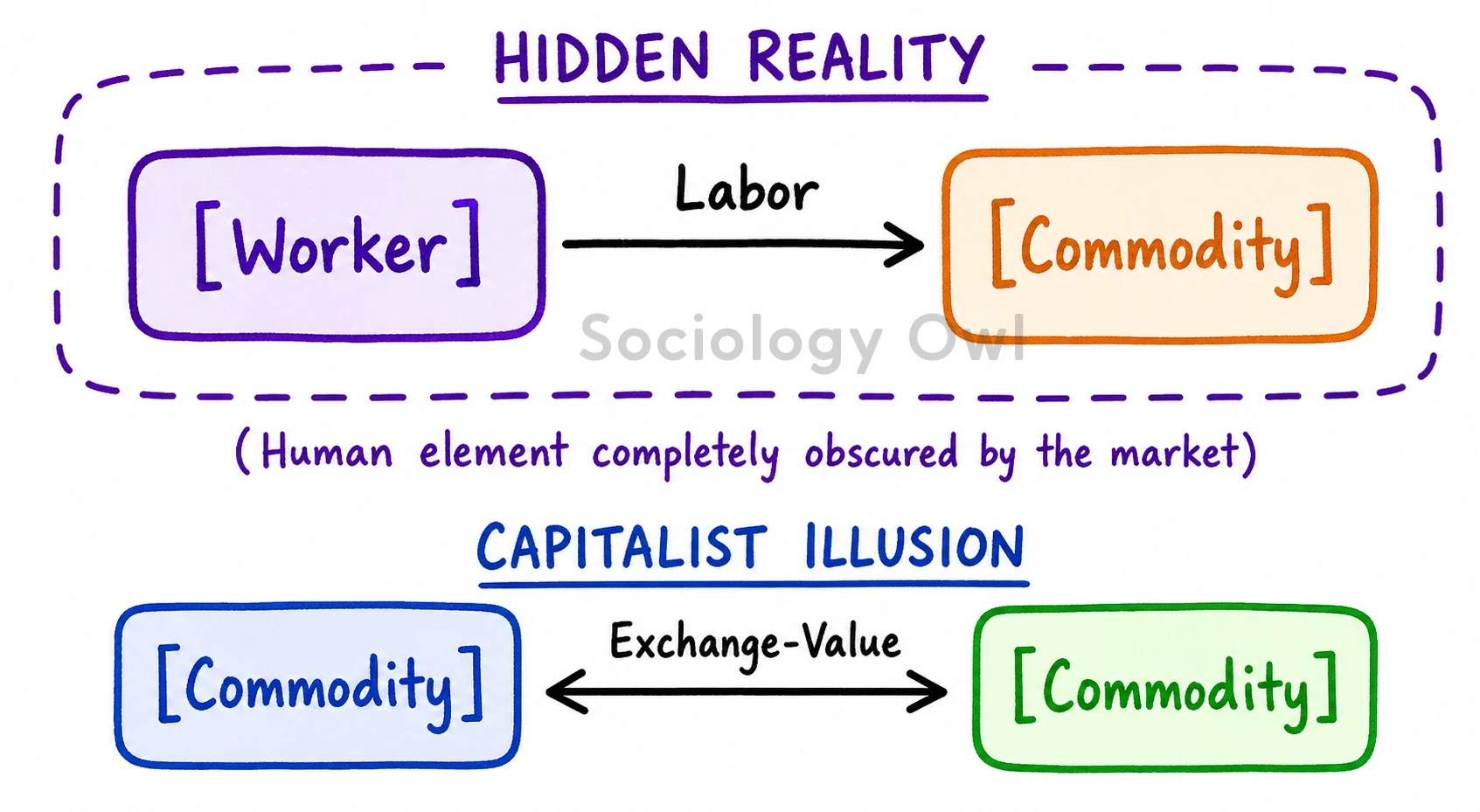
In Das Kapital, Karl Marx defines Commodity Fetishism as the phenomenon where Exchange-Value (market price) entirely overshadows Use-Value (utility). In capitalism, “a definite social relation between men assumes the fantastic form of a relation between things.”

Mechanism and Extensions

Obscured Relations: Commodities appear to possess intrinsic, “magical” power, masking the exploitative human labor that produced them.

Georg Lukács: Expanded this into Reification, where abstract social relations appear as natural, unchangeable objects.

Jean Baudrillard: Argued that modern fetishism is driven by Sign-Value (prestige and status), evolving beyond mere economic exchange.
Critique

Max Weber: Argued that modern alienation is driven by bureaucratic Rationalization, which would persist even in non-capitalist societies.

Interactionist View: Consumers are not merely passive victims of false consciousness; they actively use commodities to construct identity and meaning.

Society fetishizes smartphones for their sleek design and brand status (Sign-Value), remaining entirely blind to the exploitative labor (e.g., sweatshops, cobalt mining) driving their production.

Conclusion

Despite critiques, commodity fetishism remains a vital sociological tool to decode Alienation, hyper-consumerism, and the hidden exploitation embedded within modern global supply chains.

What is the Marxist concept of ‘fetishism of commodities’? Read More »
Critically examine Weber‘s theory of Protestant Ethic and Spirit of Capitalism.

Model Answers

Q: Critically examine Weber‘s theory of Protestant Ethic and Spirit of Capitalism.

Question asked in UPSC Sociology 2002 Paper 1. Download our app for last 20 year question with model answers.

Model Answer:

Max Weber, in his magnum opus “The Protestant Ethic and the Spirit of Capitalism” (1905), sought to explain the unique emergence of rational, modern capitalism in Western Europe. Methodologically, Weber used Ideal Types and the Historical Comparative Method to study world religions. Unlike Karl Marx, who viewed religion as the “opium of the masses” and a product of the economic base, Weber argued for an Elective Affinity (a mutual attraction and reinforcement) between the religious ideas of the Protestant Reformation and the ethos of modern capitalism.

The Core of the Weberian Thesis

Weber argued that modern capitalism is not merely about the greed for wealth, but is a rational, systematic pursuit of profit. This “spirit” was unintentionally fostered by the tenets of Calvinism (a branch of Protestantism):

  • Doctrine of Predestination: Calvinists believed that God had already chosen the “elect” for salvation, and nothing could change this decree. This created unprecedented salvation anxiety among believers.
  • The Calling (Beruf): To cope with this anxiety, Calvinists interpreted worldly success in one’s occupation as a “sign” of being chosen by God. Work became a religious duty.
  • This-Worldly Asceticism: Calvinism demanded strict discipline, hard work, and frugality. Believers were forbidden from wasting money on luxury or idle leisure.
  • Capital Accumulation: The combination of relentless work (generating wealth) and asceticism (preventing consumption) inevitably led to the constant reinvestment of profits, which is the very engine of capitalism.

Comparative Perspective: Weber vs. Marx on the Rise of Capitalism

ParameterKarl Marx (Historical Materialism)Max Weber (Social Action / Ideas)
Primary DriverChanges in the Mode of Production (Material Base).Changes in human consciousness and Religious Ideas.
View of ReligionReligion is part of the superstructure; it justifies exploitation.Religion can be an independent, revolutionary force causing social change.
Rise of CapitalismEmerged from the contradictions and class struggles of Feudalism.Emerged due to the unintended consequences of Calvinist ethics.

Critical Examination of the Thesis

While Weber’s thesis is a foundational text in sociology, it has been heavily critiqued by various scholars:

  • R.H. Tawney in Religion and the Rise of Capitalism argued that the causal direction was reversed: early capitalism in Italian city-states (like Venice and Florence, which were Catholic) created the conditions for Protestantism, not the other way around.
  • Werner Sombart criticized Weber for ignoring the contribution of Judaism, arguing that Jewish merchants played a far more crucial role in developing early capitalist institutions like credit and banking.
  • Robert Bellah demonstrated that the “spirit of capitalism” existed in non-Protestant societies. He highlighted the Samurai Ethic (Bushido) and the Tokugawa religion in Japan, which fostered similar values of loyalty, discipline, and rational capitalism.
  • Marxist Critique: Scholars argue that Weber underplays colonial exploitation, technological advancements, and the primitive accumulation of capital, placing undue emphasis on subjective religious motives.

The Indian Context: Weber’s View and Counter-Critiques

Weber extended his comparative study to India in “The Religion of India”. He argued that despite having the material prerequisites, capitalism did not develop indigenously in India due to Hinduism’s “Other-Worldly Asceticism.” He claimed that the doctrines of Karma and Dharma (within the caste system) promoted fatalism and ritual conformity rather than rational economic innovation.

However, Indian sociologists and modern anthropologists have robustly challenged Weber’s ethnocentric view:

  • Milton Singer, in his study of Madras industrialists, found that Hindu businessmen used a psychological mechanism of Compartmentalization. They separated their traditional religious life at home from their rational, modern capitalist behavior in the factory, proving Hinduism is not antithetical to capitalism.
  • Dipankar Gupta and Thomas Timberg have highlighted the role of the Marwaris, Jains, and Parsis. The traditional Vaishya ethic in India bears a strong resemblance to the Protestant ethic, emphasizing frugality, bookkeeping, and reinvestment.
  • A.R. Desai, from a Marxist perspective, argued that the lack of capitalist development in India was not due to Hindu theology, but was a direct result of British colonialism, which de-industrialized India and drained its wealth.

Contemporary Relevance

In the modern, globalized era, the religious roots of capitalism have withered away, but the “spirit” remains embedded in secular culture. Today’s “hustle culture,” the gig economy, and the relentless pursuit of productivity are secularized forms of the Protestant ethic. Furthermore, George Ritzer’s concept of McDonaldization shows how the Weberian principles of formal rationality, efficiency, and calculability continue to dominate contemporary global institutions, albeit stripped of their original spiritual meaning.

Conclusion

Max Weber’s thesis remains a masterclass in demonstrating how deeply held cultural and religious ideas can unintentionally alter the trajectory of global economic history. While his specific historical claims regarding Calvinism and Hinduism have been highly debated, his broader methodological contribution—that ideas matter in social change—is undisputed. As Weber himself poignantly concluded, the religious zeal of early capitalism has faded, leaving modern man trapped in an “Iron Cage” (Stahlhartes Gehäuse) of bureaucratic rationality and materialistic compulsion, a diagnosis that remains remarkably accurate for contemporary society.

Critically examine Weber‘s theory of Protestant Ethic and Spirit of Capitalism. Read More »

Explain Durkheim’s basic arguments on suicide. Can you analyse high suicide rates of contemporary Indian society with Durkheim’s theory?

Model Answers

Q: Explain Durkheim's basic arguments on suicide. Can you analyse high suicide rates of contemporary Indian society with Durkheim's theory?

Question asked in UPSC Sociology 2018 Paper 1. Download our app for last 20 year question with model answers.

Model Answer:

Durkheim’s Suicide Theory and Arguments

In Le Suicide (1897), Emile Durkheim sought to establish sociology as a positivist science by proving that a highly individualistic act is caused by “Social Facts” (suicidogenic currents). He defined suicide sociologically as death resulting from a direct or indirect act of the victim, knowing the outcome. Using “Concomitant Variation” on European data, he demonstrated the supremacy of society over the individual.

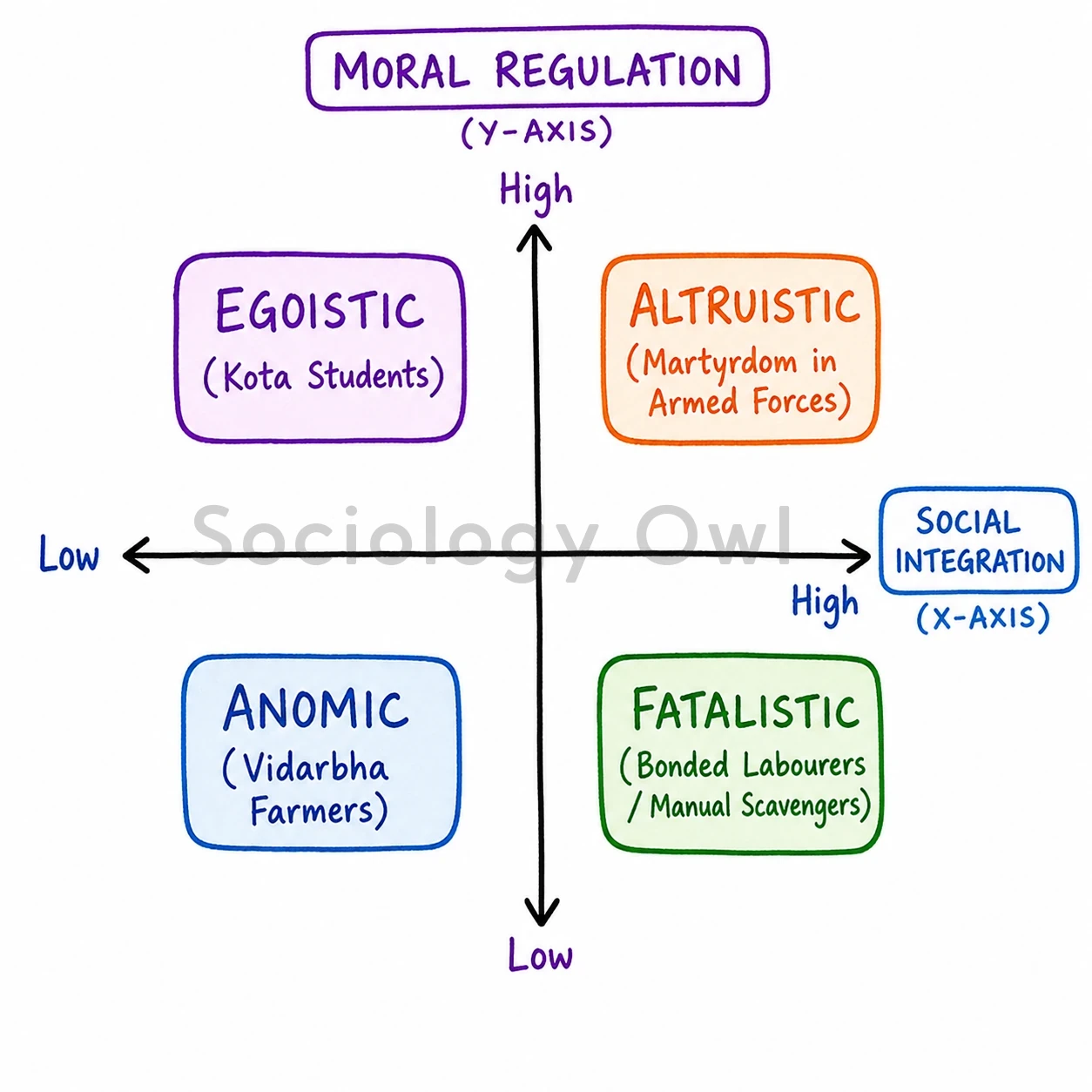
Durkheim argued suicide rates depend on two macro-sociological forces:

Social Integration

Egoistic: Low integration (detachment, isolation).

Altruistic: High integration (over-identification with group norms).

Moral Regulation

Anomic: Low regulation (normlessness, sudden economic shocks).

Fatalistic: High regulation (oppressive discipline, hopelessness).

moral regulation

Analyzing Contemporary Indian Society

Durkheim’s framework powerfully decodes India’s high suicide rates, reflecting NCRB data trends:

Egoistic Suicide

Hyper-individualism and the breakdown of traditional family support lead to extreme isolation, visible in the tragic Kota student suicides.

Altruistic Suicide

Over-integration into rigid family or sectarian beliefs, tragically exemplified by the Burari mass suicide or fasts-unto-death by political zealots.

Anomic Suicide

Globalization and market-driven agriculture create sudden economic shocks and normlessness, driving Farmer Suicides in regions like Vidarbha.

Fatalistic Suicide

Inescapable structural oppression, such as caste-based marginalization (e.g., the Rohith Vemula case) or women trapped in patriarchal domestic abuse.

Critics reject Durkheim’s macro-positivism. Phenomenologist J.D. Douglas argues official statistics are mere social constructions by coroners, while Ethnomethodologist J.M. Atkinson emphasizes the subjective “meaning” of the act. Globally, Indian youth suicides mirror suicidogenic currents in hyper-competitive societies like South Korea or Japan (Hikikomori).

Conclusion

While modern psychiatry favors a biopsychosocial model, Durkheim’s structural perspective remains indispensable. As India navigates the turbulent transition from mechanical to organic solidarity, viewing suicide through the lens of integration and regulation is vital for formulating systemic public policies, rather than merely treating it as individual psychiatric failure.

Explain Durkheim’s basic arguments on suicide. Can you analyse high suicide rates of contemporary Indian society with Durkheim’s theory? Read More »

Is sociology a value-free science ? Discuss

Model Answers

Q: Is sociology a value-free science ? Discuss

Question asked in UPSC Sociology 2020 Paper 1. Download our app for last 20 year question with model answers.

Model Answer:

Is Sociology a Value Free Science ?

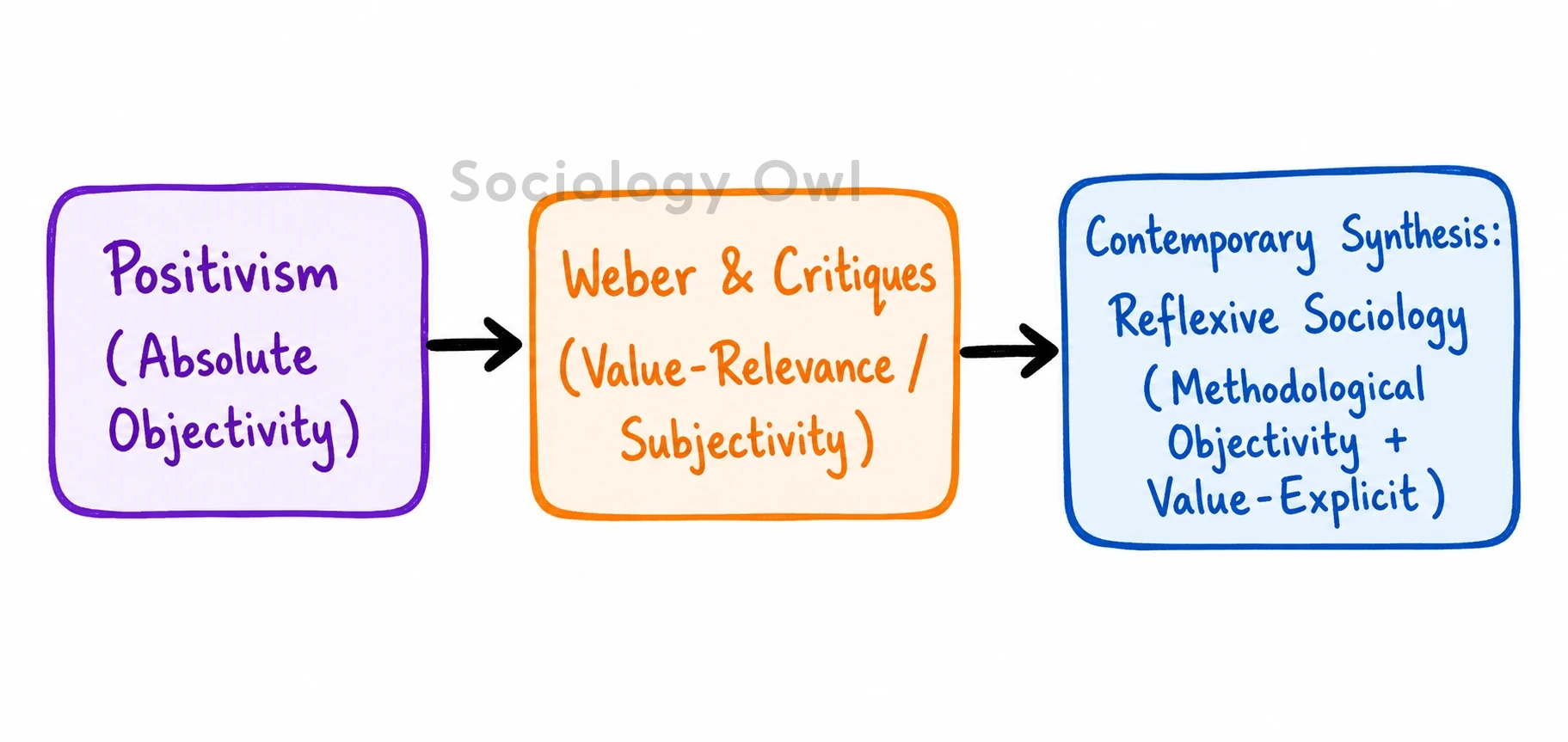
A value-free sociology implies an epistemological separation of empirical facts from researchers’ personal beliefs. The debate centers on whether sociology can emulate natural science’s objectivity (Positivism) or if human subjectivity renders this impossible.

Positivist and Interpretive Stances

Positivism: Auguste Comte and Emile Durkheim championed absolute value-neutrality, treating “social facts as things” to ensure pure objectivity.

Interpretivism: Max Weber advocated for Wertfreiheit (value-neutrality) in methodology, but acknowledged values guide topic selection. He utilized Verstehen to understand subjective meanings.

Critiques of Value-Free Sociology

Major Theoretical Critiques

Alvin Gouldner: In Anti-Minotaur: The Myth of a Value-Free Sociology, he argued neutrality is an illusion that excuses moral indifference.

Gunnar Myrdal: Noting that values are omnipresent, he advocated for “value-explicit” research.

Feminist Critique: Dorothy Smith’s Standpoint Theory highlights that supposedly “objective” sociology historically masks male-centric biases.

sociology value free

Modern research on Climate Justice or Gender Inequality inherently begins with a value judgment (that inequality is unjust) but requires strictly objective data-collection methods.

Conclusion

While absolute value-neutrality is impossible, sociology strives for methodological objectivity. By practicing Reflexivity (Pierre Bourdieu), sociologists explicitly acknowledge their social location, transforming sociology into a rigorously value-explicit and morally responsible science.

Is sociology a value-free science ? Discuss Read More »

Is non-positivistic methodology scientific? Illustrate.

Model Answers

Q: Is non-positivistic methodology scientific? Illustrate.

Question asked in UPSC Sociology 2018 Paper 1. Download our app for last 20 year question with model answers.

Model Answer:

Non-positivistic Methodology

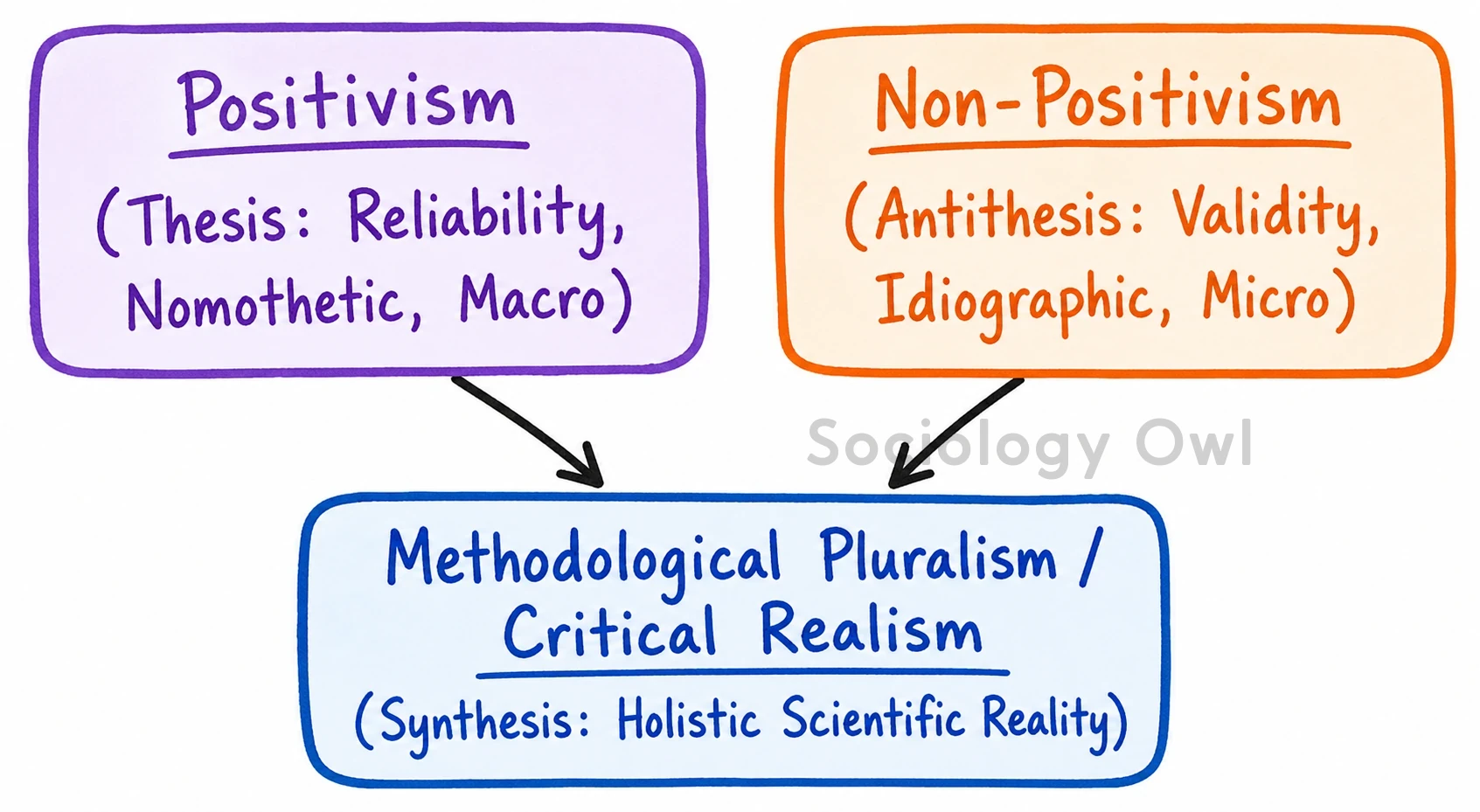
The debate on whether non-positivistic methodology is ‘scientific’ hinges on the definition of science itself. While positivists equate science with the nomothetic (natural science) model, non-positivists argue that studying conscious human beings requires an idiographic, interpretive epistemology focused on subjective reality.

Scientific Merit of Non-Positivism

  • Rigorous Conceptual Tools: Max Weber introduced Ideal Types alongside Verstehen as objective heuristic tools to systematically study subjective social action, drawing causal explanations in his seminal work, The Protestant Ethic and the Spirit of Capitalism.
  • Prioritizing Validity: Non-positivism pursues deep validity over mere reliability (replicability). William Foote Whyte’s participant observation in Street Corner Society uncovered facts about gang structures that standardized positivist surveys would inherently miss.
  • Systematic Experimentation: Harold Garfinkel’s ethnomethodology utilized “breaching experiments” to systematically uncover hidden, everyday social rules.
  • Objectivity through Reflexivity: Alvin Gouldner’s “Reflexive Sociology” mandates researchers to acknowledge their positionality, ensuring scientific transparency and addressing subjectivity biases.

Epistemological Critiques

  • Falsifiability: Karl Popper argues that non-positivist interpretations often evade strict Falsification, making them unscientific by strict positivist standards.
  • Paradigm Plurality: Countering this, Thomas Kuhn asserts that sociology is a multi-paradigmatic science where interpretivism functions as a distinct, valid scientific Paradigm.

Modern qualitative research proves non-positivism’s ongoing scientific utility. In Evicted, Matthew Desmond employs rigorous ethnography to map the hidden dimensions of urban poverty. Similarly, non-positivist studies of gig-economy workers capture “algorithmic alienation,” revealing subjective precarities entirely invisible to purely quantitative income surveys.

Conclusion

Ultimately, non-positivism expands the boundaries of science beyond mere quantification. Contemporary sociology resolves this debate through Methodological Pluralism (Alan Bryman) and Critical Realism (Roy Bhaskar), effectively synthesizing objective structural data with subjective meanings to capture a holistic and scientifically rigorous social reality.

Is non-positivistic methodology scientific? Illustrate. Read More »

“The sociological imagination enables us to grasp history and biography and the relationship between the two in a society.” – C.W.Mills. Explain.

Model Answers

Q: "The sociological imagination enables us to grasp history and biography and the relationship between the two in a society.” - C.W.Mills. Explain.

Question asked in UPSC Sociology 2018 Paper 1. Download our app for last 20 year question with model answers.

Model Answer:

The Sociological Imagination

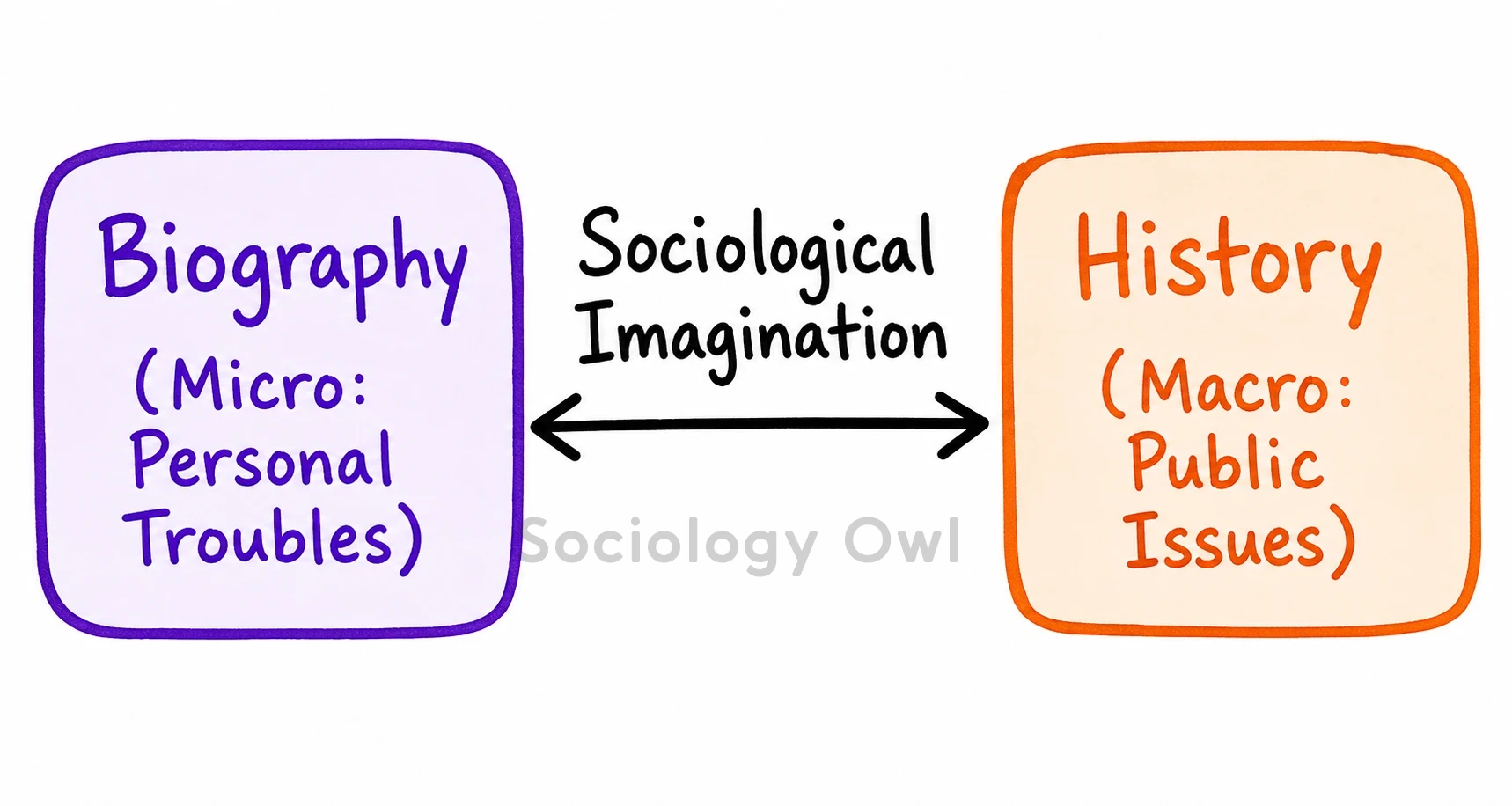
In The Sociological Imagination (1959), C.W. Mills offers a framework to bridge the micro-macro divide and the agency-structure debate. Rejecting both Talcott Parsons’ overly abstract “Grand Theory” and Paul Lazarsfeld’s micro-focused “Abstract Empiricism”, Mills envisioned a politically engaged sociology that connects individual experiences (biography) with broader structural forces (history).

Biography, History, and the Micro-Macro Link

  • Biography: Represents the micro-level, encompassing an individual’s personal experiences, character, and immediate milieu.
  • History: Represents the macro-level, including broad economic, political, and cultural transformations shaping society over time.
  • The Nexus: Mills argued that human lives are intricately woven into historical epochs. Individual choices (agency) are fundamentally constrained or facilitated by historical context (structure).

Personal Troubles vs. Public Issues

The core mechanism of sociological imagination is distinguishing:

  • Personal Troubles of Milieu: Occur within the individual’s immediate, private life.
  • Public Issues of Social Structure: Transcend local environments, rooted in institutional crises.
  • Mills’ Examples: If one person in a city is unemployed, it is a personal trouble. If 15 million are unemployed nationwide, it is a structural public issue. Similarly, mass divorce rates indicate macro-institutional shifts, not merely micro-level marital failure
  • Sociological Imagination

Theoretical Linkages and Critiques

  • Emile Durkheim demonstrated this imagination in Suicide, linking an intensely personal act (biography) to macro-social currents of regulation (history).
  • Anthony Giddens’ Structuration Theory echoes Mills by analyzing how human agency and structures mutually reproduce.
  • Critique: Postmodernists like Jean-François Lyotard reject grand historical narratives, asserting that contemporary society lacks a singular “History” connecting to fluid biographies. Furthermore, critics warn that emphasizing historical structure risks structural determinism, underplaying human free will.

Contemporary Relevance
In the era of AI automation, a freelance coder losing their job might perceive it as personal inadequacy (biography). However, the sociological imagination reframes this as a consequence of globalized platform capitalism and technological displacement (history).

Conclusion

Ultimately, Mills provided more than an analytical tool; he offered a democratic, emancipatory vision. By developing a sociological imagination, individuals transcend being passive victims of historical currents, becoming active, self-aware citizens capable of driving structural social change.

“The sociological imagination enables us to grasp history and biography and the relationship between the two in a society.” – C.W.Mills. Explain. Read More »

How can Parsons’ AGIL framework be used to analyse key problems is a society? Discuss.

Model Answers

Q: How can Parsons' AGIL framework be used to analyse key problems is a society? Discuss.

Question asked in UPSC Sociology 2013 Paper 1. Download our app for last 20 year question with model answers.

Model Answer:

AGIL Model of Talcott Parsons

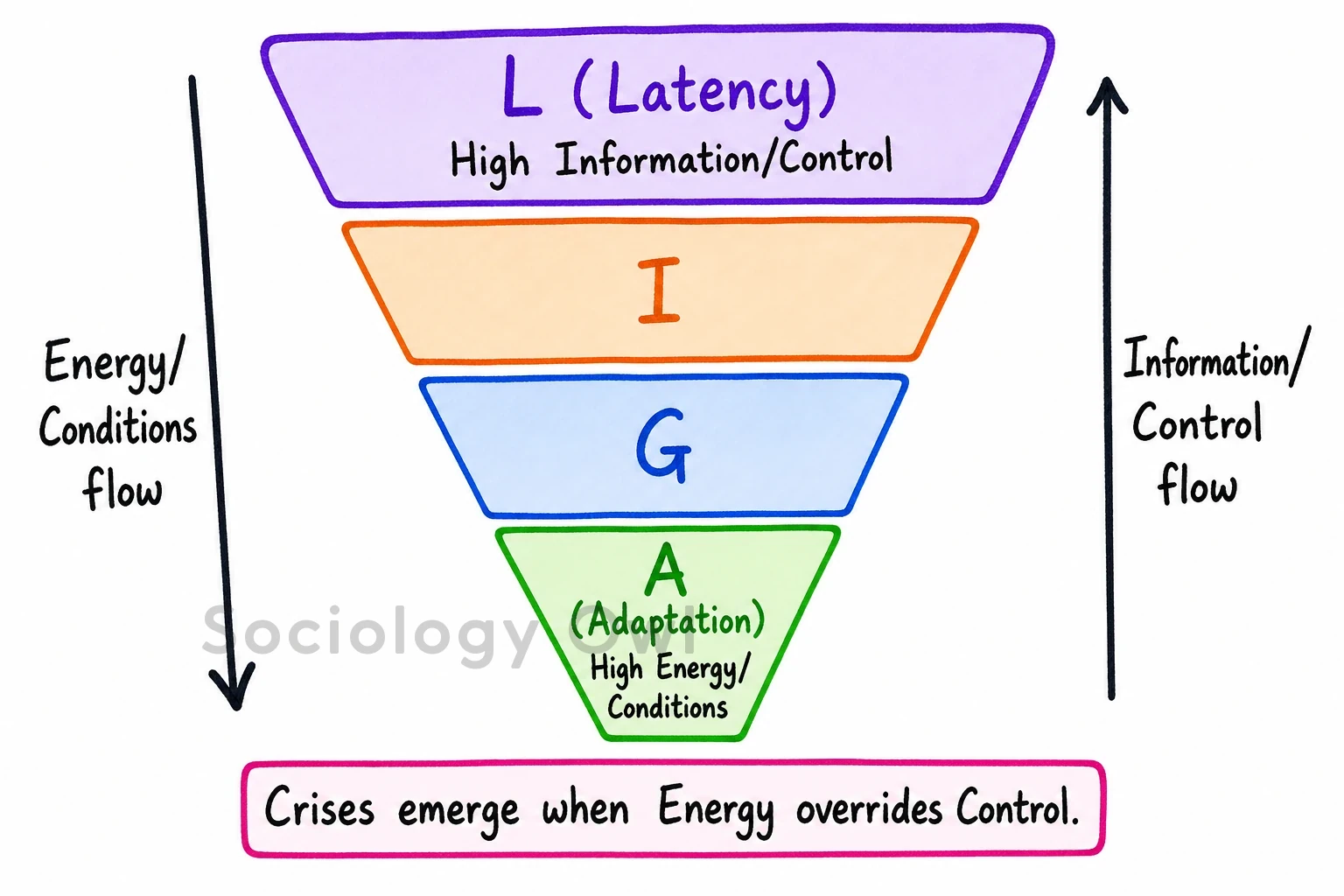
In The Social System, Talcott Parsons designed the AGIL framework to explain how societies maintain a “Moving Equilibrium”. To analyze key societal problems, this lens must shift to diagnose systemic strains, institutional maladjustments, and failures in Social Control Mechanisms.

Diagnosing Societal Crises via AGIL Deficits

Parsons argued that problems emerge when interdependent subsystems fail their functional prerequisites:

  • Adaptation (A – Economy): Deficits in resource mobilization cause unemployment and inflation. Robert Merton applied his concept of Dysfunctions here, showing how economic growth latently produces extreme inequality.
  • Goal Attainment (G – Polity): Governance deficits, corruption, and policy paralysis reflect a systemic inability to prioritize and execute collective goals.
  • Integration (I – Law/Community): The breakdown of Value Consensus breeds polarization and violence. This directly mirrors Emile Durkheim’s concept of Anomie, where rapid change dissolves normative regulation.
  • Latency (L – Family/Education): Failures in Socialization erode civic values. Jørgen Habermas’s “Legitimation Crisis” and Louis Althusser’s Ideological State Apparatus illustrate how institutional commodification destroys normative commitments.

AGIL Model
Furthermore, Parsons’ Cybernetic Hierarchy of Control explains that crises occur when high-energy subsystems (Adaptation/Economy) overwhelm high-information subsystems (Latency/Culture), leading to issues like hyper-consumerism overriding ethical values.

Critique of the Parsonian Approach

  • C. Wright Mills criticized AGIL as overly abstract “Grand Theory”, unable to capture visceral realities like poverty.
  • Ralf Dahrendorf argued its consensus-bias blinds it to how problems often stem from the coercive power of the state over the masses.

The COVID-19 pandemic highlights AGIL’s systemic interdependence. An Adaptive (A) shock (economic collapse) forced strict Goal Attainment (G) responses (state lockdowns), which triggered Integrative (I) crises (migrant distress and social isolation) and ultimately strained Latency (L) (mental health and education disruptions).

Conclusion

While conflict theorists expose its blind spots regarding power and coercion, Neo-Functionalists like Jeffrey Alexander have revived AGIL. It remains a highly sophisticated diagnostic grid, proving that mapping structural interdependencies is crucial for policymakers tackling multidimensional global crises.

How can Parsons’ AGIL framework be used to analyse key problems is a society? Discuss. Read More »

What is subjective method in social research? Examine Focus Group Discussion (FGD) as a technique for data collection, with suitable examples.

Model Answers

Q: What is subjective method in social research? Examine Focus Group Discussion (FGD) as a technique for data collection, with suitable examples.

Question asked in UPSC Sociology 2011 Paper 1. Download our app for last 20 year question with model answers.

Model Answer:

Subjective Methods in Social Research

The subjective method in social research is an approach that focuses on understanding social phenomena from the perspective of the participants involved. Key aspects include:

1. Emphasis on lived experiences and personal interpretations
2. Recognition of multiple realities constructed by individuals
3. Researcher’s active involvement in the data collection process
4. Use of qualitative techniques to capture rich, descriptive data
5. Aim to uncover meanings people attribute to their social world

Theoretical foundations:
• Weber’s Verstehen approach: Emphasizes empathetic understanding
• Symbolic Interactionism (Blumer): Focuses on how individuals interpret and create meaning in social interactions

Focus Group Discussion (FGD) as a Data Collection Technique:

FGD is a qualitative research method that exemplifies the subjective approach. It involves:

1. Definition: A structured, interactive group interview led by a moderator
2. Typical size: 6-10 participants
3. Duration: Usually 1-2 hours

Key features:
• Group interaction and dynamics
• Semi-structured format with predetermined questions
• Flexibility to explore emerging themes

Strengths:
• Generates rich, in-depth data on opinions, attitudes, and experiences
• Allows observation of social interactions and collective meaning-making
• Efficient for collecting data from multiple participants simultaneously
• Stimulates new ideas through group synergy

Limitations:
• Potential for groupthink or dominant voices influencing others
• Less suitable for sensitive topics
• Requires skilled moderation

Examples of FGD application:

1. Market research: Understanding consumer preferences for a new product
– E.g., gathering opinions on smartphone features from young adults

2. Public health: Exploring community attitudes towards health initiatives
– E.g., discussing perceptions of COVID-19 vaccination among elderly populations

3. Social policy: Evaluating the impact of government programs
– E.g., assessing the effectiveness of job training programs for unemployed individuals

4. Education: Gathering feedback on curriculum or teaching methods
– E.g., exploring student experiences with online learning during the pandemic

In conclusion, the subjective method in social research, exemplified by techniques like FGD, provides valuable insights into how people interpret and construct their social realities. While it has limitations, this approach remains crucial for understanding complex social phenomena from the participants’ perspectives.

What is subjective method in social research? Examine Focus Group Discussion (FGD) as a technique for data collection, with suitable examples. Read More »

Write short note on the sacred and the profane.

Model Answers

Q: Write short note on the sacred and the profane.

Question asked in UPSC Sociology 2002 Paper 1. Download our app for last 20 year question with model answers.

Model Answer:

Sacred and Profane

The sacred refers to things set apart and forbidden, imbued with spiritual significance and reverence. In contrast, the profane encompasses the ordinary, everyday aspects of life. This dichotomy forms a crucial framework for analyzing religious beliefs, rituals, and social structures.

• Durkheim’s Theory:

– Émile Durkheim, in his work “The Elementary Forms of Religious Life” (1912), argued that the sacred-profane distinction is the defining characteristic of religion.
– He believed this division reflects the separation between the social and the individual, with the sacred representing collective ideals.

• Characteristics of the Sacred:

– Set apart from everyday life
– Subject to prohibitions and taboos
– Inspires awe, respect, and sometimes fear
– Often associated with rituals and ceremonies
– Examples: religious symbols, holy texts, consecrated spaces

• Nature of the Profane:

– Mundane, ordinary aspects of daily existence
– Not subject to special restrictions or reverence
– Constitutes the majority of human experience
– Examples: work, leisure activities, routine tasks

• Social Function:

– The sacred-profane dichotomy helps maintain social cohesion
– Sacred elements often reinforce collective values and identity
– Rituals transitioning between sacred and profane (e.g., rites of passage) mark important life stages

• Cultural Variations:

– What is considered sacred or profane varies across cultures and time
– Some societies have more fluid boundaries between the two realms

• Modern Applications:

– Sociologists like Jeffrey Alexander have applied these concepts to understand “civil religion” and the sacralization of secular ideals in modern societies
– The sacred-profane framework can be used to analyze phenomena beyond traditional religion, such as nationalism or celebrity culture

In conclusion, the concepts of the sacred and the profane provide a powerful analytical tool for understanding how societies categorize and attach meaning to different aspects of life. This distinction continues to be relevant in studying both traditional religious practices and contemporary social phenomena.

Write short note on the sacred and the profane. Read More »

Short note on Interpretative Sociology

Model Answers

Q: Write Short note on Interpretative Sociology

Question asked in UPSC Sociology 2013 Paper 1. Download our app for last 20 year question with model answers.

Model Answer:

Interpretative Sociology

Interpretative Sociology is a key approach within sociological theory that focuses on understanding social actions through the meanings individuals attach to their behaviors and interactions. This perspective emerged as a counterpoint to positivist approaches in sociology.

Key aspects of Interpretative Sociology include:

• Emphasis on subjective meanings: Interpretative sociologists argue that to understand social phenomena, we must examine how individuals interpret and make sense of their social world.

• Focus on micro-level interactions: This approach prioritizes studying face-to-face interactions and everyday experiences rather than large-scale social structures.

• Use of qualitative methods: Researchers often employ techniques like participant observation, in-depth interviews, and ethnography to gain insight into participants’ perspectives.

• Rejection of purely objective social facts: Interpretative sociologists contend that social reality is constructed through human interpretation and interaction, rather than existing as an external, objective reality.

Key theorists and concepts associated with Interpretative Sociology include:

• Max Weber: Introduced the concept of “Verstehen” (understanding), emphasizing the importance of grasping the subjective meanings behind social actions.

• Herbert Blumer: Developed Symbolic Interactionism, which examines how people create shared meanings through social interaction and interpret symbols in their environment.

• Erving Goffman: Proposed Dramaturgical Analysis, viewing social interactions as performances with individuals managing impressions and playing roles.

• Alfred Schutz: Contributed to phenomenological sociology, exploring how individuals construct and maintain their “lifeworlds” through everyday experiences.

Examples of Interpretative Sociology in practice include:

1. A study examining how medical students develop their professional identities through interactions with peers, patients, and mentors.

2. Research investigating how individuals in online communities create and negotiate shared meanings and norms.

3. An ethnographic study of a workplace, exploring how employees interpret and respond to organizational culture and policies.

Interpretative Sociology has significantly influenced contemporary sociological thought, contributing to the development of various micro-sociological approaches. However, critics argue that it may overlook broader structural factors and power dynamics in society. Despite these critiques, Interpretative Sociology remains a valuable perspective for understanding the nuanced ways individuals construct and navigate their social realities.

Short note on Interpretative Sociology Read More »