UPSC Mains 2025 GS1 Model Answer

Q. Do you think that globalization results in only an aggressive consumer culture? Justify your answer.

Q. Do you think that globalization results in only an aggressive consumer culture? Justify your answer.

UPSC Mains 2025 GS1 Paper

Model Answer:

Globalization undeniably fosters ‘McDonaldization’ and hyper-consumption, but its impact remains multidimensional, significantly reshaping ideas, rights, and cultural identities beyond mere economics.

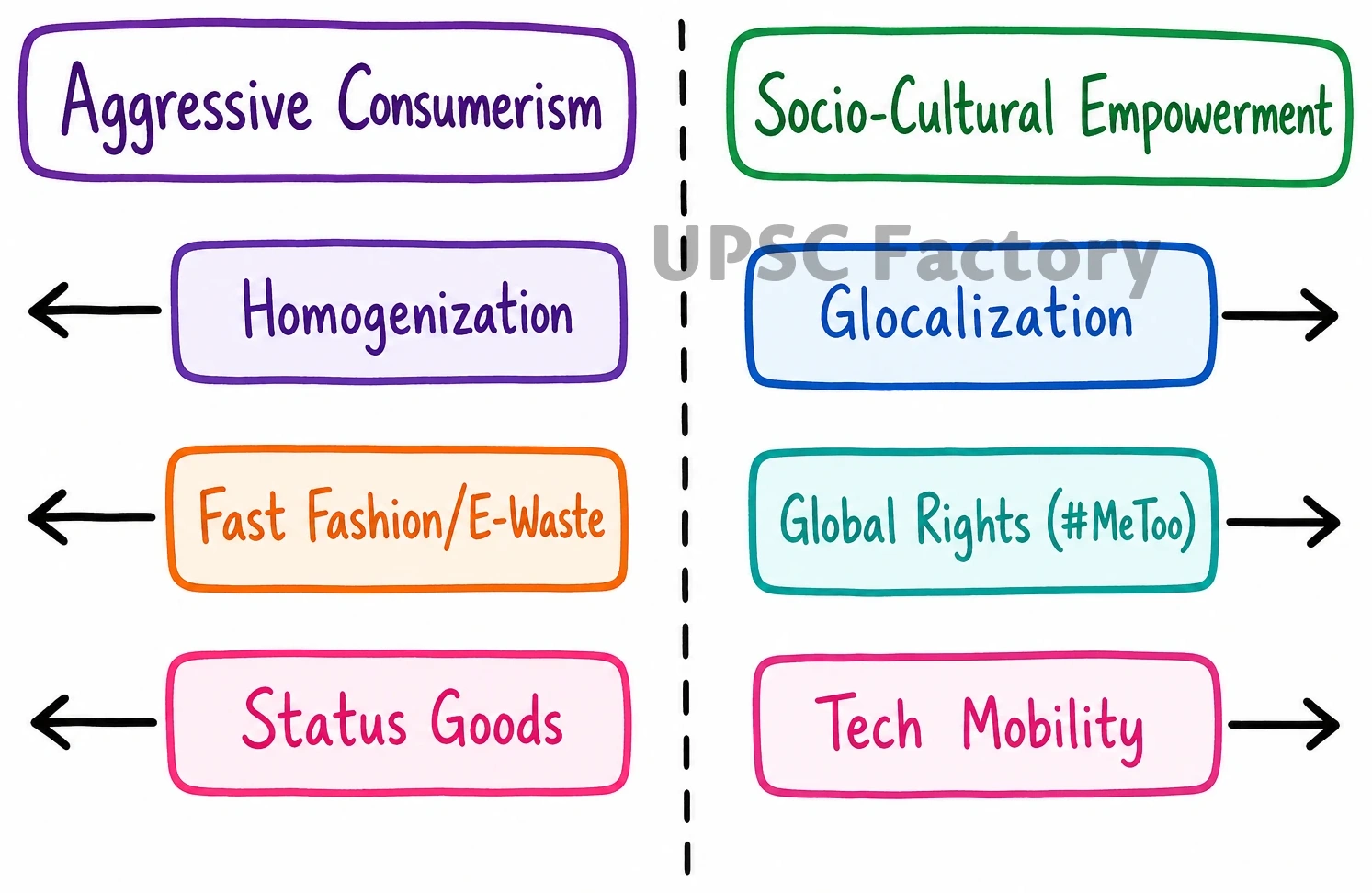
1. Globalization Fueling Aggressive Consumer Culture

  • Commodifying Traditions: Shifts focus from cultural rituals to hyper-commercialized shopping events (Diwali mega-sales).
  • Throwaway Culture: Global supply chains promote fast fashion and planned obsolescence (urban e-waste accumulation).
  • Cultural Homogenization: Multinational brands overshadow local artisans, creating uniform global consumption desires (Starbucks, Zara).
  • Status Consumption: Equates social status with the accumulation of foreign luxury goods and global brands.
2. Multidimensional Impacts Beyond Consumerism

  • Glocalization: Global concepts adapt to local sensibilities, preserving cultural uniqueness (Indo-Chinese cuisine, McAloo Tikki).
  • Rights & Awareness: Facilitates the rapid cross-border spread of progressive socio-political movements (#MeToo, climate strikes).
  • Cultural Export (Reverse Globalization): Empowers Indian soft power and global cultural integration (Global spread of Yoga, Ayurveda).
  • Technological Empowerment: Democratizes access to global knowledge, aiding social mobility (EdTech platforms, global gig economy).

Therefore, while globalization fuels capitalist consumerism, it simultaneously acts as a powerful catalyst for cross-cultural exchange, human rights solidarity, and global socio-economic empowerment.
Q. Do you think that globalization results in only an aggressive consumer culture? Justify your answer. Read More »

Q. The ethos of civil service in India stand for the combination of professionalism with nationalistic consciousness – Elucidate.

Q. The ethos of civil service in India stand for the combination of professionalism with nationalistic consciousness – Elucidate.

UPSC Mains 2025 GS1 Paper

Model Answer:

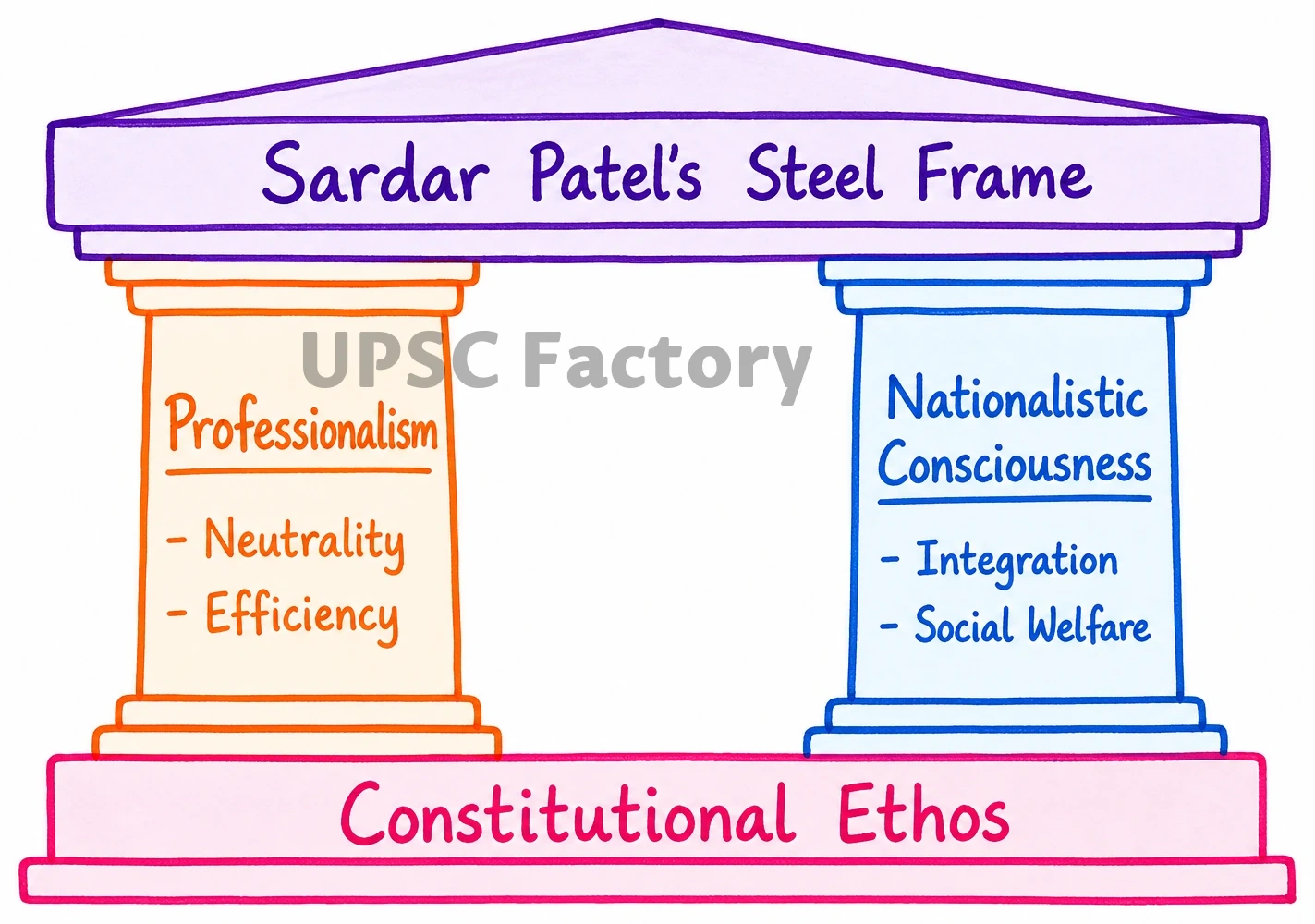
Sardar Patel envisioned the All India Services (Article 312) not merely as administrative machinery, but as India’s “Steel Frame,” blending administrative efficiency with post-independence nation-building.

1. Professionalism in Administration

  • Political Neutrality: Rendering impartial advice and executing policies without partisan bias (e.g., AIS Conduct Rules 1968).
  • Institutional Continuity: Ensuring stable, uninterrupted governance even during periods of severe political turbulence (e.g., 1990s coalition era).
  • Objective Efficiency: Implementing policies based on the rule of law and constitutional merit, aided by specialized institutional training (e.g., LBSNAA).

2. Nationalistic Consciousness in Action

  • Territorial Integration: Playing a crucial backstage role in unifying a fragmented newly-independent nation (e.g., V.P. Menon integrating 560+ princely states).
  • Socio-Economic Engineering: Spearheading grassroots poverty alleviation and managing massive developmental shifts (e.g., executing the Green Revolution).
  • Fostering National Unity: Acting as the unifying pan-India cadre that bridges regional, linguistic, and cultural divides across states.
  • Crisis Leadership: Frontline management of extraordinary national emergencies (e.g., Partition refugee rehabilitation, conducting massive democratic elections).

Contemporary reforms like Mission Karmayogi aim to revitalize this dual ethos, ensuring a future-ready, agile bureaucracy that remains deeply rooted in India’s developmental aspirations.

Q. The ethos of civil service in India stand for the combination of professionalism with nationalistic consciousness – Elucidate. Read More »

Q. How does smart city in India, address the issues of urban poverty and distributive justice?

Q. How does smart city in India, address the issues of urban poverty and distributive justice?

UPSC Mains 2025 GS1 Paper

Model Answer:

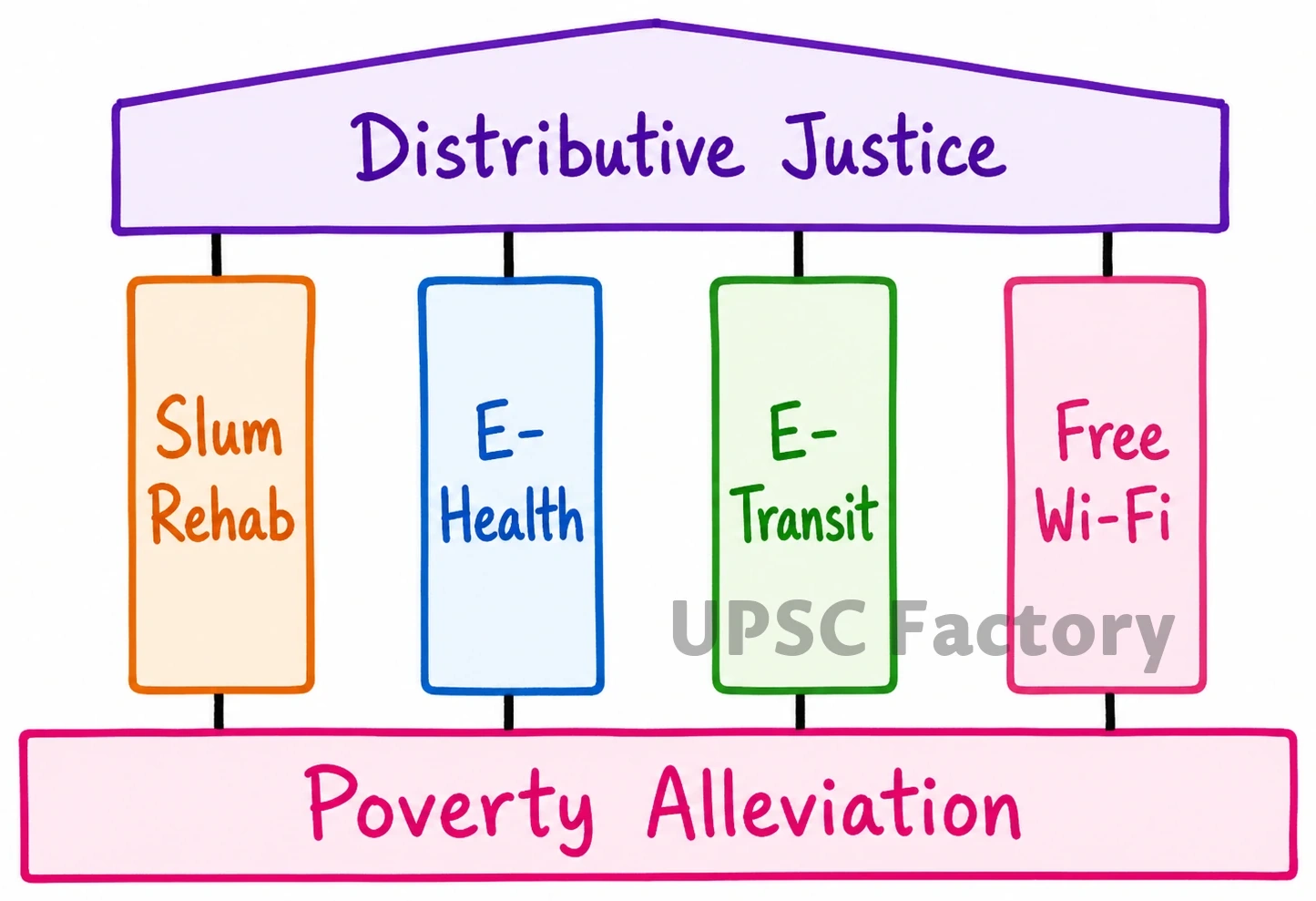
The Smart Cities Mission (SCM) aligns with SDG 11 by integrating technology and infrastructure to foster sustainable, inclusive urban spaces for marginalized populations.

Addressing Urban Poverty

  • Slum Rehabilitation: Upgrading affordable housing and ensuring tenure security via targeted Area-Based Development (ABD).
  • Essential Services: Deploying smart grids and SCADA systems to ensure equitable water and sanitation in low-income settlements.
  • Accessible Healthcare: Implementing e-health networks and localized civic infrastructure (e.g., Pune’s smart health clinics in slums).
  • Livelihood Generation: Creating skill development hubs and formalized street vending zones to support the informal economy.

Promoting Distributive Justice

  • Digital Inclusion: Providing free public Wi-Fi to bridge the digital divide for Economically Weaker Sections (EWS).
  • Spatial Equity: Developing affordable, tech-enabled mass transit (e-buses) to enhance spatial mobility for the urban poor.
  • Social Infrastructure: Building integrated community spaces for marginalized groups (e.g., Bhubaneswar’s Social Equity Centres).
  • Development Gaps: Over-reliance on ABD often creates “islands of excellence,” risking elite capture and leaving peripheries underserved.

To truly actualize distributive justice, SCM must transition from purely technology-led governance toward a “Right to the City” paradigm, prioritizing pan-city socio-economic integration.

Q. How does smart city in India, address the issues of urban poverty and distributive justice? Read More »

Q. What are Tsunamis? How and where are they formed? What are their consequences? Explain with examples.

Q. What are Tsunamis? How and where are they formed? What are their consequences? Explain with examples.

UPSC Mains 2025 GS1 Paper

Model Answer:

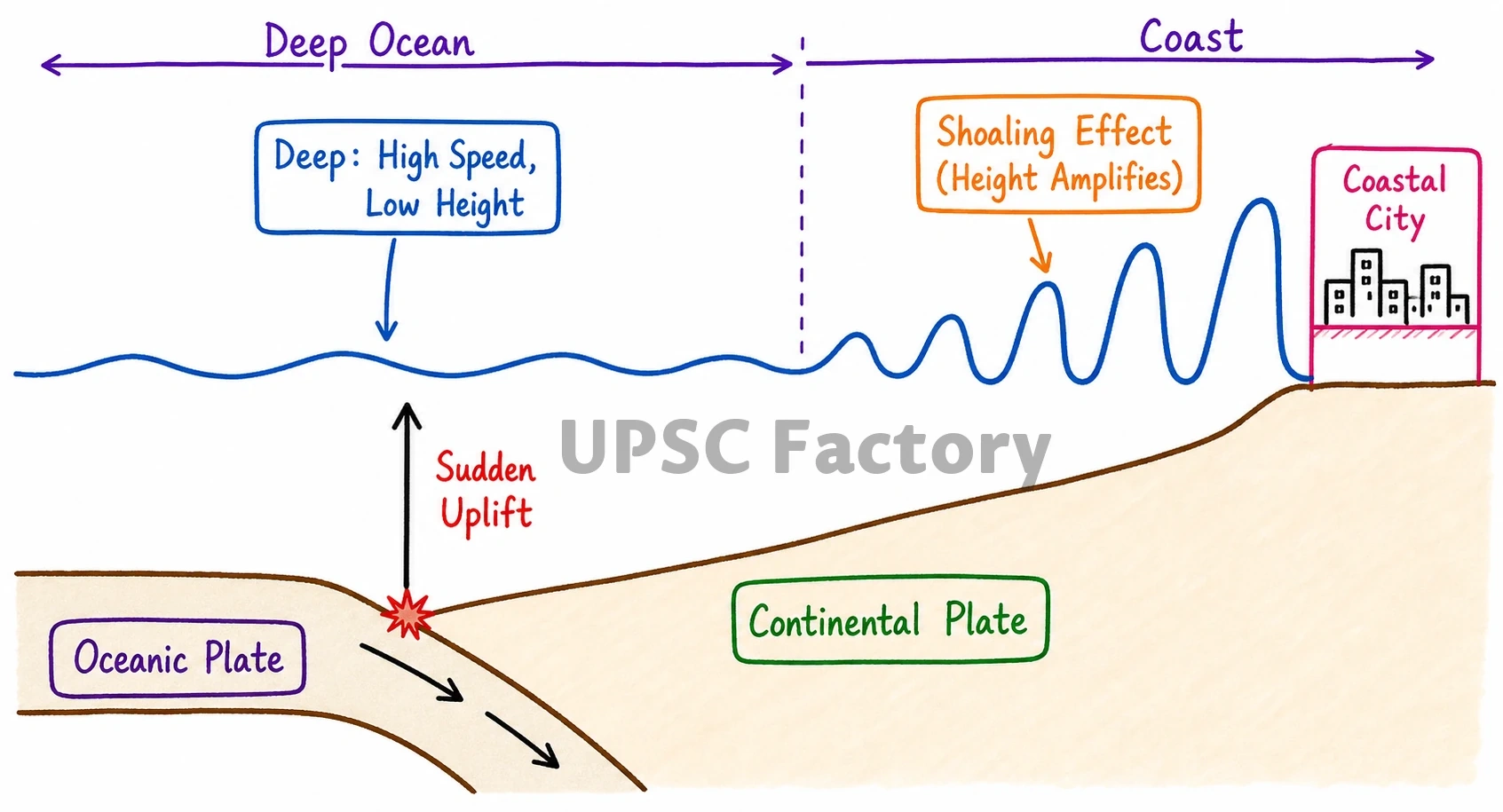
Tsunamis are massive, long-wavelength ocean waves triggered by the sudden, large-scale displacement of a marine water column.

1. Formation Mechanism and Vulnerable Regions

  • Seismic triggers: Sudden vertical tectonic plate displacement at subduction zones upheaves oceanic water (e.g., 2004 Sumatra earthquake).
  • Non-seismic triggers: Submarine landslides, volcanic eruptions, or meteorite impacts displacing water (e.g., 2022 Hunga Tonga eruption).
  • Shoaling effect: As waves approach shallow coastal waters, velocity decreases while wave height amplifies dramatically.
  • Vulnerable zones: Predominantly concentrated in highly active tectonic regions like the Pacific ‘Ring of Fire’ and the Indian Ocean.

2. Key Consequences

  • Mass casualties: Sudden, massive coastal inundation causes immense loss of human life (e.g., 230,000+ deaths, 2004 Tsunami).
  • Infrastructure devastation: Complete destruction of settlements, ports, and critical facilities (e.g., 2011 Tohoku Tsunami triggering the Fukushima nuclear disaster).
  • Ecological damage: Severe coastal erosion, coral reef destruction, and the uprooting of protective mangrove ecosystems.
  • Agricultural ruin: Saltwater intrusion salinizes groundwater aquifers and fertile coastal soils, destroying long-term agricultural livelihoods.

Mitigating tsunami devastation demands robust early warning systems (e.g., India’s INCOIS), proactive mangrove conservation, and resilient, well-regulated coastal infrastructure planning.

Q. What are Tsunamis? How and where are they formed? What are their consequences? Explain with examples. Read More »

Q. Explain briefly the ecological and economic benefits of solar energy generation in India with suitable examples.

Q. Explain briefly the ecological and economic benefits of solar energy generation in India with suitable examples.

UPSC Mains 2025 GS1 Paper

Model Answer:

India’s rapid solar energy expansion is pivotal for achieving its Panchamrit targets (500 GW non-fossil capacity by 2030) and Net Zero 2070 vision.

1. Ecological Benefits

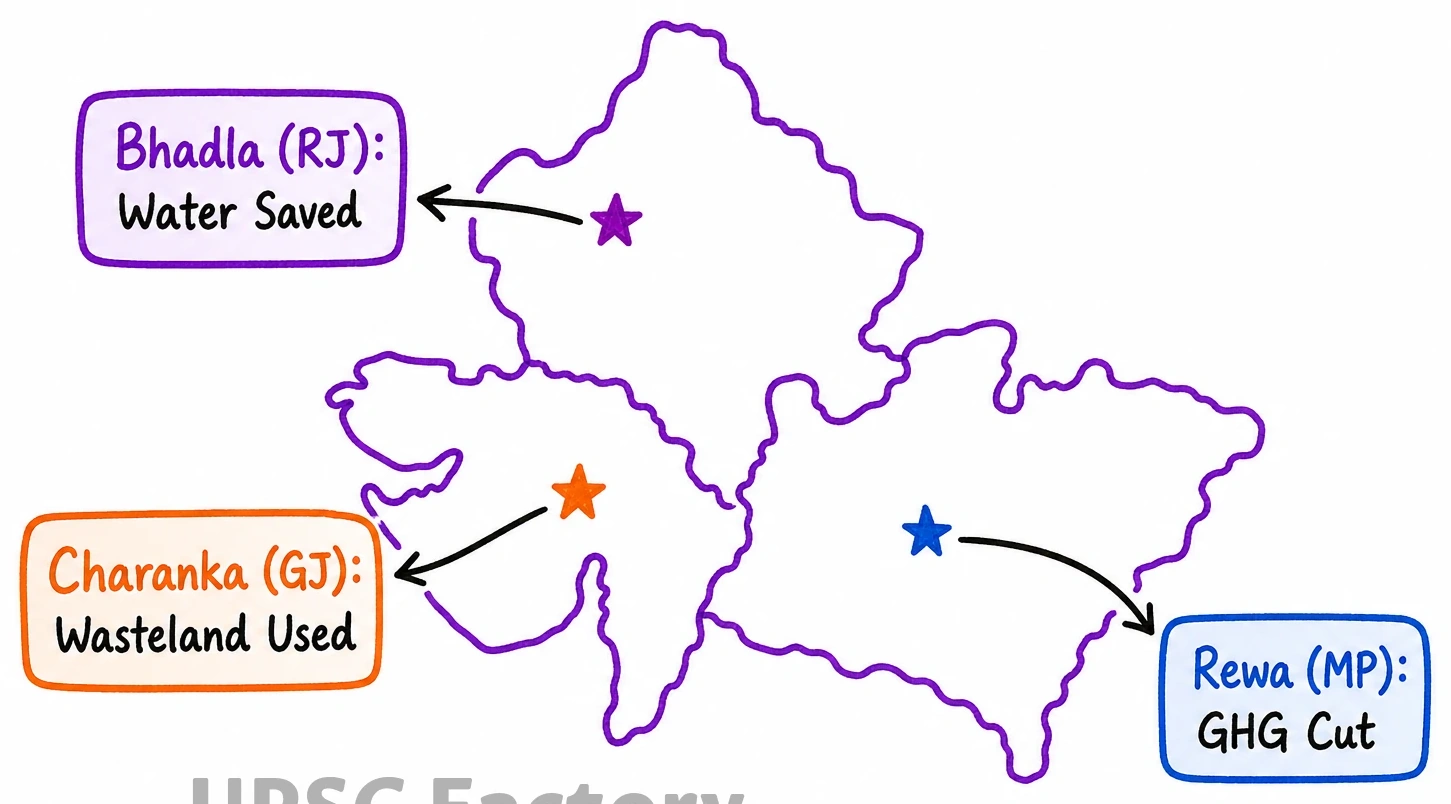
  • GHG Mitigation: Displaces coal-heavy grids, drastically curbing carbon footprints (Rewa Solar Plant, MP saves ~15 lakh tonnes CO2/year).
  • Water Conservation: Solar PVs require significantly less operational cooling water compared to thermal plants (vital for Bhadla Solar Park, Rajasthan).
  • Wasteland Utilization: Transforms barren terrains into productive green assets without triggering deforestation (Charanka Solar Park, Gujarat).
  • Air Quality: Eliminates PM2.5 and toxic sulfur emissions inherent to fossil fuel combustion.

2. Economic Benefits

  • Macro-Energy Security: Reduces heavy fossil fuel import bills, shielding the economy from global price volatility.
  • Cost Competitiveness: A falling Levelized Cost of Energy (LCOE) makes solar tariffs consistently cheaper than conventional thermal power.
  • Rural Monetization: Empowers farmers to sell surplus grid power, generating decentralized secondary income (PM-KUSUM Scheme).
  • Employment Generation: Drives localized green job creation across manufacturing, installation, and maintenance sectors (Suryamitra Skill Programme).

Harnessing solar potential ensures a sustainable, decentralized energy architecture, fundamentally driving India’s broader macroeconomic resilience and ecological security.

Q. Explain briefly the ecological and economic benefits of solar energy generation in India with suitable examples. Read More »

Q. What are non-farm primary activities? How are these activities related to physiographic features in India? Discuss with suitable examples.

Q. What are non-farm primary activities? How are these activities related to physiographic features in India? Discuss with suitable examples.

UPSC Mains 2025 GS1 Paper

Model Answer:

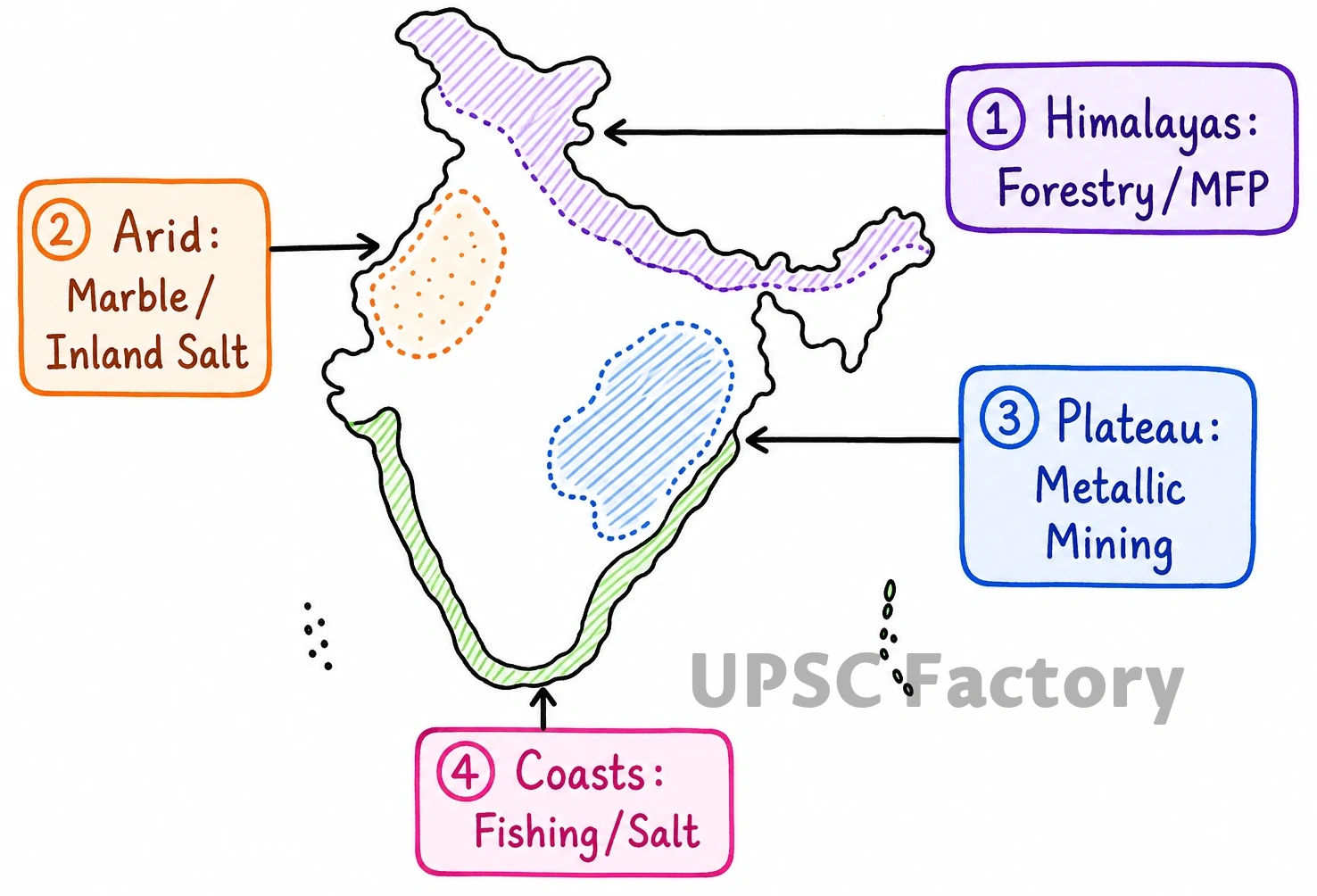
Non-farm primary activities involve the direct extraction of natural resources, excluding agriculture. Key sectors include mining, quarrying, forestry, fishing, and gathering.

Physiographic Linkages of Non-Farm Primary Activities

  1. Peninsular Plateau (Mining & Quarrying):
    • Metallic Minerals: Stable shields of igneous/metamorphic rocks hold rich reserves (Iron/coal in Chotanagpur Plateau).
    • Quarrying: Extensive extraction of granites and building materials (Deccan Trap region).
  2. Coastal Plains & Islands (Fishing & Salt):
    • Marine Fishing: Wide continental shelves and upwelling support rich fisheries (Sardines in Malabar Coast; PMMSY focus).
    • Salt Panning: Shallow coastal creeks with high evaporation (Rann of Kutch).
  3. Himalayan Region (Forestry & Gathering):
    • Silviculture: Altitudinal vegetation zones support commercial timber (Pine/Deodar in Pir Panjal).
    • Minor Forest Produce (MFP): High biodiversity sustains tribal gathering economies (Medicinal herbs in North-East).
  4. Arid Plains (Non-Metallic Extraction):
    • Building Stones: Exposed sedimentary/metamorphic structures (Marble/Sandstone in Rajasthan).
    • Inland Salt: Desiccated saline lakes (Sambhar Lake).

Conclusion: India’s geological history and physiography dictate the spatial distribution of non-farm resources. Sustainable extraction frameworks (MMDR Act, Forest Rights Act) are vital for equitable regional development.

Q. What are non-farm primary activities? How are these activities related to physiographic features in India? Discuss with suitable examples. Read More »

Q. How are climate change and the sea level rise affecting the very existence of many island nations? Discuss with examples.

Q. How are climate change and the sea level rise affecting the very existence of many island nations? Discuss with examples.

UPSC Mains 2025 GS1 Paper

Model Answer:

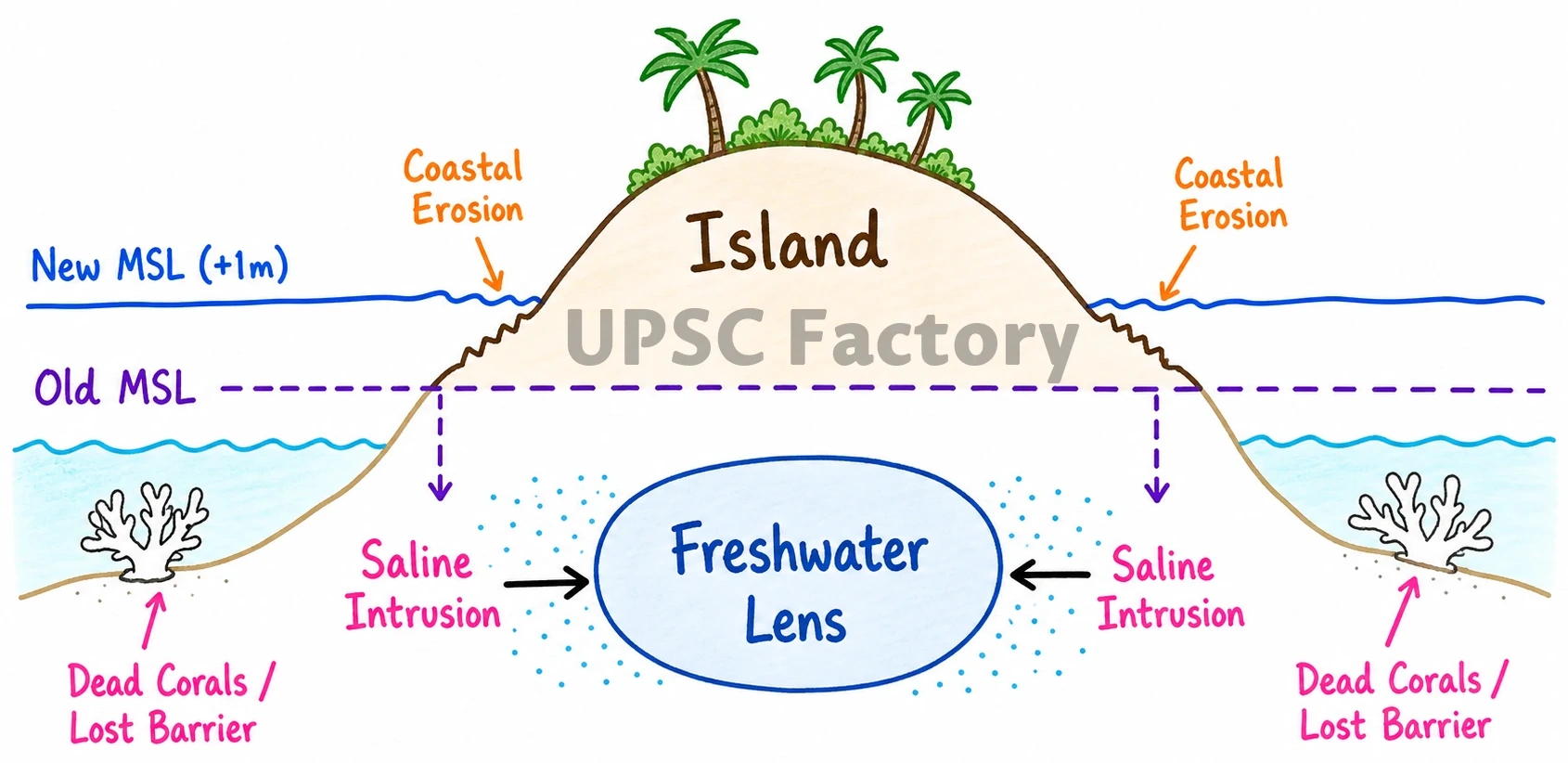
The IPCC AR6 warns of a potential 1m sea-level rise by 2100, posing a severe existential threat to Small Island Developing States (SIDS) globally.

Physical and Ecological Threats

  • Total Submergence: Rising waters threaten complete inundation, prompting unique contingencies like “digital nation” backups (Tuvalu).
  • Coastal Erosion: Intense and frequent cyclones force entire communities to relocate inland (Vunidogoloa village, Fiji).
  • Saline Intrusion: Sea-water contamination of freshwater aquifers destroys arable land and potable water security (Kiribati).
  • Marine Habitat Collapse: Ocean warming and acidification induce mass coral bleaching, destroying natural storm barriers (Maldives).

Socio-Economic and Geopolitical Crises

  • Shrinking EEZs: Submergence of coastal baselines threatens sovereign maritime rights and critical fisheries revenue (Marshall Islands).
  • Infrastructure Stress: Protecting capital cities and tourism assets requires highly expensive artificial elevation (Hulhumalé, Maldives).
  • Climate Statelessness: Irreversible loss of habitability risks creating a massive wave of unrecognized climate refugees.

Operationalizing the UN Loss and Damage Fund and strict adherence to the Paris Agreement’s 1.5°C target remain imperative for SIDS’ survival.

Q. How are climate change and the sea level rise affecting the very existence of many island nations? Discuss with examples. Read More »

Q. ‘The sculptors filled the Chandella artform with resilient vigor and breadth of life.’ Elucidate.

Q. ‘The sculptors filled the Chandella artform with resilient vigor and breadth of life.’ Elucidate.

UPSC Mains 2025 GS1 Paper

Model Answer:

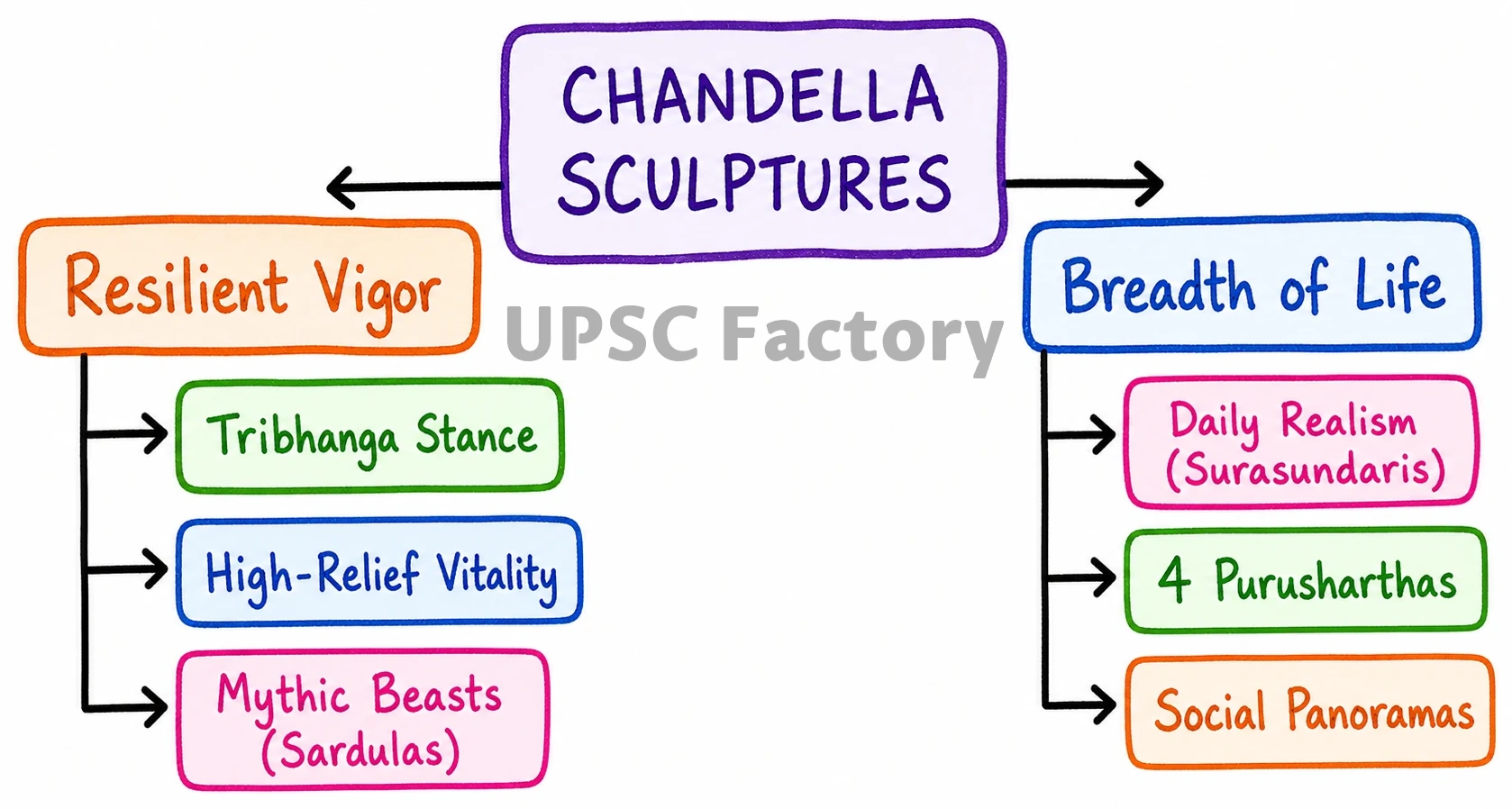
The Chandella architecture, epitomized by the Khajuraho temples (e.g., Kandariya Mahadeva, 10th-11th century CE), showcases a masterful synthesis of structural grandeur and vibrant sculptural dynamism.

1. Resilient Vigor in Sculptural Forms

  • Dynamic Postures: Masterful utilization of the Tribhanga (triple-bent) stance creates rhythmic, flowing movement within static stone blocks.
  • Anatomical Grace: Deep, high-relief carving provides figures with a three-dimensional, fleshy vitality despite being sculpted from hard sandstone.
  • Mythological Energy: Depictions of fierce mythical beasts (Sardulas, Vyalas) and spirited deities guarding temple walls exude raw, kinetic power.

2. Breadth of Life: Secular and Human Experiences

  • Everyday Realism: Surasundaris (celestial nymphs) are intimately portrayed performing mundane human chores (applying makeup, wringing wet hair, removing thorns).
  • Holistic Philosophy: The thematic panels comprehensively encapsulate all four Purusharthas (Dharma, Artha, Kama, Moksha), reflecting the totality of human existence.
  • Celebration of Sensuality: Mithuna (erotic) sculptures are portrayed with aesthetic dignity, symbolizing cosmic balance, fertility, and divine union.
  • Social Panorama: Intricate friezes along the temple base document contemporary society (royal processions, marching warriors, musicians, and dancers).

Thus, by seamlessly blending anatomical dynamism with profound worldly realism, Chandella sculptors breathed life into stone, making Khajuraho a timeless testament to complete human vitality.

Q. ‘The sculptors filled the Chandella artform with resilient vigor and breadth of life.’ Elucidate. Read More »

Q. Examine the main aspects of Akbar’s religious syncretism.

Q. Examine the main aspects of Akbar’s religious syncretism.

UPSC Mains 2025 GS1 Paper

Model Answer:

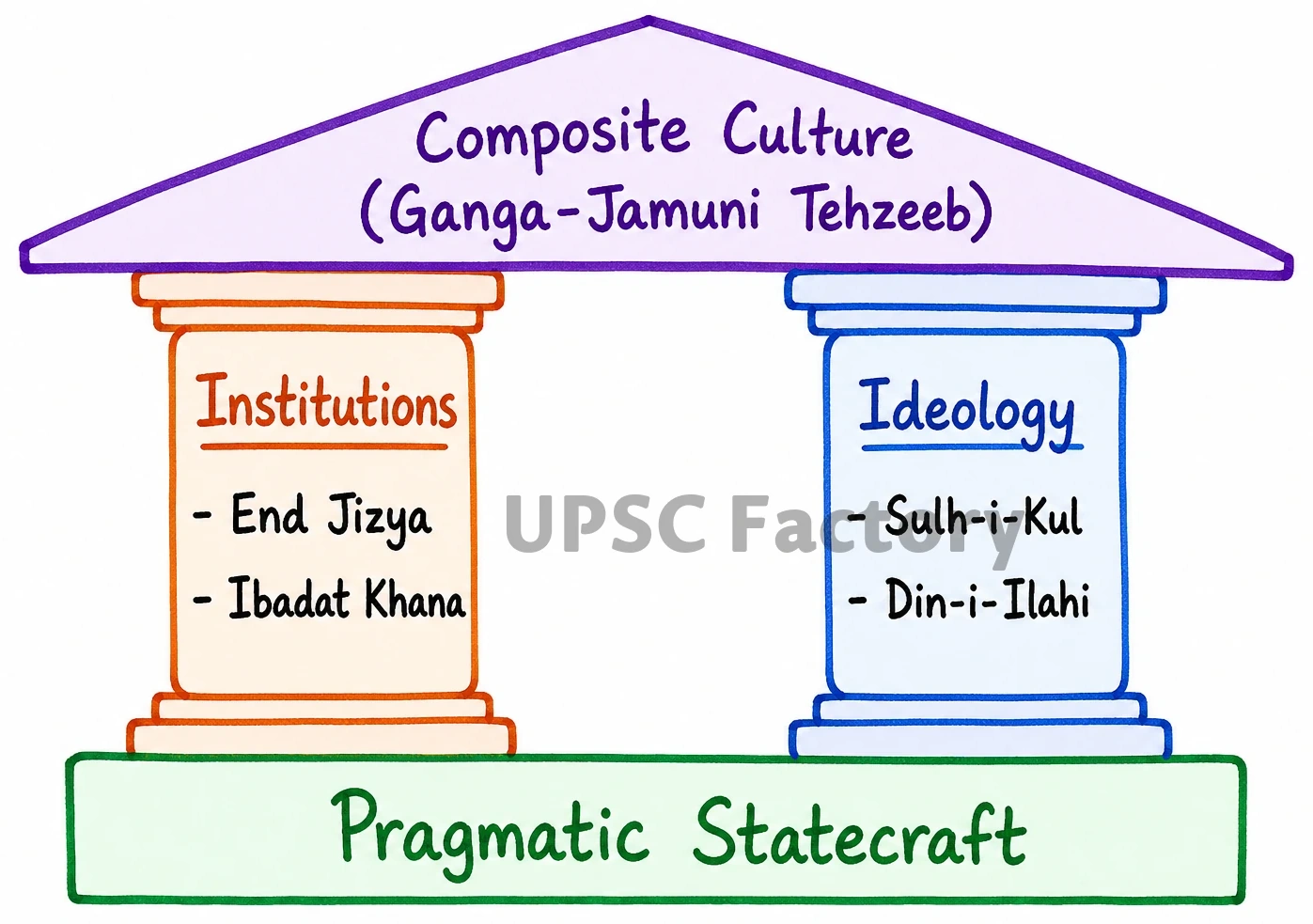
Akbar’s religious syncretism marked a paradigm shift from medieval orthodox statecraft to an inclusive administration, driven by profound philosophical curiosity and political pragmatism.

1. Institutional Measures and Policy Reforms

  • Tax Emancipation: Abolished the discriminatory Jizya (1564) and pilgrim taxes, granting non-Muslims socio-economic and religious parity.
  • Inter-faith Dialogue: Established the Ibadat Khana (Fatehpur Sikri) hosting philosophical debates among Hindu, Jain, Christian, and Zoroastrian scholars.
  • Mahzarnama (1579): Issued the ‘Infallibility Decree’ establishing the Emperor as the supreme arbiter in religious disputes, curbing orthodox Ulema.
  • Cultural Integration: Created the Maktab Khana (translation bureau) to translate Sanskrit epics into Persian (e.g., Mahabharata as Razmnama).

2. Core Ideological Pillars

  • Sulh-i-Kul (Universal Peace): Institutionalized a guiding state policy of absolute religious tolerance and non-discrimination in civil governance.
  • Din-i-Ilahi (1582): Propounded a new syncretic ethical code (Tauhid-i-Ilahi), merging moral virtues and rationalism from major world religions.
  • Secular Administration: Elevated non-Muslims to high-ranking Mansabdar positions based purely on merit (e.g., Raja Todar Mal, Man Singh).

Conclusion

Akbar’s visionary syncretism laid the foundational bedrock for India’s composite culture (Ganga-Jamuni Tehzeeb), fostering enduring socio-political stability and unity.

Q. Examine the main aspects of Akbar’s religious syncretism. Read More »

Q. Discuss the salient features of the Harappan architecture.

Q. Discuss the salient features of the Harappan architecture.

UPSC Mains 2025 GS1 Paper

Model Answer:

Harappan architecture (c. 2500 BCE) is distinguished by its utilitarian focus, secular nature, and advanced civic planning rather than monumental religious structures.

1. Urban Planning and Zoning

  • Grid-Iron Layout: Principal streets intersected at right angles, neatly dividing the city into rectangular blocks.
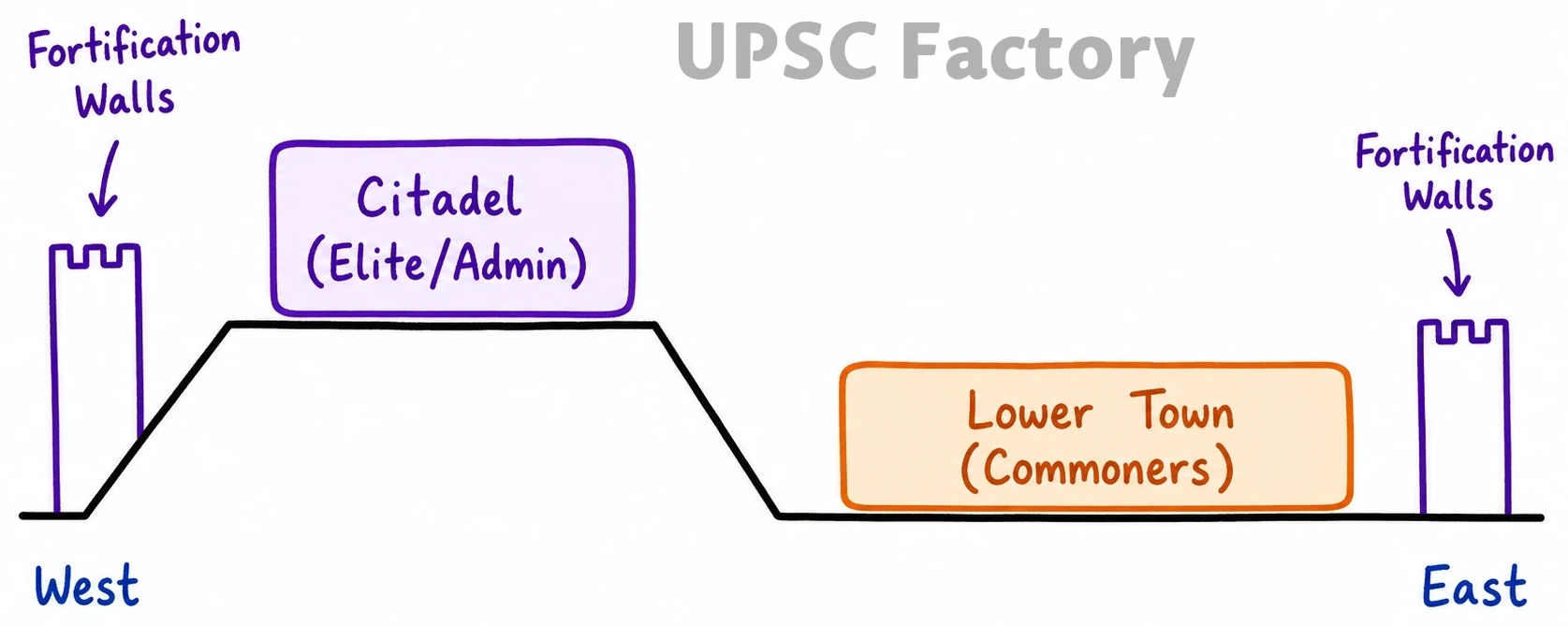
  • Strategic Zoning: Cities were bifurcated into a raised, fortified Citadel (administrative/elite use) and a Lower Town (common residences).
  • Secular & Civic Focus: Complete absence of large temples; emphasis was purely on public utility (Great Bath, Mohenjo-Daro).

2. Utilitarian Infrastructure and Materials

  • Standardized Materials: Extensive use of baked bricks maintaining a strict 1:2:4 ratio, bound by gypsum mortar.
  • English Bond Method: Alternating layers of headers and stretchers provided unprecedented structural wall strength.
  • Advanced Drainage: Covered street drains connected to individual house drains, featuring soak pits and regular inspection manholes.
  • Specialized Engineering: Scientific granaries with air ducts, artificial tidal dockyards (Lothal), and sophisticated water reservoirs (Dholavira).

Its remarkable emphasis on sanitation, standardized construction, and sustainable zoning makes Harappan architecture a timeless blueprint for modern smart cities.

Q. Discuss the salient features of the Harappan architecture. Read More »