UPSC Mains 2025 GS1 Model Answer

Q. Does tribal development in India centre around two axes, those of displacement and of rehabilitation? Give your opinion.

Q. Does tribal development in India centre around two axes, those of displacement and of rehabilitation? Give your opinion.

UPSC Mains 2025 GS1 Paper

Model Answer:

Historically, India’s tribal development was overshadowed by state-led industrialization, often reducing tribal welfare to cycles of displacement and rehabilitation. However, modern paradigms emphasize rights-based empowerment (Xaxa Committee, 2014).

Historical Axes: Displacement and Rehabilitation

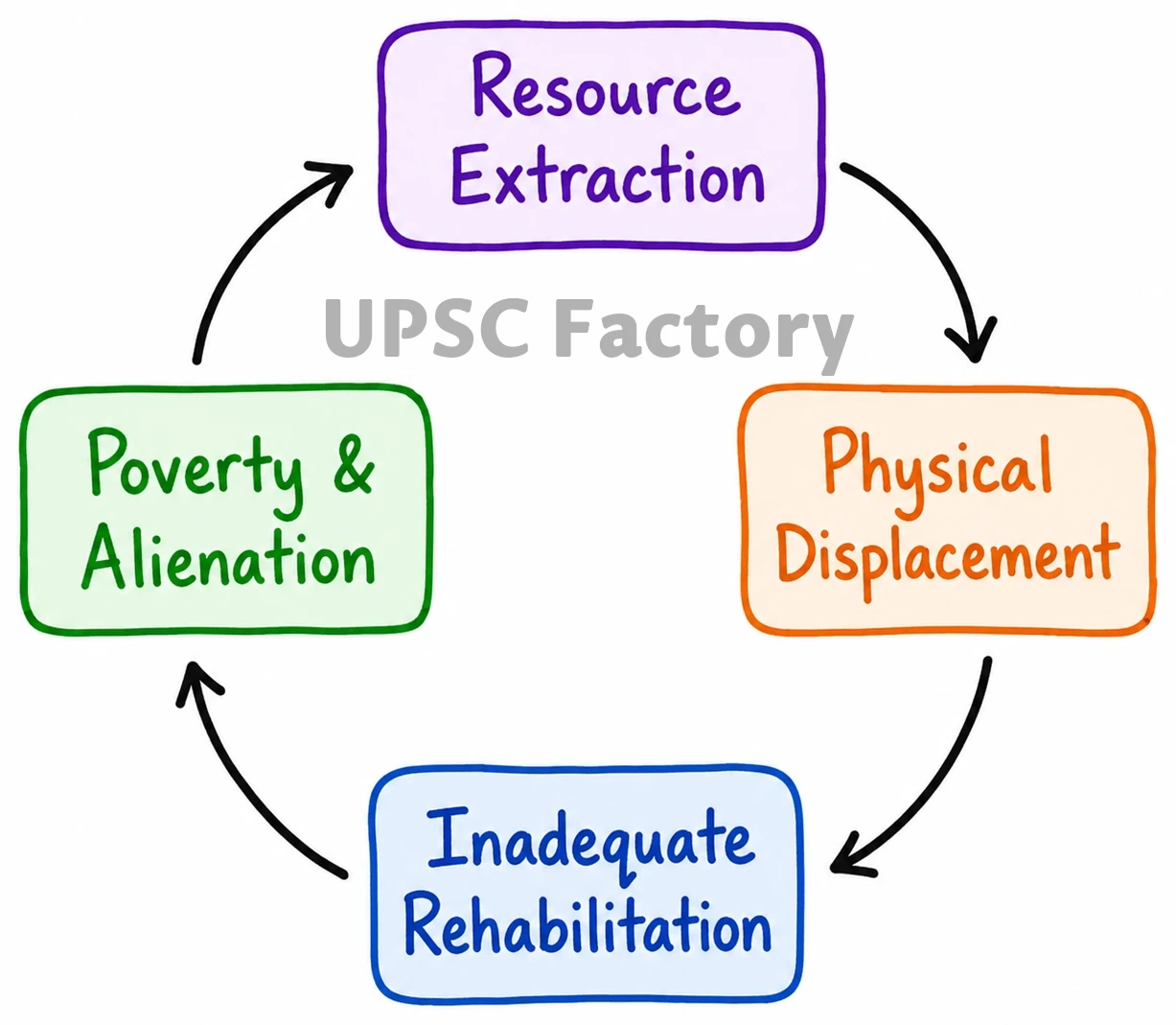
Post-independence nation-building disproportionately impacted tribal communities, making displacement and rehabilitation prominent themes:

  • Resource Curse: Resource-rich tribal heartlands became prime targets for large-scale dams and mining projects (Hirakud, Polavaram).
  • Land Alienation: Lack of formal land titles historically led to non-consensual acquisition without adequate compensation prior to modern frameworks (LARR Act, 2013).
  • Socio-Cultural Uprooting: Physical displacement dismantled traditional kinship networks and symbiotic forest-dependent lifestyles (Sardar Sarovar Dam evictions).
  • Rehabilitation Deficits: Resettlement policies frequently offered inadequate cash compensation rather than sustainable livelihoods, plunging tribals into urban poverty.
Modern Evolution: A Rights-Based Paradigm

While displacement remains a persistent challenge, contemporary tribal development has decisively broadened beyond these two axes:

  • Democratic Autonomy: Decentralized governance empowers tribal Gram Sabhas to manage local resources and safeguard traditions (PESA Act, 1996).
  • Resource Justice: Correcting historical injustices by granting individual and community forest rights over ancestral lands (FRA, 2006; Niyamgiri verdict protecting Dongria Kondh).
  • Human Capital Formation: Bridging developmental deficits through targeted education and health interventions (Eklavya Model Residential Schools, Sickle Cell Anaemia Eradication Mission).
  • Economic Empowerment: Promoting tribal entrepreneurship and value addition for minor forest produce (TRIFED, PM Van Dhan Yojana).
  • Cultural Preservation: Institutional support to protect and celebrate indigenous languages, art, and identity (Tribal Research Institutes, Janjatiya Gaurav Divas).
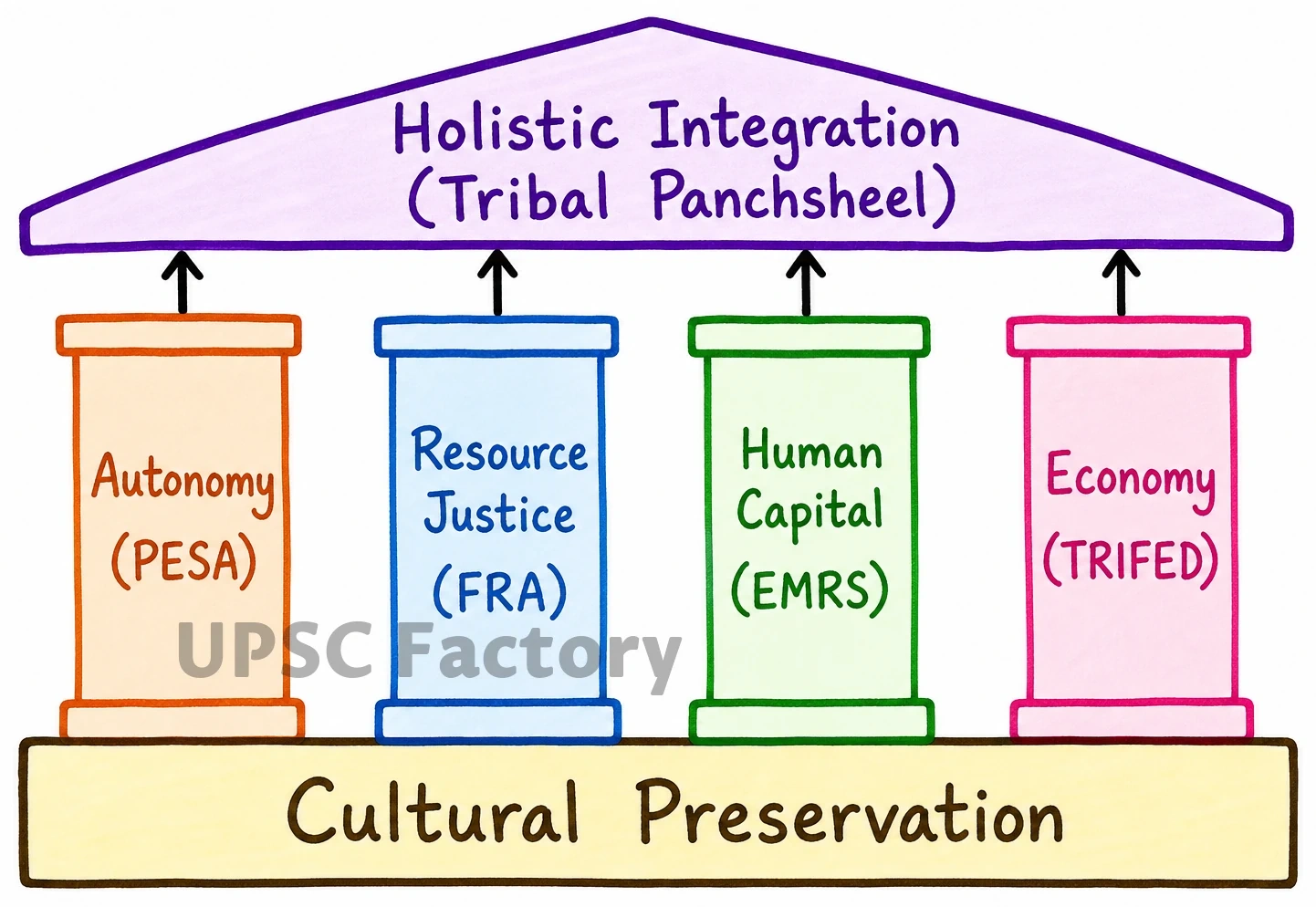
Tribal development has transcended the restrictive dual axes of displacement and rehabilitation. It is increasingly aligning with the Nehruvian “Tribal Panchsheel,” focusing on holistic integration, dignity, and rights-based socio-economic empowerment.
Q. Does tribal development in India centre around two axes, those of displacement and of rehabilitation? Give your opinion. Read More »

Q. Achieving sustainable growth with emphasis on environmental protection could come into conflict with poor people’s needs in a country like India – Comment.

Q. Achieving sustainable growth with emphasis on environmental protection could come into conflict with poor people’s needs in a country like India – Comment.

UPSC Mains 2025 GS1 Paper

Model Answer:

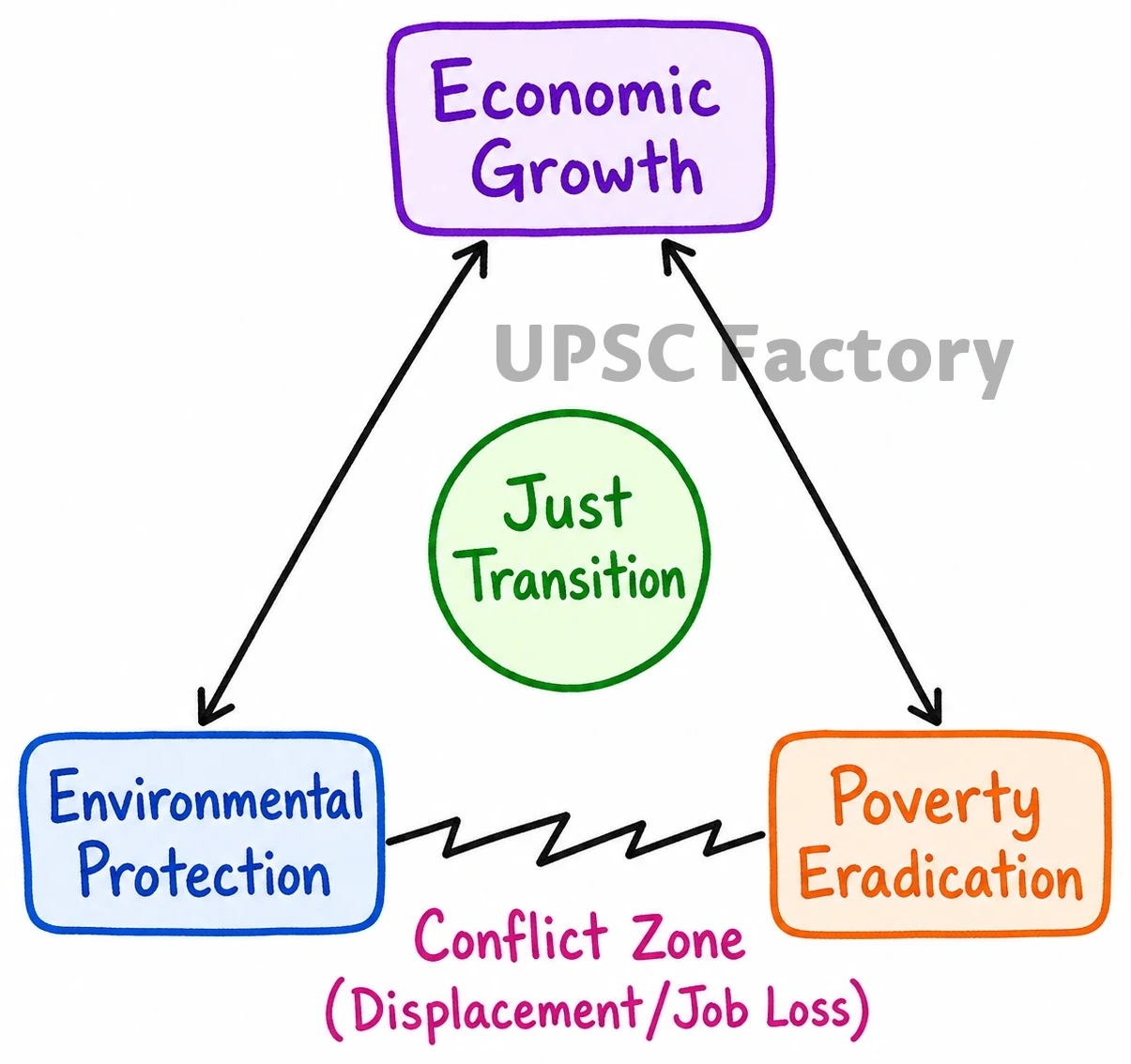
India faces a complex policy trilemma: balancing rapid economic growth, poverty eradication (SDG 1), and environmental protection (SDG 13), often triggering structural socio-economic conflicts.

1. Environmental Protection vs. Poor’s Livelihood Needs

  • Displacement for Beautification: Urban ecological restoration frequently leads to slum demolitions without adequate rehabilitation (Sabarmati Riverfront, Delhi Ridge).
  • Green Expropriation: Exclusionary conservation models restrict tribal access to minor forest produce, threatening basic survival (Tiger reserve evictions).
  • Informal Sector Job Losses: Abrupt pollution control measures heavily impact daily-wage workers in traditional MSMEs (Sivakasi firecracker ban, brick kilns).
  • Eco-Elitism: Subsidizing expensive green technologies benefits the affluent, while penalizing traditional practices disproportionately hurts the poor (EV subsidies vs. affordable public transit).
  • Energy Transition Disruptions: Phasing out fossil fuels threatens millions dependent on coal economies without providing alternative skills (Jharkhand coal belt).
  • Resource Conflicts: Land acquisition for large-scale renewable projects or mining often displaces indigenous populations (Niyamgiri Hills conflict).

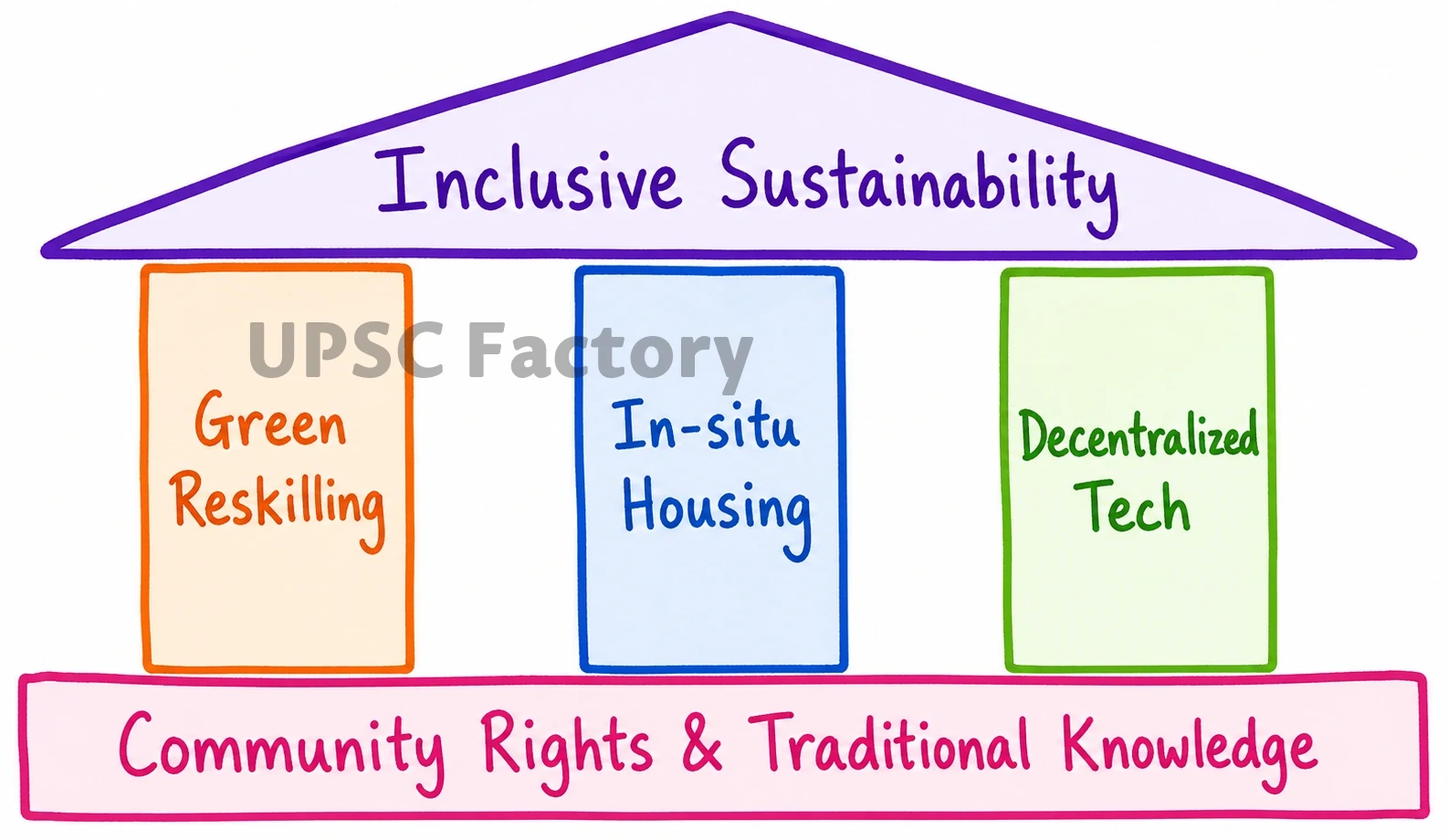
2. Harmonizing Ecology with Equity

  • Empowering Communities: Robust implementation of the Forest Rights Act (2006) to ensure decentralized, community-led conservation over exclusionary zoning.
  • Executing a ‘Just Transition’: Reskilling fossil-fuel-dependent populations for the renewable energy sector to prevent localized economic collapse.
  • Inclusive Urban Planning: Mandating in-situ slum upgradation and affordable housing quotas during environmental urban renewal missions.
  • Decentralizing Green Tech: Scaling decentralized programs that directly link rural livelihoods with clean energy generation (PM-KUSUM for solar agriculture).
  • Integrating Traditional Knowledge: Combining scientific conservation with indigenous ecological practices to create sustainable, localized green livelihoods.

True sustainability in India requires a structural shift from exclusionary “eco-elitism” to an “ecological democracy,” ensuring environmental policies actively eradicate, rather than exacerbate, systemic poverty.

Q. Achieving sustainable growth with emphasis on environmental protection could come into conflict with poor people’s needs in a country like India – Comment. Read More »

Q. How do you account for the growing fast food industries given that there are increased health concerns in modern society? Illustrate your answer with the Indian experience.

Q. How do you account for the growing fast food industries given that there are increased health concerns in modern society? Illustrate your answer with the Indian experience.

UPSC Mains 2025 GS1 Paper

Model Answer:

Despite rising health awareness, the fast-food industry is rapidly expanding globally due to complex socio-economic shifts, urbanization, and technological advancements overriding nutritional concerns.

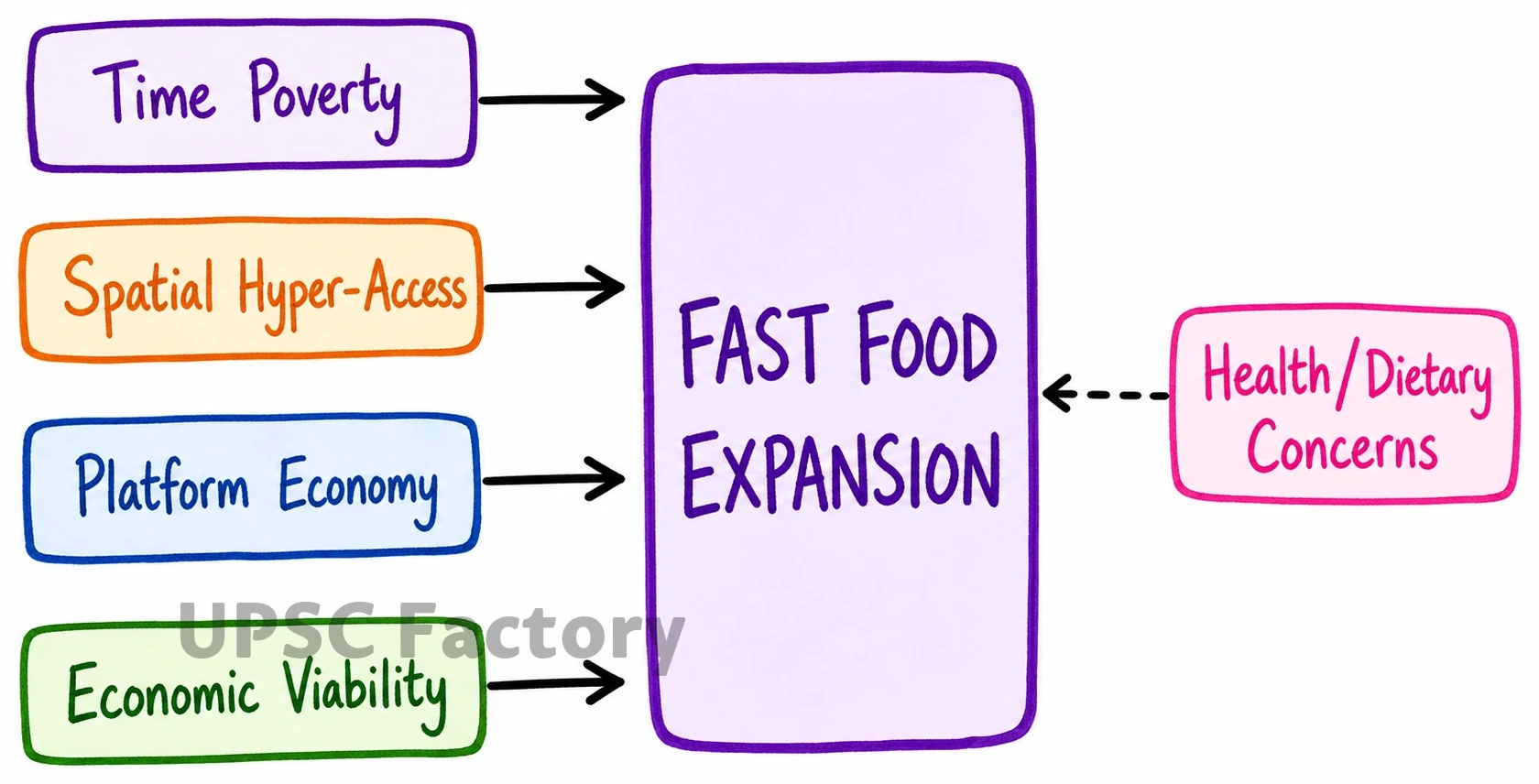
Drivers of Fast-Food Growth vs. Health Concerns

  • Time Poverty: Dual-income families and long urban commutes prioritize immediate convenience over time-consuming nutrition (time-space compression).
  • Spatial Hyper-Accessibility: Aggressive retail expansion creates ubiquitous access, transforming urban landscapes into “food swamps” where fast food dominates.
  • Economic Viability: Economies of scale and highly optimized supply chains make fast food significantly cheaper than fresh, organic alternatives.
  • Platform Economy: Delivery aggregators and dark kitchens overcome traditional geographical barriers, ensuring 24/7 doorstep availability.
  • “Health-washing”: Brands increasingly introduce pseudo-healthy options to retain health-conscious demographics (zero-sugar beverages, baked menus).

The Indian Experience: Socio-Spatial Adaptation

  • Glocalization of Tastes: Global chains successfully map local cultural geographies to redesign menus for regional palates (McDonald’s McAloo Tikki, Domino’s Paneer Makhani).
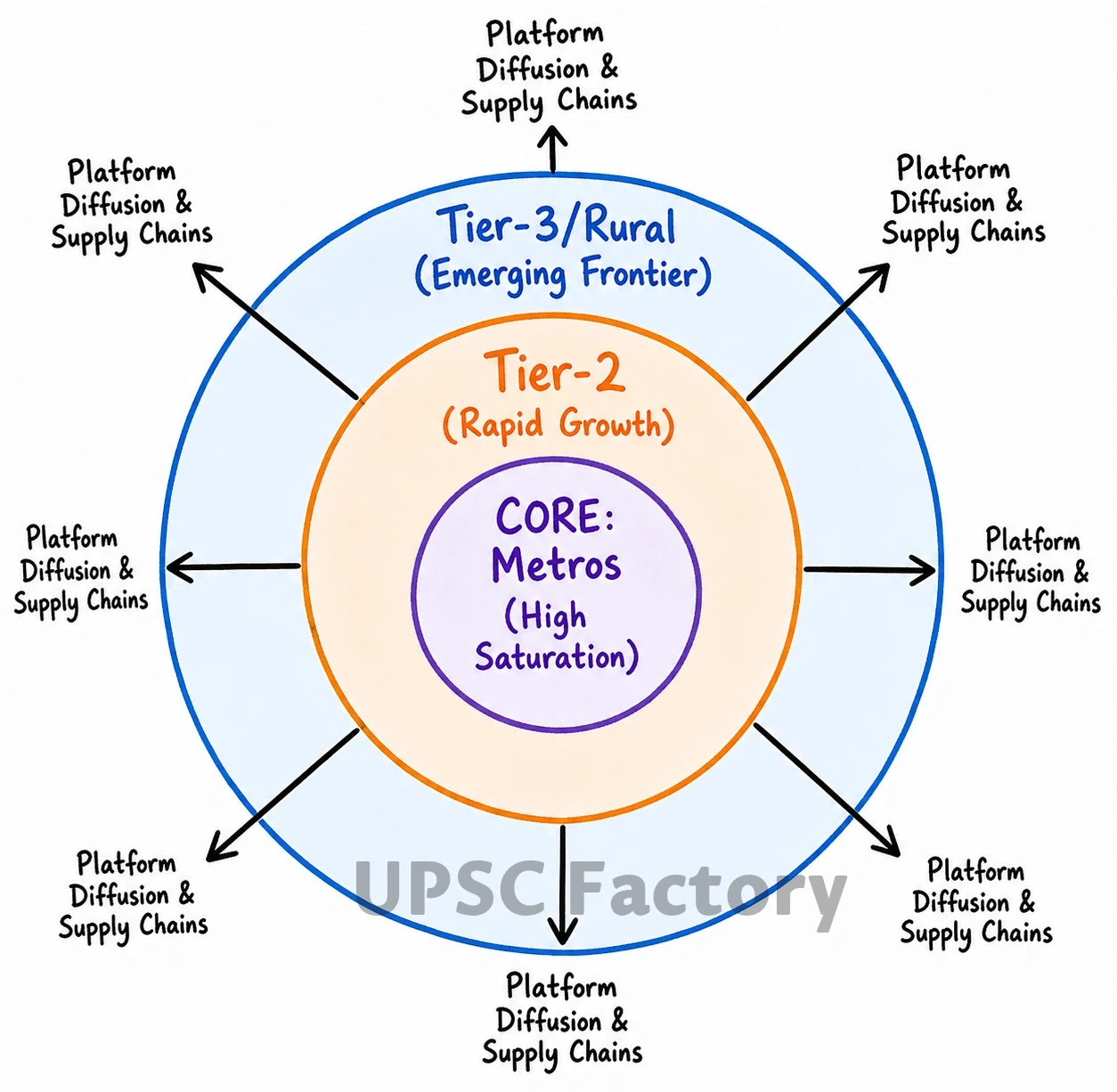
  • Spatial Diffusion into Hinterlands: Expanding digital infrastructure pushes delivery platforms (Swiggy, Zomato) beyond metros deep into Tier-2 and Tier-3 cities.

  • Demographic & Migratory Shifts: India’s young, migrating urban workforce often lacks time and domestic infrastructure, driving demand for affordable, ready-to-eat meals.
  • Cloud Kitchen Revolution: Bypassing expensive commercial real estate, delivery-only models capitalize on low-cost urban spaces for rapid scaling (Rebel Foods).
  • Socio-Cultural Urban Hubs: In densely populated Indian cities, fast-food outlets serve as accessible, aspirational socialization spaces for urban youth.

Balancing this rapid, demand-driven industry expansion with public health mandates requires stricter spatial-regulatory frameworks and behavioral nudges, as envisioned by FSSAI’s ‘Eat Right India’ movement.

Q. How do you account for the growing fast food industries given that there are increased health concerns in modern society? Illustrate your answer with the Indian experience. Read More »

Q. Discuss the distribution and density of population in the Ganga River Basin with special reference to land, soil and water resources.

Q. Discuss the distribution and density of population in the Ganga River Basin with special reference to land, soil and water resources.

UPSC Mains 2025 GS1 Paper

Model Answer:

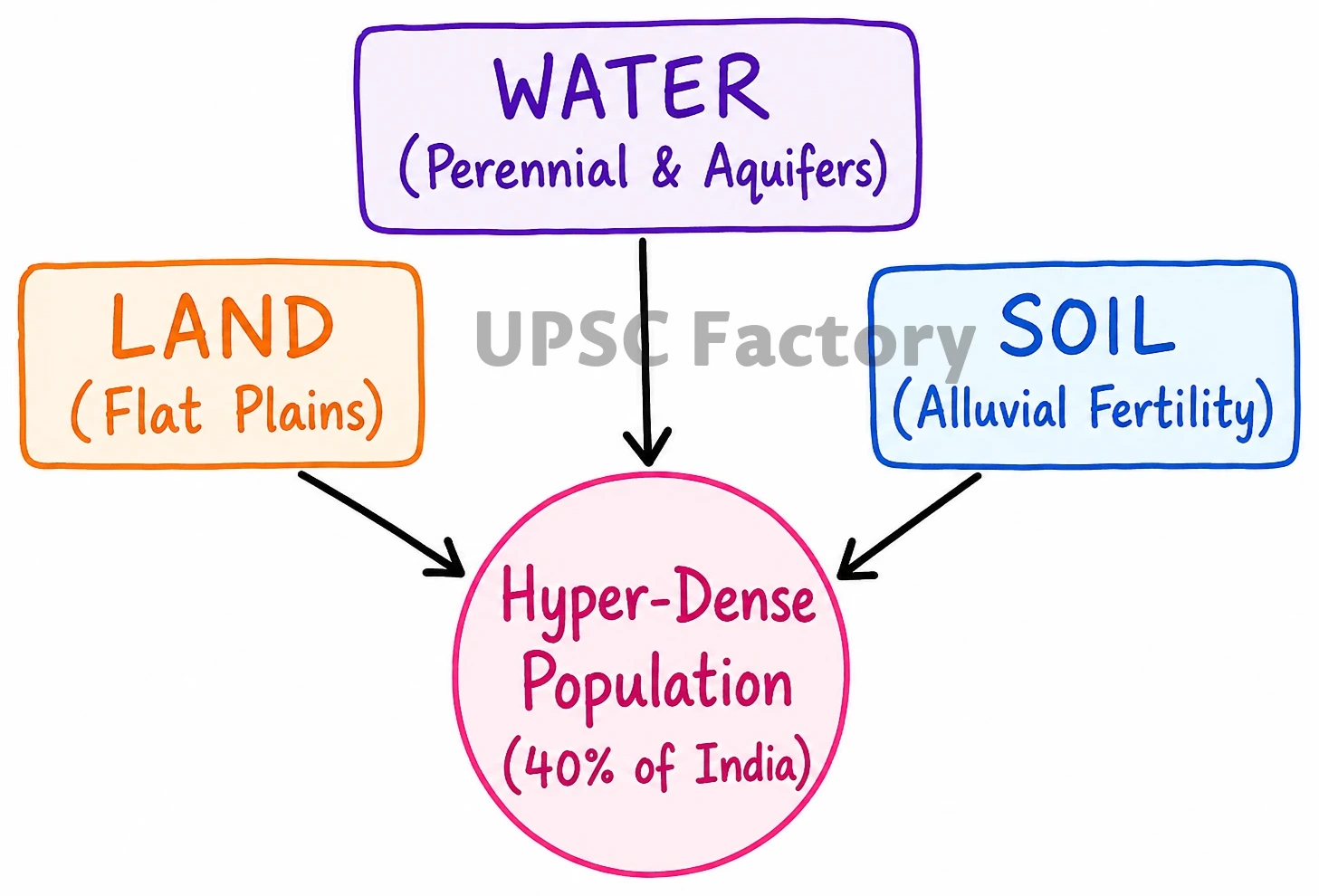
The Ganga River Basin, hosting ~40% of India’s population, forms a demographic heartland where immense population density directly correlates with rich geographical resource endowments.

Spatial Distribution and Density Patterns

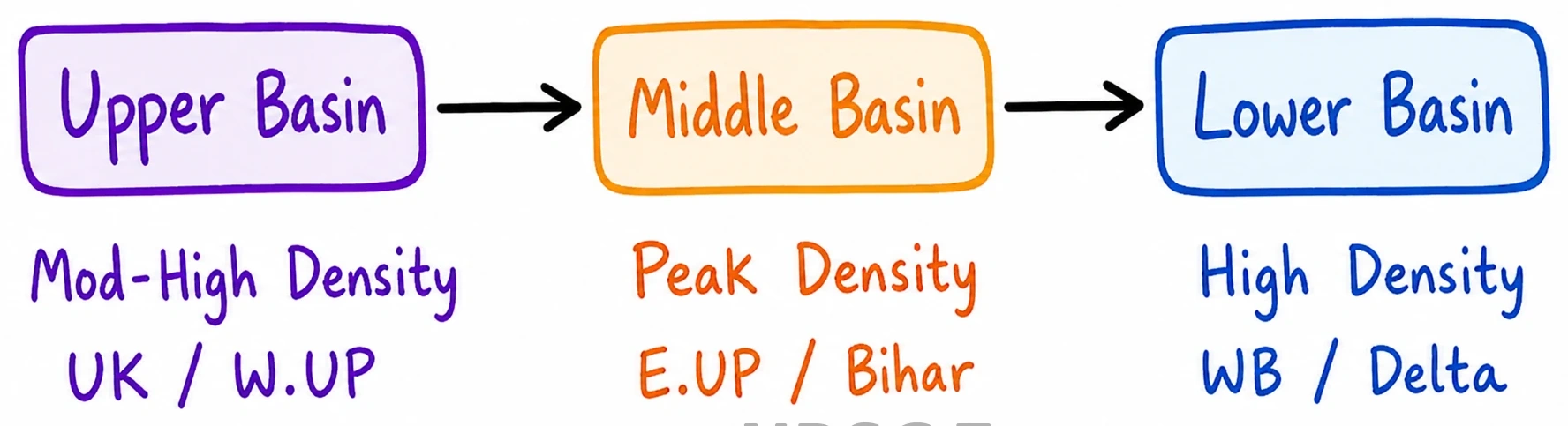
  1. Upper Basin (Uttarakhand, Western UP): Moderate-to-high density marking the transition from sparse hills to fertile plains (Haridwar, Meerut).
  2. Middle Basin (Eastern UP, Bihar): Records the highest density peaks due to vast, unbroken flatlands (Census 2011: Bihar 1106, UP 829 persons/sq.km).
  3. Lower Basin (West Bengal): Extremely high density driven by deltaic fertility and historical industrialization (Hooghly urban belt: 1029 persons/sq.km).
  4. Urban Agglomerations: Concentrated pockets of hyper-density exist along riverbanks due to historical trade and transit (Kanpur, Patna, Varanasi).

Resource-Demography Nexus: Land, Soil, and Water

  1. Topography and Infrastructure (Land): Expansive flat plains minimize construction costs, facilitating dense rail/road networks and sprawling settlements (Indo-Gangetic plains).
  2. Agrarian Carrying Capacity (Soil): Deep, fertile alluvial soils (Khadar and Bangar) support intensive multi-cropping, ensuring food security for massive populations (Rice-wheat belt).
  3. Perennial Surface Supply (Water): Glacial-fed rivers provide uninterrupted water for domestic needs, navigation, and agriculture, anchoring ancient human settlements (Ganga canal system).
  4. Rich Aquifer Wealth (Water): Thick sedimentary aquifers enable widespread tubewell irrigation, reducing monsoon dependency and sustaining dense rural populations (Green Revolution zones).
  5. Industrial Magnetism (Water & Land): Water abundance and flat terrain attract water-intensive industries, spawning mega-cities that absorb immense migrant labor (Kanpur leather, Hooghly jute).

While the basin’s resources historically sustained India’s greatest demographic concentrations, escalating population pressures now demand sustainable agro-ecological planning and robust rejuvenation efforts (Namami Gange) to prevent resource collapse.

Q. Discuss the distribution and density of population in the Ganga River Basin with special reference to land, soil and water resources. Read More »

Q. Discuss how the changes in shape and sizes of continents and ocean basins of the planet take place due to tectonic movements of the crustal masses.

Q. Discuss how the changes in shape and sizes of continents and ocean basins of the planet take place due to tectonic movements of the crustal masses.

UPSC Mains 2025 GS1 Paper

Model Answer:

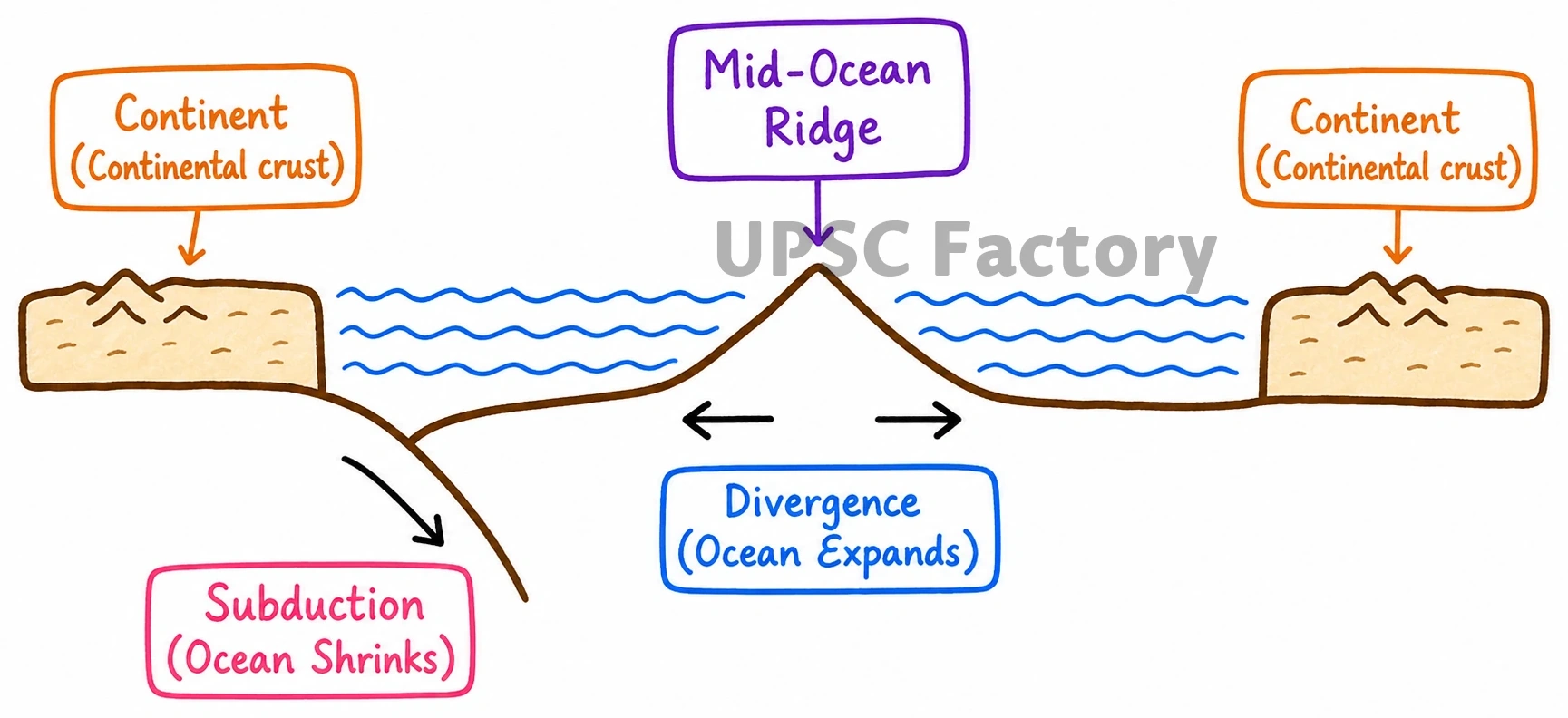
Driven by mantle convection currents, lithospheric plates constantly interact, driving a perpetual cycle of continental fragmentation and oceanic expansion under the Plate Tectonics Theory.

1. Tectonic Mechanisms Driving Morphological Changes

  1. Divergent Boundaries (Oceanic): Upwelling magma creates new crust, driving continuous seafloor spreading and expanding ocean basin sizes (Mid-Atlantic Ridge).
  2. Continental Rifting (Divergent): Tensional tectonic forces fracture contiguous continental masses, eventually birthing new linear seas (East African Rift Valley).
  3. Ocean-Continent Convergence: Denser oceanic plates subduct, destroying crust and shrinking oceans while shaping continental margins via volcanism (Andes Mountains).
  4. Continent-Continent Convergence: Compressive forces fuse crustal masses, closing intervening oceans and expanding continental size via orogeny (Himalayan accretion).
  5. Transform Boundaries: Crustal plates slide laterally, altering continental boundary shapes via massive horizontal displacement without crustal destruction (San Andreas Fault).

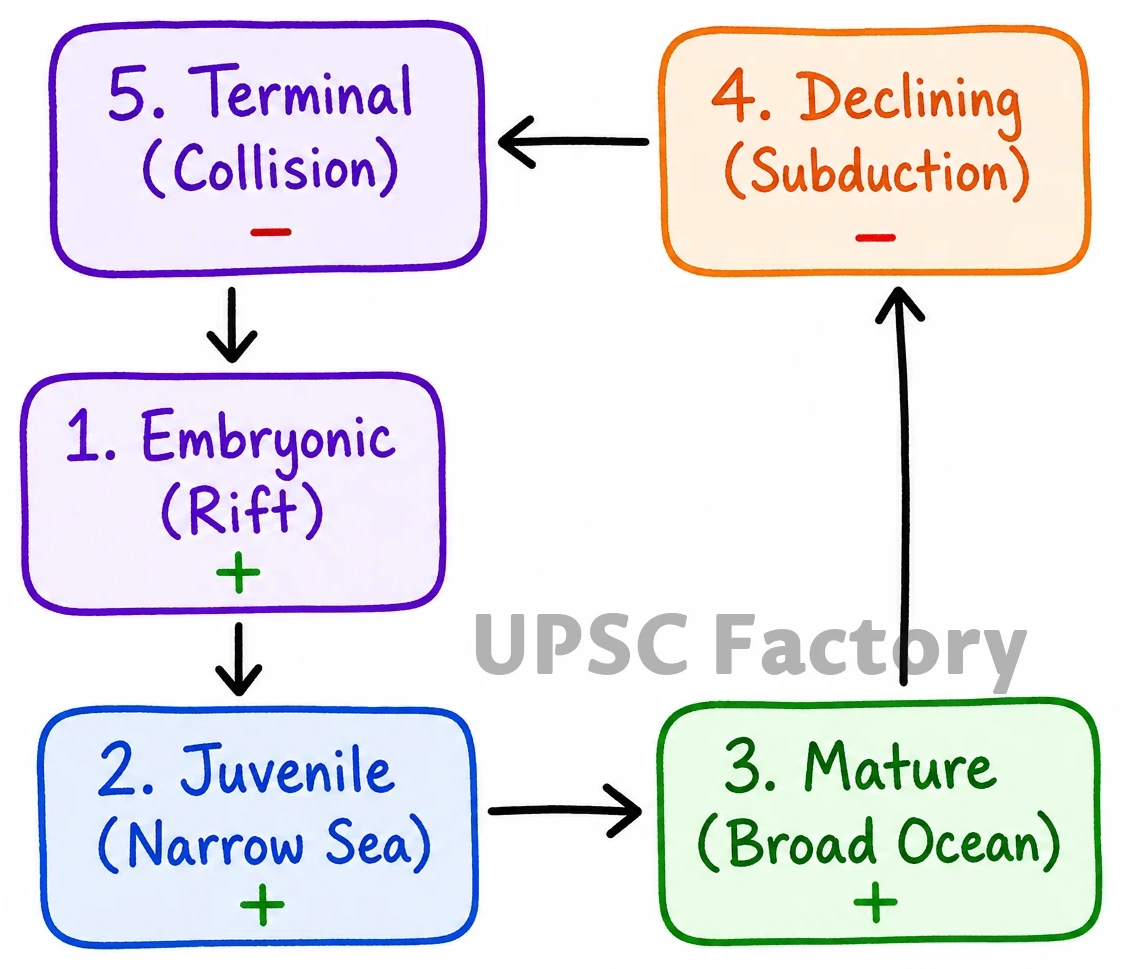
2. The Wilson Cycle: Evolutionary Stages of Basins

  1. Embryonic Stage: Mantle plumes thermally uplift and thin the continental crust, causing initial block fragmentation (Great Rift Valley).
  2. Juvenile Stage: Continued divergence separates continents, filling initial rifts with oceanic water to form narrow seas (Red Sea).
  3. Mature Stage: Sustained seafloor spreading forms vast, stable oceanic basins flanked by broad passive continental margins (Atlantic Ocean).
  4. Declining Stage: Subduction rates outpace spreading; ocean basins physically shrink, altering the adjacent continent’s shape (Pacific Ocean Ring of Fire).
  5. Terminal Stage: Complete subduction causes ocean closure and continent-continent collision, fusing landmasses into supercontinents (Mediterranean Sea shrinking).

Tectonic forces ensure Earth’s topography remains in dynamic equilibrium, continuously destroying and regenerating the lithosphere toward future supercontinent formations like Amasia.

Q. Discuss how the changes in shape and sizes of continents and ocean basins of the planet take place due to tectonic movements of the crustal masses. Read More »

Q. How can Artificial Intelligence (AI) and drones be effectively used along with GIS and RS techniques in locational and areal planning?

Q. How can Artificial Intelligence (AI) and drones be effectively used along with GIS and RS techniques in locational and areal planning?

UPSC Mains 2025 GS1 Paper

Model Answer:

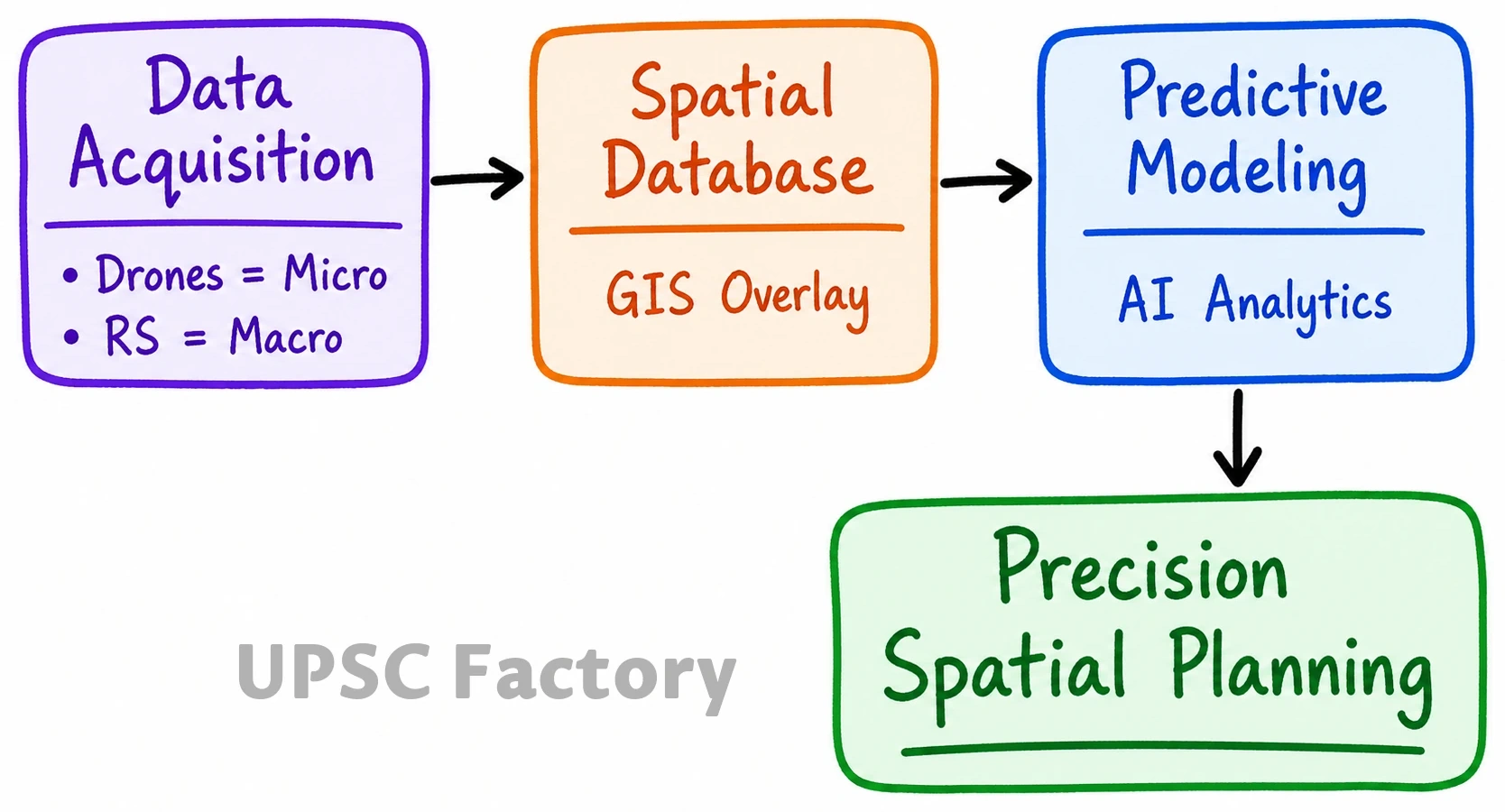
The integration of Artificial Intelligence (AI), Drones, Geographic Information Systems (GIS), and Remote Sensing (RS) creates a robust Spatial Data Infrastructure (SDI) for precision geographical planning.

Mechanisms of Synergy

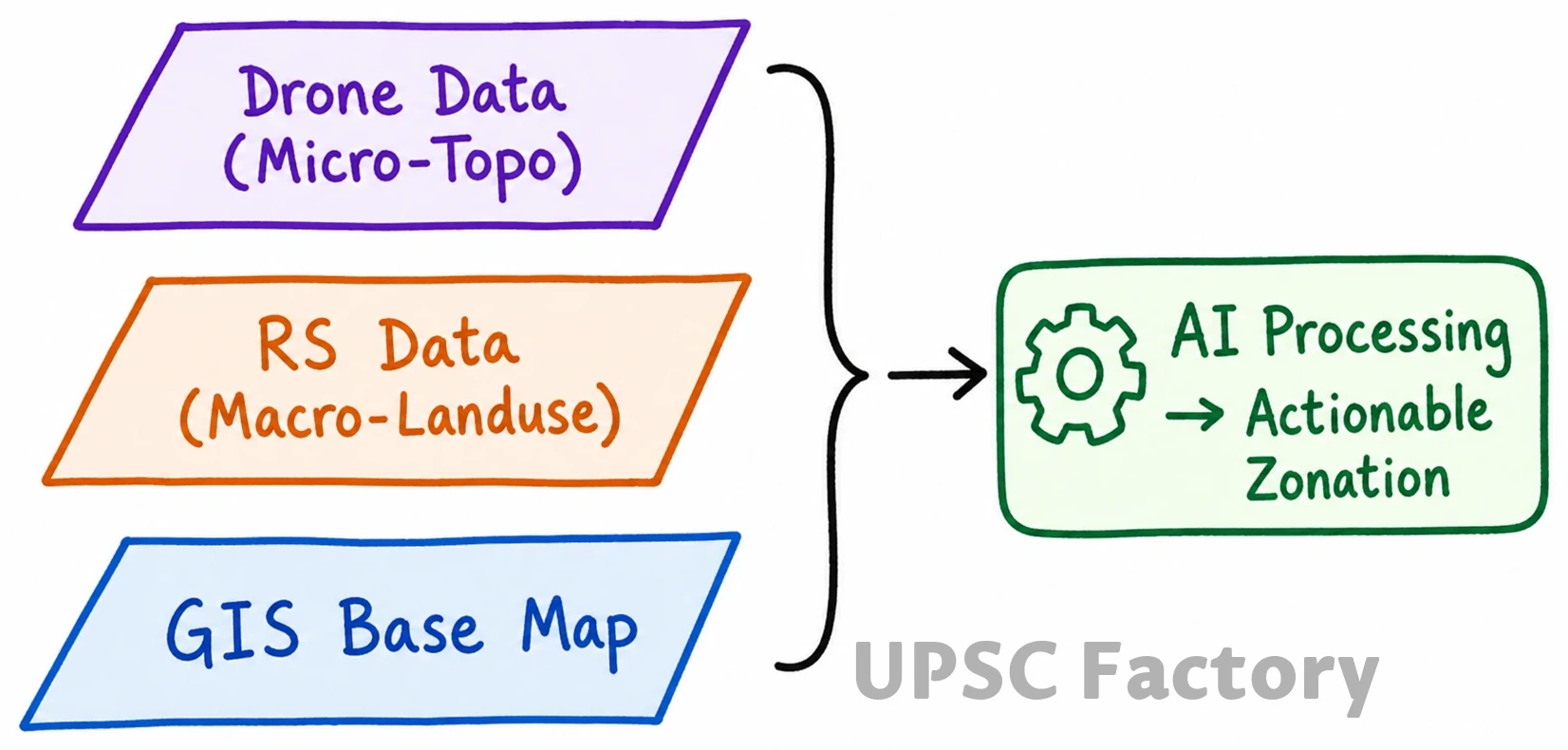
  1. Data Acquisition: Drones capture ultra-high-resolution, real-time micro-topographic data, complementing macro-level RS satellite imagery.
  2. Spatial Integration: GIS acts as the foundational database, systematically overlaying multi-layered drone and RS datasets.
  3. Predictive Modeling: AI algorithms (Machine Learning) process massive GIS datasets to identify spatial patterns and simulate future geographical scenarios.

Applications in Locational Planning (Site-Specific)

  1. Infrastructure Siting: AI optimizes route alignments for highways by analyzing terrain, slope, and land-use constraints via GIS (PM Gati Shakti).
  2. Disaster Logistics: Drones assess real-time micro-level inundation; AI models optimal rescue routes and emergency shelter sites.
  3. Property Titling: High-resolution drone mapping establishes precise rural property boundaries, resolving spatial land disputes (SVAMITVA Scheme).
  4. Urban Utility Mapping: Drone photogrammetry maps micro-utilities (pipelines, transformers) for precise maintenance and localized expansion.

Applications in Areal Planning (Regional)

  1. Agricultural Zonation: AI analyzes RS/Drone multispectral imagery to classify crop health and recommend optimal regional cropping patterns.
  2. Urban Sprawl Monitoring: AI-driven change detection on temporal RS datasets quantifies peri-urban expansion, guiding regional master planning.

  1. Watershed Management: Drone-generated Digital Elevation Models (DEMs) simulate water flow, while AI determines optimal macro-catchment area delineations.
  2. Ecological Conservation: RS-GIS mapping combined with AI anomaly detection tracks regional deforestation hotspots and habitat fragmentation accurately.

Leveraging this technological quad-core aligns with the National Geospatial Policy 2022, ensuring evidence-based, sustainable, and inclusive spatial planning for a rapidly urbanizing India.

Q. How can Artificial Intelligence (AI) and drones be effectively used along with GIS and RS techniques in locational and areal planning? Read More »

Q. Give a geographical explanation of the distribution of off-shore oil reserves of the world. How are they different from the on-shore occurrences of oil reserves?

Q. Give a geographical explanation of the distribution of off-shore oil reserves of the world. How are they different from the on-shore occurrences of oil reserves?

UPSC Mains 2025 GS1 Paper

Model Answer:

Offshore oil accounts for ~30% of global production, predominantly localized in shallow continental shelves characterized by thick marine sedimentary basins and trapped hydrocarbons.

Geographical Distribution of Offshore Oil Reserves

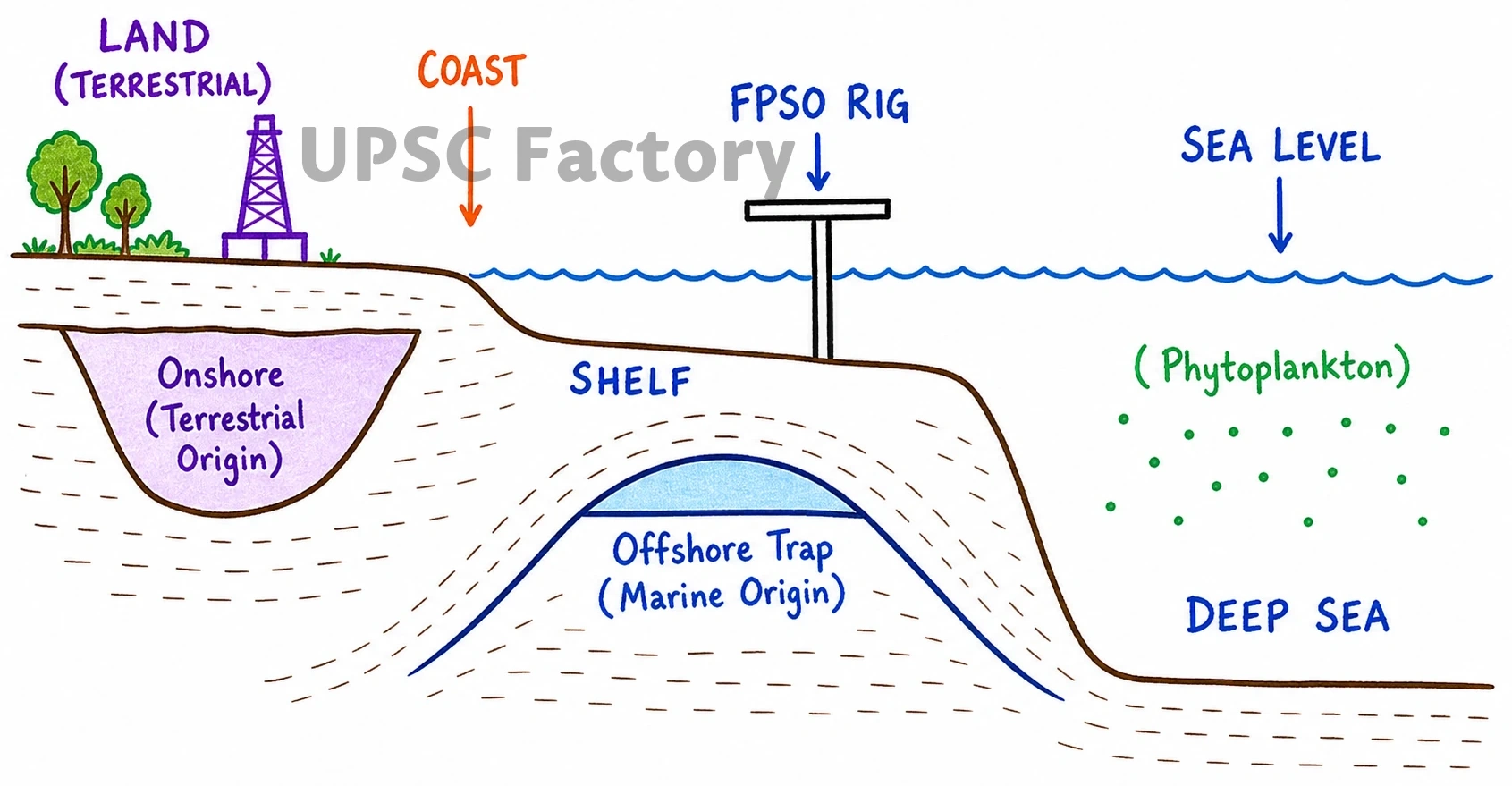
  1. Geological Basis: Geographically confined to marine sedimentary basins where phytoplankton decayed in anoxic environments over millions of years.
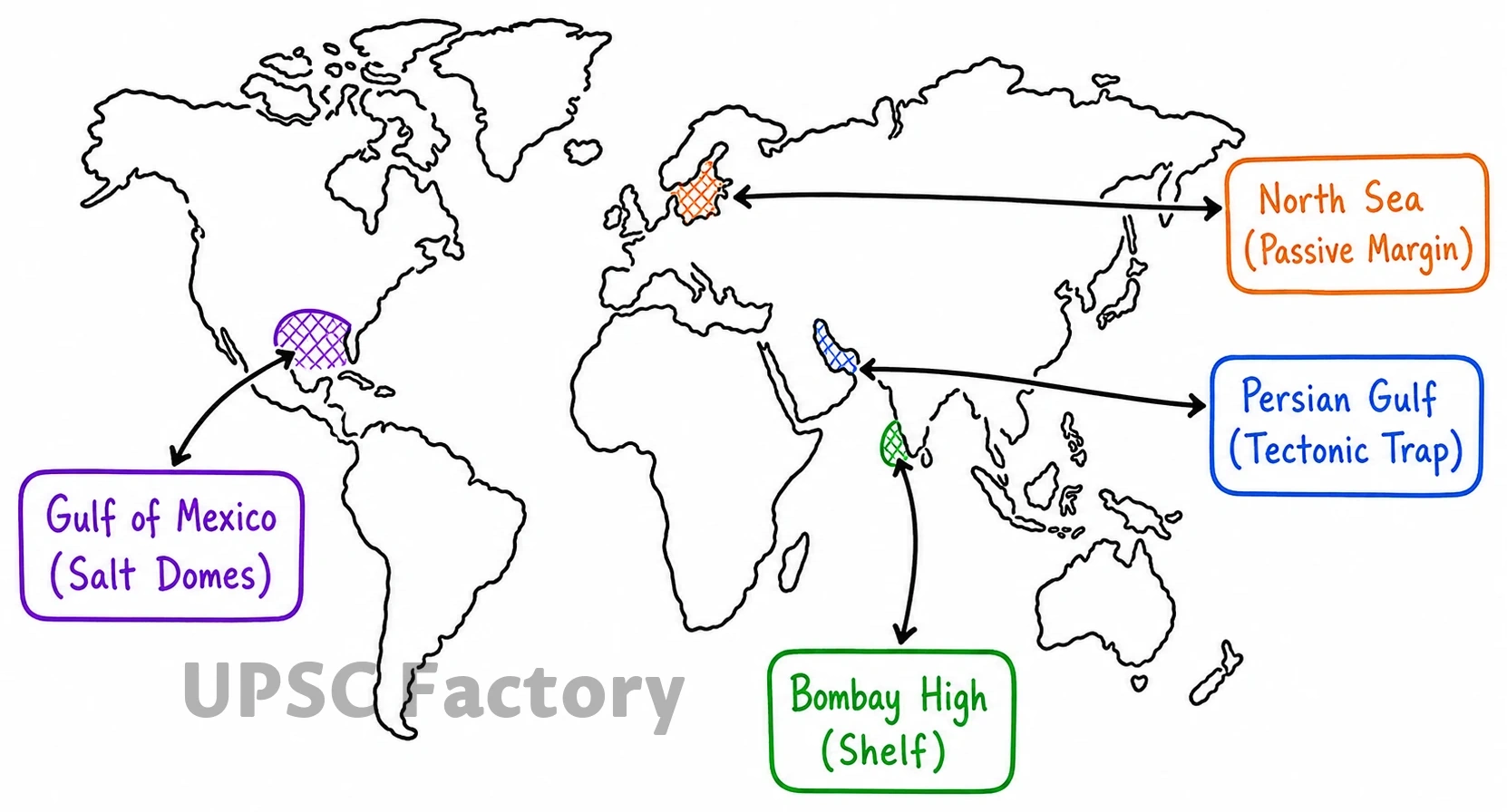
  2. Continental Shelves: Shallow, submerged coastal margins offer optimal conditions for organic accumulation and structural traps (Bombay High, India).
  3. Tectonic Depressions: Convergent boundaries and foreland basins create massive structural traps holding the largest offshore fields (Persian Gulf, Safaniya field).
  4. Passive Margins: Thick sedimentary sequences combined with prolific salt dome traps characterize major Atlantic reserves (Gulf of Mexico, North Sea).
  5. Emerging Frontiers: Technological advancements and receding ice are unlocking extreme-latitude and deep-water basins (Arctic Ocean, South China Sea).

Key Differences: Offshore vs. Onshore Reserves

  1. Biological Origin: Offshore reserves derive primarily from marine phytoplankton and algae; onshore occurrences often stem from terrestrial biomass/swamps (Digboi, Assam).
  2. Geopolitics and Governance: Offshore reserves rely on UNCLOS frameworks for EEZ extraction rights, frequently sparking maritime disputes; onshore reserves are governed by absolute territorial sovereignty.

  1. Extraction Technology: Offshore demands complex, capital-intensive infrastructure like Floating Production Storage and Offloading (FPSO) units; onshore relies on conventional land rigs and pumpjacks.
  2. Economic Viability: Offshore projects possess longer gestation periods, higher risk, and higher break-even costs ($40–$60/bbl) compared to conventional onshore extraction.
  3. Environmental Hazards: Offshore spills are rapidly dispersed by ocean currents, causing uncontainable marine ecological destruction (Deepwater Horizon); onshore spills cause highly localized soil/groundwater pollution.

As conventional onshore reserves plateau, technological breakthroughs in deep-water drilling will increasingly shift global energy reliance toward offshore frontiers, necessitating stringent transboundary ecological safeguards.

Q. Give a geographical explanation of the distribution of off-shore oil reserves of the world. How are they different from the on-shore occurrences of oil reserves? Read More »

Q. The French Revolution has enduring relevance to the contemporary world. Explain

Q. The French Revolution has enduring relevance to the contemporary world. Explain

UPSC Mains 2025 GS1 Paper

Model Answer:

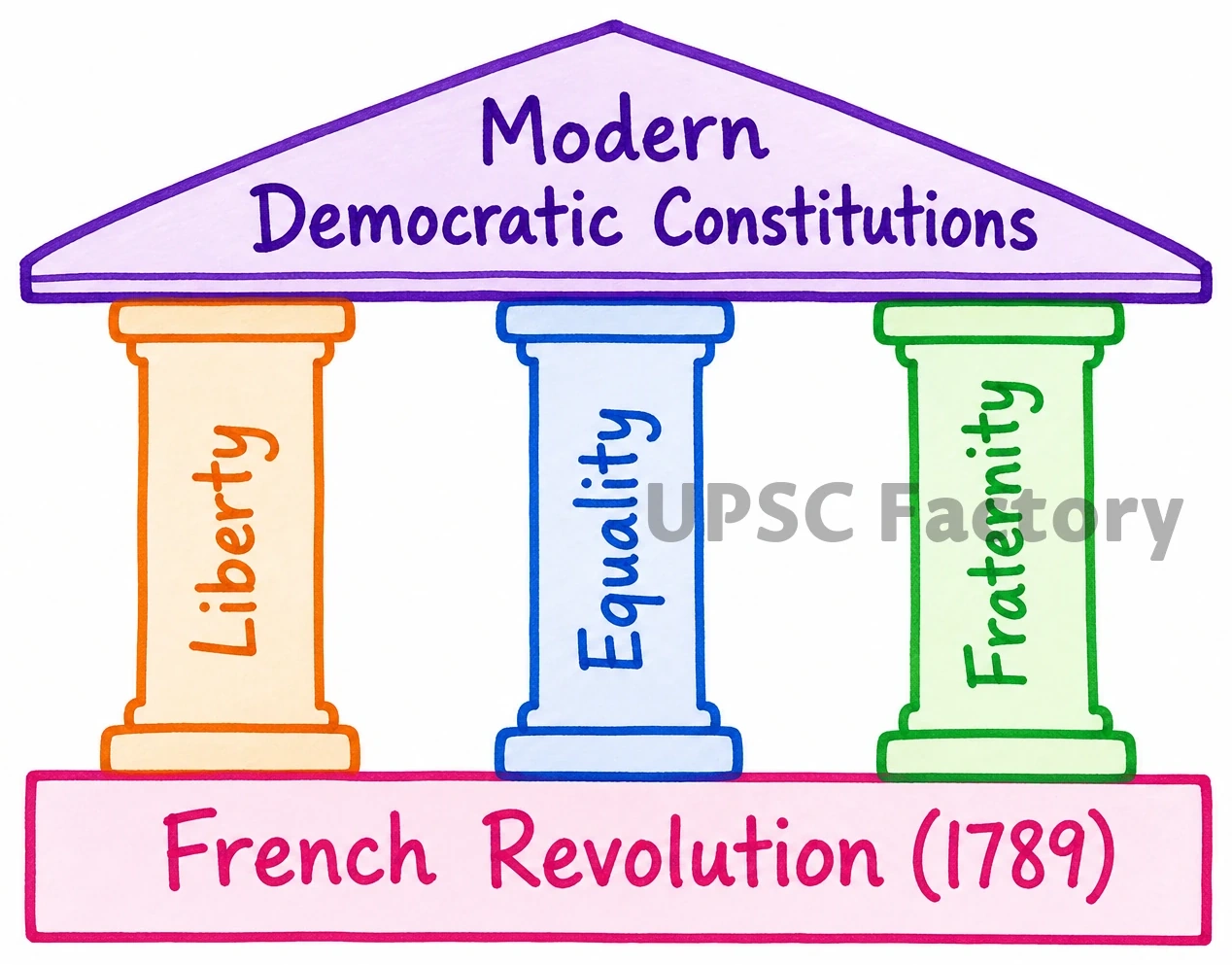
The French Revolution (1789) systematically dismantled feudal absolutism, birthing the modern ideological triad of Liberty, Equality, and Fraternity that continues to shape global governance.

1. Institutionalizing Democratic Governance & Constitutionalism

  • Constitutional Supremacy: Replaced divine right absolutism with the written rule of law, ensuring institutional accountability (Modern democratic constitutions).
  • Popular Sovereignty: Shifted political legitimacy from dynastic monarchs directly to the citizenry (Global transition to electoral republicanism).
  • Ideological Triad: “Liberty, Equality, Fraternity” became the universal bedrock for modern governance charters (Preamble to the Indian Constitution).
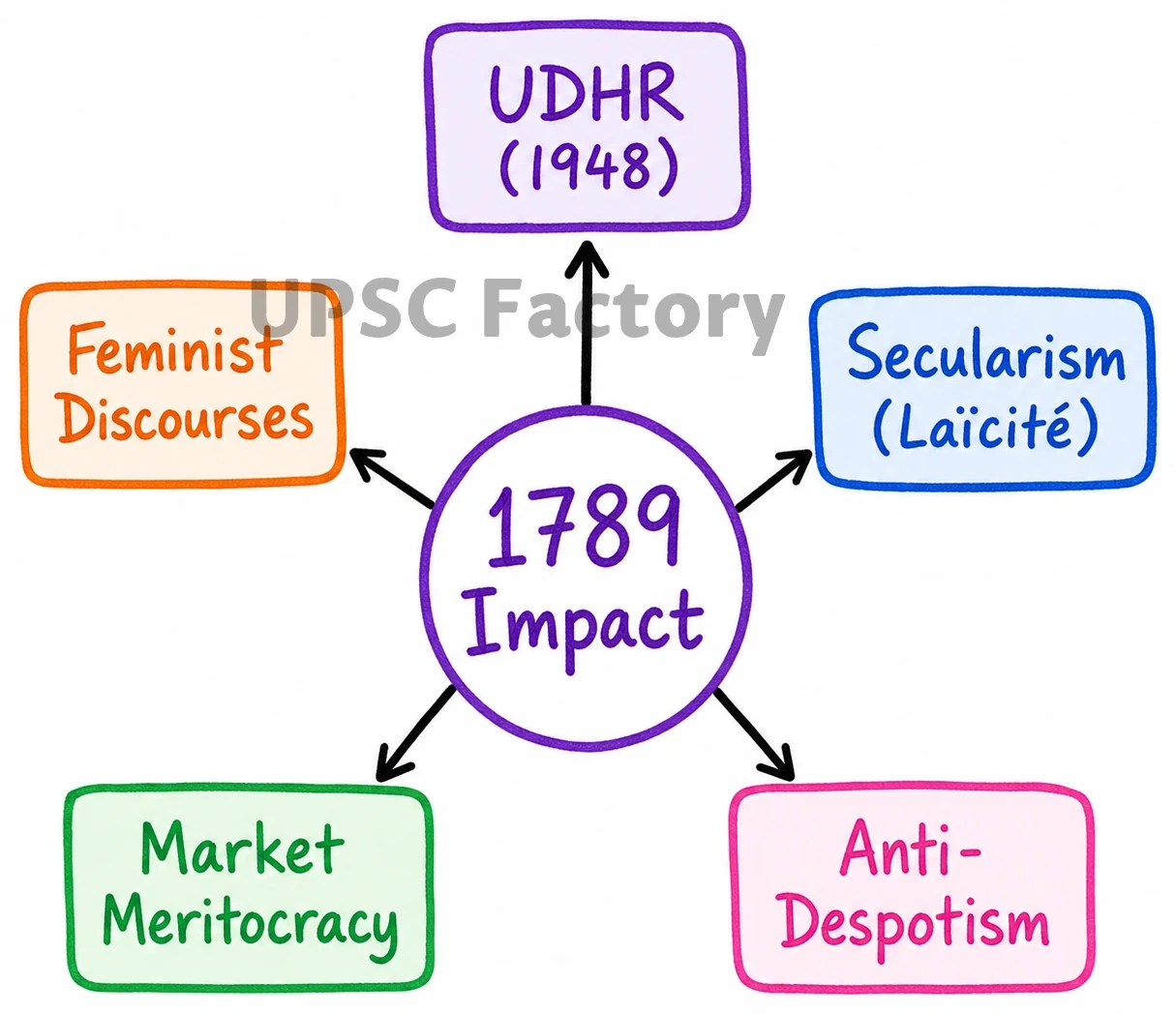
  • Secular Statecraft: Stripped the Church of political power, initiating strict state neutrality in religious affairs (French Laïcité).

2. Legacy in Modern Human Rights & Socio-political Movements

  • Universal Rights Codification: The 1789 Declaration of the Rights of Man fundamentally shaped international legal frameworks (UN Universal Declaration of Human Rights, 1948).
  • Anti-Despotism Precedent: The dismantling of autocratic structures remains a potent blueprint for citizen uprisings against oppressive regimes (The Arab Spring).
  • Genesis of Political Feminism: Early demands for gender parity birthed enduring global feminist discourses (Olympe de Gouges’ Declaration of the Rights of Woman).
  • Egalitarian Social Justice: The systemic abolition of feudal estates inspired global movements against inherited social hierarchies (Anti-caste movements and abolitionism).

3. Administrative and Economic Paradigms

  • Standardized Administration: Introduced uniform legal and administrative frameworks, replacing highly fragmented feudal systems (Derivatives of the Napoleonic Code).
  • Economic Meritocracy: Abolished aristocratic tax exemptions and guild monopolies, laying the groundwork for progressive taxation and market economics (Modern welfare states).

Ultimately, the French Revolution transcended its European origins, acting as an enduring, universal catalyst for democratization, unalienable human rights, and egalitarian governance globally.

Q. The French Revolution has enduring relevance to the contemporary world. Explain Read More »

Q. Trace India’s consolidation process during early phase of independence in terms of polity, economy, education and international relations.

Q. Trace India’s consolidation process during early phase of independence in terms of polity, economy, education and international relations.

UPSC Mains 2025 GS1 Paper

Model Answer:

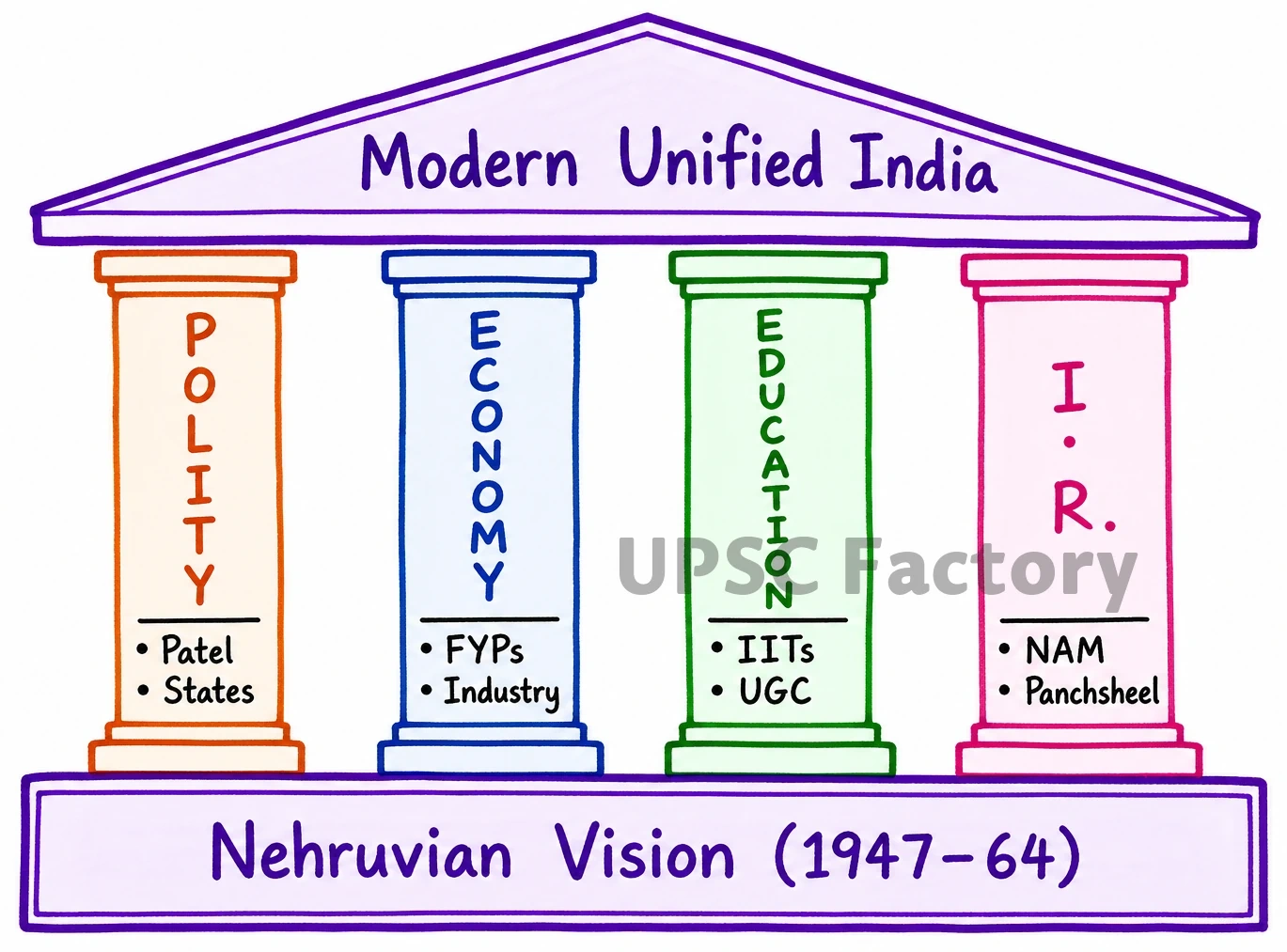
The early post-independence era (1947–1964) witnessed foundational nation-building under the Nehruvian vision, transforming a fragmented, impoverished colony into a resilient, unified democratic republic.

1. Political Consolidation

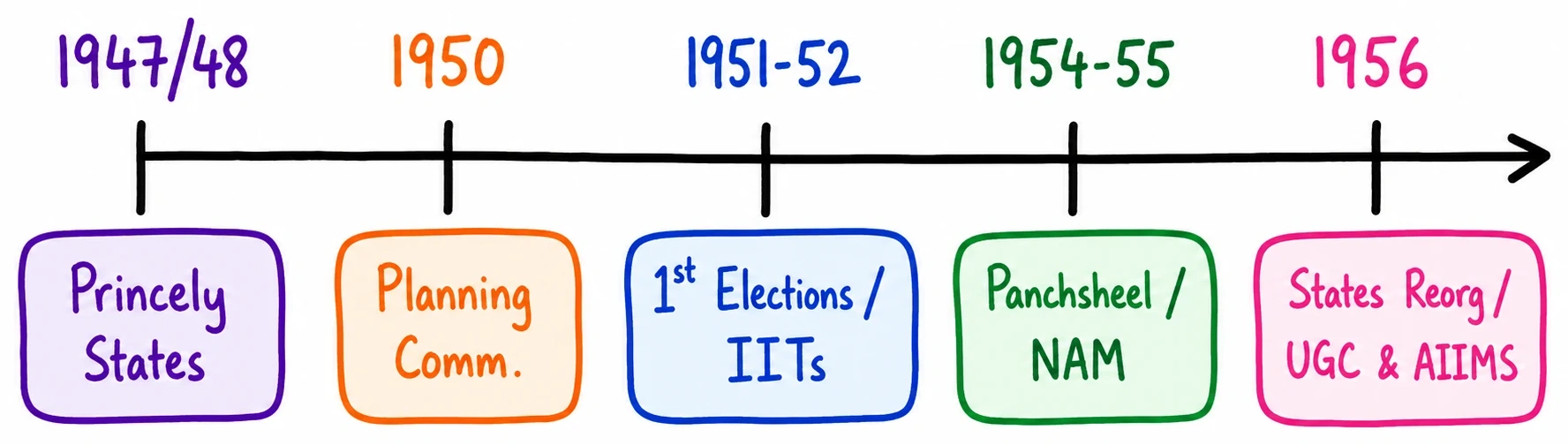
  • Territorial Integration: Sardar Patel’s astute diplomacy successfully assimilated 562 princely states into the Indian Union (Instrument of Accession, Operation Polo).
  • Linguistic Reorganization: Mitigated sub-nationalist chauvinism while preserving federal unity and administrative efficiency (States Reorganization Act 1956, Fazl Ali Commission).
  • Democratic Institutionalization: Enacted a sovereign Constitution and conducted the world’s largest democratic exercise (Article 1: Union of States, 1951-52 General Elections).

2. Economic Consolidation

  • Planned Development: Instituted a mixed economy framework driven by state-led resource allocation (Planning Commission 1950, First Five-Year Plan).
  • Industrial Base: Rapid industrialization emphasizing heavy industries and capital goods via the Mahalanobis Model (Second Plan, Bhilai/Durgapur steel plants).
  • Agrarian Reforms: Targeted rural poverty through land tenure restructuring and grassroots initiatives (Zamindari Abolition, Community Development Programme 1952).

3. Educational & International Foundations

Educational Infrastructure

  • Higher Education & Technical Skill: Established premier institutes to foster scientific temper and human capital (IIT Kharagpur 1951, AIIMS 1956).
  • Institutional Funding: Created apex statutory bodies to standardize and finance tertiary education (Radhakrishnan Commission 1948, UGC Act 1956).
  • Scientific Research: Built a robust institutional ecosystem for strategic research (CSIR, Atomic Energy Commission 1948, INCOSPAR 1962).

International Relations

  • Strategic Autonomy: Spearheaded the Non-Aligned Movement (NAM) to avoid Cold War bipolarity and retain sovereign decision-making (Bandung Conference 1955).
  • Peaceful Coexistence: Championed regional diplomacy based on mutual respect for sovereignty and non-interference (Panchsheel Agreement 1954).
  • Multilateralism: Actively advocated for anti-colonialism, anti-apartheid, and robust UN peacekeeping engagement (Korea, Congo missions).

These foundational pillars successfully integrated a highly diverse populace, establishing a robust socio-economic, political, and diplomatic bedrock for modern India’s contemporary global ascent.

Q. Trace India’s consolidation process during early phase of independence in terms of polity, economy, education and international relations. Read More »

Q. Mahatma Jotirao Phule’s writings and efforts of social reforms touched issues of almost all subaltern classes. Discuss.

Q. Mahatma Jotirao Phule’s writings and efforts of social reforms touched issues of almost all subaltern classes. Discuss.

UPSC Mains 2025 GS1 Paper

Model Answer:

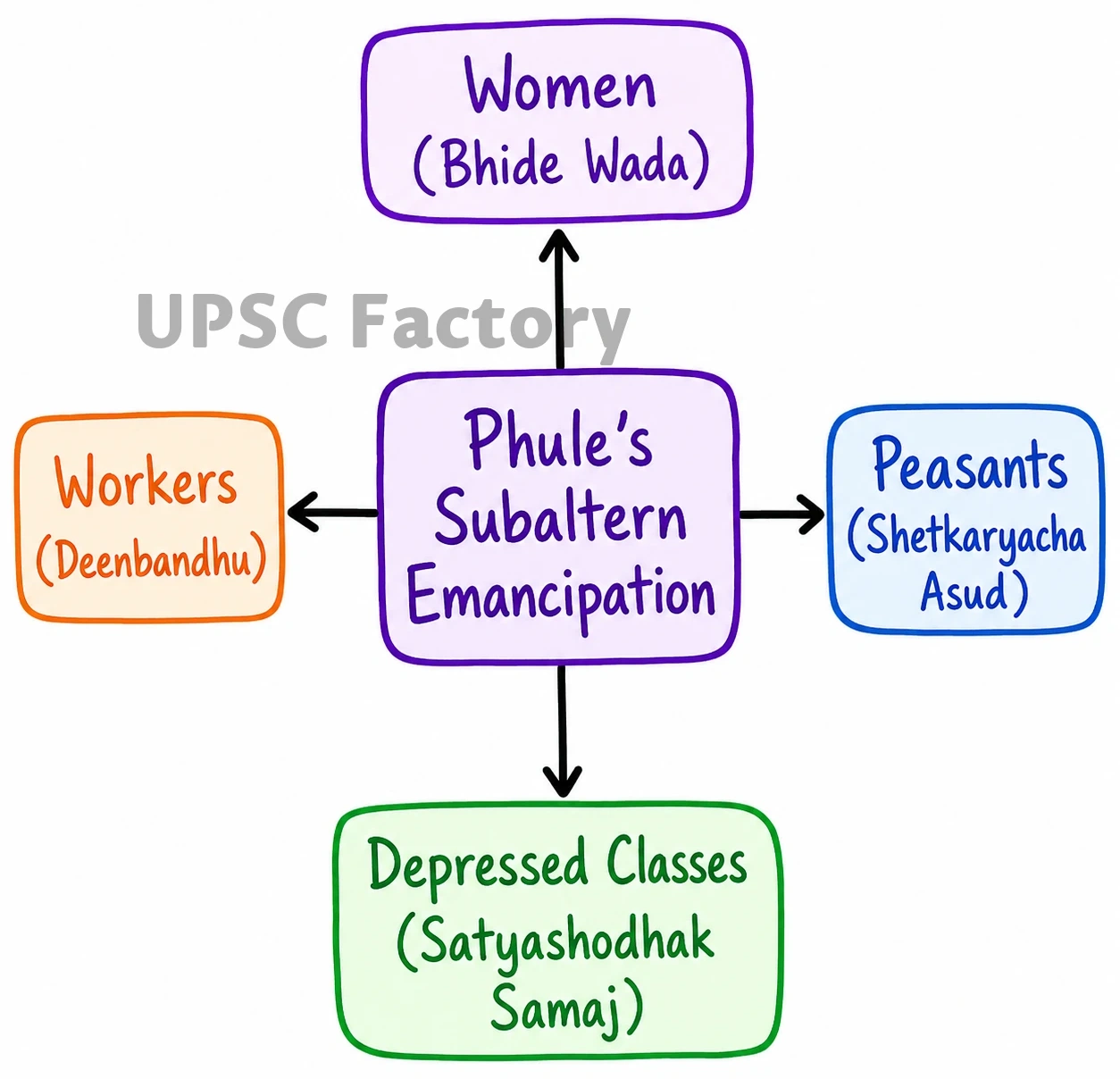
Mahatma Jotirao Phule was a revolutionary 19th-century reformer whose institutional efforts and seminal literature spearheaded the anti-caste movement and emancipated diverse marginalized subaltern classes in India.

Social Reforms: Depressed Classes & Women

1. Emancipation of Depressed Classes (Shudras & Atishudras)

  • Ideological Critique: Authored Gulamgiri (1873) to expose Brahminical hegemony, dedicating it to the American abolitionist movement against slavery.
  • Institutional Mobilization: Founded the Satyashodhak Samaj (1873) to secure basic human rights and conduct religious ceremonies without intermediary priests.
  • Eradicating Untouchability: Opened his personal water reservoir to untouchables (1868), actively defying orthodox social sanctions and caste purity norms.

2. Upliftment of Women

  • Pioneering Education: Established the first indigenous girls’ school at Bhide Wada, Pune (1848) alongside his wife, Savitribai Phule.
  • Protecting Vulnerable Women: Established the Balhatya Pratibandhak Griha (1863) to prevent female infanticide and provide safe shelter for pregnant, distressed widows.
  • Gender Equality: Vigorously championed widow remarriage and utilized his writings to dismantle patriarchal interpretations of religious scriptures.

Economic Advocacy: Peasants & Working Class

  • Exposing Agrarian Distress: Authored Shetkaryacha Asud (The Cultivator’s Whipcord, 1881), systematically detailing the exploitation of farmers by moneylenders, zamindars, and colonial bureaucrats.
  • Policy Critique: Actively protested against exploitative British forest policies and rack-renting land revenue settlements that destroyed rural livelihoods.
  • Labor Mobilization: Inspired and supported his colleague Narayan Meghaji Lokhande in forming the Bombay Mill Hands Association (1890), India’s first labor organization.
  • Subaltern Journalism: Utilized the Deenbandhu newspaper (1877) as a powerful mouthpiece to articulate the daily grievances of mill workers and marginalized laborers.

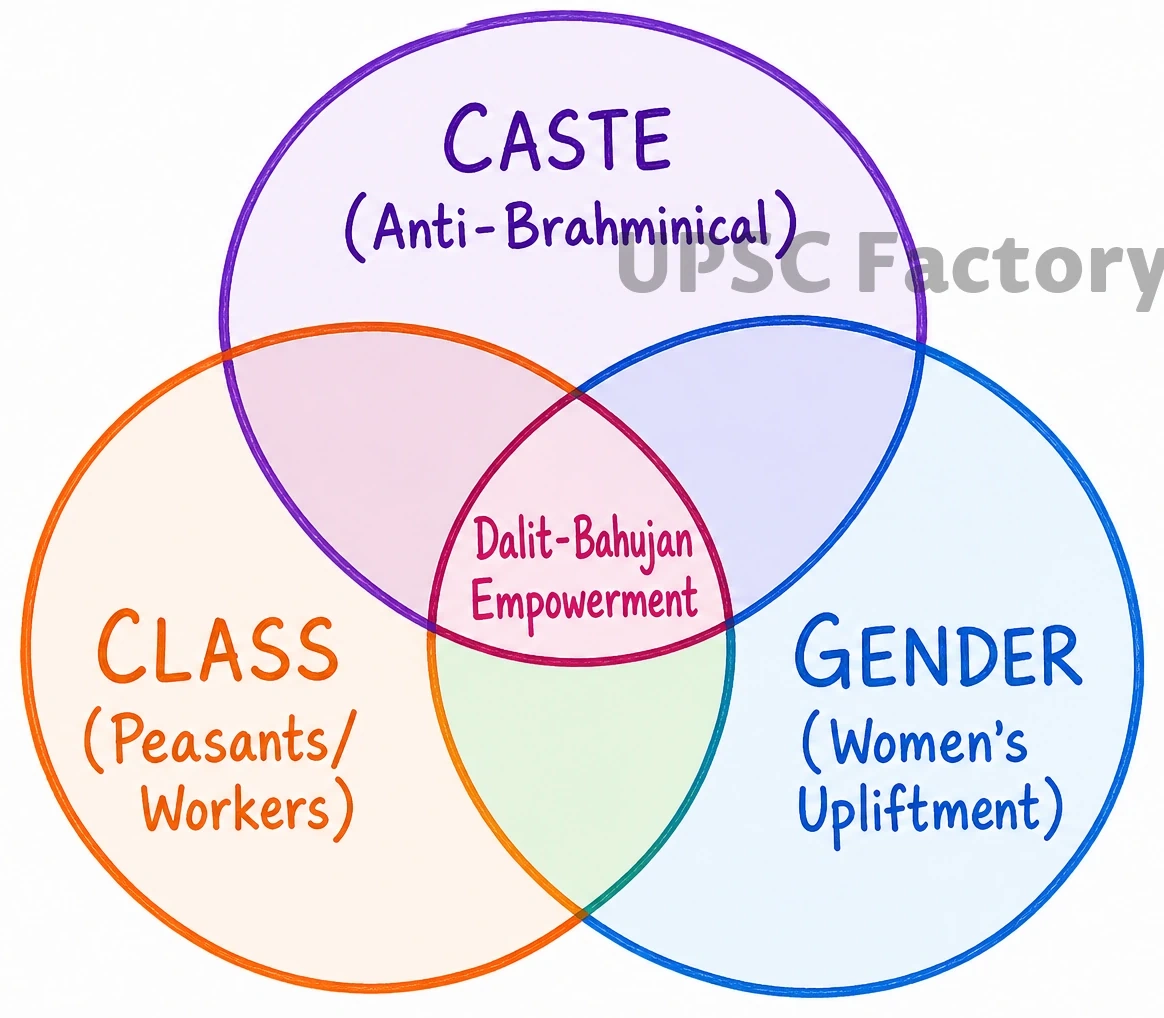
Phule’s multidimensional crusade comprehensively addressed the intersections of caste, class, and gender, laying the ideological foundation for the modern Dalit-Bahujan movement and Dr. B.R. Ambedkar’s vision of social justice.

Q. Mahatma Jotirao Phule’s writings and efforts of social reforms touched issues of almost all subaltern classes. Discuss. Read More »