2021 Sociology Paper 2

Discuss different forms of kinship system in India.

Model Answers

Q: Discuss different forms of kinship system in India.

Question asked in UPSC Sociology 2021 Paper 2. Download our app for last 20 year question with model answers.

Model Answer:

Types of Kinship

Kinship denotes socially recognised relations based on blood, marriage and adoption. In India, it is a primary principle of social organisation, shaping family, caste, inheritance, and even politics, and therefore displays multiple distinct forms across regions, castes and tribes.

1. Forms by descent and residence

• Patrilineal–patrilocal system:
Predominant among Hindus and many Muslims and Sikhs; descent, surname and property pass through male line; bride moves to husband’s home. G.S. Ghurye and A.M. Shah show how this sustains joint families and corporate lineages (gotra, vansh).

• Matrilineal–matrilocal / avunculocal system:
Found among Nayar of Kerala, Khasi and Garo (studied by Kathleen Gough, Irawati Karve). Descent and property follow the female line; residence is often with mother’s brother, creating a distinction between genitor (husband) and social father (maternal uncle).

• Bilateral tendencies:
Some tribes (e.g., among Santals) and urban middle classes show bilateral reckoning of kin, with weaker lineage solidarity but strong conjugal ties.

2. Regional kinship systems (Irawati Karve’s classification)

• Northern kinship system:
– Strongly patrilineal, patrilocal, caste-endogamous and village-exogamous.
– Strict prohibition of cousin marriage; gotra/sapinda exogamy.
– Practices of hypergamy among Rajputs and upper castes (Karve, Ghurye).
– Kinship underlies biradari councils and supports M.N. Srinivas’s “dominant caste” politics.

• Southern (Dravidian) kinship system:
– Patrilineal but with preference for cross-cousin and uncle–niece marriages (Louis Dumont).
– Local endogamy; no rigid village exogamy.
– Bifurcate-merging terminology (mother’s sister = mother; father’s brother = father) reflects merging of certain kin categories.

• Central and Western India:
– Transitional forms combining northern prohibitions with some acceptance of cross-cousin marriage (e.g., among Marathas).
– Greater flexibility in marriage circles and residence.

• Eastern India (Bengal–Assam):
– Patrilineal, but relatively more bilateral sentiments and weaker hypergamy.
– Some tribal influences in Assam and adjoining regions.

3. Tribal kinship forms

• Many tribes (Gond, Oraon) have exogamous clans with totemic identities, segmentary lineages and bride-wealth, as shown in Ghurye’s and tribal monographs.
• North-Eastern tribes (e.g., Nagas) show clan-based, often egalitarian kinship with strong youth dormitory traditions and lineage councils.

4. Change and continuity

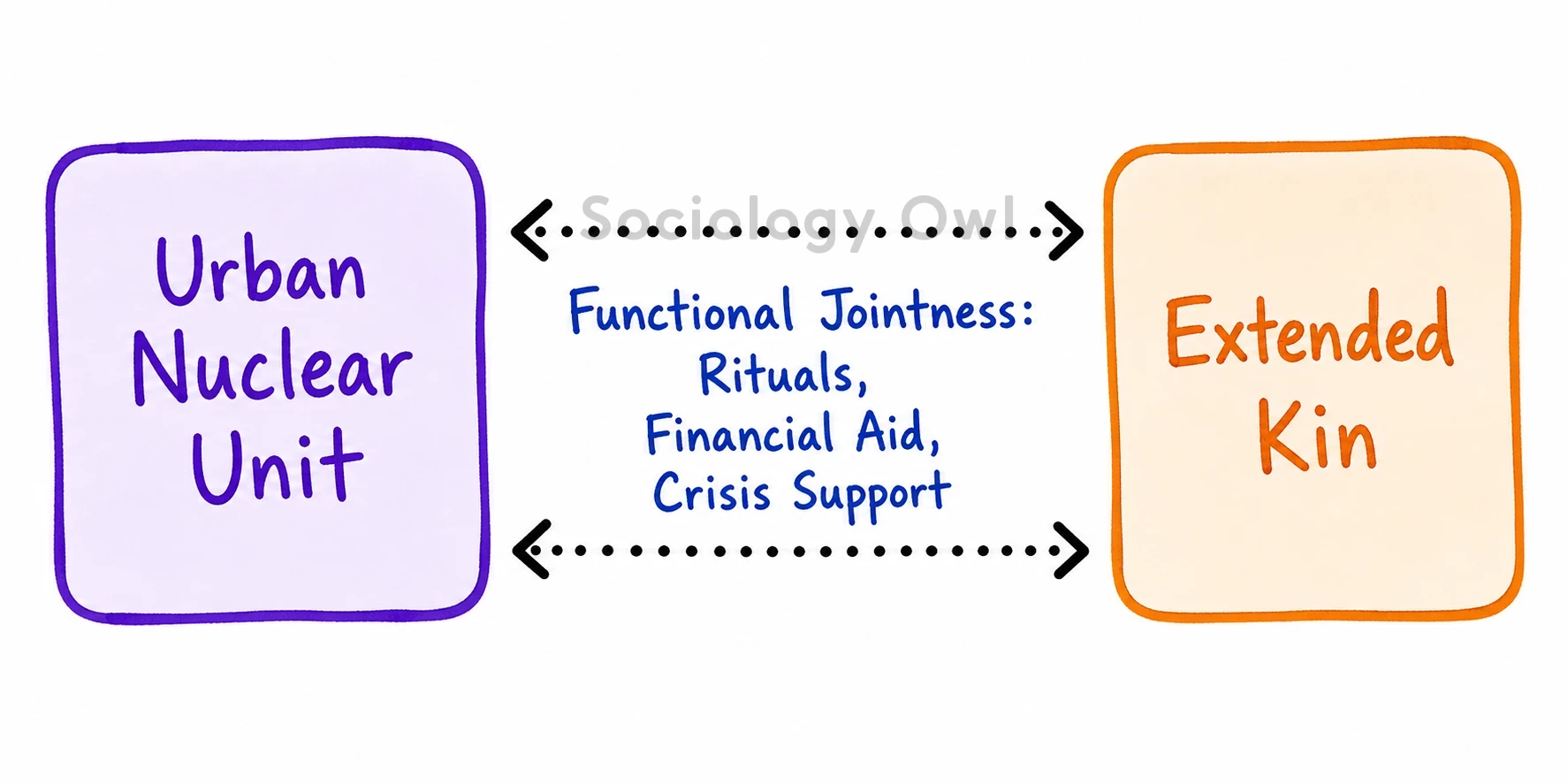
Urbanisation, education and women’s employment weaken joint residence but, as A.M. Shah and Patricia Uberoi note, kin networks remain crucial in rituals, migration, and even electoral alliances, while inter-caste and inter-regional marriages slowly pluralise kinship norms.

Conclusion: Indian kinship exhibits enduring regional and descent-based diversity, yet is gradually reworked by urbanisation, mobility, gender equality and constitutional ideals of individual choice.

Discuss different forms of kinship system in India. Read More »

Discuss the changing dimensions of family structure in urban India.

Model Answers

Q: Discuss the changing dimensions of family structure in urban India.

Question asked in UPSC Sociology 2021 Paper 2. Download our app for last 20 year question with model answers.

Model Answer:

Changing Family Structure in Urban India

Family is a universal social institution regulating reproduction, socialization and emotional support. In urban India, rapid urbanisation, industrialisation and globalisation have restructured family forms and internal relations without dissolving the institution itself.

Structurally, there is a clear trend towards nuclear households. Following Parsons and Goode, the small, mobile conjugal unit fits an industrial, occupationally diverse city. Yet, as A.M. Shah’s work on the “household dimension of family” shows, the decline is of joint households, not necessarily of joint families: nuclear households often remain embedded in wider kin networks through economic support, ritual participation and decision-making. Patricia Uberoi therefore argues that the joint–nuclear dichotomy is too simplistic for contemporary India.

Changing dimensions include:

• Size and composition
– Declining fertility, housing constraints and career mobility encourage small, neolocal nuclear families in apartments and gated communities.
– New forms are emerging: single-parent families (post-divorce or widowhood), reconstituted/step families, childless by choice couples, live-in relationships, and, post-Navtej Johar judgment, more visible same-sex partnerships, though still marginal.

• Authority, gender and intimacy
– Traditional patriarchal authority is challenged by women’s education and labour-force participation; dual-earner families are common in the middle class.
– The family increasingly emphasises companionship and negotiation over obedience, aligning with Burgess and Locke’s “from institutional to companionship family,” yet unpaid care work remains heavily feminised (Leela Dube).

• Intergenerational relations and ageing
– Migration produces “left-behind” parents in small towns and solitary elderly in metros, leading to old-age homes and paid eldercare services.
– Simultaneously, parents often fund children’s higher education and housing, reflecting continuing intergenerational dependence.

• Class and space
– Among the urban poor, extended kin often co-reside in slums/chawls for risk-sharing, childcare and informal credit, resembling “functional joint families.”
– For transnational and IT-sector professionals, “commuter marriages” and digital families (Skype/WhatsApp parenting) are increasingly visible.

Despite westernisation and individualisation (M.N. Srinivas, Ulrich Beck), arranged marriage, kin endogamy and ideologies of the joint family persist, indicating adaptive, not collapsing, family structures.

In sum, urban Indian family is neither disintegrating nor static; it is selectively modernising, balancing individual aspirations with enduring kinship obligations and support.

Discuss the changing dimensions of family structure in urban India. Read More »

Examine the factors responsible for the rural unrest in contemporary India.

Model Answers

Q: Examine the factors responsible for the rural unrest in contemporary India.

Question asked in UPSC Sociology 2021 Paper 2. Download our app for last 20 year question with model answers.

Model Answer:

Rural Unrest in Contemporary India

Rural unrest in contemporary India refers to recurrent protests, agitations, insurgencies and everyday resistance in the countryside around land, livelihood and dignity. It is sociologically significant because, as A.R. Desai argued, the agrarian question lies at the core of India’s wider class and democratic struggles.

Structural and agrarian factors

• Incomplete land reforms and persistent inequalities in landownership have produced enduring tensions between landlords, rich peasants, smallholders and landless labourers. Utsa Patnaik and Bardhan show how capitalist farming sharpened this class differentiation instead of dissolving it.
• The Green Revolution created a “prosperous farmer” (Bhalla, Chadha) but also regional and intra‑village polarisation, fuelling wage disputes, bonded labour conflicts and protests by agricultural labourers, especially in Punjab and western UP.
• M.N. Srinivas’s “dominant caste” thesis explains how land‑rich intermediate castes control panchayats and resources, provoking conflicts with Dalits and OBCs over land, common property and political power.

Economic and policy-related factors

• Neoliberal reforms have reduced state support: volatile crop prices, input cost inflation, shrinking public procurement and indebtedness contribute to farmers’ suicides and large‑scale protests (e.g., 2020–21 farm law agitation).
• Mechanisation and declining farm sizes generate underemployment and seasonal migration. For youth exposed to consumerist aspirations, this “blocked mobility” (Jodhka) produces frustration and receptivity to protest and extremism.
• Land acquisition for SEZs, mining and dams (Narmada, Singur, POSCO, Niyamgiri) displaces peasants and adivasis, transforming “development” into a source of dispossession and militancy.

Socio‑cultural and political factors

• Caste atrocities in rural India often centre on land, wages and assertion of dignity by Dalits and adivasis (Gail Omvedt). Honour killings, khap diktats and attacks on inter‑caste marriages express resistance to status equalisation.
• Identity‑based agitations by Jats, Patels, Marathas and Kapus for reservations reflect anxieties of erstwhile dominant peasant castes facing agrarian stagnation and declining returns.
• Left‑wing extremism in central India, as Oommen notes, emerges where class, ethnicity and regional deprivation intersect, amid state neglect and coercive policing.

Ecological and demographic factors

• Climate change, groundwater depletion and crop failures intensify agrarian distress.
• Rising population pressure and fragmentation of holdings make agriculture non‑viable, reinforcing a sense of crisis.

Rural unrest will persist unless structural agrarian inequalities, precarity of farm livelihoods and exclusionary development are addressed through inclusive reforms and empowered local democracy.

Examine the factors responsible for the rural unrest in contemporary India. Read More »

Discuss the salient features of ‘new middle class’ in India.

Model Answers

Q: Discuss the salient features of 'new middle class' in India.

Question asked in UPSC Sociology 2021 Paper 2. Download our app for last 20 year question with model answers.

Model Answer:

New Middle Class in India

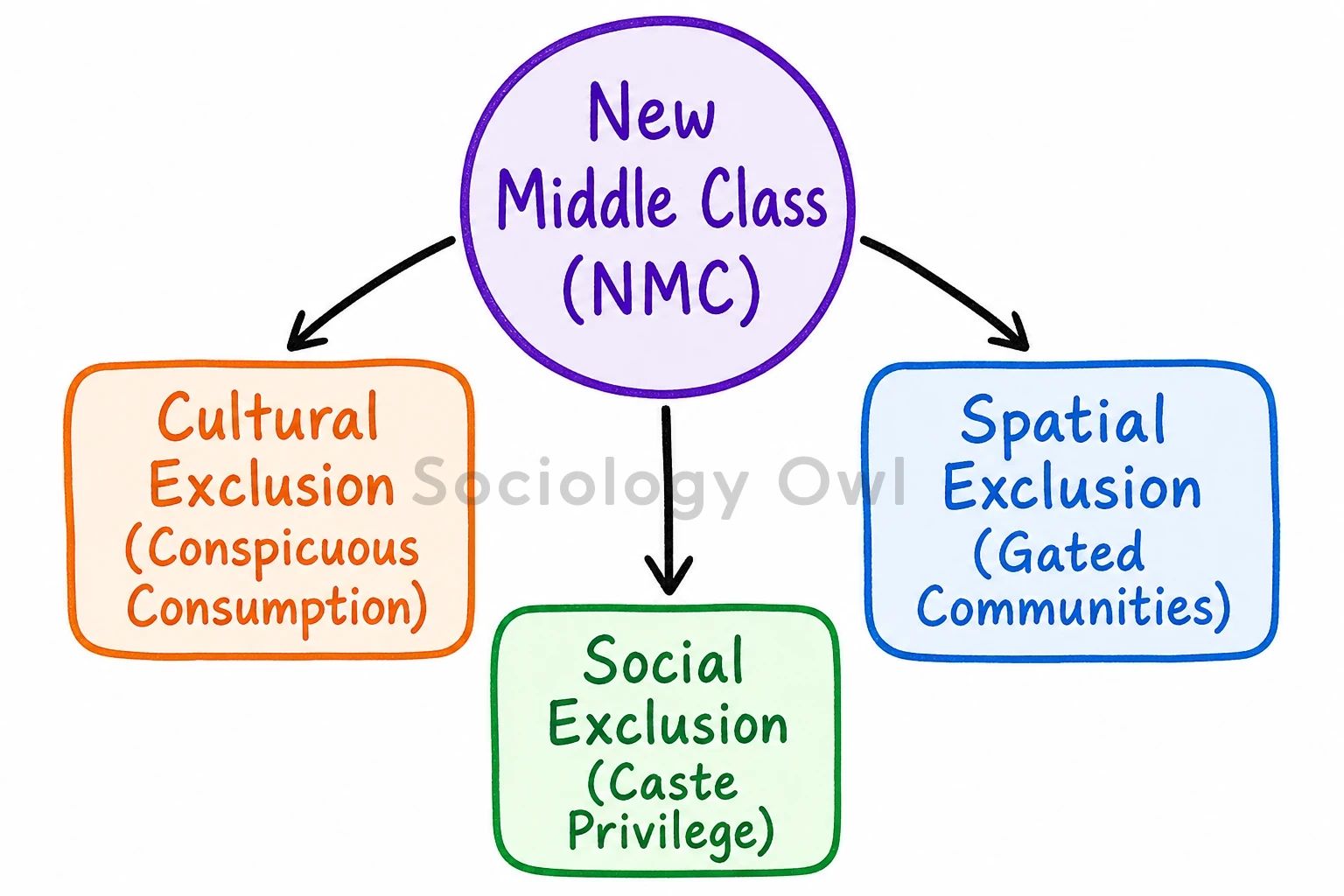
The “new middle class” in India refers to social groups that have emerged mainly since the 1980s–1990s with liberalisation, globalisation and the expansion of the service economy. It is significant because it shapes consumption patterns, media culture, electoral politics and ideas of modernity and citizenship in contemporary India.

Historically, the older middle class was state-centric, salaried, influenced by Nehruvian socialism and nationalist ideals (Srinivas, Yogendra Singh). The new middle class, by contrast, is more market-oriented, globally connected and consumer-driven, formed around private sector growth and information technology.

Salient features:

– Occupational and economic base
Composed largely of white-collar professionals in IT, finance, corporate services, education, health and media. Many members are first-generation entrants from lower middle strata, but with unstable contracts and loan-dependent lifestyles.

– Consumption-oriented lifestyle
As Leela Fernandes shows, this class defines itself through branded goods, malls, tourism and housing in gated communities. Citizenship is increasingly constructed around the right to consume rather than welfare claims.

– Cultural capital and English education
Drawing on Bourdieu, the new middle class is marked by English-medium education, digital skills and global cultural tastes, giving it symbolic power over regional-language groups.

– Urban, spatially segregated existence
Concentrated in metros and tier-2 cities like Bengaluru, Gurgaon and Pune, it produces “enclaved” spaces—IT parks, gated colonies—that separate it from working-class and informal settlements.

– Changing family and gender relations
There is a rise of nuclear families, dual-earner couples and somewhat more liberal gender norms; yet patriarchy persists through glass ceilings, unpaid care work and surveillance of women’s sexuality.

– Caste and community composition
Dominated by upper castes, but post-Mandal, educated OBCs and Dalits have entered, creating what Satish Deshpande calls “castelessness from above” that masks continuing caste privilege.

– Political orientations
Often supportive of economic liberalisation, anti-corruption and “good governance” agendas (e.g., Anna Hazare movement), but also susceptible to majoritarian and hyper-nationalist mobilisations amplified by social media.

– Ideological role
Following Béteille, this class shapes public discourse disproportionately—through media, NGOs, think-tanks—normalising neoliberal ideas of meritocracy, individualism and reduced state responsibility.

In sum, India’s new middle class is an ambivalent force—modernising and aspirational yet exclusionary—requiring policies that harness its energies while curbing inequality and cultural intolerance.

Discuss the salient features of ‘new middle class’ in India. Read More »

What is identity politics? Discuss the main trends in Dalit movements in India.

Model Answers

Q: What is identity politics? Discuss the main trends in Dalit movements in India.

Question asked in UPSC Sociology 2021 Paper 2. Download our app for last 20 year question with model answers.

Model Answer:

What is Identity Politics ?

Identity politics refers to political mobilisation based on shared ascriptive identities such as caste, race, religion, gender, rather than primarily on class or ideology. It seeks recognition, dignity and representation for historically marginalised groups. In India, Dalit politics is a central form of identity politics because caste is a foundational axis of inequality and humiliation.

Identity politics combines what Nancy Fraser calls “politics of recognition” (dignity, respect, symbols) with “politics of redistribution” (resources, jobs, land). Charles Taylor’s emphasis on recognition helps explain why Dalit movements insist on self-respect (ijjat), naming (“Dalit” instead of “Harijan”), and cultural assertion, alongside policy demands like reservations.

Main trends in Dalit movements in India

1) Early anti-caste and reformist phase (late 19th–early 20th century)
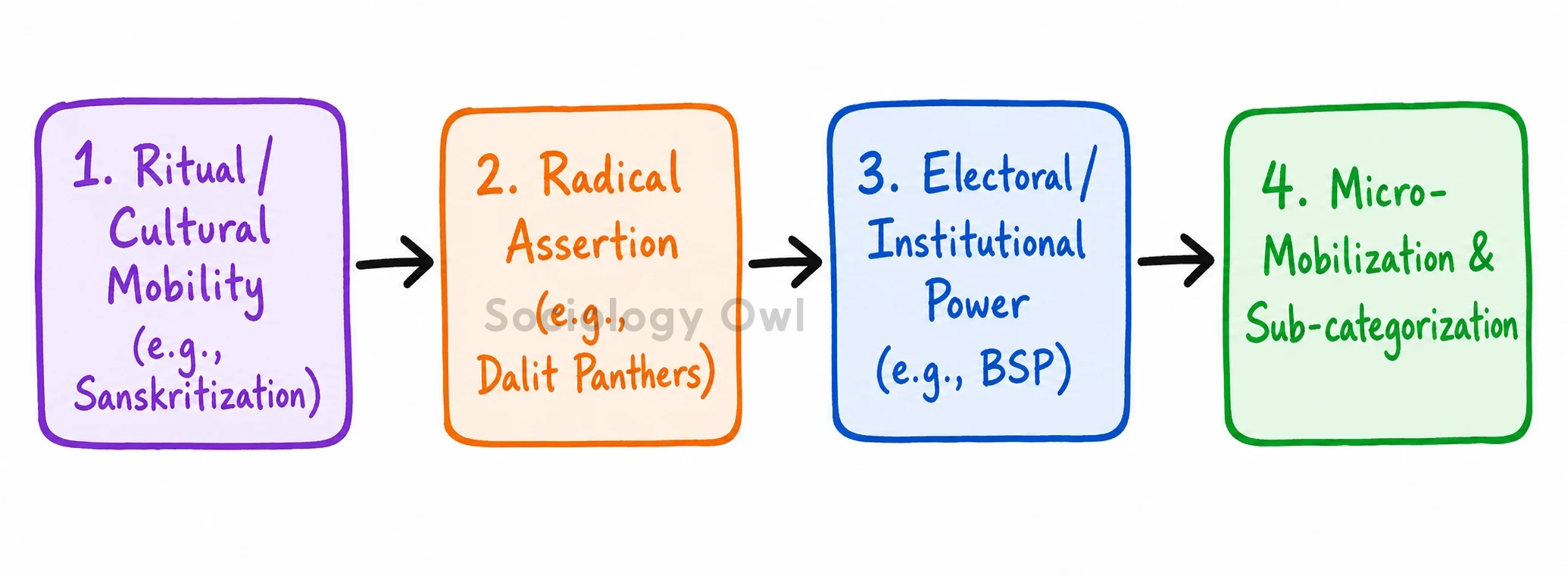
– Jotiba Phule’s Satyashodhak Samaj, Narayana Guru, Sri Narayana Dharma Paripalana emphasised education, critique of Brahminism and religious reform.
– Region-specific movements (Adi-Dravida, Nadar, etc.) sought higher ritual status and state support.

2) Ambedkarite radical-constitutional phase
– B.R. Ambedkar shifted from Sanskritisation to structural change: separate electorates, reservations, temple-entry struggles (Mahad Satyagraha), and conversion to Buddhism.
– Formation of All India Scheduled Castes Federation signalled autonomous Dalit politics rather than dependence on Congress or upper-caste parties.

3) Post-independence institutional and integrationist phase
– Use of constitutional safeguards, reservations, and welfare programmes; emergence of Republican Party of India.
– Yet, as Rajni Kothari notes, Dalits often became “vote banks” without substantive empowerment; dominance of upper-caste leadership persisted.

4) Militant and autonomous assertion (1970s–1990s)
– Dalit Panthers (inspired by Black Panthers) articulated a radical, pan-Dalit identity and produced powerful Dalit literature (Gail Omvedt).
– Kanshi Ram’s BSP redefined politics as “Bahujan” mobilisation, making state power “the master key” for social change.

5) Contemporary trends
– Intersectional politics: Dalit women’s organisations (e.g., NFDW) highlight caste–class–gender nexus (Sharmila Rege, Gopal Guru).
– Cultural and transnational assertion: memorialisation (Bhima-Koregaon), social media activism, and engagement with global human rights forums on caste.
– Critiques (Anand Teltumbde) warn against electoralism, NGO-isation and fragmentation along sub-caste and regional lines.

Dalit identity politics has evolved from reform to radical assertion; its future lies in deepening democracy through intersectional solidarities and everyday annihilation of caste.

What is identity politics? Discuss the main trends in Dalit movements in India. Read More »

What are the various forms of untouchability in India ? Critically examine.

Model Answers

Q: What are the various forms of untouchability in India ? Critically examine.

Question asked in UPSC Sociology 2021 Paper 2. Download our app for last 20 year question with model answers.

Model Answer:

Type of Untouchability in India

Untouchability refers to the practice of ritual and social exclusion of certain castes, historically justified through notions of purity–pollution. Though abolished by Article 17 of the Constitution, it persists in transformed and covert ways, making its study central to understanding inequality in India.

Forms of untouchability:

1. Ritual–religious forms
– Denial of temple entry, separate offerings, separate priests or prohibition from performing religious rituals.
– Louis Dumont links this to hierarchical ordering based on purity, while G.S. Ghurye saw it as an extreme form of caste-based distance.
– In many villages, Dalits are still relegated to the margins of religious festivals and cremation grounds.

2. Social and spatial segregation
– Separate hamlets (cheris, wadis), separate wells and tea cups, prohibition on inter-dining.
– M.N. Srinivas showed that even where Sanskritisation occurs, physical distance and commensality barriers often continue.
– Studies by Sukhadeo Thorat reveal separate seating and discrimination in mid-day meals and classrooms.

3. Economic and occupational forms
– Concentration of Dalits in stigmatized, “polluting” labour: manual scavenging, skinning carcasses, sewer work, despite the 2013 Prohibition of Employment as Manual Scavengers Act.
– André Béteille highlights how caste structures access to land and labour, producing chronic landlessness and wage discrimination.
– Audit studies (Thorat & Newman) show CVs with Dalit names get fewer interview calls, indicating new market-mediated untouchability.

4. Political–institutional forms
– Atrocities against assertive Dalits, boycott of Dalit hamlets, social and economic embargoes (documented by Ghanshyam Shah).
– In panchayats, “proxy” Dalit sarpanches and coercion show symbolic inclusion but real exclusion from power.
– In universities, the Thorat Committee (AIIMS/IIT) showed systematic academic and social discrimination; the Rohith Vemula case symbolises institutional untouchability.

5. Intra-Dalit and gendered forms
– Hierarchies among Dalits themselves (e.g., Valmikis vs other Dalits) reproduce untouchability.
– Dalit feminists like Sharmila Rege highlight “triple discrimination” based on caste, class and gender, including sexual violence as a tool of caste domination.

B.R. Ambedkar’s idea of “graded inequality” explains why overt bans may decline, yet newer, subtler exclusions persist across rural–urban and traditional–modern sites.

Untouchability has shifted from overt ritual bans to subtle exclusions; only combined legal enforcement, material redistribution and anti-caste conscientisation can secure genuine equality.

What are the various forms of untouchability in India ? Critically examine. Read More »

Discuss the role of technology in agrarian change in India.

Model Answers

Q: Discuss the role of technology in agrarian change in India.

Question asked in UPSC Sociology 2021 Paper 2. Download our app for last 20 year question with model answers.

Model Answer:

Role of Technology in Agrarian Change in India

Agrarian change refers to long‑term transformations in agricultural production, land relations, and rural social structure. In India, technology has been a central driver of such change, especially since the Green Revolution, reshaping class, caste, labour and regional patterns of development.

Economically, technology has altered the agrarian mode of production.
– The Green Revolution’s “package” (HYV seeds, fertilisers, pesticides, tube‑well irrigation) increased yields and marketable surplus, as analysed by Francine Frankel and Ashok Rudra.
– Mechanisation (tractors, harvesters, pump‑sets) enabled intensive cultivation and commercialisation. Bardhan argues this strengthened a class of rich peasants/capitalist farmers, particularly in Punjab, Haryana and western Uttar Pradesh.
– Newer technologies – drip irrigation, cold chains, food processing and precision farming – deepen integration with national and global markets, enabling diversification into horticulture, dairying and high‑value crops.

Socially, technology has restructured rural stratification and labour relations.
– Andre Béteille’s work on Tanjore shows how technological change combined with land reforms to weaken traditional landlordism and strengthen prosperous peasantry.
– The gap between large and marginal farmers widened as only those with capital and access to credit could adopt costly technologies, producing “differentiation of the peasantry” (Byres).
– Mechanisation and chemical inputs displaced manual labour, promoting seasonal and circular migration and partial proletarianisation of small peasants and landless workers.

Caste and gender relations have also been reshaped.
– Dominant peasant castes (Jats, Patidars, Reddys, etc.) could better utilise state subsidies and technology, reinforcing their political dominance (M.N. Srinivas’s “dominant caste” thesis).
– Mechanisation often reduced women’s customary work and control over seeds, while male out‑migration has simultaneously led to a “feminisation of agriculture” under precarious conditions.

Regionally, technology produced uneven development: irrigated, politically influential regions benefitted most, while rain‑fed and tribal areas lagged. Critics like Vandana Shiva highlight environmental degradation, loss of biodiversity and ecological vulnerability created by chemical‑intensive technologies.

Contemporary ICTs (mobile phones, agricultural apps, digital marketplaces, remote sensing) offer information and market access but can create new digital divides and corporate dependence through contract farming and platform intermediaries.

Thus, technology has been a powerful but uneven driver of agrarian change, demanding policies that ensure ecological sustainability, equity, and inclusive access to innovations.

Discuss the role of technology in agrarian change in India. Read More »
Does regionalism essentially lead to decentralization of power? Substantiate your answer with relevant examples.

Model Answers

Q: Does regionalism essentially lead to decentralization of power? Substantiate your answer with relevant examples.

Question asked in UPSC Sociology 2021 Paper 2. Download our app for last 20 year question with model answers.

Model Answer:

Regionalism in India and its Impact on Power Decentralization

Regionalism denotes political articulation of territorially based identities (linguistic, cultural, economic) seeking greater recognition or autonomy. Decentralization of power refers to constitutionally structured dispersal of authority from the Centre to states and below. In India, regionalism has been a major driver of federal restructuring, but its relationship with decentralization is complex, not automatic.

1. How regionalism has promoted decentralization

• Linguistic reorganisation of states (States Reorganisation Act, 1956) – As Paul Brass shows, linguistic regionalism led to creation of states like Andhra Pradesh, Maharashtra, Gujarat, which brought administration closer to vernacular publics and deepened “territorial democracy”.

• Strengthening federalism – Myron Weiner argued that accommodating regional demands through state formation (e.g., Haryana, Himachal Pradesh, later Uttarakhand, Jharkhand, Chhattisgarh, Telangana) has integrated peripheral regions and improved representation of historically neglected areas, a functional decentralization of political power.

• Rise of regional parties – Rajni Kothari and later Yogendra Yadav note that parties like DMK, TDP, Akali Dal, BJD, TRS converted regional grievances into bargaining power within coalition politics, shifting India from one‑party dominance to a multi-centric federal political system.

• Sub‑regional and tribal regionalism – Demands of Jharkhand, Bodoland, Gorkhaland, and North‑Eastern autonomy compelled greater recognition of ethnic and sub‑regional diversities and fed into reforms like the 73rd and 74th Amendments, pushing power downwards to local bodies.

2. Limits and contradictions: when regionalism does not decentralize

• Elite capture of regions – Brass points out that regionalism is often mobilized by dominant elites. Once in power, these elites can centralize authority within the state (e.g., highly centralized leadership patterns in some Dravidian or North Indian parties), substituting central domination with regional domination.

• Centralised responses to regionalism – Secessionist or militant regionalism (Punjab’s Khalistan movement, Naga and Kashmiri movements) invited heavy central intervention, AFSPA, and President’s Rule, leading to re-centralization rather than decentralization.

• Fiscal and administrative centralisation – Economic regionalism (demands for special packages, backward-region status) can intensify vertical dependence on the Centre through grants, planning and regulatory controls, as noted by Rudolph and Rudolph in their analysis of “overdeveloped” central bureaucracy.

Thus, regionalism has often acted as a vehicle for democratizing and decentralizing Indian federalism, but its outcomes depend on state response and internal class power within regions.

Does regionalism essentially lead to decentralization of power? Substantiate your answer with relevant examples. Read More »

The problem of displacement is inherent in the idea of development. Analyze the statement critically.

Model Answers

Q: The problem of displacement is inherent in the idea of development. Analyze the statement critically.

Question asked in UPSC Sociology 2021 Paper 2. Download our app for last 20 year question with model answers.

Model Answer:

Displacement & Development

Displacement refers not only to physical uprooting from habitat, but also to loss of livelihood, community ties and cultural identity. In India, Walter Fernandes estimates over 50 million people displaced since Independence, largely by state-led development projects. The issue is central to understanding the contradictions of “development” in a democratic, welfare-oriented society.

Why displacement appears inherent in dominant development models

1. Modernization and statist paradigm
• Post-independence planning, influenced by modernization theory, equated development with rapid industrialisation, big dams and mining. Nehru’s “temples of modern India” meant large projects needing vast land, forests and rivers.
• A.R. Desai saw the Indian state as a “developmental bourgeois” state that facilitates capitalist accumulation, making displacement of peasants, tribals and the urban poor almost built-in to development.

2. Class, caste and tribal dimensions
• David Harvey’s idea of “accumulation by dispossession” explains how SEZs, expressways, mining and real-estate projects convert common and peasant lands into capital.
• Displacement disproportionately affects STs and SCs; André Béteille and Nandini Sundar highlight how adivasi homelands become sacrifice zones for energy and mineral projects (Narmada, Singrauli, POSCO, Vedanta).

3. Structural impoverishment
• Michael Cernea’s Impoverishment Risks and Reconstruction (IRR) model shows displacement creates landlessness, joblessness, homelessness, marginalisation, food insecurity and social disarticulation.
• Such recurring patterns suggest that, within the prevailing growth-centric model, displacement is not accidental but structurally generated.

Critical view: Is displacement inevitable?

1. Alternative conceptions of development
• Amartya Sen’s capability approach and human development thinking redefine development as expansion of freedoms, not just GDP or mega-projects. This allows for growth without, or with minimal, forced displacement.

2. Empirical counter-tendencies
• Decentralised, small-scale initiatives (rainwater harvesting in Alwar, community forestry in Odisha, micro-hydel projects) show resource use without mass relocation.
• Participatory planning (Kerala’s People’s Plan, Gram Sabhas under PESA; in-situ slum upgrading in Ahmedabad) indicates that people-centred planning can limit displacement.

3. Rights-based and movement politics
• Laws like FRA 2006 and LARR 2013 (consent, social impact assessment, R&R) and movements such as Narmada Bachao Andolan and anti-POSCO struggles push “development with justice”, questioning inevitability of displacement.

Conclusion
Displacement is inherent in India’s current growth-centric paradigm, but not in development per se; redefining development around rights, participation and sustainability can significantly reduce forced uprooting.

The problem of displacement is inherent in the idea of development. Analyze the statement critically. Read More »

Urban settlements in India tend to replicate its rural caste-kinship imprints. Discuss the main reasons.

Model Answers

Q: Urban settlements in India tend to replicate its rural caste-kinship imprints. Discuss the main reasons.

Question asked in UPSC Sociology 2021 Paper 2. Download our app for last 20 year question with model answers.

Model Answer:

Urban Settlements in India: Persistence of Caste-Kinship System

Urban settlements are expected to be impersonal, contract-based spaces where ascriptive ties weaken. Yet in India, cities often reproduce rural caste–kinship patterns. This reflects the specific trajectory of Indian urbanisation, where community continues to mediate access to opportunities and security.

1. Pattern of migration and rural–urban continuum
Redfield–Singer and M.N. Srinivas highlight the rural–urban continuum rather than a sharp break.
– Migration is predominantly chain and kin-based: early migrants sponsor relatives and caste fellows, creating “urban villages” and caste enclaves (M.S.A. Rao’s studies on Bangalore and Hyderabad).
– Strong circulation of people, remittances and ritual obligations keeps village networks alive, extending kinship fields across rural and urban spaces.

2. Economic organisation and informal labour markets
– In the largely informal urban economy, recruitment for petty trade, construction, domestic work or transport relies on trust; caste and kinship serve as low-cost screening mechanisms.
– Traditional caste-based skills (weavers, goldsmiths, leather workers) are relocated rather than dissolved, generating caste-clustered occupational niches.
– Andre Béteille notes institutional inadequacy of universalistic markets, making particularistic ties economically rational.

3. Housing, neighbourhoods and associational life
– Residential segregation often follows caste/region lines: community colonies, chawls and slums organised around jati/biradari offer protection, credit and cultural familiarity.
– Caste and regional associations in cities (studied by N. Jayaram) provide hostels, scholarships, dispute settlement and marriage alliances, thus reactivating rural solidarities.

4. Family, marriage and cultural continuity
– Despite exposure to diversity, marriage remains overwhelmingly caste-endogamous, often arranged through kin and caste networks; biradari panchayats operate even in metros.
– Urban temples, festival committees and community halls are frequently caste-based, reinforcing symbolic boundaries (Louis Dumont’s hierarchy–purity framework remains relevant).

5. Politics and control over urban resources
– Urban local politics mobilises voters as caste blocs; dominant rural castes (Jats around Delhi, Patels in Gujarat, Reddys in Andhra cities) extend control over peri-urban land, real estate and contracts.
– Rajni Kothari’s notion of “caste in politics” explains how caste becomes an organisational resource in competitive urban settings.

Thus, Indian urbanisation remains “rurban”, where caste-kinship adapt to new opportunities; future deepening of universalistic institutions alone can dilute these imprints.

Urban settlements in India tend to replicate its rural caste-kinship imprints. Discuss the main reasons. Read More »