2021 Sociology Paper 2
Discuss different forms of kinship system in India.
Model Answers
Q: Discuss different forms of kinship system in India.
Question asked in UPSC Sociology 2021 Paper 2. Download our app for last 20 year question with model answers.
Model Answer:
Kinship constitutes the bedrock of Indian social structure. Irawati Karve, in Kinship Organization in India, comprehensively mapped its immense regional and descent-based diversity.
Regional and Descent-Based Diversity
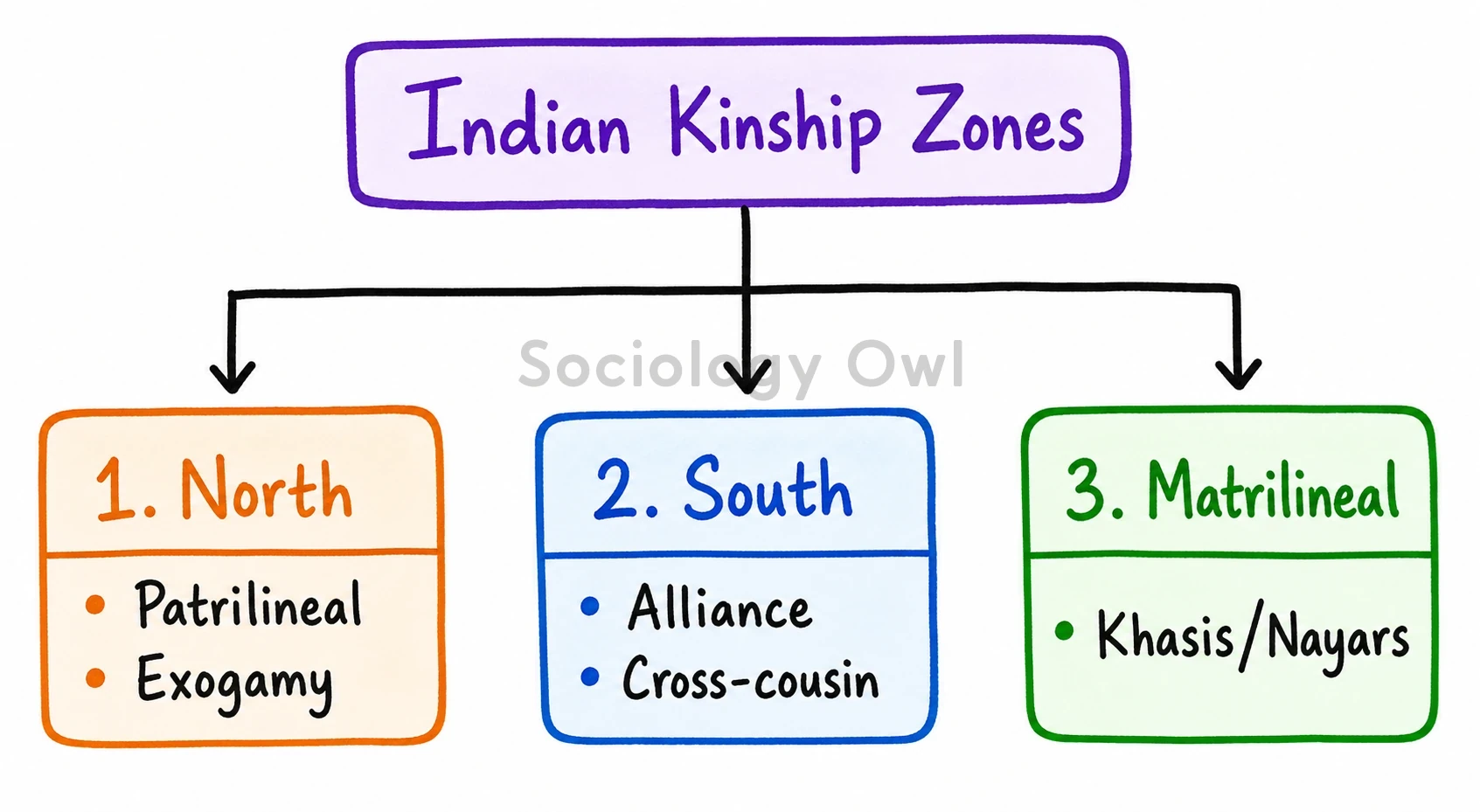
- Northern System: Strictly patrilineal and village-exogamous. Feminist Leela Dube highlights how its “Seed and Earth” metaphor justifies patriarchal control over female labor and sexuality.
- Southern System: Features cross-cousin marriage. Louis Dumont defines this as a continuous “Marriage Alliance” (affinity) over generations rather than mere consanguinity.
- Matrilineal Pockets: Found among Nayars (South) and Khasis (East). Kathleen Gough highlighted the unique Nayar Sambandham (“visiting husband”) system.

Kinship, Caste, and Tribe
- Caste Endogamy: B.R. Ambedkar argued that strict kinship endogamy is the central mechanism perpetuating the caste system.
- Tribal Kinship: Often egalitarian, featuring totemic, exogamous clans (e.g., Gonds).
The Hindu Succession (Amendment) Act, 2005 legally disrupts traditional patriliny by granting daughters coparcenary rights. Furthermore, modernization has birthed transnational kinship networks (NRI marriages) and LGBTQ+ “chosen families”.
Conclusion
Indian kinship is dynamically transitioning from rigid, structural-functional ascriptive hierarchies toward increasingly negotiated and egalitarian ties, reflecting modern democratic ideals (Patricia Uberoi).
More Questions:
Download our app for UPSC Sociology Optional - Syllabus, NCERT Books, IGNOU Books, Past Paper with Model Answers, Topper Notes & Answer Sheet.
Discuss different forms of kinship system in India. Read More »
Discuss the main features of the debate between G. S. Ghurye and V. Elwin on tribal development.
Model Answers
Q: Discuss the main features of the debate between G. S. Ghurye and V. Elwin on tribal development.
Question asked in UPSC Sociology 2021 Paper 2. Download our app for last 20 year question with model answers.
Model Answer:
The debate between G.S. Ghurye and Verrier Elwin during the late colonial and early post-independence era represents a foundational sociological clash regarding the classification, cultural identity, and governance of indigenous populations in the nascent Indian state.
The Assimilationist vs. Protectionist Discourse
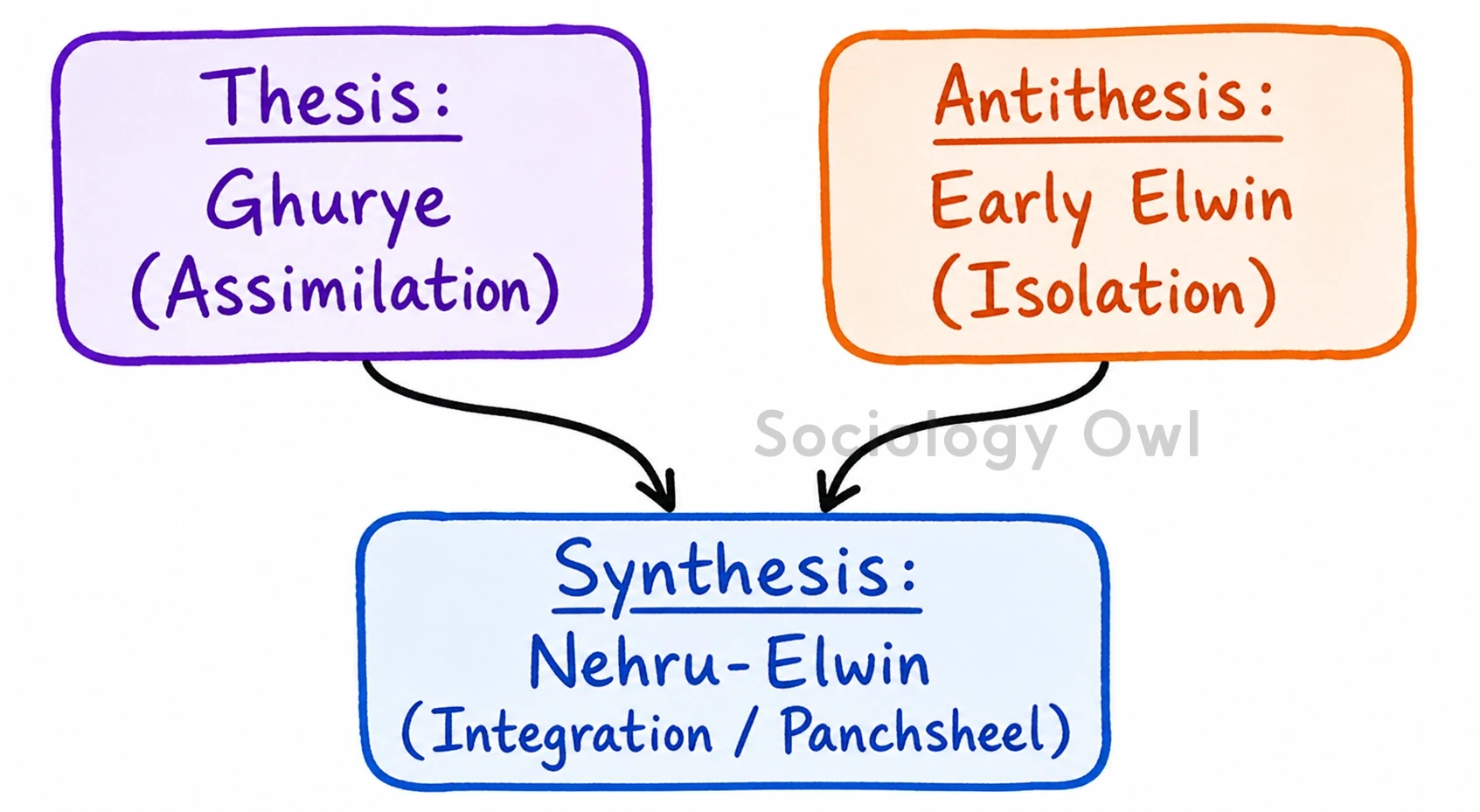
- G.S. Ghurye’s Assimilationist Approach: Adopting an Indological and Diffusionist perspective in his seminal work, “The Aborigines—’So-called’—and Their Future” (1943), Ghurye rejected the term ‘Adivasi’. He argued that tribes were merely “backward Hindus” subjected to incomplete Hinduization. Viewing tribal culture through the lens of cultural diffusion, he advocated for complete assimilation and socio-economic integration to rescue them from poverty. This view was strongly supported by nationalist A.V. Thakkar, who argued that isolation bred perpetual backwardness.
- Verrier Elwin’s Protectionist Approach: In stark contrast, Elwin championed cultural preservation. In “The Baiga” (1939), he proposed a “National Park” policy to keep tribes isolated from the exploitation of Hindu landlords and moneylenders, thereby preventing detribalization.
- Evolution of the Debate: Nationalists fiercely critiqued Elwin’s initial stance, accusing him of treating tribals as “museum specimens.” Consequently, Elwin’s views evolved from strict isolationism to a “middle path” of integration without imposition. He co-formulated the Tribal Panchsheel with Jawaharlal Nehru, detailed in “A Philosophy for NEFA” (1957), advocating development according to their own genius.

Modern Indian statecraft synthesizes both views. Ghurye’s integrationist logic is visible in mainstreaming welfare policies, while Elwin’s protectionism anchors Schedules V and VI of the Constitution, the PESA Act, 1996, and the Forest Rights Act (FRA), 2006. However, sociologist Virginius Xaxa notes a contemporary crisis of “asymmetrical integration,” where tribes face development-induced displacement, losing their land and forests without reaping modern socio-economic benefits.
Conclusion
The Ghurye-Elwin debate laid the theoretical groundwork for India’s tribal policy. The contemporary challenge remains resolving the friction between the two ideals: achieving substantive socio-economic empowerment (Ghurye’s vision) while stringently safeguarding indigenous autonomy and ecological rights (Elwin’s legacy).
More Questions:
Download our app for UPSC Sociology Optional - Syllabus, NCERT Books, IGNOU Books, Past Paper with Model Answers, Topper Notes & Answer Sheet.
Analyze the idea of developmental planning in India.
Model Answers
Q: Analyze the idea of developmental planning in India.
Question asked in UPSC Sociology 2021 Paper 2. Download our app for last 20 year question with model answers.
Model Answer:
Sociologically, developmental planning in India represents state-led “directed social change” (M.N. Srinivas) aimed at modernizing a post-colonial agrarian society through structural differentiation and equitable resource allocation.
Sociological Critiques of Developmental Planning
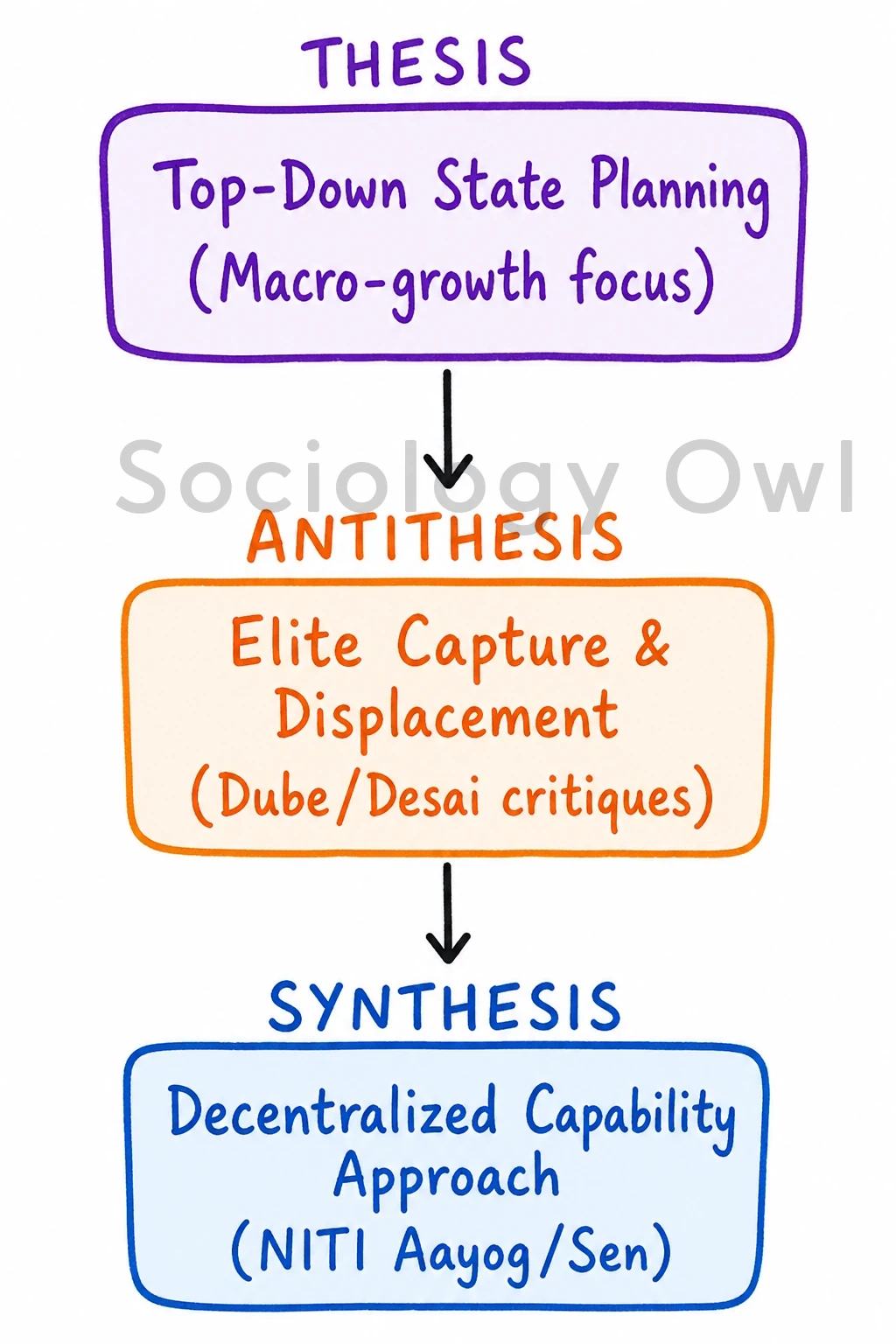
- Marxist Perspective: A.R. Desai argued that Indian planning merely masked capitalist development, consolidating the rural bourgeoisie rather than aiding the proletariat.
- Agrarian Reality: In India’s Changing Villages, S.C. Dube noted that the top-down Community Development Programme ignored local cultures and was hijacked by dominant castes, strengthening the “caste-class nexus” (Andre Beteille).
- Subaltern Critique: Walter Fernandes highlights how state-led mega-projects caused “development-induced displacement,” disproportionately marginalizing Adivasis into an ecological proletariat.

The shift from the Planning Commission to NITI Aayog marks a neoliberal transition towards cooperative federalism. Consequently, Amartya Sen advocates the “capability approach” to prioritize grassroot human development over mere macroeconomic growth.
Conclusion
To overcome historical elite-biases, modern planning must embrace decentralized, bottom-up governance—empowering Gram Sabhas through schemes like MGNREGA—to ensure inclusive rural transformation and genuine social equity.
More Questions:
Download our app for UPSC Sociology Optional - Syllabus, NCERT Books, IGNOU Books, Past Paper with Model Answers, Topper Notes & Answer Sheet.
Analyze the idea of developmental planning in India. Read More »
What are the various forms of untouchability in India ? Critically examine.
Model Answers
Q: What are the various forms of untouchability in India ? Critically examine.
Question asked in UPSC Sociology 2021 Paper 2. Download our app for last 20 year question with model answers.
Model Answer:
Type of Untouchability in India
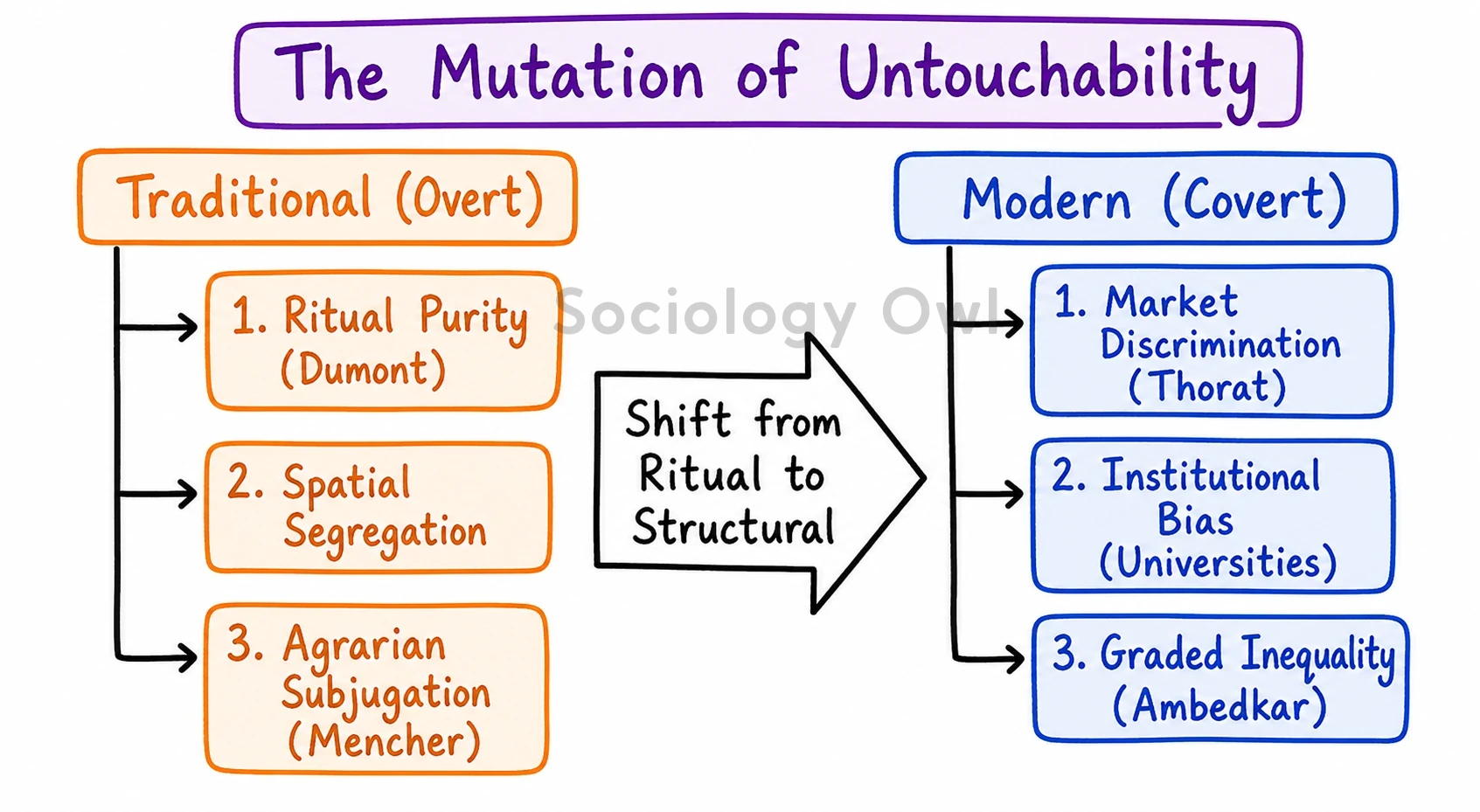
Untouchability, rooted in notions of purity-pollution, persists despite de jure abolition via Article 17 and the PoA Act (1989). It has mutated from overt traditional bans into covert modern exclusions.
Traditional and Modern Exclusions
- Ideology vs. Economics: Spatial segregation persists. While Louis Dumont views this ideologically, Joan Mencher argues untouchability historically ensured a subjugated, cheap agricultural labor force.
- Intersectionality: Sharmila Rege observes Dalit women face a “triple burden,” while Uma Chakravarti notes Brahmanical Patriarchy uses sexual violence to brutally police caste boundaries.
- Market-Mediated Bias: Sukhadeo Thorat’s CV audit studies reveal subtle hiring discrimination against Dalit applicants in urban private sectors.
- Intra-Dalit Divisions: B.R. Ambedkar’s framework of Graded Inequality explains how untouchability is paradoxically practiced even among marginalized castes.

Rising violence against Dalits (NCRB data) reflects dominant-caste backlash against subaltern assertion. Additionally, Gopal Guru highlights an invisible “architecture of discrimination” in modern universities, tragically epitomized by institutional suicides like Rohith Vemula’s.
Conclusion
Untouchability has shifted from explicit ritual practice to subtle structural discrimination. Achieving genuine equality demands dismantling the caste-class-patriarchy nexus and realizing B.R. Ambedkar’s vision in Annihilation of Caste.
More Questions:
Download our app for UPSC Sociology Optional - Syllabus, NCERT Books, IGNOU Books, Past Paper with Model Answers, Topper Notes & Answer Sheet.
What are the various forms of untouchability in India ? Critically examine. Read More »
What does Dr. B. R. Ambedkar mean by the concept of “Annihilation of caste” ?
Model Answers
Q: What does Dr. B. R. Ambedkar mean by the concept of “Annihilation of caste" ?
Question asked in UPSC Sociology 2021 Paper 2. Download our app for last 20 year question with model answers.
Model Answer:
Ambedkar’s Concept -> Annihilation of Caste
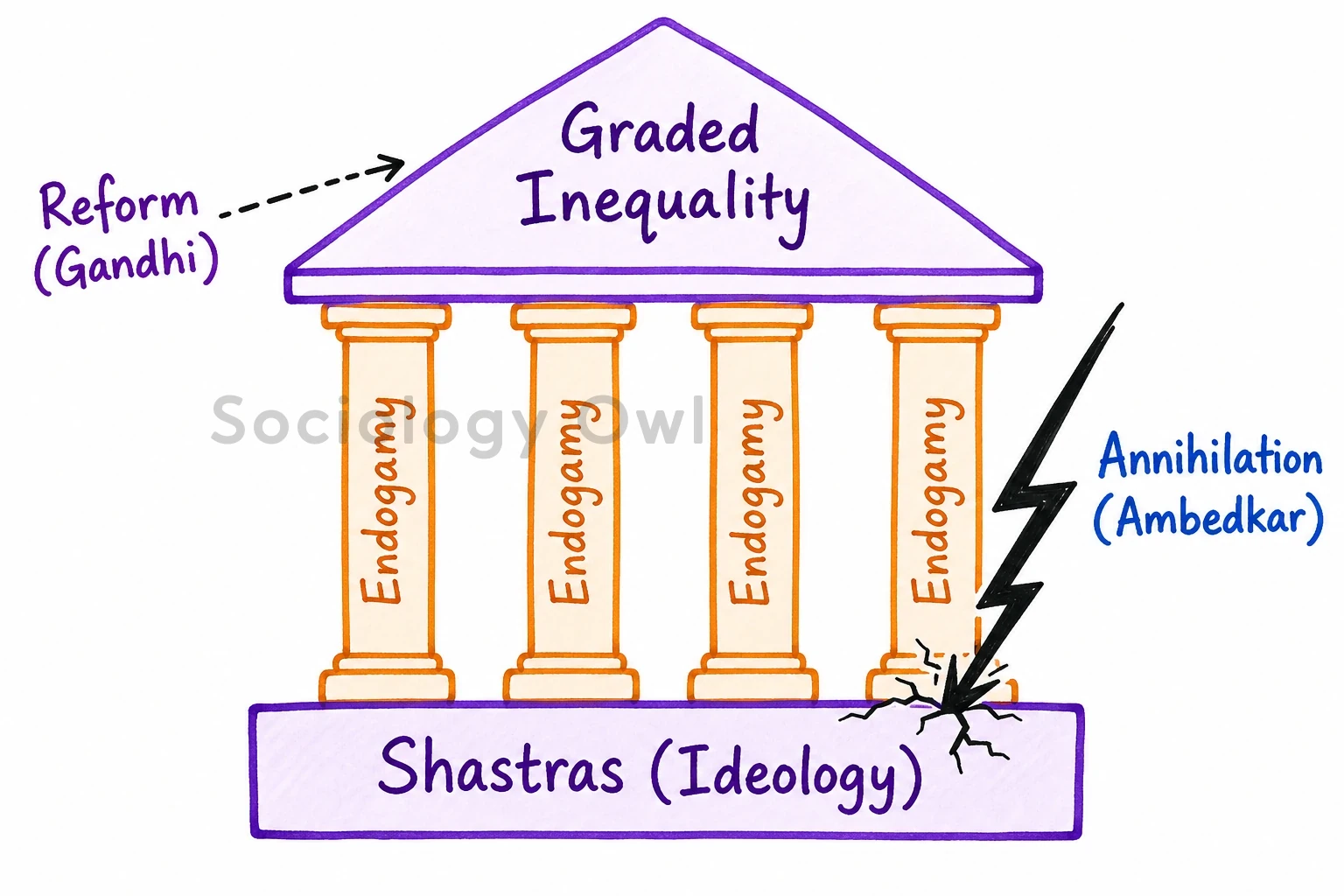
In his 1936 text, Annihilation of Caste, B.R. Ambedkar presented a radical Subaltern Perspective demanding the complete destruction of the caste system’s ideological and structural foundations, explicitly rejecting mere reform.
Core Dimensions of Annihilation
Destruction of Shastras
Arguing that caste represents “Graded Inequality” rather than a simple division of labour, Ambedkar advocated “dynamiting” the Shastras and Smritis that grant divine legitimacy to exploitation.
Eradicating Endogamy
Identifying Endogamy as the core mechanism reproducing caste boundaries, he argued that mere interdining is insufficient; the ultimate antidote is the “fusion of blood” through intermarriage.
Ambedkar vs. Gandhi Debate
Unlike M.K. Gandhi, who sought to remove untouchability while preserving an idealized Varna system, Ambedkar asserted caste is inherently pathological. As sociologist Gail Omvedt notes, Ambedkar’s vision demanded a total social revolution, not just behavioral reform.
dsfsdf
The persistence of honour killings and the rise of “Digital Endogamy” through caste-based matrimonial websites validate Ambedkar’s thesis that without ideological destruction, caste simply adapts to modernity.
Conclusion
Despite robust constitutional safeguards and political empowerment, Ambedkar’s radical vision of a truly casteless society remains an unfinished social revolution in contemporary India.
More Questions:
Download our app for UPSC Sociology Optional - Syllabus, NCERT Books, IGNOU Books, Past Paper with Model Answers, Topper Notes & Answer Sheet.
What does Dr. B. R. Ambedkar mean by the concept of “Annihilation of caste” ? Read More »
Discuss in detail the major contribution of Prof. Yogendra Singh in theorizing India’s modernization.
Model Answers
Q: Discuss in detail the major contribution of Prof. Yogendra Singh in theorizing India's modernization.
Question asked in UPSC Sociology 2021 Paper 2. Download our app for last 20 year question with model answers.
Model Answer:
Yogendra Singh’s Contributions
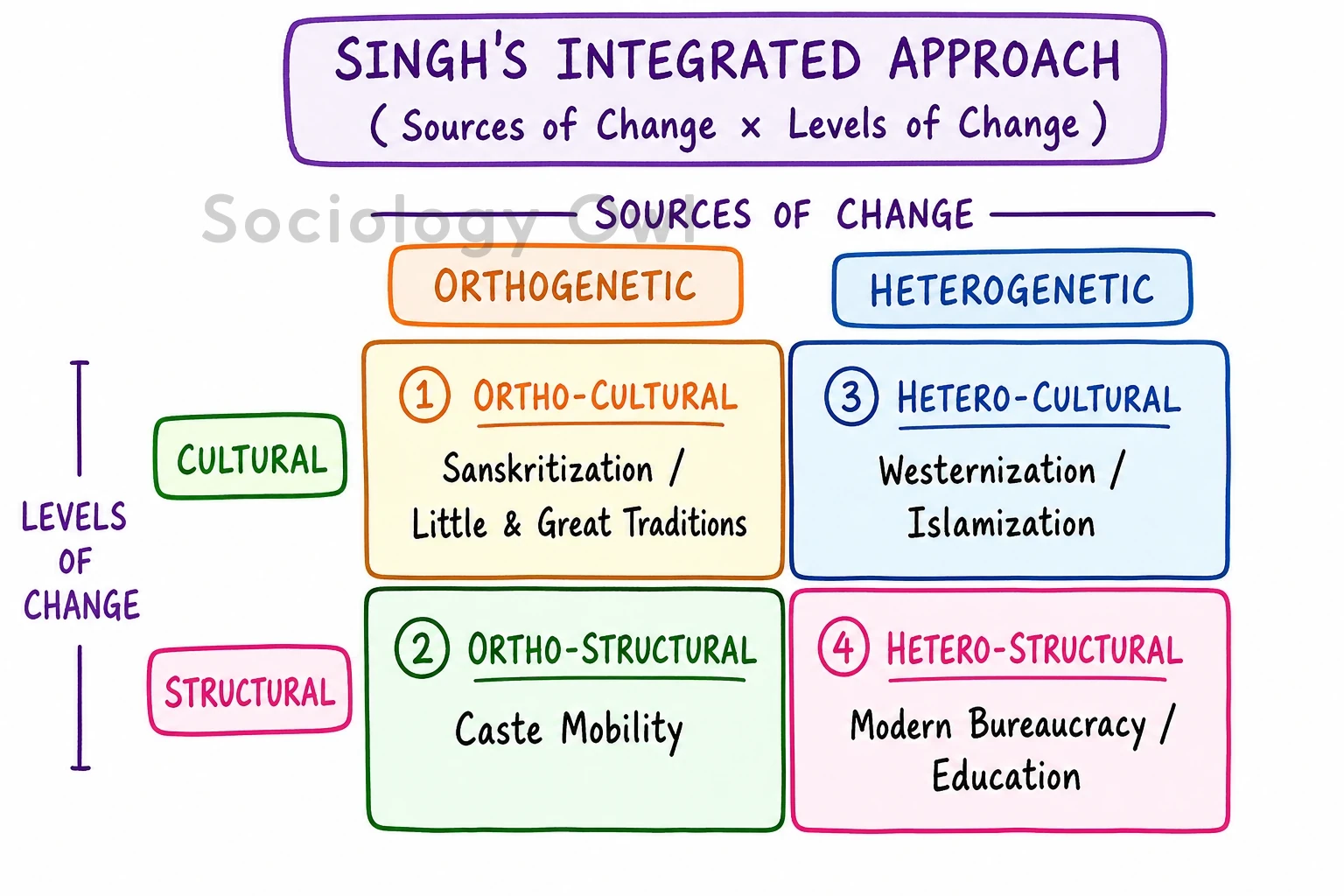
Yogendra Singh profoundly shaped the sociological discourse on India’s transition in his seminal work, Modernization of Indian Tradition (1973). Rejecting Eurocentric unilinear models, he utilized an “Integrated Approach”—combining structural-historical, structural-functional, and Marxist frameworks—to analyze the complex synthesis of tradition and modernity in India.
The Paradigm of Social Change
Singh’s most significant contribution is mapping India’s modernization across specific dimensions:
- Sources of Change: He categorized modernizing forces into Orthogenetic (internal sources like Sanskritization or the Bhakti movement) and Heterogenetic (external sources like colonial Westernization and Islamic influence).
- Levels of Change: Change operates distinctly at the Cultural Level (influencing localized “Little Traditions” and pan-Indian “Great Traditions”) and the Structural Level (transforming macro-structures like bureaucracy and micro-structures like family).
- Adaptive Modernization: He argued that modernity does not eradicate tradition; it is domesticated. This creates a “Traditionalization of Modernity”, where traditional structures adapt to modern roles (e.g., caste transforming into political vote-banks).

Globalization and Academic Critiques
In his later work, Culture Change in India: Identity and Globalization (2000), Singh theorized how global modernity paradoxically fuels the assertion of local identities. However, his framework has been actively debated:
- Marxist Critique: A.R. Desai argued that Singh’s cultural focus masks the deep class inequalities and capitalist exploitation structurally embedded in colonial modernization.
- Sociological Critique: Dipankar Gupta, in Mistaken Modernity, contends that India achieved technological advancement without true sociological modernization (civic values, equality).
- Subaltern Critique: Categorizing cultures into “Great and Little Traditions” is critiqued for carrying a Brahmanical bias that marginalizes Dalit and Adivasi experiences.
Singh’s concept of Adaptive Modernization is highly visible in modern digital India. The proliferation of algorithm-driven matrimonial apps to strictly enforce caste endogamy, or urban nuclear households retaining deep “functional jointness” through digital remittances, perfectly illustrates his thesis of continuity alongside change.
Conclusion
Yogendra Singh shifted the sociological paradigm from a Eurocentric zero-sum model—where modernity inevitably destroys tradition—to a nuanced, Indocentric framework. By demonstrating how Indian society actively negotiates change, his theories remain indispensable for understanding contemporary phenomena like cultural hybridization and glocalization.
More Questions:
Download our app for UPSC Sociology Optional - Syllabus, NCERT Books, IGNOU Books, Past Paper with Model Answers, Topper Notes & Answer Sheet.
Does regionalism essentially lead to decentralization of power? Substantiate your answer with relevant examples.
Model Answers
Q: Does regionalism essentially lead to decentralization of power? Substantiate your answer with relevant examples.
Question asked in UPSC Sociology 2021 Paper 2. Download our app for last 20 year question with model answers.
Model Answer:
Regionalism in India and its Impact on Power Decentralization
Regionalism denotes political articulation of territorially based identities (linguistic, cultural, economic) seeking greater recognition or autonomy. Decentralization of power refers to constitutionally structured dispersal of authority from the Centre to states and below. In India, regionalism has been a major driver of federal restructuring, but its relationship with decentralization is complex, not automatic.
1. How regionalism has promoted decentralization
• Linguistic reorganisation of states (States Reorganisation Act, 1956) – As Paul Brass shows, linguistic regionalism led to creation of states like Andhra Pradesh, Maharashtra, Gujarat, which brought administration closer to vernacular publics and deepened “territorial democracy”.
• Strengthening federalism – Myron Weiner argued that accommodating regional demands through state formation (e.g., Haryana, Himachal Pradesh, later Uttarakhand, Jharkhand, Chhattisgarh, Telangana) has integrated peripheral regions and improved representation of historically neglected areas, a functional decentralization of political power.
• Rise of regional parties – Rajni Kothari and later Yogendra Yadav note that parties like DMK, TDP, Akali Dal, BJD, TRS converted regional grievances into bargaining power within coalition politics, shifting India from one‑party dominance to a multi-centric federal political system.
• Sub‑regional and tribal regionalism – Demands of Jharkhand, Bodoland, Gorkhaland, and North‑Eastern autonomy compelled greater recognition of ethnic and sub‑regional diversities and fed into reforms like the 73rd and 74th Amendments, pushing power downwards to local bodies.
2. Limits and contradictions: when regionalism does not decentralize
• Elite capture of regions – Brass points out that regionalism is often mobilized by dominant elites. Once in power, these elites can centralize authority within the state (e.g., highly centralized leadership patterns in some Dravidian or North Indian parties), substituting central domination with regional domination.
• Centralised responses to regionalism – Secessionist or militant regionalism (Punjab’s Khalistan movement, Naga and Kashmiri movements) invited heavy central intervention, AFSPA, and President’s Rule, leading to re-centralization rather than decentralization.
• Fiscal and administrative centralisation – Economic regionalism (demands for special packages, backward-region status) can intensify vertical dependence on the Centre through grants, planning and regulatory controls, as noted by Rudolph and Rudolph in their analysis of “overdeveloped” central bureaucracy.
Thus, regionalism has often acted as a vehicle for democratizing and decentralizing Indian federalism, but its outcomes depend on state response and internal class power within regions.
Download our app for UPSC Sociology Optional - Syllabus, NCERT Books, IGNOU Books, Past Paper with Model Answers, Topper Notes & Answer Sheet.
The problem of displacement is inherent in the idea of development. Analyze the statement critically.
Model Answers
Q: The problem of displacement is inherent in the idea of development. Analyze the statement critically.
Question asked in UPSC Sociology 2021 Paper 2. Download our app for last 20 year question with model answers.
Model Answer:
Displacement & Development
Displacement refers not only to physical uprooting from habitat, but also to loss of livelihood, community ties and cultural identity. In India, Walter Fernandes estimates over 50 million people displaced since Independence, largely by state-led development projects. The issue is central to understanding the contradictions of “development” in a democratic, welfare-oriented society.
Why displacement appears inherent in dominant development models
1. Modernization and statist paradigm
• Post-independence planning, influenced by modernization theory, equated development with rapid industrialisation, big dams and mining. Nehru’s “temples of modern India” meant large projects needing vast land, forests and rivers.
• A.R. Desai saw the Indian state as a “developmental bourgeois” state that facilitates capitalist accumulation, making displacement of peasants, tribals and the urban poor almost built-in to development.
2. Class, caste and tribal dimensions
• David Harvey’s idea of “accumulation by dispossession” explains how SEZs, expressways, mining and real-estate projects convert common and peasant lands into capital.
• Displacement disproportionately affects STs and SCs; André Béteille and Nandini Sundar highlight how adivasi homelands become sacrifice zones for energy and mineral projects (Narmada, Singrauli, POSCO, Vedanta).
3. Structural impoverishment
• Michael Cernea’s Impoverishment Risks and Reconstruction (IRR) model shows displacement creates landlessness, joblessness, homelessness, marginalisation, food insecurity and social disarticulation.
• Such recurring patterns suggest that, within the prevailing growth-centric model, displacement is not accidental but structurally generated.
Critical view: Is displacement inevitable?
1. Alternative conceptions of development
• Amartya Sen’s capability approach and human development thinking redefine development as expansion of freedoms, not just GDP or mega-projects. This allows for growth without, or with minimal, forced displacement.
2. Empirical counter-tendencies
• Decentralised, small-scale initiatives (rainwater harvesting in Alwar, community forestry in Odisha, micro-hydel projects) show resource use without mass relocation.
• Participatory planning (Kerala’s People’s Plan, Gram Sabhas under PESA; in-situ slum upgrading in Ahmedabad) indicates that people-centred planning can limit displacement.
3. Rights-based and movement politics
• Laws like FRA 2006 and LARR 2013 (consent, social impact assessment, R&R) and movements such as Narmada Bachao Andolan and anti-POSCO struggles push “development with justice”, questioning inevitability of displacement.
Conclusion
Displacement is inherent in India’s current growth-centric paradigm, but not in development per se; redefining development around rights, participation and sustainability can significantly reduce forced uprooting.
Download our app for UPSC Sociology Optional - Syllabus, NCERT Books, IGNOU Books, Past Paper with Model Answers, Topper Notes & Answer Sheet.
Urban settlements in India tend to replicate its rural caste-kinship imprints. Discuss the main reasons.
Model Answers
Q: Urban settlements in India tend to replicate its rural caste-kinship imprints. Discuss the main reasons.
Question asked in UPSC Sociology 2021 Paper 2. Download our app for last 20 year question with model answers.
Model Answer:
Urban Settlements in India: Persistence of Caste-Kinship System
Urban settlements are expected to be impersonal, contract-based spaces where ascriptive ties weaken. Yet in India, cities often reproduce rural caste–kinship patterns. This reflects the specific trajectory of Indian urbanisation, where community continues to mediate access to opportunities and security.
1. Pattern of migration and rural–urban continuum
Redfield–Singer and M.N. Srinivas highlight the rural–urban continuum rather than a sharp break.
– Migration is predominantly chain and kin-based: early migrants sponsor relatives and caste fellows, creating “urban villages” and caste enclaves (M.S.A. Rao’s studies on Bangalore and Hyderabad).
– Strong circulation of people, remittances and ritual obligations keeps village networks alive, extending kinship fields across rural and urban spaces.
2. Economic organisation and informal labour markets
– In the largely informal urban economy, recruitment for petty trade, construction, domestic work or transport relies on trust; caste and kinship serve as low-cost screening mechanisms.
– Traditional caste-based skills (weavers, goldsmiths, leather workers) are relocated rather than dissolved, generating caste-clustered occupational niches.
– Andre Béteille notes institutional inadequacy of universalistic markets, making particularistic ties economically rational.
3. Housing, neighbourhoods and associational life
– Residential segregation often follows caste/region lines: community colonies, chawls and slums organised around jati/biradari offer protection, credit and cultural familiarity.
– Caste and regional associations in cities (studied by N. Jayaram) provide hostels, scholarships, dispute settlement and marriage alliances, thus reactivating rural solidarities.
4. Family, marriage and cultural continuity
– Despite exposure to diversity, marriage remains overwhelmingly caste-endogamous, often arranged through kin and caste networks; biradari panchayats operate even in metros.
– Urban temples, festival committees and community halls are frequently caste-based, reinforcing symbolic boundaries (Louis Dumont’s hierarchy–purity framework remains relevant).
5. Politics and control over urban resources
– Urban local politics mobilises voters as caste blocs; dominant rural castes (Jats around Delhi, Patels in Gujarat, Reddys in Andhra cities) extend control over peri-urban land, real estate and contracts.
– Rajni Kothari’s notion of “caste in politics” explains how caste becomes an organisational resource in competitive urban settings.
Thus, Indian urbanisation remains “rurban”, where caste-kinship adapt to new opportunities; future deepening of universalistic institutions alone can dilute these imprints.
Download our app for UPSC Sociology Optional - Syllabus, NCERT Books, IGNOU Books, Past Paper with Model Answers, Topper Notes & Answer Sheet.