CSAT Notes

HCF and LCM Word Problems for CSAT

HCF and LCM Word Problems for CSAT

1. Theoretical Foundation & Mathematical Underpinnings

Formal Definition & Scope

For a, b, N ∈ ℤ+ and N > 1:

  • Factor / Divisor: d is a factor of N if ∃ k ∈ ℤ+ such that N = d · k, i.e., d | N with zero remainder. The set of factors is finite and bounded by N.
  • Multiple: M is a multiple of N if ∃ k ∈ ℤ+ such that M = N · k, i.e., N | M. The set of multiples is countably infinite and unbounded.
  • Highest Common Factor (HCF) / gcd(a, b): The largest D ∈ ℤ+ such that D | a and D | b. Mathematically:
    a = D · p, b = D · q where gcd(p, q) = 1
  • Least Common Multiple (LCM) / lcm(a, b): The smallest M ∈ ℤ+ such that a | M and b | M. Mathematically:
    M = a · k1 = b · k2 for some k1, k2 ∈ ℤ+

Operational Scope: HCF and LCM are defined strictly for positive integers. In quantitative problem solving, always standardize all measurements to the lowest common integer base unit (e.g., seconds, centimeters, milliliters) before performing any factor or multiple operations.


Mathematical Proofs & Core Intuition

1. Why LCM is the Earliest Synchronization Point
Consider two periodic events recurring at intervals of a and b starting from T = 0. Their occurrence timestamps form arithmetic progressions:
A = {a, 2a, 3a, …} and B = {b, 2b, 3b, …}
A simultaneous occurrence occurs at timestamp T ∈ A ∩ B, meaning T is a common multiple of a and b.

By the Well-Ordering Principle of Natural Numbers, the non-empty set of common multiples contains a unique minimum element. This element is lcm(a, b). All subsequent simultaneous points recur at exact integer multiples of this base interval:
Tk = k · lcm(a, b), k ∈ ℤ+
Thus, LCM represents forward periodic projection.


2. Why HCF is the Largest Uniform Measuring Unit
To divide or cut elements of size x and y into identical partitions of size D without remainder or waste, D must satisfy D | x and D | y.

Therefore, D belongs to the finite set of common divisors:
C = {d ∈ ℤ+ : d | x and d | y}
The total number of partitions generated is:
N = x/D + y/D
To minimize the total count (N), the unit size (D) must be maximized. The maximum element in set C is gcd(x, y). Thus, HCF represents backward analytical decomposition.


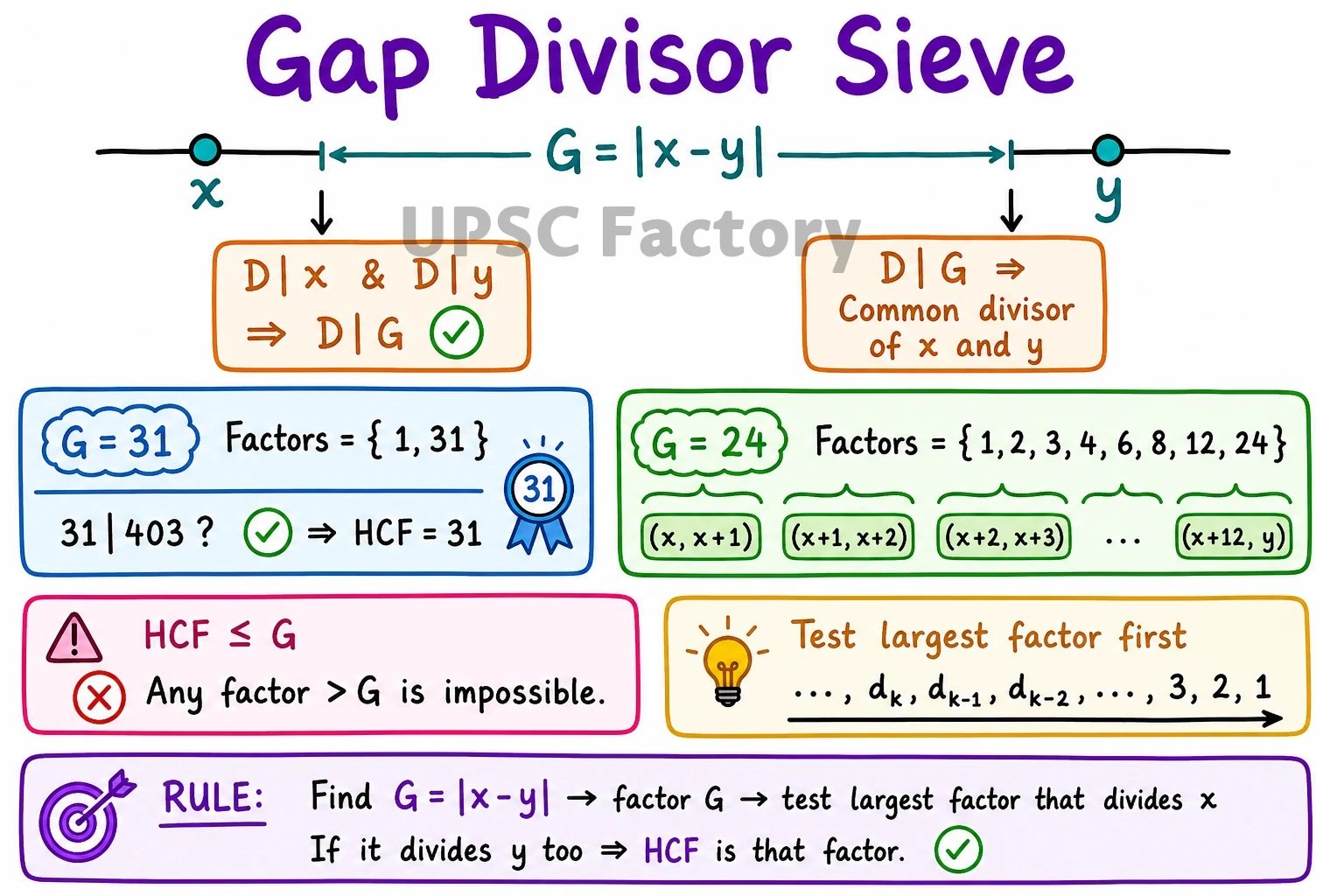
3. Why the “Gap Method” Works — The Divisor Difference Theorem

Theorem: If D | x and D | y, then D | (x – y).

Proof:
Let x = D · p and y = D · q (p, q ∈ ℤ)
⇒ x – y = D · p – D · q
= D(p – q)
Since (p – q) ∈ ℤ, it follows directly that D | (x – y).

Implication: Any common divisor (and consequently the HCF) of two numbers must divide their absolute difference. Therefore, for x ≠ y:
gcd(x, y) | |x – y| ⇒ gcd(x, y) ≤ |x – y|
Thus, gcd(x, y) is guaranteed to be a factor of |x – y|. This property enables rapid mental elimination of invalid divisor options.

Key Theorems & Fundamental Properties

  • Fundamental Product Relation (Restricted to Exactly Two Numbers):
    gcd(a, b) × lcm(a, b) = a × b
    Numerical Verification: For a = 12, b = 18:
    gcd(12, 18) = 6, lcm(12, 18) = 36 ⇒ 6 × 36 = 216 = 12 × 18

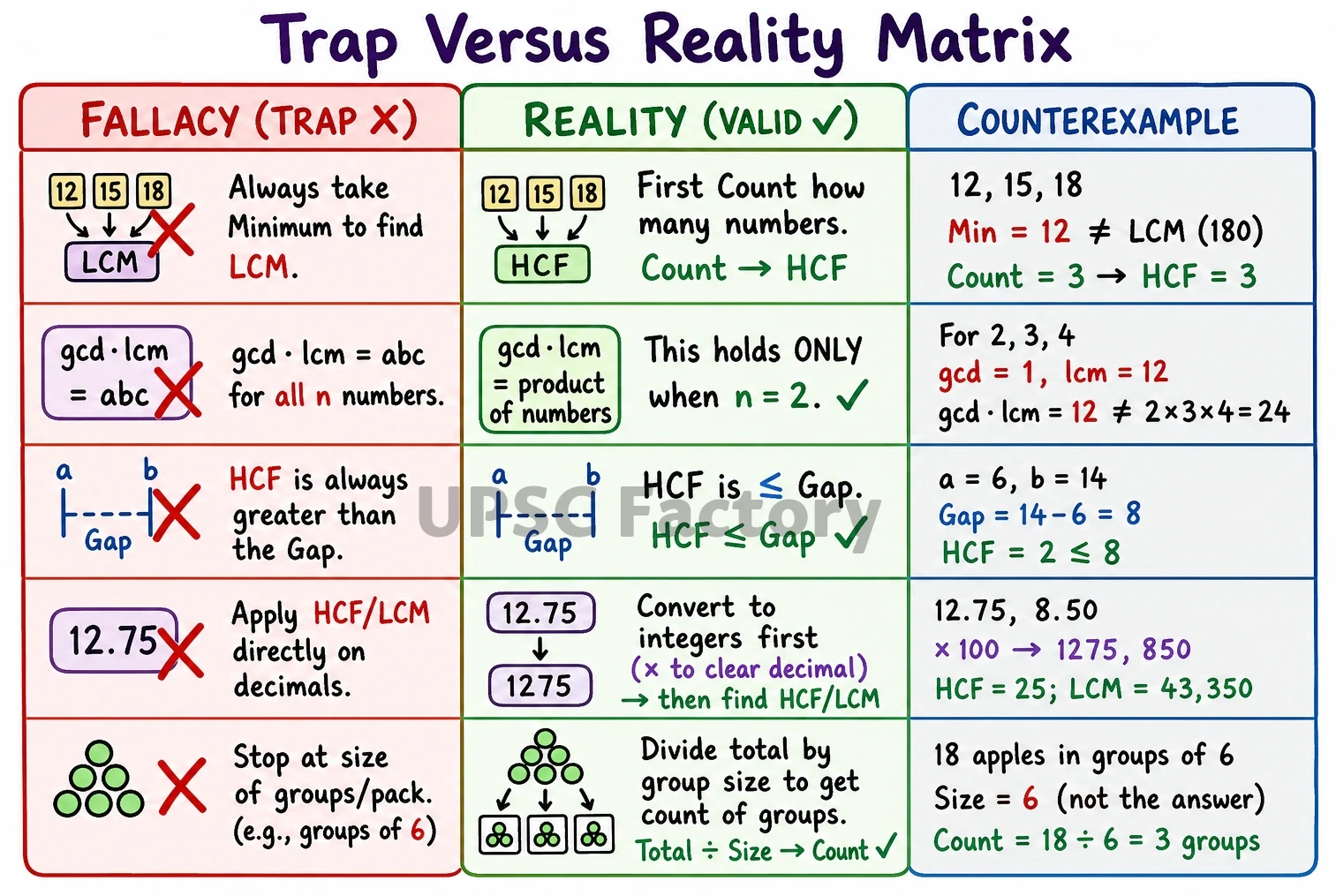
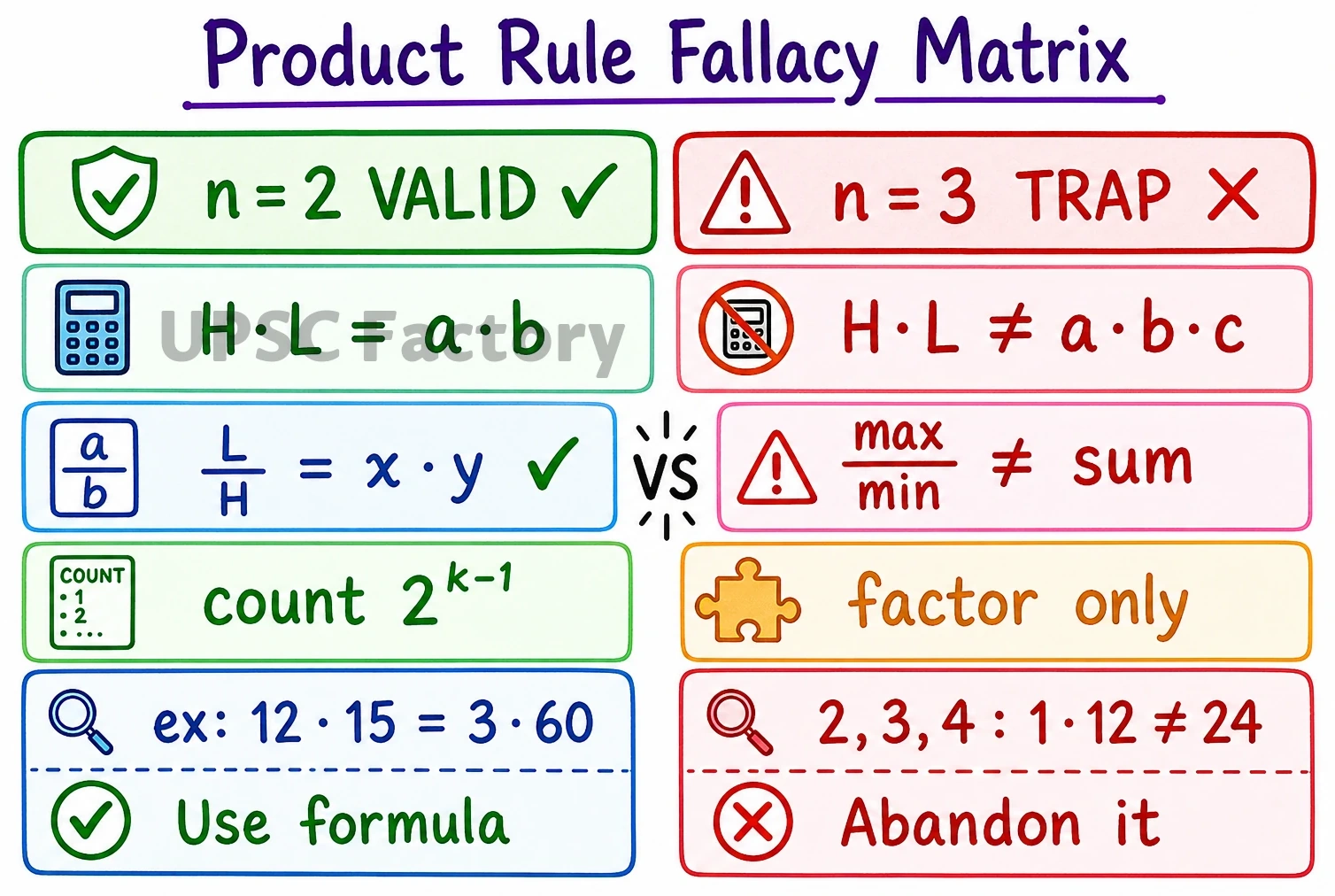
    Examiner Trap Warning: For three or more numbers, gcd(a, b, c) × lcm(a, b, c) ≠ a × b × c.
    Counterexample: For (2, 3, 4): gcd = 1, lcm = 12. Here, 1 × 12 = 12 ≠ 2 × 3 × 4 = 24.

  • Euclidean Invariance:
    gcd(a, b) = gcd(a – b, b) = gcd(a mod b, b)
  • Magnitude Bounding Property:
    gcd(a, b) ≤ min(a, b) and lcm(a, b) ≥ max(a, b)
  • Co-primality Invariant: Let D = gcd(a, b), with p = a/D and q = b/D. Then gcd(p, q) = 1. If gcd(a, b) = 1, then lcm(a, b) = a × b.
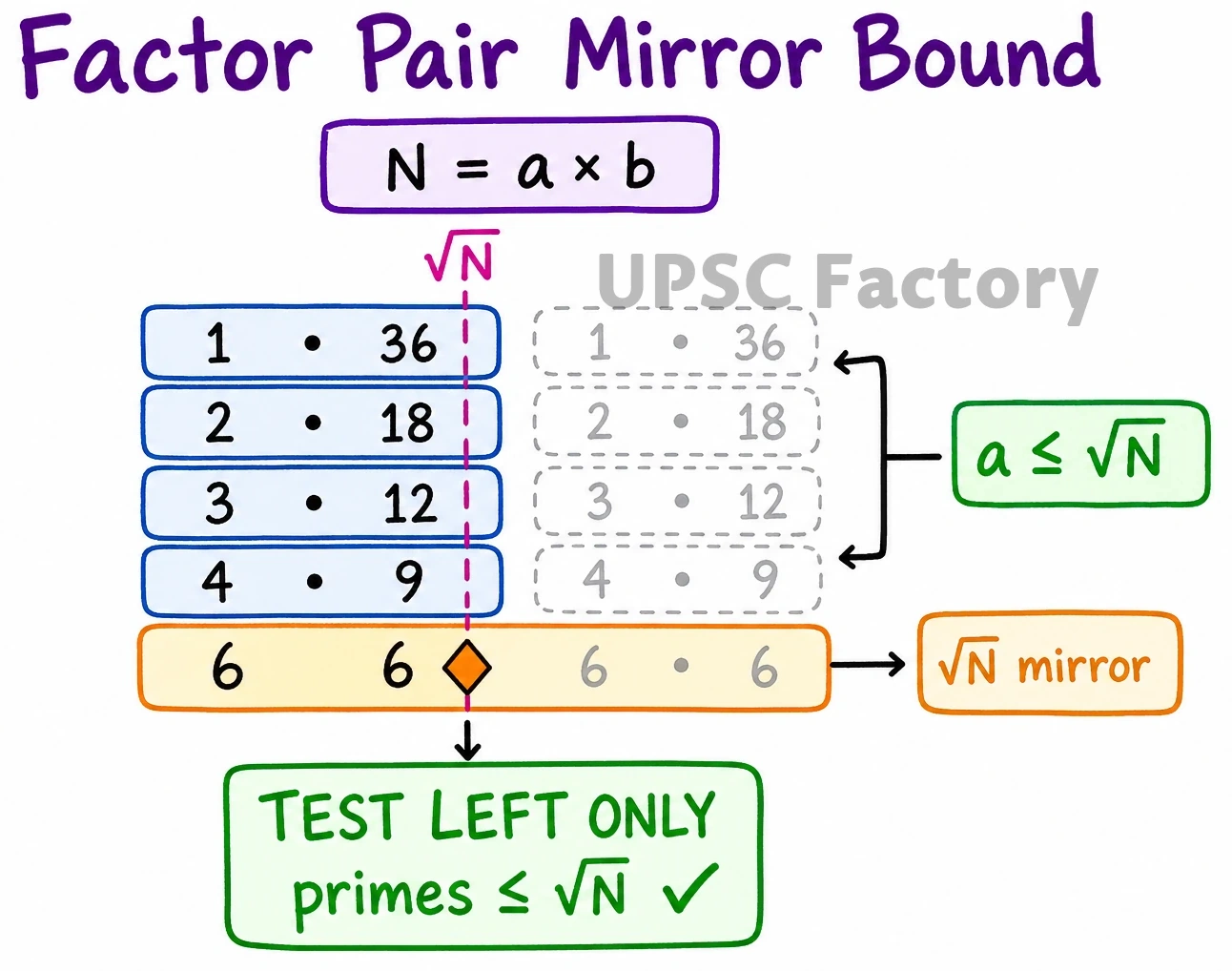
  • Factor Pairing Property: If d | N, then (N/d) | N. Factors occur in symmetric pairs around √N, meaning factor and primality verification never requires testing divisors beyond √N.

2. Comparative Matrix & Conceptual Distinctions

Table 1: LCM (Synthesis) vs HCF (Analysis) — Core Analytical Filter

Analytical DimensionLCM (Least Common Multiple)HCF (Highest Common Factor)
Mathematical NatureForward Synthesis, AggregationBackward Analysis, Decomposition
Physical ActionTo meet, synchronize, accumulateTo cut, divide, measure, pack
Relative Magnitude≥ largest input number≤ smallest input number
Set-Theoretic LogicIntersection of Multiples: A ∩ BIntersection of Divisors: A ∩ B
Keyword Triggerstogether, simultaneous, coincide, common multiple, at the same time, periodic cycle, minimum required to be measured bymaximum, greatest, largest size/capacity, exactly divisible, longest tape, no remainder/waste, identical batches
Result MeaningYields the interval or point of synchronizationYields the size of one unit; requires a secondary division step to obtain total count
Typical Question Stem“After what duration will they meet again?”“What is the maximum piece length, and how many total pieces are obtained?”


Table 2: Factor vs Multiple — Structural Comparison

ConceptFormal DefinitionCase Study for N = 12Critical Distinction
FactorAn integer d that divides N with zero remainder (d | N){1, 2, 3, 4, 6, 12}Finite set. N is always a factor of itself.
MultipleAn integer M formed by multiplying N by an integer k (N | M){12, 24, 36, 48, …}Infinite set. N is always the smallest positive multiple of itself.

3. High-Yield Data Anchors & Memorization Benchmarks

A. Unit Standardization Anchor

Examiners intentionally introduce mixed units to cause calculation errors. Apply this pre-processing step before performing any HCF or LCM computation:

Given QuantitiesStandardized Base UnitPre-processing Conversion
3.78 m, 5.25 m378 cm, 525 cmMultiply by 100
4 min 30 sec, 6 min270 sec, 360 sec(4 × 60) + 30 = 270 sec
2 hr, 45 min120 min, 45 minConvert to lowest unit referenced

B. The Gap Method Reference Benchmarks

If |a – b| = G, then gcd(a, b) ∈ Divisors(G)

  • Prime Gap (G = 31): gcd(a, b) ∈ {1, 31}.
  • Composite Gap (G = 24): gcd(a, b) ∈ {1, 2, 3, 4, 6, 8, 12, 24}.
  • Composite Gap (G = 60): gcd(a, b) ∈ {1, 2, 3, 4, 5, 6, 10, 12, 15, 20, 30, 60}.

Application Anchor: For the numbers 403, 434, 465:
434 – 403 = 31 and 465 – 434 = 31
Since 31 is prime, the HCF must be either 1 or 31. A single divisibility check (403 = 31 × 13) confirms gcd = 31 immediately.


C. High-Frequency LCM Reference Values

  • lcm(1, 2, 3, 4, 5, 6, 7, 8, 9, 10) = 2520
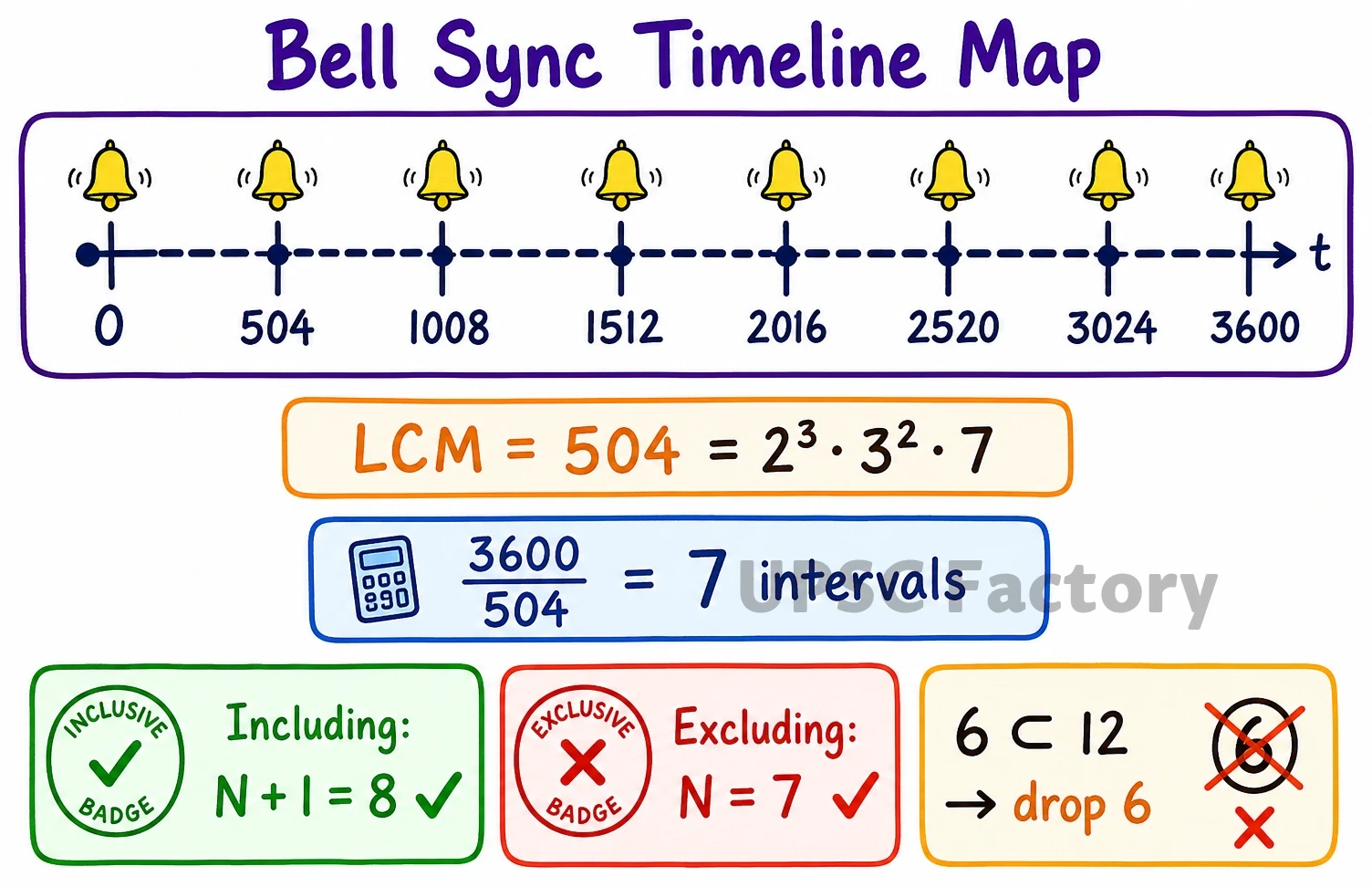
  • lcm(6, 7, 8, 9, 12) = 504 sec = 8 min 24 sec (Standard Bell Synchronization Anchor)
  • Prime Power Redundancy: When computing LCM, drop lower prime powers if a higher power is present (e.g., in {6, 8, 12}, eliminate 6 because 6 | 12, and replace 8 and 12 with their prime factor forms 23 and 22 · 3).

D. Core Algebraic Formulas

1. Dimensional Partition Rule (Total Count from HCF)
Ntotal = ∑i=1n (Qi/D) = (∑ Qi/D), where D = gcd(Q1, Q2, …, Qn)

2. Minimum Tile Inversion Formula (2D Plane Tiling)
s = gcd(L, B), Nmin = (L × B)/s2
where s is the side length of the largest uniform square tile that tiles a rectangular region of dimensions L × B completely without cutting.


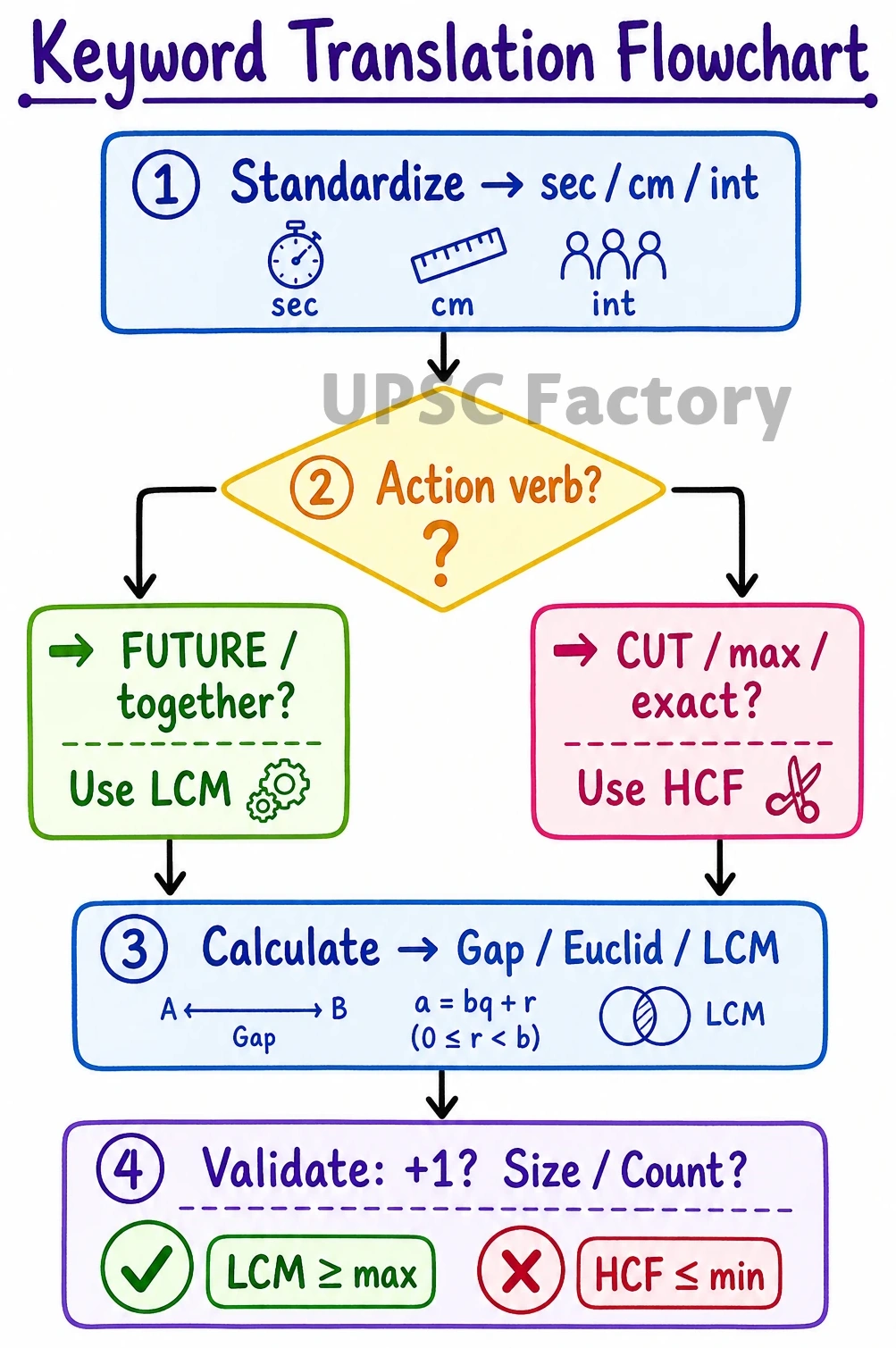
4. Standard Algorithmic Protocols (Decision Logic)

Protocol A: Systematic Problem Classification & Execution

[Phase 0: Input Sanitization]
  └── Convert all numbers to identical integer base units (e.g., m -> cm, min -> sec).

[Phase 1: Action Classification]
  ├── FORWARD / SYNCHRONIZATION (Events repeating to coincide)
  │     └── Keywords: together, simultaneously, cycle, bells, lights, lap times
  │     └── Core Operation: LCM
  │
  └── BACKWARD / DECOMPOSITION (Quantities divided, cut, or packed)
        └── Keywords: maximum size, longest tape, equal containers, no waste
        └── Core Operation: HCF

[Phase 2: Mathematical Computation]
  ├── For LCM: Extract highest prime powers; eliminate factor subsets.
  └── For HCF: Compute minimum pairwise difference |a - b|; test its descending factors.

[Phase 3: Contextual Boundary Validation]
  ├── LCM Periodic Count: N = ⌊ T_total / LCM ⌋
  │     ├── If problem specifies "including starting point" ──> Total = N + 1
  │     └── If problem specifies "excluding starting point" ──> Total = N
  │
  └── HCF Unit Count:
        ├── If question asks for "Maximum Size"  ──> Output = D = gcd
        └── If question asks for "Minimum Count" ──> Output = ∑ Q_i / D

Protocol B: Rapid HCF via Hybrid Gap–Euclidean Algorithm

To find gcd(a, b, c):

  1. Step 1: Calculate the smallest pairwise absolute difference:
    G = min(|a – b|, |b – c|, |a – c|)
  2. Step 2:
    • If G is prime or small (G < 50), test divisibility of the numbers by G. If true, gcd = G. If false, test descending factors of G.
    • If G is large or composite with many factors, execute the Euclidean chain:
      gcd(a, b) = gcd(b, a mod b)

Worked Euclidean Example: gcd(378, 525)
gcd(525, 378) = gcd(378, 525 mod 378) = gcd(378, 147)
gcd(378, 147) = gcd(147, 378 mod 147) = gcd(147, 84)
gcd(147, 84) = gcd(84, 147 mod 84) = gcd(84, 63)
gcd(84, 63) = gcd(63, 84 mod 63) = gcd(63, 21)
gcd(63, 21) = gcd(21, 63 mod 21) = gcd(21, 0) ⇒ gcd = 21


5. Standard Question Typologies & Analytical Solutions

TYPE A: Periodic Synchronization & Counting (LCM Archetype)

Core Lever: Forward projection to the least common multiple of periodic intervals, combined with boundary-inclusive/exclusive interval counting.

Problem Statement:
Five bells commence tolling together and subsequently toll at intervals of 6, 7, 8, 9, and 12 seconds respectively. How many times will they toll together in one hour, excluding the simultaneous toll at the start?

(a) 7
(b) 8
(c) 5
(d) 9


Analytical Solution:

  • Step 1: Terminology & Redundancy Analysis
    The trigger terms “intervals” and “toll together” specify an LCM operation.
    Notice that 6 | 12; therefore, 6 is redundant and can be omitted.
  • Step 2: Prime Power Factorization
    7 = 71
    8 = 23
    9 = 32
    12 = 22 × 31
    Taking the highest power of each prime present:
    lcm(7, 8, 9, 12) = 23 × 32 × 71 = 8 × 9 × 7 = 504 seconds
  • Step 3: Interval Division & Boundary Evaluation
    Total time window = 1 hour = 3600 seconds.
    N = ⌊ 3600/504 ⌋ = ⌊ 7.1428 ⌋ = 7
    Because the question specifies excluding the simultaneous toll at T = 0, no adjustment is added.

Final Count = 7

Correct Option: (a)

TYPE B: Statement-Based Sufficiency & Divisibility Properties

Core Lever: Verification of multivariable LCM–HCF identities and the Gap Theorem.

Problem Statement:
Consider the following statements:
Statement I: For any three positive integers a, b, c, the identity gcd(a, b, c) × lcm(a, b, c) = a × b × c always holds.
Statement II: If three positive integers have pairwise differences equal to 31, their HCF must be either 31 or 1.

Which of the statements given above is/are correct?

(a) I only
(b) II only
(c) Both I and II
(d) Neither I nor II


Analytical Solution:

  • Evaluation of Statement I:
    Test with counterexample a = 2, b = 4, c = 8:
    gcd(2, 4, 8) = 2, lcm(2, 4, 8) = 8
    gcd(a, b, c) × lcm(a, b, c) = 2 × 8 = 16
    a × b × c = 2 × 4 × 8 = 64
    Since 16 ≠ 64, Statement I is incorrect.
  • Evaluation of Statement II:
    Let D = gcd(a, b, c). By the Divisor Difference Theorem:
    D | (a – b) ⇒ D | 31
    Since 31 is prime, its only positive divisors are 1 and 31. Therefore, D ∈ {1, 31}. Statement II is correct.

Correct Option: (b)


TYPE C: Capacity Partitioning & Container Minimization (HCF Archetype)

Core Lever: Decomposition of discrete volumes into identical units to minimize total container count.

Problem Statement:
A dairy distributor has three batches of milk measuring 403 L, 434 L, and 465 L. Determine the minimum number of identical casks required to store all the milk without mixing batches.

(a) 42
(b) 41
(c) 45
(d) 31


Analytical Solution:

  • Step 1: Operational Identification
    “Minimum number of casks” requires maximizing cask capacity. Thus, container size D = gcd(403, 434, 465).
  • Step 2: Gap Method Evaluation
    |434 – 403| = 31 and |465 – 434| = 31
    Since 31 is a prime number, test divisibility directly:
    403/31 = 13, 434/31 = 14, 465/31 = 15
    All quotients are integers, so D = 31 L.
  • Step 3: Total Container Calculation
    Apply the Dimensional Partition Rule:
    N = 403/31 + 434/31 + 465/31 = 13 + 14 + 15 = 42 casks

Correct Option: (a)


TYPE D: Geometric Grid Fitting (2D Inversion Formula)

Core Lever: Partitioning continuous 2D surface areas using uniform square units.

Problem Statement:
A rectangular courtyard measuring 3.78 m in length and 5.25 m in width is to be paved entirely with identical square tiles without cutting. What is the maximum side length of such a tile?

(a) 14 cm
(b) 21 cm
(c) 42 cm
(d) 84 cm


Analytical Solution:

  • Step 1: Base Unit Standardization
    L = 3.78 m = 378 cm, W = 5.25 m = 525 cm
  • Step 2: HCF Computation via Successive Division
    525 = 378 × 1 + 147
    378 = 147 × 2 + 84
    147 = 84 × 1 + 63
    84 = 63 × 1 + 21
    63 = 21 × 3 + 0 ⇒ gcd(378, 525) = 21 cm
  • Step 3: Area Tile Verification (Sanity Check)
    Nmin = (378 × 525)/(21 × 21) = 18 × 25 = 450 tiles

Correct Option: (b)


TYPE E: Statement-Based Analytical Classification

Core Lever: Determining whether an applied scenario requires synthesis (LCM) or decomposition (HCF).

Problem Statement:
Consider the following scenarios:
1. Finding the time when three traffic signals blinking at intervals of 24, 36, and 54 seconds will blink simultaneously again.
2. Finding the maximum length of a measuring rod that can measure distances of 120 cm, 144 cm, and 204 cm exactly.

Which of the scenarios given above requires the computation of LCM?

(a) 1 only
(b) 2 only
(c) Both 1 and 2
(d) Neither 1 nor 2


Analytical Solution:

  • Scenario 1: Involves periodic events recurring over time to reach a common future synchronization point. This requires synthesis ⇒ lcm(24, 36, 54) = 216 seconds.
  • Scenario 2: Involves finding the largest common measure to divide discrete lengths without remainder. This requires decomposition ⇒ gcd(120, 144, 204) = 12 cm.

Therefore, only Scenario 1 requires LCM.

Correct Option: (a)


TYPE F: Algebraic Co-primality & Set Quotients

Core Lever: Utilizing the invariant property that dividing quantities by their HCF leaves mutually co-prime quotients.

Problem Statement:
Three storage reservoirs contain 120 L, 144 L, and 204 L of chemical solution. What is the maximum capacity of a flask that can empty each reservoir in an exact integer number of pours, and what is the total number of pours required?

(a) 12 L capacity, 39 pours
(b) 24 L capacity, 17 pours
(c) 6 L capacity, 78 pours
(d) 12 L capacity, 29 pours


Analytical Solution:

  • Step 1: Determine Maximum Flask Size (D)
    Pairwise differences:
    |144 – 120| = 24, |204 – 144| = 60
    gcd(24, 60) = 12
    Verify divisibility by 12:
    120/12 = 10, 144/12 = 12, 204/12 = 17
    Since 10, 12, and 17 share no common factor greater than 1, gcd(120, 144, 204) = 12 L.
  • Step 2: Total Pours (N)
    N = 10 + 12 + 17 = 39 pours

Correct Option: (a)


6. The Examiner Trap Matrix

Common PitfallMathematical RealityConcrete Counterexample / Prevention Protocol
Assuming “minimum” always implies LCM“Minimum number of containers/tiles” requires maximizing unit size (HCF) first, then dividing.In container problems, calculating lcm(403, 434, 465) yields an astronomical value. Find gcd = 31, then calculate ∑ Qi / 31 = 42.
Extending the product formula to n ≥ 3 numbersgcd(a, b, c) × lcm(a, b, c) = a · b · c is mathematically invalid for n > 2.For (2, 3, 4), gcd = 1 and lcm = 12. gcd × lcm = 12 ≠ 24.
Assuming HCF can exceed the difference between numbersFor any distinct integers a ≠ b, gcd(a, b) ≤ |a – b|.For inputs 403 and 434, difference is 31. The HCF cannot exceed 31.
Skipping unit standardizationHCF/LCM operations assume consistent integer units.If dimensions are 3.78 m and 5.25 m, convert to 378 cm and 525 cm before calculating divisors.
Off-by-One error in periodic synchronization⌊ T / lcm ⌋ counts elapsed intervals, not initial state points.For events recurring every 504 s over 3600 s: count is 7 if excluding T = 0, and 7 + 1 = 8 if including T = 0.
Selecting HCF when count is requestedHCF gives individual unit size, not total item count.For vats of 120, 144, 204 L, gcd = 12 L is the unit size; total containers required = 10 + 12 + 17 = 39.


7. Golden Rules & Instant Exam Triggers

#Trigger / ScenarioMathematical Rule & Protocol
1Simultaneous Recurrence
“together again”, “synchronize”, “toll simultaneously”, “circular track lap times”
Compute LCM (Synthesis). Forward projection to common future synchronization point: T = lcm(t1, t2, …).
2Maximum Partitioning
“maximum capacity”, “longest measuring rod”, “largest uniform tile”, “no waste”
Compute HCF (Decomposition). Backward analysis to greatest common unit measure: D = gcd(Q1, Q2, …).
3Minimum Units / Containers
“minimum number of casks / tiles / boxes / bottles”
Two-Step Protocol: Maximize unit size first (D = gcd), then compute total count using N = ∑ (Qi/D).
4Mixed Units & Decimals
Dimensions with decimals (e.g., 3.78 m) or mixed time (e.g., 4 min 30 sec)
Convert to Base Integer Units. Standardize to lowest common unit (378 cm, 270 sec) before performing factor or multiple operations.
5Dense Values with Small Gaps
Large numbers clustered closely (e.g., 403, 434, 465)
Apply the Gap Method. Compute difference G = |a – b|. Since gcd | G, test only the descending factors of G.
6Periodic Counting in Time Window
Calculating occurrences within a duration Ttotal
Interval Division & Boundary Check: N = ⌊ Ttotal/lcm ⌋.
• If “excluding start” ⇒ Output = N
• If “including start” ⇒ Output = N + 1
7Multi-Variable Product Relations
Statements asserting gcd(a,b,c) × lcm(a,b,c) = a × b × c
Unconditionally False for n ≥ 3. The product rule gcd × lcm = a × b holds strictly and exclusively for exactly two numbers.


Summary Checklist:
• SYNTHESIS (Forward Meeting) → LCM
• DECOMPOSITION (Partitioning / Measuring) → HCF

HCF and LCM Word Problems for CSAT Read More »
HCF LCM for Non-Integers for UPSC CSAT

HCF LCM for Non-Integers for UPSC CSAT

1. Theoretical Foundation & Mathematical Underpinnings

Formal Definition & Scope

For integers, divisibility is absolute. For rationals, we must extend the definition appropriately.

  • Divisibility for Rationals: A rational number r1 divides r2 if and only if:

    r2/r1 ∈ ℤ

    i.e., r2 is an integer multiple of r1.

  • HCF of Fractions/Decimals (Hf): The largest positive rational Hf such that Hf divides each given number. Hence:

    Hf ≤ min(r1, r2, …, rn)

  • LCM of Fractions/Decimals (Lf): The smallest positive rational Lf such that each given number divides Lf. Hence:

    Lf ≥ max(r1, r2, …, rn)

  • Domain Constraint: We operate strictly with fractions in the form:

    ri = pi/qi,   pi, qi ∈ ℤ+,   qi ≠ 0,   gcd(pi, qi) = 1

    and for decimals:

    ri = Ni/10k,   Ni ∈ ℤ+,   k ∈ ℤ≥ 0

Absolute Pre-condition: A fraction is not merely an isolated pair of integers (p, q); it represents a rational equivalence class. For example, 2/4 = 1/2 represents the same value. All HCF/LCM formulas are valid only when fractions are expressed in their canonical lowest terms where gcd(pi, qi) = 1. Computing on unreduced fractions silently inflates denominators or numerators with common factors, corrupting the result.


The “Why” Behind the Math

Why is LCM of fractions = LCM of Numerators/HCF of Denominators?

Proof Sketch:
Let S = {p1/q1, p2/q2} be a set of fractions reduced to lowest terms. Define:

L = Ln/Hd   where   Ln = LCM(p1, p2),   Hd = HCF(q1, q2)

For L to be a common multiple, we require L/(pi/qi) ∈ ℤ for each i. Evaluating for i = 1:

L/(p1/q1) = (Ln/Hd) · (q1/p1) = (Ln/p1) × (q1/Hd)

  • By definition, p1 | Ln, so Ln/p1 ∈ ℤ.
  • By definition, Hd | q1, so q1/Hd ∈ ℤ.

The product of two integers is always an integer; hence, L is a valid common multiple.

To guarantee that L is the least common multiple:

  1. The numerator must be minimized while remaining divisible by every pi ⇒ LCM(pi).
  2. The denominator must be maximized while dividing every qi ⇒ HCF(qi) (maximizing the denominator minimizes the overall fraction value).

The dual logic applies to the HCF:

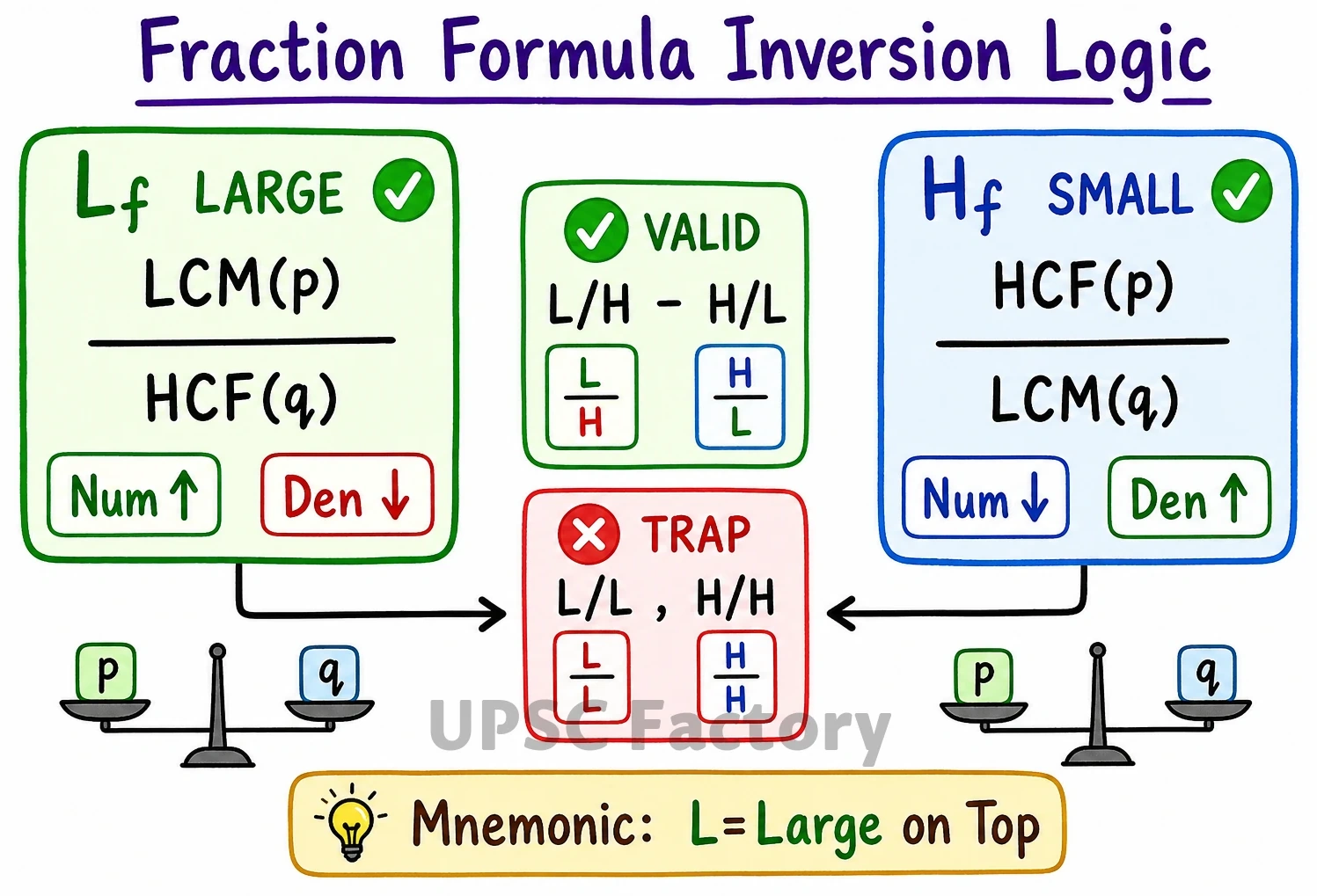
  • LCM seeks a large value: Numerator is maximized (LCM) and denominator is minimized (HCF of denominators maximizes total fractional magnitude).
  • HCF seeks a small value: Numerator is minimized (HCF) and denominator is maximized (LCM of denominators minimizes total fractional magnitude).

Hence, for any set in lowest terms:

Lf = LCM(pi)/HCF(qi),      Hf = HCF(pi)/LCM(qi)


Why Must Fractions Be Reduced?

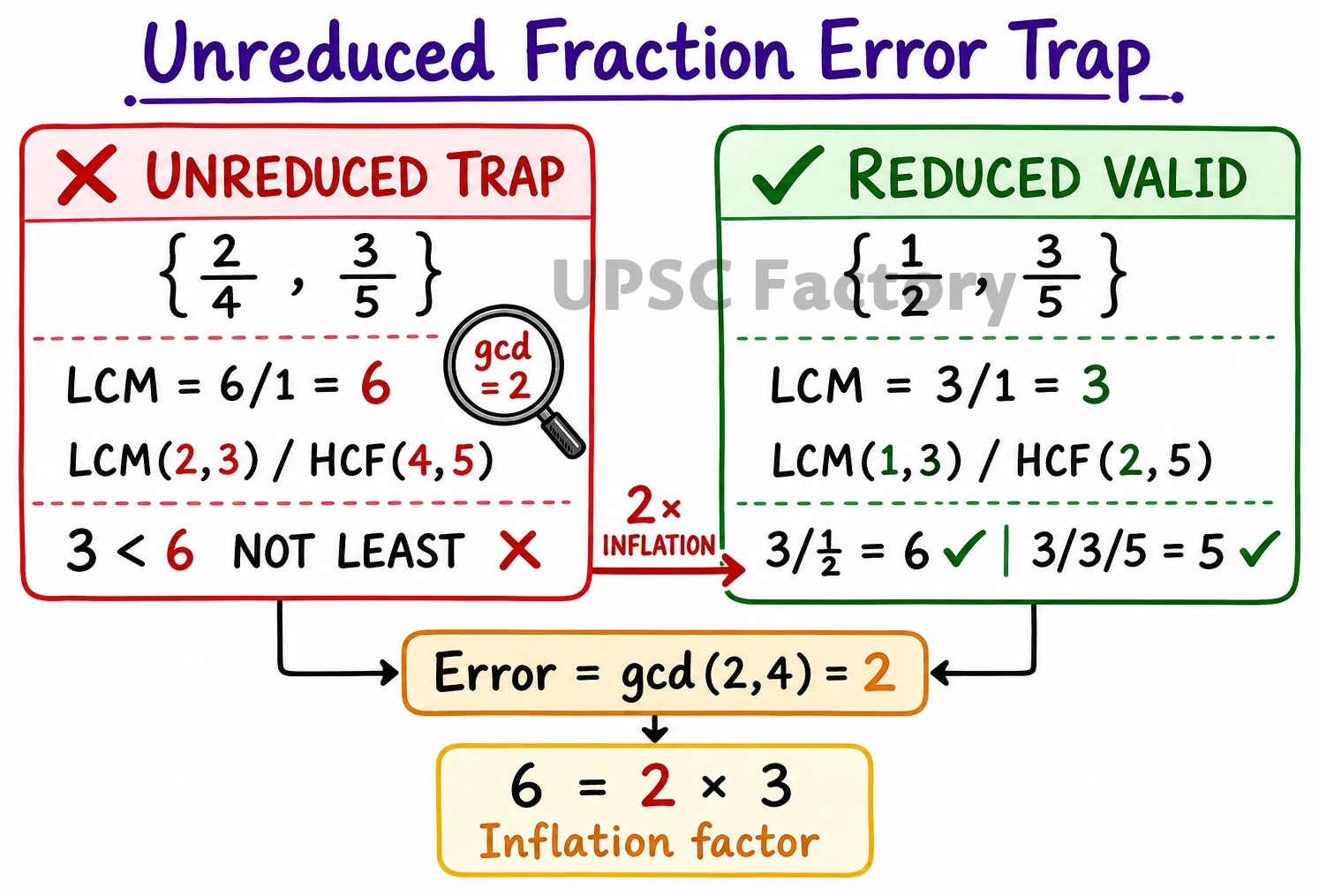
The formula relies on the denominator q being strictly coprime to p. If unreduced, an uncancelled factor gcd(p, q) > 1 distorts the least common multiple or highest common factor.

Example: Consider 2/4 unreduced (true value 1/2) and 3/5.

Using unreduced terms:

LCM(2/4, 3/5)unreduced = LCM(2, 3)/HCF(4, 5) = 6/1 = 6

However, 6 is not the least common multiple. The integer 3 is also a common multiple:

3/(1/2) = 6 ∈ ℤ,      3/(3/5) = 5 ∈ ℤ

Since 3 < 6, 6 fails minimality. Reducing the set to {1/2, 3/5} yields:

Lf = LCM(1, 3)/HCF(2, 5) = 3/1 = 3

The unreduced formula caused an error factor of gcd(2, 4) = 2.


Why Decimal Equalization Works (Scaling Invariance)

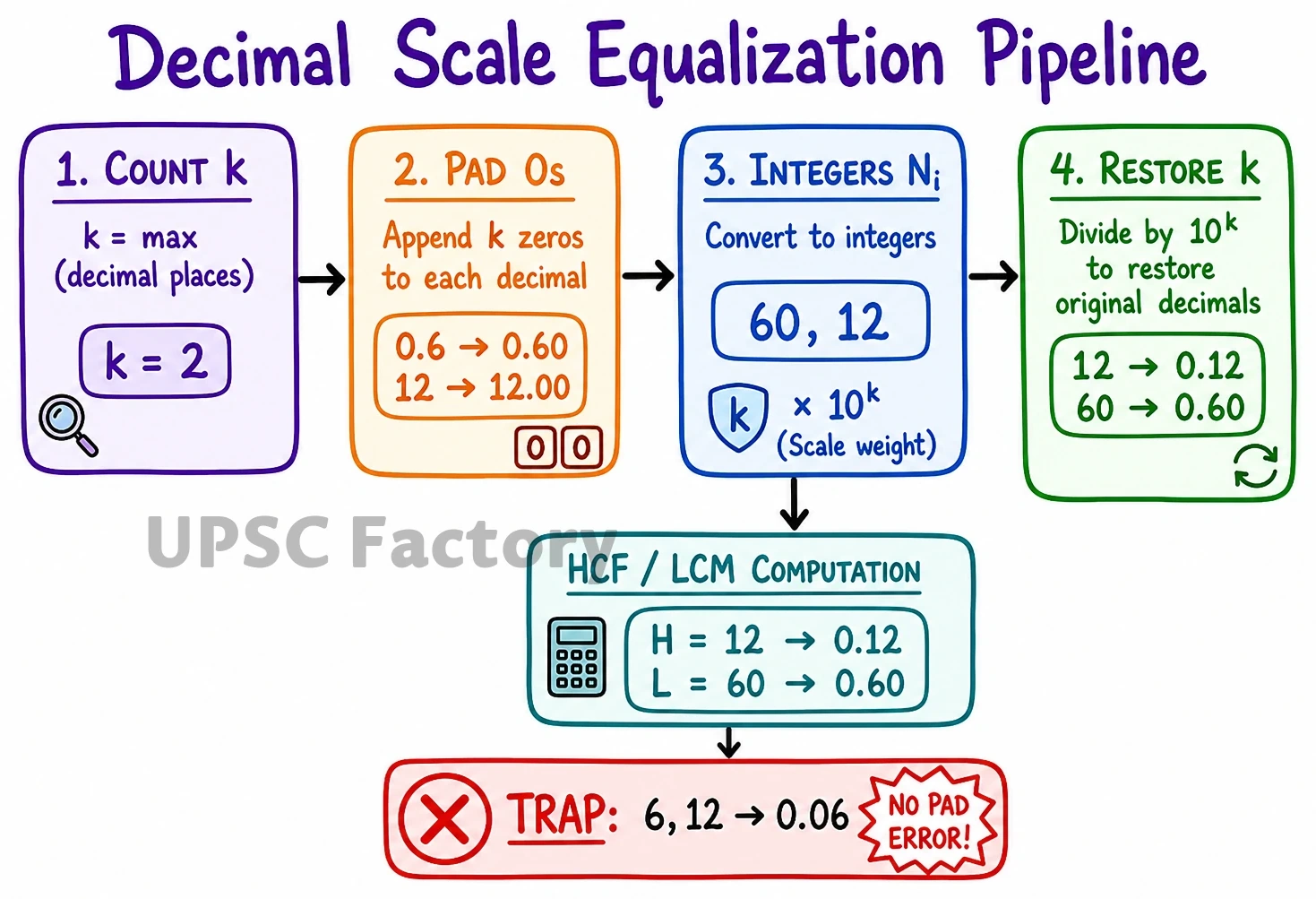
Let d1 = 0.6 and d2 = 0.12. The maximum number of decimal places is k = max(1, 2) = 2.

Express both numbers with a uniform base scale of 10k = 100:

d1 = 60/100,      d2 = 12/100

For any positive scalar c > 0:

HCF(c · a, c · b) = c · HCF(a, b)

LCM(c · a, c · b) = c · LCM(a, b)

Setting c = 10–k = 1/100:

HCF(0.60, 0.12) = 1/102 × HCF(60, 12) = 12/100 = 0.12

LCM(0.60, 0.12) = 1/102 × LCM(60, 12) = 60/100 = 0.60 = 0.6

Padding decimals with trailing zeros establishes a common integer scale. Stripping decimal points without uniform padding applies mixed scales (10-1 vs 10-2), invalidating the scalar distributive property.


Key Theorems & Properties

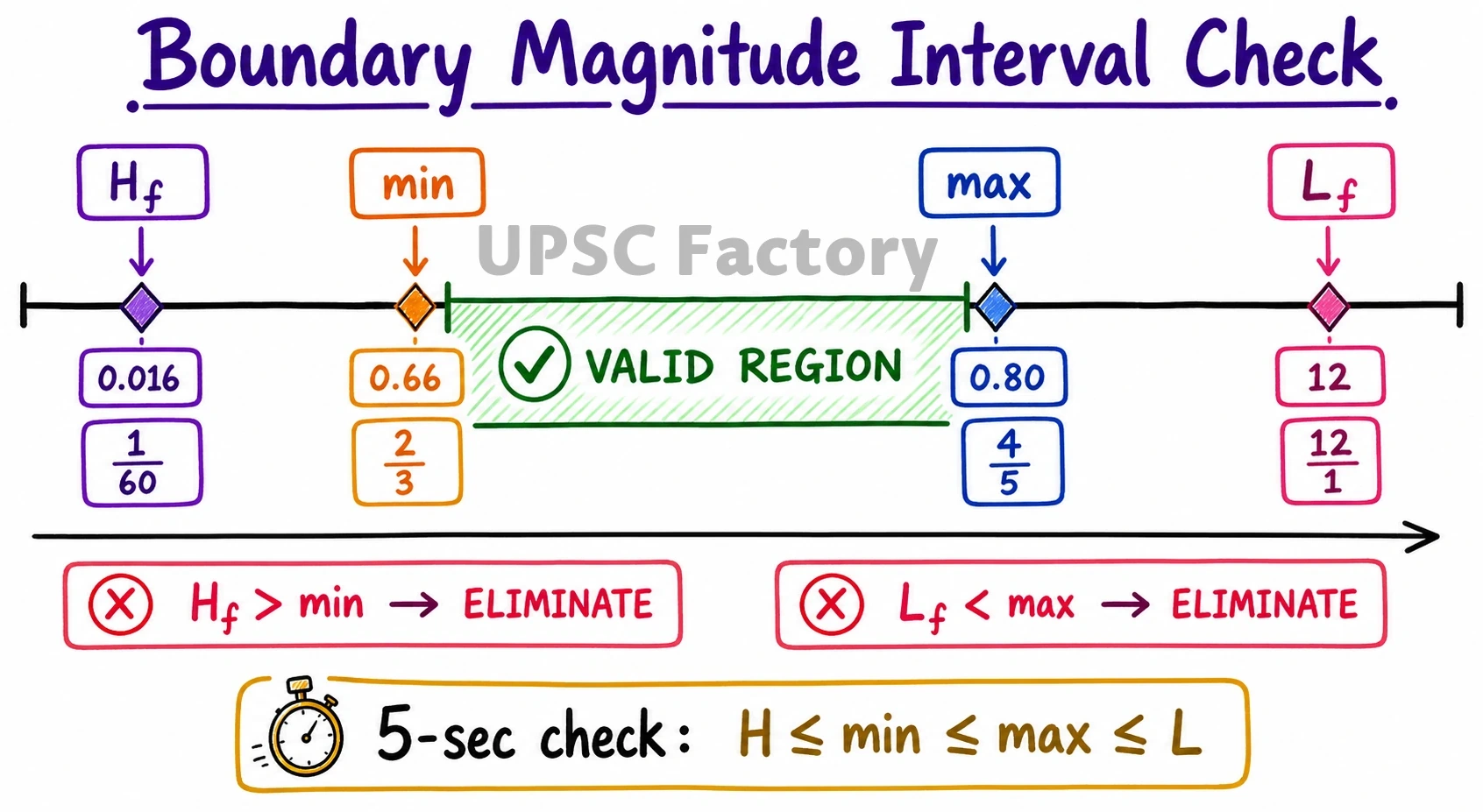
  • Boundary Theorem: For any set S:

    Hf ≤ min(S) ≤ max(S) ≤ Lf

    Any calculated HCF greater than the minimum element, or LCM smaller than the maximum element, is mathematically impossible.

  • Product Invariant Rule: For exactly two numbers, the standard product identity holds:

    Hf × Lf = r1 × r2

    Proof:

    Hf × Lf = HCF(p1, p2)/LCM(q1, q2) × LCM(p1, p2)/HCF(q1, q2) = p1p2/q1q2 = r1 × r2

    For three or more numbers (n ≥ 3), this relationship fails. Never apply H × L = Product when n ≥ 3.

    Counter-example for n = 3: Let r1 = 1/2, r2 = 1/3, r3 = 1/4.

    Hf = HCF(1, 1, 1)/LCM(2, 3, 4) = 1/12,      Lf = LCM(1, 1, 1)/HCF(2, 3, 4) = 1/1 = 1

    Hf × Lf = 1/12 × 1 = 1/12 ≠ 1/24 = (1/2 × 1/3 × 1/4)

  • Coprimality Preservation: If all denominators qi are pairwise coprime, LCM(qi) = ∏ qi. Consequently, Hf becomes significantly small—a useful order-of-magnitude sanity check.

2. Comparative Matrix & Conceptual Distinctions

DimensionIntegers a, b ∈ ℤFractions p/q, gcd(p, q) = 1Decimals N/10k
Divisor Definitiona | b ⇔ b/a ∈ ℤr1 | r2 ⇔ r2/r1 ∈ ℤSame as rational definition
HCF FormulaPrime Factorization / Euclidean AlgorithmHCF(pi)/LCM(qi)1/10k · HCF(Ni) after equalization
LCM FormulaPrime FactorizationLCM(pi)/HCF(qi)1/10k · LCM(Ni) after equalization
Core OperationDirect integer arithmeticCross-operation: LCM on num, HCF on den (and vice-versa)Scale to uniform integers, compute, descale
Mandatory Pre-stepNoneReduce all fractions to lowest termsPad to equal decimal places: k = max(ki)
Common PitfallArithmetic miscalculationsOperating on unreduced fractionsOperating across mismatched decimal scales

3. High-Yield Data Anchors & Memorization Benchmarks

A. The Reduction Fingerprint

Deceptive Unreduced FormTrue Lowest FormImpact of Failing to Reduce
28/35, 42/56, 14/214/5, 3/4, 2/3Coincidentally yields matching values due to symmetric cancellation; standard sets produce errors proportional to gcd(p, q).
6/8, 9/12Both equal 3/4For 2 terms: unreduced LCM = 18/4 = 4.5 vs. true value 0.75 (6× distortion).
18/27, 24/36Both equal 2/3Calculating with unreduced numerators {18, 24} corrupts both scale and primality.

B. Decimal Scale Anchors

  • k = 1 (tenths): Scale by 101 = 10
  • k = 2 (hundredths): Scale by 102 = 100
  • k = 3 (thousandths): Scale by 103 = 1000
  • Uniform Scale Rule: k = max(decimal places in the set). For {0.6, 9.6, 0.12}, k = 2 applies to all three numbers (0.60, 9.60, 0.12).

C. Magnitude Check (Rapid Option Elimination)

To evaluate HCF(0.6, 0.12):

  1. Boundary check: Hf ≤ min(0.6, 0.12) = 0.12. Any option > 0.12 is eliminated immediately.
  2. Equalize: k = 2 ⇒ 60, 12 ⇒ HCF(60, 12) = 12.
  3. Descale: 12/100 = 0.12.
  4. For LCM: Lf ≥ max(0.6, 0.12) = 0.6. Any option < 0.6 is eliminated immediately.

4. Standard Algorithmic Protocols

Protocol A: Computing HCF and LCM of Fractions

  1. Input: A set of rational numbers p1/q1, p2/q2, …, pn/qn.
  2. Canonical Reduction: If gcd(pi, qi) ≠ 1, reduce each fraction to its lowest terms.
  3. Array Extraction: Separate terms into two sets:
    • Numerators: N = {p1, p2, …, pn}
    • Denominators: D = {q1, q2, …, qn}
  4. Formula Execution:
    • For HCF:

      Hf = HCF(N)/LCM(D)

    • For LCM:

      Lf = LCM(N)/HCF(D)

  5. Boundary Verification: Confirm that Hf ≤ min(S) and Lf ≥ max(S).
  6. Result: Express as a simplified proper or improper fraction.

Protocol B: Computing HCF and LCM of Decimals (Equalization Method)

  1. Count Decimal Digits: Determine the number of decimal digits ki for each term di.
  2. Find Global Scale: Determine k = max(k1, k2, …, kn).
  3. Pad Trailing Zeros: Append zeros to equalize all terms to k decimal places.
    Example: For 0.6 and 0.12 with k = 2, write 0.60 and 0.12.
  4. Transform to Integers: Multiply by 10k (remove decimal point) to obtain integers Ni.
    Example: 0.60 &to; 60, 0.12 &to; 12.
  5. Compute Integer Metric: Calculate HCF(Ni) or LCM(Ni) directly.
  6. Descale: Shift the decimal point k places to the left (divide by 10k).
    Example: HCF(60, 12) = 12 ⇒ 12/100 = 0.12.
  7. Boundary Verification: Confirm H ≤ min(di) and L ≥ max(di).

Operational Warning: Avoid converting decimals into mixed fractions such as 12/10 and 45/100 before applying Protocol A without thorough cross-reduction. The differing powers of 10 require normalization; Protocol B eliminates this redundancy.


5. Standard Question Typologies & Analytical Solutions

Type A: Parity & Hidden Factor Constraint (Fractional HCF)

Question:
Find the HCF of the set of fractions 14/21, 28/35, and 36/48.

(a) 1/140
(b) 1/105
(c) 2/105
(d) 1/60

Analytical Solution:

Step 1 — Pre-condition Audit:
Check whether gcd(pi, qi) = 1 for all terms. All three fractions share common factors and must be reduced.

Step 2 — Reduction to Canonical Form:

14/21 = 2/3,      28/35 = 4/5,      36/48 = 3/4

Extract the integer sets:

N = {2, 4, 3} ⇒ HCF(N) = 1

D = {3, 5, 4} ⇒ LCM(D) = 3 × 5 × 4 = 60

Step 3 — Compute HCF:

Hf = HCF(N)/LCM(D) = 1/60

Step 4 — Boundary Check:
min(S) = 2/3 ≈ 0.667. Since 1/60 ≈ 0.0167 ≤ 2/3, the result satisfies the boundary constraint.

Correct Option: (d) 1/60


Type B: Statement-Based Conceptual Assessment (Algorithm Integrity)

Question:
Consider the following statements:

  • Statement I: The HCF of 0.5 and 0.05 is found by computing the HCF of 5 and 5 and placing the decimal point two places to the left.
  • Statement II: To find the LCM of fractions, computing LCM of unreduced numerators/HCF of unreduced denominators produces a valid least common multiple.

Which of the above statements is/are correct?
(a) I only
(b) II only
(c) Both I and II
(d) Neither I nor II

Analytical Solution:

Evaluation of Statement I:
The maximum decimal places is k = max(1, 2) = 2.
Equalizing gives 0.50 and 0.05 ⇒ integers 50 and 5.
HCF(50, 5) = 5 ⇒ 5/100 = 0.05.
While taking HCF(5, 5) = 5 &to; 0.05 matches by coincidence here, the method fails generally (e.g., for 0.6 and 0.12, unpadded inputs yield HCF(6, 12) = 6 &to; 0.06, whereas the true HCF is 0.12). The algorithmic statement is conceptually false.

Evaluation of Statement II:
As demonstrated in Section 1, unreduced fractions leave uncancelled factors that artificially inflate the resulting value, producing a common multiple that is not the least. Statement II is false.

Correct Option: (d) Neither I nor II


Type C: Existence & Parameter Counting

Question:
Let S be the set of all fractions p/q in lowest terms such that p < q ≤ 5, with p, q ∈ ℤ+. How many fractions in S yield an HCF of 1/60 when grouped with the set {4/5, 3/4}?

(a) 1
(b) 2
(c) 3
(d) 4

Analytical Solution:

Step 1 — Group Evaluation:
Let r = p/q ∈ S. The HCF of the combined set is:

HCF(4/5, 3/4, p/q) = HCF(4, 3, p)/LCM(5, 4, q) = 1/60

Step 2 — Numerator Analysis:
Since HCF(4, 3) = 1, we have HCF(1, p) = 1 for any positive integer p. The numerator constraint is universally satisfied.

Step 3 — Denominator Analysis:
We require:

LCM(20, q) = 60

Prime factorizations:

20 = 22 × 5,      60 = 22 × 3 × 5

Thus, q must contain 31 as a factor and must divide 60. Given q ≤ 5, testing possible integer values:

  • If q = 1 ⇒ LCM(20, 1) = 20 ≠ 60
  • If q = 2 ⇒ LCM(20, 2) = 20 ≠ 60
  • If q = 3 ⇒ LCM(20, 3) = 60 (Valid)
  • If q = 4 ⇒ LCM(20, 4) = 20 ≠ 60
  • If q = 5 ⇒ LCM(20, 5) = 20 ≠ 60

Hence, q = 3 is the unique solution for the denominator.

Step 4 — Enumerating Valid Numerators:
With q = 3, the condition p < q and gcd(p, 3) = 1 yields:

p ∈ {1, 2}

The valid fractions are 1/3 and 2/3 (Total = 2).

Correct Option: (b) 2


Type D: Algebraic Invariants & Product Identities

Question:
For the decimal numbers a = 0.6 and b = 0.12, evaluate the following statements:

  • Statement I: HCF(a, b) × LCM(a, b) = a × b
  • Statement II: LCM(a, b) = 0.6 and HCF(a, b) = 0.12

Which of the statements is/are correct?
(a) I only
(b) II only
(c) Both I and II
(d) Neither I nor II

Analytical Solution:

Step 1 — Compute HCF and LCM:
Set k = max(1, 2) = 2.
Scaled integers: N1 = 60, N2 = 12.

  • HCF(60, 12) = 12 ⇒ HCF(a, b) = 0.12
  • LCM(60, 12) = 60 ⇒ LCM(a, b) = 0.60 = 0.6

Statement II is true.

Step 2 — Verify Product Invariant:

a × b = 0.6 × 0.12 = 0.072

HCF(a, b) × LCM(a, b) = 0.12 × 0.6 = 0.072

Because n = 2, the product identity holds rigorously. Statement I is true.

Correct Option: (c) Both I and II


Type E: Joint Multi-Term Fraction Evaluation

Question:
Determine the HCF and LCM of the set {28/35, 42/56, 14/21}.

(a) HCF = 1/60, LCM = 12
(b) HCF = 1/30, LCM = 6
(c) HCF = 7/840, LCM = 84
(d) HCF = 2/105, LCM = 12

Analytical Solution:

Step 1 — Mandatory Reduction:

28/35 = 4/5,      42/56 = 3/4,      14/21 = 2/3

Step 2 — Compute HCF:

Hf = HCF(4, 3, 2)/LCM(5, 4, 3) = 1/60

Step 3 — Compute LCM:

Lf = LCM(4, 3, 2)/HCF(5, 4, 3) = 12/1 = 12

Correct Option: (a) HCF = 1/60, LCM = 12


Type F: Multi-Term Decimal Evaluation

Question:
Find the LCM of 0.6, 9.6, and 0.12.

(a) 9.6
(b) 0.12
(c) 28.8
(d) 0.6

Analytical Solution:

Step 1 — Equalize Decimals:
Number of decimal places: k1 = 1, k2 = 1, k3 = 2 ⇒ k = 2.
Equalized values: 0.60, 9.60, 0.12.

Step 2 — Integer Mapping:

N = {60, 960, 12}

Step 3 — Integer LCM Calculation:
Notice that 12 | 60 and 60 | 960 (960 / 60 = 16).
Since 12 and 60 both divide 960, LCM(60, 960, 12) = 960.

Step 4 — Descale:

L = 960/102 = 9.60 = 9.6

Correct Option: (a) 9.6


6. The Examiner Trap Matrix

Candidate FallacyMathematical RealityConcrete Counter-Example
1. Unreduced Fraction TrapFormulas require coprime pairs gcd(p, q) = 1. Hidden factors distort results.LCM(2/4, 3/5): unreduced formula gives 6; true canonical LCM is 3 (2× error).
2. Asymmetric Decimal TrapDecimal scaling factor 10–k must be uniform across the entire set.For {1.2, 0.04}, setting k = 2 gives LCM(120, 4) = 120 &to; 1.20. Without padding, LCM(12, 4) = 12 &to; 0.12 (10× error).
3. Raw Fraction ConversionConverting decimals directly to unreduced fractions mixes base-10 powers with unsimplified terms.0.45 = 45/100. Without reduction to 9/20, cross-fraction formulas yield incorrect intermediate denominators.
4. Formula InversionLCM requires maximizing the fraction (LCM/HCF); HCF requires minimizing (HCF/LCM).For {4/5, 3/4}, inverted LCM gives HCF(4,3)/LCM(5,4) = 1/20 = 0.05, violating L ≥ max(S).
5. Trailing Zero Descaling ErrorThe shift count k is fixed by the initial maximum decimal places, not the result’s digits.Scaled integer LCM = 960 with k = 2 ⇒ 9.60. Miscounting positions gives 96 or 0.96.
6. Multi-Term Product ExtensionH × L = Product holds only for n = 2 terms; it fails for n ≥ 3.For {1/2, 1/3, 1/4}: H = 1/12, L = 1 ⇒ H × L = 1/12 ≠ 1/24 = ∏ ri.

7. Golden Rules & Instant Exam Triggers

#TriggerMathematical Rule
1Fractions &to; Reduce FirstAlways verify gcd(pi, qi) = 1. If any numerator and denominator share common prime factors (2, 3, 5, 7), simplify completely before applying formulas.
2Decimals &to; Equalize ScaleSet k = max(ki). Append trailing zeros to align all numbers to the same number of decimal places before removing the decimal point.
3LCM of Fractions &to; Maximize ValueLCM = LCM(Numerators)/HCF(Denominators)
4HCF of Fractions &to; Minimize ValueHCF = HCF(Numerators)/LCM(Denominators)
5Boundary Constraint CheckEliminate invalid answer options rapidly using: Hf ≤ min(S) and Lf ≥ max(S).
6Decimal Restoration RuleKeep k fixed from Step 1. Shift the decimal point k places to the left on the final integer result (divide by 10k).
7Product Rule ScopeApply H × L = r1 × r2 strictly when n = 2. Never apply it for sets of 3 or more numbers.

Key Pedagogical Takeaway: Fraction problems test reduction discipline; decimal problems test scale equalization. Most errors stem from skipping these initial formatting steps rather than the core LCM/HCF calculations. Verifying canonical form at the outset guarantees accuracy.

HCF LCM for Non-Integers for UPSC CSAT Read More »
Algebraic Relations of HCF LCM for UPSC CSAT

Algebraic Relations of HCF LCM for UPSC CSAT

1. Theoretical Foundation & Mathematical Underpinnings

Formal Definition & Scope

For a, b ∈ ℤ+ where a, b > 1:

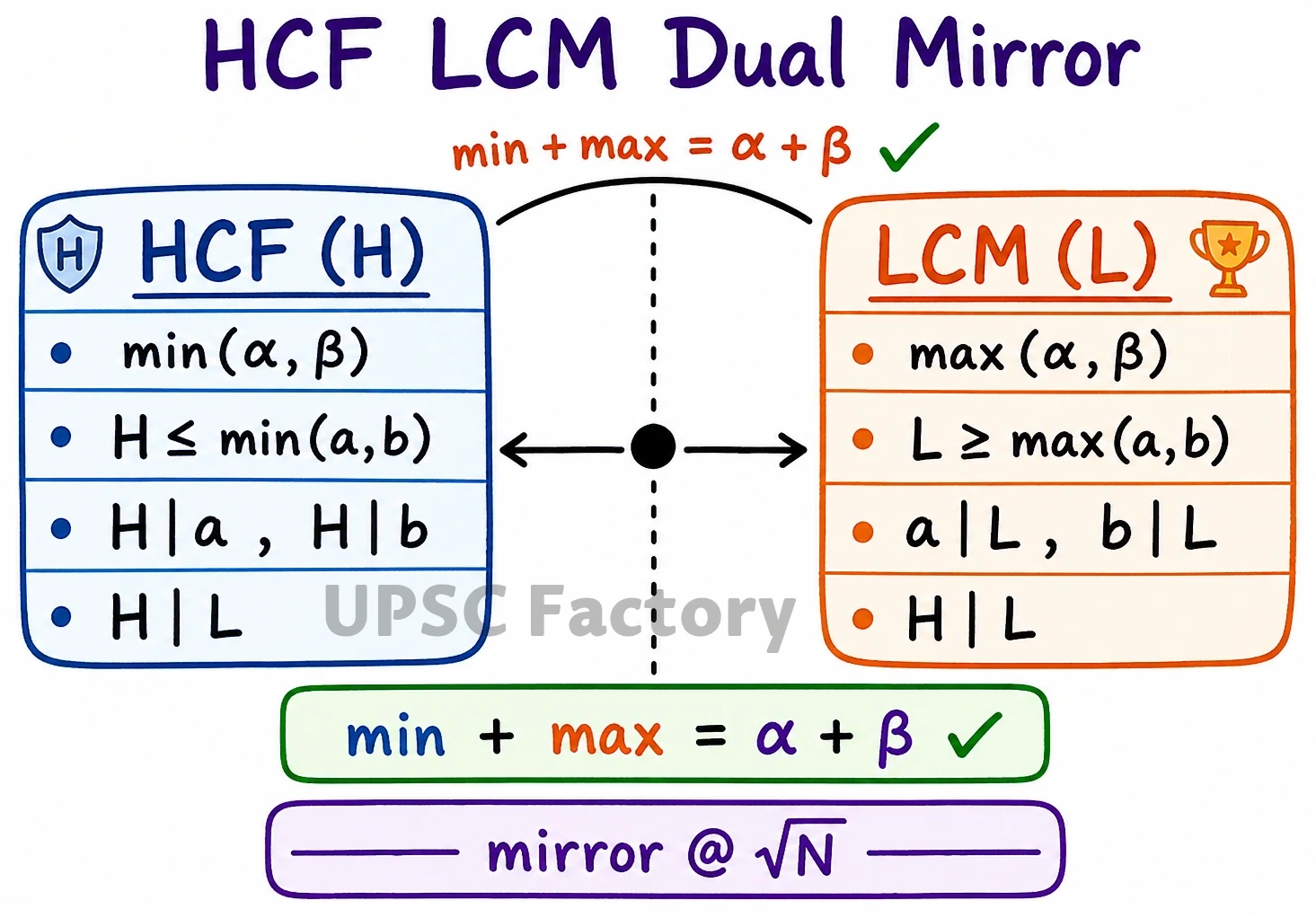
  • HCF (Highest Common Factor) / gcd(a, b) = H: The greatest integer H such that H | a and H | b. It contains only the common prime factors at their minimum exponent.
  • LCM (Least Common Multiple) / lcm(a, b) = L: The smallest integer L such that a | L and b | L. It contains all prime factors of a and b at their maximum exponent.

Domain Constraint: By definition,

H | a,   H | b,   a | L,   b | L

and crucially,

H | L

If L mod H ≠ 0, the dataset is impossible — no such pair (a, b) exists.


The “Why” Behind The Math

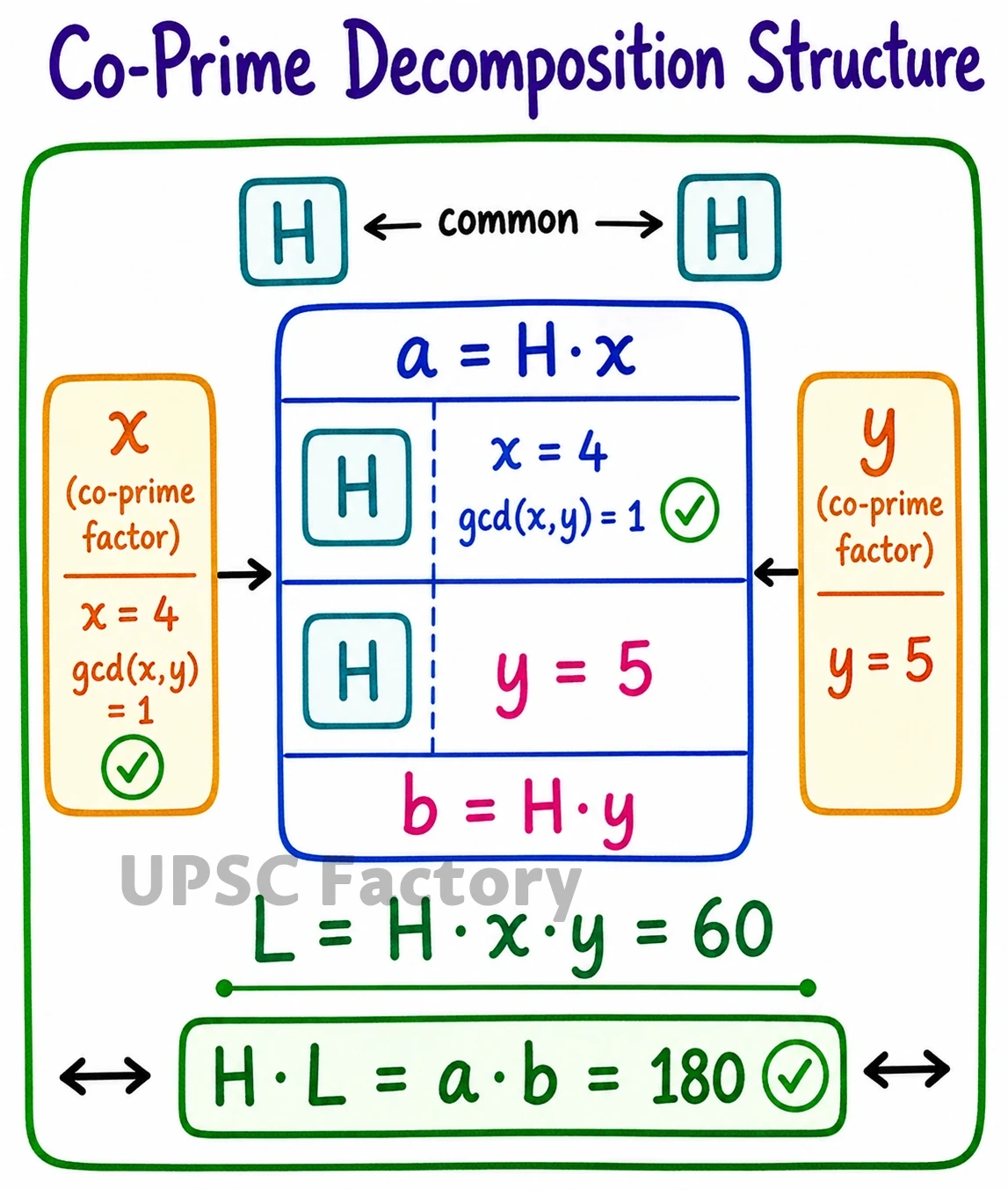
Theorem 1: The Co-Prime Decomposition

Any two numbers can be decomposed with respect to their HCF.

Let H = gcd(a, b). Then there exist unique x, y ∈ ℤ+ such that:

a = Hx,   b = Hy   where   gcd(x, y) = 1

Why must gcd(x, y) = 1? — Proof by Contradiction:

Suppose gcd(x, y) = d > 1. Then x = dx′ and y = dy′ for some x′, y′ ∈ ℤ+.

Substituting these back:

a = H(dx′) = (Hd)x′
b = H(dy′) = (Hd)y′

This implies Hd is a common divisor of a and b. Since d > 1, we have Hd > H, which contradicts the premise that H is the Highest Common Factor. Hence d must equal 1, proving (x, y) is strictly co-prime.

Corollary:

a/b = Hx/Hy = x/y

The ratio in lowest terms is the co-prime pair (x, y).


Theorem 2: The Two-Variable Product Invariant

For exactly two numbers, the foundational identity holds:

H × L = a × b

Proof 1 — Via Co-Prime Structure (Intuitive):

From Theorem 1, the least common multiple must contain the common base H alongside all distinct non-common factors x and y:

L = Hxy

Multiplying by H:

H × L = H × (Hxy)
H × L = H2xy

Expanding the product of the original numbers:

a × b = (Hx) × (Hy)
a × b = H2xy

Thus, H × L = a × b.

Proof 2 — Via Prime Factorization (Rigorous):

Let the prime factorizations of a and b be:

a = ∏ piαi
b = ∏ piβi

By definition:

H = ∏ pimin(αi, βi)
L = ∏ pimax(αi, βi)

Since for any two real numbers min(αi, βi) + max(αi, βi) = αi + βi:

H × L = ∏ pimin(αi, βi) + max(αi, βi)
H × L = ∏ piαi + βi
H × L = (∏ piαi) (∏ piβi)
H × L = a × b

Worked Verification:
Let a = 12 and b = 15.
• H = gcd(12, 15) = 3
• 12 = 3 × 4 ⇒ x = 4
• 15 = 3 × 5 ⇒ y = 5
• gcd(4, 5) = 1 is satisfied.
• L = Hxy = 3 × 4 × 5 = 60

Verifying the invariant:
H × L = 3 × 60 = 180
a × b = 12 × 15 = 180


Key Theorems & Properties

  • Divisibility Invariant: H | L always. If L/H ∉ ℤ+, no valid integer pair (a, b) exists.
    Example: H = 14, L = 200 ⇒ 200/14 ∉ ℤ ⇒ Zero valid pairs exist.
  • Co-Prime Quotient Invariant: L/H = xy where gcd(x, y) = 1. This quotient serves as the core computational engine for all pair-counting problems.
  • Exponent Complementarity Rule: For two numbers, min(αi, βi) + max(αi, βi) = αi + βi. This confirms why the product rule strictly holds for n = 2.
  • Structural Breakdown for n ≥ 3: For three numbers a, b, c:
    H = ∏ pimin(αi, βi, γi)
    L = ∏ pimax(αi, βi, γi)
    Because min(αi, βi, γi) + max(αi, βi, γi) ≠ αi + βi + γi, the identity fails:
    H × L ≠ a × b × c
  • Ratio Invariance: If a/b = p/q in lowest terms, then a = Hp and b = Hq.

2. Comparative Matrix & Conceptual Distinctions

Table 1: HCF vs. LCM — Structural Duality

FeatureHCF (H = gcd(a, b))LCM (L = lcm(a, b))
Mathematical DefinitionGreatest common divisor of both numbersSmallest common multiple of both numbers
Prime Factor Powermin(αi, βi)max(αi, βi)
Magnitude BoundaryH ≤ min(a, b)L ≥ max(a, b)
Structural RoleFactor contained inside a and bMultiple that contains a and b
Core FormulaH = (a × b)/LL = Hxy

Table 2: Comparative Analysis — Two Numbers vs. Three Numbers

Mathematical AspectFor n = 2 Numbers (a, b)For n = 3 Numbers (a, b, c)
Product RuleValid: H × L = a × bInvalid: H × L ≠ a × b × c
Quotient EvaluationL/H = xy (where gcd(x, y) = 1)L/H does not resolve to a simple product xyz
Analytical MethodSet a = Hx, b = HyUse prime factor matrices: a = ∏ piαi
Examiner TrapDirect formula substitution is safeQuestions lure candidates to use c = (H × L)/(a × b)


3. High-Yield Data Anchors & Memorization Benchmarks

Anchor 1: The Divisibility Filter

Before executing full algebraic calculations, evaluate whether L mod H = 0. If the remainder is non-zero, the configuration is invalid, yielding zero valid pairs.

Anchor 2: The Co-Prime Distribution Law

Let N = L/H = xy with the strict constraint gcd(x, y) = 1.
Let k be the number of distinct prime factors of N.

Formula Benchmarks:
• Number of unordered pairs {x, y} (and thus {a, b}) = 2k-1
• Number of ordered pairs (x, y) = 2k
(For N = 1 where L = H, there is exactly 1 pair: a = b = H. The formula 2k-1 applies for all k ≥ 1.)

Prime Factorization of N = L/HDistinct Primes (k)Unordered Co-Prime Pairs (2k-1)Valid (a, b) Configurations
N = pa (e.g., 8, 9, 16)121-1 = 1Only (1, N)
N = paqb (e.g., 12, 20, 77)222-1 = 2(1, N) and one prime-split pair
N = paqbrc (e.g., 30, 60, 84)323-1 = 44 co-prime combinations
N = paqbrcsd424-1 = 88 co-prime combinations
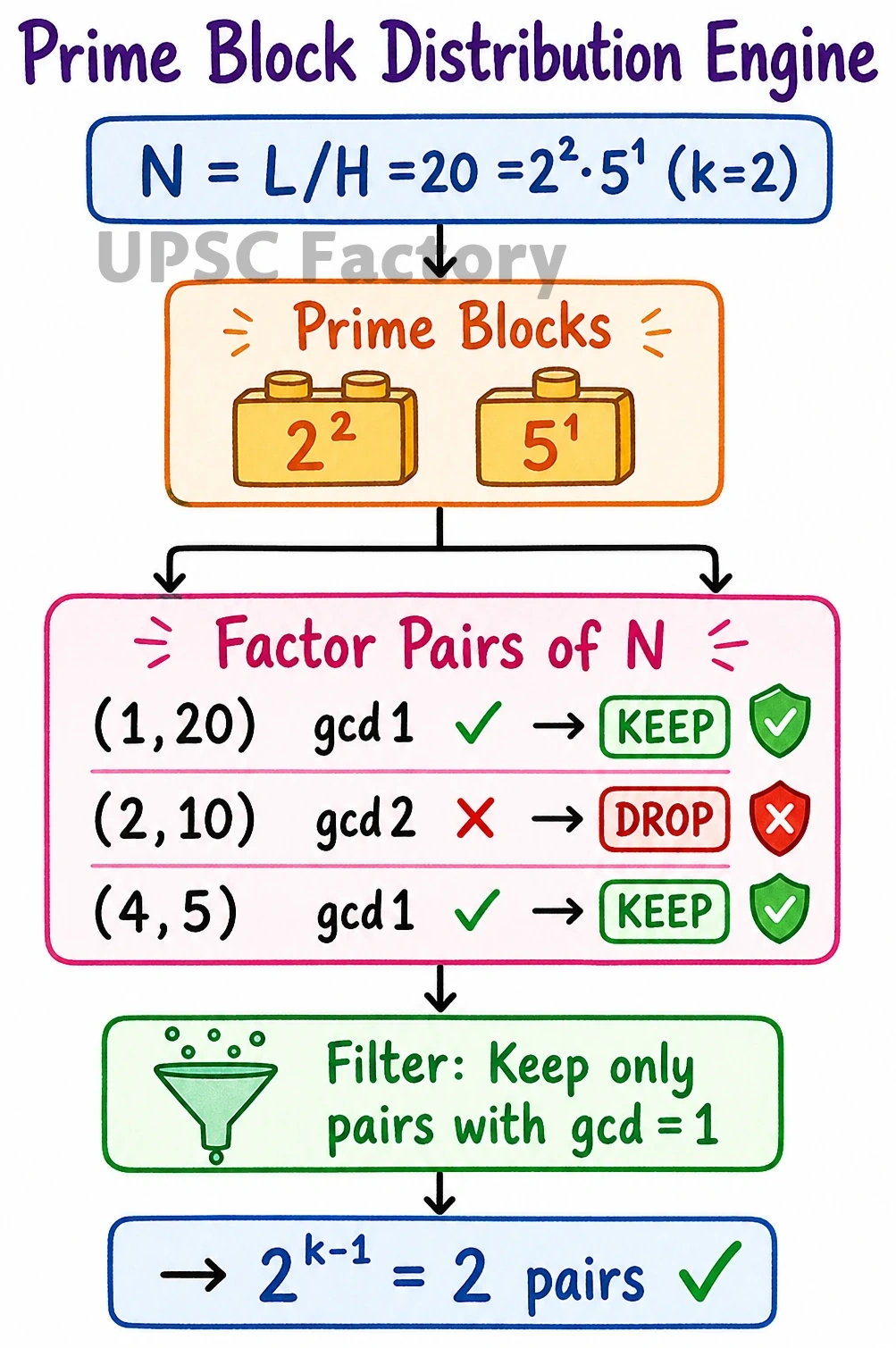
  • Example 1:
    H = 12, L = 924 ⇒ N = 924/12 = 77 = 71 × 111.
    Here k = 2, so number of pairs = 22-1 = 2.
  • Example 2:
    H = 15, L = 300 ⇒ N = 300/15 = 20 = 22 × 51.
    Here k = 2, so number of pairs = 22-1 = 2.
    The factor pairs of 20 are (1, 20) and (4, 5). The pair (2, 10) is rejected because gcd(2, 10) = 2 ≠ 1.

Anchor 3: Common Non-Co-Prime Quotient Traps

  • N = 12: Divisor factor pairs are (1, 12), (2, 6), and (3, 4).
    The pair (2, 6) is invalid because gcd(2, 6) = 2.
    ⇒ Exactly 2 valid pairs remain: (1, 12) and (3, 4).
  • N = 36: Divisor factor pairs are (1, 36), (2, 18), (3, 12), (4, 9), and (6, 6).
    Pairs (2, 18), (3, 12), and (6, 6) share common divisors.
    ⇒ Exactly 2 valid pairs remain: (1, 36) and (4, 9).

4. Standard Algorithmic Protocols

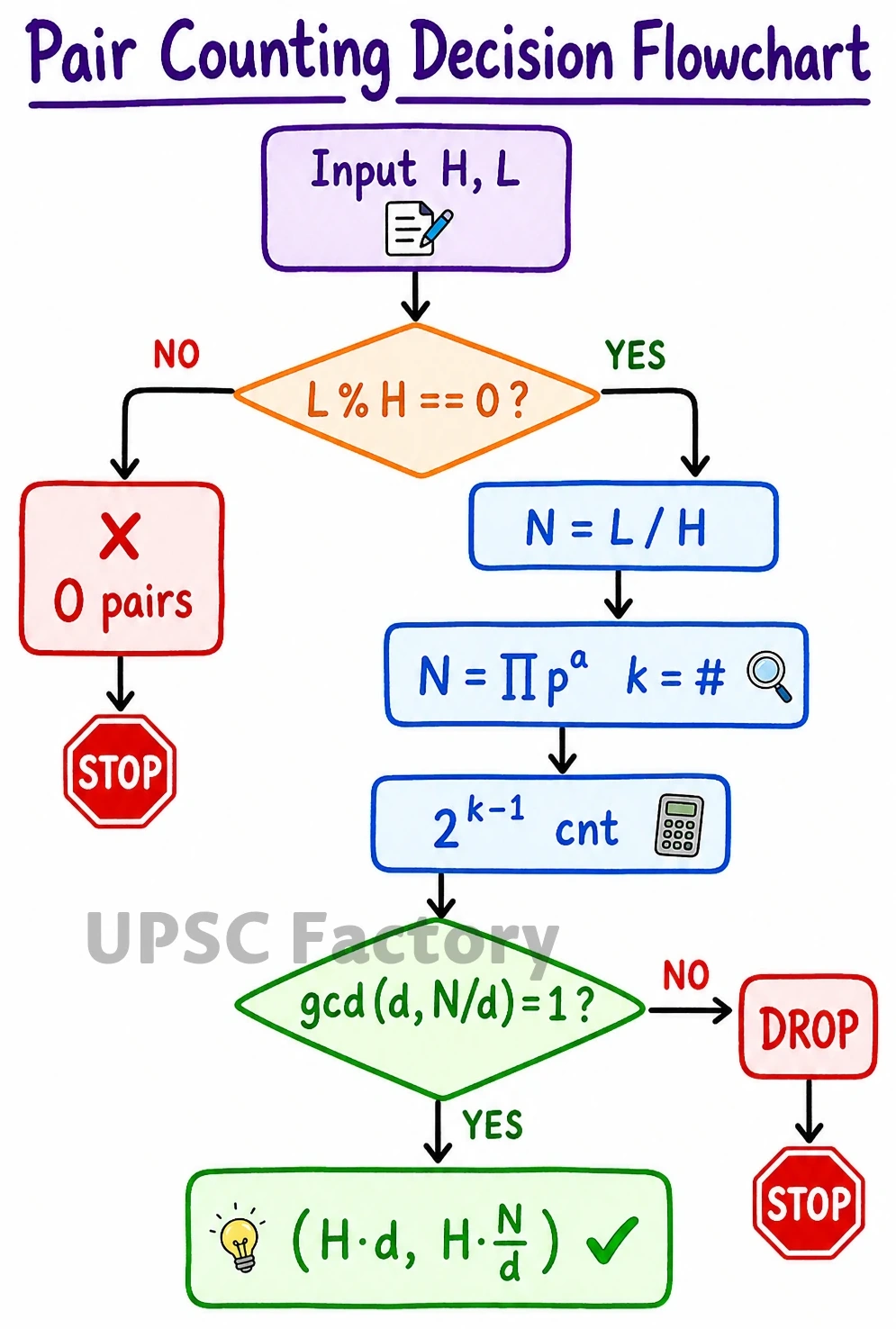
Protocol A: Systematically Finding Pairs Given H and L

Step-by-Step Procedure

  1. Divisibility Verification: Check if L mod H = 0.
    • If No: Terminate. Zero valid pairs exist.
    • If Yes: Proceed to Step 2.
  2. Calculate Quotient: Compute N = L/H.
  3. Prime Factorization: Express N = p1a1 · p2a2 ··· pkak and identify k (the count of distinct prime bases).
  4. Count Configurations:
    Unordered pairs = 2k-1,   Ordered pairs = 2k
  5. Reconstruct Numbers (if required):
    • Enumerate all factor pairs (d, N/d) such that gcd(d, N/d) = 1.
    • Multiply each component by H to get (Hd, H · (N/d)).

Numerical Execution

Find all pairs of natural numbers with H = 18 and L = 540.

  • Step 1: 540 mod 18 = 0 (Valid).
  • Step 2: N = 540/18 = 30.
  • Step 3: 30 = 21 × 31 × 51 ⇒ k = 3.
  • Step 4: Total unordered pairs = 23-1 = 4.
  • Step 5: The co-prime pairs (x, y) summing to product 30 are:
    (1, 30),   (2, 15),   (3, 10),   (5, 6)
    Multiplying by H = 18 yields the actual number pairs:
    (18, 540),   (36, 270),   (54, 180),   (90, 108)


Protocol B: Prime Exponent Matching for Three Numbers

For three numbers a, b, c, avoid the false product formula H × L = a × b × c. Use prime exponent bounding:

  1. Factorize all known terms:

    a = ∏ piαi,   b = ∏ piβi
    H = ∏ piHi,   L = ∏ piLi

  2. Apply boundary conditions per prime:

    min(αi, βi, γi) = Hi
    max(αi, βi, γi) = Li

  3. Determine constraints on c = ∏ piγi:
    • If neither αi nor βi reaches Li, then γi must equal Li.
    • If neither αi nor βi drops to Hi, then γi must equal Hi.
    • Otherwise, γi can be any integer such that Hi ≤ γi ≤ Li.

5. Standard Question Typologies & Analytical Solutions

Type A: Parity & Multi-Variable Constraints

Core Principle: When a = Hx and b = Hy, the algebraic parity of a and b is directly governed by H. If H is even, both a and b must be even.

Question: The HCF of two natural numbers is 12 and their LCM is 360. If one number is even and the sum of the numbers is odd, which of the following must be true?
(a) Both x and y are odd
(b) One of x, y is even, the other is odd
(c) Both x and y are even
(d) No such pair exists

Analytical Solution:

Step 1 — Structural Formulation:
Let the numbers be a = 12x and b = 12y, where gcd(x, y) = 1 and:
xy = L/H = 360/12 = 30

Step 2 — Parity Evaluation:
The sum of the numbers is:
a + b = 12x + 12y = 12(x + y) = 2 · [6(x + y)]
Since 12 is even, 12(x + y) is strictly even for all integers x, y. Therefore, an odd sum is mathematically impossible.

Step 3 — Conclusion:
Although factor pairs for xy = 30 exist, none can satisfy the condition that a + b is odd.

Correct Option: (d)

Quick Check: If H is even, then both a and b are even, making their sum and difference unconditionally even.


Type B: Multi-Statement Analytical Questions

Core Principle: Validate statements independently by calculating N = L/H, applying co-prime filtering, and summing real pairs.

Question: Consider two natural numbers whose HCF is 15 and LCM is 300.
Statement I: There are exactly two possible pairs of numbers.
Statement II: The sum of the numbers in one valid pair is 135.
Which of the statements given above is/are correct?
(a) I only
(b) II only
(c) Both I and II
(d) Neither I nor II

Analytical Solution:

Step 1 — Quotient and Factorization:
N = L/H = 300/15 = 20 = 22 × 51

Step 2 — Co-Prime Factor Pair Extraction:
The factor pairs of 20 are:
(1, 20) ⇒ gcd(1, 20) = 1   (Valid)
(2, 10) ⇒ gcd(2, 10) = 2 ≠ 1   (Invalid)
(4, 5) ⇒ gcd(4, 5) = 1   (Valid)
There are exactly 2 valid co-prime pairs. Statement I is correct.

Step 3 — Reconstructing the Values:
• Pair 1: (15 × 1, 15 × 20) = (15, 300) ⇒ Sum = 315
• Pair 2: (15 × 4, 15 × 5) = (60, 75) ⇒ Sum = 135
Statement II is correct.

Correct Option: (c)


Type C: Pair Counting & Existence Archetypes

Core Principle: The number of unordered co-prime pairs depends directly on 2k-1, where k is the count of distinct prime factors of L/H.

Question: The HCF and LCM of two natural numbers are 12 and 924 respectively. How many such distinct pairs of numbers are possible?
(a) 1
(b) 2
(c) 3
(d) 4

Analytical Solution:

Step 1 — Compute Quotient:
N = L/H = 924/12 = 77

Step 2 — Distinct Prime Counting:
77 = 71 × 111 ⇒ k = 2

Step 3 — Calculate Unordered Pairs:
Number of distinct pairs = 2k-1 = 22-1 = 2
The valid pairs are (x, y) ∈ {(1, 77), (7, 11)}, yielding (a, b) ∈ {(12, 924), (84, 132)}.

Correct Option: (b)


Type D: Ratio Invariance & Multiplier Logic

Core Principle: A simplified ratio a : b = p : q directly defines the co-prime pair x = p and y = q.

Question: Two numbers a and b have an HCF of 6. Their ratio in simplest form is 4 : 5. What is their LCM?
(a) 60
(b) 120
(c) 180
(d) 240

Analytical Solution:

Step 1 — Base Formulation:
Since 4 : 5 is irreducible, gcd(4, 5) = 1.
Thus, x = 4 and y = 5.

Step 2 — Calculate LCM:
L = H × x × y = 6 × 4 × 5 = 120
Alternatively, find the numbers first:
a = 6 × 4 = 24,   b = 6 × 5 = 30
L = (a × b)/H = (24 × 30)/6 = 120

Correct Option: (b)


Type E: Factor Splitting & Structural Validity

Core Principle: Prime powers in N = L/H cannot be split across both x and y; each prime power block must reside entirely within one term.

Question: The HCF of two numbers is 18 and their LCM is 324. Which of the following cannot be the values of the two numbers?
(a) 18 and 324
(b) 36 and 162
(c) 54 and 108
(d) 72 and 81

Analytical Solution:

Step 1 — Factor Constraints:
N = L/H = 324/18 = 18 = 21 × 32
To preserve gcd(x, y) = 1:

  • The factor 21 must go entirely to x or y.
  • The factor 32 must go entirely to x or y.

Valid (x, y) pairs are strictly (1, 18) and (2, 9).
Valid number pairs are (18, 324) and (36, 162).

Step 2 — Option Audit:

  • Option (a): (18, 324) ⇒ (x, y) = (1, 18) with gcd(1, 18) = 1 (Valid).
  • Option (b): (36, 162) ⇒ (x, y) = (2, 9) with gcd(2, 9) = 1 (Valid).
  • Option (c): (54, 108) ⇒ (x, y) = (3, 6) with gcd(3, 6) = 3 ≠ 1 (Invalid — prime 3 is split).
  • Option (d): 81 is not divisible by H = 18 (Fails basic divisibility H | b).

Both (c) and (d) are mathematically invalid; option (c) represents the classic co-prime factorization trap.

Intended Option: (c)


Type F: The Three-Variable Constraint Model

Core Principle: For three variables, prime factors missing from two numbers must be fully supplied by the third number to achieve the target LCM.

Question: The HCF of three numbers a, b, c is 4 and their LCM is 240. If a = 12 and b = 16, which of the following could be the value of c?
(a) 5
(b) 10
(c) 15
(d) 20

Analytical Solution:

Step 1 — Prime Factorization:
a = 12 = 22 × 31 × 50
b = 16 = 24 × 30 × 50
H = 4 = 22 × 30 × 50
L = 240 = 24 × 31 × 51

Step 2 — Prime Exponent Constraints on c = 2γ1 × 3γ2 × 5γ3:
• Prime 5: max(0, 0, γ3) = 1 ⇒ γ3 = 1 (Factor of 5 is mandatory).
• Prime 2: min(2, 4, γ1) = 2 and max(2, 4, γ1) = 4 ⇒ 2 ≤ γ1 ≤ 4 (Must be a multiple of 22 = 4).
• Prime 3: min(1, 0, γ2) = 0 and max(1, 0, γ2) = 1 ⇒ 0 ≤ γ2 ≤ 1.

Step 3 — Minimum Feasible Value:
cmin = 22 × 30 × 51 = 20

Checking options:

  • (a) 5: Not divisible by H = 4.
  • (b) 10: Divisible by 2, but not by 4.
  • (c) 15: Not divisible by 4.
  • (d) 20 = 22 × 51: Satisfies all constraints.

Correct Option: (d)


6. The Examiner Trap Matrix

Common PitfallUnderlying Mathematical RealityConcrete Counterexample
1. Over-Counting Factor Pairs
Treating every divisor pair of L/H as valid.
Only pairs with gcd(x, y) = 1 are valid. Shared factors violate the designated HCF.For H = 15, L = 300 ⇒ N = 20. The pair (2, 10) yields (30, 150), but gcd(30, 150) = 30 ≠ 15. Total valid pairs = 2, not 3.
2. Three-Number Product Error
Using H × L = a × b × c.
Identity is valid only for n = 2. For n ≥ 3, minimum and maximum exponents do not sum to the total.For {2, 3, 4}, H = 1 and L = 12.
H × L = 12, but a × b × c = 24.
3. Ignoring the Divisibility Gate
Assuming any given (H, L) pair can form numbers.
A valid integer system strictly requires H | L.H = 14, L = 200. Since 200 mod 14 = 4 ≠ 0, no such integers exist (Answer = 0 pairs).
4. Unordered vs. Ordered Pair Confusion
Double-counting sets of solutions.
Standard examination formats usually ask for distinct numerical sets {a, b} (unordered).For H = 12, L = 924, the ordered pairs are 4, but the distinct sets {a, b} are only 2.
5. Using Unreduced Ratios
Directly multiplying non-reduced ratio terms by H.
Ratios must be simplified to lowest terms (gcd(p, q) = 1) before assigning x and y.Given ratio 6 : 9 and H = 10, using 60 and 90 yields gcd = 30. Simplifying 6 : 9 &to; 2 : 3 gives the correct values: 20 and 30.

7. Golden Rules & Instant Problem Triggers

#TriggerMathematical Rule
1Given H and LImmediately compute N = L/H. If N ∉ ℤ, mark “No such pair exists” / “Data Inconsistent”.
2“How many pairs exist?”Prime factorize N = L/H into k distinct primes. Compute 2k-1 for unordered pairs (2k for ordered pairs).
3Expressing numbers as Hx and HyAlways enforce gcd(x, y) = 1. Discard any factor pair sharing common prime terms.
4Given an even HCF (H)Deduce that a and b are both even. Consequently, a + b, a − b, and L must all be even.
5Given ratio p : q alongside HReduce p : q to lowest terms. Then a = Hp, b = Hq, and L = Hpq.
6Three numbers given alongside H and LDo not use H × L = a × b × c. Use prime factor bounds: min(α, β, γ) = Hi and max(α, β, γ) = Li.
7L/H is a prime number pExactly one unordered pair exists: {H, Hp}.
(Example: H = 12, L = 60 ⇒ N = 5 ⇒ Pair is (12, 60)).

Algebraic Relations of HCF LCM for UPSC CSAT Read More »
Base 10 & Digit Mechanics: The algebraic mechanics of two-digit and three-digit numbers, quickly solve reversal questions, and bypass common digit-manipulation traps.

Base 10 & Digit Mechanics for CSAT

1. Theoretical Foundation & Mathematical Underpinnings

Formal Definition & Scope

Any integer N in the Base-10 (decimal) system is not a mere concatenation of digits, but a weighted polynomial expansion in powers of 10.

For an (n + 1)-digit number with digits dndn−1 … d1d0:

N = ∑i=0n di · 10i = dn · 10n + dn−1 · 10n−1 + … + d1 · 101 + d0 · 100

Domain Boundaries & Structural Constraints:

  • di ∈ {0, 1, 2, 3, 4, 5, 6, 7, 8, 9} for all i ∈ {0, 1, …, n}
  • Leading digit dn ≠ 0 (otherwise the effective digit-length collapses)
  • For a 2-digit number N = 10x + y: x ∈ {1, …, 9} and y ∈ {0, …, 9}
  • For a 3-digit number N = 100a + 10b + c: a ∈ {1, …, 9} and b, c ∈ {0, …, 9}

Fatal Translation Error: xy ≠ a two-digit number with digits x and y. In standard algebra, xy denotes the product x × y. The positional number is strictly 10x + y.

Place Value vs. Face Value

  • Face Value: The intrinsic identity of the digit, independent of its position (e.g., in 8275, the face value of 2 is 2).
  • Place Value: Face Value × 10n, where n is the positional index (n = 0 for units, n = 1 for tens, n = 2 for hundreds, etc.). In 8275, the place value of 2 is 2 × 102 = 200.

The “Why” Behind the Math: Proofs of Reversal Invariants

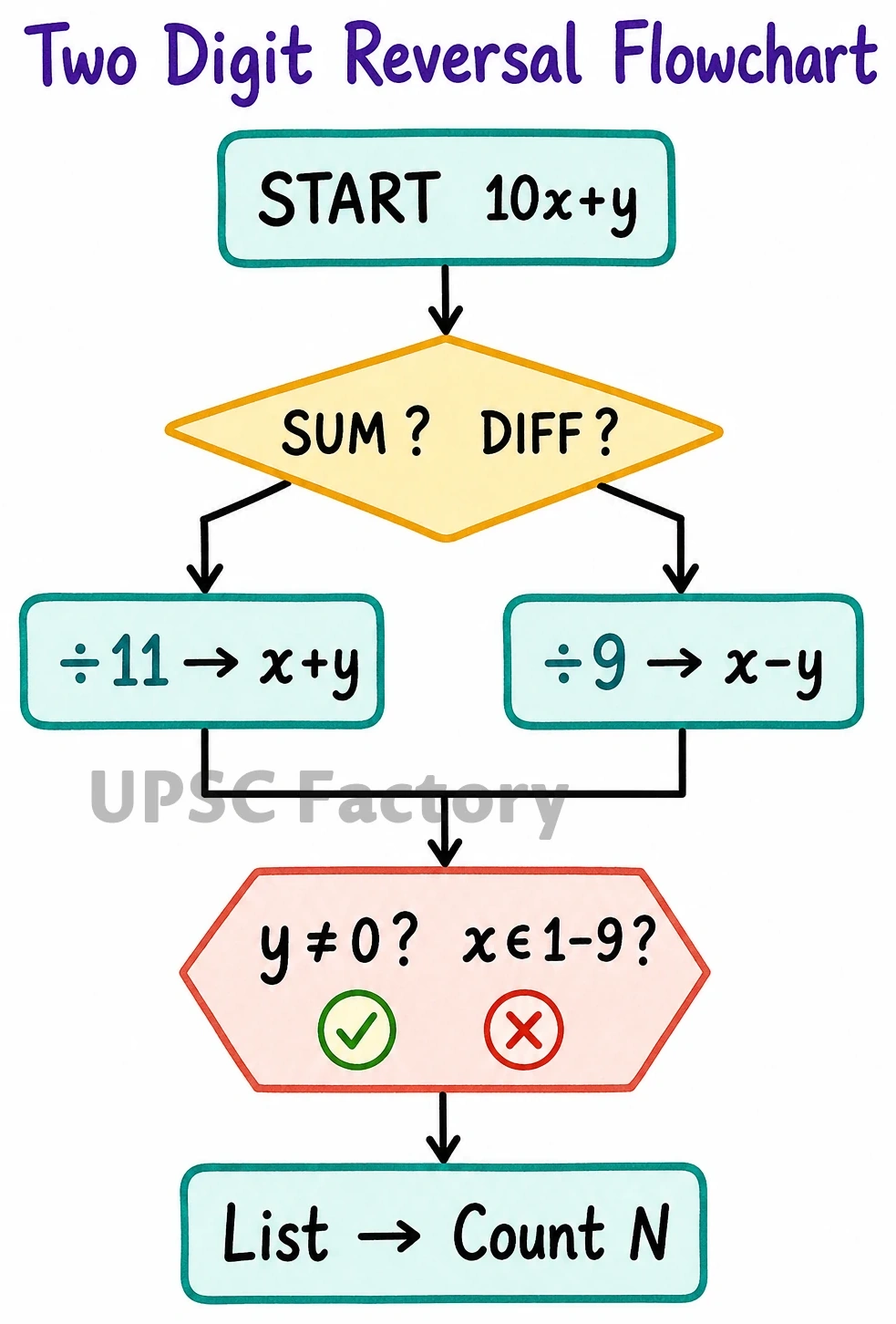
1. Why is N − Nrev for 2-digit numbers always a multiple of 9?

Let N = 10x + y and Nrev = 10y + x. Then:

N − Nrev = (10x + y) − (10y + x)
= 9x − 9y
= 9(x − y)

The positional coefficients cross-cancel to yield a factor of 9. Consequently:

  1. The difference is always divisible by 9.
  2. (N − Nrev)/9 = x − y gives the exact difference between the tens and units digits, reducing a two-variable expression to a simple single-digit relation.

2. Why is N + Nrev for 2-digit numbers always a multiple of 11?

N + Nrev = (10x + y) + (10y + x)
= 11x + 11y
= 11(x + y)

Therefore, (N + Nrev)/11 = x + y equals the sum of the digits.

3. Why does the middle digit vanish in the 3-digit difference?

Let N = 100a + 10b + c and Nrev = 100c + 10b + a. Then:

N − Nrev = (100a + 10b + c) − (100c + 10b + a)
= 99a − 99c
= 99(a − c)

The middle term 10b − 10b = 0. The tens digit b acts as a phantom variable: it has zero influence on the magnitude of the difference, but it multiplies the count of possible valid numbers by 10 (since b ∈ {0, 1, …, 9}).

4. The Modulo 9 Invariant (Digital Root)

For any integer N, N ≡ S(N) (mod 9), where S(N) represents the sum of the digits of N. Hence, N − S(N) is always divisible by 9. Because any permutation of digits preserves the digit sum S(N) = S(Nrev), the difference N − Nrev is always congruent to 0 (mod 9).


Key Theorems & Properties

  • Theorem 1 (2-Digit Difference): N − Nrev = 9(x − y). Always divisible by 3 and 9. Range: |N − Nrev| ≤ 81, and |N − Nrev| ≤ 72 if Nrev is also constrained to be a 2-digit number (y ≠ 0).
  • Theorem 2 (2-Digit Sum): N + Nrev = 11(x + y). Always divisible by 11. Range: 11 ≤ N + Nrev ≤ 198 in general, and 22 ≤ N + Nrev ≤ 198 if Nrev is a 2-digit number (y ≠ 0). Correspondingly, x + y ∈ [1, 18] in general, and x + y ∈ [2, 18] when y ≠ 0.
  • Theorem 3 (3-Digit Difference): N − Nrev = 99(a − c). Always divisible by 9, 11, 33, 99. Completely independent of the tens digit b. Range: |a − c| ∈ [1, 9].
  • Theorem 4 (3-Digit Sum): N + Nrev = 101(a + c) + 20b. Not a fixed multiple of 11 or 99.
  • Theorem 5 (Zero Collapse): If y = 0 in a 2-digit number N, Nrev collapses to a 1-digit number. If c = 0 in a 3-digit number N, Nrev collapses to a 2-digit number. Problem statements must explicitly mandate that Nrev is also a 2-digit or 3-digit number to eliminate y = 0 or c = 0.

2. Comparative Matrix & Conceptual Distinctions

Table 2.1: Face Value vs. Place Value vs. Number Value

ConceptDefinitionFor Digit 0 in N = 5082Nature
Face ValueIntrinsic identity of the digit0Position-independent, ∈ [0, 9]
Place ValueFace Value × 10position0 × 102 = 0Positional, scales in powers of 10
Number ValuePolynomial sum ∑ di10i5000 + 0 + 80 + 2 = 5082Collective magnitude of the integer

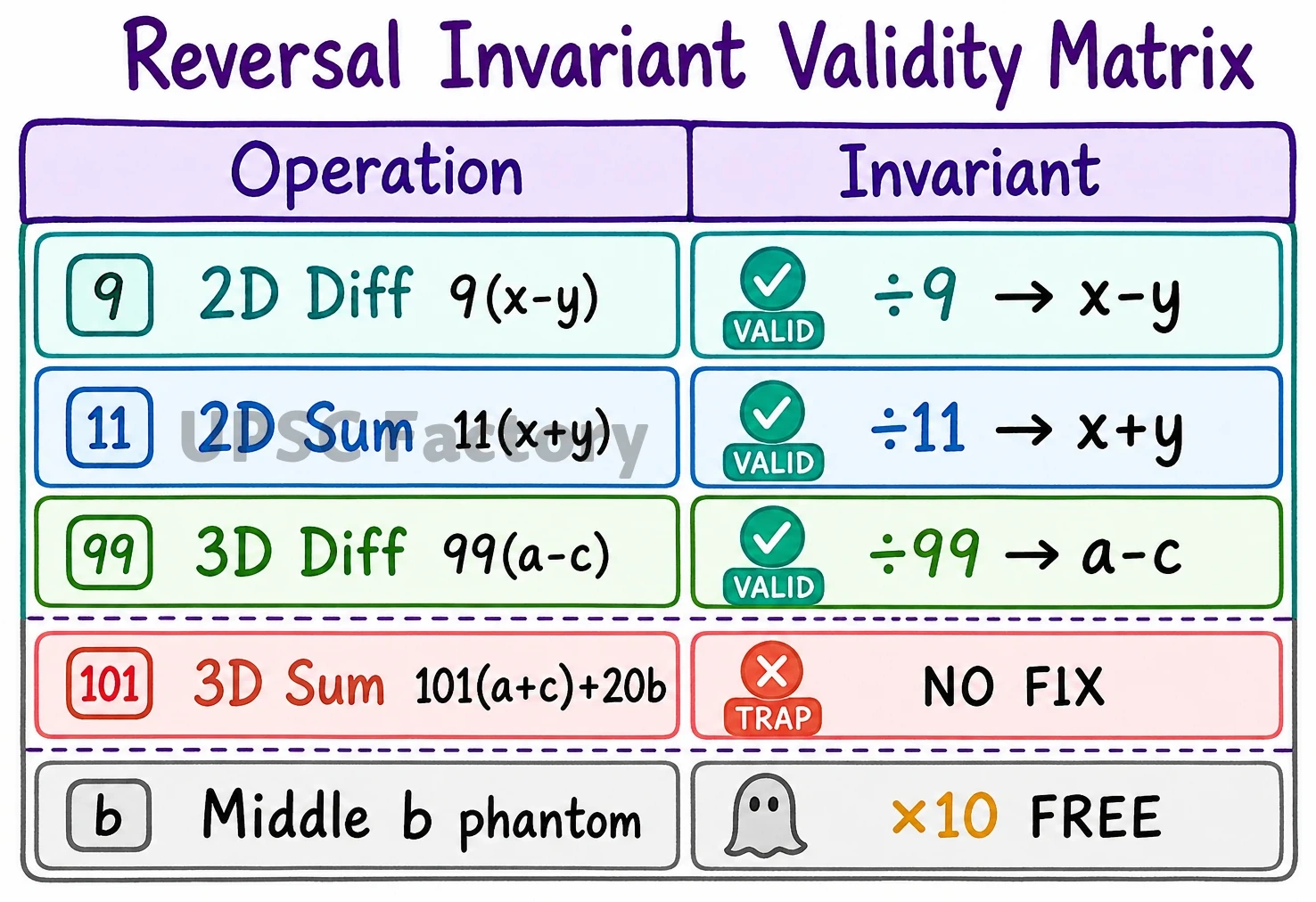
Table 2.2: Reversal Invariants — Operational Summary

OperationAlgebraic FormDivisor InvariantResult After DivisionCommon Pitfall
2-Digit Difference (N − Nrev)9(x − y)9Digit difference (x − y)Assuming x > y without checking for sign
2-Digit Sum (N + Nrev)11(x + y)11Digit sum (x + y)Assuming it is divisible by 9
3-Digit Difference (N − Nrev)99(a − c)99Outer digit difference (a − c)Forgetting that middle digit b has 10 states
3-Digit Sum (N + Nrev)101(a + c) + 20bNoneNon-factorable formAttempting to divide by 99 or 11

Table 2.3: Algebraic Representation Pitfalls

Invalid SetupCorrect SetupConsequence of Error
Let number be xyLet number be 10x + yxy − yx = 0 (falsely implies difference is always zero)
Let number be abcLet number be 100a + 10b + cabc − cba = 0
Reversed number is yxReversed number is 10y + xEquation fails to represent positional place value


3. High-Yield Data Anchors & Memorization Benchmarks

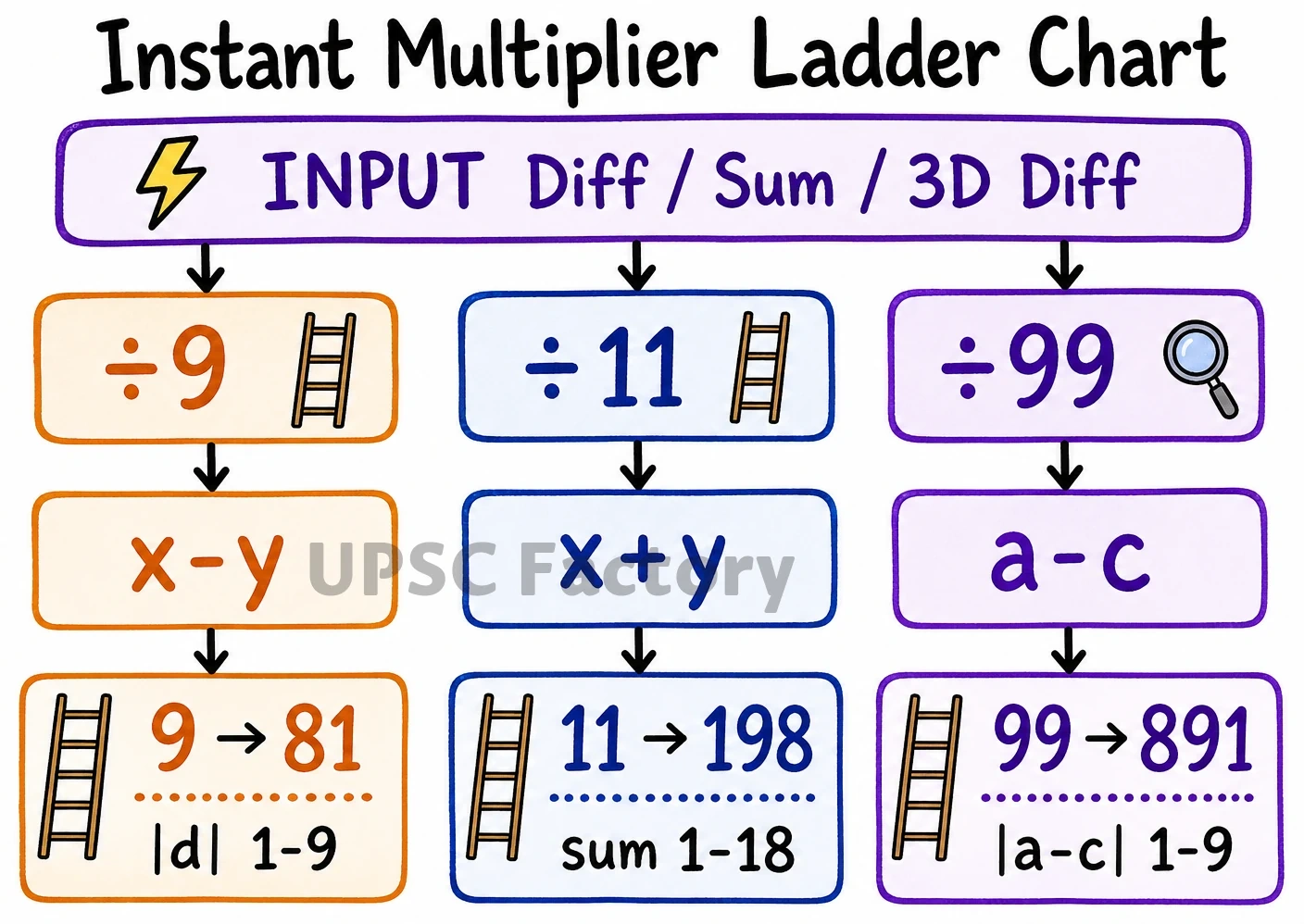
3.1 Instant Multiplier Matrix

For 2-Digit Difference: |N − Nrev| = 9|x − y|

Given DifferenceInstant |x − y|Given DifferenceInstant |x − y|
91546
182637
273728
364819 (Maximum)
455——

For 2-Digit Sum: N + Nrev = 11(x + y)

Sum = 33 ⇒ x + y = 3
Sum = 77 ⇒ x + y = 7
Sum = 121 ⇒ x + y = 11
Sum = 143 ⇒ x + y = 13
Sum = 165 ⇒ x + y = 15
Sum = 187 ⇒ x + y = 17

For 3-Digit Difference: |N − Nrev| = 99|a − c|

Multiples of 99: {99, 198, 297, 396, 495, 594, 693, 792, 891} correspond directly to |a − c| ∈ {1, 2, 3, 4, 5, 6, 7, 8, 9}.

Elimination Trigger: If a 3-digit difference |N − Nrev| is stated as a non-multiple of 99 (e.g., 250), no such integer exists. Reject the case immediately.


3.2 Boundary Conditions for Digit Counting

  • Fixed Sum x + y = S (x ∈ [1, 9], y ∈ [0, 9]): Example: S = 13 ⇒ (x, y) ∈ {(4, 9), (5, 8), (6, 7), (7, 6), (8, 5), (9, 4)} ⇒ 6 numbers. Pairs such as (3, 10) are invalid because y ≤ 9.
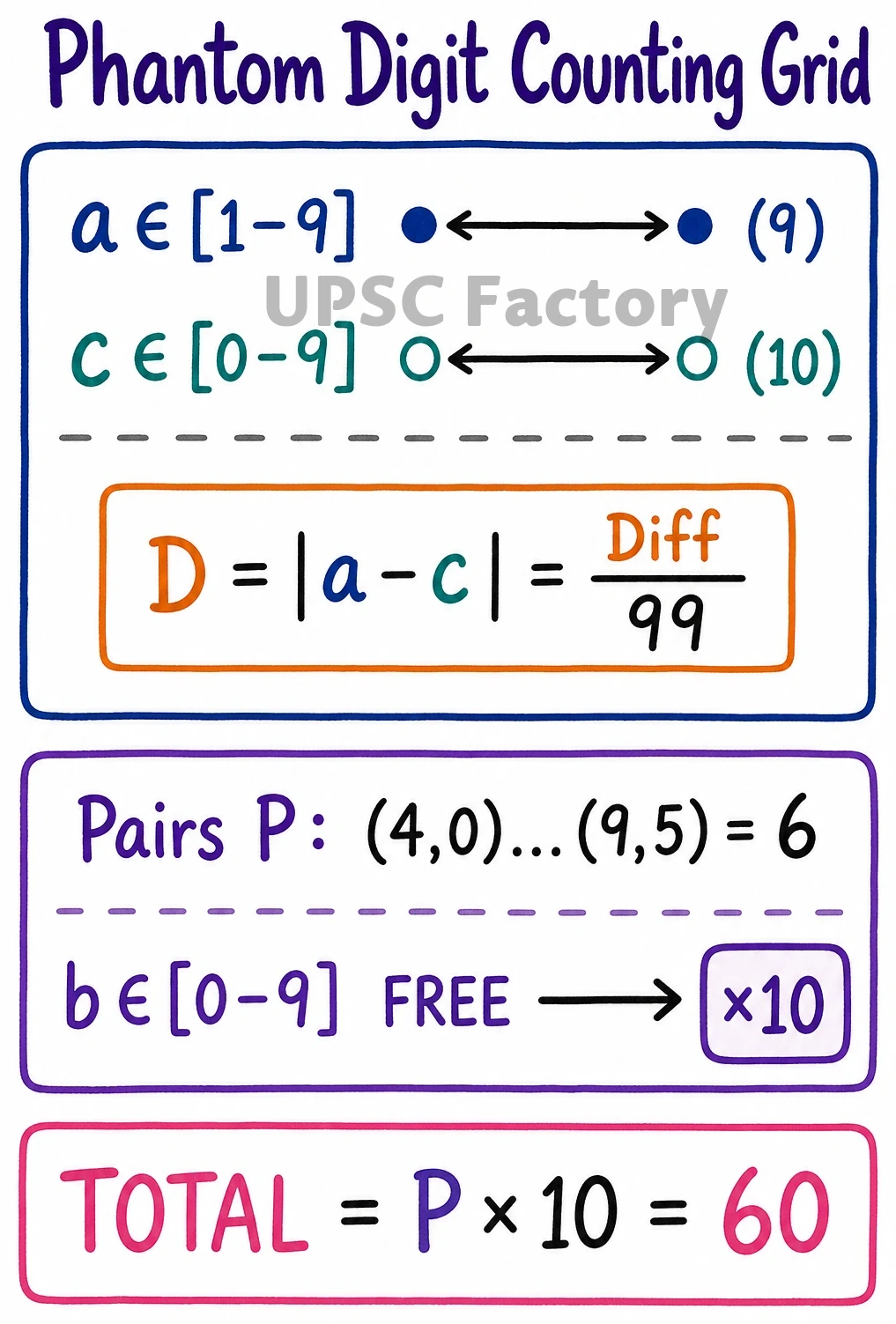
  • Fixed Difference a − c = D (a ∈ [1, 9], c ∈ [0, 9]): Example: D = 4 ⇒ (a, c) ∈ {(4, 0), (5, 1), (6, 2), (7, 3), (8, 4), (9, 5)} ⇒ 6 pairs.
  • The Phantom Multiplier: In 3-digit difference problems, each valid outer pair (a, c) yields 10 distinct integers corresponding to b ∈ {0, 1, 2, …, 9}, unless b is explicitly constrained.

4. Standard Algorithmic Protocols (Decision Logic)

Protocol A: Universal 2-Digit Reversal Solver

Given a 2-digit number N = 10x + y with x ∈ {1, …, 9} and y ∈ {0, …, 9}, and its reversal Nrev = 10y + x:

  1. Identify the Given Operation:
    • Branch 1 (Sum Given): Set N + Nrev = 11(x + y).
      • Calculate x + y = Sum/11.
      • Validity Check: If the given sum is not divisible by 11, no integer solution exists.
    • Branch 2 (Difference Given): Set |N − Nrev| = 9|x − y|.
      • Calculate |x − y| = Difference/9.
      • Validity Check: If the given difference is not divisible by 9, no integer solution exists.
      • Parity Property: Because 9 is odd, Parity(N − Nrev) = Parity(x − y).
  2. Integrate Secondary Constraints & Solve:
    • Combine with auxiliary conditions (e.g., product xy, parity constraints, prime restrictions).
    • When both sum S = x + y and difference D = x − y are known:

      x = (S + D)/2,   y = (S − D)/2

      (Note: S + D must be an even integer for x, y ∈ ℤ).

  3. Apply Boundary & Length Filters:
    • Reversed Length Constraint: Does the problem state “the reversed number is also a 2-digit number”?
      • Yes: Enforce y ≠ 0 (drop any pair with y = 0).
      • No: y = 0 is permitted (Nrev becomes a single-digit integer).
    • Distinct Digits Constraint: Unless stated “digits are distinct”, include the case x = y (where difference = 0).
  4. Output Count or Specific Values:
    • Enumerate all valid integer pairs (x, y) within the valid domain.
    • Construct N = 10x + y or report the total count.


Protocol B: 3-Digit Reversal Counter (The Phantom Digit Protocol)

Given a 3-digit number N = 100a + 10b + c (a ∈ {1, …, 9}, b, c ∈ {0, …, 9}) and its reversal Nrev = 100c + 10b + a:

  1. Classify Operation Type:
    • Difference: Apply the invariant N − Nrev = 99(a − c).
    • Sum: No single-variable invariant exists (N + Nrev = 101(a + c) + 20b). Expand directly without dividing by 99 or 11.
  2. Compute Outer Digit Gap:
    • Set up |N − Nrev| = 99|a − c|.
    • Determine D = |a − c| = |N − Nrev|/99.
    • If the difference is not a multiple of 99, total possible numbers = 0.
  3. Enumerate Valid Outer Pairs (a, c):
    • List all pairs (a, c) satisfying a − c = D or |a − c| = D subject to a ∈ {1, …, 9} and c ∈ {0, …, 9}.
    • Length Filter: If Nrev must also be a 3-digit number, enforce c ≠ 0 (exclude (D, 0)).
    • Let P be the number of valid (a, c) pairs.
  4. Apply the Middle Digit (b) Multiplier:
    • Because 10b − 10b = 0, the tens digit b is unrestricted by the difference equation:
      • Unconstrained b: b ∈ {0, 1, …, 9} ⇒ 10 choices per pair:

        Total Valid Numbers N = P × 10

      • Constrained b: Multiply P by the count of admissible values for b (e.g., b is prime, even, or distinct from a and c).


5. Standard Question Typologies & Analytical Solutions

Type A: Parity & Multi-Variable Constraints

Core Principle: Parity of N − Nrev = 9(x − y) matches the parity of (x − y) because 9 is odd.

Problem:
Consider a two-digit number N = 10x + y where x and y are prime digits (x, y ∈ {2, 3, 5, 7}). The number formed by reversing N is smaller than N by 36. Which of the following statements is/are necessarily true?
1. x and y are both odd.
2. x + y is divisible by 4.

Select the correct option:
A) 1 only
B) 2 only
C) Both 1 and 2
D) Neither 1 nor 2

Analytical Solution:

Step 1: Translate Constraints
N − Nrev = 36 ⇒ 9(x − y) = 36 ⇒ x − y = 4
Domain: x, y ∈ {2, 3, 5, 7} with x > y.

Step 2: Enumerate Admissible Digit Pairs

  • If y = 2 ⇒ x = 2 + 4 = 6 (not prime; reject).
  • If y = 3 ⇒ x = 3 + 4 = 7 (prime; accept ⇒ (x, y) = (7, 3)).
  • If y = 5 ⇒ x = 5 + 4 = 9 (not prime; reject).
  • If y = 7 ⇒ x = 7 + 4 = 11 (not a single digit; reject).

The unique solution is (x, y) = (7, 3), corresponding to N = 73.

Step 3: Evaluate Statements

  1. x = 7 (odd) and y = 3 (odd) ⇒ Statement 1 is true.
  2. x + y = 7 + 3 = 10, which is not divisible by 4 ⇒ Statement 2 is false.

Correct Answer: A) 1 only


Type B: Statement-Based / Data Sufficiency Archetype

Core Principle: The sum invariant 11(x + y) provides only the sum of digits. Symmetry in (x + y) and xy leads to non-unique ordered numbers unless an asymmetric condition is added.

Problem:
Consider a two-digit number N = 10x + y.
Statement I: The sum of N and its reversal is 110.
Statement II: The product of its digits is 24.

Is the data sufficient to determine N uniquely?
A) Statement I alone is sufficient
B) Statement II alone is sufficient
C) Both statements together are sufficient
D) Neither Statement I nor Statement II is sufficient

Analytical Solution:

Step 1: Analyze Statement I alone
N + Nrev = 110 ⇒ 11(x + y) = 110 ⇒ x + y = 10
Possible pairs (x, y):
(1, 9), (2, 8), (3, 7), (4, 6), (5, 5), (6, 4), (7, 3), (8, 2), (9, 1)
There are 9 candidates. Statement I alone is insufficient.

Step 2: Analyze Statement II alone
xy = 24   where x ∈ {1, …, 9}, y ∈ {0, …, 9}
Possible pairs (x, y): (3, 8), (4, 6), (6, 4), (8, 3).
There are 4 candidates. Statement II alone is insufficient.

Step 3: Combine Statements I and II
x + y = 10
xy = 24
Setting up the quadratic: t2 − 10t + 24 = 0 ⇒ (t − 4)(t − 6) = 0.
Thus, the unordered set of digits is {4, 6}. This yields two distinct valid numbers:
N = 46   or   N = 64
Since N cannot be determined uniquely, both statements together are insufficient.

Correct Answer: D) Neither Statement I nor Statement II is sufficient


Type C: Existence & Counting Archetype

Core Principle: In 3-digit differences, N − Nrev = 99(a − c). The middle digit b contributes a multiplicative factor of 10.

Problem:
Let N be a three-digit number such that the difference between N and the number obtained by reversing its digits is 396. How many such numbers N exist?
A) 50
B) 60
C) 70
D) 80

Analytical Solution:

Step 1: Set Up the Invariant Equation
Let N = 100a + 10b + c. Assuming N > Nrev:
N − Nrev = 99(a − c) = 396 ⇒ a − c = 4

Step 2: Enumerate Admissible Outer Pairs (a, c)
Subject to a ∈ {1, …, 9} and c ∈ {0, …, 9}:

  • c = 0 ⇒ a = 4
  • c = 1 ⇒ a = 5
  • c = 2 ⇒ a = 6
  • c = 3 ⇒ a = 7
  • c = 4 ⇒ a = 8
  • c = 5 ⇒ a = 9

Total valid (a, c) pairs P = 6.

Step 3: Account for the Phantom Tens Digit b
The difference 99(a − c) is independent of b. Since no extra restrictions are placed on b, b ∈ {0, 1, 2, …, 9} provides 10 valid choices for each (a, c) pair:
Total Possible Values of N = 6 × 10 = 60

(Note: If the problem had added the constraint “and Nrev is also a three-digit number”, then c ≠ 0, excluding (4, 0), leading to 5 × 10 = 50 numbers).

Correct Answer: B) 60


Type D: Algebraic Expressions & Modulo 9 Invariants

Core Principle: N ≡ S(N) (mod 9). Any linear permutation difference is divisible by 9.

Problem:
For a three-digit number N = 100a + 10b + c, let S = a + b + c. Which of the following expressions is/are always divisible by 9?
1. N − S
2. N − Nrev
3. N + Nrev

Select the correct option:
A) 1 and 2 only
B) 2 and 3 only
C) 1 only
D) 1, 2, and 3

Analytical Solution:

Expression 1:
N − S = (100a + 10b + c) − (a + b + c) = 99a + 9b = 9(11a + b)
Since 11a + b is an integer, N − S is always divisible by 9. (True)

Expression 2:
N − Nrev = (100a + 10b + c) − (100c + 10b + a) = 99(a − c) = 9 · 11(a − c)
N − Nrev is always divisible by 99, and therefore always divisible by 9. (True)

Expression 3:
N + Nrev = 101(a + c) + 20b
Counterexample: Let N = 123 ⇒ Nrev = 321.
N + Nrev = 123 + 321 = 444.
444/9 = 49.333… ∉ ℤ. Thus, Expression 3 is not generally divisible by 9. (False)

Correct Answer: A) 1 and 2 only


Type E: Boundary & Zero-Constraint Analysis

Core Principle: Reversal with a trailing zero reduces the total digit length of Nrev.

Problem:
How many two-digit numbers N exist such that N − Nrev = 27 and Nrev is also a two-digit number?
A) 5
B) 6
C) 7
D) 8

Analytical Solution:

Step 1: Set Up the Base Equation
N − Nrev = 9(x − y) = 27 ⇒ x − y = 3

Step 2: Enumerate Integer Pairs (x, y)
With x ∈ {1, …, 9} and y ∈ {0, …, 9}:
(x, y) ∈ {(3, 0), (4, 1), (5, 2), (6, 3), (7, 4), (8, 5), (9, 6)} ⇒ 7 pairs

Step 3: Apply the Length Constraint
The problem mandates that Nrev = 10y + x must be a two-digit number ⇒ y ≠ 0.
Eliminating the pair (3, 0) (where N = 30 and Nrev = 03 = 3):
Remaining Valid Pairs = 7 − 1 = 6

Correct Answer: B) 6


Type F: Deterministic Value Extraction

Core Principle: Combining sum invariant 11(x + y) and difference invariant 9(x − y) creates an orthogonal linear system solvable via elementary algebra.

Problem:
The sum of a two-digit number and its reversal is 121, and the difference between its tens digit and units digit is 3. What is the value of the original number?
A) 74
B) 85
C) 96
D) Cannot be determined

Analytical Solution:

Step 1: Formulate the Linear System
N + Nrev = 121 ⇒ 11(x + y) = 121 ⇒ x + y = 11
x − y = 3

Step 2: Solve for x and y
Adding the two equations:
(x + y) + (x − y) = 11 + 3 ⇒ 2x = 14 ⇒ x = 7
Substituting x = 7 into the sum equation:
7 + y = 11 ⇒ y = 4

Step 3: Verify Domain and Boundaries
x = 7 ∈ [1, 9] and y = 4 ∈ [0, 9].
Original number N = 10(7) + 4 = 74.
Check: 74 + 47 = 121 and 7 − 4 = 3. Both conditions are satisfied.

Correct Answer: A) 74


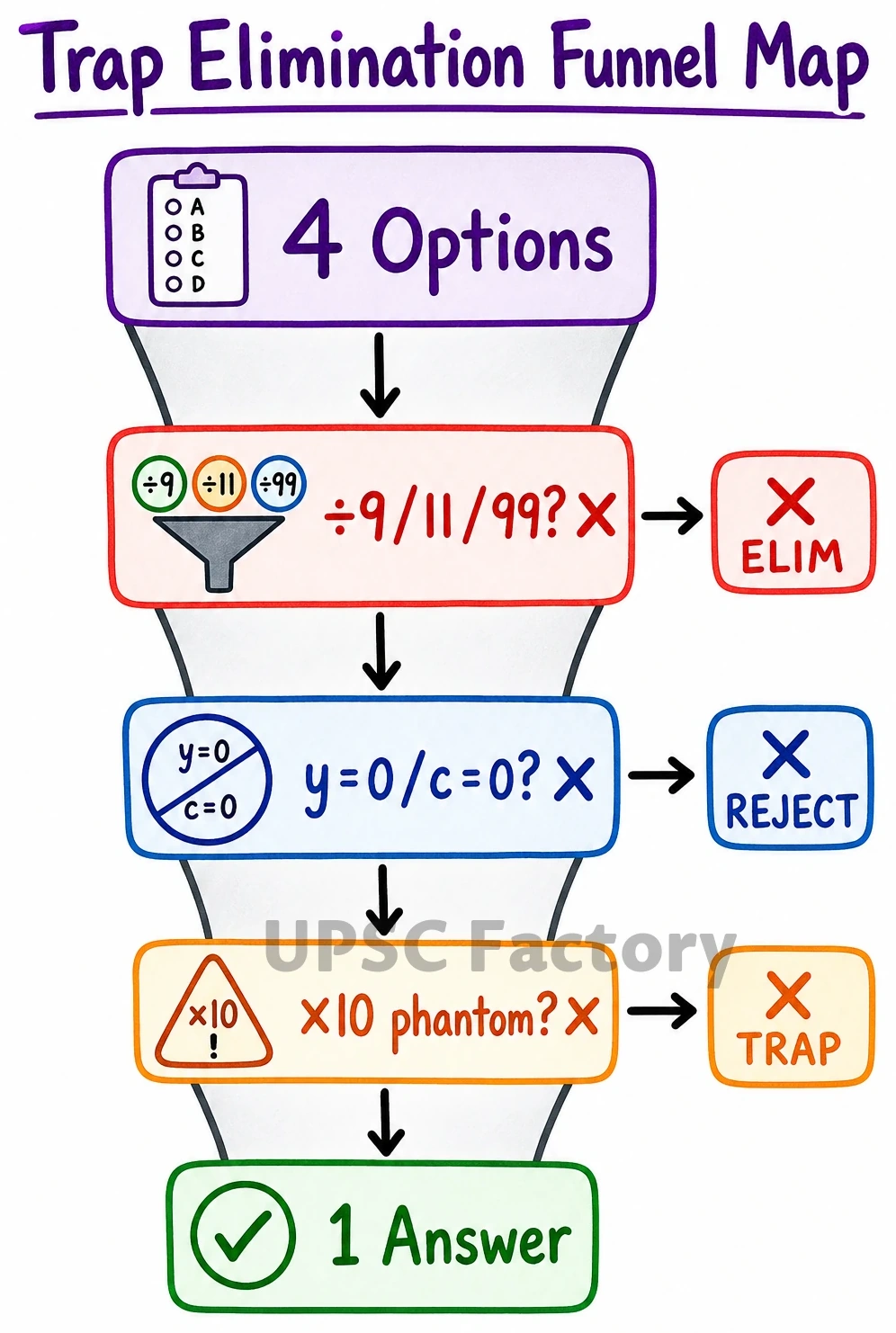
6. The Examiner Trap Matrix

Common PitfallUnderlying Mathematical RealityCounterexample / Edge Case
1. Representing digits as products (xy)xy = x × y, whereas positional value is 10x + y.If x = 4, y = 7, xy = 28, but 10x + y = 47. Writing xy − yx = 0 incorrectly asserts the difference is always zero.
2. Assuming reversal preserves digit lengthReversal of 40 is 04 = 4 (a 1-digit number).For N = 40, Nrev = 4. N − Nrev = 36, but y = 0 violates conditions requiring Nrev to remain 2-digit.
3. Assuming digits must be distinctUnless specified, x = y is valid.For N = 77, Nrev = 77 ⇒ N + Nrev = 154 = 11 × 14. The pair (7, 7) is fully valid.
4. Factoring middle digit into 3-digit differenceIn N − Nrev = 99(a − c), the tens digit b cancels completely.825 − 528 = 297 and 805 − 508 = 297. The choice of b does not alter the difference magnitude.
5. Assuming 2-digit reversal sum divides by 9Sum is 11(x + y), which is divisible by 11, not necessarily by 9.12 + 21 = 33, which is divisible by 11 but not by 9.
6. Overcounting digit pairsFor x + y = S, values of x, y are strictly bounded by 9.For x + y = 13, (3, 10) is invalid because y ≤ 9. Only 6 pairs exist: (4, 9) through (9, 4).
7. Omitting phantom digit multiplierOuter pairs (a, c) must be scaled by 10 for unconstrained b.a − c = 4 gives 6 outer pairs, but 6 × 10 = 60 total three-digit numbers.
8. Assuming 3-digit reversal sum divides by 99N + Nrev = 101(a + c) + 20b has no fixed integer divisor.102 + 201 = 303, which is not divisible by 99 or 11.


7. Golden Rules & Instant Exam Triggers

#TriggerMathematical Rule
1“Two-Digit Number” SetupInstantly write N = 10x + y with x ∈ {1, …, 9}, y ∈ {0, …, 9} and Nrev = 10y + x. Never use product notation xy.
2Difference of 2-Digit Number & ReversalCompute |N − Nrev|/9 = |x − y|.
Parity Check: An even difference implies x and y share the same parity.
3Sum of 2-Digit Number & ReversalCompute (N + Nrev)/11 = x + y. The sum must be a multiple of 11.
4Difference of 3-Digit Number & ReversalCompute |N − Nrev|/99 = |a − c|. Remember that the tens digit b is unconstrained; multiply outer pair counts by 10 unless b is restricted.
5“Reversed Number is also an n-Digit Number”Impose y ≠ 0 (for 2-digit numbers) or c ≠ 0 (for 3-digit numbers) and exclude boundary pairs containing zero.
6Permutation Subtraction (N − Digit Permutation)The expression is always congruent to 0 (mod 9). Use this to eliminate incorrect multiple-choice options immediately.
7Determining Valid Ordered PairsCheck both lower and upper bounds: x ≥ 1, y ≥ 0, and x, y ≤ 9.
8Simultaneous Sum and Difference (S = x + y, D = x − y)Ensure S + D is even. If S + D is odd, no integer digits exist, allowing immediate elimination of the case.

Pedagogical Note: Digit mechanics problems test algebraic invariant recognition rather than arithmetic computation. Master the primary divisors (9, 11, 99) and the phantom variable b to solve standard digit reversal problems systematically and efficiently.

Base 10 & Digit Mechanics: The algebraic mechanics of two-digit and three-digit numbers, quickly solve reversal questions, and bypass common digit-manipulation traps. Read More »

Prime and Special Number Categories for UPSC CSAT

Prime and Special Number Categories for UPSC CSAT

1. Theoretical Foundation & Mathematical Underpinnings

1.1 Formal Definition & Scope

  • Prime Number (p): An integer p > 1 that has exactly two distinct positive divisors: {1, p}.
    • Set Notation: P = { p ∈ ℤ+ | d(p) = 2 }, where d(p) denotes the number of positive divisors.
    • Boundary Condition: 1 is neither prime nor composite because d(1) = 1. Negative integers and 0 are excluded from primality definitions in standard arithmetic.
    • Fundamental Theorem of Arithmetic: Every integer N > 1 can be uniquely factored into a product of prime powers:

      N = p1a1 · p2a2 … pkak

      where each pi is a distinct prime and each ai ≥ 1. Primes serve as the foundational building blocks of the integers.

  • Perfect Number (N): An integer equal to the sum of its proper positive divisors:

    N = ∑ dproper(N) = σ(N) – N

    where σ(N) is the sum of all positive divisors.

    • Examples: 6 = 1 + 2 + 3, 28 = 1 + 2 + 4 + 7 + 14, followed by 496 and 8128.
    • Euclid-Euler Theorem: Every even perfect number takes the form:

      N = 2p-1(2p – 1)

      where both p and (2p – 1) are prime numbers (the term 2p – 1 being a Mersenne prime).

  • Co-Prime / Relatively Prime Pair (a, b): Two integers a and b satisfying gcd(a, b) = 1 or HCF(a, b) = 1. Their prime factorizations share no common prime bases.
    • Scope: Co-primality is a relational property between numbers, not an intrinsic property of an individual number.
  • Twin Primes: A pair of primes of the form (p, p + 2).
    • Examples: (3, 5), (5, 7), (11, 13), (17, 19), (29, 31), (41, 43).

1.2 The “Why” Behind the Math — Short Proofs

Why is 2 the only even prime?
If an integer p > 2 is even, it can be written as p = 2k where k > 1. The divisor set of p must include at least {1, 2, 2k}, which means d(p) ≥ 3. Thus, p is composite. Consequently, every prime p > 2 must be odd.

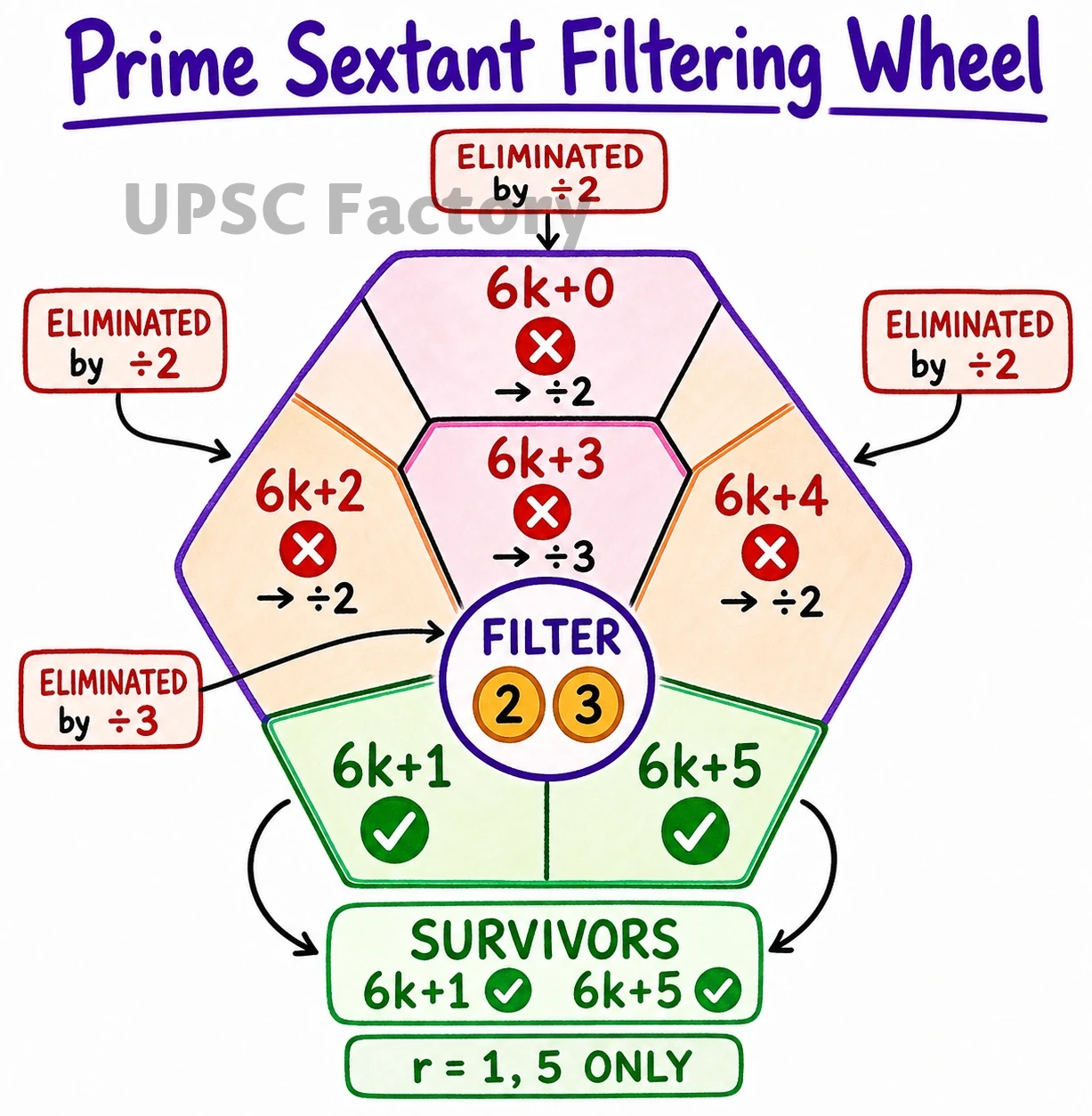
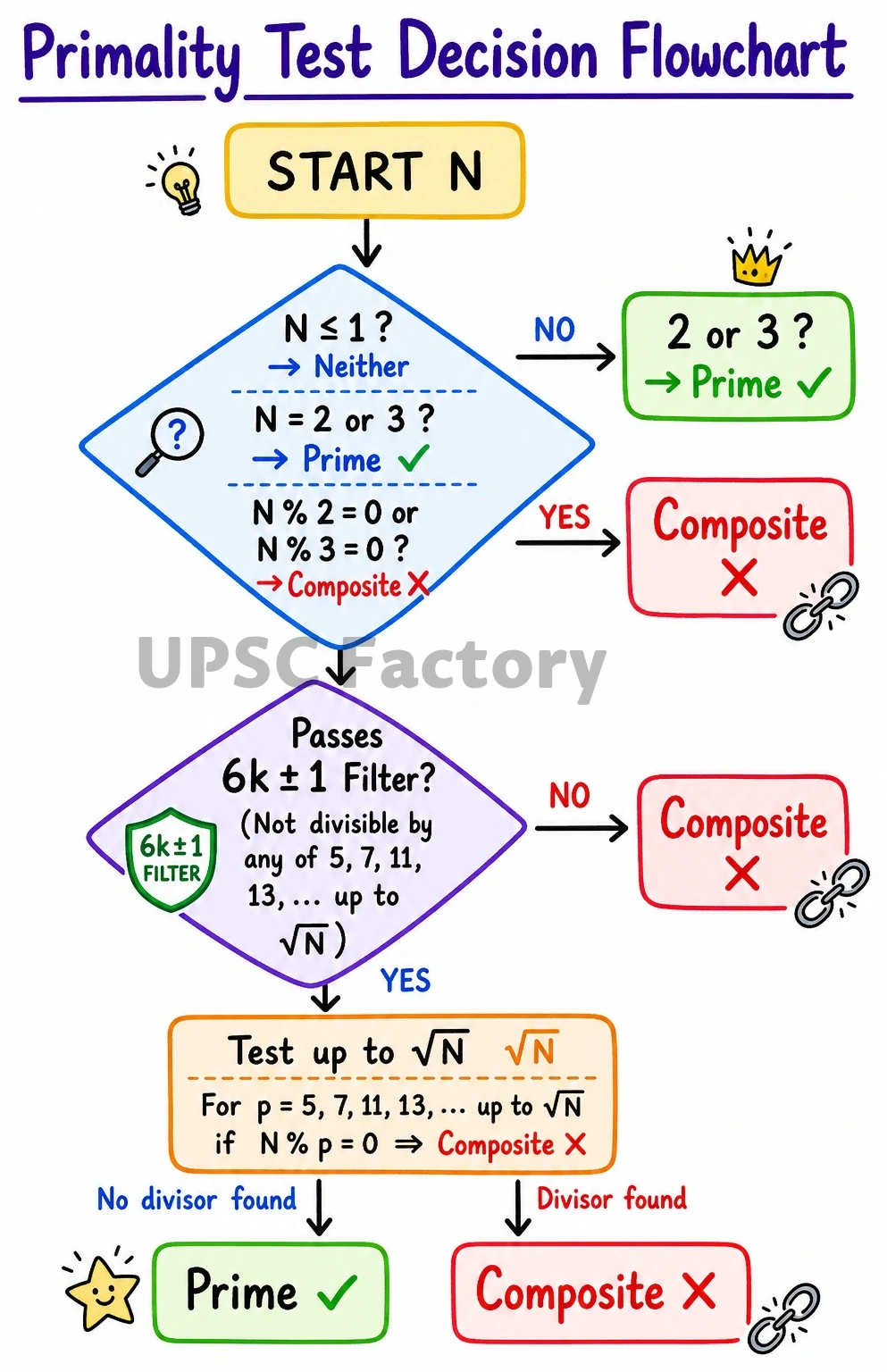
Why does every prime p > 3 satisfy p = 6k ± 1?
By the Division Algorithm, any integer N can be expressed in one of six forms modulo 6:

N ∈ {6k, 6k + 1, 6k + 2, 6k + 3, 6k + 4, 6k + 5}

Evaluating each residue class for primality:

  • 6k, 6k + 2 = 2(3k + 1), 6k + 4 = 2(3k + 2) are all divisible by 2 and thus composite for k ≥ 1.
  • 6k + 3 = 3(2k + 1) is divisible by 3 and thus composite for k ≥ 1.
  • The only remaining candidates are 6k + 1 and 6k + 5 ≡ 6k – 1.

Critical Distinction (Necessary vs. Sufficient): The condition p = 6k ± 1 is necessary for primes > 3, but not sufficient. It acts as an elimination filter. For instance, 25 = 6(4) + 1 = 52 and 35 = 6(6) – 1 = 5 × 7 satisfy the form, yet both are composite.

Why do we test divisors only up to √N for primality?
Let N = a × b with 1 < a ≤ b < N. If a > √N, then:

a × b > √N × √N = N

This creates a contradiction. Therefore, in any non-trivial factor pair (a, b), the smaller factor must satisfy a ≤ √N.

  • Contrapositive: If an integer N has no prime factor p ≤ √N, it cannot have any factor q > √N. Hence, checking prime divisors up to ⌊√N⌋ is mathematically sufficient to prove primality.

Why is the integer between twin primes (p > 3) always divisible by 6?
Let the twin prime pair be (p, p + 2) with p > 3. The intermediate integer is m = p + 1.

  1. Divisibility by 3: Among any three consecutive integers {p, p + 1, p + 2}, exactly one is divisible by 3. Since p and p + 2 are primes strictly greater than 3, neither is divisible by 3. Therefore, m = p + 1 must be divisible by 3.
  2. Divisibility by 2: Since p is an odd prime, m = p + 1 is an even integer and divisible by 2.

Because gcd(2, 3) = 1, it follows that m is divisible by 2 × 3 = 6.

Why are consecutive integers always co-prime?
Let d = gcd(n, n + 1). By the properties of divisibility:

d | (n + 1) and d | n ⇒ d | ((n + 1) – n) ⇒ d | 1

Since d is a positive integer, d = 1. Thus, gcd(n, n + 1) = 1 for all n ∈ ℤ+.


1.3 Key Theorems & Invariant Properties

  • Parity Theorem for Primes:
    • Prime + Prime = Odd ⇒ One of the primes must be 2.
    • If the sum of an odd number of primes is even, then at least one prime in the set must be 2.
    • Example: If p + q + r = 50 (sum of 3 primes is even), the sum Odd + Odd + Odd = Odd fails; hence, one prime must be even (⇒ p = 2).
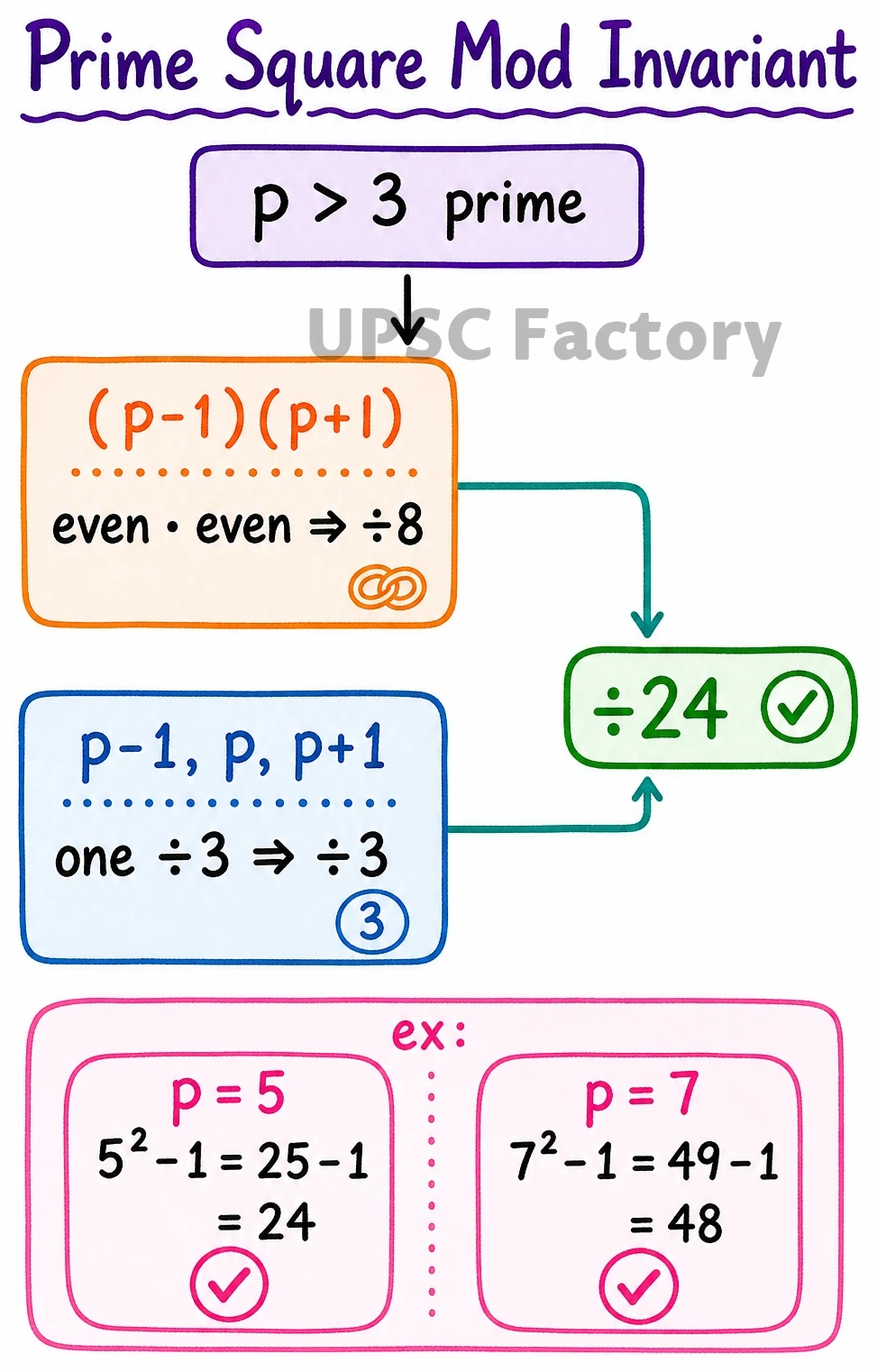
  • Prime Square Invariant:
    For any prime p > 3:

    p2 ≡ 1 (mod 24) ⇔ 24 | (p2 – 1)

    Proof Outline: Factor p2 – 1 = (p – 1)(p + 1). Since p is an odd prime, (p – 1) and (p + 1) are consecutive even integers, making one a multiple of 4 and the other a multiple of 2 (⇒ 8 | (p2 – 1)). Additionally, one of the three consecutive integers {p – 1, p, p + 1} is divisible by 3; since p > 3 is prime, 3 | (p – 1)(p + 1). Since gcd(8, 3) = 1, 24 | (p2 – 1).

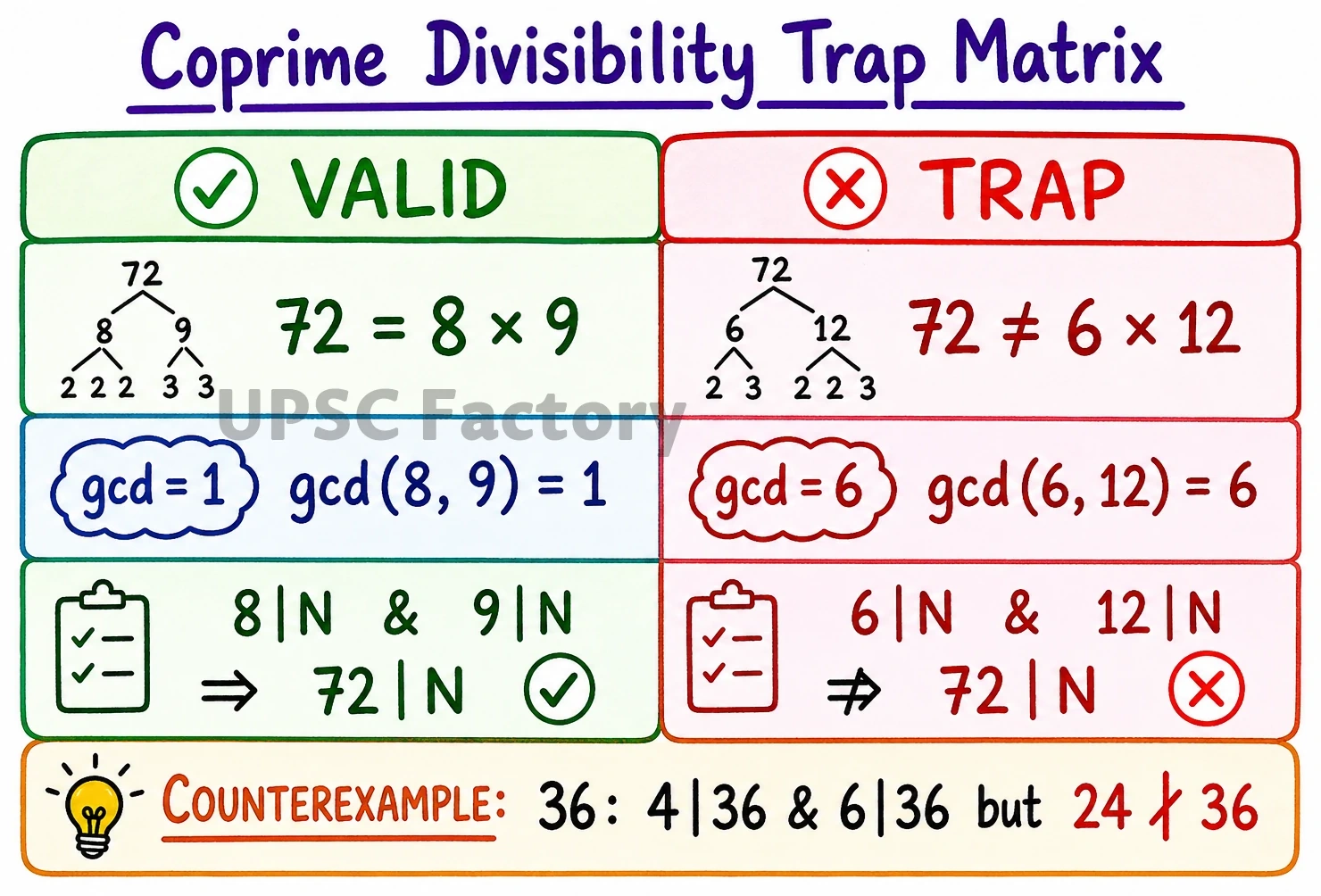
  • Co-prime Divisibility Theorem:
    If a | N, b | N, and gcd(a, b) = 1, then:

    (a × b) | N

    Caution: If gcd(a, b) ≠ 1, the conclusion does not hold.

    • Valid: 8 | N and 9 | N ⇒ 72 | N (since gcd(8, 9) = 1).
    • Invalid: 4 | 36 and 6 | 36, but 24 ∤ 36 (because gcd(4, 6) = 2 ≠ 1).


2. Comparative Matrix & Conceptual Distinctions

ConceptFormal DefinitionRelational ScopeRepresentative ExampleCommon Examiner Pitfall
Prime Numberp > 1 with exactly 2 distinct positive divisorsIntrinsic property of a single number2, 13, 79, 211Assuming 1 is prime (d(1) = 1), or treating 91 = 7 × 13 as prime
Co-Prime Pairgcd(a, b) = 1 (no common prime factors)Relational property between a pair(8, 15), where 8 = 23, 15 = 3 × 5Assuming co-prime numbers must themselves be prime (e.g., neither 8 nor 15 is prime)
Twin PrimesPair of primes (p, p + 2)Property of a specific prime pair(11, 13), (41, 43)Confusing with cousin primes (p, p + 4), or including pairs like (7, 9) where 9 is composite
Perfect NumberN = ∑ dproper(N)Intrinsic property of a single number6, 28, 496, 8128Confusing with abundant numbers (12: proper sum = 16 ≠ 12)
Factor vs. Multiplea is a factor of N if N = a · k; N is a multiple of aRelational inverse propertiesFactors of 12: {1, 2, 3, 4, 6, 12}; Multiples: {12, 24, 36, …}Inverting the relationship: 36 is a multiple of 6, not a factor of 6

3. High-Yield Data Anchors & Benchmarks

A. Prime Frequency Distribution

IntervalNumber of PrimesCumulative PrimesStrategic Insight
1 – 2599Highest density interval (36% prime)
26 – 50615Primes: 29, 31, 37, 41, 43, 47
51 – 1001025Exactly 25 primes in 1 – 100
101 – 2002146Primes in 1 – 200 = 46
1 – 1000168168Governed asymptotically by π(x) ≈ x/ln x

Key Benchmark: When counting primes in the range 1 ≤ N ≤ 100, the total is strictly 25. Avoid the common error of counting 1.

B. High-Frequency Deceptive Composites (Prime Look-Alikes)

These numbers satisfy 6k ± 1 and have no obvious divisibility by 2, 3, or 5, making them standard trap options.

Deceptive IntegerPrime FactorizationStructural Reason for Error
917 × 1391 = 6(15) + 1; frequently mistaken for prime
51, 57, 87, 933 × 17, 3 × 19, 3 × 29, 3 × 31Look prime at a glance; digit sums are divisible by 3
119, 133, 1617 × 17, 7 × 19, 7 × 23Non-obvious multiples of 7
121, 169, 289112, 132, 172Perfect squares of primes; have exactly 3 positive divisors
143, 221, 323, 39111 × 13, 13 × 17, 17 × 19, 17 × 23Products of two close primes; require systematic trial division
25, 35, 49, 55, 7752, 5 × 7, 72, 5 × 11, 7 × 11All satisfy the 6k ± 1 filter

C. Core Invariants & Algebraic Benchmarks

  • For any prime p > 3: p ≡ ±1 (mod 6) and p2 ≡ 1 (mod 24).
  • Consecutive Integer Product: n(n + 1) is always even, and gcd(n, n + 1) = 1.
  • Three Consecutive Integers: n3 – n = (n – 1)n(n + 1) is always divisible by 6.
  • Essential Benchmark Squares (⌊√N⌋ references):
    112 = 121, 132 = 169, 152 = 225, 172 = 289, 192 = 361, 232 = 529

4. Standard Algorithmic Protocols

PROTOCOL 1: Systematic Primality Testing for an Integer N

  1. Boundary & Base Cases:
    • If N ≤ 1 ⇒ Neither prime nor composite.
    • If N ∈ {2, 3} ⇒ Prime.
  2. Filter Multiples of 2 and 3:
    • If N > 3 and N mod 2 = 0 or N mod 3 = 0 ⇒ Composite.
    • Otherwise, N must satisfy N = 6k ± 1. Proceed to Step 3.
  3. Establish the Square-Root Upper Bound:
    • Determine k = ⌊√N⌋.
    • Compile the list of all prime numbers p ≤ k.
  4. Trial Division by Primes Only:
    • Test divisibility of N sequentially by each prime p ≤ k.
    • If N mod p = 0 for any p ⇒ Composite (terminate).
    • If no prime p ≤ k divides N ⇒ Certified Prime.

Working Example: Primality Test of N = 257

  1. 257 > 3, not divisible by 2 (odd) or 3 (digit sum = 14).
  2. Form check: 257 = 6(43) – 1 (passes filter).
  3. Upper bound: √257 ≈ 16.03 ⇒ k = 16.
  4. Primes to test: {5, 7, 11, 13}.
    • 257 mod 5 = 2 ≠ 0
    • 257 = 7 × 36 + 5 ⇒ Remainder 5 ≠ 0
    • 257 = 11 × 23 + 4 ⇒ Remainder 4 ≠ 0
    • 257 = 13 × 19 + 10 ⇒ Remainder 10 ≠ 0
  5. Conclusion: 257 is prime.


PROTOCOL 2: Divisibility by a Composite Modulus C

To establish whether C | N for a composite divisor C:

  1. Decompose C into Pairwise Co-prime Factors:
    Find integers a, b > 1 such that:

    C = a × b with gcd(a, b) = 1

    (Correct: 72 = 8 × 9 where gcd(8, 9) = 1. Incorrect: 72 = 6 × 12 where gcd(6, 12) = 6 ≠ 1.)

  2. Verify Sub-Divisibility:
    • Evaluate if a | N. If false ⇒ C ∤ N.
    • Evaluate if b | N. If false ⇒ C ∤ N.
  3. Synthesize Result:
    If both conditions hold, then C | N.

Working Example: Check if N = 43,200 is divisible by C = 72.

  1. Factorize 72 = 8 × 9 with gcd(8, 9) = 1.
  2. Check 8 | 43,200: Last three digits are 200; 200 / 8 = 25 (✓).
  3. Check 9 | 43,200: Digit sum is 4 + 3 + 2 + 0 + 0 = 9, which is divisible by 9 (✓).
  4. Conclusion: Since both conditions are satisfied, 72 | 43,200.

5. Standard Question Typologies & Analytical Solutions

TYPE A: Parity & Multi-Variable Constraints

Problem Statement:
Let x, y, z be prime numbers such that x < y < z and x + y + z = 100. What is the maximum possible value of z?

(a) 79
(b) 83
(c) 89
(d) 97

Detailed Analytical Solution:

Step 1: Parity Analysis
The target sum 100 is even. For three positive integers:

Odd + Odd + Odd = Odd
Even + Odd + Odd = Even

Since the sum of three primes is even, at least one prime must be even. The only even prime is 2. Given the strict ordering x < y < z, we must set:

x = 2

Step 2: Algebraic Reduction & Optimization
Substitute x = 2 into the equation:

2 + y + z = 100 ⇒ y + z = 98 ⇒ z = 98 – y

To maximize z, we must minimize the odd prime y such that y > 2 and z is prime:

  • Try y = 3 ⇒ z = 98 – 3 = 95 = 5 × 19 (Composite ×)
  • Try y = 5 ⇒ z = 98 – 5 = 93 = 3 × 31 (Composite ×)
  • Try y = 7 ⇒ z = 98 – 7 = 91 = 7 × 13 (Composite × — classic trap)
  • Try y = 11 ⇒ z = 98 – 11 = 87 = 3 × 29 (Composite ×)
  • Try y = 13 ⇒ z = 98 – 13 = 85 = 5 × 17 (Composite ×)
  • Try y = 17 ⇒ z = 98 – 17 = 81 = 34 (Composite ×)
  • Try y = 19 ⇒ z = 98 – 19 = 79 (Prime ✓)

Step 3: Verification
For x = 2, y = 19, and z = 79:

  • 2 < 19 < 79 (Ordering satisfied)
  • 2 + 19 + 79 = 100
  • 79 is prime (divisors tested up to √79 < 9 ⇒ {2, 3, 5, 7}; none divide 79).

Correct Option: (a) 79


TYPE B: Statement-Based / Analytical Evaluation

Problem Statement:
Consider the following statements:

  1. Every prime number greater than 3 can be written in the form 6k ± 1 for some integer k.
  2. Every integer of the form 6k ± 1, where k is a positive integer, is a prime number.
  3. If p is a prime number greater than 3, then p2 – 1 is always divisible by 24.

Which of the statements given above is/are correct?

(a) 1 and 3 only
(b) 2 and 3 only
(c) 1 only
(d) 1, 2 and 3

Detailed Analytical Solution:

Step 1: Evaluate Statement 1
By the Division Algorithm modulo 6, all integers take one of the forms 6k, 6k ± 1, 6k ± 2, 6k + 3. Multiples of 2 and 3 cannot be prime for p > 3. Thus, every prime p > 3 must be of the form 6k ± 1. (Statement 1 is TRUE)

Step 2: Evaluate Statement 2
The condition 6k ± 1 is necessary, not sufficient. A single counterexample disproves universality: for k = 4, 6(4) + 1 = 25 = 52 (composite). Similarly, for k = 6, 6(6) – 1 = 35 = 5 × 7 (composite). (Statement 2 is FALSE)

Step 3: Evaluate Statement 3
Factor p2 – 1 = (p – 1)(p + 1). Because p is an odd prime > 3:

  • (p – 1) and (p + 1) are consecutive even numbers ⇒ their product is divisible by 8.
  • One of {p – 1, p, p + 1} is divisible by 3; since p is prime > 3, 3 | (p – 1)(p + 1).
  • Since gcd(8, 3) = 1, 24 | (p2 – 1). (Statement 3 is TRUE)

Correct Option: (a) 1 and 3 only


TYPE C: Existence & Arithmetic Progression Archetype

Problem Statement:
How many prime triplets of the form (p, p + 2, p + 4) exist such that all three terms are prime numbers?

(a) Exactly one
(b) Exactly two
(c) Infinitely many
(d) None

Detailed Analytical Solution:

Step 1: Modulo 3 Analysis
Any prime p can be represented in one of three residue classes modulo 3:

p ≡ 0 (mod 3), p ≡ 1 (mod 3), or p ≡ 2 (mod 3)

Step 2: Evaluate Each Residue Class

  • Case 1 (p ≡ 0 (mod 3)): Since p is prime, the only multiple of 3 that is prime is p = 3.
    • Evaluating the triplet: (3, 3 + 2, 3 + 4) = (3, 5, 7). All three are prime. ⇒ Valid triplet.
  • Case 2 (p ≡ 1 (mod 3)): Then p = 3k + 1.
    • p + 2 = (3k + 1) + 2 = 3k + 3 = 3(k + 1).
    • Since p > 3 ⇒ k ≥ 1, p + 2 is a multiple of 3 strictly greater than 3, making it composite.
  • Case 3 (p ≡ 2 (mod 3)): Then p = 3k + 2.
    • p + 4 = (3k + 2) + 4 = 3k + 6 = 3(k + 2).
    • Since k ≥ 1, p + 4 is a multiple of 3 strictly greater than 3, making it composite.

Step 3: Conclusion
The only prime triplet of the form (p, p + 2, p + 4) is (3, 5, 7).

Correct Option: (a) Exactly one


TYPE D: Algebraic Expressions & Prime Invariants

Problem Statement:
Let p be a prime number strictly greater than 5. Consider the integer N = p2 – 1. Which of the following statements is always true?

(a) N is divisible by 12, but not necessarily by 24
(b) N is always divisible by 24
(c) N is always divisible by 120
(d) N is always an odd number

Detailed Analytical Solution:

Step 1: Structural Factorization

N = p2 – 1 = (p – 1)(p + 1)

Since p > 5 is prime, p is odd and not divisible by 2 or 3.

Step 2: Divisibility Analysis

  • Divisibility by 8: Let p – 1 = 2k and p + 1 = 2k + 2 = 2(k + 1). Then:

    N = 4k(k + 1)

    Since k(k + 1) is the product of two consecutive integers, it is always even (2 | k(k + 1)). Hence, 8 | N.

  • Divisibility by 3: Among the three consecutive integers {p – 1, p, p + 1}, exactly one is divisible by 3. Since p > 3 is prime, 3 ∤ p, forcing 3 | (p – 1)(p + 1).
  • Combining Divisors: Because gcd(8, 3) = 1, N is always divisible by 8 × 3 = 24.

Step 3: Counterexample for 120
Test p = 7: N = 72 – 1 = 48. While 24 | 48, 120 ∤ 48. Thus, divisibility by 120 is not universally guaranteed.

Correct Option: (b) N is always divisible by 24


TYPE E: Divisibility & Co-Prime Factorization

Problem Statement:
A positive integer N is divisible by both 12 and 18. Which of the following statements must be true?

  1. N is divisible by 36.
  2. N is divisible by 216 (12 × 18).

Select the correct answer:

(a) 1 only
(b) 2 only
(c) Both 1 and 2
(d) Neither 1 nor 2

Detailed Analytical Solution:

Step 1: Prime Factor Decomposition

12 = 22 × 31, 18 = 21 × 32

For N to be divisible by both 12 and 18, the prime factorization of N must satisfy:

Power of 2 ≥ max(2, 1) = 2
Power of 3 ≥ max(1, 2) = 2

Step 2: Evaluate Statements

  • Statement 1: The minimal integer satisfying these prime factor bounds is:

    LCM(12, 18) = 22 × 32 = 36

    Therefore, any common multiple of 12 and 18 must be a multiple of 36. ⇒ True.

  • Statement 2: Since gcd(12, 18) = 6 ≠ 1, we cannot multiply the divisors directly. For instance, if N = 36, N is divisible by both 12 and 18, but 36 is not divisible by 216. ⇒ False.

Correct Option: (a) 1 only


TYPE F: Perfect Numbers & Factor Fingerprints

Problem Statement:
Consider the following statements regarding the integer 28:

  1. It is a perfect number.
  2. It can be expressed as the sum of the first 5 prime numbers.

Which of the statements given above is/are correct?

(a) 1 only
(b) 2 only
(c) Both 1 and 2
(d) Neither 1 nor 2

Detailed Analytical Solution:

Step 1: Verify Statement 1
Find all positive proper divisors of 28:

dproper(28) = {1, 2, 4, 7, 14}

Sum of proper divisors:

∑ dproper = 1 + 2 + 4 + 7 + 14 = 28

Since the sum equals the number itself, 28 is a perfect number. (Statement 1 is TRUE)

Step 2: Verify Statement 2
List the first 5 prime numbers: {2, 3, 5, 7, 11}.
Calculate their sum:

2 + 3 + 5 + 7 + 11 = 28

(Statement 2 is TRUE)

Correct Option: (c) Both 1 and 2


6. The Examiner Trap Matrix

Common Candidate FallacyUnderlying Mathematical RealityConcrete Counterexample / Edge Case
“The number 1 is prime”A prime requires exactly two distinct positive divisors. 1 has only one divisor (d(1) = 1).Treating 1 as prime violates the Fundamental Theorem of Arithmetic (6 = 2 × 3 = 1 × 2 × 3).
“Every 6k ± 1 number is prime”6k ± 1 is a necessary filter, not a sufficient proof. It only eliminates multiples of 2 and 3.25 = 6(4) + 1, 35 = 6(6) – 1, 49 = 6(8) + 1, and 91 = 6(15) + 1 are all composite.
“Co-prime numbers must be individually prime”Co-primality is a relational property (gcd(a, b) = 1), not an intrinsic property.In the pair (8, 15), both 8 = 23 and 15 = 3 × 5 are composite, but gcd(8, 15) = 1.
“If a | N and b | N, then ab | N”This product rule holds if and only if gcd(a, b) = 1.4 | 36 and 6 | 36, but 24 ∤ 36 because gcd(4, 6) = 2 ≠ 1. Use LCM(a, b) = 12.
“Primality testing requires checking divisors up to N/2”Any non-trivial factorization N = a × b requires the smaller factor to satisfy a ≤ √N.To test 397, one only needs to test primes p ≤ ⌊√397⌋ = 19. Testing up to 198 is redundant.
“Numbers like 91, 143, 221 are prime”These are products of two primes close to each other, often disguised within the 6k ± 1 form.91 = 7 × 13, 143 = 11 × 13, 221 = 13 × 17, 323 = 17 × 19, 391 = 17 × 23.
“Twin primes contain an arbitrary integer between them”The intermediate number between twin primes (p, p + 2) with p > 3 is always divisible by 6.For (11, 13), middle value 12 = 6 × 2; for (17, 19), middle value 18 = 6 × 3.

7. Core Rules & Instant Exam Deductions

#Trigger / Exam ScenarioMathematical Rule & Actionable Deduction
1Even Sum of an Odd Number of Primes (∑i=12k+1 pi = 2M)At least one prime must be 2. If p + q + r = 100 with p < y < z, immediately set the smallest prime p = 2.
2Rapid Primality Screening for N > 3Compute N mod 6. If the remainder is 0, 2, 3, or 4, N is composite. If the remainder is 1 or 5, establish the bound k = ⌊√N⌋ and test only prime divisors p ≤ k.
3Co-Prime Divisibility Synthesis (Composite Modulus C)To test divisibility by composite C, decompose C = a × b where gcd(a, b) = 1 (e.g., 72 = 8 × 9, 45 = 5 × 9). Never split composite moduli into non-co-prime factors (e.g., 72 ≠ 6 × 12).
4Prime Square Invariant (p > 3)p2 ≡ 1 (mod 24) ⇒ p2 – 1 = 24k. Use this invariant to evaluate polynomial expressions, algebraic divisibility, and remainder problems.
5Small Bound Optimization for N ≤ 400Since √N ≤ 20, the test set of prime divisors is strictly bounded by Ptest = {2, 3, 5, 7, 11, 13, 17, 19}. (e.g., for N = 391, trial division by 17 yields 391 / 17 = 23 ⇒ composite in under 15 seconds).
6Product of Three Consecutive Integers(n – 1)n(n + 1) = n3 – n ≡ 0 (mod 6). Always divisible by 6 because it must contain at least one multiple of 2 and exactly one multiple of 3.

Summary: Problem design in prime number theory frequently revolves around edge-case constraints: recognizing that 2 is the unique even prime, using 6k ± 1 as an elimination sieve rather than a generator, testing only up to ⌊√N⌋, and checking prime factors for composite look-alikes such as 91, 143, and 221.

Prime and Special Number Categories for UPSC CSAT Read More »
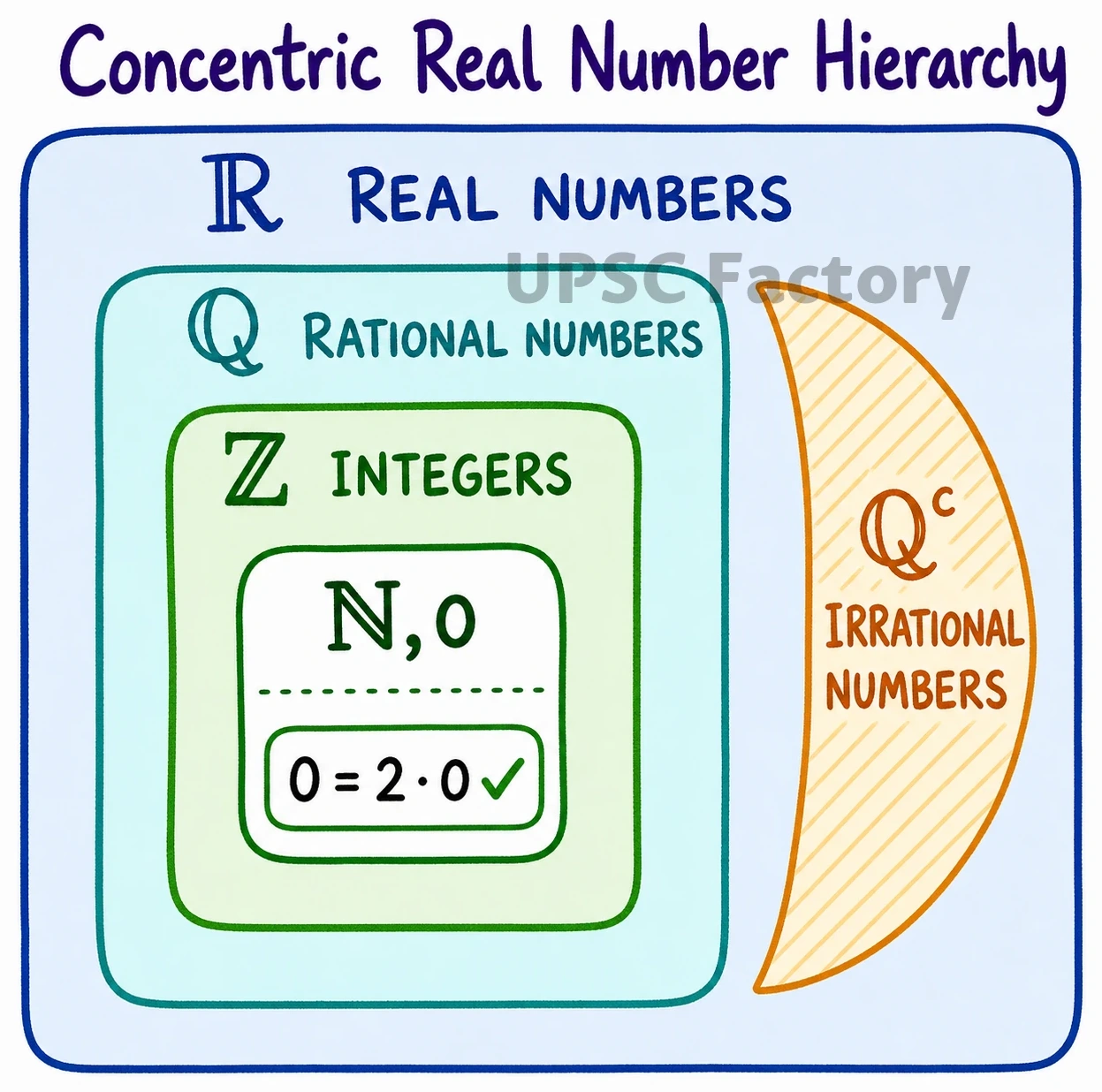
Recurring Decimals & Fraction Conversions for CSAT UPSC

Recurring Decimals & Fraction Conversions for CSAT UPSC

1. Theoretical Foundation & Mathematical Underpinnings

Formal Definition & Scope

A rational number is any number expressible in the form p/q where p ∈ ℤ, q ∈ ℤ+, gcd(p, q) = 1.

Every rational number possesses a decimal expansion belonging to exactly one of the following categories:

  • Terminating: The decimal expansion terminates after a finite sequence of n digits:
    x = A.a1a2…an
  • Pure Recurring (Pure Repetend): The repeating cycle begins immediately following the decimal point:
    x = A.b1b2…br, r ≥ 1
    Examples: 0.27, 2.142857
  • Mixed Recurring (Mixed Repetend): A non-repeating block of n ≥ 1 digits precedes a recurring block of r ≥ 1 digits:
    x = A.c1…cnb1…br
    Examples: 0.16, 0.235

Scope Boundary — The 0.9 = 1 Exception: 0.9 is not strictly less than 1; it is an identical mathematical representation of 1. This represents the only non-unique decimal representation among real numbers and serves as a classic examiner trap. Consequently, every terminating decimal can also be expressed as an expansion ending in 9 (e.g., 0.5 = 0.49).

The “Why” Behind the Math

Why Infinite Tail Cancellation Works:

Any recurring decimal can be formulated as an infinite geometric series. For a 2-digit repetend xy:

x = 0.xy
x = xy/102 + xy/104 + xy/106 + ···

This is a geometric series with first term a = xy/100 and common ratio r = 1/100 < 1:

S = a/(1 − r) = (xy / 100)/(1 − 1/100) = (xy / 100)/(99 / 100) = xy/99

The algebraic technique of scaling by powers of 10 and subtracting cancels the infinite tails. Multiplying by 10r (where r is the repetend length) shifts the decimal point by exactly one full repeating period, rendering the non-terminating tails identical.

Proof for Mixed Recurring Decimals: Let x = 0.abc where n = 1 and r = 2:

x = 0.abc
10nx = 10x = a.bc — (Eq. 1) [Repetend starts at decimal point]
10n+rx = 1000x = abc.bc — (Eq. 2) [Shifted by one full period]

Subtracting Eq. 1 from Eq. 2:

(10n+r − 10n)x = abc − a
990x = abc − a
⇒ x = (abc − a)/990

(where abc represents the integer formed by the concatenation of digits a, b, c).

General Master Theorem:
For any decimal of the form x = A.c1…cnb1…br:

x = A + [(c1…cnb1…br) − (c1…cn)] / [99…9 (r times) 00…0 (n times)]

  • If n = 0 (Pure Recurring): x = A + (b1…br) / [99…9 (r times)]
  • If r = 0 (Terminating): x = A + (c1…cn) / 10n

Retention Anchor: 9 for Bar, 0 for Gap — The denominator takes r nines followed by n zeros. The numerator is the entire sequence of digits after the decimal minus the non-repeating prefix.

Key Theorems & Properties

  • Termination Criterion: A rational number p/q in irreducible form (gcd(p, q) = 1) is terminating if and only if the prime factorization of q contains no primes other than 2 and 5:
    q = 2a5b (a, b ∈ ℕ0)
    Otherwise, the expansion is recurring.
    • Example: 13/40 = 13/(23 · 5) ⇒ Terminating (0.325).
    • Example: 13/30 = 13/(2 · 3 · 5) ⇒ Mixed recurring (0.43) due to the prime factor 3.
    • Reduction Warning: For 6/90, reducing to lowest terms yields 1/15 = 1/(3 · 5). Because the denominator still contains 3, the decimal is recurring (0.06). Always reduce the fraction before factoring the denominator.

x

  • The 0.9 = 1 Identity: Let x = 0.9 ⇒ 10x = 9.9 ⇒ 9x = 9 ⇒ x = 1.
  • Period Length Theorem: For p/q with gcd(q, 10) = 1, the length r of the repetend divides Euler’s totient φ(q) and is the smallest positive integer r satisfying:
    10r ≡ 1 (mod q)
    For instance, the period length of 1/7 is 6 because 106 ≡ 1 (mod 7) and no smaller positive integer exponent satisfies the congruence.
  • Factor Pairing Property: If x = N/99…9, then N plus its 9’s complement equals 99…9. Consequently, 1/11 = 0.09 and 10/11 = 0.90.

2. Comparative Matrix & Conceptual Distinctions

FeatureTerminatingPure RecurringMixed RecurringIrrational
Decimal FormA.a1…anA.b1…brA.c1…cnb1…brNon-terminating, non-repeating
Denominator q (gcd(p, q) = 1)q = 2a5bgcd(q, 10) = 1q = 2a5b · k, k > 1, gcd(k, 10) = 1Cannot be written as p/q
Conversion Denominator10n99…9 (r nines)99…9 (r nines) 00…0 (n zeros)Non-convertible
Standard Example0.35 = 35/100 = 7/200.45 = 45/99 = 5/110.235 = (235 − 2)/990 = 233/990π, √2, e
Examiner Trap RiskModerate (0.49 conversion)High (direct addition errors)Critical (omitting prefix subtraction)Low

Diagnostic Rule: A prime denominator does not ensure a recurring expansion. Denominators q = 2 and q = 5 produce strictly terminating values.


3. High-Yield Data Anchors & Memorization Benchmarks

A. The Instant Conversion Invariants

FamilyFraction ↔ DecimalKey Invariant
Denominator 9 (1-digit repetend)1/9 = 0.1, 4/9 = 0.4, 8/9 = 0.80.p = p/9
Denominator 11 (2-digit repetend)1/11 = 0.09, 5/11 = 0.45, 7/11 = 0.63Repetend is (9 × Numerator). Ex: 5/11 = 45/99
Denominators 3 & 6 (Mixed forms)1/3 = 0.3, 1/6 = 0.16, 5/6 = 0.830.16 = 1/6, 0.83 = 5/6
Denominator 7 (Cyclic 6-digit repetend)1/7 = 0.142857, 2/7 = 0.285714, 3/7 = 0.428571Cyclic sequence: 142857; 142857 × 7 = 999999
Denominator 27 / 370.037 = 1/27, 0.074 = 2/2737 × 27 = 999 ⇒ 0.037 = 37/999

B. Deceptive Composites & Digit Misalignments

  • 0.1666… = 0.16 = (16 − 1)/90 = 1/6. Do not evaluate this as 16/99. Note that 0.16 and 0.166 are mathematically identical (0.1666…), whereas 0.16 = 0.161616… = 16/99.
  • 0.090909… = 0.09 = 1/11, which is distinct from 0.099 = 0.1000… = 0.1.
  • 0.9 = 1, whereas 0.09 = 0.0999… = (09 − 0)/90 = 9/90 = 0.1.

C. Algebraic Invariant Anchors for Fast Simplification

  • 99 = 9 × 11
  • 999 = 27 × 37
  • 9999 = 9 × 1111 = 9 × 11 × 101
  • 99999 = 9 × 11111 = 9 × 41 × 271

Pattern Trigger: If the numerator features values such as 37, 74, or 111, anticipate factorization against denominators containing 999 or 9999.


4. Standard Algorithmic Protocols (Decision Logic)

Fast Decimal-to-Fraction Protocol (≤ 15 Seconds)

To convert any decimal value D into an irreducible rational fraction p/q, follow this 4-step sequence:

  1. Step 1: Isolate the Integer Component
    D = A + Decimal Part
    (Separating the integer component A prevents handling unwieldy numerators during factorization).
  2. Step 2: Determine Repetend and Non-Repetend Counts
    • Identify n = number of non-repeating digits after the decimal point (Gap).
    • Identify r = number of repeating digits under the repetend bar (Bar).
  3. Step 3: Construct the Fractional Quotient
    • Case I: Terminating (r = 0)
      Fraction = (All digits after decimal) / 10n
    • Case II: Pure Recurring (n = 0, r ≥ 1)
      Fraction = (Repetend digits) / [99…9 (r nines)]
    • Case III: Mixed Recurring (n ≥ 1, r ≥ 1)
      Fraction = [(All digits after decimal) − (Non-repeating prefix)] / [99…9 (r nines) 00…0 (n zeros)]
  4. Step 4: Recombine and Simplify
    D = A + Numerator/Denominator → (Reduce by gcd) → p/q

Step-by-Step Worked Demonstration Models

Model 1: Terminating Decimal (r = 0)

Convert D = 0.375 to p/q:

  • A = 0, n = 3, r = 0
  • Fraction = 375/103 = 375/1000
  • Divide numerator and denominator by gcd(375, 1000) = 125:
    (375 ÷ 125) / (1000 ÷ 125) = 3/8

Model 2: Pure Recurring Decimal (n = 0)

Convert D = 0.45 to p/q:

  • A = 0, n = 0, r = 2 (repeating block: 45)
  • Denominator = 99 (2 nines)
  • Fraction = 45/99
  • Divide numerator and denominator by gcd(45, 99) = 9:
    (45 ÷ 9) / (99 ÷ 9) = 5/11

Model 3: Mixed Recurring Decimal with Zero Integer (A = 0, n ≥ 1)

Convert D = 0.1635 to p/q:

  • A = 0, n = 2 (non-repeating digits 16), r = 2 (repeating block 35)
  • Numerator = 1635 − 16 = 1619
  • Denominator = 9900 (r = 2 nines, n = 2 zeros)
  • D = 1619/9900
    (Since gcd(1619, 9900) = 1, the fraction is in simplest form).

Model 4: Mixed Recurring with Non-Zero Integer Part (A > 0)

Convert D = 1.42 to p/q:

  • Method A (Integer Separation):
    • A = 1, n = 1 (digit 4), r = 1 (digit 2)
    • Numerator = 42 − 4 = 38
    • Denominator = 90 (1 nine, 1 zero)
    • D = 1 + 38/90 = 1 + 19/45 = (45 + 19)/45 = 64/45
  • Method B (Direct Single-Fraction Conversion):
    • Numerator = (Entire number without decimal) − (Digits before bar) = 142 − 14 = 128
    • Denominator = 90
    • D = 128/90 = 64/45

5. Standard Question Typologies & Analytical Solutions

Type A: Parity & Multi-Variable Constraints

Archetype: Pure recurring fractions of the form m/9 and n/99 subject to range constraints.

Problem: Consider the numbers x = 0.a and y = 0.b, where a and b are single non-zero digits (1 ≤ a, b ≤ 9). If x + y = 0.c, where c is also a single digit, find the number of distinct ordered pairs (a, b) that satisfy this equation.

Analytical Solution:

Step 1: Convert to Fractional Form
x = a/9, y = b/9 ⇒ x + y = (a + b)/9
The target sum is 0.c = c/9, where 1 ≤ c ≤ 9.

Step 2: Establish Boundary Constraints
For the sum (a + b)/9 to remain strictly in the form 0.c, the sum of the digits must satisfy:
a + b = c ≤ 9
If a + b > 9, the sum becomes 1 + (a + b − 9)/9 = 1.a + b − 9, which is no longer of the form 0.c.

Step 3: Count Valid Integer Pairs
For each integer k = a + b such that 2 ≤ k ≤ 9, the number of valid pairs (a, b) with a, b ≥ 1 is (k − 1):

Total Pairs = ∑k=29 (k − 1) = 1 + 2 + 3 + 4 + 5 + 6 + 7 + 8 = 36

Step 4: Boundary Evaluation on c = 9

  • If c = 9 is permissible (0.9 = 1), there are 36 pairs.
  • If the problem strictly defines 0.c < 1 (excluding c = 9), then a + b ≤ 8:
    ∑k=28 (k − 1) = 1 + 2 + ··· + 7 = 28 pairs

Exam Shortcut: In additions involving pure single-digit repetends 0.a + 0.b, convert directly to denominators of 9. The non-carry condition a + b ≤ 9 governs validity.


Type B: Statement Evaluation & Conceptual Validity

Archetype: Validating termination properties and the 0.9 = 1 identity.

Problem: Consider the following statements:

  1. The value of 0.9 is strictly less than 1.
  2. The rational equivalent of 1.42 in lowest terms has a denominator divisible by 3.
  3. Every fraction with a denominator of 40 yields a terminating decimal expansion.

Which of the above statements are correct?

Analytical Solution:

Statement 1:
Let x = 0.9 ⇒ 10x = 9.9 ⇒ 9x = 9 ⇒ x = 1. Thus, 0.9 = 1 exactly. (Incorrect)

Statement 2:
1.42 = 1 + (42 − 4)/90 = 1 + 38/90 = 128/90 = 64/45
The simplified denominator is 45 = 32 × 5, which is divisible by 3. (Correct)

Statement 3:
The prime factorization of the denominator is 40 = 23 × 51. Since the prime factors are exclusively from the set {2, 5}, any fraction p/40 will simplify to a denominator of the form 2a5b. Consequently, the expansion always terminates. (Correct)

Correct Answer: Statements 2 and 3 are correct.


Type C: Existence & Combinatorial Counting

Archetype: Counting distinct rational outputs generated by digit combinations.

Problem: How many distinct rational numbers of the form 0.pq can be formed where p and q are distinct non-zero single digits (p, q ∈ {1, 2, …, 9} with p ≠ q)?

Analytical Solution:

Step 1: Algebraic Representation
0.pq = (10p + q − p)/90 = (9p + q)/90

Step 2: Injectivity & Uniqueness Check
We evaluate whether two distinct digit pairs (p1, q1) ≠ (p2, q2) can yield the same value:
9p1 + q1 = 9p2 + q2 ⇒ 9(p1 − p2) = q2 − q1
Because q1, q2 ∈ {1, …, 9}, the difference |q2 − q1| ≤ 8.
The only multiple of 9 in this range is 0, meaning p1 − p2 = 0 ⇒ p1 = p2 and q1 = q2.
Thus, every distinct ordered pair (p, q) generates a unique numerator 9p + q.

Step 3: Combinatorial Computation
Selecting 2 distinct digits from 9 without replacement:
P(9, 2) = 9 × 8 = 72 distinct rational values


Type D: Algebraic Simplification with Cyclics

Archetype: Factor cancellation using 999 and prime period properties.

Problem: Evaluate the exact value of:
E = (0.037 × 27) + 0.83

Analytical Solution:

Step 1: Convert Individual Terms
0.037 = 37/999
Recall the algebraic identity 999 = 27 × 37:
0.037 × 27 = (37 × 27)/999 = 999/999 = 1

Step 2: Convert the Mixed Recurring Term
0.83 = (83 − 8)/90 = 75/90 = 5/6

Step 3: Sum the Terms
E = 1 + 5/6 = 11/6 = 1.83


Type E: Modular Periodicity & Co-Prime Denominators

Archetype: Counting coprime period lengths and irreducible fractions.

Problem: Let N = 0.ab where ab is a two-digit integer (10 ≤ ab ≤ 99). When expressed as an irreducible fraction p/q, the denominator is given by q = 99/gcd(ab, 99). How many two-digit integers ab ∈ [10, 99] are co-prime to 99?

Analytical Solution:

Step 1: Factorization and Totient Function
99 = 32 × 11
The number of integers in [1, 99] co-prime to 99 is given by Euler’s totient function φ(99):
φ(99) = 99 × (1 − 1/3) × (1 − 1/11) = 99 × 2/3 × 10/11 = 60

Step 2: Exclude Single-Digit Values
The single-digit values in [1, 9] co-prime to 99 are 1, 2, 4, 5, 7, 8 (a total of 6 values).

Step 3: Compute the Target Count
Count = φ(99) − 6 = 60 − 6 = 54
(For these 54 values, the denominator remains strictly q = 99).


Type F: Composite Arithmetic & Denominator LCM

Archetype: Addition of mixed and pure recurring decimals with fractional reduction.

Problem: Evaluate the sum S = 0.16 + 0.27. Express the result as an irreducible fraction p/q and find (q − p).

Analytical Solution:

Step 1: Fractional Conversion
0.16 = (16 − 1)/90 = 15/90 = 1/6
0.27 = 27/99 = 3/11

Step 2: Compute the Sum
S = 1/6 + 3/11 = (11 + 18)/66 = 29/66

Step 3: Evaluate Invariant
Since gcd(29, 66) = 1, we have p = 29 and q = 66:
q − p = 66 − 29 = 37


6. The Examiner Trap Matrix

Candidate FallacyMathematical FactCounterexample & Verification
Assuming 0.9 < 10.9 = 1 identically1 − 0.9 = 0. The statement “0.9 < 1″ is strictly false.
Direct digit-by-digit bar addition: 0.4 + 0.7 = 1.1Bar notation is non-linear across base carries4/9 + 7/9 = 11/9 = 1.2 ≠ 1.1
Incorrect mixed numerator: 0.58 = 58/90Must subtract the non-repeating prefixCorrect: (58 − 5)/90 = 53/90. Note that 58/90 = 0.64.
Inverting denominator structure: For 0.235, writing 900 or 099Rule: Place r nines first, followed by n zeros0.235 = (235 − 2)/990 = 233/990.
Omitting final reductionFraction options are always presented in irreducible form75/90 → 5/6; 27/99 → 3/11. Always factor out common terms.
Ignoring bar start position: 0.16 = 0.16Repetend start index fundamentally changes the value0.16 = 1/6 = 0.1666… whereas 0.16 = 16/99 = 0.161616…


7. Golden Rules & Instant Exam Triggers

#TriggerMathematical Rule
1Encountering 0.9, 1.9, or k.9Immediately replace with 1, 2, or k + 1. This is exact equality, not an approximation.
2Arithmetic operations on recurring decimals (+, −, ×, ÷)Never add or multiply repetend digits directly. Convert every term to its rational fraction p/q first.
3Single-digit repetend (0.a) or Two-digit repetend (0.ab)Instantly write as a/9 or ab/99.
4Mixed recurring pattern (0.pq)Instantly apply [(10p + q) − p]/90 = (9p + q)/90.
5Denominator termination checksReduce the fraction to lowest terms, then factor q. If q = 2a5b, it terminates; if any other prime factor exists, it recurs.
6Recognizing cyclic numbers (142857, 037, 285714)0.142857 = 1/7, 0.037 = 1/27.
7Evaluating expressions like (q − p) or (p + q)Always ensure gcd(p, q) = 1 before calculating the final sum or difference.

Final Retention Formula: “9 for Bar, 0 for Gap, Subtract the Prefix”
Rational Fraction = [(All digits after decimal) − (Non-repeating prefix)] / [99…9 (Length of Bar) 00…0 (Length of Gap)]

Recurring Decimals & Fraction Conversions for CSAT UPSC Read More »
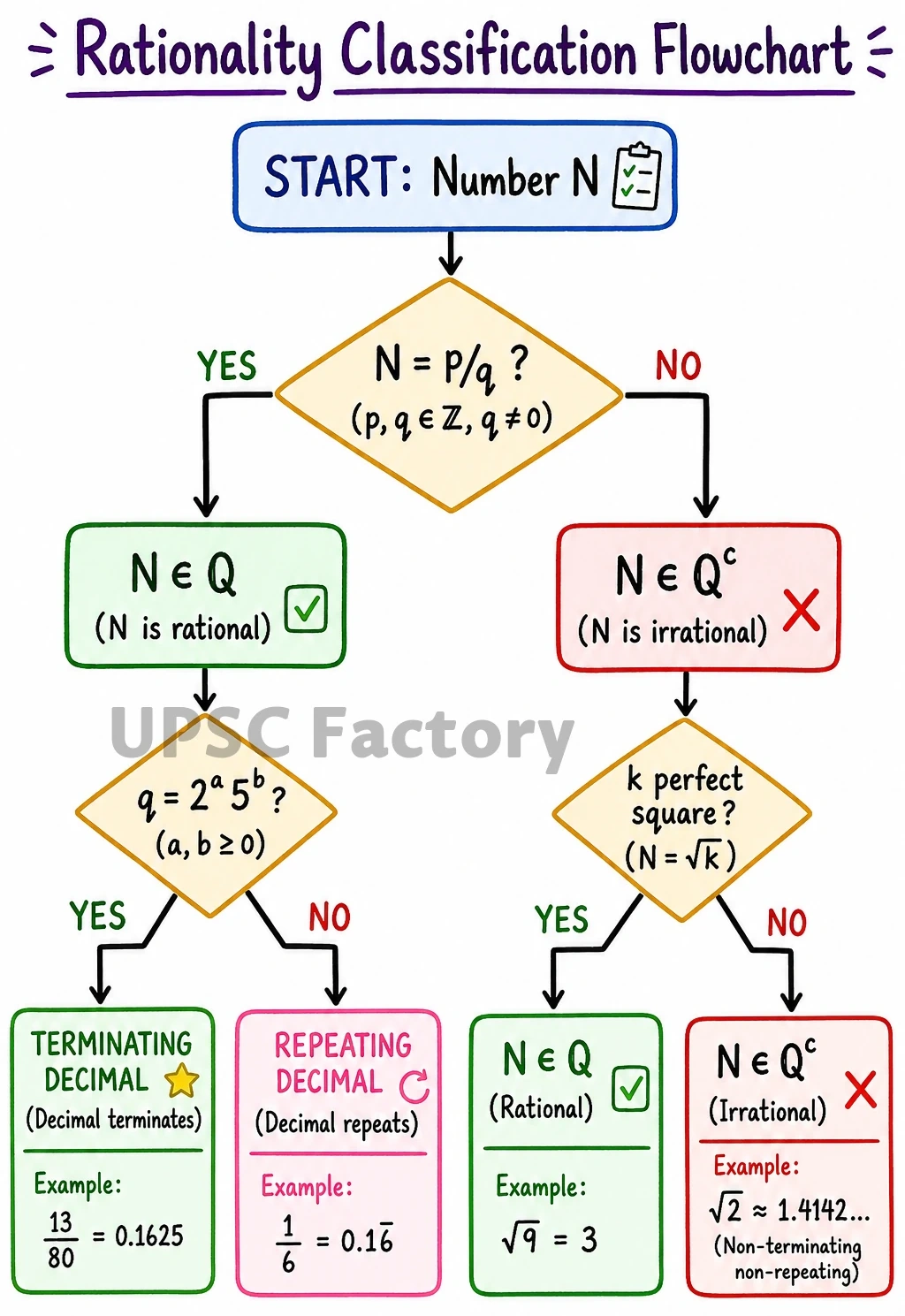
Real Numbers & Integer Properties for CSAT

Real Numbers & Integer Properties for CSAT

1. Theoretical Foundation & Mathematical Underpinnings

Formal Definition & Scope

The quantitative framework rests upon the Real Number System (ℝ) — the set of all quantities representable on a one-dimensional continuous number line. It forms a mutually exclusive and exhaustive partition:

ℝ = ℚ ∪ ℚc  and  ℚ ∩ ℚc = ∅

where ℚ denotes the set of Rational Numbers, and ℚc denotes the set of Irrational Numbers (ℝ \ ℚ).

1. Rational Numbers (ℚ):

ℚ = { p/q | p, q ∈ ℤ, q ≠ 0 }

A real number is rational if and only if its decimal expansion is either Terminating or Non-Terminating but Repeating (Recurring).

  • Terminating: 1/2 = 0.5, 7/8 = 0.875, 13/400 = 0.0325
  • Repeating: 1/3 = 0.3, 1/7 = 0.142857, 1/6 = 0.16

2. Irrational Numbers (ℚc):

Numbers that cannot be expressed in the form p/q where p, q ∈ ℤ and q ≠ 0. Defining property: the decimal expansion is Non-Terminating and Non-Repeating. No finite sequence of digits recurs indefinitely.

  • Canonical Examples: √2, √3, √5, √7, … (surds of non-perfect squares); transcendental constants such as π, e; and constructed decimals such as 0.101001000100001…

3. Integers (ℤ):

A critical subset of ℚ where the denominator in reduced form is q = 1.

ℤ = {…, -3, -2, -1, 0, 1, 2, 3, …}

ℤ+ = {1, 2, 3, …} (Natural Numbers / Positive Integers)

ℤ– = {-1, -2, -3, …} (Negative Integers)


The “Why” Behind the Math — Proofs for Retention

Why 1: Why does a rational number always terminate or repeat?
When dividing an integer p by a positive integer q, the remainder at each step of standard long division must strictly belong to the set:

R ∈ {0, 1, 2, …, q – 1}

This yields at most q distinct possible remainders:

  1. If the remainder becomes 0 at any step, the division process halts, producing a terminating decimal.
  2. If the remainder never reaches 0, then by the Pigeonhole Principle, a remainder must recur within at most q subsequent division steps. Once a remainder repeats, the exact sequence of quotient digits generated thereafter repeats identically.

Hence, every rational representation yields a periodic or finite decimal, whereas irrationality corresponds to an infinite, non-repeating sequence of remainders.

Why 2: Why is a rational decimal terminating if and only if its reduced denominator contains only prime factors of 2 and 5?
Any terminating decimal with k decimal places can be expressed as a base-10 fraction:

N/10k = N/(2 · 5)k = N/(2k · 5k)

for some integer N and non-negative integer k ≥ 0. After cancelling all common factors between numerator and denominator:

p/q = (N / gcd(N, 10k))/(10k / gcd(N, 10k))

The simplified denominator q cannot contain any prime factors other than 2 and 5.

Verification Test:

  • 7/40 = 7/(23 · 5) ⇒ Denominator has only primes 2 and 5 ⇒ Terminating (0.175).
  • 5/14 = 5/(2 · 7) ⇒ Denominator contains the prime factor 7 ⇒ Non-terminating repeating (0.3571428).

Note: This test is valid only after the fraction is reduced to its lowest terms.

Why 3: Why is Rational + Irrational = Irrational always true?

Proof by Contradiction:
Let r ∈ ℚ and s ∈ ℚc. Assume, for contradiction, that their sum is rational:

r + s = t  where  t ∈ ℚ

Isolating the irrational term yields:

s = t – r

Because the set of rational numbers ℚ is closed under subtraction, the difference of two rational numbers (t – r) must be rational:

(t – r) ∈ ℚ ⇒ s ∈ ℚ

This directly contradicts the initial premise that s ∈ ℚc. Thus, the sum t must be irrational.

Corollary Trap: This closure property does not extend to the sum of two irrational numbers (ℚc + ℚc). The set of irrational numbers is not closed under addition:

(2 + √3) + (2 – √3) = 4 ∈ ℚ

Why 4: Why is Zero (0) Even? Two Rigorous Proofs

  • Algebraic Definition: An integer n is even if there exists an integer k ∈ ℤ such that n = 2k. Setting k = 0:
    2k = 2(0) = 0 ⇒ 0 ∈ 2ℤ (Even)
  • Sequential Parity Invariance: Parity strictly alternates across consecutive integers on the number line:
    …, -3 (Odd), -2 (Even), -1 (Odd), 0 (?), 1 (Odd), 2 (Even), …
    To preserve strict alternating parity (Odd ↔ Even), 0 must be Even.

Consequence: Zero (0) is an even integer, but it is neither positive nor negative; it serves as the neutral sign boundary on ℝ.


Key Theorems & Properties

  • Closure Properties:
    • ℚ + ℚ = ℚ and ℚ × ℚ = ℚ (Closed under addition and multiplication)
    • If r ∈ ℚ \ {0} and s ∈ ℚc, then r · s ∈ ℚc
    • ℚc + ℚc = Indeterminate (ℚ or ℚc)
    • ℚc × ℚc = Indeterminate (ℚ or ℚc)

  • Parity Arithmetic (0 is Even):
    • Addition / Subtraction:
      Even ± Even = Even,   Odd ± Odd = Even,   Even ± Odd = Odd
    • Multiplication:
      Even × (Any Integer) = Even,   Odd × Odd = Odd
      (An odd product requires every factor in the product to be odd.)
    • Operational Examples:
      4 (Even) + 0 (Even) = 4 (Even)
      (-3) (Odd) × 0 (Even) = 0 (Even)
  • Independence of Sign and Parity: Sign and parity are independent mathematical properties. For instance, -4 is Negative and Even, while -3 is Negative and Odd.

2. Comparative Matrix & Conceptual Distinctions

Table 1: Rational vs. Irrational — The Decisive Divide

ParameterRational Numbers (ℚ)Irrational Numbers (ℚc)
Formal DefinitionCan be expressed as p/q where p, q ∈ ℤ, q ≠ 0Cannot be expressed as p/q with integer terms
Decimal RepresentationTerminating OR Non-Terminating RecurringNon-Terminating and Non-Repeating
Representative Examples22/7 = 3.142857, 0.5, -4, 0π ≈ 3.14159…, √2 ≈ 1.4142…, e
Common Exam Trap0.9 = 1 (Strictly Rational)√4 = 2 is Rational, not Irrational

Table 2: Integer Terminology Spectrum — The Zero Boundary

Term in Problem StatementMathematical Set NotationIncludes 0?Risk Level / Pitfall Frequency
Natural / Positive Integer{1, 2, 3, …}   (x > 0)NOModerate
Non-Negative Integer{0, 1, 2, 3, …}   (x ≥ 0)YESCritical
Negative Integer{-1, -2, -3, …}   (x < 0)NOModerate
Non-Positive Integer{0, -1, -2, -3, …}   (x ≤ 0)YESCritical
Whole Number{0, 1, 2, 3, …}YESHigh
Even Integer{…, -4, -2, 0, 2, 4, …}YESHigh

Key Takeaway: In standardized competitive examinations, problem stems frequently distinguish between Positive and Non-Negative to test boundary-condition awareness.

Table 3: The π versus 22/7 Fallacy

Mathematical PropertyThe Constant πThe Fraction 22/7
ClassificationIrrational (ℚc)Rational (ℚ)
Decimal Behavior3.14159265… (Infinite, non-periodic)3.142857 (Period length = 6)
Value PrecisionExact transcendental circle ratioRational approximation (22/7 – π ≈ 0.00126)
Statement Truth Value“π is rational” ⇒ FALSE“22/7 is irrational” ⇒ FALSE

3. High-Yield Data Anchors & Memorization Benchmarks

A. Terminating Decimal Test (Denominator Factorization)

Given a rational fraction p/q in irreducible form (gcd(p, q) = 1):

  • If q = 2a · 5b for non-negative integers a, b ≥ 0 ⇒ Terminating Decimal
  • If q contains any prime factor pk ∉ {2, 5} ⇒ Non-Terminating Repeating Decimal

Examples:

  • 3/80 ⇒ 80 = 24 · 51 ⇒ Terminates (0.0375)
  • 9/44 ⇒ 44 = 22 · 111 ⇒ Repeats (0.2045)

B. High-Frequency Deceptive Numbers

Number / ExpressionCommon MisconceptionActual Mathematical ClassificationUnderlying Proof / Rationale
0Sign-less, hence parity-lessEven Integer, Rational0 = 0/1 = 2(0) with k = 0 ∈ ℤ
√4, √9, √0.25Radical symbol implies irrationalityRationalExact integer/fraction evaluations: 2, 3, 0.5
0.1010010001…Looks periodic due to zeros and onesIrrationalThe zero-run length increases monotonically; no fixed period
3.142857Looks like irrational πRationalIdentical to 22/7; period repeats infinitely
π + (-π)Sum of two irrationalsRational (0)Sum of additive inverses yields integer zero

C. Algebraic Parity Invariants

  • Square Invariant: n2 ≡ n (mod 2) (An integer and its square share the identical parity).
  • Consecutive Pair Invariant: n(n + 1) is always Even for all n ∈ ℤ (Every pair of consecutive integers contains at least one factor of 2).
  • Consecutive Triplet Invariant: n3 – n = (n – 1)n(n + 1) is always divisible by 6 (Contains at least one multiple of 2 and one multiple of 3).

4. Standard Algorithmic Protocols (Decision Logic)

Protocol 1: Systematic Rationality & Decimal Classification

When analyzing any given number N:

  1. Algebraic Representation Check:
    • Can N be represented as p/q with p, q ∈ ℤ and q ≠ 0?
    • Yes: N ∈ ℚ (Rational). Proceed to Step 2.
    • No: N ∈ ℚc (Irrational). Proceed to Step 3.
  2. Rational Decimal Expansion Analysis:
    • Reduce p/q completely such that gcd(p, q) = 1.
    • Factor the denominator: q = 2a · 5b · k.
    • If k = 1, the decimal expansion is Terminating.
    • If k > 1 (contains prime factors other than 2 or 5), the decimal expansion is Non-Terminating Recurring.
  3. Irrational / Radical Form Analysis:
    • If N = √k for an integer k:
    • If k = m2 for some m ∈ ℤ, then N = m ∈ ℚ (Rational).
    • If k is not a perfect square, N ∈ ℚc (Irrational).

Step-by-Step Numerical Example:
Classify the value N = 21/280.

  • Step 1: Reduce to lowest terms: gcd(21, 280) = 7 ⇒ (21/7)/(280/7) = 3/40.
  • Step 2: Factor the simplified denominator: 40 = 23 · 51.
  • Step 3: Since all prime factors belong to {2, 5}, N produces a terminating decimal (0.075).

Protocol 2: Parity and Zero-Product Consecutive Integer Resolution

For problems constrained by P × Q × R = 0 over consecutive integers P < Q < R:

  1. Zero-Product Condition:
    P · Q · R = 0 ⇒ 0 ∈ {P, Q, R}
  2. Enumerate Feasible Consecutive Triplets:
    • Case 1 (R = 0): Triple A = {-2, -1, 0}
    • Case 2 (Q = 0): Triple B = {-1, 0, 1}
    • Case 3 (P = 0): Triple C = {0, 1, 2}
  3. Evaluate Parity Constraints on the Sum:
    • Sum(A) = -2 + (-1) + 0 = -3 (Odd)
    • Sum(B) = -1 + 0 + 1 = 0 (Even)
    • Sum(C) = 0 + 1 + 2 = 3 (Odd)
  4. Parity Elimination:
    Match the required sum parity (remembering that 0 is Even) to select the unique valid set.

Step-by-Step Numerical Example:
Find three consecutive integers whose product is 0 and whose sum is strictly odd and positive.

  • Step 1: Identify the three candidate triplets: {-2, -1, 0}, {-1, 0, 1}, and {0, 1, 2}.
  • Step 2: Calculate the sums: -3, 0, and +3.
  • Step 3: Apply the constraint (Sum > 0 and Sum is Odd) ⇒ triplet {0, 1, 2} is the unique solution with P = 0, Q = 1, R = 2.

Protocol 3: Quantitative Terminology Decoder

To avoid boundary-value errors when translating word problems into algebraic domains:

  1. Look for the Prefix “Non-“:
    • Non-Negative: Condition is x ≥ 0 ⇒ Includes 0 ({0, 1, 2, …}).
    • Non-Positive: Condition is x ≤ 0 ⇒ Includes 0 ({0, -1, -2, …}).
  2. Check for Strict Positivity / Negativity:
    • Positive: Condition is x > 0 ⇒ Excludes 0 ({1, 2, 3, …}).
    • Negative: Condition is x < 0 ⇒ Excludes 0 ({-1, -2, -3, …}).
  3. Check Parity Descriptors:
    • Even Integer: Condition is x ∈ 2ℤ ⇒ Includes 0 ({…, -2, 0, 2, …}).

5. Standard Question Typologies & Analytical Solutions

Type A: Parity & Multi-Variable Constraints

Core Principle: Zero is Even; Parity of Consecutive Integers

Question:
Let P, Q, R be three consecutive integers such that P < Q < R. If P × Q × R = 0 and P + Q + R is an even integer, what is the value of Q?
(a) -1
(b) 0
(c) 1
(d) Cannot be determined

Analytical Solution:

  • Step 1 (Constraint Setup): Since P, Q, R are consecutive integers and their product is zero, the number 0 must be one of the three integers.
  • Step 2 (Exhaustive Case Listing):
    Window 1: P = -2, Q = -1, R = 0
    Window 2: P = -1, Q = 0, R = 1
    Window 3: P = 0, Q = 1, R = 2
  • Step 3 (Sum and Parity Evaluation):
    Window 1: P + Q + R = -2 + (-1) + 0 = -3 (Odd)
    Window 2: P + Q + R = -1 + 0 + 1 = 0 (Even, since 0 = 2 × 0)
    Window 3: P + Q + R = 0 + 1 + 2 = 3 (Odd)
  • Step 4 (Conclusion): Only Window 2 satisfies the condition that the sum is an even integer. In this window, the middle integer is Q = 0.

Correct Answer: (b) 0
Exam Strategy: When a product of consecutive integers is 0, immediately list the three potential triplets containing 0. Evaluate the parity of the sums to eliminate invalid windows in seconds.


Type B: Statement Evaluation & Set Closure

Core Principle: Set Inclusions and Irrational Counterexamples

Question:
Consider the following statements:
1. Every integer is a rational number, but every rational number is not an integer.
2. The sum of two irrational numbers is always an irrational number.
3. π is an irrational number, whereas 22/7 is a rational number.

Which of the statements given above is/are correct?
(a) 1 and 2 only
(b) 1 and 3 only
(c) 3 only
(d) 1, 2, and 3

Analytical Solution:

  • Evaluation of Statement 1: Any integer z ∈ ℤ can be written as z/1, where z, 1 ∈ ℤ and 1 ≠ 0, so ℤ ⊂ ℚ. Conversely, fractions such as 1/2 ∈ ℚ do not belong to ℤ. Statement 1 is Correct.
  • Evaluation of Statement 2: Consider the two irrational numbers x = 3 + √5 and y = 3 – √5.
    x + y = (3 + √5) + (3 – √5) = 6 = 6/1 ∈ ℚ
    Because the sum can be rational, the sum of two irrationals is not always irrational. Statement 2 is Incorrect.
  • Evaluation of Statement 3: π is non-terminating and non-repeating (transcendental irrational), whereas 22/7 is explicitly a ratio of two integers with a repeating decimal expansion (3.142857). Statement 3 is Correct.

Correct Answer: (b) 1 and 3 only
Exam Strategy: Statements containing universal quantifiers like “always” or “never” regarding irrational operations can frequently be disproven using conjugate pairs (a + √b) and (a – √b).


Type C: Boundary Counting & Non-Negative Constraints

Core Principle: Zero Inclusion in Non-Negative Sets

Question:
If x and y are non-negative integers such that x + y = 3, how many distinct ordered pairs (x, y) are possible?
(a) 2
(b) 3
(c) 4
(d) Infinite

Analytical Solution:

  • Step 1 (Domain Interpretation): The term “non-negative integers” means x, y ∈ {0, 1, 2, 3, …}.
  • Step 2 (Systematic Enumeration):
    (x, y) ∈ {(0, 3), (1, 2), (2, 1), (3, 0)}
    This gives exactly 4 distinct ordered pairs.
  • Step 3 (Trap Analysis): If the stem had specified “positive integers”, x, y ≥ 1, which would leave only (1, 2) and (2, 1) (2 pairs). The inclusion of zero provides 2 additional boundary pairs.

Correct Answer: (c) 4
Exam Strategy: For equations of the form x + y = n:
• Number of solutions in non-negative integers = n + 1
• Number of solutions in positive integers = n – 1


Type D: Algebraic Expressions & Rational-Irrational Invariants

Core Principle: Preservation of Irrationality Under Non-Zero Operations

Question:
Let a be a non-zero rational number and b be an irrational number. Consider the following statements:
1. a + b is irrational.
2. a × b is irrational.
3. b2 is always irrational.

Which of the statements given above is/are correct?
(a) 1 and 2 only
(b) 1 and 3 only
(c) 2 and 3 only
(d) 1, 2, and 3

Analytical Solution:

  • Statement 1: If a + b = q ∈ ℚ, then b = q – a ∈ ℚ, which contradicts b ∈ ℚc. Thus, a + b ∈ ℚc. Statement 1 is Correct.
  • Statement 2: If a · b = q ∈ ℚ, then since a ≠ 0, we have b = q/a ∈ ℚ, which is a contradiction. Thus, a · b ∈ ℚc. Statement 2 is Correct.
  • Statement 3: Let b = √3 ∈ ℚc. Then:
    b2 = (√3)2 = 3 ∈ ℚ
    Since b2 can be rational, Statement 3 is Incorrect.

Correct Answer: (a) 1 and 2 only
Key Invariant: Operations between ℚ \ {0} and ℚc yield irrational outcomes (ℚ ± ℚc = ℚc and ℚ* × ℚc = ℚc). However, operations within ℚc itself (ℚc ± ℚc or ℚc × ℚc) are indeterminate.


Type E: Parity Proofs & Definitions

Core Principle: Structural Form of Even Numbers and Parity of Zero

Question:
Consider the following statements:
• Statement-I: If n is an even integer, then n2 + n is always even.
• Statement-II: Zero is not an even integer but is a whole number.

Which one of the following options is correct?
(a) Both Statement-I and Statement-II are correct
(b) Statement-I is correct but Statement-II is incorrect
(c) Statement-I is incorrect but Statement-II is correct
(d) Both Statement-I and Statement-II are incorrect

Analytical Solution:

  • Analysis of Statement-I: Let n = 2k where k ∈ ℤ.
    n2 + n = (2k)2 + 2k = 4k2 + 2k = 2(2k2 + k)
    Since (2k2 + k) ∈ ℤ, the expression n2 + n is divisible by 2 and is therefore always even. (Alternatively, Even2 + Even = Even + Even = Even). Statement-I is Correct.
  • Analysis of Statement-II: 0 = 2(0), so 0 satisfies the definition of an even integer. It is also a whole number ({0, 1, 2, …}). The assertion that “Zero is not an even integer” is false. Statement-II is Incorrect.

Correct Answer: (b) Statement-I is correct but Statement-II is incorrect


Type F: Terminating Decimal Recognition

Core Principle: Denominator Prime Factorization

Question:
Which of the following fractions will produce a terminating decimal expansion?
1. 13/80
2. 7/24
3. 3/160

Select the correct answer:
(a) 1 and 2 only
(b) 1 and 3 only
(c) 2 and 3 only
(d) 1, 2, and 3

Analytical Solution:
Ensure all fractions are reduced, then factor each denominator:

  1. 13/80: gcd(13, 80) = 1. The denominator factors as 80 = 24 · 51. Prime factors are exclusively from {2, 5} ⇒ Terminating (0.1625).
  2. 7/24: gcd(7, 24) = 1. The denominator factors as 24 = 23 · 31. Contains the prime factor 3 ⇒ Non-terminating recurring (0.2916).
  3. 3/160: gcd(3, 160) = 1. The denominator factors as 160 = 25 · 51. Prime factors are exclusively from {2, 5} ⇒ Terminating (0.01875).

Correct Answer: (b) 1 and 3 only


6. The Examiner Trap Matrix

Common Candidate FallacyMathematical RealityConcrete Counterexample / Edge Case
π = 22/7 exactlyπ ∈ ℚc, whereas 22/7 ∈ ℚ. 22/7 – π ≈ 0.00126 ≠ 0The statement “π is a rational number because it equals 22/7” is mathematically false.
Zero is parity-neutral or oddZero satisfies 2k with k = 0; alternating number line parity demands 0 be evenIf x is even and -2 < x < 2, then x = 0 is a valid solution.
“Positive integer” includes 0Positive ≡ x > 0; Non-negative ≡ x ≥ 0Counting pairs for x + y = 3: Positive → 2 pairs; Non-negative → 4 pairs.
Sum or product of two irrationals is always irrationalThe set ℚc is not closed under addition or multiplication(2 + √3) + (2 – √3) = 4 ∈ ℚ; √8 × √2 = 4 ∈ ℚ.
Every radical expression represents an irrational numberA radical is irrational only if the radicand is not a perfect power√9 = 3, √0.25 = 0.5, ∛27 = 3 are all rational.
Long or pattern-like decimals are always irrationalNon-terminating repeating decimals are rational0.090909… = 0.09 = 1/11 ∈ ℚ.

7. Golden Rules & Instant Exam Triggers

#TriggerMathematical Rule / Exam Strategy
1Problem states “Non-negative” or “Non-positive”Immediately include 0 in the candidate set (x ≥ 0 or x ≤ 0). For x + y = n, there are (n + 1) non-negative integer solutions versus (n – 1) positive integer solutions.
2Product of terms equals zero (a · b · c = 0)Immediately deduce that at least one variable is 0. For consecutive integers, list the candidate triplets: {-2, -1, 0}, {-1, 0, 1}, and {0, 1, 2}.
3Statement asserts “The sum/product of two irrationals is ALWAYS…”Mark FALSE immediately. Disprove using conjugate pairs: (a + √b) + (a – √b) = 2a ∈ ℚ and (a + √b)(a – √b) = a2 – b ∈ ℚ.
4Constraint specifies “Even integer”Include 0, -2, -4 as valid test values. Zero is often the simplest even test value to evaluate or eliminate answer choices.
5Theoretical question mentions π and 22/7Treat π ≠ 22/7 strictly. π is an irrational transcendental constant; 22/7 is a rational approximation.
6Fraction classification (Terminating vs. Recurring)Reduce to lowest terms and inspect the prime factors of the denominator. Denominator contains only 2 and 5 ⇒ Terminating. Any other prime factor ⇒ Recurring.
7Parity of polynomial expressions (n2, n3 – n, n(n + 1))Apply standard parity invariants: n(n + 1) is always Even; n2 shares the parity of n; n3 – n is always a multiple of 6.

Real Numbers & Integer Properties for CSAT Read More »