Q. Critically analyse India’s evolving diplomatic, economic and strategic relations with the Central Asian Republics (CARs) highlighting their increasing significance in regional and global geopolitics.
UPSC Mains 2024 GS2 Paper
Model Answer:
India considers the Central Asian Republics (CARs) its ‘Extended Neighbourhood’, making them increasingly vital for Eurasian connectivity, energy security, and regional stability.
Evolving Relations & Geopolitical Significance
Diplomatic Elevation: Ties transitioned to structured strategic partnerships, highlighted by the institutionalization of the 1st India-Central Asia Summit (2022).
Economic & Energy Synergy: Growing cooperation in critical minerals and energy security (e.g., Kazakhstan’s uranium supply) amidst global supply chain shifts.
Strategic & Security Alignment: Enhanced joint counter-terrorism mechanisms and defense capacity building (e.g., Tajikistan’s Farkhor airbase) addressing Af-Pak instability.
Geopolitical Pivot: CARs increasingly serve as an independent balancing force against dominant regional powers (Russia, China) in the Eurasian heartland.
Bottlenecks & Critical Limitations
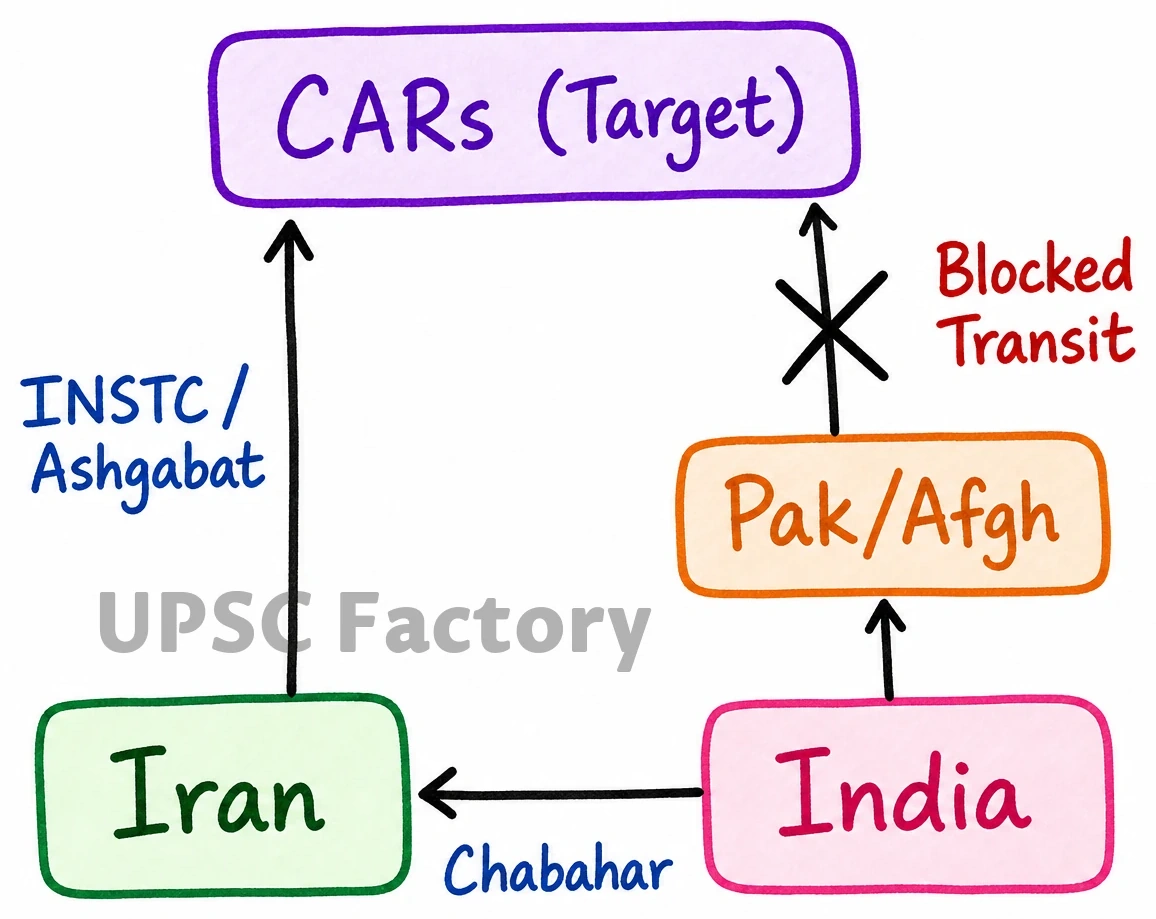
Geographic Barriers: The lack of direct land transit via Pakistan restricts bilateral trade volume (currently stagnant at ~$2 billion).
Execution Delays: Slow implementation of mega-projects hampers strategic reach (e.g., TAPI pipeline delays, sluggish INSTC integration).
Chinese Dominance: Massive economic leverage through the Belt and Road Initiative (BRI) deeply entrenches Beijing, overshadowing India’s footprint.
Regional Volatility: Proximity to the unstable Afghan theater creates persistent transit risks and cross-border radicalization threats.
Accelerating the operationalization of Chabahar Port and leveraging the Ashgabat Agreement are indispensable to actualize India’s “Connect Central Asia” policy effectively.
Q. “The West is fostering India as an alternative to reduce dependence on China’s supply chain and as a strategic ally to counter China’s political and economic dominance.” Explain this statement with examples.
UPSC Mains 2024 GS2 Paper
Model Answer:
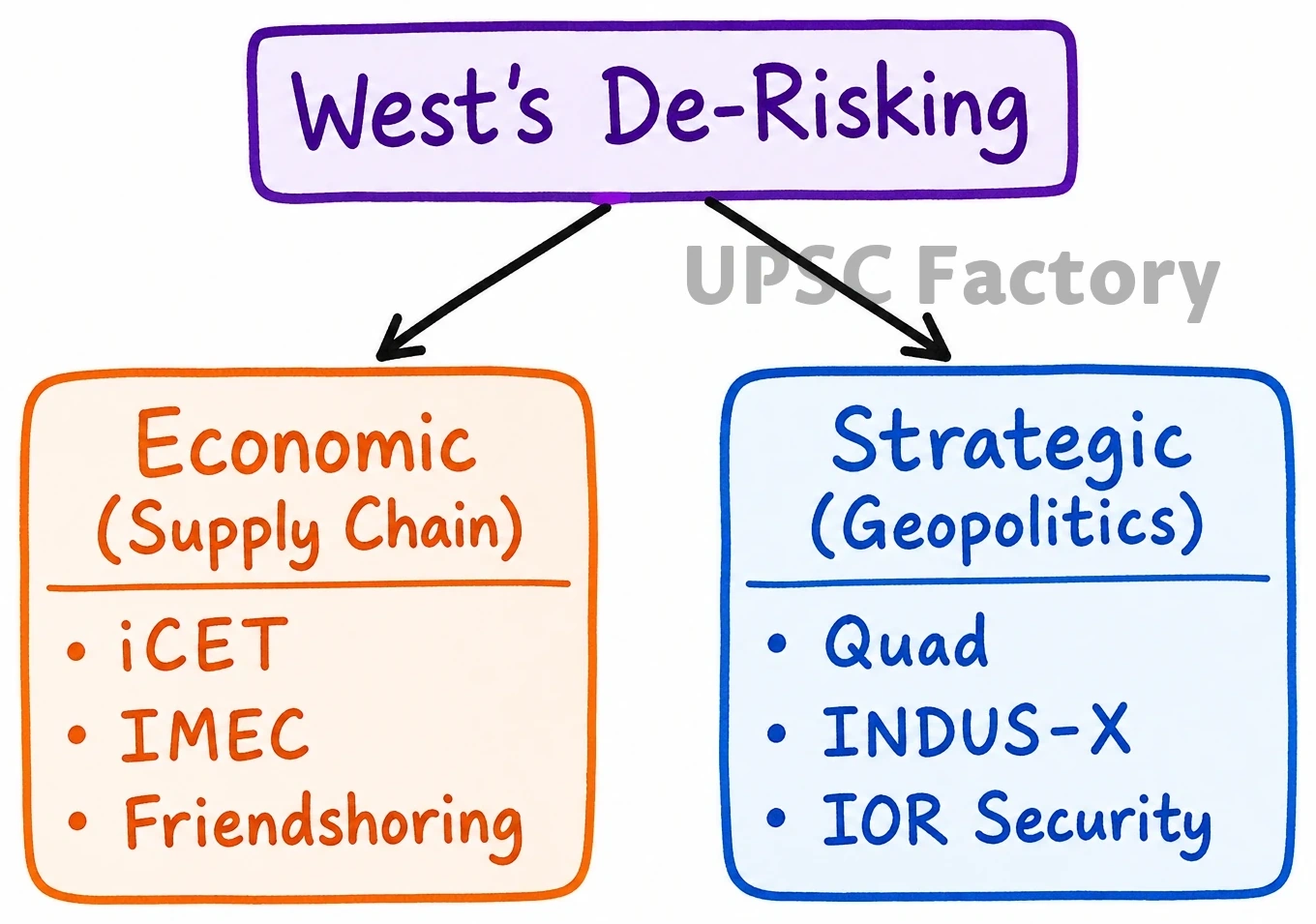
Western “de-risking” strategies position India as the cornerstone of the “China Plus One” manufacturing framework and the geopolitical anchor of a free, rules-based Indo-Pacific.
1. India as an Economic Alternative (Supply Chain)
Friendshoring Initiatives: Shifting critical manufacturing to trusted geographies to reduce overreliance on Beijing (Apple producing 14% of global iPhones in India).
Technology Partnerships: Fostering advanced innovation outside Chinese ecosystems (US-India iCET agreement for semiconductors and AI).
Supply Chain Resilience: Mitigating vulnerabilities in green energy and critical resource networks (India’s inclusion in the US-led Minerals Security Partnership).
Indo-Pacific Security: Elevating maritime containment and ensuring freedom of navigation through multilateral groupings (Quad mechanism; Malabar exercises).
Defence Interoperability: Strengthening military asymmetry against China via advanced technology transfers (US-India GE F414 jet engine deal; INDUS-X).
Regional Counterweight: Empowering India’s naval capacity to act as the primary ‘Net Security Provider’ in the Indian Ocean Region (IOR).
Diplomatic Leadership: Backing New Delhi to counter Beijing’s political hegemony among developing nations (India as the ‘Voice of Global South’ during G20).
While aggressively leveraging this Western convergence for capacity building, India continues to exercise “strategic autonomy” to maximize national interests without entering formal, restrictive military alliances.
Q. The Doctrine of Democratic Governance makes it necessary that the public perception of the integrity and commitment of civil servants becomes absolutely positive. Discuss.
UPSC Mains 2024 GS2 Paper
Model Answer:
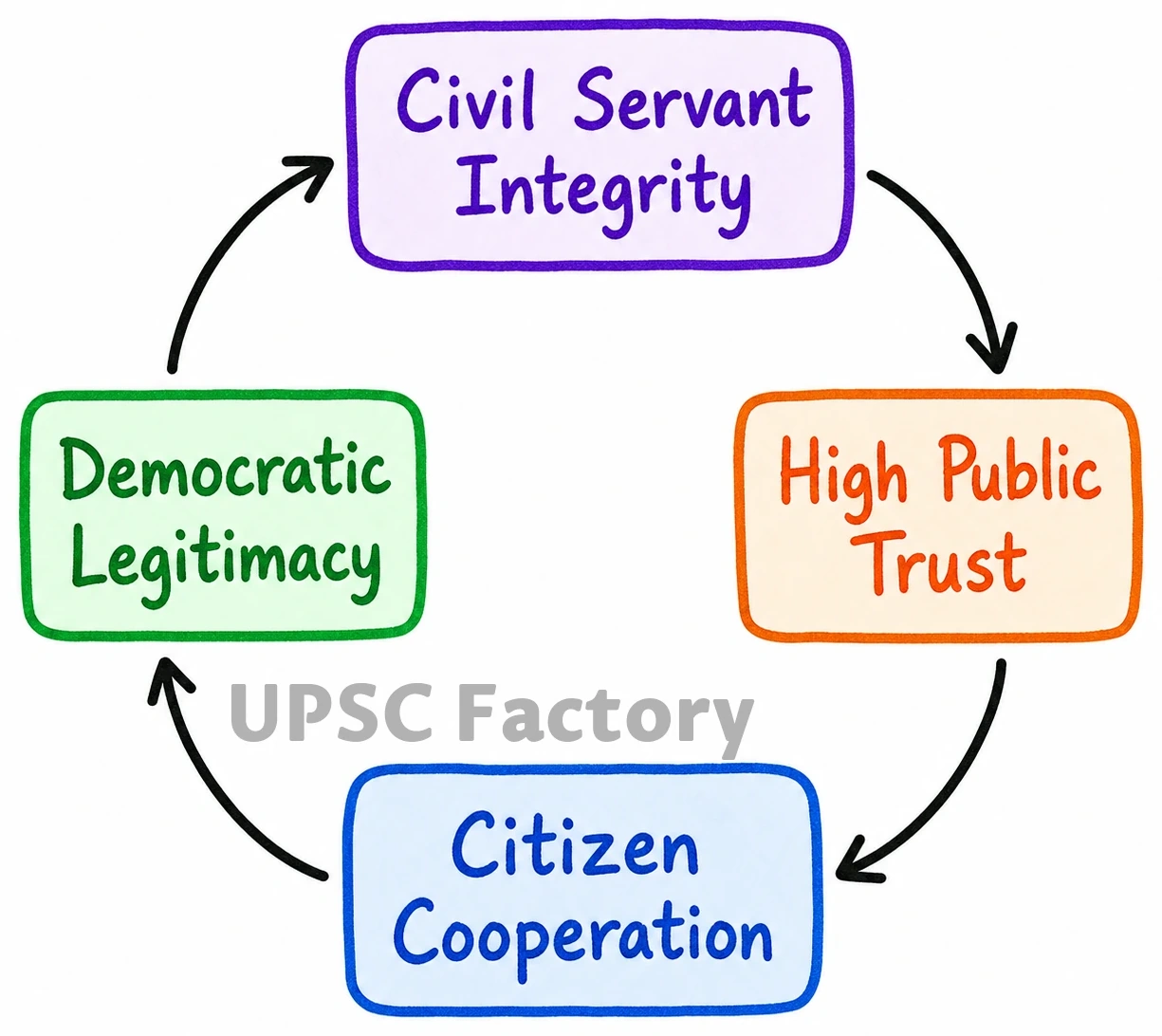
In democratic governance, civil servants are the primary bridge between the state and citizens. Public faith in their integrity is essential to sustain institutional trust and democratic legitimacy.
1. Imperative of Positive Public Perception
Policy Efficacy: Public trust drives voluntary citizen cooperation in state initiatives (e.g., Swachh Bharat Jan Andolan, Covid-19 protocols).
Democratic Legitimacy: Positive perception eliminates state-citizen friction, reinforcing the social contract and democratic values.
Inclusive Development: An image of empathy ensures marginalized sections confidently access state entitlements (e.g., DBT, PDS).
Systemic Accountability: A recognized culture of integrity actively deters cronyism, political-bureaucratic nexus, and administrative opacity.
2. Frameworks to Institutionalize Integrity and Commitment
Ethical Scaffolding: Embedding foundational values into public administration (e.g., Nolan Principles, 2nd ARC’s proposed Code of Ethics).
Capacity & Attitude: Transitioning from a rigid, rule-bound bureaucracy to a citizen-centric, role-based civil service (e.g., Mission Karmayogi).
Transparency & Grievance Redressal: Empowering citizens to directly monitor and question the bureaucracy (e.g., RTI Act, CPGRAMS, Social Audits).
Statutory Deterrence: Ensuring swift penalization of malfeasance (e.g., Lokpal, Prevention of Corruption Act).
Fostering a civil service rooted in uncompromised integrity transforms administrators into true ‘Karmayogis’, essential for translating the democratic vision of “Minimum Government, Maximum Governance” into reality.
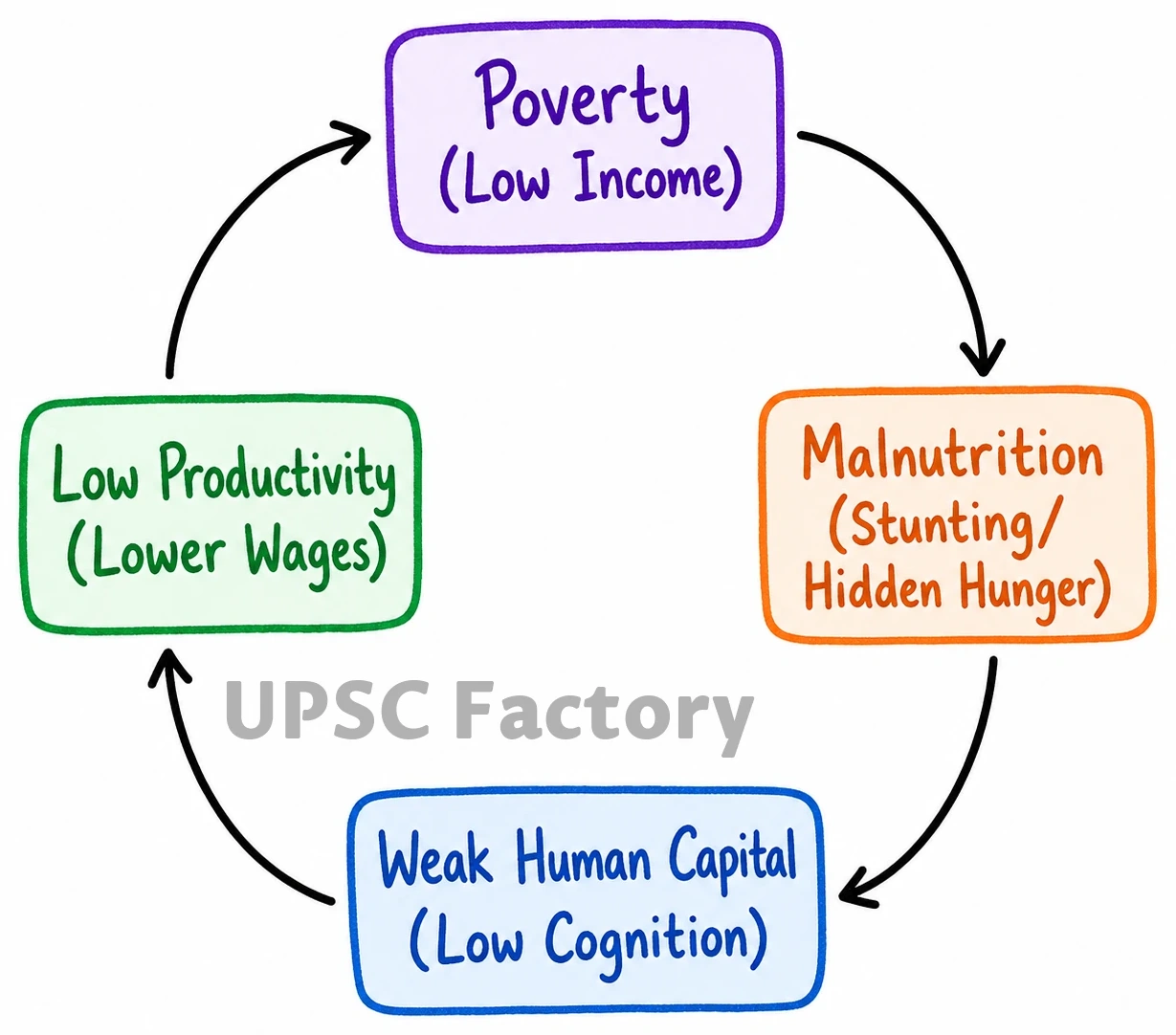
Productivity Loss: Poor health lowers adult workforce productivity, reinforcing income poverty (Amartya Sen’s Capability Deprivation).
2. Multi-Pronged Steps to Break the Cycle
Economic Empowerment: Expand rural wage security and promote women-led micro-enterprises integrating livelihoods with nutrition (MGNREGA; Kerala’s Kudumbashree model).
Nutritional Security: Diversify PDS by mainstreaming millets and expand bio-fortification in targeted feeding programs (PM POSHAN; Poshan Abhiyaan 2.0).
Maternal & Child Health: Ensure adequate maternal nutrition and strengthen early childhood care to prevent low birth weight (PMMVY; ICDS/Anganwadis).
WASH Integration: Universalize clean water and sanitation to reduce disease-induced nutrient malabsorption (Swachh Bharat; Jal Jeevan Mission).
Targeted Delivery: Leverage the JAM trinity for Direct Benefit Transfers (DBT) to prevent leakages and ensure targeted dietary support.
Breaking this cycle requires converging health, education, and livelihood interventions. Achieving SDG 1 (No Poverty) and SDG 2 (Zero Hunger) is critical to transforming India’s population into a productive demographic dividend.
Q. Public charitable trusts have the potential to make India’s development more inclusive as they relate to certain vital public issues. Comment.
UPSC Mains 2024 GS2 Paper
Model Answer:
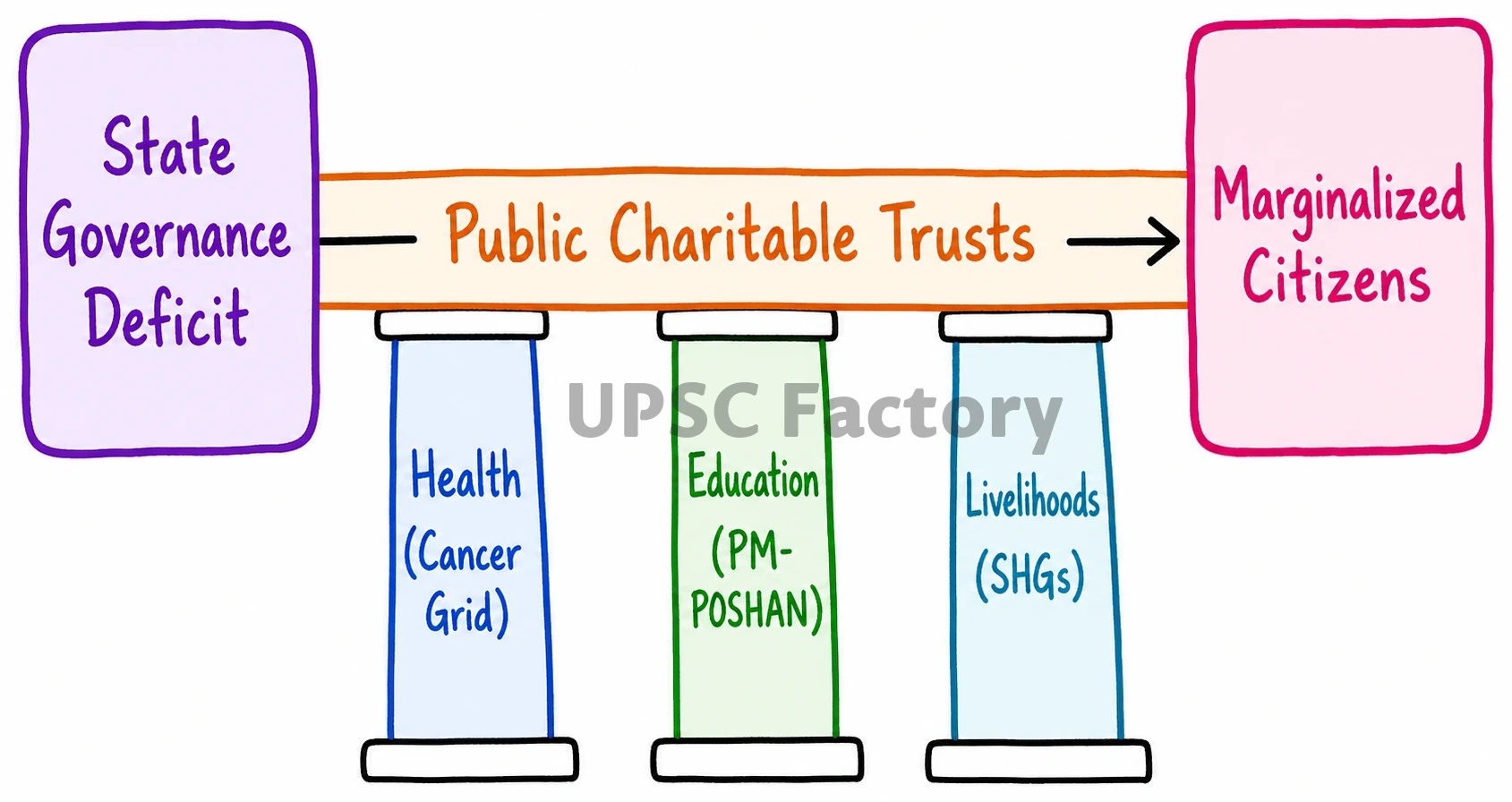
Public charitable trusts (guided by the Indian Trusts Act, 1882) act as vital non-state multipliers, bridging governance deficits and driving grassroots socio-economic equity.
1. Role in Vital Public Issues & Inclusive Development
Healthcare Access: Bridging critical affordability and infrastructure gaps for marginalized demographics (Tata Trusts’ National Cancer Grid).
Education & Nutrition: Enhancing school retention and tackling hidden hunger via scaled grassroots interventions (Akshaya Patra under PM-POSHAN).
Livelihood Generation: Driving rural micro-entrepreneurship and capacity-building, specifically empowering women and vulnerable castes.
Last-Mile Delivery: Translating top-down state welfare policies into accessible realities and acting as swift first-responders during disasters.
Financial Opacity: Misuse of charitable tax exemptions (Sec 12A/80G, Income Tax Act) through shell entities for money laundering.
Geographic Asymmetry: Over-concentration of institutional funding and trust activities in developed urban centers, neglecting backward/aspirational districts.
Adopting an “enabling yet accountable” regulatory architecture, bolstered by centralized digital transparency portals (like DARPAN), will optimally harness charitable trusts for India’s inclusive growth.
Q. Analyse the role of local bodies in providing good governance at local level and bring out the pros and cons merging the rural local bodies with the urban local bodies.
UPSC Mains 2024 GS2 Paper
Model Answer:
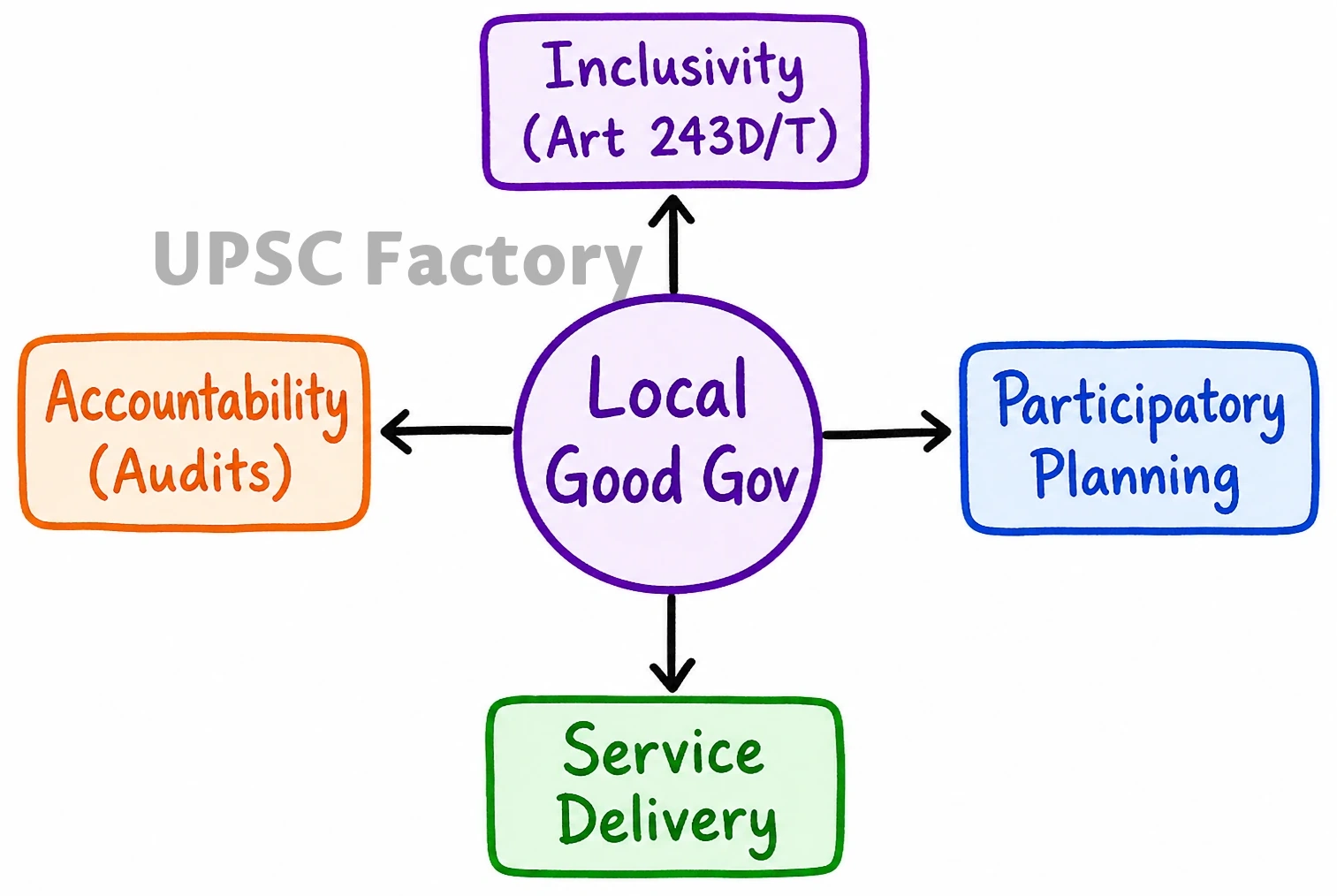
The 73rd and 74th Amendments established local bodies as foundational pillars for realizing democratic decentralization and grassroots good governance.
Rather than a structural merger, empowering District Planning Committees (Article 243ZD) can effectively foster functional rural-urban synergy, aligning with the Rurban Mission’s vision.
Q. “The duty of the Comptroller and Auditor General is not merely to ensure the legality of expenditure but also its propriety.” Comment.
UPSC Mains 2024 GS2 Paper
Model Answer:
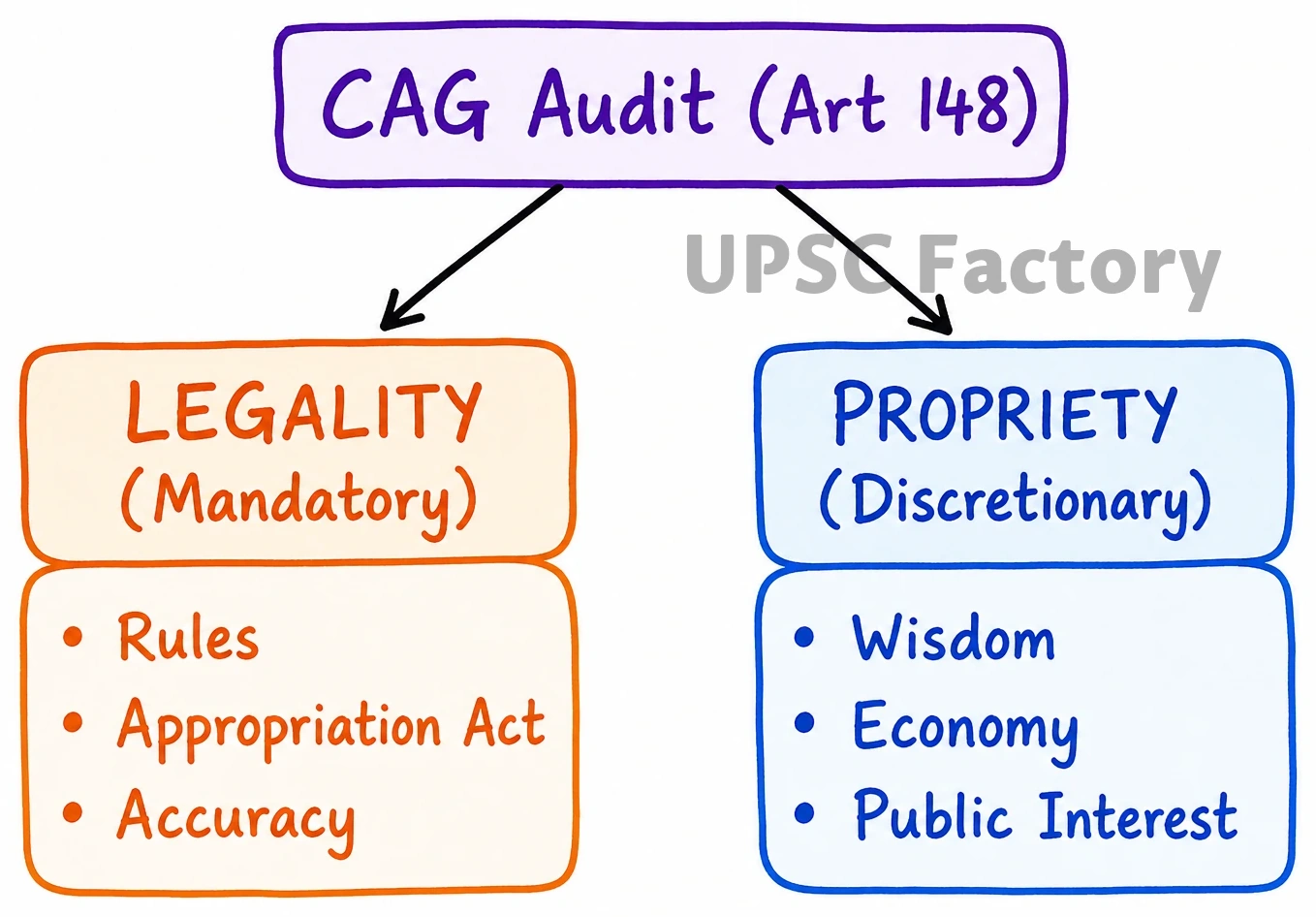
Article 148 establishes the CAG as the guardian of the public purse, drawing its dual audit mandate from the CAG (Duties, Powers and Conditions of Service) Act, 1971.
Wisdom and Economy: Evaluates if the spending was prudent, assessing “value for money” to prevent wasteful allocation.
Substantive Accountability: Questions executive discretion to ensure it genuinely serves the public interest, even if the expenditure is technically legal.
Discretionary Power: While legal audit is mandatory, propriety audit is discretionary yet fundamental for comprehensive parliamentary oversight.
By transcending mechanical compliance to evaluate the overarching prudence of public expenditure, the CAG upholds substantive democratic accountability and financial integrity.
Q. “The growth of cabinet system has practically resulted in the marginalisation of the parliamentary supremacy.” Elucidate.
UPSC Mains 2024 GS2 Paper
Model Answer:
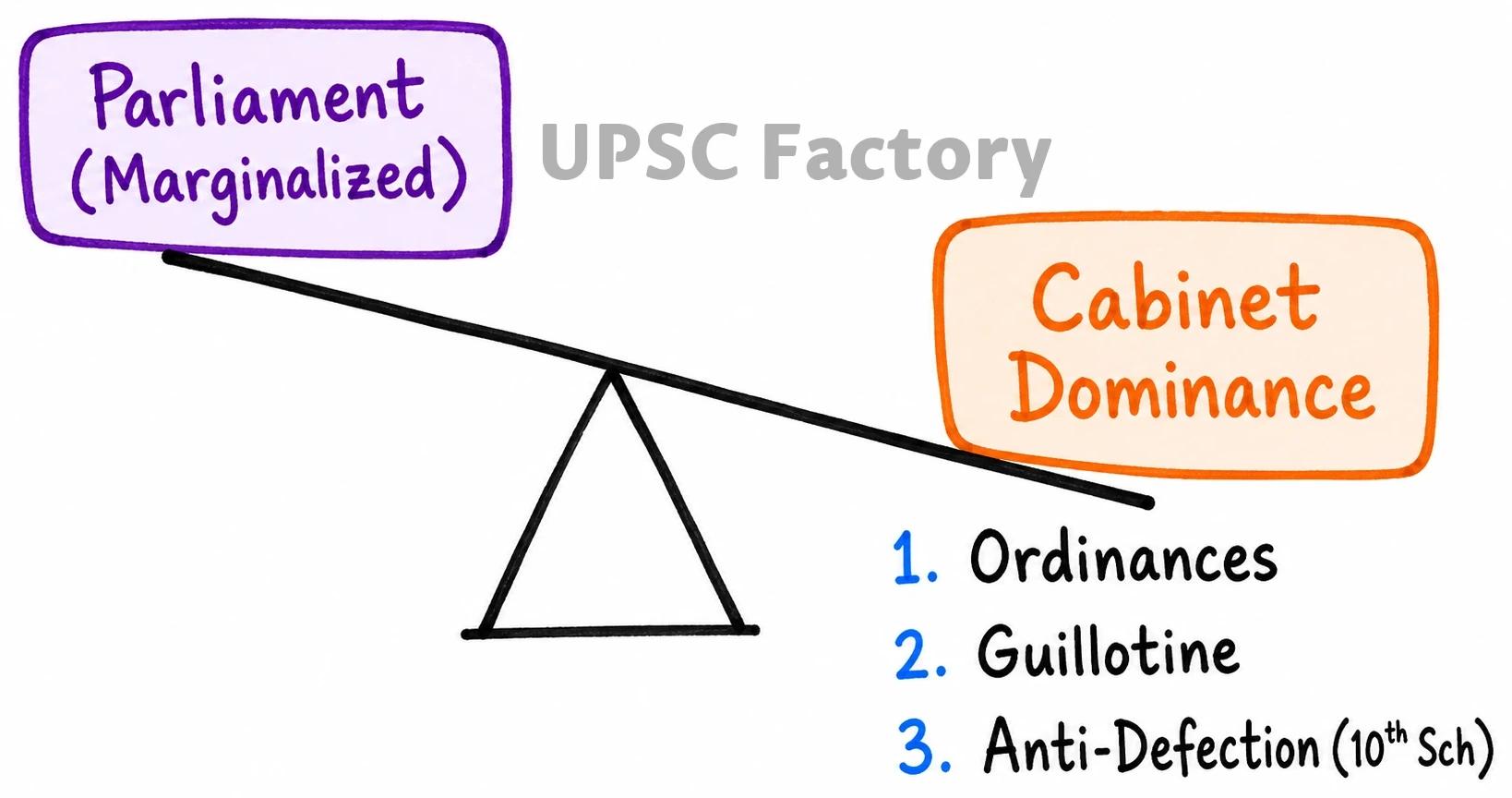
The Westminster model rests on parliamentary supremacy. However, the expanding influence of the Cabinet has progressively shifted the balance of power toward the executive, prompting concerns of a “Cabinet Dictatorship.”
1. Mechanisms of Cabinet Dominance
Legislative Monopoly: The Cabinet dominates law-making, while the 10th Schedule (Anti-Defection Law) stifles independent voting by MPs.
Bypassing Scrutiny: Frequent reliance on ordinances (Ramachandrappa case) and bypassing Parliamentary Standing Committees (e.g., Farm Laws) undermines legislative debate.
Financial Dominance: Excessive use of the “Guillotine” allows massive budgets to pass without adequate parliamentary discussion on Demands for Grants.
Delegated Legislation: Parliament increasingly drafts skeleton laws, leaving substantive rule-making powers entirely to the executive.
2. Sustaining Parliamentary Supremacy
Constitutional Accountability: Under Article 75(3), the Cabinet remains collectively responsible to the Lok Sabha and can be ousted (No-Confidence Motion).
Procedural Checks: Tools like Question Hour, Zero Hour, and Adjournment Motions continuously force the Cabinet to defend its policies.
Post-Mortem Scrutiny: Parliamentary bodies like the Public Accounts Committee, leveraging CAG reports, enforce strict financial accountability.
While the modern Cabinet necessarily drives governance, strengthening the mandate of Parliamentary Committees and easing anti-defection rigidities is vital to restore the constitutional balance of executive accountability.
Q. Explain and distinguish between Lok Adalats and Arbitration Tribunals. Whether they entertain civil as well as criminal cases?
UPSC Mains 2024 GS2 Paper
Model Answer:
Lok Adalats and Arbitration Tribunals are Alternate Dispute Resolution (ADR) mechanisms ensuring speedy, cost-effective justice, albeit differing fundamentally in process and jurisdiction.
1. Key Differences
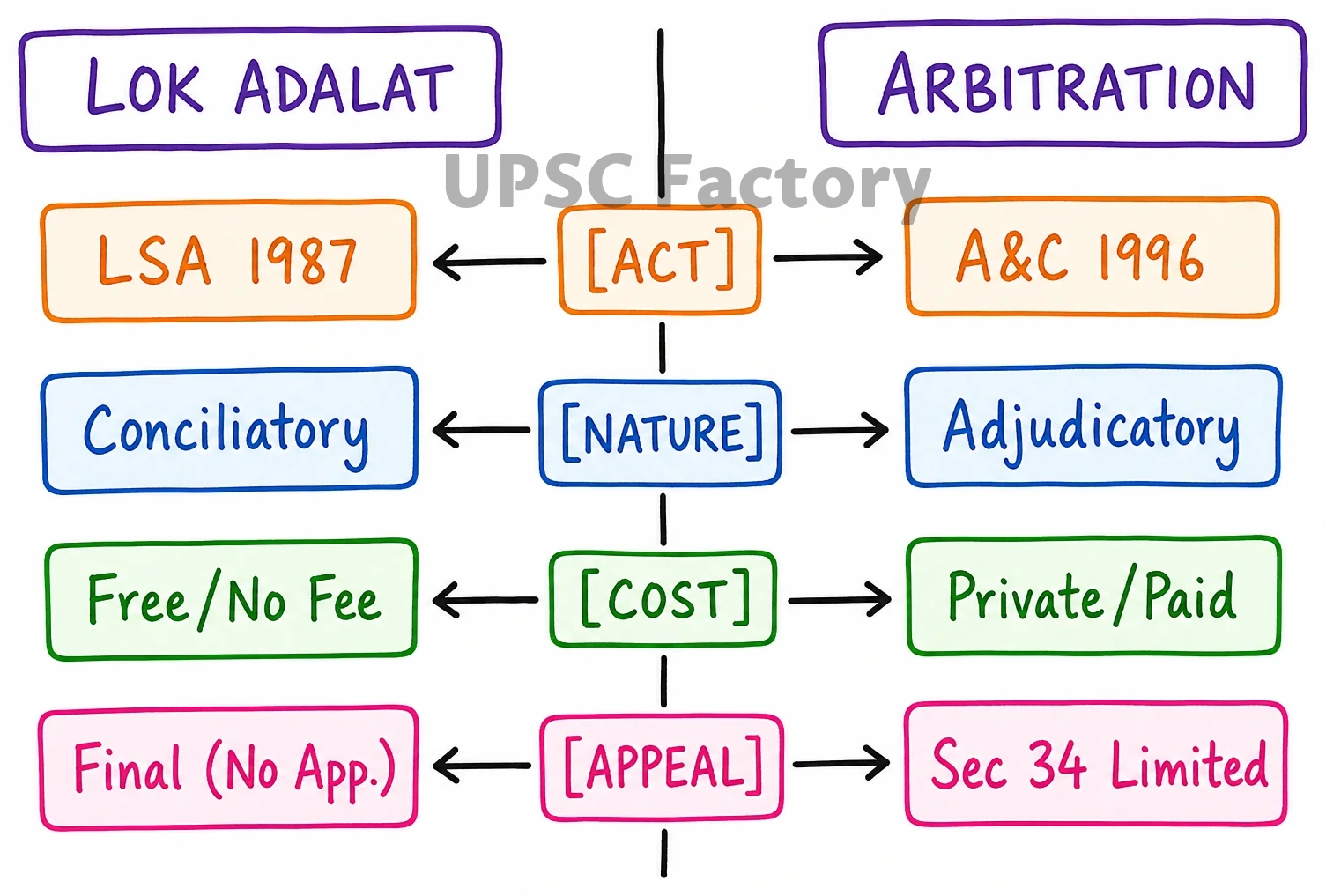
Statutory Basis: Lok Adalats operate under Legal Services Authorities Act, 1987; Arbitration under Arbitration & Conciliation Act, 1996.
Nature: Lok Adalats rely on conciliation and mutual compromise; Arbitration is quasi-judicial and adjudicatory.
Cost: Lok Adalats are completely free (court fee refunded); Arbitration involves private, often expensive arbitrator fees.
Appeal: Lok Adalat awards are final (no appeal); Arbitral awards face limited challenge (Sec 34 A&C Act).
2. Civil and Criminal Jurisdiction
Civil Cases: Both mechanisms widely entertain civil, commercial, and financial disputes (Afcons Infrastructure vs Cherian Varkey).
Criminal Cases (Lok Adalat): Entertains strictly compoundable criminal offences where mutual compromise is legally permissible (Sec 320 CrPC).
Criminal Cases (Arbitration): Strictly barred from entertaining any criminal matters, as crimes are non-arbitrable public wrongs against the State.
While Arbitration promotes commercial efficiency and ease of doing business, Lok Adalats fulfill the constitutional mandate of free, accessible legal aid (Article 39A).
Q. Examine the need for electoral reforms as suggested by various committees with particular reference to “one nation – one election” principle.
UPSC Mains 2024 GS2 Paper
Model Answer:
Electoral reforms are imperative to insulate India’s democracy from structural flaws, prompting multiple expert committees to recommend systemic overhauls.
1. Need for Electoral Reforms: Committee Perspectives
Money Power: Dinesh Goswami Committee recommended partial state funding to curb exorbitant election expenses.
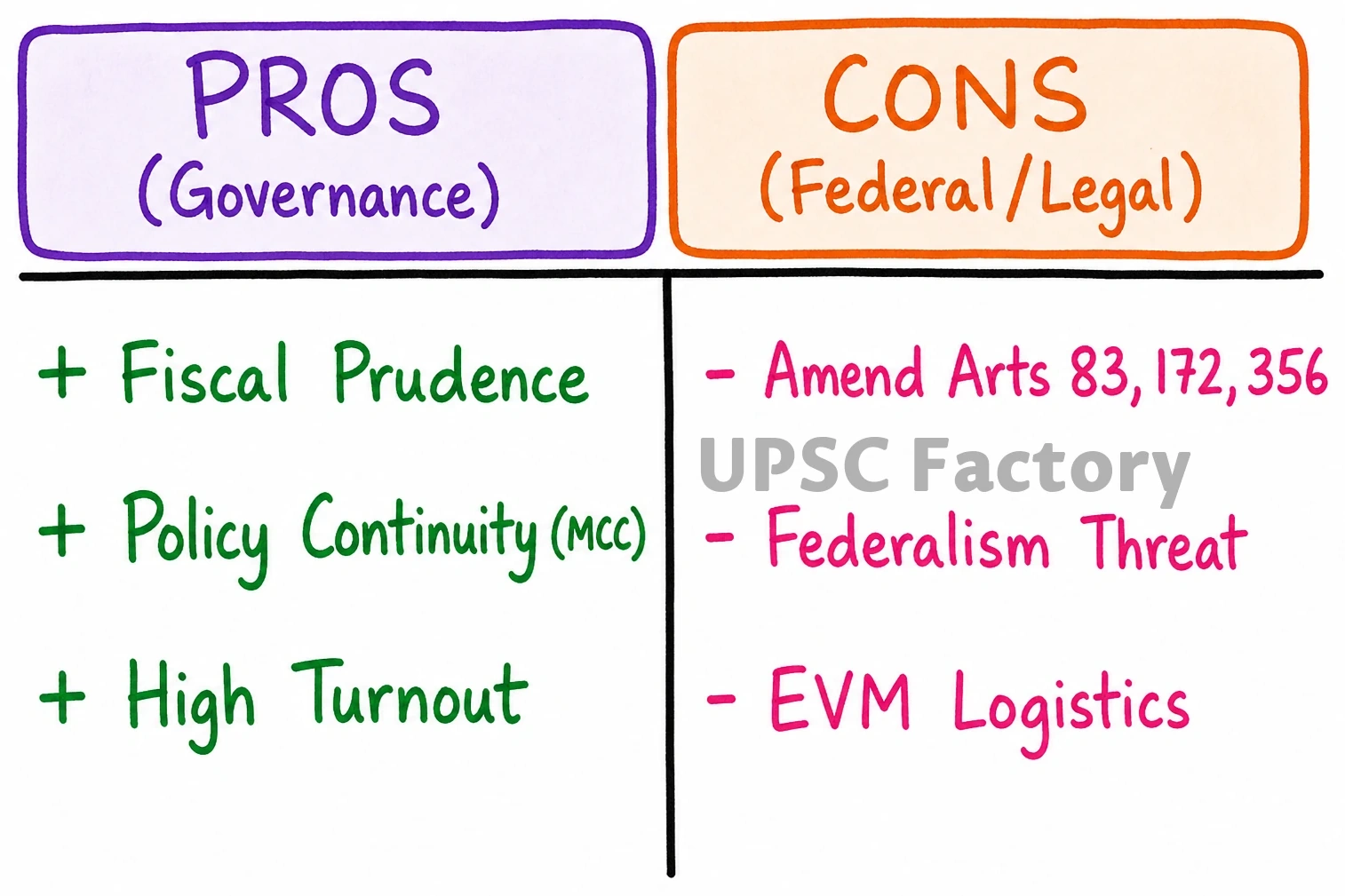
Constitutional Hurdles: Demands complex constitutional amendments (Articles 83, 85, 172, 356) and heavy logistical deployment (EVMs/VVPATs).
Federalism Concerns: Risks overshadowing hyper-local and regional issues with dominant national political narratives.
Implementing ONOE effectively requires broad-based political consensus, a staggered transition mechanism, and robust federal safeguards to uphold India’s constitutional integrity.