Model Answer

Q. Analyse the trilogy between environmental movement, development and tribal identity.

Q. Analyse the trilogy between environmental movement, development and tribal identity.

UPSC Sociology 2024 Paper 2

Model Answer:

Development, Tribal Identity, and Environmental Resistance

The interplay between environmental movements, development, and tribal identity constitutes the central fault line of India’s post-colonial political economy. It highlights the structural contradictions between capitalist growth, ecological sustainability, and indigenous survival.

Development versus Tribal Identity

  • A.R. Desai argues that India’s capitalist path of development structurally necessitates the expropriation of tribal resources through “primitive accumulation.”
  • Walter Fernandes highlights this disproportionate burden: tribals constitute ~8% of the population but over 40% of those displaced by development projects.
  • Virginius Xaxa notes that this alienation from land and forests paradoxically crystallized a pan-tribal political identity, often leading to Retribalization as communities assert distinct roots to resist marginalization.

Regarding tribal identity and environmental resistance, Madhav Gadgil and Ramachandra Guha, in Ecology and Equity, conceptualize this conflict as one between urban-industrial “Omnivores” and tribal “Ecosystem People.” Extractive development turns tribals into “ecological refugees,” sparking an “environmentalism of the poor.” Amita Baviskar, in In the Belly of the River, demonstrates how Bhilala tribals during the Narmada Bachao Andolan mobilized their indigenous identity to fight the dam, proving that grassroots environmentalism is fundamentally about cultural survival and identity defense.

The friction between conservation and tribes shows that the trilogy is not always harmonious. Amita Baviskar critiques “Bourgeois Environmentalism,” where urban-centric conservation (e.g., Tiger Reserves) views tribals as encroachers. This “authoritarian conservation” leads to “green displacement,” attacking tribal identity just as brutally as industrial development.

The Dongria Kondh’s resistance against Vedanta’s bauxite mining in the Niyamgiri Hills perfectly encapsulates this trilogy: corporate development versus ecological degradation versus tribal spiritual identity. Institutional interventions like the Forest Rights Act (FRA), 2006 and PESA, 1996 attempt to reconcile these tensions by legally recognizing tribes as custodians of the environment.

Conclusion

Resolving this trilogy requires moving beyond extractive state capitalism. As B.K. Roy Burman observes, tribes possess a symbiotic relationship with their land. Tribal identity must therefore be embraced not as an obstacle to development, but as an epistemological guide to achieving true ecological and social balance.

Q. Analyse the trilogy between environmental movement, development and tribal identity. Read More »

Q. Is the social stratification theory gender-blind? Elucidate.

Q. Is the social stratification theory gender-blind? Elucidate.

UPSC Sociology 2025 Paper 1

Model Answer:

Gender Stratification and Classical Sociology

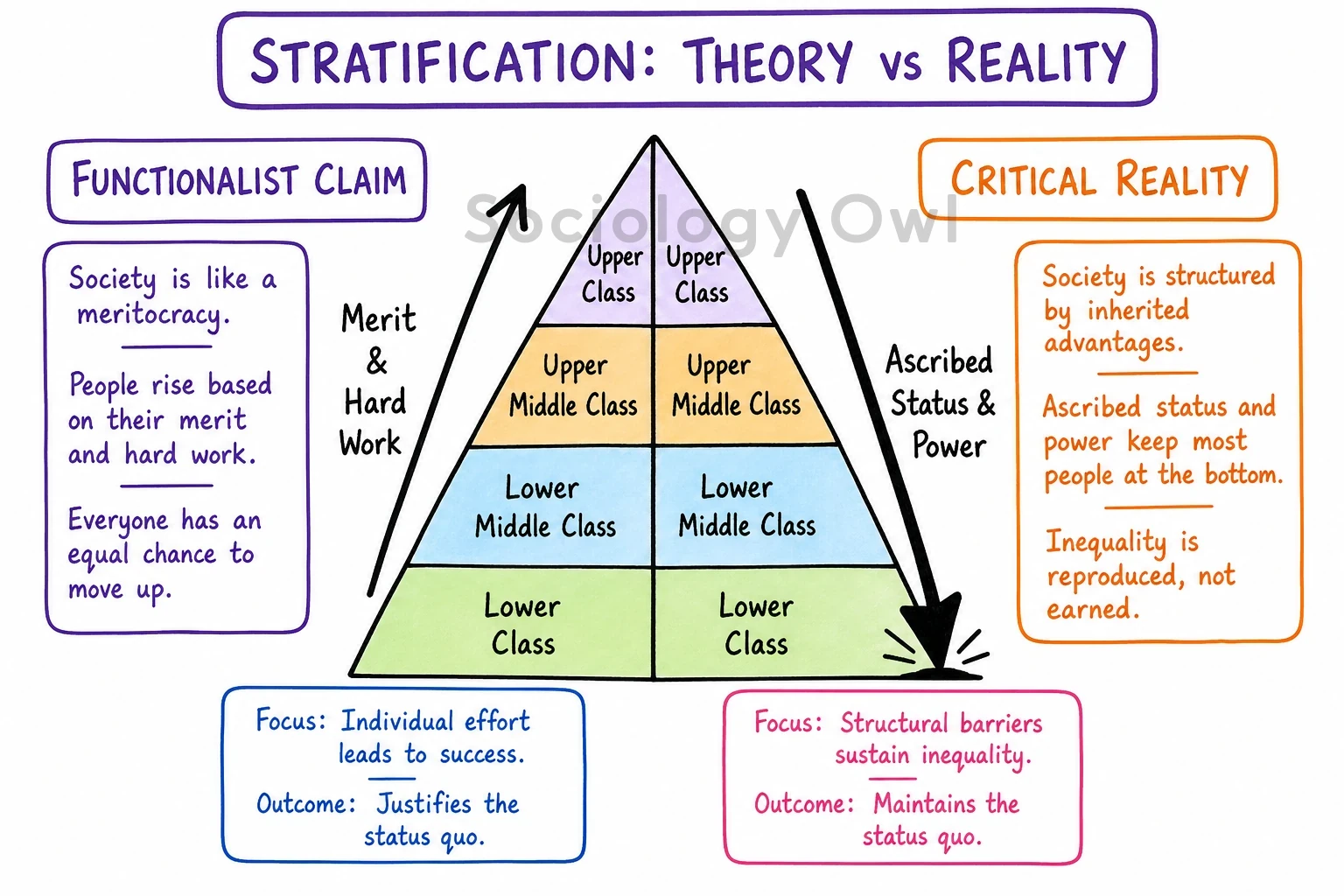
Early stratification theories suffered from “Malestream Sociology”, treating male experiences as the universal norm and ignoring gender as an independent axis of inequality.

  • Marxist Approach: Friedrich Engels reduced women’s subordination merely to a byproduct of capitalism and private property.
  • John Goldthorpe: Derived a family’s class solely from the male household head, sparking fierce critiques from feminists like Michelle Stanworth.
  • Talcott Parsons: Naturalized inequality by functionally justifying the division between male “instrumental” and female “expressive” roles.

Feminist Reconceptualization

  • Unpaid Labor: Ann Oakley (The Sociology of Housework) exposed domestic exploitation, and Arlie Hochschild highlighted women’s “second shift”.
  • Intersectionality: Kimberl0e9 Crenshaw proved that gender stratification is not monolithic but intricately overlaps with race and class.

Stratification remains visibly gendered today, evidenced by the global “Motherhood Penalty” and inherently gendered organizational structures (Joan Acker).

Conclusion

While classical sociology was inherently gender-blind, contemporary paradigms are not. Feminist and intersectional frameworks have successfully established gender as a fundamental, cross-cutting dimension of global social stratification.

Q. Is the social stratification theory gender-blind? Elucidate. Read More »

Do you think that the boundary line between ethnicity and race is blurred? Justify your answer.

Model Answers

Q: Do you think that the boundary line between ethnicity and race is blurred? Justify your answer.

Question asked in UPSC Sociology 2023 Paper 1. Download our app for last 20 year question with model answers. 

Model Answer:

Historically, race implied biological taxonomy, while ethnicity denoted cultural identity. Max Weber defined ethnicity as a “subjective belief in common descent.” Today, sociology views both as intersecting social constructs, making their boundaries highly porous.

Sociological Perspectives on Blurring Boundaries

  • Race as a “Floating Signifier”: Stuart Hall argued racial boundaries are historically fluid. Culturally distinct Irish immigrants in the US, for instance, were later assimilated into the racial category of “whiteness.”
  • “New Racism”: Martin Barker highlights a shift from biological to cultural racism. Ethnicity is increasingly racialized, as seen in Islamophobia, where Muslims face prejudice based on perceived innate cultural traits.
  • Negotiated Boundaries: Fredrik Barth emphasized that Ethnic Boundaries are socially negotiated rather than static, enabling ethnogenesis (e.g., the emergence of a pan-ethnic “Asian American” identity).


In India, the racialization of ethnicities is evident when North-Eastern communities, despite being culturally distinct ethnic groups, face prejudice based on phenotypical physical traits.

Conclusion

While sociobiologists like Pierre van den Berghe maintain an analytical distinction (race as genetics vs. cultural ethnicity), postmodern realities demonstrate that race and ethnicity frequently merge as intertwined tools of social stratification.

Do you think that the boundary line between ethnicity and race is blurred? Justify your answer. Read More »

Q. Discuss the changes taking place in the industrial class structure in India.

Q. Discuss the changes taking place in the industrial class structure in India.

UPSC Sociology 2024 Paper 2

Model Answer:

Historically, Mark Holmstrom termed India’s organized industrial sector a protected “citadel.” Post-1991 reforms breached this wall, transforming secure unionized labor into a deeply fragmented workforce.

Structural Shifts in the Industrial Class

  • Informalization and the Precariat: Jan Breman highlights the rise of “footloose labor,” aligning with Guy Standing’s Precariat—a modern contractual class lacking basic social security.
  • Caste-Class Nexus: As observed by Jonathan Parry, upper castes dominate secure managerial roles, while Dalits and Adivasis overwhelmingly constitute the casual labor pool.
  • Class Bifurcation: Highly skilled knowledge workers undergo Embourgeoisement (adopting middle-class lifestyles), whereas deskilled contract workers suffer diminished collective bargaining power (E.A. Ramaswamy).
  • Feminization of Casual Labor: Export-oriented industries increasingly employ women as cheap, “docile” labor, reflecting a dual capitalist-patriarchal exploitation.

The institutionalization of the Gig Economy and the New Labour Codes (2020) legally formalize this casualization, leading to contemporary industrial frictions, such as the recent unrests at Foxconn.

Conclusion

India’s industrial class structure has transitioned from classic Marxist exploitation to systemic precarity. While liberalization expanded the industrial base, its workforce remains heavily fractured along caste, gender, and contractual vulnerabilities.

Q. Discuss the changes taking place in the industrial class structure in India. Read More »

Q. Critically examine the roles of science and technology in social change. What is your opinion on their increasing trend in ‘online’ education an teaching?

Q. Critically examine the roles of science and technology in social change. What is your opinion on their increasing trend in ‘online’ education an teaching?

UPSC Sociology 2024 Paper 1

Model Answer:

Thorstein Veblen’s “Technological Determinism” views science and technology (S&T) as prime movers of change. Karl Marx noted technology alters the forces of production, while Max Weber linked S&T to rationalization. Conversely, William F. Ogburn warns of a “Cultural Lag” when non-material culture fails to adapt.

S&T and Social Change

While driving progress, S&T also generates systemic modern hazards, creating what Ulrich Beck terms a “Risk Society” (e.g., algorithmic surveillance, cyber-threats).

Sociological View on Online Education

The trend toward online teaching is a double-edged sword:

  • Democratization: It mirrors Ivan Illich’s Deschooling Society by offering decentralized learning webs outside rigid schooling.
  • Class Reproduction: Per Pierre Bourdieu, the digital divide leverages existing Cultural Capital, heavily favoring elites and reproducing inequality.
  • Socialization Deficit: Emile Durkheim saw schools driving secondary socialization. Virtual platforms risk an anomic environment lacking moral peer-group development.

Post-pandemic EdTech and AI (ChatGPT) expand global access but threaten “digital Taylorism”, deskilling traditional educators.

Conclusion

While online learning democratizes education, unmitigated digital divides risk making S&T a tool for class reproduction rather than upward social mobility.

Q. Critically examine the roles of science and technology in social change. What is your opinion on their increasing trend in ‘online’ education an teaching? Read More »

Trace the trajectory of development perspectives on social change.

Model Answers

Q: Trace the trajectory of development perspectives on social change.

Question asked in UPSC Sociology 2022 Paper 1. Download our app for last 20 year question with model answers.

Model Answer:

Development implies directed and desired social change. Sociological perspectives have systematically evolved from unilinear, Eurocentric economic models to critical, structural, and human-centric paradigms.

Trajectory of Development Theories

  • Modernization (1950s-60s): W.W. Rostow (The Stages of Economic Growth) and Talcott Parsons viewed development as a linear, evolutionary shift from “traditional” to “modern” industrial societies.
  • Dependency (1970s): Critiquing modernization, A.G. Frank argued that global capitalism causes the “development of underdevelopment” through surplus extraction by core nations from the periphery.
  • World Systems (1980s): Immanuel Wallerstein refined dependency by adding the dynamic semi-periphery concept to explain shifting global capitalist inequalities.
  • Human and Post-Development (1990s+): Amartya Sen (Development as Freedom) introduced the Capability Approach prioritizing human well-being, while Arturo Escobar offered post-development critiques of Western hegemony.

The rise of BRICS nations perfectly exemplifies Wallerstein’s semi-periphery, while the global adoption of Sustainable Development Goals (SDGs) reflects the contemporary shift toward eco-centric and human-development paradigms.

Conclusion

The sociology of development has successfully transitioned from equating social change merely with capital accumulation and economic growth to a holistic framework emphasizing global equity, ecological sustainability, and human freedom.

Trace the trajectory of development perspectives on social change. Read More »

Q. To what extent can education and skill development be an agent of social change? Critically analyze.

Q. To what extent can education and skill development be an agent of social change? Critically analyze.

UPSC Sociology 2025 Paper 1

Model Answer:

Education has a dual sociological role: a Functionalist catalyst for mobility and a Conflict mechanism reproducing inequality, often driving positional rather than structural change.

Agent of Change (Functionalist View)

  • Value Transformation: Talcott Parsons notes schools instill universalistic values. Alex Inkeles links education to modernization.
  • Capacity Building: Aligning with Amartya Sen’s Capability Approach, initiatives like Skill India expand human freedoms.

Agent of Status Quo (Conflict View)

  • Cultural Capital: Pierre Bourdieu argues schools validate dominant culture, marginalizing lower classes.
  • Credentialism: Randall Collins warns that unchecked skill-focus drives credential inflation, exacerbating educated unemployment.
  • Reproduction: Bowles and Gintis (Schooling in Capitalist America) identify a Correspondence Principle conditioning students for capitalist hierarchies. Paulo Freire critiques this status-quo-affirming “Banking Concept of Education”.

Global EdTech (MOOCs) democratizes skills but simultaneously creates a “New Digital Divide” between the Global North and South, reinforcing systemic inequities.

Conclusion

As A.R. Desai suggests, unless underlying unequal economic structures are transformed, education remains necessary but insufficient for genuine social change, often perpetuating the very hierarchies it aims to dismantle.

Q. To what extent can education and skill development be an agent of social change? Critically analyze. Read More »

Q. How do you understand the phenomena of the mushrooming of sects and cults in contemporary society? Discuss the factors responsible for the trend.

Q. How do you understand the phenomena of the mushrooming of sects and cults in contemporary society? Discuss the factors responsible for the trend.

UPSC Sociology 2024 Paper 1

Model Answer:

Sociologically, the mushrooming of sects and cults falls under the study of New Religious Movements (NRMs) (Eileen Barker). Max Weber and Ernst Troeltsch define sects as exclusive, breakaway groups existing in high tension with broader society. Conversely, Howard Becker defines cults as loosely structured, highly individualistic groups centered on novel mystical experiences outside dominant religious traditions.

Structural and Post-modern Perspectives

Loss of the Sacred Canopy: Peter Berger argues modernity and secularization have collapsed the overarching “Sacred Canopy”, leaving individuals in a state of meaninglessness (Anomie). Cults provide a new, rigid moral framework.

Relative Deprivation Theory: Charles Glock and Rodney Stark emphasize that people join NRMs not just due to economic poverty, but due to psychic, organismic, or ethical deprivation. This explains the affluent, middle-class appeal of movements like Osho or Scientology.

Charismatic Leadership: As per Max Weber, during periods of societal crisis, leaders with Charismatic Authority emerge to offer revolutionary, customized salvation that contrasts with bureaucratic established religions.

Religious Market Theory: Rodney Stark and William Bainbridge argue that secularization creates a “spiritual marketplace.” Here, sects and cults act as entrepreneurial firms competing for adherents by offering tailored “religious compensators.”

Liquid Modernity: Following Jean-François Lyotard’s thesis on the decline of grand narratives, Zygmunt Bauman argues that in “Liquid Modernity,” individuals reject traditional orthodoxy to create “do-it-yourself” micro-religions.

The Cultic Milieu: Colin Campbell notes that contemporary society possesses a deep cultural openness to mysticism and alternative healing, creating fertile ground for cults.

Globally, the internet fosters algorithm-driven virtual cults (e.g., QAnon). In India, the rise of Dera culture is a structural response to agrarian alienation and mainstream caste rigidities. This sparks an academic debate: Bryan Wilson argues sectarianism proves Secularization as religion fragments into marginalized niches. Conversely, post-secularists invoke Mircea Eliade’s concept of Homo Religiosus in The Sacred and the Profane, asserting religion is merely transforming, not dying.

Conclusion

Ultimately, the proliferation of sects and cults reflects Grace Davie’s concept of “believing without belonging.” As trust in orthodox religious institutions wanes, individuals seek alternative, personalized avenues for spiritual consumption, identity, and community in a fragmented world.

Q. How do you understand the phenomena of the mushrooming of sects and cults in contemporary society? Discuss the factors responsible for the trend. Read More »

Q. What is sustainable development? How can sustainability be achieved in India where livelihood needs conflict with environmental protection?

Q. What is sustainable development? How can sustainability be achieved in India where livelihood needs conflict with environmental protection?

UPSC Sociology 2024 Paper 2

Model Answer:

Sustainable development, defined by the Brundtland Commission as meeting present needs without compromising future generations, is not just an ecological issue in India but a profound crisis of social equity. In India’s biomass-based subsistence economy, development often pits environmental conservation against the basic livelihoods of marginalized communities.

Sociological Analysis of the Conflict

The livelihood-environment conflict in India is rooted in unequal resource distribution and power dynamics:

  • Environmentalism of the Poor: Ramachandra Guha divides Indian society into “Omnivores” (urban/capitalist elite), “Ecosystem People” (tribals/peasants dependent on nature), and “Ecological Refugees” (those displaced by development). The conflict is essentially Omnivores exploiting resources at the direct cost of Ecosystem People.
  • Bourgeois Environmentalism: Amita Baviskar highlights how the urban middle-class vision of a pristine environment (e.g., exclusive national parks or slum clearances) routinely criminalizes and displaces the livelihoods of the rural and urban poor.
  • Marxist Perspective: A.R. Desai asserts that the post-independence, state-led capitalist development model commodified nature, resulting in the structural marginalization of tribes through primitive accumulation.

Pathways to Achieving Sustainability in India

Balancing ecology and livelihood requires the structural democratization of resource management:

  • Institutional Decentralization: Legislations like the Forest Rights Act (FRA), 2006 reconcile this conflict by recognizing the historical rights of forest-dwellers, shifting the paradigm from “conservation against people” to “conservation by people.”
  • Feminist Environmentalism: Contrasting Vandana Shiva’s spiritual eco-feminism, Bina Agarwal argues that women’s connection to nature is rooted in their material reality (gathering fuel, fodder). Sustainability requires integrating women into resource governance.
  • Ideological Shift: Blending Traditional Ecological Knowledge (TEK) with Mahatma Gandhi’s principle of Sarvodaya (welfare of all) counters ecologically destructive modern industrialism.

Instances of subaltern environmentalism, such as the Niyamgiri Hills movement (Dongria Kondh tribe vs. mining interests) and the Hasdeo Arand protests, perfectly illustrate this clash, emphasizing that true sustainability demands indigenous consent and community-led conservation models.

Conclusion

Sustainability in India cannot be achieved through top-down, coercive “fortress conservation.” It necessitates an eco-socialist framework where the poorest are empowered and recognized not as enemies of the environment, but as its primary custodians.

Q. What is sustainable development? How can sustainability be achieved in India where livelihood needs conflict with environmental protection? Read More »

Q. Describe the main idea of Max Weber’s book, ‘The Protestant Ethic and the Spirit of Capitalism’ as a critique of Marxism.

Q. Describe the main idea of Max Weber’s book, ‘The Protestant Ethic and the Spirit of Capitalism’ as a critique of Marxism.

UPSC Sociology 2024 Paper 1

Model Answer:

Max Weber’s The Protestant Ethic and the Spirit of Capitalism is often described by scholars like Albert Salomon as a “dialogue with the ghost of Karl Marx.” It offers a fundamental critique of Marx’s Historical Materialism, demonstrating how non-material ideological forces can drive profound economic transformations.

Weber’s Critique of Marxist Economic Determinism

Inverting the Base-Superstructure Model: While Marx argued that the economic “base” strictly determines the ideological “superstructure,” Weber demonstrated that ideas can shape economies. He highlighted how Calvinism fostered the Spirit of Capitalism.

Elective Affinity over Strict Causality: Rejecting mechanical determinism, Weber proposed an Elective Affinity (Wahlverwandtschaft) between the Doctrine of Predestination and modern capitalism. The anxiety of salvation was resolved through Inner-worldly asceticism—treating rational labor and wealth accumulation as a religious “calling.”

Pluralistic Causality: Weber rejected Marxist monocausality. He explicitly clarified that his goal was not to replace a “one-sided materialistic” explanation of history with an equally flawed “one-sided spiritualistic” one, but to show their interplay via Social Action.

Critiques and Theoretical Extensions

Materialist Pushback: R.H. Tawney countered Weber, arguing that the technological and economic foundations of capitalism preceded Protestantism, which merely adapted to existing material realities.

Alternative Cultural Origins: Werner Sombart argued that the Jewish ethic, rather than Protestantism, was the true catalyst for capitalist development.

Neo-Marxist Critique: Immanuel Wallerstein argued that capitalism emerged not from religious ethics, but from historical colonialism and structural exploitation of the Global South.

Shared Structural Pessimism: Despite debating its origins, both thinkers despised capitalism’s outcomes. Marx condemned Alienation, while Weber warned of a secularized, bureaucratic “Iron Cage of Rationality.”

Weber’s framework remains vital today. Sociologist Tu Weiming utilized it to explain the rapid rise of the “Asian Tigers,” attributing their success to a Confucian Work Ethic. Furthermore, modern “hustle culture” in Silicon Valley mirrors a hyper-rationalized, secularized descendant of Weber’s Protestant ethic.

Conclusion

Weber provided a necessary corrective to crude economic determinism. By establishing that cultural meanings shape economic structures, he permanently cemented the sociological axiom that while material realities are crucial, ideas frequently act as the “switchmen of history.”

Q. Describe the main idea of Max Weber’s book, ‘The Protestant Ethic and the Spirit of Capitalism’ as a critique of Marxism. Read More »