Model Answer

Q. How does a multicultural society accommodate diversities of all kinds—ethnic, linguistic and religious? Discuss its major challenges.

Q. How does a multicultural society accommodate diversities of all kinds—ethnic, linguistic and religious? Discuss its major challenges.

UPSC Sociology 2024 Paper 1

Model Answer:

Multicultural Society

Multiculturalism represents both a sociological reality and a normative political ideology, shifting societies from an assimilationist “Melting Pot” to a pluralistic “Salad Bowl” model. Charles Taylor, in his “Politics of Recognition”, posits that accommodating diversity is essential because human identity is fundamentally shaped by social recognition of one’s distinct culture.

Mechanisms of Accommodating Diversities

Societies institutionalize pluralism by moving beyond uniform equality to specialized frameworks:

  • Differentiated Citizenship Rights: Will Kymlicka argues that true accommodation requires group-specific rights. This includes polyethnic rights (funding minority cultural/religious practices), special representation rights (affirmative action in politics), and self-government rights (autonomy for indigenous groups).
  • Consociational Democracy: Arend Lijphart highlights accommodation through institutionalized power-sharing, mutual vetoes, and proportional representation among ethnic or religious elites.
  • Dialogical Approach: Bhikhu Parekh emphasizes establishing a formal “dialogue between cultures” where no single dominant culture acts as the universal benchmark for legal and educational policies.

Major Sociological Challenges

  • The Feminist Critique: In Is Multiculturalism Bad for Women?, Susan Moller Okin argues that granting special group rights often shields and reinforces deeply rooted patriarchal practices within minority communities.
  • Recognition vs. Redistribution: Scholars like Nancy Fraser and Slavoj Žižek argue that an overemphasis on identity politics and cultural recognition obscures underlying systemic economic inequalities and class struggles.
  • Social Capital Deficit: Robert Putnam’s research indicates that, in the short term, high ethnic diversity can cause communities to “hunker down,” leading to ghettoization and a reduction in civic solidarity and social trust.

Globally, accommodation models vary. Canada pioneered the “Cultural Mosaic” via official state multiculturalism. Conversely, France’s assimilationist Laïcité (secularism) struggles to accommodate religious diversity, evident in hijab bans. Today, perceived integration failures have sparked a Western European backlash, fueling right-wing populism.

Conclusion

To prevent individuals from being trapped in rigid cultural boxes, Amartya Sen advocates recognizing fluid “Plural Identities”. Ultimately, sustainable multiculturalism requires Jürgen Habermas’s “Constitutional Patriotism,” where social cohesion is anchored in shared democratic values rather than a homogenized majority culture.

Q. How does a multicultural society accommodate diversities of all kinds—ethnic, linguistic and religious? Discuss its major challenges. Read More »

Write short note on Concept of Ideal Type and its limitations.

Model Answers

Q: Write short note on Concept of Ideal Type and its limitations.

Question asked in UPSC Sociology 2006 Paper 1. Download our app for last 20 year question with model answers.

Model Answer:

The concept of the Ideal Type was introduced by Max Weber in his seminal work, “The Methodology of the Social Sciences” (1949). The concept emerged against the backdrop of the Methodenstreit (debate on methods) in late 19th-century Germany. At the time, scholars were deeply divided between the positivist approach (which sought universal laws or nomothetic knowledge) and the historicist approach (which emphasized unique, unrepeatable historical events or idiographic knowledge). Influenced by Neo-Kantian philosophers like Heinrich Rickert and Wilhelm Windelband, Weber developed the Ideal Type as a methodological bridge. It allowed sociologists to extract general patterns from unique historical realities, thus making the scientific study of subjective social action (Verstehen) possible.

Understanding the ‘Ideal Type’

An Ideal Type is a mental construct (Gedankenbild) formed by the one-sided accentuation of one or more points of view. It synthesizes a great many diffuse and discrete individual phenomena into a unified analytical construct. It is important to note that the word “ideal” does not denote moral perfection or a normative goal, but rather logical purity.

Key Characteristics

  • Heuristic Device: It is an analytical tool used as a measuring rod to compare, analyze, and understand empirical reality.
  • Value-Neutrality: Ideal types are free from moral or ethical judgments. An ideal type of a brothel is as scientifically valid as an ideal type of a church.
  • Conceptual Construct: It is not a historical reality or a statistical average; rather, it is a deliberately exaggerated and simplified model.
  • Logical Coherence: While it exaggerates certain traits, the construct must make logical sense and reflect causal relationships.

Sociological Application of Ideal Types

Weber applied this methodology extensively to study various social phenomena. Below is a comparative table demonstrating how an Ideal Type functions as a benchmark against empirical reality:

ConceptWeber’s Ideal Type (Theoretical Construct)Empirical Reality (Real-World Observation)
BureaucracyStrict hierarchy, complete impersonal relations, purely merit-based recruitment, and comprehensive written rules.Nepotism may exist, informal networks influence decisions, and red tape slows down efficiency.
AuthorityPurely Traditional, Charismatic, or Rational-Legal forms of domination.A mix of types (e.g., a democratically elected leader who also possesses charismatic appeal).
CapitalismPurely rational pursuit of profit, completely free market exchange, absolute private ownership.State interventions, monopolies, and irrational speculative behaviors exist.

The Indian Context: Application and Critique

The concept of the Ideal Type is deeply relevant to Indian sociology (Paper 2), as Indian and Western scholars have frequently used idealized constructs to make sense of India’s complex social fabric.

  • Louis Dumont: In his book “Homo Hierarchicus”, Dumont constructed an Ideal Type of the Indian caste system based on the principles of purity and pollution. He contrasted this with “Homo Equalis” (the egalitarian West).
  • Critique of Dumont: Indian sociologists like Dipankar Gupta argue that Dumont’s Ideal Type oversimplifies reality by ignoring the material, economic, and power disparities inherent in the caste system, mistaking a Brahminical textual ideal for empirical reality.
  • M.N. Srinivas: Concepts like Sanskritization and the Dominant Caste function as heuristic devices (Ideal Types) to understand social mobility and power dynamics in rural India, even if no single village perfectly embodies all criteria of a dominant caste.
  • A.R. Desai: Using a Marxist lens, Desai rejected purely cultural ideal types of Indian society, arguing that such constructs obscure the actual class struggles and historical materialism shaping the Indian agrarian structure.

Limitations and Criticisms

While highly influential, Weber’s methodology has faced significant scrutiny from various sociological traditions:

  • Phenomenological Critique: Alfred Schutz criticized Weber for imposing the sociologist’s subjective ideal type onto the actors. Schutz argued that sociologists should focus on the “typifications” constructed by everyday people in their lived experiences, rather than artificial academic constructs.
  • Static Nature: Talcott Parsons noted that Ideal Types often fail to capture the dynamic, evolving nature of social systems. They provide a “snapshot” of a phenomenon but struggle to explain the mechanics of continuous social change.
  • Risk of Reification: There is a frequent danger of the Fallacy of Misplaced Concreteness, where researchers mistake the Ideal Type for a true description of reality, thereby forcing empirical data to fit preconceived models.
  • Cultural Bias: Marxist scholars argue that Weber’s ideal types (like Rational-Legal authority) carry an implicit Eurocentric bias, presenting Western modernization and capitalism as the ultimate standard of rationality.

Contemporary Relevance

In the modern, globalized world, the Ideal Type remains an indispensable tool for sociological inquiry. With the rise of the digital age, sociologists are constructing new ideal types to study emerging phenomena. For instance, analyzing the “Gig Economy” or “Algorithmic Bureaucracy” requires creating new ideal types to benchmark how artificial intelligence and platform capitalism deviate from traditional Weberian rational-legal bureaucracy. Furthermore, analyzing global phenomena like cyber-terrorism or virtual communities relies heavily on constructing updated heuristic models.

Conclusion

Despite its limitations, the Ideal Type remains a foundational pillar of sociological methodology. It prevents sociology from becoming a mere chronological listing of historical facts by providing a rigorously defined vocabulary for comparative analysis. As the prominent sociologist Lewis Coser aptly summarized, “The ideal type is a conceptual measuring rod… it is an analytical construct that enables the investigator to estimate the distance between the theoretical model and the empirical reality.” Thus, when used cautiously as a point of departure rather than an end in itself, the Ideal Type continues to drive profound sociological insights.

Write short note on Concept of Ideal Type and its limitations. Read More »

Q. Bring out various factors responsible for declining of village Industries in India.

Q. Bring out various factors responsible for declining of village Industries in India.

UPSC Sociology 2025 Paper 2

Model Answer:

Historically romanticized as “little republics,” Indian villages relied on a symbiotic integration of agriculture and artisan crafts. However, structural and cultural transformations have driven their precipitous decline.

Sociological Factors for Decline

  • Colonial Capitalism: A.R. Desai notes that colonial market forces destroyed pre-capitalist rural economies, causing the “proletarianization” of artisans into landless laborers.
  • Jajmani Disintegration: William Wiser documented the collapse of reciprocal caste-based patronage. F.G. Bailey adds that rural monetization replaced hereditary duties with precarious contractual relations.
  • Caste Stigma & Mobility: Driven by purity-pollution stigmas, youths from lower artisan castes increasingly abandon traditional crafts for secular jobs, seeking upward mobility (Sanskritization).
  • Gender Marginalization: The collapse of household industries heavily displaced female family labor, worsening the “feminization of agricultural poverty.”

State interventions like the PM Vishwakarma Yojana and civil society cooperatives like SEWA actively counter artisan exploitation by providing modern credit, skills, and market access.

Conclusion

This decline represents the dismantling of traditional social ecology. Reinvigorating rural industries is vital for curbing distress migration, checking economic marginalization, and empowering historically oppressed artisan castes.

Q. Bring out various factors responsible for declining of village Industries in India. Read More »

How do you understand the relationship between patriarchy and social development ?

Model Answers

Q: How do you understand the relationship between patriarchy and social development ?

Question asked in UPSC Sociology 2022 Paper 1. Download our app for last 20 year question with model answers.

Model Answer:

Patriarchy and Development

Sylvia Walby defines Patriarchy as a structural system of male dominance. Conversely, social development, per Amartya Sen’s Capability Approach, means expanding human freedoms. Patriarchy acts as systemic capability deprivation.

Patriarchy’s Dual Impact on Growth

Patriarchy Subsidizing Development:

  • Marxist-Feminism: Maria Mies argues capitalism relies on patriarchy, utilizing women’s unpaid reproductive labor to subsidize growth.
  • Marginalization: Ester Boserup, in Woman’s Role in Economic Development, proved early modernization marginalized women, deepening the Sexual Division of Labour.

Patriarchy Hindering Growth:

  • Resource Exclusion: Bina Agarwal shows patriarchal norms restrict property rights, stifling economic autonomy.
  • Demographic Deficit: Healthcare biases create extreme disparities, culminating in Amartya Sen’s concept of “Missing Women”.

Globalized development sustains patriarchy via the “Global Care Chain” (Arlie Hochschild), extracting care labor from the Global South while imposing a “Second Shift” on working women.

Conclusion

Authentic development requires transitioning from ‘Women in Development’ (WID) to ‘Gender and Development’ (GAD) frameworks, dismantling patriarchal structures rather than merely integrating women into flawed economic models.

How do you understand the relationship between patriarchy and social development ? Read More »

Q. Identify different forms of inequalities associated with agrarian social structure in India.

Q. Identify different forms of inequalities associated with agrarian social structure in India.

UPSC Sociology 2024 Paper 2

Model Answer:

Agrarian Social Structure and Inequalities

The agrarian social structure refers to the institutional framework of agricultural production and the resulting social relations. Daniel Thorner conceptualized this structure through property relations, classifying agrarian classes into Maliks (landlords), Kisans (working peasants), and Mazdoors (landless laborers), immediately highlighting the inherent structural inequalities.

Historically, as Andre Béteille noted, agrarian India featured “cumulative inequality,” where upper castes exclusively monopolized land, wealth, and political power. While modern democratic forces are shifting this toward “dispersed inequality,” Dalits overwhelmingly remain landless agricultural laborers.

M.N. Srinivas conceptualized that agrarian inequalities are sustained by Dominant Castes (e.g., Jats, Kammas). They leverage their numerical strength and land ownership to exert localized political and socio-economic dominance over lower castes.

Using a Marxist perspective, A.R. Desai argued that state-led land reforms actually fostered a new class of rural capitalists, deepening class divides. Furthermore, Jan Breman highlights how traditional patronage has devolved into pure capitalist exploitation of unorganized rural labor.

Bina Agarwal, in A Field of One’s Own, emphasizes that patriarchal inheritance norms exclude women from land titles. Despite the contemporary “Feminization of Agriculture”, women perform the majority of farm labor but lack land ownership and access to institutional credit.

Today, traditional disparities are exacerbated by the Digital Divide and Ecological Inequality. As highlighted by P. Sainath, marginal farmers are disproportionately vulnerable to climate change and debt traps, culminating in rural distress. This reflects the complex Mode of Production Debate—Indian agriculture remains an unequal hybrid of semi-feudal legacies and ruthless capitalist market forces.

Conclusion

Agrarian inequalities have mutated from traditional caste-based hierarchies to complex capitalist divides. Dismantling this structure requires systemic interventions, notably Land Reforms 2.0 to secure tenancy and women’s land rights, thereby empowering the subaltern classes toward an egalitarian rural society.

Q. Identify different forms of inequalities associated with agrarian social structure in India. Read More »

Q. How can you assess the significance of social movements in the digital era? Explain.

Q. How can you assess the significance of social movements in the digital era? Explain.

UPSC Sociology 2025 Paper 1

Model Answer:

In the digital era, movements have shifted from hierarchical structures to fluid networks, fundamentally transforming Resource Mobilization (McCarthy & Zald) through rapid cyber-activism.

Networked Mobilization and Public Sphere

  • Networks of Outrage and Hope: Manuel Castells argues decentralized digital nodes drastically lower mobilization costs and bypass traditional organizational hierarchies.
  • Networked Public Sphere: Updating Jürgen Habermas, digital platforms allow subaltern groups (e.g., Dalit WhatsApp networks) to bypass media gatekeepers via viral framing.
  • New Social Movements: Following Alberto Melucci, digital activism focuses heavily on post-materialistic identity and symbols rather than traditional class struggles.

Critical Limitations

  • Weak Ties: Malcolm Gladwell critiques digital “slacktivism” for fostering shallow connections that lack the organizational resilience (Zeynep Tufekci) necessary for high-risk activism.
  • Digital Authoritarianism: In The Net Delusion, Evgeny Morozov highlights how states weaponize algorithms for surveillance and control.

The 2020-21 Indian Farmers’ Protest successfully merged digital “toolkits” with grassroots organizing to build transnational solidarity, mirroring the global identity-based mobilization of #MeToo.

Conclusion

Ultimately, while digital platforms provide a powerful mobilizing spark, sustaining structural social change requires translating online “weak ties” into robust, offline structural action.

Q. How can you assess the significance of social movements in the digital era? Explain. Read More »

Q. Discuss the trend of urbanization in India. Do you think that Industrialization is the only precondition of urbanization? Give you arguments.

Q. Discuss the trend of urbanization in India. Do you think that Industrialization is the only precondition of urbanization? Give you arguments.

UPSC Sociology 2025 Paper 2

Model Answer:

Urbanization in India is not merely a demographic shift but a complex structural and cultural transformation. Ashish Bose characterizes India’s unique demographic trajectory as “Pseudo-urbanization,” where urban growth occurs without commensurate economic development, while M.S.A. Rao views it as a profound shift in the traditional social matrix.

Trends of Urbanization in India

  • Subaltern Urbanization: Coined by Eric Denis and Partha Mukhopadhyay, the emergence of thousands of new census towns reflects autonomous growth driven by local capital and informal networks, independent of state industrial planning.
  • Exclusionary Urbanization: Amitabh Kundu argues that top-heavy metropolitan growth pushes the urban poor to the peripheries while gentrifying core city spaces.
  • Rural-Urban Continuum: Disputing a strict rural-urban dichotomy, G.S. Ghurye and Dipankar Gupta highlight a continuum where mixed migration blurs spatial and cultural boundaries.

Industrialization: Not the Sole Precondition

While the Western paradigm links urbanization directly to the Industrial Revolution, India’s trajectory is multi-causal:

  • Over-urbanization: Bert F. Hoselitz notes that Indian cities grow demographically without proportionate industrial expansion, heavily driven instead by the tertiary service sector.
  • Typology of Cities: M.S.A. Rao explicitly identified non-industrial origins for urban centers, including religious (Varanasi), administrative (Chandigarh), and commercial towns.
  • Agrarian Distress and Informalization: Jan Breman highlights how rural unviability pushes footloose labor into cities. Furthermore, Kalyan Sanyal argues that post-1991 economic reforms bypassed traditional manufacturing, creating vast informal sectors rather than an industrial proletariat.

Policy and Crisis Integration: The government’s Shyama Prasad Mukherji Rurban Mission actively addresses non-industrial rural-urban clusters by providing urban amenities. Additionally, the COVID-19 reverse migration ruthlessly exposed how Indian urbanization heavily relies on an informal, non-industrial workforce, validating Breman’s thesis.

Conclusion

India’s urbanization represents a distinct, multi-causal synthesis of modern economic shifts and traditional structures, proving industrialization is not the sole precondition. Moving forward, urban policy must embrace David Harvey’s framework of the “Right to the City,” shifting from exclusionary enclaves toward inclusive spaces for informal and rural migrant populations.

Q. Discuss the trend of urbanization in India. Do you think that Industrialization is the only precondition of urbanization? Give you arguments. Read More »

The decade of 1950s was the golden period of village studies in Indian Sociology. Explain the statement.

Model Answers

Q: The decade of 1950s was the golden period of village studies in Indian Sociology. Explain the statement.

Question asked in UPSC Sociology 2023 Paper 2. Download our app for last 20 year question with model answers. 

Model Answer:

Golden Period of Village Studies in Indian Sociology: The 1950s

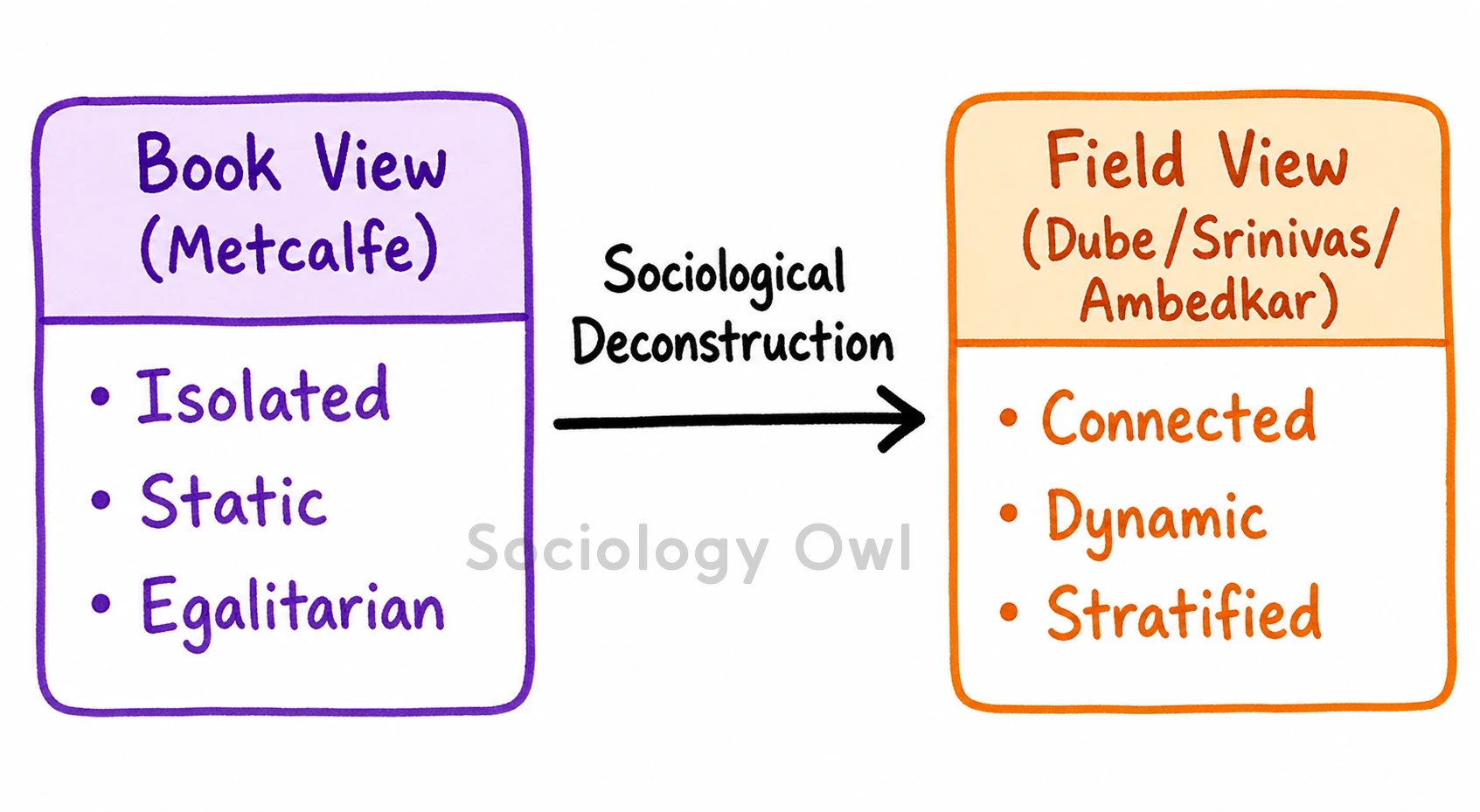
The 1950s marked a paradigm shift in Indian Sociology from the text-based Indological “Book-View” to an empirical “Field-View”, dismantling the colonial myth of Indian villages as isolated “little republics.”

Emergence of the “Field-View”

  • Methodological Shift: Scholars adopted structural-functionalism and participant observation to study villages as microcosms of larger Indian civilization.
  • Landmark Works: S.C. Dube’s Indian Village (1955) and M.N. Srinivas’s edited volume India’s Villages (1955) pioneered holistic rural ethnography.
  • Theoretical Innovations: Foundational concepts like Sanskritization and Dominant Caste (M.N. Srinivas) were conceptualized during this era.
  • Policy Linkage: The state sponsored these village studies to aid post-independence nation-building and the Community Development Programme (1952).

Critiques of the 1950s Studies

  • Marxist Critique: A.R. Desai criticized the over-emphasis on caste and harmony, arguing it ignored agrarian class conflicts and land ownership disparities.
  • Subaltern Perspective: B.R. Ambedkar starkly rejected the romanticized sociological view, terming the Indian village a “sink of localism” and a den of exploitation.

The ethnographic foundation laid in the 1950s remains vital today for analyzing modern rural transformations, such as shifting power dynamics within Panchayati Raj Institutions and the impact of reverse migration.

Conclusion

While the 1950s studies occasionally exhibited a structural-functional harmony bias, they successfully institutionalized rigorous empirical fieldwork, permanently establishing sociology as a scientific discipline in India.

The decade of 1950s was the golden period of village studies in Indian Sociology. Explain the statement. Read More »

Critically examine the contribution of dependency theories in understanding the present global scenario.

Model Answers

Q: Critically examine the contribution of dependency theories in understanding the present global scenario.

Question asked in UPSC Sociology 2021 Paper 1. Download our app for last 20 year question with model answers.

Model Answer:

Dependency theories view underdevelopment not as an internal deficit, but as a historical condition caused by the unequal integration of “peripheral” societies into a capitalist world economy. Pioneered by A.G. Frank (Capitalism and Underdevelopment in Latin America), they shifted sociological focus to relational global power structures.

Manifestations of Dependency Today

  • Surplus Extraction: Samir Amin highlighted how “Unequal Exchange” and “imperial rent” drain peripheral wealth. Today, core nations capture value via Intellectual Property rights and financialization.
  • Feminist Dependency: Maria Mies argues global capitalism extracts surplus from the unpaid reproductive labor of women in the Global South via the “housewifization” of labor.
  • Global Care Chains: Arlie Russell Hochschild notes how domestic labor continually flows from periphery to core, creating severe “care deficits” in developing nations.
  • Internal Stratification: Dependency creates a “dual society” where highly modernized comprador elites thrive alongside an impoverished, informal rural sector.

Sociological Limitations and Critiques

  • Over-structural Determinism: Dependency ignores local agency. Amartya Sen’s Capability Approach emphasizes that true development requires building internal human capacities, not just escaping capitalist structures.
  • Industrialization via Integration: Marxist critic Bill Warren (Imperialism: Pioneer of Capitalism) argues global integration actively fosters industrialization, evidenced by the East Asian tigers.
  • Dynamic Mobility: Immanuel Wallerstein’s World-Systems Theory addresses rigid binaries by introducing a dynamic semi-periphery, allowing for upward mobility.
  • Vaccine Nationalism: The COVID-19 “vaccine apartheid” exemplified dependency; core countries hoarded IP and manufacturing, leaving the periphery dependent on charity.
  • Neo-Dependency: China’s Belt and Road Initiative demonstrates that the core-periphery model persists; the “Core” has simply expanded through new “debt-trap diplomacy.”
  • Data Colonialism: Digital infrastructures systematically concentrate platform power in the Global North.

Conclusion

While orthodox dependency theories seem deterministic, their analytical spirit survives. In a world grappling with climate injustice, neo-colonial debt, and digital monopolies, dependency remains an evolving reality. Navigating it requires intersectional analysis and exploring radical alternatives like Samir Amin’s concept of “Delinking.”

Critically examine the contribution of dependency theories in understanding the present global scenario. Read More »

Q. Is it possible to have sustainable development in India? Cite major environmental issues and suggest a few measures to achieve the sustainability.

Q. Is it possible to have sustainable development in India? Cite major environmental issues and suggest a few measures to achieve the sustainability.

UPSC Sociology 2025 Paper 2

Model Answer:

Sustainable development requires meeting present needs without compromising future generations. Sociologically, however, it is a contested struggle over Jal, Jungle, and Zameen. A.R. Desai argues that India’s post-independence capitalist development inherently breeds ecological degradation and inequality, making sustainability fundamentally a question of social justice.

Sociological Debates on Sustainable Development

Achieving sustainability in India requires addressing inherent structural inequalities:

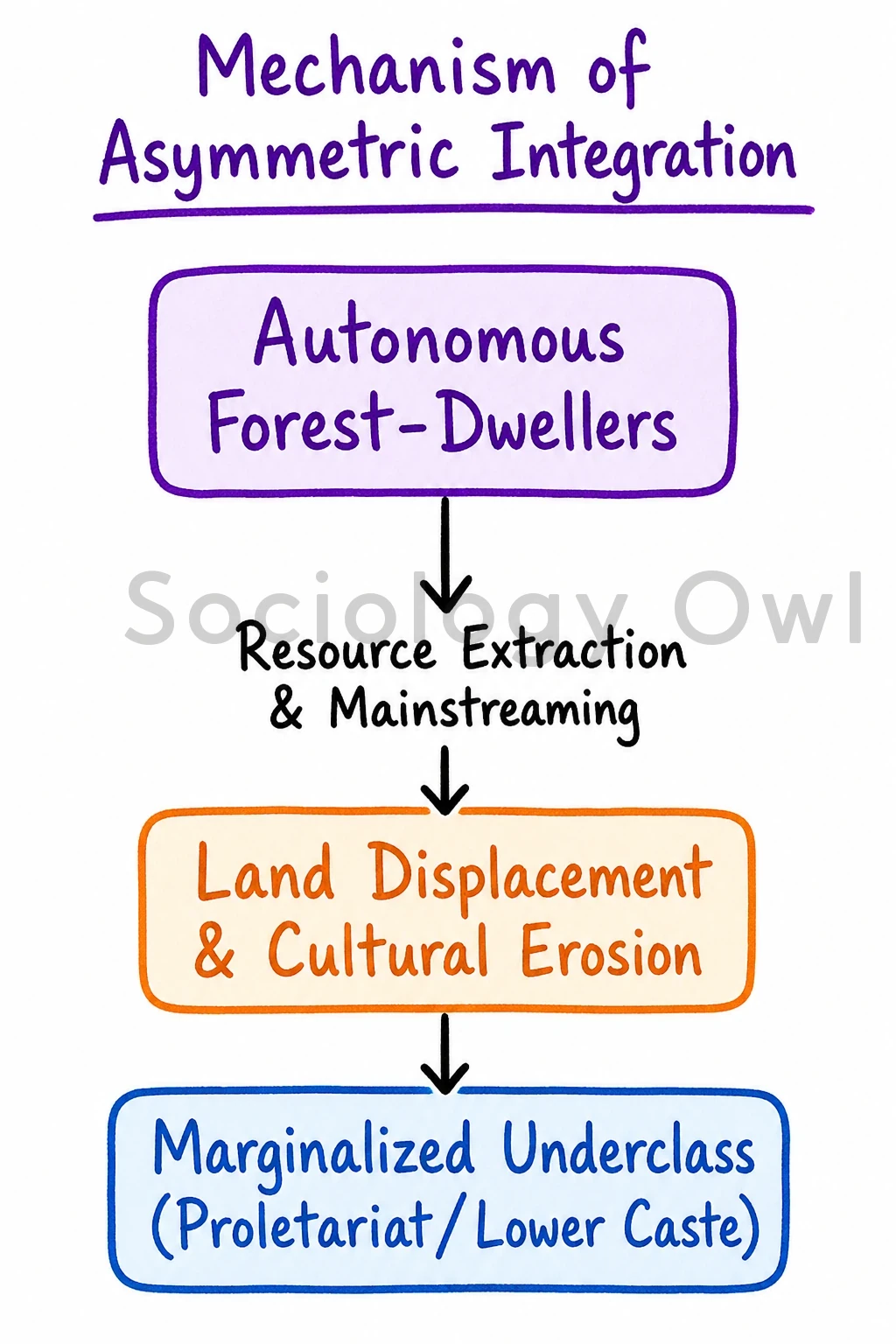
  • Ecological Stratification: In Ecology and Equity, Madhav Gadgil and Ramachandra Guha argue that sustainable development is impossible unless the unchecked consumption of “Omnivores” (urban capitalists) is curtailed to protect “Ecosystem People” (tribals and rural poor) from becoming ecological refugees.
  • Feminist Environmentalism: Vandana Shiva, in Staying Alive, highlights “Maldevelopment”, arguing that Western capitalist models are inherently patriarchal and anti-nature, disproportionately harming women.

Major Environmental Issues

  • Urban Ecology and Class Conflicts: Amita Baviskar introduces “Bourgeois Environmentalism” to explain how middle-class demands for “clean” cities often result in slum demolitions, evicting the urban poor and destroying livelihoods under the guise of beautification.
  • Development-Induced Displacement: As Walter Fernandes notes, Adivasis constitute over 40% of displaced populations despite being only 8% of the demography. This highlights a severe class-caste nexus in environmental degradation.
  • Gender and Caste Vulnerability: Bina Agarwal emphasizes that environmental depletion disproportionately increases the labor burden on rural women (collecting fuel and fodder) and pushes marginalized castes into ecologically fragile, disaster-prone zones.

Sustainability requires structural empowerment rather than mere technological fixes:

  • Decentralization and Rights: Democratizing governance through the Forest Rights Act (FRA, 2006) and PESA shifts power to the Gram Sabha.
  • Social Movements: Ramachandra Guha identifies the “Environmentalism of the poor”, visible when the Dongria Kondh tribe successfully resisted Vedanta’s mining in Niyamgiri, illustrating grassroots assertion over ecological governance.

Conclusion

In a highly stratified society like India, ecological sustainability is inextricably linked to social equity. As Amartya Sen posits, viewing development as “freedom” dictates that true sustainability is achieved only when marginalized communities transition from passive victims of ecological decay to active decision-makers in resource management.

Q. Is it possible to have sustainable development in India? Cite major environmental issues and suggest a few measures to achieve the sustainability. Read More »