Model Answer

Is reference group theory a universally applicable model? Elucidate.

Model Answers

Q: Is reference group theory a universally applicable model? Elucidate.

Question asked in UPSC Sociology 2023 Paper 1. Download our app for last 20 year question with model answers. 

Model Answer:

Reference Group Theory

Reference Group Theory, coined by Herbert Hyman and expanded by R.K. Merton, explains how individuals evaluate themselves against aspirational groups. It utilizes Relative Deprivation (Samuel Stouffer, The American Soldier) and Anticipatory Socialization.

Applicability in Diverse Contexts

Traditional Societies: M.N. Srinivas proved RGT functions even in rigid caste structures via Sanskritization, where lower castes emulate upper castes as normative reference groups for mobility.

Critiques of Universal Applicability

  • Marxist Perspective: Aspirational behavior reflects False Consciousness, where the proletariat adopts bourgeois values over actual objective class awareness.
  • Postmodern View: Zygmunt Bauman argues that in Liquid Modernity, stable reference groups are replaced by fluid, fragmented “neo-tribes.”
  • Structural Limits: RGT assumes agency and free choice; severe totalitarianism or extreme poverty restricts the capacity to form alternative reference groups.

Social media forms borderless Virtual Reference Groups. Algorithmic “Echo Chambers” act as localized normative groups, heavily influencing youth consumerism and political polarization globally.

Conclusion

Though not an absolute universal law, RGT remains a vital heuristic tool to analyze socialization and identity formation across traditional hierarchies and modern digital landscapes.

Is reference group theory a universally applicable model? Elucidate. Read More »

Sociology Optional 2023 Paper 2 Solution

2023 Paper 2

Sociology Optional 2023 Paper 2 Model Answers

Our UPSC Sociology Optional 2023 Paper 2 webpage provides a comprehensive collection of model answers to questions from this examination. This resource is designed to help aspirants understand the depth and breadth of responses expected in the UPSC Sociology Optional Paper 2. 

Download Sociology Optional 2023 Paper 2 PDF

Click on Question to see Model Answer

खण्ड – A / SECTION – A

Q1: Write short answers, with a sociological perspective, on the following questions in about 150 words each: 10×5=50

(a) Highlight the significant features of A. R. Desai’s ‘Dialectical Perspective’ to study Indian Society. 10 Marks
(b) “The decade of 1950s was the golden period of village studies in Indian Sociology. Explain the statement. 10 Marks
(c) Analyse the differences between the attributional and interactional approach in studying the caste system. 10 Marks
(d) Are Tradition and Modernity antithetical to each other? Comment. 10 Marks
(e) Discuss the main features of Land Reforms in post-independence India. 10 Marks

Q2. (a) Do you agree with the view of Andre Beteille that India’s villages are representative of Indian society’s basic civilizational values? Present a sociological overview. 20 Marks
(b) Elaborate the salient features and the role of middle class in India’s democracy and development. 20 Marks
(c) Analyse the role of market and modern forces in understanding the changing trends in marriage systems in India. 10 Marks

Q3. (a) Contextualize Louis Dumont’s concept of binary opposition’ with reference to caste system in India. 20 Marks
(b) Define the concepts of ‘Descent’ and ‘Alliance’. Differentiate between North Indian and South Indian Kinship systems with examples. 20 Marks
(c) Critically examine the concept of Sanskritization with suitable illustrations. 10 Marks

Q4. (a) Analyse the perspectives of Isolation, Assimilation and Integration in understanding the trajectories of Indian Tribal Development. 20 Marks
(b) Explain the implications and the impact of globalization in situating the changing agrarian class structure in India. 20 Marks
(c) Critique the victory narratives of Green Revolution in the context of Indian society. 10 Marks

खण्ड – B / SECTION – B

Q5. Write short answers, with a sociological perspective, on the following questions in about 150 words each: 10×5=50

(a) Citing some case studies, expand the concept of ‘Development-induced Displacement’. 10 Marks
(b) Examine the concept of ‘Cultural Pluralism’ in the context of India’s Unity in Diversity. 10 Marks
(c) Highlight the salient features of the New Education Policy (NEP) 2020. 10 Marks
(d) Analyse the sociological interconnections between Social Media and Mass Mobilization in India. 10 Marks
(e) Discuss the nature of regional variations in sex ratio in India, stating reasons thereof. 10 Marks

Q6. (a) How do you account for the increasing significance of religion in public and personal spheres in the context of secularization thesis in India? Explain. 20 Marks
(b) In the face of rising global climatic concerns, how do you contextualize the relevance of Chipko Movement and its Gandhian tone? Answer analytically. 20 Marks
(c) What actionable measures would you suggest to curb the recurrent child labour menace in India ? 10 Marks

Q7. (a) Do you think that the decades of Dalit political mobilizations and movements have helped in strengthening India’s democracy? Substantiate your arguments with facts. 20 Marks
(b) What is ‘reverse migration’ ? Discuss its features, causes and consequences in India. 20 Marks
(c) Discuss the phenomenon of rural-urban continuum with suitable examples. 10 Marks

Q8. (a) Explain the thematic linkages between ‘Patriarchy’ and ‘Honour killing’ in India, citing some recent cases. 20 Marks
(b) Discuss the challenges faced by the cooperative movements in India. Suggest measures to strengthen the movement at the grass-roots level. 20 Marks
(c) What is Ageing? Discuss the major problems of aged people in India. 10 Marks

Sociology Optional Paper 2 2023
Sociology Owl New Version

Sociology Optional 2023 Paper 2 Solution Read More »

Examine epistemological foundations of qualitative methods of social research.

Model Answers

Q: Examine epistemological foundations of qualitative methods of social research.

Question asked in UPSC Sociology 2017 Paper 1. Download our app for last 20 year question with model answers.

Model Answer:

Epistemology (“how we know”) in qualitative research rejects Positivism’s search for objective laws. Rooted in Interpretivism, it argues that social reality is multiple and subjectively constructed.

Core Epistemological Principles

  • Interpretive Meaning: Max Weber’s Verstehen mandates the empathetic understanding of actors’ motives.
  • Constructed Knowledge: Symbolic Interactionism (G.H. Mead) asserts that knowledge emerges from context-bound, everyday interactions.
  • Inductive Logic: Rather than testing hypotheses, knowledge is generated bottom-up, exemplifying the Grounded Theory of Glaser and Strauss.
  • Reflexivity: Feminist sociologists like Ann Oakley argue that the researcher’s positionality inherently shapes knowledge production.

Epistemological Critiques

  • Positivist View: Emile Durkheim criticized qualitative epistemology for lacking reliability, generalizability, and objectivity.
  • Postmodern View: Highlights a “crisis of representation,” questioning whether researchers can ever authentically capture another’s subjective reality without imposing their own narrative.

Understanding modern gig-workers requires qualitative epistemology to grasp their subjective lived reality of algorithmic alienation, which objective income statistics miss.

Conclusion

Modern sociology transcends this epistemological divide through Methodological Pluralism and Triangulation (Alan Bryman), merging qualitative depth with quantitative breadth to capture holistic social realities.

Examine epistemological foundations of qualitative methods of social research. Read More »

Q. What, according to you, are the factors responsible for the continuance of caste system in India? Explain.

Q. What, according to you, are the factors responsible for the continuance of caste system in India? Explain.

UPSC Sociology 2024 Paper 2

Model Answer:

While its traditional ritual framework weakens, caste’s structural resilience persists in modern India. As Dipankar Gupta observes, caste has morphed from a system of hierarchy to one of difference and identity.

Factors Sustaining the Caste System

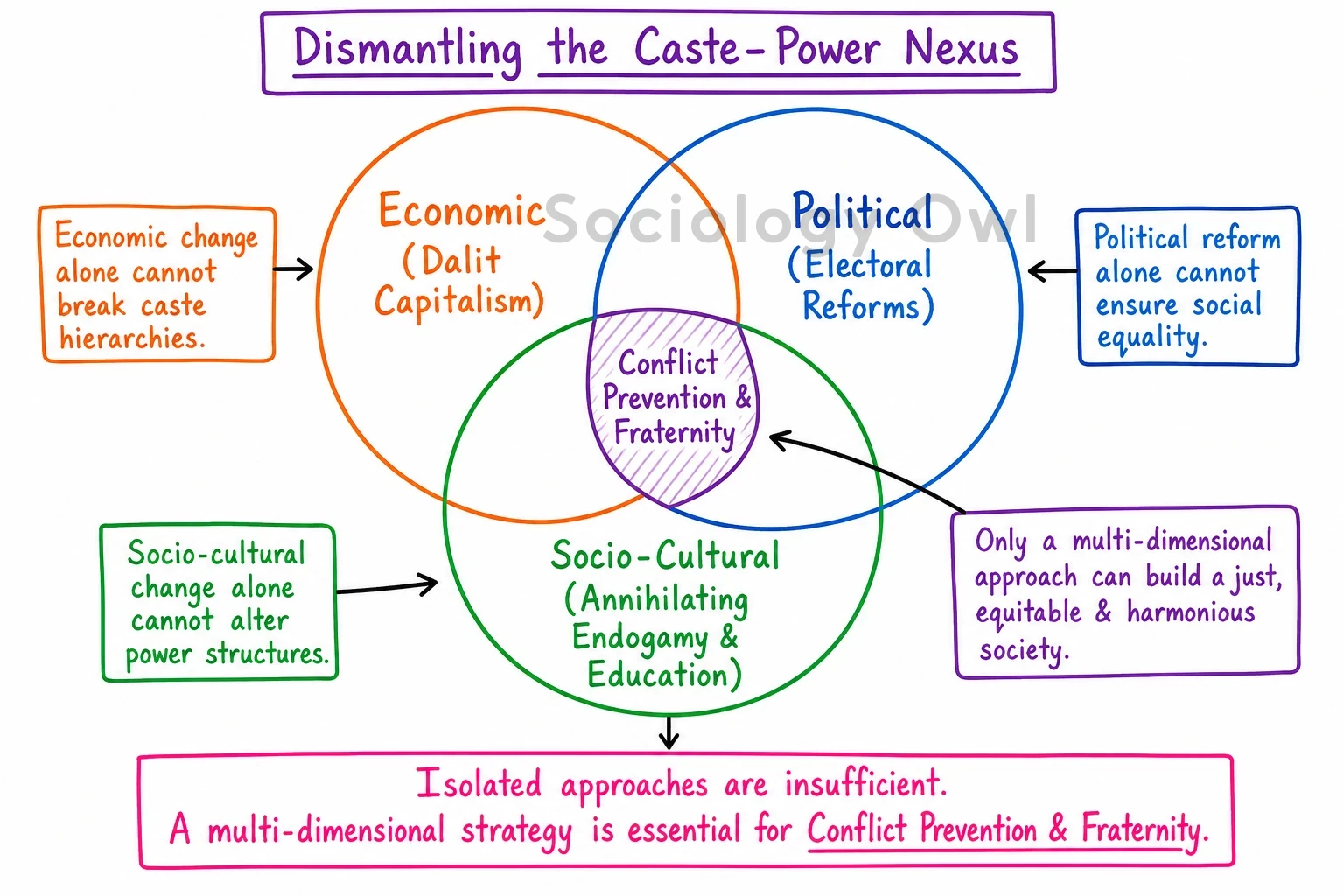
  • Politicization of Caste: Rajni Kothari argues that democratic politics transforms castes into competing interest groups, sustained by “Vote Bank Politics” (M.N. Srinivas).
  • Ethnicization: C.J. Fuller notes castes now compete as ethnic groups for secular resources, replacing traditional Jajmani interdependence.
  • Economic Nexus: From a Marxist lens, A.R. Desai highlights how modern capitalism utilizes caste networks, trapping lower castes in the informal sector and sustaining a rigid Caste-Class nexus.
  • Endogamy: Marriage restrictions preserve inherited wealth and social capital among dominant groups, reinforcing distinct boundaries (G.S. Ghurye).

Affirmative action has fueled the “Substantivization of Caste” (M.N. Srinivas), visible in recent dominant caste agitations (e.g., Marathas) seeking OBC status to counter agrarian distress. Furthermore, technology facilitates “Digital Endogamy” through caste-filtered matrimonial websites.

Conclusion

Caste persists not merely as a ritual order but as a modern tool of power. As B.R. Ambedkar diagnosed, it remains a deeply entrenched “division of labourers.” Eradicating its contemporary resilience requires the annihilation of endogamy and structural material inequalities.

Q. What, according to you, are the factors responsible for the continuance of caste system in India? Explain. Read More »

Examine different understandings of secularization in india?

Model Answers

Q: Examine different understandings of secularization in india?

Question asked in UPSC Sociology 2022 Paper 2. Download our app for last 20 year question with model answers.

Model Answer:

In India, secularization implies a shift from religious to rational explanations. M.N. Srinivas, in Social Change in Modern India, defines it as structural differentiation where orthodox purity-pollution concepts lose their everyday grip.

Sociological Understandings of Secularization

  • The Paradoxical View: M.N. Srinivas notes that secularization co-exists paradoxically with Sanskritization. Milton Singer identifies this as Compartmentalization (e.g., acting rational at work, but religious at home).
  • Anti-Secularization Thesis: T.N. Madan and Ashis Nandy argue Western secularism is alien. Imposing it breeds fundamentalism, as religion in India is inherently a “way of life.”
  • State Secularism: Rajeev Bhargava defines India’s constitutional model as “Principled Distance”, distinct from the Western “wall of separation.”
  • Subaltern Perspective: For marginalized communities, secularization acts as an emancipatory tool to escape caste-based ritual hierarchies.

Secularization is evident in the commercialization of religion, where faith adapts to modernity via corporate temple management and online e-darshans.

Conclusion

Unlike Western predictions of religion’s demise, Indian secularization has not erased faith. Instead, it has driven its dynamic reconfiguration, commercialization, and politicization within modern institutions.

Examine different understandings of secularization in india? Read More »

Q. What are the ‘basic and irreducible’ functions of the family as proposed by Talcott Parsons? Explain.

Q. What are the ‘basic and irreducible’ functions of the family as proposed by Talcott Parsons? Explain.

UPSC Sociology 2024 Paper 1

Model Answer:

Talcott Parsons’ Basic and Irreducible Functions of the Family

Operating from a Structural Functionalist perspective in his work Family, Socialization and Interaction Process, Talcott Parsons argued that industrialization led to Structural Differentiation. As institutions like schools and hospitals absorbed traditional familial roles, the nuclear family was left with two basic and irreducible functions. These fulfill the Latency (Pattern Maintenance) prerequisite within his AGIL paradigm.

Basic and Irreducible Functions

  • Primary Socialization of Children: The family ensures the “internalization of society’s culture” into a child’s emerging personality. Parsons argued this creates a “value consensus,” which is essential for social integration and long-term societal order.
  • Stabilization of Adult Personalities: Parsons introduced the “Warm Bath Theory”, positing that the family acts as a soothing sanctuary against the alienating stress of the industrial workplace. For this stabilization to occur, he proposed a strict gendered division of labor: men performing the Instrumental Role (breadwinner) and women the Expressive Role (emotional caretaker).

Sociological Critiques

  • Marxist Critique: Eli Zaretsky argued that these functions benefit capitalism rather than the individual, utilizing the family to reproduce and pacify an exploited workforce.
  • Feminist Critique: Ann Oakley dismissed the instrumental/expressive divide as a patriarchal construct. Furthermore, Fran Ansley dismantled the “warm bath theory,” arguing that wives absorb capitalist-induced frustrations, rendering women the “takers of shit.”
  • Alternative Functionalism: Ronald Fletcher argued the family has not lost functions but gained new ones, such as becoming an essential unit of economic consumption.

During the COVID-19 lockdowns, the family’s “stabilization” role was tested globally. While it acted as a primary buffer against pandemic stress, surging domestic violence simultaneously validated feminist critiques of the “warm bath.” Additionally, in the digital age, the family’s monopoly on primary socialization is heavily contested by social media and virtual peer networks.

Conclusion

While Parsons is widely critiqued for idealizing the white, middle-class “cereal packet family” and ignoring family diversity, his framework remains a foundational sociological baseline for analyzing how institutional shifts impact family dynamics in modern industrial societies.

Q. What are the ‘basic and irreducible’ functions of the family as proposed by Talcott Parsons? Explain. Read More »

What are new religious movements? Elaborate emphasizing their forms and orientations.

Model Answers

Q: What are new religious movements? Elaborate emphasizing their forms and orientations.

Question asked in UPSC Sociology 2023 Paper 1. Download our app for last 20 year question with model answers. 

Model Answer:

New Religious Movements (NRMs)

New Religious Movements (NRMs) are modern faith-based groups offering novel spiritual paths outside mainstream traditions. Sociologist Eileen Barker popularized the term to replace the pejorative label “cult.” Their emergence is sociologically explained by Glock and Stark’s concept of “Relative Deprivation,” where individuals seek spiritual solace to counter the alienation and meaninglessness of highly rationalized, postmodern societies.

Forms and Orientations of New Religious Movements

Building upon Ernst Troeltsch’s Church-Sect continuum, Howard Becker identified key structural forms of NRMs:

  • Sects: Exclusive, breakaway groups claiming religious purity and strict moral discipline. An example is the Brahma Kumaris.
  • Cults: Individualistic, loosely organized groups often revolving around a charismatic leader’s novel esoteric revelations. Global examples include Scientology and the Osho movement.

Roy Wallis famously categorized NRMs based on their relationship with the secular world:

  • World-affirming: Embrace societal goals like wealth and success, offering spiritual techniques to achieve them (e.g., Soka Gakkai, Art of Living).
  • World-rejecting: Highly critical of secular life, demanding radical transformation and communal isolation (e.g., Unification Church/Moonies, early ISKCON).
  • World-accommodating: Emphasize inner purity and individual spiritual salvation without overtly challenging secular society (e.g., Neo-Pentecostalism).

NRMs are central to the debate on the Secularization Thesis. Bryan Wilson argues their proliferation proves religion has fragmented, losing societal power. Conversely, Peter Berger views them as evidence of “De-secularization,” highlighting a modern resurgence of faith. Furthermore, in The Making of a Moonie, Barker debunked mainstream “brainwashing” critiques, proving NRM affiliation is often a rational choice.

Conclusion

NRMs illustrate that religion in late-modernity is transforming rather than disappearing. Reflecting Grace Davie’s concept of “believing without belonging,” they function as a “spiritual supermarket,” allowing postmodern individuals to curate personal identities and ensuring the sacred remains relevant amidst rapid social change.

What are new religious movements? Elaborate emphasizing their forms and orientations. Read More »

What, according to Robert Michels, is the iron law of oligarchy? Do lions and foxes in Vilfredo Pareto’s theory, essentially differ from each other? Substantiate.

Model Answers

Q: What, according to Robert Michels, is the iron law of oligarchy? Do lions and foxes in Vilfredo Pareto’s theory, essentially differ from each other? Substantiate.

Question asked in UPSC Sociology 2023 Paper 1. Download our app for last 20 year question with model answers. 

Model Answer:

Classical Elite Theory

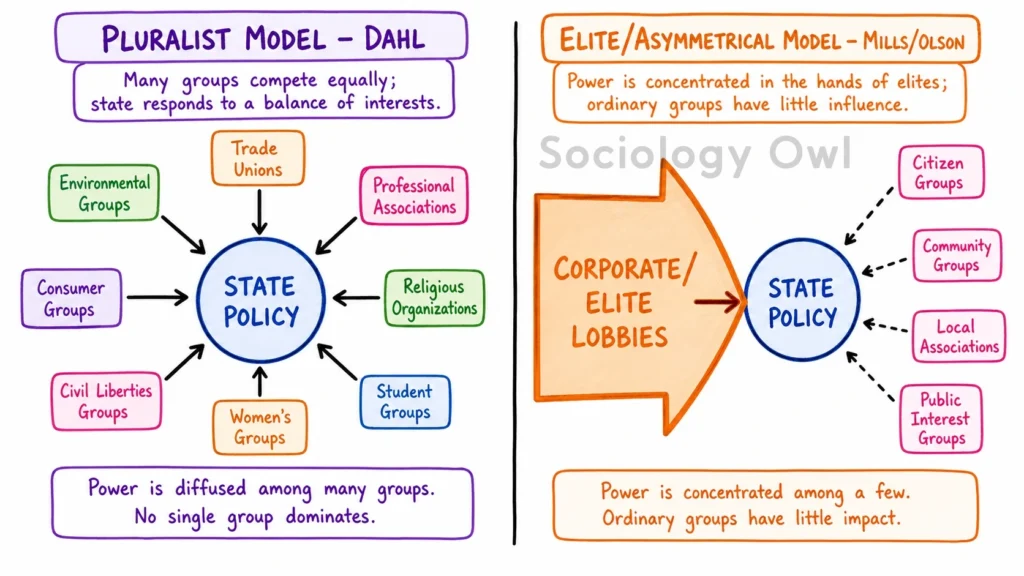
Classical Elite Theory argues an organized minority inevitably rules an unorganized majority. Robert Michels and Vilfredo Pareto offer seminal perspectives on this power dynamic, critiquing both Marxist economic determinism and Democratic Pluralism.

In Political Parties, Michels formulated his law based on the egalitarian German Social Democratic Party, arguing that all organizations inevitably become oligarchic due to:

  • Structural Needs: Complex administration demands rapid, centralized decision-making, aligning with Max Weber’s concept of rational-legal bureaucracy.
  • Psychological Drivers: The innate apathy of the masses who seek direction, combined with the leaders’ acquired thirst for power.

In The Mind and Society, Pareto utilizes his Theory of Residues to substantiate that Lions and Foxes differ fundamentally in their psychology and instruments of rule:

  • Foxes (Class I Residues – Instinct for Combinations): Rule via cunning, diplomacy, and innovation, avoiding physical force.
  • Lions (Class II Residues – Persistence of Aggregates): Rely on coercive force, traditional values, and patriotism for stability.

This essential contrast (fraud vs. force) drives the Circulation of Elites. When manipulative Foxes fail to use force during crises, Lions seize control, eventually recruiting Foxes back to manage societal complexity.

Michels’ law manifests in the centralized High Commands of modern political parties. Pareto’s Foxes resemble modern technocratic coalition-builders, while Lions parallel military juntas. Contrastingly, Robert Dahl counters this with Polyarchy, arguing modern democratic power is dispersed among competing interest groups.

Conclusion

While Marxists argue that power rests primarily on economic ownership, the frameworks of Michels and Pareto provide enduring sociological insights into the bureaucratic complexities and psychological mechanisms that sustain minority dominance in contemporary society.

What, according to Robert Michels, is the iron law of oligarchy? Do lions and foxes in Vilfredo Pareto’s theory, essentially differ from each other? Substantiate. Read More »

Analyse the differences between the attributional and interactional approach in studying the caste system

Model Answers

Q: Analyse the differences between the attributional and interactional approach in studying the caste system.

Question asked in UPSC Sociology 2023 Paper 2. Download our app for last 20 year question with model answers. 

Model Answer:

The attributional approach defines caste through inherent traits or properties possessed by a group (endogamy, traditional occupation). Conversely, the interactional approach understands caste via everyday behavioral exchanges and power relations between different groups.

Key Differences in Studying Caste

  • Methodology and Focus: The attributional approach aligns with the “Book-View” (Indology), emphasizing texts and ritual axes of purity-pollution. The interactional approach uses the “Field-View” to map empirical, secular realities like the Jajmani system.
  • Key Thinkers: G.S. Ghurye and Célestin Bouglé detailed fixed caste attributes. Conversely, McKim Marriott mapped hierarchy via commensality (food/water exchange) in Kishan Garhi, while Andre Beteille analyzed secular power dynamics in Caste, Class, and Power.
  • Nature of Caste: Attributional models (Louis Dumont) depict a rigid hierarchy. Interactional models highlight fluidity and negotiation.

Attributional reality persists in the private sphere (strict endogamy via caste matrimony), while interactional dynamics dominate the public sphere (diluted commensal restrictions in secular workspaces and dynamic political mobilization).

Conclusion

Neither approach is wholly sufficient. As Dipankar Gupta suggests, comprehending contemporary caste requires synthesizing static attributional boundaries with dynamic interactional realities.

Analyse the differences between the attributional and interactional approach in studying the caste system Read More »

Q. Why is the study of marriage important in Sociology? Analyse the implications of changing marriage patterns for Indian society.

Q. Why is the study of marriage important in Sociology? Analyse the implications of changing marriage patterns for Indian society.

UPSC Sociology 2024 Paper 2

Model Answer:

In the Indian context, studying marriage is vital to decoding the complexities of kinship, caste, and patriarchy. Indologist K.M. Kapadia defines traditional Hindu marriage not as a civil contract, but as a Sanskara (sacrament) fulfilling Dharma (duty), Praja (progeny), and Rati (pleasure).

Sociological Importance of Studying Marriage in India

  • Caste Reproduction: B.R. Ambedkar argued that Endogamy is the sole characteristic peculiar to caste; studying marriage explains how social stratification continually reproduces itself.
  • Kinship Mapping: Iravati Karve demonstrated how diverse marriage rules (Northern village Exogamy vs. Southern cross-cousin unions) dictate regional social structures.
  • Patriarchal Control: Leela Dube utilized the “Seed and Earth” metaphor to illustrate how marriage legally and culturally regulates female sexuality and labor.
  • Structural Alliance: Louis Dumont highlighted that Indian marriage is primarily an alliance structurally binding two kin groups, rather than a mere union of individuals.

Implications of Changing Marriage Patterns

Viewing changes through a Continuity and Change framework reveals nuanced sociological shifts:

  • Negotiated Agency: Rather than a simple rise in “love marriages,” Patricia Uberoi identifies the emergence of “arranged love marriages,” representing a negotiation between individual agency and traditional family approval.
  • Modernization of Dowry: Dowry has not declined; instead, via Sanskritization (M.N. Srinivas), it has spread to lower castes and non-Hindu communities, morphing into a commodified, consumerist transaction (Sylvia Vatuk).
  • Technological Endogamy: While mate selection has moved online, Janaki Abraham observes that matrimonial websites paradoxically reinforce traditional boundaries by utilizing modern technology to filter for caste, class, and gotra.

The recent Supriyo v. Union of India case regarding same-sex unions signifies a normative shift from traditional, reproduction-centric alliances toward Companionate Marriage, challenging rigid heteronormative kinship structures.

Conclusion

As A.M. Shah notes, institutions like Indian marriage are not disintegrating under modernization. Rather, they exhibit profound resilience, dynamically adapting their outer forms (mate selection, age) while largely maintaining core structural functions like caste endogamy and class reproduction.

Q. Why is the study of marriage important in Sociology? Analyse the implications of changing marriage patterns for Indian society. Read More »