Model Answer
What characterizes degradation of work in capitalist society according to Marx ?
Model Answers
Q: What characterizes degradation of work in capitalist society according to Marx ?
Question asked in UPSC Sociology 2022 Paper 1. Download our app for last 20 year question with model answers.
Model Answer:
Karl Marx analyzed the degradation of work primarily in his Economic and Philosophic Manuscripts of 1844 and Das Kapital. While the exact phrase was popularized later by Harry Braverman in Labor and Monopoly Capital, Marx argued that industrial capitalism inherently transforms creative human labor into a dehumanizing, exploitative mechanism driven by profit.
Mechanisms of Work Degradation
- Alienation: Capitalist production estranges workers from the product, the production process, fellow workers, and ultimately their Species-Being (inherent creative human potential).
- Deskilling and Subsumption: Through the Real Subsumption of Labor, capitalism replaces skilled artisans with machinery. The separation of conception (management) from execution (labor)—later systematized as Taylorism—reduces workers to interchangeable cogs.
- Commodification and Exploitation: Human labor-power is reduced to a tradable commodity. Capitalists continuously extract Surplus Value through the intensification of work, a process enforced by the Reserve Army of Labor (the unemployed), which forces workers to accept degrading conditions.

Sociological Critiques
- Emile Durkheim: In The Division of Labour in Society, he argued specialization creates Organic Solidarity. He viewed degradation not as inherent to capitalism, but as an abnormal Anomic Division of Labor.
- Max Weber: Attributed worker alienation to the inevitable Rationalization and bureaucratic “Iron Cage” of modern society, which would persist even under socialism.
- Robert Blauner & Daniel Bell: Blauner argued that advanced automation restores worker control (U-Curve theory), while Bell highlighted the rise of highly autonomous “knowledge workers” in the post-industrial economy.
Marx’s thesis remains highly visible in modern Platform Capitalism (gig economy). Companies like Uber and Amazon utilize algorithmic management (Digital Taylorism) to surveil, deskill, and intensify labor. Additionally, Artificial Intelligence is increasingly driving the deskilling of white-collar professions.
Conclusion
While welfare states and labor rights have prevented the absolute immiseration Marx predicted, his structural critique of work degradation remains an indispensable sociological tool for understanding modern precarious labor, the precariat, and contemporary workplace alienation.
Download our app for UPSC Sociology Optional - Syllabus, NCERT Books, IGNOU Books, Past Paper with Model Answers, Topper Notes & Answer Sheet.
What characterizes degradation of work in capitalist society according to Marx ? Read More »
Q. How same sex marriages are responsible for population dynamics in India? Discuss.
UPSC Sociology 2025 Paper 2
Model Answer:
Same-Sex Marriages and Population Dynamics in India
While legally unrecognized (Supriyo v. Union of India, 2023), same-sex marriage impacts India’s social demography normatively rather than statistically, challenging traditional, procreation-centric population models.
Disruption of Traditional Kinship
- K.M. Kapadia identifies Praja (progeny) as a core mandate of Hindu marriage. Same-sex unions fundamentally decouple marriage from biological reproduction.
- They challenge Leela Dube’s “Seed and Earth” metaphor, disrupting patrilineal reproduction (Vansh) and shifting focus from collective lineage to emotional companionship.

Alternative Parenthood and Policy
- The demographic expansion of queer “families of choice” is actively curtailed by the Surrogacy (Regulation) Act, 2021 and CARA guidelines.
- This fosters DINK (Double Income, No Kids) households, potentially altering future elderly dependency ratios by increasing reliance on institutional care rather than filial support.
Same-sex dynamics drive rural-to-urban demographic migration. Queer individuals frequently relocate to metropolitan cities seeking progressive spaces and anonymity, shaping distinct urban enclaves.
Conclusion
While macro-factors drive India’s fertility decline, same-sex unions mark a qualitative demographic shift. As Patricia Uberoi notes, they reflect modern India’s negotiation between traditional kinship obligations and the emergence of individual constitutional morality.
Q. How same sex marriages are responsible for population dynamics in India? Discuss. Read More »
Write short note on Class struggle as conceived by Karl Marx.
Model Answers
Q: Write short note on Class struggle as conceived by Karl Marx.
Question asked in UPSC Sociology 2005 Paper 1. Download our app for last 20 year question with model answers.
Model Answer:
Karl Marx’s Theory of Class Struggle: A Sociological Analysis
Karl Marx’s concept of class struggle is the cornerstone of his sociological framework, intricately linked to his theories of Historical Materialism and Social Change. In his seminal work, “The Communist Manifesto” (1848), co-authored with Friedrich Engels, Marx famously declared, “The history of all hitherto existing society is the history of class struggles.” For UPSC Sociology, understanding this concept requires moving beyond basic definitions to explore its historical origins, structural components, sociological critiques, and application to both Indian society and contemporary global dynamics.
Historical Context and Origins
Marx formulated his theory during the tumultuous era of the 19th-century Industrial Revolution in Europe. Witnessing the severe exploitation of factory workers, Marx inverted G.W.F. Hegel’s concept of “Dialectical Idealism” into Dialectical Materialism. He argued that it is not ideas, but material/economic conditions that drive history. He combined French socialist thought, British political economy, and German philosophy to posit that societal transformation occurs through the systemic conflict between economic classes.
Core Tenets of Marxian Class Struggle
- Historical Materialism and Modes of Production: Marx argued that society’s Economic Base (infrastructure) determines its Superstructure (religion, law, state). As the Forces of Production (FOP) advance, they come into contradiction with the existing Relations of Production (ROP), sparking class conflict and pushing society into a new historical epoch (e.g., Feudalism to Capitalism).
- Class Polarization: Capitalism inherently divides society into two mutually antagonistic camps: the Bourgeoisie (owners of the means of production) and the Proletariat (who possess only their labor-power). Marx predicted the absorption of the middle class (petty bourgeoisie) into the proletariat, a process known as Proletarianization.
- From Class-in-Itself to Class-for-Itself: This is a crucial sociological transition. A Class-in-itself exists objectively as people sharing a common economic position. Through shared experiences of Alienation and Pauperization (extreme poverty), workers overcome False Consciousness and develop Class Consciousness, transforming into a Class-for-itself capable of revolutionary action.
- The Revolutionary Resolution: The ultimate climax of this struggle is a violent revolution, leading to the Dictatorship of the Proletariat, and eventually culminating in a classless, stateless Communist society.
Comparative Analysis: Sociological Critiques and Refinements
Marx’s unidimensional, purely economic view of class was subsequently refined by later sociologists who recognized the complexities of modern stratification.
| Sociologist | Key Concept / Work | Departure from Marx’s Theory |
|---|---|---|
| Max Weber | Class, Status, and Party | Argued that stratification is multi-dimensional. Economic class is important, but social prestige (Status) and political power (Party) also drive social conflict, preventing strict polarization. |
| Ralf Dahrendorf | Class and Class Conflict in Industrial Society | Replaced the concept of property ownership with Authority. He argued that conflict in modern society occurs within Imperatively Coordinated Associations (ICAs) between order-givers and order-takers. |
| Antonio Gramsci | Cultural Hegemony | Shifted focus to the Superstructure. Argued that the ruling class maintains dominance not just through economic force, but by manipulating culture and ideology to manufacture consent among the working class. |
The Indian Context: Applying Marxist Class Struggle (Paper 2 Integration)
While traditional Indology focused heavily on Caste and Religion, several prominent Indian sociologists have successfully applied Marxist frameworks to understand Indian social realities:
- A.R. Desai: In his seminal work “Social Background of Indian Nationalism”, Desai used a Marxist historical materialist approach to argue that Indian nationalism was not merely a political awakening, but a product of new class equations and class struggles emerging under British colonial capitalism.
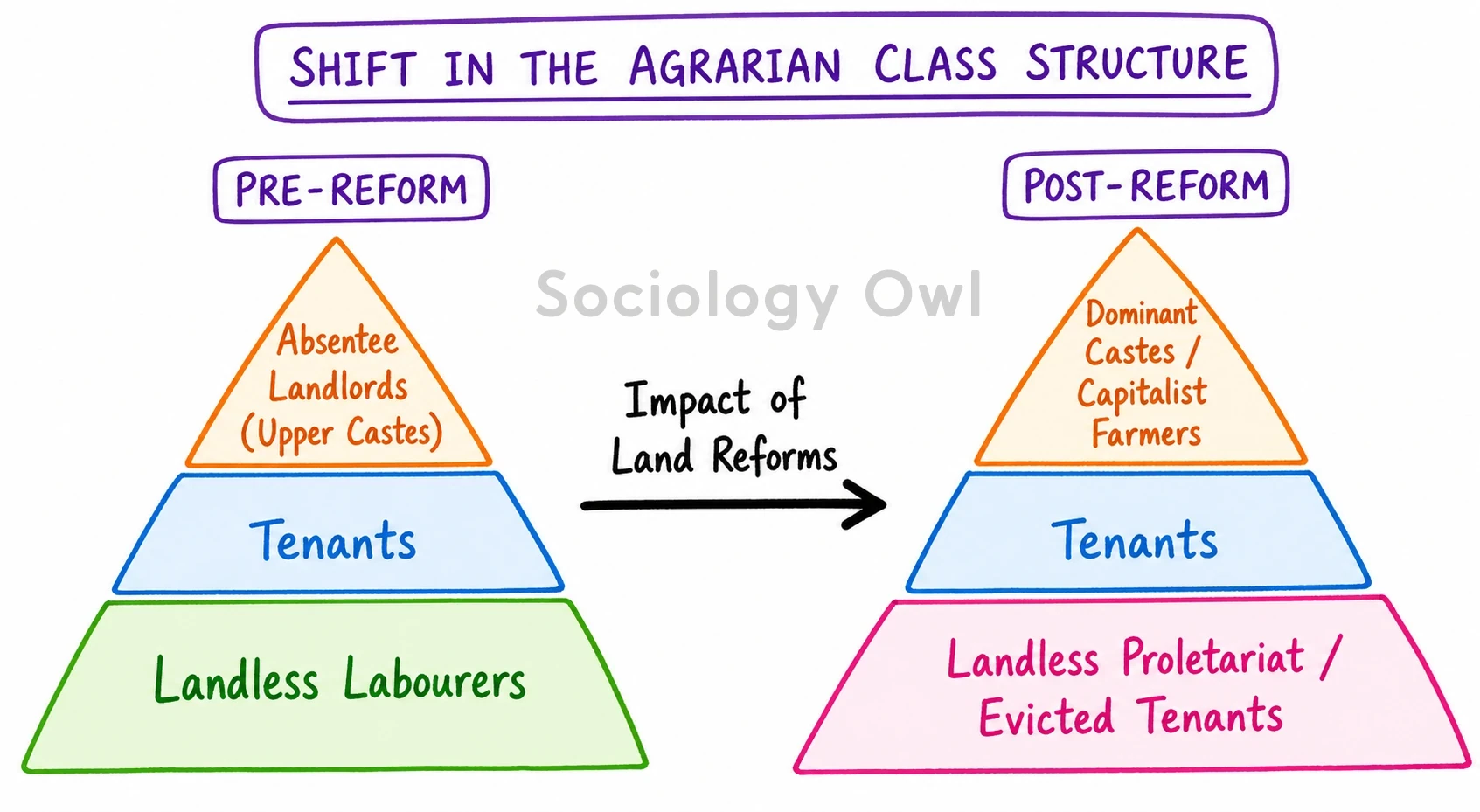
- Agrarian Class Structure: Scholars like D.N. Dhanagare and Kathleen Gough utilized the Marxist lens to study peasant uprisings in India (e.g., the Telangana and Naxalbari movements). They demonstrated how rural India is divided into landlords, rich peasants, and landless laborers, marked by intense class antagonism.
- Caste and Class Intersection: Andre Beteille, in his study of a Tanjore village (“Caste, Class, and Power”), observed that the traditional congruence between caste and class is breaking down. However, Marxist scholars like Ranadive argue that in India, caste often acts as a proxy for class, and the Dalit struggle is inherently a class struggle against agrarian capitalism.
- Jan Breman: Explored the plight of the informal sector and footloose labor in Gujarat, highlighting the hyper-exploitation and class struggle of the unorganized workforce in modern India.
Contemporary Relevance in the Globalized World
Marx’s predictions of extreme polarization and absolute pauperization did not materialize precisely as he envisioned in the West, largely due to the rise of the welfare state and trade unionism (as noted by T.H. Marshall). However, the essence of class struggle remains profoundly relevant today:
- Wealth Inequality: Economist Thomas Piketty’s “Capital in the Twenty-First Century” empirically validates Marx’s theory that capitalism inherently concentrates wealth in the hands of a few, leading to widening global inequalities.
- The Rise of the Precariat: Sociologist Guy Standing identifies a new dangerous class, the “Precariat”—gig economy workers (like Uber drivers and delivery agents) who lack job security, benefits, and occupational identity, reflecting modern-day Marxian alienation and exploitation.
- Transnational Capitalist Class: Leslie Sklair highlights how globalization has created a global bourgeoisie that controls multinational corporations, leading to an internationalized class struggle against global labor forces.
Conclusion
While Karl Marx’s prophecy of an inevitable, global communist revolution remains unfulfilled, his analytical framework of class struggle endures as a vital heuristic tool in sociology. It provides an indispensable vocabulary for critiquing structural inequality, exploitation, and power dynamics. As modern society grapples with algorithmic management, gig-labor exploitation, and staggering wealth gaps, Marx’s assertion that structural contradictions breed social conflict remains as prescient as ever, reminding us that the struggle for equitable resource distribution is an ongoing historical process.
Download our app for UPSC Sociology Optional - Syllabus, NCERT Books, IGNOU Books, Past Paper with Model Answers, Topper Notes & Answer Sheet.
Write short note on Class struggle as conceived by Karl Marx. Read More »
Discuss the challenges during village studies in India.
Model Answers
Q: Discuss the challenges during village studies in India.
Question asked in UPSC Sociology 2022 Paper 2. Download our app for last 20 year question with model answers.
Model Answer:
Village Studies in India & Their Challenges
Village studies shifted Indian sociology from Indology’s “Book View” (G.S. Ghurye) to the empirical “Field View” (M.N. Srinivas, The Remembered Village), but this transition faced major hurdles.
Theoretical Challenges
- Elite Bias: Researchers primarily engaged with the Dominant Caste. B.R. Ambedkar vehemently critiqued this romanticization, terming villages as “dens of ignorance.”
- Functionalist Bias: Over-focusing on ritual harmony ignored capitalist exploitation and agrarian class conflicts, prompting Marxist critiques by A.R. Desai.
- Patriarchal Bias: Early ethnographies completely ignored women’s agrarian labor. Feminist sociologists like Leela Dube highlighted this systemic gender-blindness.

Methodological Challenges
- “Native Sociologist” Dilemma: M.N. Srinivas highlighted the challenge of maintaining scientific objectivity when upper-caste, urban sociologists study their own society.
- Structural Complexity: Generalizing macro-Indian reality from micro-studies, or capturing the complex caste-class nexus (Andre Beteille, Caste, Class, and Power), proved methodologically difficult.
Today, traditional ethnographies struggle against de-agrarianization. Dipankar Gupta conceptualizes the “vanishing village,” while Jan Breman points to the modern reality of migrating “Footloose Labour”.
Conclusion
By overcoming early biases, village studies have dynamically evolved from rigid structural-functionalism into multi-sited ethnographies, remaining indispensable microcosms of a rapidly changing Indian society.
Download our app for UPSC Sociology Optional - Syllabus, NCERT Books, IGNOU Books, Past Paper with Model Answers, Topper Notes & Answer Sheet.
Discuss the challenges during village studies in India. Read More »
Explain the different types of non- probability sampling techniques .Bring out the conditions of their usage with appropriate examples.
Model Answers
Q: Explain the different types of non- probability sampling techniques. Bring out the conditions of their usage with appropriate examples.
Question asked in UPSC Sociology 2022 Paper 1. Download our app for last 20 year question with model answers.
Model Answer:
Non-probability sampling selects participants without equal selection chances. While Positivists favor probability sampling for macro-level Reliability, Interpretivists (following Max Weber’s Verstehen) and Phenomenologists utilize non-probability methods to achieve deep subjective understanding and high Validity of micro-level social realities.
Types and Conditions of Non-Probability Sampling
- Snowball Sampling: Essential for studying “hidden” or deviant populations lacking a sampling frame. Howard Becker utilized this in Becoming a Marihuana User, asking initial contacts to refer others to study a deviant subculture.
- Purposive (Judgmental) Sampling: Applied when specific participant characteristics are vital. William Foote Whyte in Street Corner Society purposefully selected “Doc” as a key informant to access the Italian-American slum’s social dynamics.
- Quota Sampling: Aims for proportional representation across categories without random selection. Early researchers like Charles Booth used structured approaches resembling this to study London poverty. Modern sociologists use it to study Intersectionality (e.g., quotas for Dalit women and upper-caste men).
- Convenience Sampling: Used under resource constraints for easily accessible subjects, such as a sociologist surveying students on a campus about gig-economy participation.
- Self-Selection Sampling: Volunteers participate based on an invitation. Feminist and Conflict theorists often use this to study sensitive, marginalized experiences (e.g., domestic abuse survivors) missed by macro-census data.

Methodological Debate: Reliability vs. Validity
Positivists critique non-probability methods for researcher bias and an inability to generate macro-sociological generalizations (Reliability). Conversely, Interpretivists argue these methods provide unparalleled Ecological Validity, capturing authentic, nuanced reflections of real-world settings.
Today, non-probability sampling is crucial for researching structurally invisible populations. For example, studying LGBTQ+ individuals in conservative societies or tracking the informal networks of undocumented manual scavengers heavily relies on purposive and snowball techniques.
Conclusion
Modern sociology recognizes the trade-offs of standalone methodologies. To balance statistical breadth with deep subjective insight, sociologists increasingly rely on Methodological Pluralism and Triangulation (championed by Norman Denzin), blending probability and non-probability techniques for holistic social research.
More Questions:
Download our app for UPSC Sociology Optional - Syllabus, NCERT Books, IGNOU Books, Past Paper with Model Answers, Topper Notes & Answer Sheet.
Q. Compare capability deprivation approach with that of social capital deprivation in understanding chronic poverty.
UPSC Sociology 2025 Paper 1
Model Answer:
Chronic poverty, extending persistently across generations, transcends classical income-subsistence models like those of Seebohm Rowntree. It is fundamentally a structural trap of powerlessness. Robert Chambers’ “Deprivation Trap” illustrates how isolation, physical vulnerability, and poverty intersect. To understand this multidimensionality, sociology employs capability and social capital deprivation frameworks.
Capability Deprivation Approach
- Core Concepts: Advanced by Amartya Sen (Development as Freedom) and Martha Nussbaum, poverty is defined as the lack of substantive freedoms or “Capabilities” to achieve valuable “Functionings” (e.g., nourishment, education).
- “Conversion Factors”: Sen argues that even if resources are provided, marginalized individuals may lack the personal or social conversion factors necessary to translate resources into actual well-being.
- Critique: Marxist scholars criticize this approach as overly individualistic, arguing it focuses excessively on personal agency while underplaying the macro-structural forces of capitalism that intentionally maintain an impoverished reserve army of labor.
Social Capital Deprivation Approach
- Conflict Perspective: Pierre Bourdieu argues that elites use social capital to maintain class boundaries. Chronic poverty is thus the reproduction of inequality, as the poor are systematically excluded from resource-rich elite networks.
- Functionalist Perspective: Robert Putnam emphasizes the lack of “Bridging” capital (inter-group linkages), which isolates impoverished communities from broader economic opportunities.
- Critique: Alejandro Portes highlights the “dark side” of social capital. In chronic poverty (e.g., slums), strong intra-group “Bonding” capital can create isolation and dependency traps, echoing Oscar Lewis’s “Culture of Poverty”.
- Unit of Analysis: Sen focuses on individual agency (capabilities as the ends), whereas Bourdieu and Putnam emphasize structural networks (social capital as the means).
- Interdependence: Social capital acts as a structural “Conversion Factor”. Without social networks, an individual’s capability to achieve mobility remains fundamentally stunted.

Globally, the UNDP’s Multidimensional Poverty Index (MPI) operationalizes capability deprivations. In India, the intersectionality of caste and class demonstrates this nexus: Dalits historically excluded from Savarna-dominated social networks suffer severe social capital deprivation, directly resulting in capability deprivations like poor health and educational outcomes.
Conclusion
Eradicating chronic poverty requires moving beyond economic alleviation towards structural empowerment. It necessitates a holistic policy approach that synthesizes Sen’s focus on expanding human agency with Bourdieu’s structural critique of dismantling exclusionary social networks.
Do you agree with the view of Andre Beteille that India’s villages are representative of Indian society’s basic civilizational values? Present a sociological overview.
Model Answers
Q: Do you agree with the view of Andre Beteille that India’s villages are representative of Indian society’s basic civilizational values? Present a sociological overview.
Question asked in UPSC Sociology 2023 Paper 2. Download our app for last 20 year question with model answers.
Model Answer:
The premise that Indian villages are static, harmonious repositories of basic civilizational values is highly contested in sociology. While colonial administrators (like Charles Metcalfe’s “little republics”) and nationalists romanticized the village, empirical sociologists like André Béteille demonstrated that villages are not isolated relics, but dynamic entities marked by shifting inequalities and contested power dynamics.
The Village as a Civilizational Microcosm
- The Indological/Nationalist View: Mahatma Gandhi asserted that India’s civilizational soul—rooted in truth, non-violence, and self-sufficiency—resides in its villages.
- The Structural View: Louis Dumont saw the village as an architectural expression of the civilizational value of Homo Hierarchicus (purity and pollution). M.N. Srinivas highlighted how villages are structurally integrated via the Jajmani system and connected to the macro-civilization through Sanskritization.
Béteille’s Empirical Intervention and Critiques
- Dissociation of Power: In his seminal work, Caste, Class, and Power, André Béteille dismantled the romanticized view. Studying Sripuram, he showed that the traditional, overlapping civilizational hierarchy of status (caste), economy (class), and dominance (power) is breaking down into a differentiated, contested structure.

- The Subaltern Critique: B.R. Ambedkar fiercely rejected the village as a positive civilizational model, famously terming it a “sink of localism, a den of ignorance, narrow-mindedness, and communalism” characterized by oppressive caste dynamics.
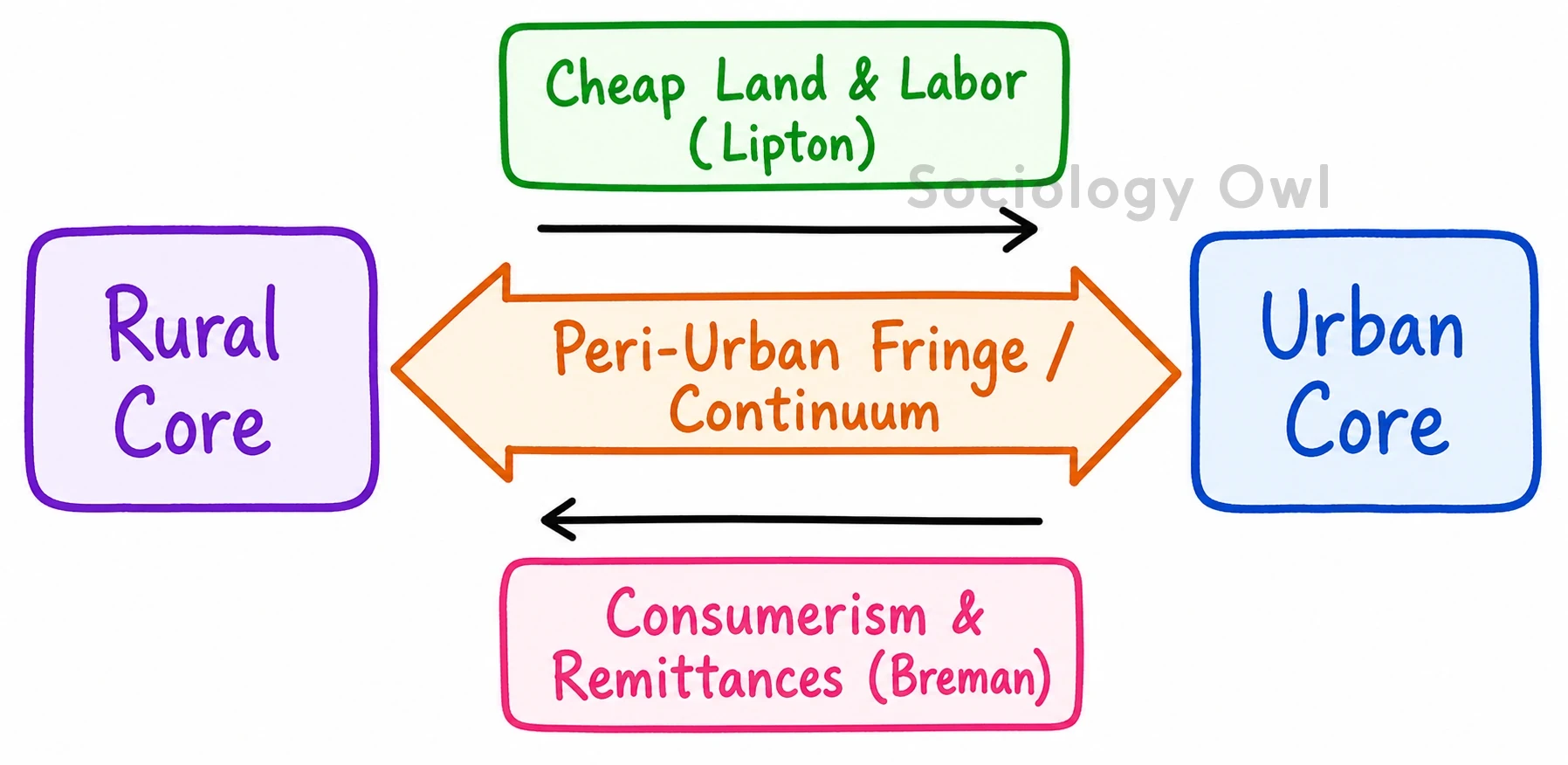
- The Vanishing Village: Dipankar Gupta argues the village is no longer the primary site of civilizational identity due to rapid de-peasantization and rural-urban migration.
- Shifting Agrarian Relations: Surinder Jodhka notes that traditional patronage has been replaced by market exploitation, echoing Jan Breman’s concept of “footloose labor.” Furthermore, the politicization of Dominant Castes (e.g., Marathas demanding reservations) proves villages are now hubs of democratic mobilization, not static harmony.
Conclusion
While the village remains a crucial methodological site to study Indian society, it cannot be viewed as the sole, unchanging repository of its civilizational values. As rural-urban boundaries blur, Indian civilizational values are themselves transforming from traditional, rigid hierarchies toward dynamic, constitutional, and democratic aspirations.
Download our app for UPSC Sociology Optional - Syllabus, NCERT Books, IGNOU Books, Past Paper with Model Answers, Topper Notes & Answer Sheet.
How do sociologists construct gender in their analysis on social inequality?
Model Answers
Q: How do sociologists construct gender in their analysis on social inequality?
Question asked in UPSC Sociology 2022 Paper 1. Download our app for last 20 year question with model answers.
Model Answer:
Ann Oakley (Sex, Gender and Society) pioneered the sociological distinction between biological “sex” and constructed “gender,” framing it as a foundational system of social stratification and inequality.
Sociological Paradigms of Gender Construction
- Functionalism: Talcott Parsons originally constructed gender as functional for social equilibrium, assigning men “Instrumental” and women “Expressive” roles.
- Conflict and Feminist Views: Sylvia Walby theorizes gender as an exploitative system of Patriarchy. Similarly, Joan Acker exposes “Gendered Organizations”, demonstrating how supposedly neutral institutions favor masculinity.
- Interactionist and Post-Structural Views: West and Zimmerman argue inequality is actively reproduced via “Doing Gender” in daily interactions. Judith Butler (Gender Trouble) advances “Gender Performativity”, deconstructing gender binaries entirely.
- Intersectionality: Kimberlé Crenshaw argues that gender interacts with race and class to co-produce unique matrixes of domination.

Nobel laureate Claudia Goldin highlights the “Motherhood Penalty”, illustrating how constructed gender roles perpetuate the modern global wage gap and unequal unpaid care burdens.
Conclusion
Moving beyond rigid binaries, contemporary sociology increasingly utilizes Queer Theory to understand gender fluidity, analyzing it not merely as structural inequality, but as a dynamic site of resistance.
Download our app for UPSC Sociology Optional - Syllabus, NCERT Books, IGNOU Books, Past Paper with Model Answers, Topper Notes & Answer Sheet.
How do sociologists construct gender in their analysis on social inequality? Read More »
Q. What do you understand by decentralisation of power? What is its role in strengthening the roots of democracy in India? Elaborate.
UPSC Sociology 2024 Paper 2
Model Answer:
Decentralization of power refers to the devolution of administrative, financial, and political authority to the grassroots. Institutionalized via the 73rd and 74th Amendments, it catalyzed a structural transformation in India, shifting the locus of power from traditional caste hierarchies to statutory, democratic institutions.
Democratization of the Social Structure
- Shift in Power Dynamics: Andre Beteille, in his study of Sripuram, observed that decentralization shifted power away from traditional Caste Panchayats to secular Gram Panchayats, slowly replacing substantive hierarchy with procedural equality.
- Modernization of Tradition: Yogendra Singh notes that local self-governance exemplifies the Modernization of Indian Tradition, where traditional village bodies adapt to democratic, egalitarian processes.

Subaltern Empowerment and Gender Dynamics
- The Subaltern Critique: While Mahatma Gandhi romanticized Gram Swaraj (village self-rule), B.R. Ambedkar warned that Indian villages were “dens of ignorance and communalism.” Decentralization mandated power-sharing through reservations, acting as a catalyst for Dalit and Adivasi political assertion.
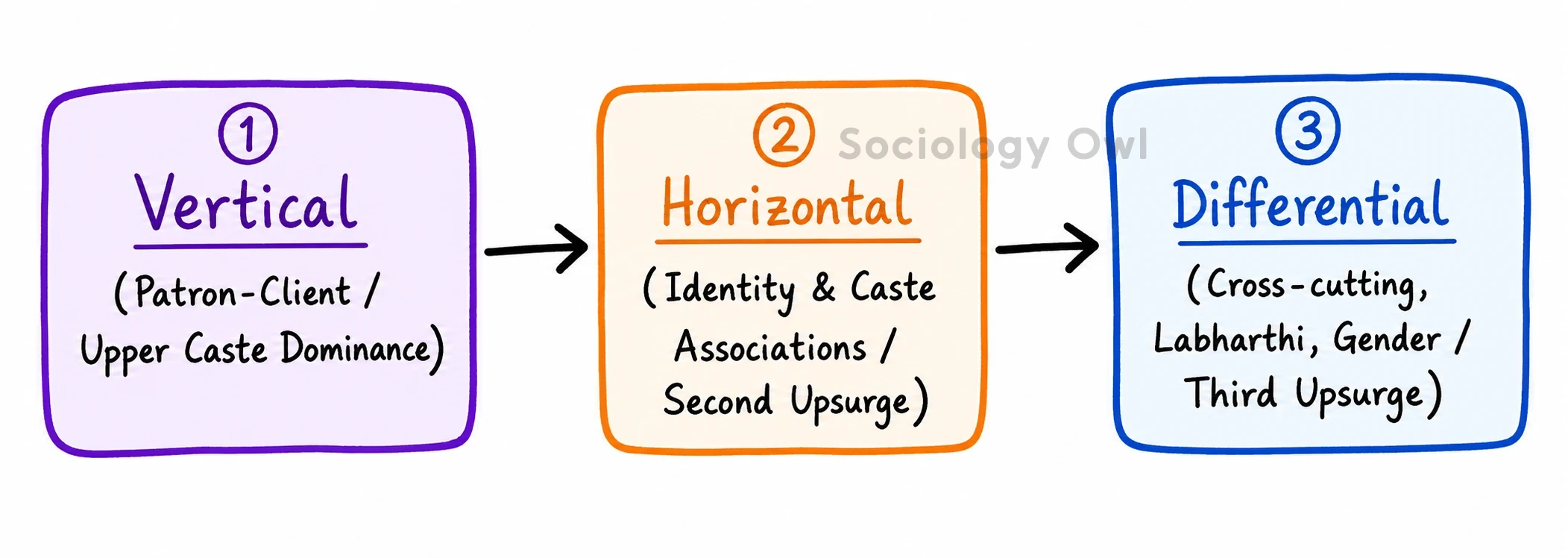
- The Conflict Perspective: Conversely, M.N. Srinivas demonstrated how the Dominant Caste utilizes numerical strength and land ownership to capture Panchayats. Marxist sociologist A.R. Desai argued that this caste-class nexus often decentralizes exploitation rather than power, empowering the “rural bourgeoisie.”
- Negotiating Patriarchy: Women’s reservation initially faced pushback via the “Sarpanch Pati” syndrome (husbands wielding actual proxy power). However, Bina Agarwal highlights that sustained participation eventually creates genuine female agency, reorienting rural priorities toward water, sanitation, and health.
The Kudumbashree model in Kerala proves how integrating women’s Self-Help Groups (SHGs) with local Panchayats dismantles traditional class-gender hierarchies. Furthermore, scholars like Gopal Guru note the rising political socialization of Dalit Sarpanches in Tamil Nadu, marking deep grassroots democratization despite instances of violent upper-caste backlash.
Conclusion
While democratic decentralization continuously navigates the complex fault lines of India’s entrenched social stratification, it has initiated an irreversible democratization of the rural matrix. It remains a vital tool for transforming the Indian village from an arena of rigid hierarchy to a nursery of participatory democracy.