Explain how political parties and pressure groups are dialectically related to each other in terms of achieving their goals.
Model Answers
Q: Explain how political parties and pressure groups are dialectically related to each other in terms of achieving their goals.
Question asked in UPSC Sociology 2021 Paper 1. Download our app for last 20 year question with model answers.
Model Answer:
Max Weber defines political parties as vehicles for acquiring social power, while Robert Dahl views pressure groups as instruments of pluralist representation. Their relationship to achieve goals is inherently dialectical—operating through the Hegelian framework of Thesis, Antithesis, and Synthesis—where continuous friction and negotiation shape democratic governance.
The Dialectical Process: Articulation vs. Aggregation
The interaction between these entities represents a structural clash and subsequent integration:
- Thesis (Consensus & Aggregation): Political parties seek broad institutional power. Otto Kirchheimer describes them as “Catch-all parties” that dilute specific ideologies to aggregate maximum voter consensus.
- Antithesis (Disruption & Articulation): Pressure groups disrupt this broad consensus by prioritizing specific, uncompromised demands. In Gabriel Almond’s structural-functional framework, pressure groups articulate raw interests, challenging the party’s status quo.
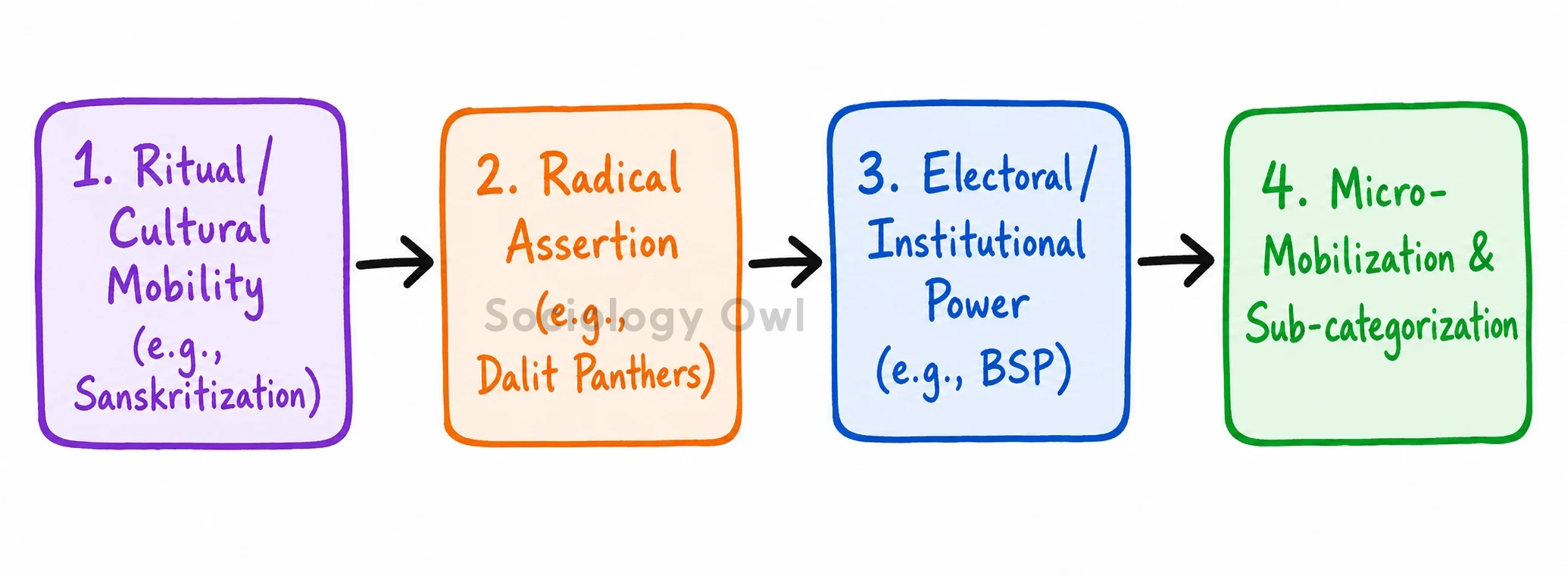
- Synthesis (Evolution): This friction forces a resolution. Parties either absorb the demands into legislation, or the pressure group captures power itself. Maurice Duverger noted that pressure groups often birth parties, such as UK Trade Unions forming the Labour Party. Similarly, in India, BAMCEF (a pressure group) dialectically evolved into the Bahujan Samaj Party (BSP).

Critical Perspectives: The Illusion of Dialectics
Critical sociologists argue this relationship is often asymmetrical and undemocratic:
- Elite Theory: In The Power Elite, C. Wright Mills argues the dialectic is an illusion. Both political parties and powerful pressure groups (corporate lobbies) are controlled by the same interconnected elite.
- Neo-Pluralism: Charles Lindblom notes an asymmetrical dialectic where business lobbies exert disproportionate influence over parties, distorting democratic goals.
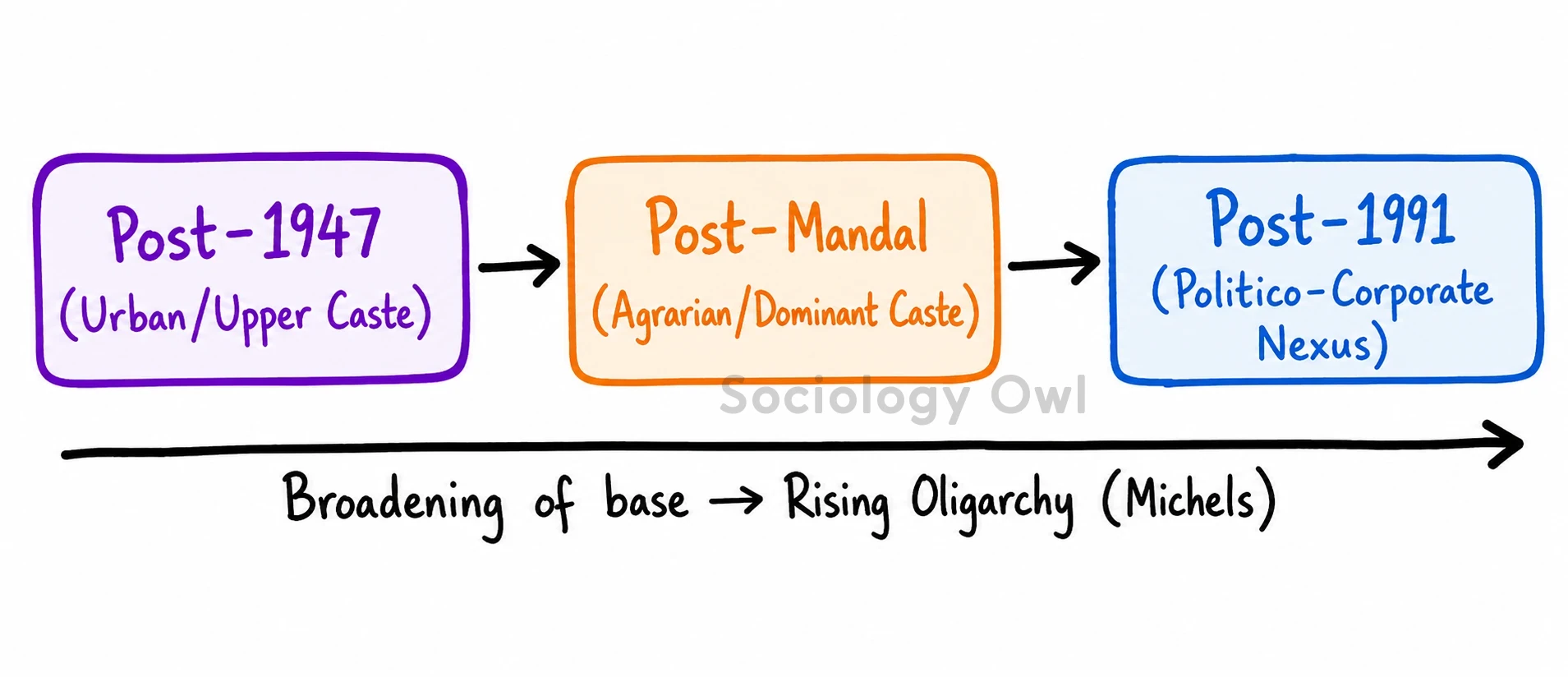
- Robert Michels: Through his “Iron Law of Oligarchy”, he asserts that as these groups interact and institutionalize, their leadership inevitably prioritizes organizational survival over their original grassroots goals.
Through the lens of New Social Movements (Jurgen Habermas), modern environmental groups act as antitheses to state “legitimation crises.” Globally, Germany’s Green Party exemplifies an extra-parliamentary pressure group dialectically synthesizing into a formal political party. Today, Manuel Castells’ “Network Society” shows digitized, leaderless flash-movements accelerating this dialectical cycle.
Conclusion
The dialectical relationship between parties and pressure groups is the primary engine of political modernization. While it ensures dynamic democratic deliberation by synthesizing marginalized voices into mainstream policy, critical sociological frameworks rightly caution against the overarching influence of elite oligopolies within this process.
Download our app for UPSC Sociology Optional - Syllabus, NCERT Books, IGNOU Books, Past Paper with Model Answers, Topper Notes & Answer Sheet.