Model Answer

Explain with examples, the explanatory and exploratory designs of social research.

Model Answers

Q: Explain with examples, the explanatory and exploratory designs of social research.

Question asked in UPSC Sociology 2018 Paper 1. Download our app for last 20 year question with model answers.

Model Answer:

Research design is a sociological study’s blueprint, reflecting the epistemological divide between Interpretivism and Positivism.

Comparative Analysis of Research Designs

  • Objective: Exploratory design generates new hypotheses regarding undefined phenomena via an Inductive approach. Explanatory design tests existing theories to establish cause-and-effect relationships via a Deductive approach.
  • Epistemology: Exploratory aligns with Interpretivism and micro-sociology, seeking Verstehen (empathic understanding). Explanatory relies on Positivism and macro-sociology to discover objective universal laws.
  • Methodology: Exploratory uses unstructured qualitative methods (e.g., ethnography); Explanatory uses structured quantitative tools (e.g., statistical surveys).
  • Sociological Examples: William Foote Whyte’s Street Corner Society explored hidden slum structures using participant observation. Conversely, Emile Durkheim’s Suicide used explanatory concomitant variation to causally link social integration and suicide.

Studying artificial intelligence’s impact on gig workers requires exploratory interviews to grasp new subjective nuances, followed by explanatory surveys to map structural employment trends.

Conclusion

Modern sociology rejects strict methodological binaries. By embracing Methodological Pluralism and Triangulation (Norman Denzin), researchers successfully combine exploratory depth with explanatory breadth to achieve holistic insights.

Explain with examples, the explanatory and exploratory designs of social research. Read More »

What are variables? How do they facilitate research?

Model Answers

Q: What are variables? How do they facilitate research?

Question asked in UPSC Sociology 2023 Paper 1. Download our app for last 20 year question with model answers. 

Model Answer:

Variables in Sociology

According to Earl Babbie, a variable is a “logical grouping of attributes” taking different values. Through Operationalization, sociologists translate abstract concepts (e.g., social class) into measurable empirical variables (e.g., income levels).

Facilitating Sociological Research

  • Empirical Measurement: Variables make abstract phenomena tangible, enabling Positivists to systematically identify trends and compare societies.
  • Hypothesis Testing: Researchers establish causal relationships by observing how an Independent Variable (IV) affects a Dependent Variable (DV). In Suicide, Emile Durkheim explicitly correlated the degree of social integration (IV) with societal suicide rates (DV).

  • Interpretivist Critique: Phenomenologists and sociologists like Max Weber argue that strictly quantifying human behavior into variables risks Reductionism, often missing the deeper, subjective meanings (Verstehen) behind social actions.

Variables frame modern global studies, such as analyzing the impact of the “algorithm-driven gig economy” (IV) on “worker alienation” (DV).

Conclusion

Despite interpretivist critiques, variables remain the methodological bedrock of objective, replicable research, effectively bridging theoretical sociological constructs with observable empirical realities.

What are variables? How do they facilitate research? Read More »

Q. Discuss the concept of animism and differentiate it from naturism.

Q. Discuss the concept of animism and differentiate it from naturism.

UPSC Sociology 2024 Paper 1

Model Answer:

Animism and Naturism

Animism and Naturism are early theories from the evolutionary school of religion, attempting to explain the origins of primitive belief systems.

Concepts and Differences

  • Animism (E.B. Tylor): Rooted in primitive psychological experiences of dreams and death, it posits that all entities possess a dual existence and a soul (“anima”).
  • Naturism (Max Müller): Stems from early man’s awe and fear of infinite natural forces. Through a “disease of language,” these abstract forces were gradually personified into deities.
  • Core Difference: Animism venerates the hidden spirit inside specific objects, while Naturism worships the macro physical forces (like the sun or wind) themselves.

Emile Durkheim (The Elementary Forms of Religious Life) famously critiqued both theories, arguing that enduring social institutions like religion cannot stem from mere “illusions” or fear. Today, indigenous practices blending both—like India’s tribal Sarna religion—drive modern eco-spirituality and the conservation of sacred groves.

Conclusion

Though classically criticized for ethnocentric bias, Animism and Naturism remain foundational sociological frameworks, functionally validated today by their latent role in promoting ecological harmony.

Q. Discuss the concept of animism and differentiate it from naturism. Read More »

Q. What do you mean by reliability? Discuss the importance of reliability in social science research.

Q. What do you mean by reliability? Discuss the importance of reliability in social science research.

UPSC Sociology 2025 Paper 1

Model Answer:

According to Alan Bryman, reliability is the degree to which a conceptual measure is stable and consistent. It anchors Positivist epistemology, enabling the replicable measurement of the social world.

Importance and Critique in Research

  • Scientific Rigour: Facilitates objective measurement of Social Facts. Emile Durkheim’s Suicide utilized reliably recorded official statistics to map social correlations.
  • Nomothetic Generalization: Crucial for macro-sociology to verify studies, generalize from samples, and formulate universal societal laws.
  • Precondition for Validity: An unreliable tool fundamentally cannot be valid.
  • Interpretivist Critique: Max Weber argued that rigid, highly reliable tools (e.g., structured questionnaires) impose artificial limits on respondents, sacrificing deeper subjective meanings (Verstehen).

Diverging unemployment data between India’s PLFS and CMIE highlights debates over research tool reliability. Furthermore, large-scale educational surveys like ASER strictly depend on inter-rater reliability across thousands of diverse fieldworkers.

Conclusion

Modern sociology manages the classic reliability-validity trade-off via Triangulation (Norman Denzin)—combining highly reliable quantitative methods with highly valid qualitative techniques to holistically capture complex social realities.

Q. What do you mean by reliability? Discuss the importance of reliability in social science research. Read More »

What is ‘reverse migration’ ? Discuss its features, causes and consequences in India

Model Answers

Q: What is ‘reverse migration’ ? Discuss its features, causes and consequences in India.

Question asked in UPSC Sociology 2023 Paper 2. Download our app for last 20 year question with model answers.

Model Answer:

Reverse Migration Meaning

Reverse migration is the large-scale return of migrants to their native regions, disrupting Everett Lee’s Push-Pull theory. In India, it signifies a structural shift from “pull-driven” urbanization to distress-induced, “push-driven” rural return.

Features and Causes of Reverse Migration

  • Circularity and Distress: Jan Breman describes such informal migrants as “Footloose Labour,” oscillating involuntarily between rural and urban spaces.
  • Marxist Perspective: Migrants serve as a “reserve army of labour,” extracted for surplus value by capitalist urban centers but discarded during crises.
  • International Dimension: While largely internal, it includes international returns, such as Gulf-to-Kerala migration studied by Leela Gulati.
  • Urban Alienation: Migrants lack “social citizenship” and basic entitlements in cities, leading to systemic exclusion that creates urban Anomie.
  • Rural Safety Valve: Structural-functionalists view traditional caste and kinship networks as the ultimate sanctuary during crises, reinforcing Dipankar Gupta’s concept of the rural-urban continuum.

Sociological Consequences

  • Caste Hierarchies: Returning marginalized castes lose the relative anonymity of cities, facing a re-traditionalization of rigid village hierarchies.
  • Gender Dynamics: Reverses the “feminization of agriculture”; returning men reclaim economic decision-making, while women’s domestic care-burden drastically increases.
  • Demographic Strain: Disproportionately impacts Ashish Bose’s BIMARU states, exacerbating agrarian distress and disguised unemployment.

The COVID-19 pandemic triggered mass reverse migration. Chinmay Tumbe, in India Moving, highlights this as India’s second-largest exodus after Partition. It necessitated policy interventions like MGNREGA (rural safety net) and One Nation One Ration Card (ONORC) for portable food security.

Conclusion

Reverse migration exposes the fault lines of India’s unequal, urban-biased development model. Echoing Amartya Sen’s welfare perspectives, ensuring inclusive urbanization and portable social security is imperative to rescue informal workers from the dual trap of urban exploitation and rural stagnation.

What is ‘reverse migration’ ? Discuss its features, causes and consequences in India Read More »

What are the ethical issues that a researcher faces in making use of participant observation as a method of collecting data? Explain.

Model Answers

Q: What are the ethical issues that a researcher faces in making use of participant observation as a method of collecting data? Explain.

Question asked in UPSC Sociology 2023 Paper 1. Download our app for last 20 year question with model answers. 

Model Answer:

Ethical issues in participant observation

Participant observation, pioneered by Bronisław Malinowski, is an interpretivist method aiming for Verstehen. While avoiding the Hawthorne Effect, it inherently presents severe ethical dilemmas.

Ethical Dilemmas in Participant Observation

  • Consent and Deception: Covert observation violates the right to informed consent. Laud Humphreys’ Tearoom Trade exemplifies the intense ethical backlash of secretly observing subjects and breaching privacy.
  • Harm and Intervention: Witnessing illicit or dangerous acts creates moral conflicts. Alice Goffman (On the Run) faced scrutiny for driving a getaway car for subjects, blurring boundaries between researcher and accomplice.
  • “Going Native”: Deep immersion risks over-identification, compromising the researcher’s objectivity and ethical neutrality.
  • Power Dynamics: Feminist sociologists like Ann Oakley argue that traditional observation creates hierarchical relationships, exploiting vulnerable subjects as mere data sources.

In digital ethnography (Netnography), “lurking” in closed online communities (e.g., radical groups or patient forums) creates modern ethical grey areas regarding digital consent.

Conclusion

To resolve these dilemmas, sociologists must practice Reflexivity (Alvin Gouldner) to acknowledge biases, and strictly adhere to institutional safeguards like the ASA Code of Ethics to protect human subjects.

What are the ethical issues that a researcher faces in making use of participant observation as a method of collecting data? Explain. Read More »

Do you think Talcott Parsons gave an adequate theory of social change? Justify your answer.

Model Answers

Q: Do you think Talcott Parsons gave an adequate theory of social change? Justify your answer.

Question asked in UPSC Sociology 2021 Paper 1. Download our app for last 20 year question with model answers.

Model Answer:

Talcott Parsons and Theory of Social Change

Talcott Parsons viewed social change through a structural-functionalist perspective, describing it as a “moving equilibrium” where social systems continuously adjust to internal and external strains to maintain stability.

Evolutionary Paradigm of Change

Parsons argued that institutional change is evolutionary and occurs via four interrelated processes:

  • Structural Differentiation: Single institutions splitting into specialized units (e.g., family losing economic functions to factories).
  • Adaptive Upgrading: Systems increasing their productive capacity and efficiency.
  • Inclusion: Integrating marginalized groups into the broader social system.
  • Value Generalization: Values broadening to accommodate highly complex, heterogeneous societies.

Sociological Critiques

  • Ralf Dahrendorf: Critiqued Parsons’ model as a “Utopia,” arguing it ignores coercion, power imbalances, and inevitable class conflicts.
  • C. Wright Mills: Dismissed it as an overly abstract “Grand Theory” disconnected from historical realities.
  • Robert Merton: Highlighted that Parsons ignored how internal “dysfunctions” can organically drive systemic change.

During the COVID-19 pandemic, global societies exhibited rapid adaptive upgrading (shifting to telemedicine and digital economies) to restore structural equilibrium.

Conclusion

Parsons’ theory is only partially adequate. While highly effective at explaining gradual, institutional evolution, it entirely fails to account for disruptive, revolutionary transformations (e.g., the Arab Spring), necessitating a synthesis with conflict perspectives.

Do you think Talcott Parsons gave an adequate theory of social change? Justify your answer. Read More »

Q. Do you think that in a society like India orthogenetic changes take place through differentiation? Do you observe continuities in the orthogenetic process? Elaborate your answer with suitable examples.

Q. Do you think that in a society like India orthogenetic changes take place through differentiation? Do you observe continuities in the orthogenetic process? Elaborate your answer with suitable examples.

UPSC Sociology 2025 Paper 2

Model Answer:

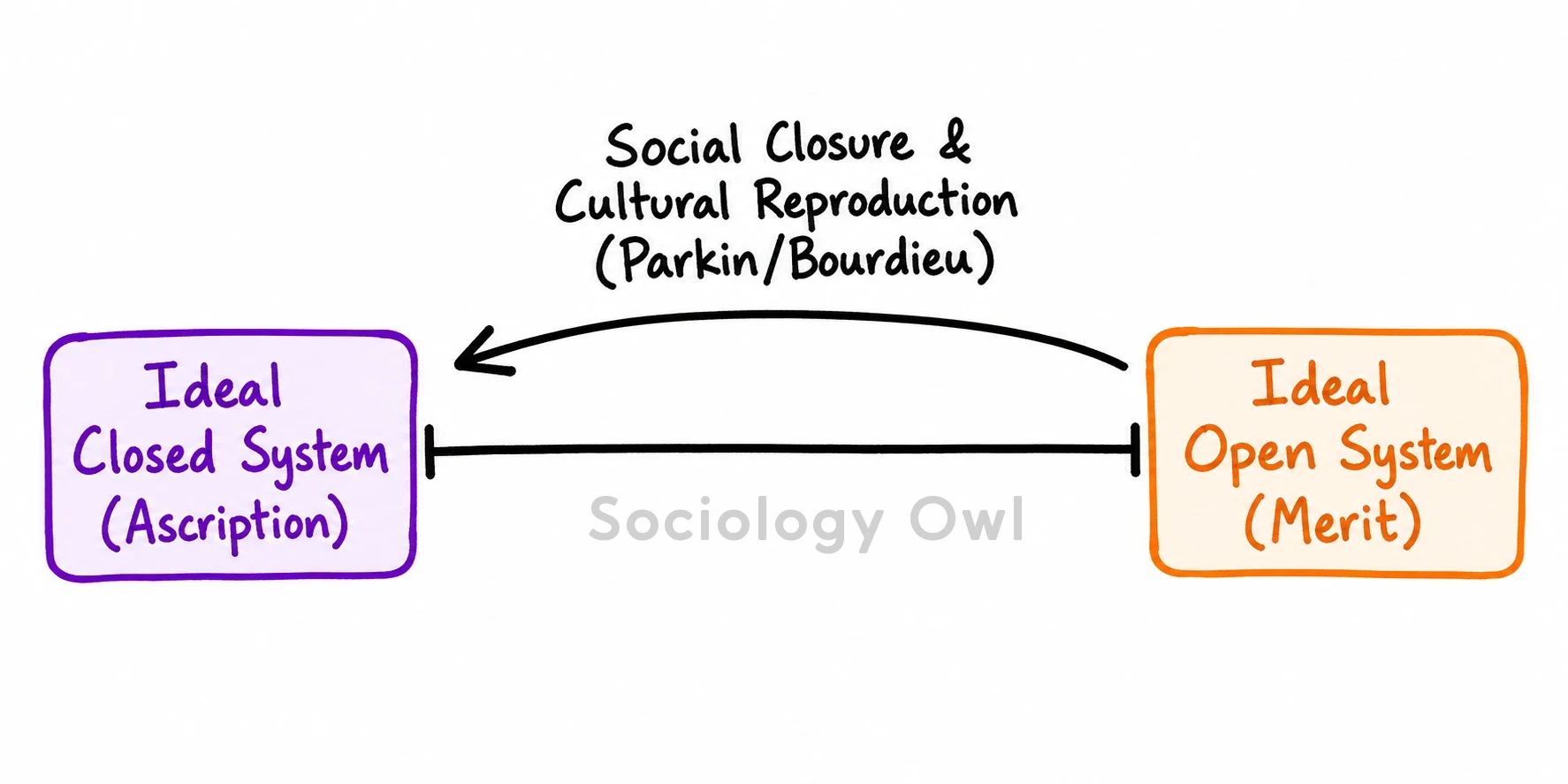
In Modernization of Indian Tradition, Yogendra Singh defines orthogenetic changes as internal cultural transformations (e.g., Buddhism, Sanskritization) that evolve without complete structural breakdown. He argues that Indian society undergoes modernization primarily through structural differentiation while maintaining deep civilizational continuity.

Orthogenetic Change through Differentiation

  • Social Differentiation: Andre Beteille, in Caste, Class, and Power, demonstrates this in Sripuram, observing that the traditionally overlapping axes of caste, class, and political power have differentiated into distinct, separate spheres.
  • Cultural Differentiation: M.N. Srinivas’s concept of Sanskritization exemplifies orthogenetic change, where lower castes differentiate their rituals and lifestyles to claim upward mobility within the traditional hierarchy.
  • Economic Differentiation: The breakdown of the undifferentiated Jajmani system fostered specialized labor markets, enabling phenomena like “Dalit Capitalism” (noted by Chandrabhan Prasad) and disrupting hereditary caste-occupation linkages.

Continuities and Critique of Differentiation

  • Compartmentalization: Milton Singer observes that Indians separate modern occupational spheres from traditional ritualistic spheres (e.g., scientists performing pujas before space launches), ensuring cultural continuity.
  • Politicization of Caste: Rajni Kothari notes the “traditionalization of modernity,” wherein modern, differentiated democratic institutions are navigated using traditional caste arithmetic.


From a Marxist Perspective, A.R. Desai argues that differentiation has merely modernized traditional exploitation. The agrarian hierarchy has morphed into an urban Caste-Class Nexus, where differentiation bypasses the marginalized, leaving Dalits trapped in undifferentiated, exploitative roles like manual scavenging.

Modern matrimonial platforms (like Shaadi.com) perfectly illustrate this synthesis. They utilize highly differentiated, modern algorithms solely to enforce strict orthogenetic continuities, such as caste endogamy and Gotra-matching. Similarly, traditional Khap Panchayats have differentiated their functions to demand modern political reservations.

Conclusion

India’s orthogenetic evolution eschews unilinear Western displacement. It creates a unique social fabric where modern forms carry traditional content—a phenomenon Dipankar Gupta terms “Mistaken Modernity.” Ultimately, Indian society demonstrates dynamic structural differentiation intricately interwoven with profound cultural continuity.

Q. Do you think that in a society like India orthogenetic changes take place through differentiation? Do you observe continuities in the orthogenetic process? Elaborate your answer with suitable examples. Read More »

Do you agree that the agrarian class structure in India is changing ?Justify your answer with illustrations.

Model Answers

Q: Do you agree that the agrarian class structure in India is changing ? Justify your answer with illustrations.

Question asked in UPSC Sociology 2022 Paper 2. Download our app for last 20 year question with model answers.

Model Answer:

Daniel Thorner’s traditional agrarian model of Malik (landlord), Kisan (peasant), and Mazdoor (laborer) is rapidly fragmenting today due to state policies and capitalist penetration (A.R. Desai).

Transformations in Agrarian Class Structure

  • Rise of Capitalist Farmers: The Green Revolution created profit-oriented capitalist farmers (Utsa Patnaik), consolidating economic power among middle-tier Dominant Castes like Jats (M.N. Srinivas).
  • Marginalization: Relentless land fragmentation has spawned a precarious class of smallholders, expanding the “bulge in the middle” (Andre Beteille).
  • De-peasantization & Proletarianization: Shrinking incomes force cultivators into wage labor, generating circular “footloose labor” (Jan Breman). Consequently, traditional Jajmani ties have shifted from status to contract (Kathleen Gough).
  • Feminization of Agriculture: Rural male out-migration has left women as the primary agrarian working class (Bina Agarwal).


The recent Farmers’ Protests (2020-21) illustrate these shifting dynamics. As Surinder Jodhka notes, they reflect the economic anxieties of an agrarian middle class threatened by corporatization and distress diversification.

Conclusion

India’s agrarian structure has decisively transitioned from a rigid, caste-based feudal hierarchy to a highly fragmented, capitalist reality marked by complex intersections of class mobility and deep rural distress.

Do you agree that the agrarian class structure in India is changing ?Justify your answer with illustrations. Read More »

Are Tradition and Modernity antithetical to each other? Comment

Model Answers

Q: Are Tradition and Modernity antithetical to each other? Comment

Question asked in UPSC Sociology 2023 Paper 2. Download our app for last 20 year question with model answers. 

Model Answer:

Tradition and Modernity in India

Classical sociologists viewed tradition and modernity as antithetical. However, in India, they engage in a dynamic amalgamation, blending orthogenetic (internal) and heterogenetic (external) changes (Yogendra Singh).

Dialectics of Tradition and Modernity

  • Adaptive Coexistence: L.I. & S.H. Rudolph (The Modernity of Tradition) argue traditional structures adapt to modern democracy, seen in castes functioning as modern pressure groups.
  • Compartmentalization: Milton Singer observed Indian industrialists separating traditional domestic rituals (purity) from rational workplace behaviors.
  • Paradoxical Mobility: M.N. Srinivas noted the simultaneous occurrence of Sanskritization among lower castes and Westernization among upper castes.
  • “Mistaken Modernity”: Dipankar Gupta highlights that India adopted modern technology and consumerism but lacks modern values (universalism), allowing orthodox traditions to persist.

ISRO scientists performing traditional rituals before space launches, or AI-driven matrimonial apps filtering matches by traditional caste lines, perfectly illustrate this synthesis.

Conclusion

In India, modernity does not eradicate tradition. Instead, tradition acts as a filter through which modernity is processed, leading to a unique “evolutionary synthesis” (Yogendra Singh) that ensures continuity amid change.

Are Tradition and Modernity antithetical to each other? Comment Read More »